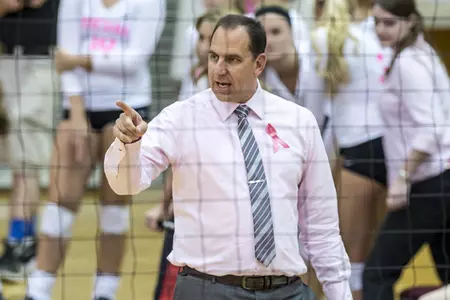
Where in the world is Brian Doyon?
3/16/2016 1:01:00 PM | Volleyball
His travel itinerary for the winter looks like a traveling salesman's: Nebraska, Nevada, Utah, Colorado, Oregon, Washington, Hawaii, twice up to Canada.
And a salesman is what Montana volleyball coach Brian Doyon, who was hired a little more than a year ago, has become. He's trying to sell to everyone he comes across, from hotshot players to club and high school coaches across the region, the idea of Montana volleyball. His idea of Montana volleyball.
A visual: Last Saturday, at the same time the Montana men's basketball team was taking on Weber State in the Big Sky championship game in Reno, Doyon was recruiting, doing whatever is necessary to take his own program to similar heights, when title-game trips become the norm, even expected.
If Doyon was a salesman and in the business world, he would have taken over the equivalent of a company that had filed for Chapter 11 back in November 2014. The program was bankrupt in spirit and wins, and no closer to reaching the bright future that has been promised for the last two decades.
The program's struggles remain one of the department's biggest head-scratchers, an enigma wrapped in a riddle, stuffed inside a Molten volleyball.
The program has a sweet, volleyball-specific facility and a fan base that has been ready since the Dick Scott era to reengage and jump aboard the bandwagon. All that's needed is the right person to man the reins and the athletes to pull it out of the ditch.
An assistant at Utah before he was hired by Montana, Doyon looked at the program from an outsider's perspective, saw everything it has going for it, or should have going for it, and couldn't help but wonder: What am I missing here? How is this not a powerhouse?
Mark Plakorus, hired in January 2011, has rebuilt the Griz soccer team into one of the Big Sky's best programs. Steve Ascher's and Kris Nord's tennis teams have won Big Sky titles in recent years. Tennis! In Montana! Without a true home facility!
Brian Schweyen's track and field teams, also without a true wintertime training facility, have had top-three success at both indoor and outdoor Big Sky championships, and it won't be long before Jamie Pinkerton's team becomes the answer to the question: Who has the league's top softball program?
And that does not even touch on the success of the department's football and basketball teams, which at this point would only feel like piling on.
Because, still, the volleyball program has languished. For every step forward the last 15 years, those have been matched and undone by one or more taken in the opposite direction. Montana is 89 matches under .500 since 2000 and has a single Big Sky tournament victory since 1996.
Imagine, with all the department's other successes: Since 2000, there have been more volleyball seasons with 10 or fewer wins (eight) than those with 11 or more (seven). All of which is to say, when it comes to volleyball, Montana has not been Montana.
It will be a slow process, building the program back up to the glory days of the early 1990s, when the Grizzlies were annually in contention for Big Sky championships. But that past is now older than the current members of the team.
"That was one of the draws of the job," said Doyon when he accepted the position in January 2015. "There has been success in the program in the past, and we can have success again in the future."
While some coaches might have been overwhelmed by the prospect of taking over an underachieving program in a department of high achievers, Doyon saw it as a positive.
"I was attracted to the spirit of the school and the success of the other programs, because when athletes see other teams doing well, that can be infectious. The camaraderie that's shared through athletics can create an amazing environment for student-athletes to be in," he said.
Doyon, who has the patience of Job and has needed every bit of it in his first year on the job, remains undaunted, despite going 8-20 last fall, missing the Big Sky tournament and flipping over most of his roster after the season.
He has taken a big-picture view of rebuilding the program, taking the architect's philosophy of Ascher, who borrowed it from former Florida State football coach Bobby Bowden, who built a consistent national contender in Tallahassee: lose big, lose close, win close, win big.
With the program's third 20-loss season last fall in the last four years, step one has thoroughly been fulfilled, that box more than checked off. How long the next steps take will be part of the fun of watching a program evolve.
Robin Selvig-like success -- 38 years, 31 20-win seasons -- won't happen magically, and it won't come tomorrow, next month or maybe even next fall. But steps will be taken. It's why Doyon is on the road every weekend, away from home and family. He knows there is simply no other way.
"Recruiting is the lifeblood of a program," he says. "Without identifying talent and seeing it in person, your program won't survive. You can't rely on whoever comes through the door.
"It takes a lot of time and a lot of commitment to make sure you get out and see each one of those athletes and watch them develop. There aren't any shortcuts."
Indeed. After making a pre-Christmas trip to the volleyball Final Four in Omaha for coaching clinics and seminars -- the hot topic: video review -- it was on to Anaheim for the latest USA Volleyball holiday camp over the normally relaxing days between Christmas and New Year's.
Instead of bowl games and Christmas dinner leftovers in the comfort of his own home, Doyon was putting the Montana name in front of the nation's top players -- all impressionable and so, so talented -- born between 2000 and 2002.
In a world of Tinder-like recruiting -- text messages, emails, check yes or no if you like my school or not -- Doyon still needs to do it the old-fashioned way: face-to-face. And thanks to his relationship with USA Volleyball, he can.
"They are all kids who have been identified and brought into the national training program," says Doyon of the athletes he worked with in Anaheim. "Some of the kids we're targeting as part our recruiting plan, so it gets us in front of them."
In January, it was off to Hawaii. Any down time, which most coaches would have maxed out, was filled for Doyon with a service project. In the evenings, he a dozen other coaches from around the country helped put on a camp for those players who couldn't afford the more expensive combine.
"To be able to help run that program was special and a lot of fun," says Doyon, who still has a Monday-through-Friday job back on campus, training his current team and preparing it for spring competitions, like this weekend's trip to Spokane for five matches.
And that's a coach's balance, always having a foot in two different worlds. One in the here and now, getting his current team as good as it can be, the other pointed toward the future, trying to find championship-caliber athletes and attracting them with the vision he holds for the Grizzlies.
Both worlds in need of constant attention. And only so many hours in the day.
"During the week we're here working with our athletes, and on the weekends we're usually all on the road recruiting," says Doyon, who has the same one-foot-in-two-different-worlds balance between his professional and his personal lives, which includes wife Kate and son James.
"A big part of the balance is having a wonderful wife who supports you and understands your time commitments. You have to make time for your personal life and make sure the time you get with them is just that."
It's a crazy lifestyle, hectic, pressure-filled and not for everyone, but one Doyon chose for himself. And he can't imagine doing anything else.
He doesn't ask for your sympathy for the Sisyphean-like challenge he's accepted. He just asks that you grab a seat while you can. Because when his program goes from losing big to losing close, then winning close and finally winning big, the bandwagon and the West Auxiliary Gym will only hold so many.
And a salesman is what Montana volleyball coach Brian Doyon, who was hired a little more than a year ago, has become. He's trying to sell to everyone he comes across, from hotshot players to club and high school coaches across the region, the idea of Montana volleyball. His idea of Montana volleyball.
A visual: Last Saturday, at the same time the Montana men's basketball team was taking on Weber State in the Big Sky championship game in Reno, Doyon was recruiting, doing whatever is necessary to take his own program to similar heights, when title-game trips become the norm, even expected.
If Doyon was a salesman and in the business world, he would have taken over the equivalent of a company that had filed for Chapter 11 back in November 2014. The program was bankrupt in spirit and wins, and no closer to reaching the bright future that has been promised for the last two decades.
The program's struggles remain one of the department's biggest head-scratchers, an enigma wrapped in a riddle, stuffed inside a Molten volleyball.
The program has a sweet, volleyball-specific facility and a fan base that has been ready since the Dick Scott era to reengage and jump aboard the bandwagon. All that's needed is the right person to man the reins and the athletes to pull it out of the ditch.
An assistant at Utah before he was hired by Montana, Doyon looked at the program from an outsider's perspective, saw everything it has going for it, or should have going for it, and couldn't help but wonder: What am I missing here? How is this not a powerhouse?
Mark Plakorus, hired in January 2011, has rebuilt the Griz soccer team into one of the Big Sky's best programs. Steve Ascher's and Kris Nord's tennis teams have won Big Sky titles in recent years. Tennis! In Montana! Without a true home facility!
Brian Schweyen's track and field teams, also without a true wintertime training facility, have had top-three success at both indoor and outdoor Big Sky championships, and it won't be long before Jamie Pinkerton's team becomes the answer to the question: Who has the league's top softball program?
And that does not even touch on the success of the department's football and basketball teams, which at this point would only feel like piling on.
Because, still, the volleyball program has languished. For every step forward the last 15 years, those have been matched and undone by one or more taken in the opposite direction. Montana is 89 matches under .500 since 2000 and has a single Big Sky tournament victory since 1996.
Imagine, with all the department's other successes: Since 2000, there have been more volleyball seasons with 10 or fewer wins (eight) than those with 11 or more (seven). All of which is to say, when it comes to volleyball, Montana has not been Montana.
It will be a slow process, building the program back up to the glory days of the early 1990s, when the Grizzlies were annually in contention for Big Sky championships. But that past is now older than the current members of the team.
"That was one of the draws of the job," said Doyon when he accepted the position in January 2015. "There has been success in the program in the past, and we can have success again in the future."
While some coaches might have been overwhelmed by the prospect of taking over an underachieving program in a department of high achievers, Doyon saw it as a positive.
"I was attracted to the spirit of the school and the success of the other programs, because when athletes see other teams doing well, that can be infectious. The camaraderie that's shared through athletics can create an amazing environment for student-athletes to be in," he said.
Doyon, who has the patience of Job and has needed every bit of it in his first year on the job, remains undaunted, despite going 8-20 last fall, missing the Big Sky tournament and flipping over most of his roster after the season.
He has taken a big-picture view of rebuilding the program, taking the architect's philosophy of Ascher, who borrowed it from former Florida State football coach Bobby Bowden, who built a consistent national contender in Tallahassee: lose big, lose close, win close, win big.
With the program's third 20-loss season last fall in the last four years, step one has thoroughly been fulfilled, that box more than checked off. How long the next steps take will be part of the fun of watching a program evolve.
Robin Selvig-like success -- 38 years, 31 20-win seasons -- won't happen magically, and it won't come tomorrow, next month or maybe even next fall. But steps will be taken. It's why Doyon is on the road every weekend, away from home and family. He knows there is simply no other way.
"Recruiting is the lifeblood of a program," he says. "Without identifying talent and seeing it in person, your program won't survive. You can't rely on whoever comes through the door.
"It takes a lot of time and a lot of commitment to make sure you get out and see each one of those athletes and watch them develop. There aren't any shortcuts."
Indeed. After making a pre-Christmas trip to the volleyball Final Four in Omaha for coaching clinics and seminars -- the hot topic: video review -- it was on to Anaheim for the latest USA Volleyball holiday camp over the normally relaxing days between Christmas and New Year's.
Instead of bowl games and Christmas dinner leftovers in the comfort of his own home, Doyon was putting the Montana name in front of the nation's top players -- all impressionable and so, so talented -- born between 2000 and 2002.
In a world of Tinder-like recruiting -- text messages, emails, check yes or no if you like my school or not -- Doyon still needs to do it the old-fashioned way: face-to-face. And thanks to his relationship with USA Volleyball, he can.
"They are all kids who have been identified and brought into the national training program," says Doyon of the athletes he worked with in Anaheim. "Some of the kids we're targeting as part our recruiting plan, so it gets us in front of them."
In January, it was off to Hawaii. Any down time, which most coaches would have maxed out, was filled for Doyon with a service project. In the evenings, he a dozen other coaches from around the country helped put on a camp for those players who couldn't afford the more expensive combine.
"To be able to help run that program was special and a lot of fun," says Doyon, who still has a Monday-through-Friday job back on campus, training his current team and preparing it for spring competitions, like this weekend's trip to Spokane for five matches.
And that's a coach's balance, always having a foot in two different worlds. One in the here and now, getting his current team as good as it can be, the other pointed toward the future, trying to find championship-caliber athletes and attracting them with the vision he holds for the Grizzlies.
Both worlds in need of constant attention. And only so many hours in the day.
"During the week we're here working with our athletes, and on the weekends we're usually all on the road recruiting," says Doyon, who has the same one-foot-in-two-different-worlds balance between his professional and his personal lives, which includes wife Kate and son James.
"A big part of the balance is having a wonderful wife who supports you and understands your time commitments. You have to make time for your personal life and make sure the time you get with them is just that."
It's a crazy lifestyle, hectic, pressure-filled and not for everyone, but one Doyon chose for himself. And he can't imagine doing anything else.
He doesn't ask for your sympathy for the Sisyphean-like challenge he's accepted. He just asks that you grab a seat while you can. Because when his program goes from losing big to losing close, then winning close and finally winning big, the bandwagon and the West Auxiliary Gym will only hold so many.

National Girls and Women in Sports Day 2026
Monday, March 30
Student-Athlete Spotlight: Maddie Pyles (Griz Volleyball)
Thursday, January 15
Griz Volleyball: Name The Person
Tuesday, December 30
Griz Volleyball: Name The Object
Tuesday, December 30