Volleyball jumping into research thanks to help across campus
1/14/2021 12:57:00 PM | Volleyball
Share:
By: Montana Sports Information
When volleyball fans watch the Griz take the court later this month, don't be surprised to see the Montana student-athletes jumping a little bit higher than normal.
Sure, there's the pent-up excitement of a delayed season opener, and the extra time in the fall allowed for more strength and agility training in the weight room. But the biggest factor in Montana's increased ability to jump – and even more so, jump more efficiently – comes from a small device that each player has been wearing.
Head coach Allison Lawrence has always been fascinated by an athlete's progression. From an individual sense, she wants to know how an athlete can progress throughout a season or a career. In a more narrowed scope, she's looking at how an athlete can progress throughout a week, or even a specific match.
In a sport like volleyball, where jumping is a critical part of on-court performance, the goal would be to have a player jumping at optimal, peak height in the most crucial moments of a match.
In the past, the only way to gauge that would be to measure one's height at the beginning of a practice and again at the end, to set a baseline and compare it to the second test. Now, thanks to the help of Dr. Shane Murphy, a professor for Montana's school of integrative physiology and athletic training, Montana's data runs much deeper. A screenshot of a generated report, showing patterns throughout practice.
Throughout the fall, Montana's players wore a jump-tracking sensor during practices and scrimmages. The sensor, from the company VERT, is an accelerometer that tracks when an athlete jumps and comes back in contact with the ground. Through biomechanics, it is able to detect every movement an athlete makes, and measure how high they jump and how hard they land.
"The great thing about it is we're not limited to a quick snapshot at the beginning of practice and the end," Murphy said. "We can look at an athlete, a position group or the entire team, and see how their movements are increasing or decreasing throughout a period of time."
Plenty of information can be pulled from the data, and the biggest thing, for Lawrence, is that it helps tell her how she can adjust practices to allow an athlete to be at their peak performance when it matters most.
"This is a game-changer for us," the fourth-year head coach said. "We're just getting started, and the data has already helped us be more explosive, more efficient with our movements, and has the opportunity to cut down on injuries. It helps us maximize our growth, maximize our health and, perhaps biggest, gives our players the most helpful information possible of where they stand and what the need to be doing to reach their full potential."
The device itself is simple. The sensor is built into an elastic waistband that tucks into a player's spandex. One of Murphy's biggest concerns was if it would interfere with an athlete's performance on the court, but the consensus has been that it's unnoticeable, even when a player dives and lands on the sensor.
Players collect their VERT jump-tracking sensors prior to a practice [Photo by Derek Johnson]
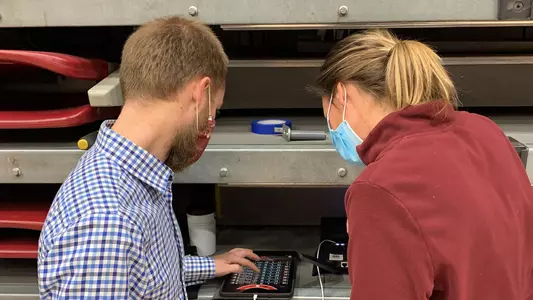
During practice, Murphy is generally on the sideline monitoring the technology and making sure the sensors are properly working. Through an app on his iPad, he can track data in live speed, ranging from how frequently and high an athlete is jumping to her acceleration.
Following practice, Murphy will send a generated report to the coaching staff that shows the number of jumps an athlete took, how high they reached, their average height, what percent of the time they reached their maximum potential, the stress level of their landing, the speed of their movements and more.
The benefits to Montana's volleyball program are immense. Lawrence has already seen how the data she receives has influenced the way she structures practice and prepares her athletes for in-match situations.
"We're trying to constantly increase capacity and gain fitness, and also stay injury free," Lawrence said. "This data has helped us see how far we, as coaches, can push our athletes in healthy ways. It's really freeing and beneficial, because it has given us data behind our decisions."
As much as the volleyball team has benefited from the data, it has been equally beneficial for Murphy.
"One of the highlights of this experience, so far, for me has been when I've been able to provide helpful data to the coaches," Murphy said. "I think back to the first time when Coach (Lawrence) had a question while I was checking the data, and I was able to provide her an answer.
"It sounds so simple, but she had something she was curious about, meaning it was important to her, and I was able to help. This is all noise until it has value, and that was the moment where I could know that it's not just noise, but that this is meaningful." Dr. Shane Murphy
Murphy received his bachelor's degree in athletic training from Wisconsin-Eau Claire in 2014, before earning a master's degree in Kinesiology, with an emphasis in biomechanics, from Indiana two years later. From there, he traveled to Northern Colorado and earned his doctorate of philosophy in sport and exercise science, with a minor in applied statistics and research methods.
Throughout his professional tenure, Murphy has been intrigued by wearable devices and the technology and research behind them. Shortly after being hired by the University of Montana, he was connected to Lawrence through a separate performance-testing project he was part of for the Champions Center.
The two talked about having Murphy come to a practice last spring, but then COVID-19 shut everything down. The conversation picked back up over the summer and into the fall, when Murphy asked if he could come to one single practice, just to see if his data would be beneficial.
"Coaches, strength coaches and athletic trainers are great at having a feel for their athletes, but sometimes it's helpful to have quantifiable numbers to support what they're seeing and doing," Murphy said. "Essentially, I wanted to be able to provide something that would be meaningful and valuable to the team, and scientifically novel to me."
The two found that combination, with Murphy coming back to collect data multiple times per week throughout the semester.
During the fall, data collection was for unofficial research purposes. While he works for the University and is the director of the CBAT Research Lab on campus, Murphy was choosing to collect this data on his own, as a side volunteer project, to learn more about the technology and how it can be of assistance in the future. Murphy recently received IRB approval to conduct research in a full capacity, however, meaning he will be able to continue collecting data and providing assistance through the 2021 season.
"It's been really cool to see how much it measures," sophomore outside hitter Elsa Godwin said. "To visually be able to see things like your intensity, how high you're jumping and if you're able to maintain the same amount of intensity and movements throughout rallies is super helpful to know. Being able to see where you're at compared to your teammates, or other people in your position, has also created a whole new level of competition in practice and in the weight room."
Elsa Godwin during a 2019 match vs. UTEP [Photo by Derek Johnson]
In addition to using the technology to alter training, Lawrence has found the sensors to be helpful in two other, unexpected, ways.
First, in addition to jumps and landings, the wearables also track other movements. Through the data collected in the fall, Murphy and the staff have been able to notice certain unnecessary movements, where perhaps an athlete is exerting energy when she doesn't need to be.
The second is the ability to learn an athlete's maximum jump height, and determine what percent of the time an athlete is max jumping. This is where the data is most crucial in learning how the numbers differentiate throughout a season, a match or even a specific rally.
"It's kind of nuanced, but it has added a ton of depth to the feedback we're giving players, not only in practice, but in follow-up meetings," Lawrence said. "It really connects the dots between what Brandon (Ronan) is doing (in the weight room), what we need them to do on the court and how efficient of an athlete they're being.
"Any time you can show the numbers behind something, it becomes way more powerful."
The wearable devices are popular in the USA Volleyball organization at the national level, and even among some high-level collegiate volleyball programs. To have something like this at Montana, though, is groundbreaking for a Big Sky Conference school.
A screenshot of a sample report, tracking a player's jump progression throughout a practice.
"I've never had anything like this that shows performance in a different way," Godwin said. "You don't think about those things while you're playing, but when you see the numbers and the science behind it, it just helps us become better athletes."
After six weeks away for the holidays, Montana is back on the court, preparing for its season opener at Idaho State on Jan. 24. Also back on the court is Murphy, who continues to dive into the numbers he's collecting in order to try and better determine how the Griz athletes can reach their optimal-performance levels more frequently.
"We're so grateful for the time Shane has put in to our program," Lawrence said. "I initially thought we'd be able to provide him some numbers and some metrics that would be valuable to him, and hopefully that some of those numbers could show us how to make our movements more efficient, be more explosive and cut down on injuries.
"It has become that and so much more. One of the main reasons why it's an honor to work at a place like Montana is that there are people on campus, like Shane, who are willing to do things for others that are just so unbelievable. Our story of success will be wrapped up in Shane's generosity with his time and knowledge." Murphy is an assistant professor of athletic training in Montana's school of integrative physiology and athletic training. He is also Montana's Clinical Biomechanics & Athletic Training (CBAT) Research Laboratory director, which utilizes biomechanical research tools to better understand activity related to musculoskeletal pathologies and their underlying causes. His research interests encompass pathological gait and posture mechanics, with a particular interest in asymmetrical movement patters in sport. In addition to Murphy's work, he acknowledged his former classmates and graduate students who have helped behind the scenes, including Nathan Robey (Western Washington), Otto Buchholz (Eastern Washington) and his former classmates at Northern Colorado.



![Elsa Godwin during a 2019 match vs. UTEP [Photo by Derek Johnson]](/common/controls/image_handler.aspx?thumb_id=13&image_path=/images/2021/1/14/UTEP_9_14_19_Derek_Johnson_69_.jpg)