Photo by: Derek Johnson
Volleyball gaining consistency, confidence through spring
4/15/2022 12:38:00 PM | Volleyball
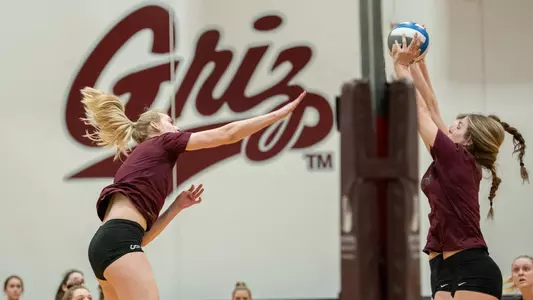
While the spring is technically volleyball's offseason, Montana has been busy in the gym over the past several months with near-daily practices early in the morning.
From the start of the semester through Feb. 18, each individual was limited to eight hours of training per week, meaning that often times players were divided into individual or small groups for more specific focus. Beginning in late February, student-athletes were allowed to train for 20 hours per week, greatly enhancing what can get accomplished.
The expanded time in the gym also opened Montana's schedule to four competition dates, where the Grizzlies can scrimmage against other area teams. Montana has completed three of its competition weekends – traveling to Butte, Bozeman and Spokane – and will conduct its fourth and final weekend next Saturday in Bozeman.
When the spring segment concludes in early May, it will be the last time players and coaches will be together in the gym until fall camp begins in August, mere weeks before the start of the season. Without a doubt, the spring is a crucial time of training.
It also is the first time since 2019 that Montana has had a traditional spring, after the 2020 offseason was erased due to COVID-19 and last year's spring was transformed into a delayed competition season.
Below is a Q&A with head coach Allison Lawrence:
GoGriz.com: Due to COVID-19, the last two spring training seasons were eliminated. How good is it to be back in the gym, getting this instructional time?
Allison Lawrence: It's been unbelievable, really. It's hard to measure the rate of growth because we haven't been through this in so long. Our class that will be juniors academically has never had a full spring. To reach your third year in college, and be an upperclassman, and not have a portion of your year as an athlete to be devoted to development, is pretty wild. There's only so much you can do during the season in terms of development, growth and the technical side, so we really rely on the spring.
It's been very meaningful. It feels very productive, more so than other years. Your awareness is heightened when you go without something, so I think there was an eagerness for this time. I think I can speak for them when I say that it's been enriching, motivating and rewarding.
GG: What do you love about spring workouts?
AL: We're missing players who will be here in the fall, but this is a special time for returners. We have talked a lot about finding our identity for this group, and the identity we want to welcome our new teammates into. Being intentional about our identity and how it's being shaped, and how this team is different from any team that came before it, you see leaders emerge in areas you don't expect and you see a whole new direction when pressure is applied – fatigue, lifting, running, adversity. Spring is a grind, and it reveals character. It shapes a team.
GG: You and your team have been practicing early in the mornings again this spring. What do you enjoy about that time of day?
AL: A lot of it has to do with classes in the spring that our athletes need to take, and we want them to feel the freedom to take those classes or labs in the afternoon, and not be stressed about taking some of those tougher classes. But I also really love the mornings, and I think our athletes do too.
Spring is stressful in a unique way, but it allows for a little bit of balance in their lives. I like that we get our work in early in the morning and then they have the full day after that to go to class, study, recover and be together.
Gallery: (3-14-2022) VB: Spring Practices
GG: What are some areas that you're working on this spring?
AL: After the season, we looked at our stats from the last couple of years and found areas where we are in the bottom half of the conference for. We really looked into how we want to train to get those areas of our game to the top half of the conference. We've been sharing those goals with the team, and there's been a good awareness of why we're doing what we're doing. It's been measurable and very specific, and individual training has a purpose. It's been analytical and collaborative, and it's been fun to hear when a player speaks up with an opinion.
GG: Where have you seen growth?
AL: I've been really impressed with their ability to hold those tactical and technical details while under a ton of stress, because that's what spring is all about. It develops mature players. We have a lot of young players, but so many mature players, which will be a good balance come this fall.
GG: You get four competition weekends where you actually get to take your training and go line up across from another team. What have those weekends been like?
AL: The NCAA limits us to four competition days in the spring, but the nice thing is, we can play as much volleyball in a day as we want to. Each weekend has been different and has been helpful in its own way. Some weekends we play one opponent in a standard match, other times we will play a bunch of teams one after another. But it allows us to try new things, try out different lineups, and see what is working.
GG: Your first weekend was back in February and most recently you were at Gonzaga. What have you seen from your team during competition?
AL: We had an early date this year, back in February, and every team that showed up hadn't had much training up to that point, so it was an interesting day in the gym and I think every team felt off. But we got some good context by playing really early and seeing things we needed to focus on. We got back into the gym for three, four weeks and then went to Bozeman where we played several opponents in a small window. One, two or three sets, and then eat in a small window of time and then play again. It was club tournament-style all over again.
Last weekend, we played at Gonzaga, and it was only against them. We decided we would play four sets no matter what, and it was great to have some success. Spring is all about internal measurements, but getting to play against another opponent is a little carrot that you're working toward to get to fall.
GG: Now that the spring is in its final few weeks, how has this segment given you confidence going into the fall?
AL: You go into these competitions playing all different lineups and trying new things, and regardless of the lineup and matchup, we've seen a lot of success. I think that gives us confidence, particularly in our depth. It has allowed us to be consistent against Division-I teams and regional rivals, and Division II and NAIA opponents, too.
Last season, we had some high moments where we felt like we were extremely relevant and competitive against any number of teams, but it's no secret that we also had inconsistencies and didn't hit our stride until late in the season. We have been fighting in a major way, starting in January, to be the most consistent team we possibly can, from the first point to the last, and I think this spring has given us some confidence.
Gallery: (2-5-2022) VB: National Girls & Women in Sports Day (2.5.22)
From the start of the semester through Feb. 18, each individual was limited to eight hours of training per week, meaning that often times players were divided into individual or small groups for more specific focus. Beginning in late February, student-athletes were allowed to train for 20 hours per week, greatly enhancing what can get accomplished.
The expanded time in the gym also opened Montana's schedule to four competition dates, where the Grizzlies can scrimmage against other area teams. Montana has completed three of its competition weekends – traveling to Butte, Bozeman and Spokane – and will conduct its fourth and final weekend next Saturday in Bozeman.
When the spring segment concludes in early May, it will be the last time players and coaches will be together in the gym until fall camp begins in August, mere weeks before the start of the season. Without a doubt, the spring is a crucial time of training.
It also is the first time since 2019 that Montana has had a traditional spring, after the 2020 offseason was erased due to COVID-19 and last year's spring was transformed into a delayed competition season.
Below is a Q&A with head coach Allison Lawrence:
GoGriz.com: Due to COVID-19, the last two spring training seasons were eliminated. How good is it to be back in the gym, getting this instructional time?
Allison Lawrence: It's been unbelievable, really. It's hard to measure the rate of growth because we haven't been through this in so long. Our class that will be juniors academically has never had a full spring. To reach your third year in college, and be an upperclassman, and not have a portion of your year as an athlete to be devoted to development, is pretty wild. There's only so much you can do during the season in terms of development, growth and the technical side, so we really rely on the spring.
It's been very meaningful. It feels very productive, more so than other years. Your awareness is heightened when you go without something, so I think there was an eagerness for this time. I think I can speak for them when I say that it's been enriching, motivating and rewarding.
GG: What do you love about spring workouts?
AL: We're missing players who will be here in the fall, but this is a special time for returners. We have talked a lot about finding our identity for this group, and the identity we want to welcome our new teammates into. Being intentional about our identity and how it's being shaped, and how this team is different from any team that came before it, you see leaders emerge in areas you don't expect and you see a whole new direction when pressure is applied – fatigue, lifting, running, adversity. Spring is a grind, and it reveals character. It shapes a team.
GG: You and your team have been practicing early in the mornings again this spring. What do you enjoy about that time of day?
AL: A lot of it has to do with classes in the spring that our athletes need to take, and we want them to feel the freedom to take those classes or labs in the afternoon, and not be stressed about taking some of those tougher classes. But I also really love the mornings, and I think our athletes do too.
Spring is stressful in a unique way, but it allows for a little bit of balance in their lives. I like that we get our work in early in the morning and then they have the full day after that to go to class, study, recover and be together.
GG: What are some areas that you're working on this spring?
AL: After the season, we looked at our stats from the last couple of years and found areas where we are in the bottom half of the conference for. We really looked into how we want to train to get those areas of our game to the top half of the conference. We've been sharing those goals with the team, and there's been a good awareness of why we're doing what we're doing. It's been measurable and very specific, and individual training has a purpose. It's been analytical and collaborative, and it's been fun to hear when a player speaks up with an opinion.
GG: Where have you seen growth?
AL: I've been really impressed with their ability to hold those tactical and technical details while under a ton of stress, because that's what spring is all about. It develops mature players. We have a lot of young players, but so many mature players, which will be a good balance come this fall.
GG: You get four competition weekends where you actually get to take your training and go line up across from another team. What have those weekends been like?
AL: The NCAA limits us to four competition days in the spring, but the nice thing is, we can play as much volleyball in a day as we want to. Each weekend has been different and has been helpful in its own way. Some weekends we play one opponent in a standard match, other times we will play a bunch of teams one after another. But it allows us to try new things, try out different lineups, and see what is working.
GG: Your first weekend was back in February and most recently you were at Gonzaga. What have you seen from your team during competition?
AL: We had an early date this year, back in February, and every team that showed up hadn't had much training up to that point, so it was an interesting day in the gym and I think every team felt off. But we got some good context by playing really early and seeing things we needed to focus on. We got back into the gym for three, four weeks and then went to Bozeman where we played several opponents in a small window. One, two or three sets, and then eat in a small window of time and then play again. It was club tournament-style all over again.
Last weekend, we played at Gonzaga, and it was only against them. We decided we would play four sets no matter what, and it was great to have some success. Spring is all about internal measurements, but getting to play against another opponent is a little carrot that you're working toward to get to fall.
GG: Now that the spring is in its final few weeks, how has this segment given you confidence going into the fall?
AL: You go into these competitions playing all different lineups and trying new things, and regardless of the lineup and matchup, we've seen a lot of success. I think that gives us confidence, particularly in our depth. It has allowed us to be consistent against Division-I teams and regional rivals, and Division II and NAIA opponents, too.
Last season, we had some high moments where we felt like we were extremely relevant and competitive against any number of teams, but it's no secret that we also had inconsistencies and didn't hit our stride until late in the season. We have been fighting in a major way, starting in January, to be the most consistent team we possibly can, from the first point to the last, and I think this spring has given us some confidence.


National Girls and Women in Sports Day 2026
Monday, March 30
Student-Athlete Spotlight: Maddie Pyles (Griz Volleyball)
Thursday, January 15
Griz Volleyball: Name The Person
Tuesday, December 30
Griz Volleyball: Name The Object
Tuesday, December 30