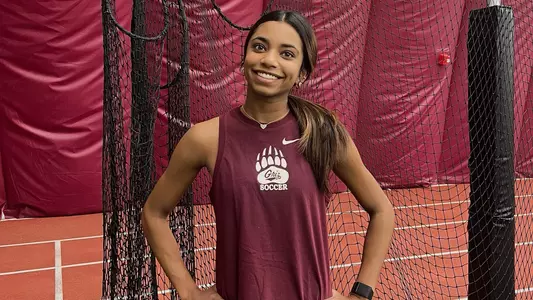
The power of a chance taken
3/27/2026 4:42:00 PM | Soccer
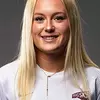
There are plenty of arcs her story could have taken, hanging a left there instead of a right, saying yes that one time instead of no, but whose life hasn't been determined, transformed by forks in the road and decisions made?
There could have been another story written about Shiana Samarasinghe, of how she was born and raised in Sri Lanka, how she came of age and did great things in what would have been her home country, the one that goes back generations on both sides of her family.
Who knows what she would have pursued, what she would have found as outlets for that competitive spirit, that speed, maybe becoming a sprinter and hurdler like her mom, Suresha, maybe finding something more in line with the sporting interests of her dad, Sanjeev, the former rugby player.
She could have been there today, making a life for herself, making the most of the opportunities available. Instead, she is in the U.S., a first-generation American thanks to choices made by her parents, risks taken when they weren't that much older than she is, to give a new country a shot.
The arc, as it played out, had her land in Missoula in January after spending the fall semester at UC San Diego, taking a chance of her own, joining a program without a head coach, but sometimes a person just has to get out of the way and let the heart lead the way.
"I'm lucky to live this life but would have made myself also very happy if I had grown up in Sri Lanka," she said earlier this month. "You only live one life, so you want to make something really valuable."
It's a life view that should probably just be made permanent on the family crest, dating back to Sanjeev's mom, the Fulbright Scholar who departed Sri Lanka to get her Ivy League education at Cornell, then did a 180 and headed home to serve in Sri Lanka's national hospital system.
That rubbed off on her three children, as did the U.S. programming that made its way to the family's television. Where else would Sanjeev and his older brother look for their own U.S. education than the state of Florida after watching Crockett and Tubbs on the tube on the regular?
"I was very familiar with the U.S., so the natural tendency was to come here," he said. His brother enrolled at Florida State. Sanjeev ended up in Jacksonville, at North Florida, where he studied criminal justice, an interest he passed down to his younger of two daughters, the future lawyer.
It was never his design to remain in the U.S., rather to follow in his mom's footsteps, to take his education back to Sri Lanka and make his life there. But then his brother landed in Los Angeles, set up his own company, and California and the dot-com explosion were too much of an enticement.
Sanjeev got his masters degree in software engineering at National University in San Diego, accepted a job with Cisco Systems and spent the next two decades in Silicon Valley, in 2024 switching companies, from Cisco, where he was a project manager, to Apple.
"My dad's dad encouraged him to come (to the U.S.). He wanted something different, to have a different life," says Shiana. "It's very comfortable and easy to stay in your country. I'm grateful to my parents for moving out and starting a different life here."
She was in kindergarten by the time she was four, graduated from high school two months after turning 17. Her older sister is at Florida International, studying pre-med. But it was never study, study, study and then study some more in the Samarasinghe home.
The girls' parents were athletes in their youth and had learned the value of sport as a way of achieving a more balanced life, a more balanced perspective.
"Academics were important, but sports made us who we are today," says Sanjeev. "Well-rounded way of looking at things, think about team, think about others. It's not about yourself when you're on a team, so that was very, very important."
Their youngest was on the soccer field by the age of five, neighborhood stuff, mostly playing against boys, and the girl didn't just hold her own, she stood out, her mom's speed making her a terror on the outside, her innate technical ability helping her become a goal-scoring maven in the box.
Dad was fine with that, soccer mostly as an extra-curricular, for fun, for the exercise, for the team experience. Mom took on the more American mindset. If she's this good, what else is out there that might challenge her more, might allow her to fulfill this potential that seems to be emerging?
"I give that credit to my wife," says Sanjeev, who didn't miss one of his daughter's practices or games until Shiana was able to drive. "I was, hey, it's okay, let's stay with this club. No, no, no, no, let's find a club that is more competitive."
Her sister excelled in volleyball, Shiana in both basketball and soccer until she went all in on the latter. They have a cousin in Los Angeles who will play college tennis. And when they travel back to Sri Lanka to visit, every two or three years, they are treated like rock stars, athletes who made it big.
"It's so normalized here but they view it as a big accomplishment. They are so amazed because it's not that common. It just isn't the same. I just got lucky to become an athlete and become good at my sport," says Shiana, who could totally see herself playing for the Sri Lankan national team one day.
She liked basketball, the way it allowed you to use your hands, her speed at the point-guard position giving her the same edge it gave her in soccer, but her passion was soccer, the joy that came from scoring goals something that could not be matched by anything in basketball, gymnastics or swimming.
And when she started getting recognized as a standout player? Well, that only supplied more fuel to the burner, as did her first appearance at an ECNL showcase event, where she saw way more parents than usual packing the sidelines. Wait, those weren't parents. Those were college coaches.
You make a play and maybe notice somebody jot something down. Coaches watch, then drift off to another field. Did they like what they saw? Are they passing and looking for something else? Ahhh! What's a girl to think?
"You play your first ECNL game and you notice coaches watching you and they are watching you because they might want to recruit you," she says. "That's a realization I had and it made me stressed out and nervous."
She committed early, not long after she could be contacted by college coaches, narrowing her available choices by deciding that no schools outside of California had a shot. Her friends were in California, her family was in California. It was home.
Her mom was thrilled. Her dad? Call it mixed emotions. He and Suresha had never missed one of Shiana's soccer matches. He loved getting away from work, the camaraderie that was shared between the parents of the girls on the team.
But this was also the guy who embraced the why not see what's out there? approach, when he left Sri Lanka to go to school at North Florida, when he opted not to return to his home country and make a life in California.
His daughter deciding to remain in California for school, no matter what, certainly wasn't settling but it also needlessly eliminated other potential schools from consideration. "Probably we had blinders on. I wanted her to go out of state," says Sanjeev. "Lesson learned. Don't box yourself in."
His work was done. Guide, counsel, then let your child make her own decision. "That's something I would change. I would have gone in with more of an open mind," says Shiana. "I limited my options a bit. There could have been better opportunities outside of California."
But she was committed and San Diego was where Sanjeev and Suresha both wanted to end up living one day and the Tritons were a five-time NCAA Division III national champion, twice hoisting the Division II trophy before more recently transitioning to Division I, so it was historically successful.
She turned 17, two months later graduated from high school, then took a gap year, taking college credits locally while continuing to play for her club team, Mountain View Los Altos.
"I felt I was too young and wanted to go (into college) with my age," she says. "I was always ahead, always the youngest. I wanted to finally be with my age."
She moved to San Diego last summer. Her parents did as well, the location of their dreams, their end-of-the-trail home, made possible by Sanjeev's ability to work remotely for Apple and Suresha's job in banking.
She played in 12 of 19 matches for the Tritons in the fall, totaling 191 minutes. "I was really unhappy at times," she says. "The team wasn't for me, the school wasn't for me. I wanted to go to an environment I would thrive in and become better."
A former coach told her she needed to create a list, boxes she needed to check before she even started to think about transferring, about her fit with the school, with the program, how she viewed her development, her relationships.
"They didn't check any of those boxes. That's when I knew I had to make that hard decision to transfer, especially mid-year," she says. "You literally have one month."
Word spread, among her former teammates, among her friends, of which Grace Morton is both, the midfielder who would be heading to Montana to become a Grizzly in January, an early enrollee, now putting two and two together, a friend looking for a new home, a team in need of players.
After Montana's former coach left in December for Washington State and after associate head coach J. Landham made the decision to stay put, he reached out to the incoming freshman class, let them know he was staying on.
Morton called back a while later and told Landham about Samarasinghe. "Their friendship is really strong and genuine and really important to them," said Landham. "Very quickly it was clear that (Shiana) was interested and a great human being.
"Even at a time of need, it was important to us that it was the right people joining the program. We still needed the right people and she's the right person."
The recruiting game is one done best over time, on both sides, coaches and athletes, with visits, multiple conversations, time to think. A midyear transfer takes all of that and compresses it into a couple of days. A phone call leads to a visit which leads to: we really need to know, like today.
"Being valued by coaches and teammates was something I was really looking for," says Shiana, and luckily for her, that's a foundational tenet of the Montana soccer program. But what about the beaches she'd be leaving behind? What about her parents, who just moved to San Diego to be closer to her?
"Why not try to get out of your comfort zone? Get away from family, get away from friends, have my own life, find peace in being away," she says.
The early days were hard and had her leaning toward, wait, did I make the right decision? But it wasn't her decision that was wrong or Montana, it was her mindset.
"I was homesick and having a hard time adjusting," she admits. "Once I started focusing on the positive things, that helped me. It's kind of what you make of it. Finding time with friends, trying to focus on getting better at soccer."
She and three other midyear additions joined a small group of returners from last season's Big Sky Conference championship team, making for an intimate setting. But don't think that led to a whoa-is-us mentality. Quite the opposite. The chip on their collective shoulder barely fits in the indoor facility.
"It's one of the hardest-working groups of girls I've ever met," she says. "The way everyone shows up early, the amount of encouragement, it's insane compared to what I came from. The standard is so much higher. They make me better every day. I like that." Then she changes her stance. "I love it.
"It feels like I've known this team for years. For it to happen that fast, it's really special because you don't see that a lot in college sports. The way we've bonded, I've never had that on any team. It can be really hard in college, with different ages and experiences, but they've seen so welcoming and inviting."
And that was all before the international man of mystery arrived one day and quietly stood off to the side at a 7 a.m. practice in mid-February, taking it all in.
"What I respected most was that he didn't come in and just try to take over the team," says Samarasinghe of the guy who is now her coach, Stuart Gore. "He eased his way into it. He let everybody get settled in with him.
"I love him as a coach. I love his style of play. He's very direct with what he wants and is very encouraging. He has a good balance between going at it but also having fun. It's really helped me that I've built a connection with the coaches, something I'd never had."
Samarasinghe will be one of Gore's forwards next season on a roster that is coming together as the coach has not just stabilized what he inherited but has quickly started filling in around them. He has a championship mentality and is moving forward like it.
"She's really stepped out in the last couple weeks and shown us what she can do and how quick she is," said Gore. "Her first couple of steps are lightning quick and she's got a quick, good release on her shot. She works hard.
"It seems like she's really embedded herself in the culture and the girls really like her. Definitely a good pick-up."
She has three years left to play, then it will be off to law school. Who knows, maybe even at Montana. Then it will be back to California, she is almost certain, this girl who needs her big cities, the energy she gets from crowds of people, the hit you get when you come across someone famous.
Her dad? He's trying to figure out how to make it to Montana for the season opener against Bucknell. And after that? Well, it won't be like it was before, when Shiana Samarasinghe had family at every single game she played.
But who knows better than Sanjeev about the good that can come and what can happen when comfort and familiarity are set aside and a chance on something different is taken.
There could have been another story written about Shiana Samarasinghe, of how she was born and raised in Sri Lanka, how she came of age and did great things in what would have been her home country, the one that goes back generations on both sides of her family.
Who knows what she would have pursued, what she would have found as outlets for that competitive spirit, that speed, maybe becoming a sprinter and hurdler like her mom, Suresha, maybe finding something more in line with the sporting interests of her dad, Sanjeev, the former rugby player.
She could have been there today, making a life for herself, making the most of the opportunities available. Instead, she is in the U.S., a first-generation American thanks to choices made by her parents, risks taken when they weren't that much older than she is, to give a new country a shot.
The arc, as it played out, had her land in Missoula in January after spending the fall semester at UC San Diego, taking a chance of her own, joining a program without a head coach, but sometimes a person just has to get out of the way and let the heart lead the way.
"I'm lucky to live this life but would have made myself also very happy if I had grown up in Sri Lanka," she said earlier this month. "You only live one life, so you want to make something really valuable."
It's a life view that should probably just be made permanent on the family crest, dating back to Sanjeev's mom, the Fulbright Scholar who departed Sri Lanka to get her Ivy League education at Cornell, then did a 180 and headed home to serve in Sri Lanka's national hospital system.
That rubbed off on her three children, as did the U.S. programming that made its way to the family's television. Where else would Sanjeev and his older brother look for their own U.S. education than the state of Florida after watching Crockett and Tubbs on the tube on the regular?
"I was very familiar with the U.S., so the natural tendency was to come here," he said. His brother enrolled at Florida State. Sanjeev ended up in Jacksonville, at North Florida, where he studied criminal justice, an interest he passed down to his younger of two daughters, the future lawyer.
It was never his design to remain in the U.S., rather to follow in his mom's footsteps, to take his education back to Sri Lanka and make his life there. But then his brother landed in Los Angeles, set up his own company, and California and the dot-com explosion were too much of an enticement.
Sanjeev got his masters degree in software engineering at National University in San Diego, accepted a job with Cisco Systems and spent the next two decades in Silicon Valley, in 2024 switching companies, from Cisco, where he was a project manager, to Apple.
"My dad's dad encouraged him to come (to the U.S.). He wanted something different, to have a different life," says Shiana. "It's very comfortable and easy to stay in your country. I'm grateful to my parents for moving out and starting a different life here."
She was in kindergarten by the time she was four, graduated from high school two months after turning 17. Her older sister is at Florida International, studying pre-med. But it was never study, study, study and then study some more in the Samarasinghe home.
The girls' parents were athletes in their youth and had learned the value of sport as a way of achieving a more balanced life, a more balanced perspective.
"Academics were important, but sports made us who we are today," says Sanjeev. "Well-rounded way of looking at things, think about team, think about others. It's not about yourself when you're on a team, so that was very, very important."
Their youngest was on the soccer field by the age of five, neighborhood stuff, mostly playing against boys, and the girl didn't just hold her own, she stood out, her mom's speed making her a terror on the outside, her innate technical ability helping her become a goal-scoring maven in the box.
Dad was fine with that, soccer mostly as an extra-curricular, for fun, for the exercise, for the team experience. Mom took on the more American mindset. If she's this good, what else is out there that might challenge her more, might allow her to fulfill this potential that seems to be emerging?
"I give that credit to my wife," says Sanjeev, who didn't miss one of his daughter's practices or games until Shiana was able to drive. "I was, hey, it's okay, let's stay with this club. No, no, no, no, let's find a club that is more competitive."
Her sister excelled in volleyball, Shiana in both basketball and soccer until she went all in on the latter. They have a cousin in Los Angeles who will play college tennis. And when they travel back to Sri Lanka to visit, every two or three years, they are treated like rock stars, athletes who made it big.
"It's so normalized here but they view it as a big accomplishment. They are so amazed because it's not that common. It just isn't the same. I just got lucky to become an athlete and become good at my sport," says Shiana, who could totally see herself playing for the Sri Lankan national team one day.
She liked basketball, the way it allowed you to use your hands, her speed at the point-guard position giving her the same edge it gave her in soccer, but her passion was soccer, the joy that came from scoring goals something that could not be matched by anything in basketball, gymnastics or swimming.
And when she started getting recognized as a standout player? Well, that only supplied more fuel to the burner, as did her first appearance at an ECNL showcase event, where she saw way more parents than usual packing the sidelines. Wait, those weren't parents. Those were college coaches.
You make a play and maybe notice somebody jot something down. Coaches watch, then drift off to another field. Did they like what they saw? Are they passing and looking for something else? Ahhh! What's a girl to think?
"You play your first ECNL game and you notice coaches watching you and they are watching you because they might want to recruit you," she says. "That's a realization I had and it made me stressed out and nervous."
She committed early, not long after she could be contacted by college coaches, narrowing her available choices by deciding that no schools outside of California had a shot. Her friends were in California, her family was in California. It was home.
Her mom was thrilled. Her dad? Call it mixed emotions. He and Suresha had never missed one of Shiana's soccer matches. He loved getting away from work, the camaraderie that was shared between the parents of the girls on the team.
But this was also the guy who embraced the why not see what's out there? approach, when he left Sri Lanka to go to school at North Florida, when he opted not to return to his home country and make a life in California.
His daughter deciding to remain in California for school, no matter what, certainly wasn't settling but it also needlessly eliminated other potential schools from consideration. "Probably we had blinders on. I wanted her to go out of state," says Sanjeev. "Lesson learned. Don't box yourself in."
His work was done. Guide, counsel, then let your child make her own decision. "That's something I would change. I would have gone in with more of an open mind," says Shiana. "I limited my options a bit. There could have been better opportunities outside of California."
But she was committed and San Diego was where Sanjeev and Suresha both wanted to end up living one day and the Tritons were a five-time NCAA Division III national champion, twice hoisting the Division II trophy before more recently transitioning to Division I, so it was historically successful.
She turned 17, two months later graduated from high school, then took a gap year, taking college credits locally while continuing to play for her club team, Mountain View Los Altos.
"I felt I was too young and wanted to go (into college) with my age," she says. "I was always ahead, always the youngest. I wanted to finally be with my age."
She moved to San Diego last summer. Her parents did as well, the location of their dreams, their end-of-the-trail home, made possible by Sanjeev's ability to work remotely for Apple and Suresha's job in banking.
She played in 12 of 19 matches for the Tritons in the fall, totaling 191 minutes. "I was really unhappy at times," she says. "The team wasn't for me, the school wasn't for me. I wanted to go to an environment I would thrive in and become better."
A former coach told her she needed to create a list, boxes she needed to check before she even started to think about transferring, about her fit with the school, with the program, how she viewed her development, her relationships.
"They didn't check any of those boxes. That's when I knew I had to make that hard decision to transfer, especially mid-year," she says. "You literally have one month."
Word spread, among her former teammates, among her friends, of which Grace Morton is both, the midfielder who would be heading to Montana to become a Grizzly in January, an early enrollee, now putting two and two together, a friend looking for a new home, a team in need of players.
After Montana's former coach left in December for Washington State and after associate head coach J. Landham made the decision to stay put, he reached out to the incoming freshman class, let them know he was staying on.
Morton called back a while later and told Landham about Samarasinghe. "Their friendship is really strong and genuine and really important to them," said Landham. "Very quickly it was clear that (Shiana) was interested and a great human being.
"Even at a time of need, it was important to us that it was the right people joining the program. We still needed the right people and she's the right person."
The recruiting game is one done best over time, on both sides, coaches and athletes, with visits, multiple conversations, time to think. A midyear transfer takes all of that and compresses it into a couple of days. A phone call leads to a visit which leads to: we really need to know, like today.
"Being valued by coaches and teammates was something I was really looking for," says Shiana, and luckily for her, that's a foundational tenet of the Montana soccer program. But what about the beaches she'd be leaving behind? What about her parents, who just moved to San Diego to be closer to her?
"Why not try to get out of your comfort zone? Get away from family, get away from friends, have my own life, find peace in being away," she says.
The early days were hard and had her leaning toward, wait, did I make the right decision? But it wasn't her decision that was wrong or Montana, it was her mindset.
"I was homesick and having a hard time adjusting," she admits. "Once I started focusing on the positive things, that helped me. It's kind of what you make of it. Finding time with friends, trying to focus on getting better at soccer."
She and three other midyear additions joined a small group of returners from last season's Big Sky Conference championship team, making for an intimate setting. But don't think that led to a whoa-is-us mentality. Quite the opposite. The chip on their collective shoulder barely fits in the indoor facility.
"It's one of the hardest-working groups of girls I've ever met," she says. "The way everyone shows up early, the amount of encouragement, it's insane compared to what I came from. The standard is so much higher. They make me better every day. I like that." Then she changes her stance. "I love it.
"It feels like I've known this team for years. For it to happen that fast, it's really special because you don't see that a lot in college sports. The way we've bonded, I've never had that on any team. It can be really hard in college, with different ages and experiences, but they've seen so welcoming and inviting."
And that was all before the international man of mystery arrived one day and quietly stood off to the side at a 7 a.m. practice in mid-February, taking it all in.
"What I respected most was that he didn't come in and just try to take over the team," says Samarasinghe of the guy who is now her coach, Stuart Gore. "He eased his way into it. He let everybody get settled in with him.
"I love him as a coach. I love his style of play. He's very direct with what he wants and is very encouraging. He has a good balance between going at it but also having fun. It's really helped me that I've built a connection with the coaches, something I'd never had."
Samarasinghe will be one of Gore's forwards next season on a roster that is coming together as the coach has not just stabilized what he inherited but has quickly started filling in around them. He has a championship mentality and is moving forward like it.
"She's really stepped out in the last couple weeks and shown us what she can do and how quick she is," said Gore. "Her first couple of steps are lightning quick and she's got a quick, good release on her shot. She works hard.
"It seems like she's really embedded herself in the culture and the girls really like her. Definitely a good pick-up."
She has three years left to play, then it will be off to law school. Who knows, maybe even at Montana. Then it will be back to California, she is almost certain, this girl who needs her big cities, the energy she gets from crowds of people, the hit you get when you come across someone famous.
Her dad? He's trying to figure out how to make it to Montana for the season opener against Bucknell. And after that? Well, it won't be like it was before, when Shiana Samarasinghe had family at every single game she played.
But who knows better than Sanjeev about the good that can come and what can happen when comfort and familiarity are set aside and a chance on something different is taken.

Players Mentioned
M
/ Soccer
F
/ SoccerTuesday, September 15
Monday, September 14
Wednesday, September 09
Monday, September 07