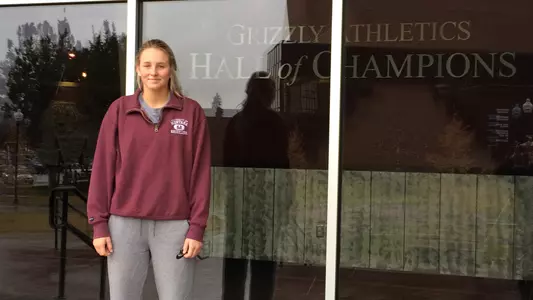
Freshman orientation with Nora Klick
12/5/2016 4:09:00 PM | Women's Basketball
It would have been storybook, right? As Montana as a Montana tale can be?
A girl who travels an hour each way -- no, not on horseback -- from her family's ranch in central Montana to attend high school earns a spot on the Lady Griz basketball team.
Who grows up driving a swather on a farm that grows hay, barley, wheat and alfalfa helps Montana overcome injuries to its three returning starters and have another in a long line of successful seasons.
Who learns everything there is to know about raising and keeping healthy 200 head of cattle has a playing career full of individual honors and Big Sky Conference championships.
But in a season of freshman this and redshirt freshman that for the Lady Griz, Nora Klick's is a name that won't be getting mentioned.
She is redshirting this season, and not necessarily because of roster numbers or lack of available minutes. Lord knows first-year coach Shannon Schweyen could use another body.
Instead Klick is sitting out this season because storybooks just don't have the same magic when the protagonist isn't saving the day so much as simply trying to overcome a debilitating injury.
And one of the worst imaginable for an athlete: Nora Klick has a bad back.
"It first hit me during a game my freshman year," says Klick, who was raised near Simms but attended Great Falls High. "I was about crying in the locker room. I couldn't even reach down past my knees."
And so it began, Klick's uneasy relationship with her balky back, an affliction that is as insidious as it is enervating.
Kayleigh Valley's and Alycia Sims' injured knees are wrapped up in braces, and they hobble around on crutches. Mekayla Isaak's broken hand is in a cast. Klick? She sits on the end of the bench, looking like she could enter the game if called upon.
"You can't see it, and that's the hardest part for me. It's just always there," she says. "When it first happened four years ago, I didn't say anything because I didn't think much of it. And I wanted to keep playing as a freshman, so I kept it pretty quiet."
An MRI after her freshman year revealed she had a pair of herniated discs in her back. As her doctor explained it to her in the most layman terms possible, located between each vertebra is a small jelly-filled donut. Some of that jelly had leaked out and was pinching the nerves in her spine.
An innocuous image to describe an excruciating real-life result: a throbbing back coupled with pain that shot down her leg, all the way to the ankle.
"It's just constant, annoying pain that's always there. It never really goes away," she says.
Of course this being the second decade of the 21st century, options have been developed, because Klick is far from the first person to have a herniated disc or two.
There was surgery. A microdiscectomy could clean up the jelly that had leaked out, once again allowing the nerves to move freely, but to the Klicks that was always the last resort.
There was the physiological concern -- "You can only take out so much of that jelly before the vertebrae start to collapse on each other. Then you've got major problems," says Klick. -- and also the more here-and-now anxieties of an athletic teenager.
Surgery would shelve her for six months. For a high schooler, when sports seasons come one after another and the opportunity to play is finite, even the discussion of it was anathema.
Sports just have a way of putting a girl's back under constant pressure, from the torqueing of an outside hitter preparing to put down another kill to a post player holding her ground against a like-sized opponent on the block, so something had to be done.
"If I never wanted to play sports again, it would definitely suck, but you wouldn't really have to worry about it any more than the discomfort, because it wouldn't really affect your day-to-day activities," says Klick.
She wasn't going to stop playing, so the Klicks sought out the less-invasive treatment.
After her freshman year, after the MRI, a course of action: a series of cortisone shots, three per year. It wouldn't exactly fix the problem so much as mask it, but it would at least offer a temporary solution, courtesy of a 10-inch needle that was inserted at the base of her back until it reached the target.
"I hated the shots. They were terrible. But I got the first one and was feeling great. I played basketball that summer and felt fine," she says.
She may have detested the procedure, but she couldn't argue with the results. She competed pain-free for months with a single injection.
She had five in high school, but they grew less and less effective each time they were administered. The immediate relief was the same, but how long they lasted began to taper off.
"The length of time it would help got shorter and shorter. By the time I got the fifth shot in my junior year, it hardly worked for a week," she says.
Playing in discomfort hardly held Klick back. She was a volleyball starter as a freshman, sophomore and junior, an all-state basketball player as a junior.
But when the cortisone injections had finally lost their effectiveness, the Klicks decided to look into the more permanent solution. She underwent back surgery the summer after her junior year.
"I would have stuck with the cortisone shots, but they just quit working," says Klick, who was on bed rest for two weeks after the procedure.
The surgery worked. She missed her senior year of volleyball as she recovered, but she was back in time for the basketball season. She was voted all-state again last winter after Great Falls fell to Bozeman by a point in the Class AA title game.
Klick moved to Missoula last summer and took a class at Montana to get a jumpstart on her academic career -- go figure: she plans to pursue health and human performance -- and joined her teammates in the fall as they ran the M and did their preseason conditioning. All was perfect.
It was a career just getting started. Finally the best part of the storybook could be written.
"Then it started happening again. At first I thought I maybe pulled a muscle in my back. Maybe I wasn't doing enough stretching. One morning it was really bad, and I knew what it was," she says, her voice catching with the emotion of the memory.
"It's frustrating, because I've quit practicing and it's still not going away. In high school I would get to the point where I was playing great. I would be at the top, then it would happen and I'd have to restart at square one. That's where we're at again, at square one."
It's a tragedy -- the Greeks would certainly be impressed, since Klick could fill the role of Sisyphus -- with the protagonist being led to suffer by the storybook's unyielding author.
There was another MRI taken. Now everyone is trying to figure out whether the nerve is just inflamed or if the disc is re-herniated. In the meantime, life and the Lady Griz basketball season are moving forward without her.
Here is the best-case scenario: The nerve is inflamed, and she gets back on a schedule of cortisone shots. They work as well as they did when she first started getting them, and she rejoins the team once again at practice. She goes pain-free from shot to shot and has a great five-year career.
The worst-case scenario? That would be never playing a game for the Lady Griz, which is much more than she wants to consider at this point, because in her mind, she'll endure more pain than you can imagine to keep her dream alive. Because not playing at all would be even more painful.
"Not playing this year is bad enough," she says. "I don't want to think about anything beyond that."
So when you go to Montana's game against Rocky Mountain on Monday night, and you see Klick sitting there at the end of the bench and wonder why, in a season that's turned into all-hands-on-deck emergency, she isn't suited up, she is dealing with more -- emotionally and physically -- than she lets on.
And for sure she doesn't want your pity. If the last four years have given her anything, it's perspective on her situation, an acceptance.
"I'm not mad at anyone," she says. "I'm just one of the percentages. But a lot of people have it a lot worse than I do. It's something I have to deal with. I'm just going to keep going."
A girl who travels an hour each way -- no, not on horseback -- from her family's ranch in central Montana to attend high school earns a spot on the Lady Griz basketball team.
Who grows up driving a swather on a farm that grows hay, barley, wheat and alfalfa helps Montana overcome injuries to its three returning starters and have another in a long line of successful seasons.
Who learns everything there is to know about raising and keeping healthy 200 head of cattle has a playing career full of individual honors and Big Sky Conference championships.
But in a season of freshman this and redshirt freshman that for the Lady Griz, Nora Klick's is a name that won't be getting mentioned.
She is redshirting this season, and not necessarily because of roster numbers or lack of available minutes. Lord knows first-year coach Shannon Schweyen could use another body.
Instead Klick is sitting out this season because storybooks just don't have the same magic when the protagonist isn't saving the day so much as simply trying to overcome a debilitating injury.
And one of the worst imaginable for an athlete: Nora Klick has a bad back.
"It first hit me during a game my freshman year," says Klick, who was raised near Simms but attended Great Falls High. "I was about crying in the locker room. I couldn't even reach down past my knees."
And so it began, Klick's uneasy relationship with her balky back, an affliction that is as insidious as it is enervating.
Kayleigh Valley's and Alycia Sims' injured knees are wrapped up in braces, and they hobble around on crutches. Mekayla Isaak's broken hand is in a cast. Klick? She sits on the end of the bench, looking like she could enter the game if called upon.
"You can't see it, and that's the hardest part for me. It's just always there," she says. "When it first happened four years ago, I didn't say anything because I didn't think much of it. And I wanted to keep playing as a freshman, so I kept it pretty quiet."
An MRI after her freshman year revealed she had a pair of herniated discs in her back. As her doctor explained it to her in the most layman terms possible, located between each vertebra is a small jelly-filled donut. Some of that jelly had leaked out and was pinching the nerves in her spine.
An innocuous image to describe an excruciating real-life result: a throbbing back coupled with pain that shot down her leg, all the way to the ankle.
"It's just constant, annoying pain that's always there. It never really goes away," she says.
Of course this being the second decade of the 21st century, options have been developed, because Klick is far from the first person to have a herniated disc or two.
There was surgery. A microdiscectomy could clean up the jelly that had leaked out, once again allowing the nerves to move freely, but to the Klicks that was always the last resort.
There was the physiological concern -- "You can only take out so much of that jelly before the vertebrae start to collapse on each other. Then you've got major problems," says Klick. -- and also the more here-and-now anxieties of an athletic teenager.
Surgery would shelve her for six months. For a high schooler, when sports seasons come one after another and the opportunity to play is finite, even the discussion of it was anathema.
Sports just have a way of putting a girl's back under constant pressure, from the torqueing of an outside hitter preparing to put down another kill to a post player holding her ground against a like-sized opponent on the block, so something had to be done.
"If I never wanted to play sports again, it would definitely suck, but you wouldn't really have to worry about it any more than the discomfort, because it wouldn't really affect your day-to-day activities," says Klick.
She wasn't going to stop playing, so the Klicks sought out the less-invasive treatment.
After her freshman year, after the MRI, a course of action: a series of cortisone shots, three per year. It wouldn't exactly fix the problem so much as mask it, but it would at least offer a temporary solution, courtesy of a 10-inch needle that was inserted at the base of her back until it reached the target.
"I hated the shots. They were terrible. But I got the first one and was feeling great. I played basketball that summer and felt fine," she says.
She may have detested the procedure, but she couldn't argue with the results. She competed pain-free for months with a single injection.
She had five in high school, but they grew less and less effective each time they were administered. The immediate relief was the same, but how long they lasted began to taper off.
"The length of time it would help got shorter and shorter. By the time I got the fifth shot in my junior year, it hardly worked for a week," she says.
Playing in discomfort hardly held Klick back. She was a volleyball starter as a freshman, sophomore and junior, an all-state basketball player as a junior.
But when the cortisone injections had finally lost their effectiveness, the Klicks decided to look into the more permanent solution. She underwent back surgery the summer after her junior year.
"I would have stuck with the cortisone shots, but they just quit working," says Klick, who was on bed rest for two weeks after the procedure.
The surgery worked. She missed her senior year of volleyball as she recovered, but she was back in time for the basketball season. She was voted all-state again last winter after Great Falls fell to Bozeman by a point in the Class AA title game.
Klick moved to Missoula last summer and took a class at Montana to get a jumpstart on her academic career -- go figure: she plans to pursue health and human performance -- and joined her teammates in the fall as they ran the M and did their preseason conditioning. All was perfect.
It was a career just getting started. Finally the best part of the storybook could be written.
"Then it started happening again. At first I thought I maybe pulled a muscle in my back. Maybe I wasn't doing enough stretching. One morning it was really bad, and I knew what it was," she says, her voice catching with the emotion of the memory.
"It's frustrating, because I've quit practicing and it's still not going away. In high school I would get to the point where I was playing great. I would be at the top, then it would happen and I'd have to restart at square one. That's where we're at again, at square one."
It's a tragedy -- the Greeks would certainly be impressed, since Klick could fill the role of Sisyphus -- with the protagonist being led to suffer by the storybook's unyielding author.
There was another MRI taken. Now everyone is trying to figure out whether the nerve is just inflamed or if the disc is re-herniated. In the meantime, life and the Lady Griz basketball season are moving forward without her.
Here is the best-case scenario: The nerve is inflamed, and she gets back on a schedule of cortisone shots. They work as well as they did when she first started getting them, and she rejoins the team once again at practice. She goes pain-free from shot to shot and has a great five-year career.
The worst-case scenario? That would be never playing a game for the Lady Griz, which is much more than she wants to consider at this point, because in her mind, she'll endure more pain than you can imagine to keep her dream alive. Because not playing at all would be even more painful.
"Not playing this year is bad enough," she says. "I don't want to think about anything beyond that."
So when you go to Montana's game against Rocky Mountain on Monday night, and you see Klick sitting there at the end of the bench and wonder why, in a season that's turned into all-hands-on-deck emergency, she isn't suited up, she is dealing with more -- emotionally and physically -- than she lets on.
And for sure she doesn't want your pity. If the last four years have given her anything, it's perspective on her situation, an acceptance.
"I'm not mad at anyone," she says. "I'm just one of the percentages. But a lot of people have it a lot worse than I do. It's something I have to deal with. I'm just going to keep going."
Players Mentioned

F
/ Women's Basketball
F
/ Women's Basketball
F
/ Women's Basketball
F
/ Women's BasketballGriz Softball vs. Seattle Highlights - 3/24/26
Monday, March 30
2026 Griz Softball Hype Video
Monday, March 30
2006 Griz Basketball Flashback: NCAA Tournament Win Over Nevada
Monday, March 30
Name The Person: Griz Basketball
Monday, March 30