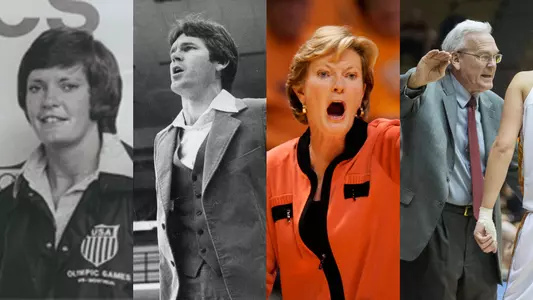
6/28/2016 6:13:00 PM | Women's Basketball
She was born on June 14, 1952, in Clarksville, on 1,000 acres of rolling hayfields in north-central Tennessee, hard against the Kentucky border.
He was born 68 days later in Plentywood -- but only because Outlook didn't have a hospital -- on 640 acres of ranchland in northeast Montana, a few minutes' drive from either Canada or North Dakota.
That distance was one of the few things that would separate Montana women's basketball coach Robin Selvig and former Tennessee coach Pat Summitt, who died early Tuesday at the age of 64 from complications arising from Alzheimer's disease.
Though their teams met just twice on the basketball court, theirs was a shared journey, of taking women's college basketball from the earliest days of Title IX in the 1970s and shepherding the game to what it's become today, four decades later.
They are on the short list of pioneers, coaches who can be counted with the fingers of two hands, who found their calling early, stuck with it and in turn changed lives, schools, communities and entire states. And most important, perceptions.
All of them, from Jody Conradt to Debby Ryan, from Leon Barmore to C. Vivian Stringer, did it a bit differently, but they all accomplished the same thing. They forced people long accustomed to watching men's athletics finally take notice. Turns out the girls could play a little too.
"Those of us who have been in it since the beginning, it's been an interesting journey," says Selvig.
To be blinded by the enormity of Summitt's accomplishments -- 1,098 wins, eight national championships, zero four-year players between 1976 and 2011 who didn't make at least one trip to the Final Four -- is to lose sight of how it all began.
She accepted the job at Tennessee, where she'd gone to be a graduate assistant after playing at Tennessee-Martin, at the age of 22, or the current age of Lady Griz senior Rachel Staudacher to put that in perspective. Her first stipend of $3,000 would still be less than $15,000 in 2016 dollars.
Selvig wasn't far behind. After playing at Montana, he spent three years coaching high school girls' basketball in Plentywood before returning to his alma mater in the summer of 1978.
She famously had to wash her team's uniforms and drive the team van, and once held a bake sale to raise funds. Selvig recalls having to set up the gym before his team's games.
Montana had a women's basketball team, but it had been operating within the physical education department. Title IX was part of the Education Amendments of 1972, but even half a decade later no one knew where the sport, which wasn't even sanctioned by the NCAA until the early 80s, was going.
"Those were interesting times," says Selvig. "There was Title IX, but it was a gradual process. It didn't mean you all of a sudden got the same amount of money for locker rooms and travel (as the men's team). The mistake would have been thinking it was going to happen overnight."
But it did happen, and Selvig and the Lady Griz had some built-in advantages. First, Montana was already crazy about men's basketball at the time. Think: today's passion for Griz football, but squeezed into Dahlberg Arena, all winter long.
And instead of adding women's basketball to the department as an outlier, a necessary evil to comply with federal regulations (and treat it as such), it was brought under the umbrella of men's basketball, giving it immediate respectability.
It didn't hurt Montana brought on as its new women's coach a former Griz player whose family name already held a high Q score within the state.
Mike Montgomery, hired shortly before Selvig and charged with bringing on the new coach, wasn't just the men's basketball coach. He oversaw Selvig's program through its infancy.
"There were different paths taken by different places back then," says Selvig. "A lot of programs were the women and men, but we were incorporated into the program, and I think that helped us grow. It got us pulling for each other faster."
None of which is to overlook Selvig's influence. By year three, in 1980-81, he was already winning 20 games, and in 1983-84 there was an NCAA tournament victory over Oregon State, in front of 4,093 fans at Dahlberg Arena, the game he still looks back on as being the one that really got things rolling.
Today: Montana has made 27 national tournament appearances and won 24 conference championships, and Selvig enters season No. 39 next fall with 865 wins. And while it's not the Final Four, no four-year player has gone through the program without enjoying a conference championship.
But by her own season three, Summitt and Tennessee were winning 20 games. Soon 30 would be the new standard of excellence. Then national championships. The Volunteers won their first in 1987, then added two more in 1989 and '91.
Which made Tennessee a three-time national champion when Summitt and Selvig reached a deal in the early 90s. If you come play us here, we'll travel and play you there.
"It would be rare for that to happen now," says Selvig. "The bigger schools can buy guarantee games at home, but that was before there was much of that at all."
Montana traveled to Knoxville in late November 1993 and pushed the Volunteers before falling 82-66 in front of 3,426 fans. "We actually played them tough. I remember they called a timeout in the final four minutes because we were hanging in it," says Selvig.
"You heard (Tennessee's fight song) Rocky Top about 10 more times than you'd want to hear it, but it helped us become a better team, and it gave us confidence we could compete with them."
Tennessee would go 31-2 that season and lose to Louisiana Tech in the regional semifinals of the NCAA tournament. Montana fell 66-62 at Stanford in the second round.
That set the stage for the following season, when Tennessee returned the favor and visited Missoula a few days before Christmas. The Volunteers, who had five players in double figures, led by two at the half and won 66-61. The crowd: 8,371.
"Our fans knew who Tennessee was, and they showed up for that game," says Selvig. "It was a great crowd, a great environment." And a testament to what Selvig and Summitt had built at their schools.
Tennessee made it to that year's national championship game, where it would fall to Connecticut. NCAA titles followed in 1996, '97 and '98. Two more came in 2007 and '08. Montana made the NCAA tournament 10 out of 11 years between the late 80s and 90s.
After those meetings, as money became more influential and the sport became more segregated, Montana and Tennessee eventually took up different positions within the women's basketball world.
But that didn't mean Summitt and Selvig were no longer on the same journey. It's just that she was now on the game's superhighway, he on the sport's quieter back roads, just the way a guy from rural northeast Montana likes it.
But the basics never changed. Both employed intense sideline demeanors, hers an icy stare, his more histrionics, and both would do anything to win. Then give all the credit to the players when they did, nearly 2,000 times between them.
Both began their careers in the states they loved and never left. She turned Knoxville into the dream destination for the nation's top players. He did the same thing for players growing up in Montana, where all roads pointed toward Missoula and Dahlberg Arena.
"Not that many coaches are at the same place for a long, long, long time. We both loved where we were," says Selvig. "She was definitely a pioneer, not just of women's basketball but of women's athletics and opportunities."
They taught girls it was okay to strive, okay to sweat, okay to pursue greatness and want to win as badly as the guys. They shook the trees at their schools to get what their programs deserved, and along the way became the envy of rival athletic directors who wanted the same thing at their schools.
"It's been very gratifying for me, but for a woman to fight those battles over the years and make those gains, that must have been very rewarding," says Selvig. "A lot of young women owe a lot to Pat Summitt."
Summitt's death gives us a chance to stop and reflect, on where she and Selvig and the game started, and where they've taken it.
There won't be another Pat Summitt, just like there won't be another Robin Selvig. And because of the foundation they've established, not only at their schools but for women's college basketball, there won't have to be.
The heaviest lifting has already been done. And there can be no greater legacy than that. Rest in peace, Pat.
Players Mentioned

F
/ Women's BasketballGriz Football Weekly Press Conference - UIW - 11.23.26
Monday, November 23
Montana Football Weekly Press Conference
Monday, November 23
Eli Gillman: Walter Payton Award Candidate
Saturday, November 21
UM vs ISU Highlights
Monday, November 16