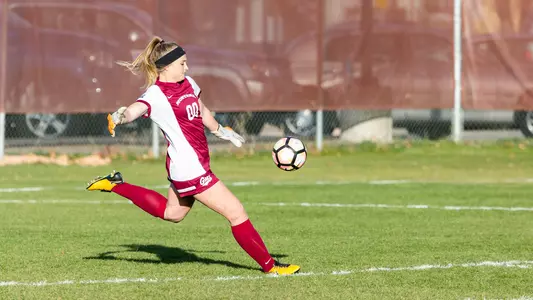
Howard leads Griz into Big Sky tournament
11/2/2017 1:30:00 PM | Soccer
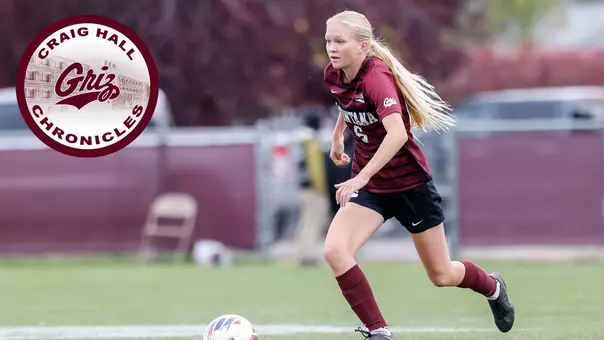
As a goalkeeper -- the best at her position in the Big Sky Conference, notwithstanding the opinions of some of the league's coaches -- Claire Howard is used to watching things that are important to her take place from afar.
It's the nature of her craft, when 90 percent of a match's action happens in front of her, without her involvement. As much as she'd like to do more, she long ago embraced the fact that she can only do so much to help.
Howard went to bed on Sunday night, Oct. 8, in the apartment she shares with teammate Kennedy Yost, having helped Montana to a 2-0 weekend.
On Friday was a 1-0 win over Sacramento State, one of seven shutouts for Howard this season.
She allowed a hard-luck goal in the 21st minute in Sunday's match against Northern Arizona -- a header off a header, really? -- but her teammates had her back. Janessa Fowler tied it in the 80th minute on a penalty kick. Ellie Otteson won it just over six minutes into the first overtime.
It was probably about the time she was drifting off to sleep that Sunday night that a single spark 1,000 miles away, likely caused by a downed power line in heavy Diablo winds, changed the arc of what had been a predictable and comfortable student-plus-athlete life for Howard.
Twelve miles northeast of Howard's hometown of Santa Rosa, Calif., itself sitting 45 miles north of San Francisco, that spark led to the most destructive fire in California history.
It erupted immediately from its flashpoint near Calistoga, fueled by tinder-dry conditions and strong winds. As it picked up size and strength, it began advancing southwest, toward Santa Rosa, at three miles per hour, eating up an acre every minute, the winds sending embers ahead to light the way.
By 2 a.m., the fire, now raging and spreading rapidly in winds that were hitting 50 miles per hour, reached Santa Rosa's city limits, where Tim and Ingrid Howard, Claire's parents, and her younger sister, Brynn, were home asleep.
It was a formula for disaster: fire that was out of control, winds that were not only strong but shifting and unpredictable, dry vegetation everywhere and a city of 175,000 that was mostly unaware of what was happening, believing they were safe in their beds.
People awoke to a real-life dystopia, of officials trying to evacuate entire neighborhoods that were in imminent danger, towering flames of fire lighting up the background. In some cases, people had just minutes to decide what was important enough to gather up and take with them for safekeeping.
When Howard awoke on Monday morning, it's likely her thoughts first turned to her team's upcoming road trip to Idaho and Eastern Washington, important as it was. It wasn't long before soccer was the furthest thing from her mind.
"I woke up to a ton of texts on my phone from my parents. Hey, call us as soon as you can. Then I started getting texts from my friends. Hey, praying for your family. I was like, what is happening?" Howard said.
"I tried to call my parents, but cell service was down. So I went on social media. That's when I learned about the fires that were coming through."
The numbers detail the toll. The Tubbs Fire, one of many to hit that part of California in early October, was responsible for 22 deaths in Santa Rosa and destroyed more than 5,000 structures.
Large swaths of the city were burning largely out of control Monday and Tuesday of that week, with winds so strong that the fire was able to jump the 101, the main traffic corridor leading north out of San Francisco that bisects Santa Rosa as it heads up the coast.
"It was hard," says Howard, whose instinct, understandably, was to rush to her family, toward the fire. "But I knew going home wasn't going to solve anything. My family was staying safe. That was the most important thing. And they wanted me to stay in Montana, knowing I was safe here."
As Sunday night turned into Monday, people and property were at the mercy of the winds. And the fires didn't discriminate, reducing both million-dollar homes and trailers to ash and rubble.
The Howards and their neighborhood were given an evacuation advisory, at the time mostly due to the thick smoke that shrouded the city. They were never in immediate danger from the fires, but they had their bags packed just in case.
"The winds were the hardest part, because they were so unpredictable. It was kind of a waiting game to see if any fires were going to reach our house," says Howard. "Some of the pictures my family was sending me, the sky was just orange. You could see flames and big things of red.
"Life for a lot of people just got put on pause. Nobody was worried about work or school. Everyone was just trying to stay safe."
It was life mirroring soccer for Howard. All she could do was watch from a distance. And hope.
"I felt almost helpless, and that's how I feel in certain situations on the soccer field," she said. "My job was to check on my parents, love on them and make sure they were doing okay. Just be strong for them."
The Howards never had to leave their home, so they did what came naturally to so many in Santa Rosa. They opened their home to those who were displaced and volunteered where they could to provide services to those in need. People banding together in a time of trouble, looking out for others.
In Missoula, Howard's teammates provided the same type of support. They may not have been affected by the fires, but a teammate had, and that meant it was personal.
"It was hard to live a life of normality that week, just knowing what was going on. I still had to go to class and to practice. I just tried to compartmentalize the best I could," Howard says. "Soccer was what I needed. It was a good outlet. I was grateful I had practice to go to every day, just to keep my mind busy.
"The coaching staff and my teammates were amazing. They were texting me all the time, making sure I was okay, giving me the love and support I needed. I don't know what I would have done without them."
It was team as support group and extending to the level of family away from family. At an age when so many players on the team have left home for an extended period for the first time, it's natural to seek out a substitute, a group of people who can fill the same role.
It was needed. Especially this year.
The Sunday before the Tubbs Fire erupted, the shooting that killed 58 at the Route 91 Harvest country music festival occurred in Las Vegas.
Freshman Morgan Meatovich, who is from Las Vegas, had friends who attended the event. Dani Morris, from nearby Henderson, saw a city being portrayed on the news that had become unrecognizable to her.
And on the week that Howard's mind was elsewhere, Hallie Widner lost a grandmother, causing her to miss a weekend of matches. The challenges arrived at every turn for the Grizzlies this fall.
"When you go away to college, you're at an age when these types of life things start to impact you," said coach Mark Plakorus. "We've had a lot of real-life things happen to us this year. I understand what they are going through for sure."
Indeed. In Plakorus's first season at Montana, in 2011, he learned of the death of his brother the day his team hosted Sacramento State. Two days later the Grizzlies faced Portland State at South Campus Stadium. Afterwards he shared with his team why he was going to be away from them for a few days.
He traveled on Monday, attended his brother's funeral on Tuesday and traveled back to Montana on Wednesday, arriving in Butte, where he was picked up by the team bus as it made its way south for a Thursday match at Weber State.
It's easy to picture the scene, of Plakorus stepping onto the bus and feeling the collective embrace -- emotional if not all at once physical -- of two dozen who had become like extended family.
"Being back with the team and being around them at that time let me know that everything was going to be okay," he said. "I was where I belonged and doing what I loved to do. In a way it kind of let me know that my brother would always be with me."
One convenient storyline for Howard would be that she was so inspired by the resiliency of her family and hometown and that she used that to up the level of her own play. But that would be a disservice to her season-long body of work. She's been fantastic from the start as a redshirt freshman.
Montana has allowed just 14 goals in 20 matches this season, a league low. And yet the Grizzlies' keepers have had to make just 3.1 saves per match, a tip of the cap to the Big Sky's most aggressive back line, a group that often takes care of matters before the very last line of defense has to.
"I came into the season with no expectations, but I'm someone who always competes to be the best, so I want to be the best goalkeeper in this conference," says Howard, who earned honorable mention All-Big Sky honors this week, partly due to her low number of saves, as if that should be held against her.
She helped Montana win 1-0 in overtime at Idaho, four days after awakening to the news of the fires. Two days later the Grizzlies lost 1-0 at Eastern Washington on an own goal in the opening minute, about the only thing they did wrong that day while outplaying the Eagles on their home field.
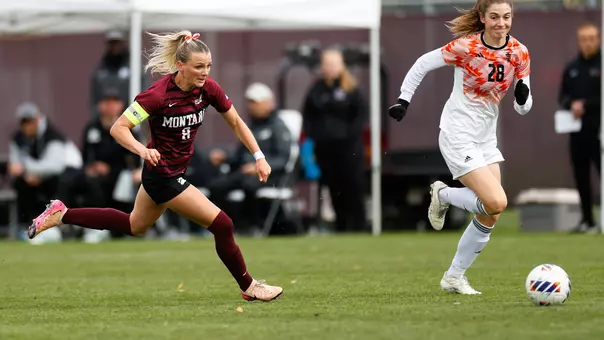
It's to Cheney where Montana returns this week, the Big Sky tournament's No. 2 seed scheduled to face No. 3 Northern Colorado on Friday at 11 a.m. (MT). The Grizzlies are 4-1-3 over their last eight matches, including a 0-0 draw against the Bears in Greeley two weeks ago.
"It's been a really good season, and we're not done yet," said Howard. "We've been successful, but we still haven't played our best soccer. We can play better, which is super exciting.
"It felt like this weekend was never going to get here. Now it's here, so we're all really excited."
With all due respect to Northern Colorado and No. 4 Portland State, which will face the top-seeded Eagles on Friday afternoon, the match-up most people want to see in Sunday's championship game is Montana and Eastern Washington, the tournament's top two seeds who have some history.
Ten of the team's last 11 matches have been decided by a single goal, three times in overtime. To close out the regular season last year, Montana rallied from a 2-0 deficit in Cheney to win 3-2 in overtime.
Five days later, in the quarterfinals of the Big Sky tournament, which Eastern Washington hosted despite being the No. 5 seed, the Eagles won 1-0 despite Montana doubling them up in shots and more than doubling them in shots on goal.
This year's first meeting played out the same way. Montana was the better team, but Eastern Washington got the result. And that sticks with a girl.
"I really want to play Eastern Washington. They knocked us out of the tournament last year, so there is still a sour taste in our mouths," Howard said.
"And when we played them this year, they didn't beat us. We beat ourselves. We want to prove to them and everybody else that we can beat them."
In a season when so many non-soccer things affected the team, distractions that could have pulled it apart, it kept coming back together, stronger each time.
If the Grizzlies win on Friday and advance to Sunday, when everything is on the line, would you bet against Montana?
It's the nature of her craft, when 90 percent of a match's action happens in front of her, without her involvement. As much as she'd like to do more, she long ago embraced the fact that she can only do so much to help.
Howard went to bed on Sunday night, Oct. 8, in the apartment she shares with teammate Kennedy Yost, having helped Montana to a 2-0 weekend.
On Friday was a 1-0 win over Sacramento State, one of seven shutouts for Howard this season.
She allowed a hard-luck goal in the 21st minute in Sunday's match against Northern Arizona -- a header off a header, really? -- but her teammates had her back. Janessa Fowler tied it in the 80th minute on a penalty kick. Ellie Otteson won it just over six minutes into the first overtime.
It was probably about the time she was drifting off to sleep that Sunday night that a single spark 1,000 miles away, likely caused by a downed power line in heavy Diablo winds, changed the arc of what had been a predictable and comfortable student-plus-athlete life for Howard.
Twelve miles northeast of Howard's hometown of Santa Rosa, Calif., itself sitting 45 miles north of San Francisco, that spark led to the most destructive fire in California history.
It erupted immediately from its flashpoint near Calistoga, fueled by tinder-dry conditions and strong winds. As it picked up size and strength, it began advancing southwest, toward Santa Rosa, at three miles per hour, eating up an acre every minute, the winds sending embers ahead to light the way.
By 2 a.m., the fire, now raging and spreading rapidly in winds that were hitting 50 miles per hour, reached Santa Rosa's city limits, where Tim and Ingrid Howard, Claire's parents, and her younger sister, Brynn, were home asleep.
It was a formula for disaster: fire that was out of control, winds that were not only strong but shifting and unpredictable, dry vegetation everywhere and a city of 175,000 that was mostly unaware of what was happening, believing they were safe in their beds.
People awoke to a real-life dystopia, of officials trying to evacuate entire neighborhoods that were in imminent danger, towering flames of fire lighting up the background. In some cases, people had just minutes to decide what was important enough to gather up and take with them for safekeeping.
When Howard awoke on Monday morning, it's likely her thoughts first turned to her team's upcoming road trip to Idaho and Eastern Washington, important as it was. It wasn't long before soccer was the furthest thing from her mind.
"I woke up to a ton of texts on my phone from my parents. Hey, call us as soon as you can. Then I started getting texts from my friends. Hey, praying for your family. I was like, what is happening?" Howard said.
"I tried to call my parents, but cell service was down. So I went on social media. That's when I learned about the fires that were coming through."
The numbers detail the toll. The Tubbs Fire, one of many to hit that part of California in early October, was responsible for 22 deaths in Santa Rosa and destroyed more than 5,000 structures.
Large swaths of the city were burning largely out of control Monday and Tuesday of that week, with winds so strong that the fire was able to jump the 101, the main traffic corridor leading north out of San Francisco that bisects Santa Rosa as it heads up the coast.
"It was hard," says Howard, whose instinct, understandably, was to rush to her family, toward the fire. "But I knew going home wasn't going to solve anything. My family was staying safe. That was the most important thing. And they wanted me to stay in Montana, knowing I was safe here."
As Sunday night turned into Monday, people and property were at the mercy of the winds. And the fires didn't discriminate, reducing both million-dollar homes and trailers to ash and rubble.
The Howards and their neighborhood were given an evacuation advisory, at the time mostly due to the thick smoke that shrouded the city. They were never in immediate danger from the fires, but they had their bags packed just in case.
"The winds were the hardest part, because they were so unpredictable. It was kind of a waiting game to see if any fires were going to reach our house," says Howard. "Some of the pictures my family was sending me, the sky was just orange. You could see flames and big things of red.
"Life for a lot of people just got put on pause. Nobody was worried about work or school. Everyone was just trying to stay safe."
It was life mirroring soccer for Howard. All she could do was watch from a distance. And hope.
"I felt almost helpless, and that's how I feel in certain situations on the soccer field," she said. "My job was to check on my parents, love on them and make sure they were doing okay. Just be strong for them."
The Howards never had to leave their home, so they did what came naturally to so many in Santa Rosa. They opened their home to those who were displaced and volunteered where they could to provide services to those in need. People banding together in a time of trouble, looking out for others.
In Missoula, Howard's teammates provided the same type of support. They may not have been affected by the fires, but a teammate had, and that meant it was personal.
"It was hard to live a life of normality that week, just knowing what was going on. I still had to go to class and to practice. I just tried to compartmentalize the best I could," Howard says. "Soccer was what I needed. It was a good outlet. I was grateful I had practice to go to every day, just to keep my mind busy.
"The coaching staff and my teammates were amazing. They were texting me all the time, making sure I was okay, giving me the love and support I needed. I don't know what I would have done without them."
It was team as support group and extending to the level of family away from family. At an age when so many players on the team have left home for an extended period for the first time, it's natural to seek out a substitute, a group of people who can fill the same role.
It was needed. Especially this year.
The Sunday before the Tubbs Fire erupted, the shooting that killed 58 at the Route 91 Harvest country music festival occurred in Las Vegas.
Freshman Morgan Meatovich, who is from Las Vegas, had friends who attended the event. Dani Morris, from nearby Henderson, saw a city being portrayed on the news that had become unrecognizable to her.
And on the week that Howard's mind was elsewhere, Hallie Widner lost a grandmother, causing her to miss a weekend of matches. The challenges arrived at every turn for the Grizzlies this fall.
"When you go away to college, you're at an age when these types of life things start to impact you," said coach Mark Plakorus. "We've had a lot of real-life things happen to us this year. I understand what they are going through for sure."
Indeed. In Plakorus's first season at Montana, in 2011, he learned of the death of his brother the day his team hosted Sacramento State. Two days later the Grizzlies faced Portland State at South Campus Stadium. Afterwards he shared with his team why he was going to be away from them for a few days.
He traveled on Monday, attended his brother's funeral on Tuesday and traveled back to Montana on Wednesday, arriving in Butte, where he was picked up by the team bus as it made its way south for a Thursday match at Weber State.
It's easy to picture the scene, of Plakorus stepping onto the bus and feeling the collective embrace -- emotional if not all at once physical -- of two dozen who had become like extended family.
"Being back with the team and being around them at that time let me know that everything was going to be okay," he said. "I was where I belonged and doing what I loved to do. In a way it kind of let me know that my brother would always be with me."
One convenient storyline for Howard would be that she was so inspired by the resiliency of her family and hometown and that she used that to up the level of her own play. But that would be a disservice to her season-long body of work. She's been fantastic from the start as a redshirt freshman.
Montana has allowed just 14 goals in 20 matches this season, a league low. And yet the Grizzlies' keepers have had to make just 3.1 saves per match, a tip of the cap to the Big Sky's most aggressive back line, a group that often takes care of matters before the very last line of defense has to.
"I came into the season with no expectations, but I'm someone who always competes to be the best, so I want to be the best goalkeeper in this conference," says Howard, who earned honorable mention All-Big Sky honors this week, partly due to her low number of saves, as if that should be held against her.
She helped Montana win 1-0 in overtime at Idaho, four days after awakening to the news of the fires. Two days later the Grizzlies lost 1-0 at Eastern Washington on an own goal in the opening minute, about the only thing they did wrong that day while outplaying the Eagles on their home field.
It's to Cheney where Montana returns this week, the Big Sky tournament's No. 2 seed scheduled to face No. 3 Northern Colorado on Friday at 11 a.m. (MT). The Grizzlies are 4-1-3 over their last eight matches, including a 0-0 draw against the Bears in Greeley two weeks ago.
"It's been a really good season, and we're not done yet," said Howard. "We've been successful, but we still haven't played our best soccer. We can play better, which is super exciting.
"It felt like this weekend was never going to get here. Now it's here, so we're all really excited."
With all due respect to Northern Colorado and No. 4 Portland State, which will face the top-seeded Eagles on Friday afternoon, the match-up most people want to see in Sunday's championship game is Montana and Eastern Washington, the tournament's top two seeds who have some history.
Ten of the team's last 11 matches have been decided by a single goal, three times in overtime. To close out the regular season last year, Montana rallied from a 2-0 deficit in Cheney to win 3-2 in overtime.
Five days later, in the quarterfinals of the Big Sky tournament, which Eastern Washington hosted despite being the No. 5 seed, the Eagles won 1-0 despite Montana doubling them up in shots and more than doubling them in shots on goal.
This year's first meeting played out the same way. Montana was the better team, but Eastern Washington got the result. And that sticks with a girl.
"I really want to play Eastern Washington. They knocked us out of the tournament last year, so there is still a sour taste in our mouths," Howard said.
"And when we played them this year, they didn't beat us. We beat ourselves. We want to prove to them and everybody else that we can beat them."
In a season when so many non-soccer things affected the team, distractions that could have pulled it apart, it kept coming back together, stronger each time.
If the Grizzlies win on Friday and advance to Sunday, when everything is on the line, would you bet against Montana?
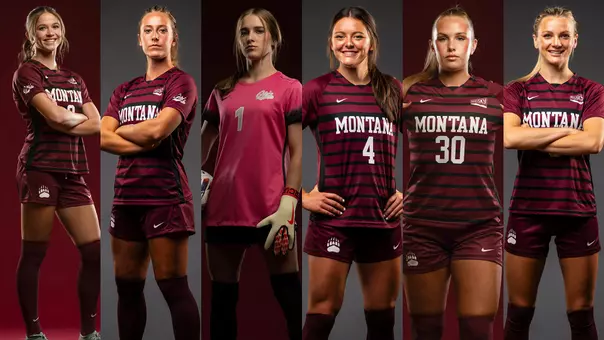
Players Mentioned




Griz football weekly press conference 12.8.25
Monday, December 08
UM vs SDSU Highlights
Monday, December 08
Griz Football Press Conference 12-1-25
Monday, December 01
2025 Brawl of the Wild Trailer
Friday, November 21