The time of their lives
6/14/2018 7:07:00 PM | Softball
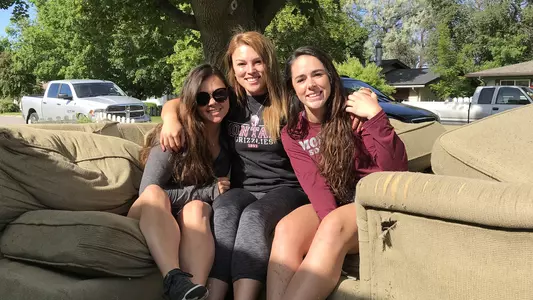
The couch that sat outside, by the curb, at 8 Virginia Drive on Wednesday morning looked like so many others at this time of year in a college town, popping up as they do like dandelions as leases come up and furniture is cleared out of houses that grow emptier and quieter.
This one -- perhaps three pieces in its heyday but on Wednesday just a huddled mass of cushions and torn fabric -- looked exactly like one would expect of a couch that gave everything it had to support a rollicking household of five college students, four dogs and a cat for an academic year.
But this couch was also weighed down with history, with stories and secrets never to be revealed, hidden deeply, safe forever. Passersby saw something abandoned, ready to be trucked off and discarded. Those who wore it out knew its value was so much more and how it had the ability to unite.
It's where three softball players worked through their feelings following the departure of Jamie Pinkerton, who left Montana last August for Iowa State, and where they resolved that the program he left behind would not only survive but continue to thrive.
It provided comfort when news arrived in September of a mother's cancer diagnosis, a decade after she'd beaten a different type of cancer. And it gave more of the same in December after exploratory surgery revealed that they weren't looking at Stage 1 this time around. It was Stage 4.
It's where they retreated to weather the challenges of the fall, when everyone knew a new softball coach was going to be hired but nobody knew who it was going to be. And why was the process taking so long?
It's where they binged-watched Netflix and where they talked about the February poll that had the coaches of the Big Sky Conference putting a target on Montana's softball team, and how the program that had defined itself for three years as an overachiever now had the pressure of expectations.
It's where they talked about the future and life after college, and where softball practices and games turned into naps and -- what the heck, we're here, our dogs are here, we're comfortable, why get up? -- occasional all-night sleepovers.
It's where they celebrated the highs of the season, its lows and where they found themselves last month, their careers at an end earlier than any of them would have wanted following a return from Ogden without the Big Sky championship trophy they so deeply wanted to hold up once again.
But the couch did more than that. During months of service, it helped foster a relationship between three players who arrived in Missoula nearly four years ago as strangers but who leave 8 Virginia Drive this month as friends of the highest order, who expect to remain that way for life.
"I wish this living situation would have happened sooner," said Madison Saacke, who, at catcher, was one-third of a power triangle that included shortstop Delene Colburn and first baseman Ashlyn Lyons, a connection that worked as well as roommates as it did on the diamond.
"They say you meet your best friends in college, and I got exactly what I expected and even more than that," said Lyons. "I didn't anticipate ever being this close with two people. You move in together, and you build your whole life around each other.
"We're already starting to plan when we're going to be able to get together next."
Colburn is all set to begin teaching fourth grade at Gildo Rey Elementary in her hometown of Auburn, Wash., in the fall. It's where Saacke will move in August, after spending a chunk of the summer with her family in Southern California. A job in marketing will just have to wait until she arrives.
Lyons, for now, will remain in Missoula. Her phone may have already rung with orders to report to Mobile, Ala., and the E1 Pro Ballers of the American Softball Association, or the call might never come. And what should she do in the meantime? Or beyond that?
And that's part of the story of the 2018 Montana softball season, which so many thought would be a seamless transition from the championship campaign of 2017.
But no two seasons are ever alike, no matter how similar their rosters, especially when a team has 11 seniors, as Montana did in the spring, all of whom could see the end of their softball careers in the distance. And adulthood one step beyond that. And that can change a player's perspective.
This wasn't 2015, when they were freshmen and had two concerns: school and softball. There was always a next year to look forward to, until there wasn't.
And there was this: They were supposed to be good. Really good. And no one -- outside of the program, at least -- had expected that of them before.
"You want it to be that simple. You want it to be something that flows off the year before," said Melanie Meuchel, who was Pinkerton's assistant coach and the program's interim head coach in the fall before being named Pinkerton's permanent replacement in October.
"But there are different variables every season. You can never go into a season thinking you're going to be the way you were the previous year. You have different dynamics, and we had a number of dynamics that were different."
First Pinkerton left. Then there were more than two months without a named head coach while the fall season played out. Then Meuchel, after her own promotion, had to hire an assistant to replace her, and there was the change to a new strength and conditioning coach last winter.
As storybook as that would have been, this would be no continuation of the 2017 season.
"Our senior year almost felt like a transition," said Saacke. "We were getting used to Pink being gone, Mel being our head coach, (assistant coach) Betsy (Westermann) being here and Rachel (Drees), our new weight trainer.
"All those things. It felt like the whole year we were trying to get used to it, and that showed in our play."
Maybe more than anything else was the residual effect of winning that Big Sky championship in 2017. It changed everything, in good ways and in ways unexpected.
Pinkerton and Meuchel had built their original roster with players who joined the startup program with something to prove, who played with a chip on their shoulder.
But what happens when that group of players does their proving and trades that chip in for a trophy? And does it mostly as juniors, with one more year still to go? What do you do when you reach the finish line and collect your medal, only to discover there is more race to be run?
What do you chase when there is nothing before you to hunt? And when you turn around, you see everyone salivating at the opportunity to take a bite out of the big dog? How do you react when all of that goes against your very nature?
"Winning the Big Sky tournament in 2017 after just three years was phenomenal, but we were always the ones doing the hunting," said Meuchel. "Now you become the hunted.
"We're good, but we still need to attack the same way our personality was developed around, as if we never won a championship."
Yes, the early-season schedule was tougher than it had been the first three years of the program, but no one was expecting Montana to open the season 1-10, not with so many seniors and returning starters from the year before.
Meuchel saw the warning signs early, at both Grand Canyon's and Arizona's tournaments. Her team felt like it had to play mistake-free softball. They thought they needed to be a different version of themselves to satisfy the outside expectations when all they needed to do was be themselves.
They had already showed that that was good enough, that that was championship-level, but the glare of that trophy was blinding.
"We brought in kids who wanted to prove that they could play at this level, and they were always looking to prove who they were," said Meuchel. "You have to play within your personality, and when we're the aggressor, we're really good.
"Now they were being looked at a little differently. I think we thought we had to win every game to be considered good. Then the pressures start to build, some unnecessary pressures of being perfect when I don't know a team that's perfect."
It wasn't the only change. The team had 11 seniors, or 11 players who were now thinking beyond just softball and school, of what was to come next. Oh, for the simplicity of life as a freshman or sophomore or junior. Softball and school. Softball and school. Thank goodness for that couch.
"You start thinking, I have to adult now. I'm not going to be with my friends anymore," said Lyons. "Where am I going to live? Do I go back home to my parents? Do I stay here with this new family I've created the last four years? All the unknowns is the most stressful part.
"Freshman year it feels like it's forever away. Senior year? Whatever. That's never going to come. Then you get to senior year and it's gone. You're done."
So, yeah, Montana played with some burdens in 2018 that the Grizzlies didn't have in 2017. Hitting a rise ball is one thing. Doing it while distracted by the end of a playing career or thoughts of what might be coming next on life's journey or while trying to go 21-0 and error-free in league is another.
Montana didn't win the championship in the spring so many were predicting. It won just two of seven Big Sky series and lost tournament games to Sacramento State and North Dakota after opening with a win over Portland State.
So how did you evaluate the season? Did you take into account the off-the-field issues, how multiple players had family members fighting cancer? How a team had to adapt to a new coach, a new role, and how so many players had to fight to stay in the moment while trying to keep the future out of mind?
"Every year brings different things to a person's personal life, their team life, and that changes the overall dynamic," said Meuchel.
"People might not think so from the previous year, but from what our team went through as a whole, I'm completely proud of this team, to its commitment and its ability to fight through adversity and trying times. I look at it as a successful season."
For Colburn, Lyons and Saacke, no matter what, there was always home base on Virginia Drive. At the end of every day, upon the return home from every road trip, there was that couch, never judging, always welcoming.
And a friendship deepened, each player in step with the others, always able to relate to the joys and sorrows, the challenges being faced, whether personal, athletic or academic.
"We really did feed off each other," said Colburn. "If someone was having a more difficult day, it was nice to have someone to lean on. We helped each other through the rough times and celebrated the good times."
Colburn and Saacke departed for Auburn on Wednesday. They'll be in Omaha next week for the College World Series, helping Katrina Saacke, Madison's mom, sell bracelets at a vendor booth. Then they hit the road to Colorado and do the same thing at a club softball tournament.
Then they'll split up, to different ends of the West Coast, before reuniting in Auburn in August.
Each day now is the first day of the rest of their lives. They no longer have the day-to-day of Griz softball to keep them connected or the home they shared as seniors.
The sport attracted them to Montana and the program brought them together. But it was the couch, the one that sat curbside on Wednesday, that formalized their friendship. "That's why we had to get rid of it," said Saacke, "because it's been through so much."
In the end, the couch gave everything it had for the greater good. It may have had its holes, its rips and tears and stains, but its ability to unite three softball players will extend its memory for a lifetime.
This one -- perhaps three pieces in its heyday but on Wednesday just a huddled mass of cushions and torn fabric -- looked exactly like one would expect of a couch that gave everything it had to support a rollicking household of five college students, four dogs and a cat for an academic year.
But this couch was also weighed down with history, with stories and secrets never to be revealed, hidden deeply, safe forever. Passersby saw something abandoned, ready to be trucked off and discarded. Those who wore it out knew its value was so much more and how it had the ability to unite.
It's where three softball players worked through their feelings following the departure of Jamie Pinkerton, who left Montana last August for Iowa State, and where they resolved that the program he left behind would not only survive but continue to thrive.
It provided comfort when news arrived in September of a mother's cancer diagnosis, a decade after she'd beaten a different type of cancer. And it gave more of the same in December after exploratory surgery revealed that they weren't looking at Stage 1 this time around. It was Stage 4.
It's where they retreated to weather the challenges of the fall, when everyone knew a new softball coach was going to be hired but nobody knew who it was going to be. And why was the process taking so long?
It's where they binged-watched Netflix and where they talked about the February poll that had the coaches of the Big Sky Conference putting a target on Montana's softball team, and how the program that had defined itself for three years as an overachiever now had the pressure of expectations.
It's where they talked about the future and life after college, and where softball practices and games turned into naps and -- what the heck, we're here, our dogs are here, we're comfortable, why get up? -- occasional all-night sleepovers.
It's where they celebrated the highs of the season, its lows and where they found themselves last month, their careers at an end earlier than any of them would have wanted following a return from Ogden without the Big Sky championship trophy they so deeply wanted to hold up once again.
But the couch did more than that. During months of service, it helped foster a relationship between three players who arrived in Missoula nearly four years ago as strangers but who leave 8 Virginia Drive this month as friends of the highest order, who expect to remain that way for life.
"I wish this living situation would have happened sooner," said Madison Saacke, who, at catcher, was one-third of a power triangle that included shortstop Delene Colburn and first baseman Ashlyn Lyons, a connection that worked as well as roommates as it did on the diamond.
"They say you meet your best friends in college, and I got exactly what I expected and even more than that," said Lyons. "I didn't anticipate ever being this close with two people. You move in together, and you build your whole life around each other.
"We're already starting to plan when we're going to be able to get together next."
Colburn is all set to begin teaching fourth grade at Gildo Rey Elementary in her hometown of Auburn, Wash., in the fall. It's where Saacke will move in August, after spending a chunk of the summer with her family in Southern California. A job in marketing will just have to wait until she arrives.
Lyons, for now, will remain in Missoula. Her phone may have already rung with orders to report to Mobile, Ala., and the E1 Pro Ballers of the American Softball Association, or the call might never come. And what should she do in the meantime? Or beyond that?
And that's part of the story of the 2018 Montana softball season, which so many thought would be a seamless transition from the championship campaign of 2017.
But no two seasons are ever alike, no matter how similar their rosters, especially when a team has 11 seniors, as Montana did in the spring, all of whom could see the end of their softball careers in the distance. And adulthood one step beyond that. And that can change a player's perspective.
This wasn't 2015, when they were freshmen and had two concerns: school and softball. There was always a next year to look forward to, until there wasn't.
And there was this: They were supposed to be good. Really good. And no one -- outside of the program, at least -- had expected that of them before.
"You want it to be that simple. You want it to be something that flows off the year before," said Melanie Meuchel, who was Pinkerton's assistant coach and the program's interim head coach in the fall before being named Pinkerton's permanent replacement in October.
"But there are different variables every season. You can never go into a season thinking you're going to be the way you were the previous year. You have different dynamics, and we had a number of dynamics that were different."
First Pinkerton left. Then there were more than two months without a named head coach while the fall season played out. Then Meuchel, after her own promotion, had to hire an assistant to replace her, and there was the change to a new strength and conditioning coach last winter.
As storybook as that would have been, this would be no continuation of the 2017 season.
"Our senior year almost felt like a transition," said Saacke. "We were getting used to Pink being gone, Mel being our head coach, (assistant coach) Betsy (Westermann) being here and Rachel (Drees), our new weight trainer.
"All those things. It felt like the whole year we were trying to get used to it, and that showed in our play."
Maybe more than anything else was the residual effect of winning that Big Sky championship in 2017. It changed everything, in good ways and in ways unexpected.
Pinkerton and Meuchel had built their original roster with players who joined the startup program with something to prove, who played with a chip on their shoulder.
But what happens when that group of players does their proving and trades that chip in for a trophy? And does it mostly as juniors, with one more year still to go? What do you do when you reach the finish line and collect your medal, only to discover there is more race to be run?
What do you chase when there is nothing before you to hunt? And when you turn around, you see everyone salivating at the opportunity to take a bite out of the big dog? How do you react when all of that goes against your very nature?
"Winning the Big Sky tournament in 2017 after just three years was phenomenal, but we were always the ones doing the hunting," said Meuchel. "Now you become the hunted.
"We're good, but we still need to attack the same way our personality was developed around, as if we never won a championship."
Yes, the early-season schedule was tougher than it had been the first three years of the program, but no one was expecting Montana to open the season 1-10, not with so many seniors and returning starters from the year before.
Meuchel saw the warning signs early, at both Grand Canyon's and Arizona's tournaments. Her team felt like it had to play mistake-free softball. They thought they needed to be a different version of themselves to satisfy the outside expectations when all they needed to do was be themselves.
They had already showed that that was good enough, that that was championship-level, but the glare of that trophy was blinding.
"We brought in kids who wanted to prove that they could play at this level, and they were always looking to prove who they were," said Meuchel. "You have to play within your personality, and when we're the aggressor, we're really good.
"Now they were being looked at a little differently. I think we thought we had to win every game to be considered good. Then the pressures start to build, some unnecessary pressures of being perfect when I don't know a team that's perfect."
It wasn't the only change. The team had 11 seniors, or 11 players who were now thinking beyond just softball and school, of what was to come next. Oh, for the simplicity of life as a freshman or sophomore or junior. Softball and school. Softball and school. Thank goodness for that couch.
"You start thinking, I have to adult now. I'm not going to be with my friends anymore," said Lyons. "Where am I going to live? Do I go back home to my parents? Do I stay here with this new family I've created the last four years? All the unknowns is the most stressful part.
"Freshman year it feels like it's forever away. Senior year? Whatever. That's never going to come. Then you get to senior year and it's gone. You're done."
So, yeah, Montana played with some burdens in 2018 that the Grizzlies didn't have in 2017. Hitting a rise ball is one thing. Doing it while distracted by the end of a playing career or thoughts of what might be coming next on life's journey or while trying to go 21-0 and error-free in league is another.
Montana didn't win the championship in the spring so many were predicting. It won just two of seven Big Sky series and lost tournament games to Sacramento State and North Dakota after opening with a win over Portland State.
So how did you evaluate the season? Did you take into account the off-the-field issues, how multiple players had family members fighting cancer? How a team had to adapt to a new coach, a new role, and how so many players had to fight to stay in the moment while trying to keep the future out of mind?
"Every year brings different things to a person's personal life, their team life, and that changes the overall dynamic," said Meuchel.
"People might not think so from the previous year, but from what our team went through as a whole, I'm completely proud of this team, to its commitment and its ability to fight through adversity and trying times. I look at it as a successful season."
For Colburn, Lyons and Saacke, no matter what, there was always home base on Virginia Drive. At the end of every day, upon the return home from every road trip, there was that couch, never judging, always welcoming.
And a friendship deepened, each player in step with the others, always able to relate to the joys and sorrows, the challenges being faced, whether personal, athletic or academic.
"We really did feed off each other," said Colburn. "If someone was having a more difficult day, it was nice to have someone to lean on. We helped each other through the rough times and celebrated the good times."
Colburn and Saacke departed for Auburn on Wednesday. They'll be in Omaha next week for the College World Series, helping Katrina Saacke, Madison's mom, sell bracelets at a vendor booth. Then they hit the road to Colorado and do the same thing at a club softball tournament.
Then they'll split up, to different ends of the West Coast, before reuniting in Auburn in August.
Each day now is the first day of the rest of their lives. They no longer have the day-to-day of Griz softball to keep them connected or the home they shared as seniors.
The sport attracted them to Montana and the program brought them together. But it was the couch, the one that sat curbside on Wednesday, that formalized their friendship. "That's why we had to get rid of it," said Saacke, "because it's been through so much."
In the end, the couch gave everything it had for the greater good. It may have had its holes, its rips and tears and stains, but its ability to unite three softball players will extend its memory for a lifetime.
Players Mentioned



UM vs Weber State Highlights
Saturday, April 04
Griz Softball vs. Seattle Highlights - 3/24/26
Monday, March 30
2026 Griz Softball Hype Video
Monday, March 30
2006 Griz Basketball Flashback: NCAA Tournament Win Over Nevada
Monday, March 30