Griz Soccer at 25 :: Betsy Duerksen’s heart will forever be in Montana
7/25/2018 11:33:00 PM | Soccer
For as successful as her teams were for 13 seasons and for as many lives as were changed for the better because of the time she spent at Seattle and Montana from 1991-2003, this may come as a surprise: Betsy Duerksen never set out to become a college soccer coach. At either school.
Both were stories more happenstance than mapped-out career progression.
Had the envelope not arrived in her mailbox in Boston from her brother, who was living in Seattle and had spotted a classified ad he thought might intrigue his sister and bring her and her husband to the West Coast, she would have pursued a career in social work and probably still be living in the Northeast.
And had General Electric not had an opening for a representative in Montana at a time that just so happened to coincide with the start of the Griz soccer program in early 1994, three successful seasons at Seattle with the Redhawks may have been the totality of her college coaching career.
Has ever the fate of one -- and by extension dozens and dozens of players she raised to heights they never imagined -- swung so freely in the wind? Certainly, but is it possible there were greater forces at work this time, fingering the strings of fate in soccer's and those players' favor?
After Duerksen had become a four-time all-American at Boston College and been voted the school's female Athlete of the Decade for the 80s, maybe the soccer gods weren't willing to just let Duerksen walk away and leave the sport behind. Perhaps they knew what she had to offer, even if she didn't.
She had earned her master's degree in social work from Boston College and was working as the director of social services for the Elizabeth Peabody House in Somerville, right in the heart of greater Boston, when the envelope arrived.
Wanted: a new women's soccer coach at Seattle University. The challenge: take over a program that had gone 35-86-12 over its first five seasons of existence despite sitting in the middle of a hotbed of soccer talent.
She wasn't looking to break into college coaching, but she was intrigued enough to give it some consideration. What the heck, she thought, I'll give it a shot.
She was open to trying something new, and so was Seattle, which hired her and turned its soccer program over to a 24-year-old, a coach who was just one year older than one of her upperclassmen that first season.
"All of a sudden I was a college coach. I had no idea what I was doing," she says. "It was a leap of faith." For both sides. But neither would have to wait long to discover they had both made the right decision.
The winning started immediately. Duerksen hadn't necessarily trained to be a coach, but the skills she possessed, how to motivate, how to build a team, how to focus on the process and not the outcome, came naturally.
The turnaround started in Year 1 and continued in Year 2. At the end of Year 3 at Seattle, in the fall of 1993, the Redhawks had completed the transformation from afterthought to national contender. They were one of six teams to compete that November at the NAIA national championship in St. Louis.
But before Seattle had even departed for the tournament, Duerksen had come to a decision. For as much as she enjoyed it and for as good as she was at her job, she was going to get out of college coaching.
She wasn't doing anything she hadn't asked her players to do for three years: to put the group's needs over their own. But the group in this case wasn't the Redhawks. In a move that she would repeat a decade later at Montana, she put her family ahead of her own pursuits.
She had invested a lot. Of time. Of energy. And it was her passion in the moment. But she had never set out to be a college soccer coach, never believed that the profession was the end-all, be-all, something she couldn't do without or something she needed as her identity.
Over time, that made the decision to step down easier to accept. Besides, her family was on the move.
She arrived in Seattle in 1991 after a cross-country drive with her husband, Aaron, himself a BC grad. He got on with a couple of startups in Seattle but none had staying power. At one point he found himself selling elevators in support of his wife and her blossoming career.
First, she had gotten her big break. Then came his. He was selected by General Electric to go through its training program as the first part of a career in GE's medical division. The money would be better, and there was a family to start. But he wouldn't be working in Seattle. They would have to relocate.
He had first sacrificed all for her. Now she had the opportunity to do the same. "He did it for me. Now it's my turn," Duerksen said at the time, assuming her coaching career, at least at the college level, was done. Because what might possibly come her way that would ever be as good as she had it at Seattle?
His training complete, Aaron was given three regions from which to choose to start his career: Salt Lake City, Baltimore or Montana.
"I told him, the only one of those I'm going to is Montana," says Duerksen, who remembered with fondness the annual camping trips her family took to Big Sky Country while growing up in Edina, Minn. She wouldn't have soccer, but she'd have Montana, and she believed that was a fair tradeoff.
Again, she thought she controlled her fate, that she was breaking free of the path the soccer gods had set before her. But they had seen what she did for the Redhawks, and they had been pleased. So they stepped in once again, refusing to let her out of their grasp.
The Duerksens bought a house in Bozeman, the city they chose as their new home. Aaron would work. His wife would start raising a family. Everyone would ski at Bridger Bowl every chance they got. And life would be epic.
But before they ever made it to Bozeman, one of Duerksen's former players at Seattle contacted her. It would be the next envelope-in-the-mail type moment.
"She said, 'Hey, you're not going to believe this, but the University of Montana is starting a program,' " Duerksen says. "Again, I didn't plan it out. It just sort of happened to me."
More than 150 candidates applied for the job. Duerksen was the one who got it. She was pregnant with her first child. She had no home field, no players, and the season was set to begin just eight months after she stepped foot on campus. Seattle was one thing. This was another.
"I had no idea what I was getting myself into. I was young and bold. I thought I could do anything," she says. "Now I look back and I was crazy to take that on."
So the family set up in Missoula instead of Bozeman. Duerksen had never lived in Montana before, but her trips to the state growing up let her know she was moving to her spiritual home, one that would remain so no matter where she and her family might move in the future.
All she had to do now was find players who felt the same way about the place she adored.
"I fell in love with Montana right away, so I knew how to sell it. I'd bring recruits in and show them Rattlesnake Creek. If they loved it, then it was right for them to be here. If they didn't love it, it was the wrong place for them. That was my big recruiting trick," she says.
She had another advantage. Both Washington and Washington State, which tended to attract the Northwest's top prep players, were in the process of hiring new coaches.
That gave Duerksen, already familiar with soccer in the region and hired in January 1994, a window of time to get a jump on the Huskies and Cougars.
"All those kids who would normally go to U-Dub or Wazzu, I was able to snag some kids who we probably should have lost to those two programs," she says.
August arrived, eight months after Duerksen was hired, and Montana somehow had put together a roster of 21. Thirteen were freshmen, all but two were underclassmen. And the two upperclassmen, both of whom transferred from Seattle to Montana when Duerksen got the job, would redshirt.
Even so, on Sept. 9, 1994, at Rick Bean Field at Fort Missoula, Montana won its first match in program history, 4-0 over Gonzaga, a program that had gotten a three-year headstart on the Grizzlies.
Montana would finish its debut season with a respectable record of 7-8, with wins over Northwestern and New Mexico.
Montana went 12-7 in 1995, won the first Big Sky Conference championship in 1997 and advanced to the NCAA tournament in both 1999 and 2000, defeating Washington State on the Cougars' home field in the first round of the latter, still the signature win in program history.
She was building a powerhouse where no one would have expected one to emerge, but remember: Duerksen had never set out to be a college coach. She loved her job, loved her teams, but the program, early on her only priority, had slowly begun to slip down the list of things she found most important.
The Duerksens' first son, Justice, was born early in the 1994 season. Then came a daughter, Lake, and a second son, Liam. In the early 2000s, Duerksen found herself at a crossroads.
She had always succeeded as a player. She had always succeeded as a coach. And when it was only Justice who had joined the family, Duerksen succeeded as a mother as well.
But three kids, a husband who worked fulltime, and a Division I program that needed more and more of her time and attention as it sought to continue its winning ways? Succeeding like she wanted to was no longer possible across the board.
She had a decision to make, and the answer she arrived at came as no surprise to anyone who knew her.
"I felt like I couldn't do either job well," she says. "I felt like I wasn't raising my kids very well. I felt like I wasn't being a very good mother. College coaching can be sort of anti-family in that you travel so much, both in season and for recruiting.
"I also didn't feel like I was doing the program justice anymore. I've never regretted the decision I made, to be with my kids. For me, that was the right decision."
This time the soccer gods acquiesced and allowed her to go in peace in another direction, perhaps finally satisfied that they'd gotten 13 unexpected years out of her. And so many lives had been changed for the better through the sport.
Now it was time to give her all to those closest to her: her family. Duerksen stepped down shortly after the 2003 season, after guiding the Grizzlies to 117 wins in 10 seasons, producing a consistent winner where few thought it possible.
The Duerksens remained in Missoula until 2005, when they decamped for San Clemente, Calif., a surf town that sits hard against the Pacific, midway between Los Angeles and San Diego. It wasn't Missoula, but it had its own unique vibe.
"We ended up in the right place in Southern California for us. It's surrounded by Orange County, but it's not as Orange County as Orange County, if that makes sense," she says.
She was leaving Montana, perhaps for good, at least as a primary residence, but part of her remained, and that piece keeps her connected to the place she will forever consider special, a second home, more so than Minnesota, Boston or Seattle ever could.
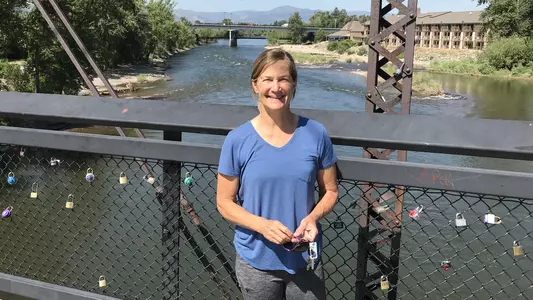
So she returns each summer to the family cabin on Holland Lake, purchased by the Duerksens in 2000 and held on to, even after the move to California. She divides her time between the cabin, where she is this week, and the small group of close family friends that remain in Missoula.
She has a pride in what was laid in stone by her teams, the foundation that Neil Sedgwick and Mark Plakorus, the coaches who followed her, were able to build from, but she doesn't follow the program as closely as you might think.
She'll usually check every fall, just to see if the team won the Big Sky or made the national tournament, but she's mostly moved on. "I got into living my own life," she says. By that she means she's moved on from the program, not from Montana. That will be with her forever.
She still coaches, but now it's as a private instructor, a few hours after school a few days a week. It allows her to still feel connected to the sport, still allows her to impact kids, both as soccer players and as people, but she can set her own schedule, something a college coach can only do so much of.
And she stays connected to soccer through her children.
Justice played two years at Seattle, two more at UC San Diego, from which he graduated last summer. He spent last year playing professionally in Germany. He'll return to Germany this coming season, earning enough money to make a living playing the family sport, and that's good enough for now.
Liam, who is entering his senior year at San Clemente High, will play college soccer as well.
Working as a private instructor hasn't afforded Duerksen the thrills she enjoyed as the coach at Seattle and Montana, but she's had her moments when she's been able to return to the team environment.
A few years ago she had the opportunity to co-coach Liam's team, from the ages of 9 to 12. On the roster were three players whose fathers had competed for the U.S. men's national team. One was Duerksen's co-coach.
"That was probably the most fun thing I've ever done professionally. I loved coaching at Montana, but it was probably my second-best coaching experience. That was the best," she says.
And Lake? She was good enough to earn a full-ride scholarship to Seattle to play for Duerksen's best friend, Julie Woodward, who, as Julie Holmes, played for Duerksen at Seattle and later was her assistant coach at Montana.
But she surprised everyone when she put an end to her soccer career before ever going away to college. It may have been the family sport, but the heart wants what the heart wants. After time, it gets hard to keep faking it.
"I've learned a lot along the way. With our oldest, he always had a passion for it. My youngest will play college too," Duerksen says. "With our daughter, I think we missed some things.
"She was good and put a lot of time into it, but it wasn't her passion. Playing at that level isn't for everyone. Not everyone is wired that way. She's pursuing art now. She was an artist at heart playing competitive soccer."
Duerksen has now been away from college coaching longer than the length of time she spent at Seattle and Montana. And she's lived in California longer than she did Montana.
The boys in the family, Aaron, Justice and Liam, sons of the water and sun and warmth, found collectively just three blocks from the family home, all consider San Clemente and California their home.
Duerksen loves it as well, just not quite as much as Montana. Maybe it's why she's never given up her 406 phone number. And when Southern California becomes just a little too much Southern California, she knows which direction to set her internal compass. It always points the way she needs to head.
"It's good for my soul to come back and get mountains and rivers and hiking," she says.
Betsy Duerksen never set out to become a college soccer coach. Perhaps that's why she was able to give it up when the time was right. Montana? She'll never give that up. It's a love that will stay with her for life.
Both were stories more happenstance than mapped-out career progression.
Had the envelope not arrived in her mailbox in Boston from her brother, who was living in Seattle and had spotted a classified ad he thought might intrigue his sister and bring her and her husband to the West Coast, she would have pursued a career in social work and probably still be living in the Northeast.
And had General Electric not had an opening for a representative in Montana at a time that just so happened to coincide with the start of the Griz soccer program in early 1994, three successful seasons at Seattle with the Redhawks may have been the totality of her college coaching career.
Has ever the fate of one -- and by extension dozens and dozens of players she raised to heights they never imagined -- swung so freely in the wind? Certainly, but is it possible there were greater forces at work this time, fingering the strings of fate in soccer's and those players' favor?
After Duerksen had become a four-time all-American at Boston College and been voted the school's female Athlete of the Decade for the 80s, maybe the soccer gods weren't willing to just let Duerksen walk away and leave the sport behind. Perhaps they knew what she had to offer, even if she didn't.
She had earned her master's degree in social work from Boston College and was working as the director of social services for the Elizabeth Peabody House in Somerville, right in the heart of greater Boston, when the envelope arrived.
Wanted: a new women's soccer coach at Seattle University. The challenge: take over a program that had gone 35-86-12 over its first five seasons of existence despite sitting in the middle of a hotbed of soccer talent.
She wasn't looking to break into college coaching, but she was intrigued enough to give it some consideration. What the heck, she thought, I'll give it a shot.
She was open to trying something new, and so was Seattle, which hired her and turned its soccer program over to a 24-year-old, a coach who was just one year older than one of her upperclassmen that first season.
"All of a sudden I was a college coach. I had no idea what I was doing," she says. "It was a leap of faith." For both sides. But neither would have to wait long to discover they had both made the right decision.
The winning started immediately. Duerksen hadn't necessarily trained to be a coach, but the skills she possessed, how to motivate, how to build a team, how to focus on the process and not the outcome, came naturally.
The turnaround started in Year 1 and continued in Year 2. At the end of Year 3 at Seattle, in the fall of 1993, the Redhawks had completed the transformation from afterthought to national contender. They were one of six teams to compete that November at the NAIA national championship in St. Louis.
But before Seattle had even departed for the tournament, Duerksen had come to a decision. For as much as she enjoyed it and for as good as she was at her job, she was going to get out of college coaching.
She wasn't doing anything she hadn't asked her players to do for three years: to put the group's needs over their own. But the group in this case wasn't the Redhawks. In a move that she would repeat a decade later at Montana, she put her family ahead of her own pursuits.
She had invested a lot. Of time. Of energy. And it was her passion in the moment. But she had never set out to be a college soccer coach, never believed that the profession was the end-all, be-all, something she couldn't do without or something she needed as her identity.
Over time, that made the decision to step down easier to accept. Besides, her family was on the move.
She arrived in Seattle in 1991 after a cross-country drive with her husband, Aaron, himself a BC grad. He got on with a couple of startups in Seattle but none had staying power. At one point he found himself selling elevators in support of his wife and her blossoming career.
First, she had gotten her big break. Then came his. He was selected by General Electric to go through its training program as the first part of a career in GE's medical division. The money would be better, and there was a family to start. But he wouldn't be working in Seattle. They would have to relocate.
He had first sacrificed all for her. Now she had the opportunity to do the same. "He did it for me. Now it's my turn," Duerksen said at the time, assuming her coaching career, at least at the college level, was done. Because what might possibly come her way that would ever be as good as she had it at Seattle?
His training complete, Aaron was given three regions from which to choose to start his career: Salt Lake City, Baltimore or Montana.
"I told him, the only one of those I'm going to is Montana," says Duerksen, who remembered with fondness the annual camping trips her family took to Big Sky Country while growing up in Edina, Minn. She wouldn't have soccer, but she'd have Montana, and she believed that was a fair tradeoff.
Again, she thought she controlled her fate, that she was breaking free of the path the soccer gods had set before her. But they had seen what she did for the Redhawks, and they had been pleased. So they stepped in once again, refusing to let her out of their grasp.
The Duerksens bought a house in Bozeman, the city they chose as their new home. Aaron would work. His wife would start raising a family. Everyone would ski at Bridger Bowl every chance they got. And life would be epic.
But before they ever made it to Bozeman, one of Duerksen's former players at Seattle contacted her. It would be the next envelope-in-the-mail type moment.
"She said, 'Hey, you're not going to believe this, but the University of Montana is starting a program,' " Duerksen says. "Again, I didn't plan it out. It just sort of happened to me."
More than 150 candidates applied for the job. Duerksen was the one who got it. She was pregnant with her first child. She had no home field, no players, and the season was set to begin just eight months after she stepped foot on campus. Seattle was one thing. This was another.
"I had no idea what I was getting myself into. I was young and bold. I thought I could do anything," she says. "Now I look back and I was crazy to take that on."
So the family set up in Missoula instead of Bozeman. Duerksen had never lived in Montana before, but her trips to the state growing up let her know she was moving to her spiritual home, one that would remain so no matter where she and her family might move in the future.
All she had to do now was find players who felt the same way about the place she adored.
"I fell in love with Montana right away, so I knew how to sell it. I'd bring recruits in and show them Rattlesnake Creek. If they loved it, then it was right for them to be here. If they didn't love it, it was the wrong place for them. That was my big recruiting trick," she says.
She had another advantage. Both Washington and Washington State, which tended to attract the Northwest's top prep players, were in the process of hiring new coaches.
That gave Duerksen, already familiar with soccer in the region and hired in January 1994, a window of time to get a jump on the Huskies and Cougars.
"All those kids who would normally go to U-Dub or Wazzu, I was able to snag some kids who we probably should have lost to those two programs," she says.
August arrived, eight months after Duerksen was hired, and Montana somehow had put together a roster of 21. Thirteen were freshmen, all but two were underclassmen. And the two upperclassmen, both of whom transferred from Seattle to Montana when Duerksen got the job, would redshirt.
Even so, on Sept. 9, 1994, at Rick Bean Field at Fort Missoula, Montana won its first match in program history, 4-0 over Gonzaga, a program that had gotten a three-year headstart on the Grizzlies.
Montana would finish its debut season with a respectable record of 7-8, with wins over Northwestern and New Mexico.
Montana went 12-7 in 1995, won the first Big Sky Conference championship in 1997 and advanced to the NCAA tournament in both 1999 and 2000, defeating Washington State on the Cougars' home field in the first round of the latter, still the signature win in program history.
She was building a powerhouse where no one would have expected one to emerge, but remember: Duerksen had never set out to be a college coach. She loved her job, loved her teams, but the program, early on her only priority, had slowly begun to slip down the list of things she found most important.
The Duerksens' first son, Justice, was born early in the 1994 season. Then came a daughter, Lake, and a second son, Liam. In the early 2000s, Duerksen found herself at a crossroads.
She had always succeeded as a player. She had always succeeded as a coach. And when it was only Justice who had joined the family, Duerksen succeeded as a mother as well.
But three kids, a husband who worked fulltime, and a Division I program that needed more and more of her time and attention as it sought to continue its winning ways? Succeeding like she wanted to was no longer possible across the board.
She had a decision to make, and the answer she arrived at came as no surprise to anyone who knew her.
"I felt like I couldn't do either job well," she says. "I felt like I wasn't raising my kids very well. I felt like I wasn't being a very good mother. College coaching can be sort of anti-family in that you travel so much, both in season and for recruiting.
"I also didn't feel like I was doing the program justice anymore. I've never regretted the decision I made, to be with my kids. For me, that was the right decision."
This time the soccer gods acquiesced and allowed her to go in peace in another direction, perhaps finally satisfied that they'd gotten 13 unexpected years out of her. And so many lives had been changed for the better through the sport.
Now it was time to give her all to those closest to her: her family. Duerksen stepped down shortly after the 2003 season, after guiding the Grizzlies to 117 wins in 10 seasons, producing a consistent winner where few thought it possible.
The Duerksens remained in Missoula until 2005, when they decamped for San Clemente, Calif., a surf town that sits hard against the Pacific, midway between Los Angeles and San Diego. It wasn't Missoula, but it had its own unique vibe.
"We ended up in the right place in Southern California for us. It's surrounded by Orange County, but it's not as Orange County as Orange County, if that makes sense," she says.
She was leaving Montana, perhaps for good, at least as a primary residence, but part of her remained, and that piece keeps her connected to the place she will forever consider special, a second home, more so than Minnesota, Boston or Seattle ever could.
So she returns each summer to the family cabin on Holland Lake, purchased by the Duerksens in 2000 and held on to, even after the move to California. She divides her time between the cabin, where she is this week, and the small group of close family friends that remain in Missoula.
She has a pride in what was laid in stone by her teams, the foundation that Neil Sedgwick and Mark Plakorus, the coaches who followed her, were able to build from, but she doesn't follow the program as closely as you might think.
She'll usually check every fall, just to see if the team won the Big Sky or made the national tournament, but she's mostly moved on. "I got into living my own life," she says. By that she means she's moved on from the program, not from Montana. That will be with her forever.
She still coaches, but now it's as a private instructor, a few hours after school a few days a week. It allows her to still feel connected to the sport, still allows her to impact kids, both as soccer players and as people, but she can set her own schedule, something a college coach can only do so much of.
And she stays connected to soccer through her children.
Justice played two years at Seattle, two more at UC San Diego, from which he graduated last summer. He spent last year playing professionally in Germany. He'll return to Germany this coming season, earning enough money to make a living playing the family sport, and that's good enough for now.
Liam, who is entering his senior year at San Clemente High, will play college soccer as well.
Working as a private instructor hasn't afforded Duerksen the thrills she enjoyed as the coach at Seattle and Montana, but she's had her moments when she's been able to return to the team environment.
A few years ago she had the opportunity to co-coach Liam's team, from the ages of 9 to 12. On the roster were three players whose fathers had competed for the U.S. men's national team. One was Duerksen's co-coach.
"That was probably the most fun thing I've ever done professionally. I loved coaching at Montana, but it was probably my second-best coaching experience. That was the best," she says.
And Lake? She was good enough to earn a full-ride scholarship to Seattle to play for Duerksen's best friend, Julie Woodward, who, as Julie Holmes, played for Duerksen at Seattle and later was her assistant coach at Montana.
But she surprised everyone when she put an end to her soccer career before ever going away to college. It may have been the family sport, but the heart wants what the heart wants. After time, it gets hard to keep faking it.
"I've learned a lot along the way. With our oldest, he always had a passion for it. My youngest will play college too," Duerksen says. "With our daughter, I think we missed some things.
"She was good and put a lot of time into it, but it wasn't her passion. Playing at that level isn't for everyone. Not everyone is wired that way. She's pursuing art now. She was an artist at heart playing competitive soccer."
Duerksen has now been away from college coaching longer than the length of time she spent at Seattle and Montana. And she's lived in California longer than she did Montana.
The boys in the family, Aaron, Justice and Liam, sons of the water and sun and warmth, found collectively just three blocks from the family home, all consider San Clemente and California their home.
Duerksen loves it as well, just not quite as much as Montana. Maybe it's why she's never given up her 406 phone number. And when Southern California becomes just a little too much Southern California, she knows which direction to set her internal compass. It always points the way she needs to head.
"It's good for my soul to come back and get mountains and rivers and hiking," she says.
Betsy Duerksen never set out to become a college soccer coach. Perhaps that's why she was able to give it up when the time was right. Montana? She'll never give that up. It's a love that will stay with her for life.


Lady Griz Basketball Locker Room Unveiling - 5/1/26
Friday, May 01
Griz Track & Field - Montana Open Highlights - 4/25/26
Friday, May 01
Griz Softball vs. Idaho State Game-Winning Hit - 3/25/26
Friday, May 01
Griz Softball Championship Series Promo
Friday, May 01