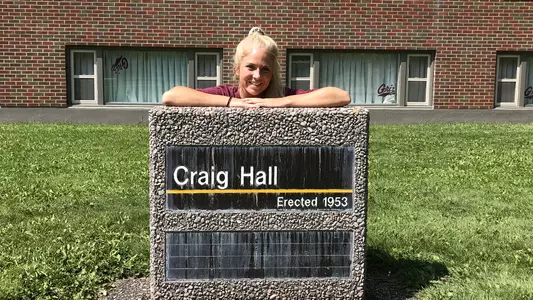
The Craig Hall Chronicles :: Kylie Hanson
8/17/2018 6:13:00 AM | Soccer
The Craig Hall Chronicles have, sadly, come to an end, at least for now. They'll be going on hold until August 2019, when next year's class of incoming freshmen arrives on campus, ready to take on the world, each of them possessing a unique story just waiting to be told.
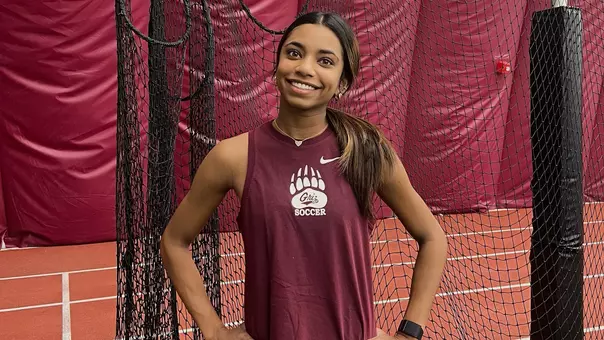
But first (and last): Kylie Hanson, who may be the ideal player to wrap up the 2018 series, because she is essentially a composite of the group that's been profiled before her, with each of the previous stories reflecting her own.
Like Zoe Transtrum and McKenzie Kilpatrick, she arrives from Idaho, by way of Coeur d'Alene, Long Beach (Calif.), Coeur d'Alene, Danville (Calif.) and finally Coeur d'Alene again.
Like Brooke Johnston and Alexa Bentley, she has a history of playing for the best clubs or working under the best individual instructors she could find, no matter the geography involved or personal or family sacrifice needed to make it happen.
Like Sami Siems and Kendall Furrow, she saw her college soccer dreams flicker at just the wrong time of the recruiting process, another player put on the shelf for a year with an ACL injury, but another who bounced back and then rewarded Montana's patience and commitment by signing with the Grizzlies.
And like Katie Hansen, she'll leave you wondering what just happened, when you look up, the ball no longer at your feet, and see a blond ponytail doubling as a contrail, the only thing in her wake as she starts the counterattack, a ruthlessness hidden within an otherwise delightful person.
But that's where their stories diverge, at least Hanson's, because none of Montana's other freshmen ever mentioned having thoughts of quitting the sport altogether, and not that long ago, when it felt like everything in the universe was conspiring to make her life as difficult as possible.
It wasn't supposed to be like that. She'd paid her dues. Oh boy, had she paid her dues. There was the summer spent living in a hotel room with her dad so she could finish out the season with the Mustang Soccer Club in Danville as a middle schooler, after her mom and sister had moved back to Coeur d'Alene.
There were the dozens and dozens and dozens of trips across the length Washington, either by road or by air, so she could continue to train and play at the ECNL level, with Washington Premier in Puyallup, six hours one way from her home even on the best of travel days.
If someone should have earned immunity from the scourge of the ACL tear, it was Hanson, but still the sporting Grim Reaper -- because, really, it's an immediate death, at least temporarily, sometimes permanently, of a soccer life -- showed up in Houston to rake his scythe across her right knee.
She was playing for Premier, in February of her sophomore year at Coeur d'Alene High, and everything was right, her dream-big schools sitting there in front of her: UC Santa Barbara, San Diego State, Pepperdine, whose camp she had attended the summer before.
Sure, they may have been out of reach, but she was of an age when reverie can be enjoyed to its fullest measure. And who's to say it wouldn't have happened, had that one moment in time in Texas been scripted just a bit differently.
As is the nature of ACL injuries, everything came to a screeching halt that day in Houston, another broken body sent to the shoulder of the recruiting superhighway, at another ECNL event where she was showing off to a sideline full of Division I coaches.
Until they all had to look away, because it had happened again. Another player on the turf, her knee in her hands, her future offers being tabled as they watched her getting helped off the field, offers likely to be presented to another player one day, someone who wasn't damaged goods.
Former Montana coach Mark Plakorus was there, not 20 feet away from where it took place. And until the moment of the injury, he had no idea he was standing right next to Jim Hanson, who was on the phone with his wife when he ended their conversation with an abrupt, "I've got to go. Kylie's down."
"I'd never thought I'd be that person to get hurt, because I've always been a stronger-built player," she says. "I never thought I'd be the one going down."
Injury, meet insult: While she was recovering back home in Coeur d'Alene in the months after her injury, through the summer before her junior year, her team on Washington Premier switched coaches. And with it came a new dictum. Only players who practiced fulltime would be allowed to play going forward.
The previous policy, under the previous coach, had been that the best players, which included Hanson, would be on the field at the start of every match and play a majority of the minutes. It didn't matter where they lived or how many practices they had to miss. Talent was recognized and rewarded.
She would never be able to comply with the new rule, not with midweek practices and her family living more than 300 miles away.
As she recovered from her surgery and continued with her rehabilitation, she was forced to face a new reality: she would no longer be able to play the sport at its highest level. The Spokane Shadow (now the Sounders) was a good club, but it wasn't ECNL. It wasn't Premier. But it was the only practical option.
"I didn't want to do that. I didn't want to take a step down," she admits. It had been months since she'd been a soccer player, so she'd already lost her identity. Now the fastest route to getting back to what she'd been before was being taken away from her.
And everywhere she looked, players she'd grown up with and played alongside were committing here and there, while coaches were either taking a wait-and-see approach with Hanson or moving on entirely. "It felt like the world was against me at that point. I didn't know if I wanted to keep playing."
She was born in Coeur d'Alene, then spent some of her pre-memory years in Long Beach, in Southern California, before the family moved back to northern Idaho.
Her dad was still commuting, to stretch that word to the furthest boundaries of its definition, to Long Beach for his job as a project manager before he got on at a Starbucks regional facility in San Francisco, which brought the family to Danville, just east of the Bay Area.
It wasn't Coeur d'Alene in nearly any measurable metric, but it did offer the Hansons' youngest of two daughters something new: soccer at a level she'd never experienced before. It was her first year being age-eligible to play on an ECNL team with the Danville Mustangs. This wasn't Coeur d'Alene soccer.
"We started traveling and going to showcases, and that's when I realized that that was what I needed if I wanted to go on to the next level," she says.
But the family was on the move again, back to Idaho, a year and a half later. Soccer was starting to become important enough that she and her dad stayed behind and lived in a hotel room so she could finish off the summer club season. "I didn't get to live the normal eighth-grade-girl summer," she says.
She may have been back in Coeur d'Alene, but she couldn't stop now. Her ascent was off the charts, talent meeting the right coaching meeting the highest level of competition available for someone her age. She was going somewhere.
Spokane was nearby and would have been a much simpler option, but it didn't have what she needed. "I still wanted to play ECNL and go to the showcases, so I went and tried out for Washington Premier," she says. She made it.
"Once school came along, I'd be at school all week, then on Friday, right after school, we'd bust it to the airport. I'd fly out at 2:45, and either my dad would be in Seattle for work or I'd have a teammate come pick me up."
There'd be a practice on Friday night, another on Saturday morning, then often a Sunday game or two. Then she'd fly back home. "My life was booked with soccer," she says.
It was easy to project ahead: More improvement, more showcases, more schools, the names getting more recognizable by the contact, clamoring for her talents.
And that was the player who was considering putting an end to everything she'd worked for, of everything her family had put into making her dream a reality.
It was an issue of health, first, and of geography second, little of which she could control. She'd gotten into a fistfight, one she hadn't asked for, and she was on the ropes.
Nothing in her life felt like it had before the injury, when there was boundless hope and she felt like she was in charge. Or at least had a say in what would happen to her. When all her power was taken away -- she couldn't play the sport she wanted with the team she wanted -- that's when the doubts crept in.
Is it worth it? Do I even want to do this anymore?
That is, until the Spokane Shadow -- yes Shadow, the local team she'd once spurned -- entered the picture and saved the day. Or more specifically Dan Philp, a coach who came along at just the right time, who made the sport fun again for Hanson, who turned the arc of her story in a new direction.
Before it could be enjoyable again, she had to get healthy, and the lower-key nature of the club, once viewed as a negative, worked in her favor. Because even major leaguers spend time at the triple-A level as they return to form. It takes the pressure to perform off.
"It gave me a chance to get back into the flow of things without going full force into it, because I wasn't at the same level I had been playing at," she says. "It gave me a chance to get back into my normal movements. It was hard. There were times I doubted if I'd be able to come back and play."
Philp has a picture that pops into his head, if not on the screen of his phone, when asked about his favorite memory of Hanson. It was the summer after her junior year. Shadow had just won the U18 Super Group at the Crossfire Challenge, one of the Northwest's largest summer youth tournaments.
"There are a couple pictures of her celebrating, a huge smile on her face," says Philp. "I'm happy we were a really good fit for Kylie. I didn't quite realize she was feeling that low about soccer, so it made me feel good at the end of the season when she told me."
"He got me to where I wanted to keep playing," says Hanson, who had worked herself back onto schools' wish lists.
But one stood out to her. She hadn't known Montana was at that tournament in Houston, and she was surprised when she got a call on the first day she was able to be contacted as a junior. It was Plakorus. He wanted to know how her rehab was going.
She didn't know him or know he knew of her situation. And that tends to hit a girl right in the soft part of the heart, especially when she's wondering where all the other coaches have gone, all while wondering if she would ever again be the player she'd been on that field in Houston.
"My first game back, he was there. Throughout my first few weeks back, he made sure he was there," Hanson says. "Montana hadn't been on my radar whatsoever, but I think it worked out perfectly. When I came on my official (visit), it felt like the right place to be."
She had to remake herself physically after her injury. Now she's in the process of remaking herself positionally, after Chris Citowicki took over, in title, for Plakorus in May and the head coach's office in June.
For most of her playing career, Hanson had viewed the game from a defensive perspective, from her position as a holding midfielder, with most of the play on the field taking place in front of her, where she could calmly evaluate and possess the ball.
With holding midfielder a position of strength -- and depth -- for Montana, Hanson has moved up the field, to an attacking midfielder position. There is still grass under her feet, but she's a fish out of water, trying to learn a whole new skillset. For now.
"I'm used to having play in front of me and being able to distribute. Now I'm in the middle of things, making runs and taking corner kicks," she says.
"My mind messes with me. I find myself wanting to sit back. I'm trying to fight it. I'm taking in everything I can and trying to figure it out and do the best that I can."
She's been a quick learner. She scored one of Montana's goals in Saturday's 9-0 exhibition victory over North Idaho, a lobbed ball from the left side that was placed over the outstretched gloves of the Cardinals' goalkeeper.
"It's still a little overwhelming. I'm just trying to learn off the upperclassmen," she says. "It's a grind right now trying to figure it out, but it's also exciting, because I have time. And Chris wouldn't put me in a position if he doesn't see me being successful there."
And it seems like that might be the biggest of her concerns right now, that she's attempting to learn a mostly new position on the fly, and that reveals a lot. Never once does she mention her knee. That seems to be done, in the past.
"I really didn't give it a second thought after I came back," she says. "As soon as I got the brace off, there was no doubt in my mind that it wasn't as strong as my other knee.
"I never favored it, and I think that helped me in the long run. It's probably stronger than my other knee at this point."
The season opens on Friday, at home against Fresno State, and this is where the paths of the freshmen start to go in possibly different directions.
One or more might redshirt, which has a way of breaking up a class, as a player stays behind a year, her senior year coming a season later than the others.
Some will become starters, some may not. All may finish out their four- or five-year careers, some may not, perhaps because of injury, maybe for other reasons.
But for now, they are a group, bound by their stories told the last few weeks (and one last spring). What happens to them individually now will become the rest of the story, codas to those revealed in the Craig Hall Chronicles.
Now we sit, watch and enjoy. It's their move and their time. From here on out, they do the writing.
But first (and last): Kylie Hanson, who may be the ideal player to wrap up the 2018 series, because she is essentially a composite of the group that's been profiled before her, with each of the previous stories reflecting her own.
Like Zoe Transtrum and McKenzie Kilpatrick, she arrives from Idaho, by way of Coeur d'Alene, Long Beach (Calif.), Coeur d'Alene, Danville (Calif.) and finally Coeur d'Alene again.
Like Brooke Johnston and Alexa Bentley, she has a history of playing for the best clubs or working under the best individual instructors she could find, no matter the geography involved or personal or family sacrifice needed to make it happen.
Like Sami Siems and Kendall Furrow, she saw her college soccer dreams flicker at just the wrong time of the recruiting process, another player put on the shelf for a year with an ACL injury, but another who bounced back and then rewarded Montana's patience and commitment by signing with the Grizzlies.
And like Katie Hansen, she'll leave you wondering what just happened, when you look up, the ball no longer at your feet, and see a blond ponytail doubling as a contrail, the only thing in her wake as she starts the counterattack, a ruthlessness hidden within an otherwise delightful person.
But that's where their stories diverge, at least Hanson's, because none of Montana's other freshmen ever mentioned having thoughts of quitting the sport altogether, and not that long ago, when it felt like everything in the universe was conspiring to make her life as difficult as possible.
It wasn't supposed to be like that. She'd paid her dues. Oh boy, had she paid her dues. There was the summer spent living in a hotel room with her dad so she could finish out the season with the Mustang Soccer Club in Danville as a middle schooler, after her mom and sister had moved back to Coeur d'Alene.
There were the dozens and dozens and dozens of trips across the length Washington, either by road or by air, so she could continue to train and play at the ECNL level, with Washington Premier in Puyallup, six hours one way from her home even on the best of travel days.
If someone should have earned immunity from the scourge of the ACL tear, it was Hanson, but still the sporting Grim Reaper -- because, really, it's an immediate death, at least temporarily, sometimes permanently, of a soccer life -- showed up in Houston to rake his scythe across her right knee.
She was playing for Premier, in February of her sophomore year at Coeur d'Alene High, and everything was right, her dream-big schools sitting there in front of her: UC Santa Barbara, San Diego State, Pepperdine, whose camp she had attended the summer before.
Sure, they may have been out of reach, but she was of an age when reverie can be enjoyed to its fullest measure. And who's to say it wouldn't have happened, had that one moment in time in Texas been scripted just a bit differently.
As is the nature of ACL injuries, everything came to a screeching halt that day in Houston, another broken body sent to the shoulder of the recruiting superhighway, at another ECNL event where she was showing off to a sideline full of Division I coaches.
Until they all had to look away, because it had happened again. Another player on the turf, her knee in her hands, her future offers being tabled as they watched her getting helped off the field, offers likely to be presented to another player one day, someone who wasn't damaged goods.
Former Montana coach Mark Plakorus was there, not 20 feet away from where it took place. And until the moment of the injury, he had no idea he was standing right next to Jim Hanson, who was on the phone with his wife when he ended their conversation with an abrupt, "I've got to go. Kylie's down."
"I'd never thought I'd be that person to get hurt, because I've always been a stronger-built player," she says. "I never thought I'd be the one going down."
Injury, meet insult: While she was recovering back home in Coeur d'Alene in the months after her injury, through the summer before her junior year, her team on Washington Premier switched coaches. And with it came a new dictum. Only players who practiced fulltime would be allowed to play going forward.
The previous policy, under the previous coach, had been that the best players, which included Hanson, would be on the field at the start of every match and play a majority of the minutes. It didn't matter where they lived or how many practices they had to miss. Talent was recognized and rewarded.
She would never be able to comply with the new rule, not with midweek practices and her family living more than 300 miles away.
As she recovered from her surgery and continued with her rehabilitation, she was forced to face a new reality: she would no longer be able to play the sport at its highest level. The Spokane Shadow (now the Sounders) was a good club, but it wasn't ECNL. It wasn't Premier. But it was the only practical option.
"I didn't want to do that. I didn't want to take a step down," she admits. It had been months since she'd been a soccer player, so she'd already lost her identity. Now the fastest route to getting back to what she'd been before was being taken away from her.
And everywhere she looked, players she'd grown up with and played alongside were committing here and there, while coaches were either taking a wait-and-see approach with Hanson or moving on entirely. "It felt like the world was against me at that point. I didn't know if I wanted to keep playing."
She was born in Coeur d'Alene, then spent some of her pre-memory years in Long Beach, in Southern California, before the family moved back to northern Idaho.
Her dad was still commuting, to stretch that word to the furthest boundaries of its definition, to Long Beach for his job as a project manager before he got on at a Starbucks regional facility in San Francisco, which brought the family to Danville, just east of the Bay Area.
It wasn't Coeur d'Alene in nearly any measurable metric, but it did offer the Hansons' youngest of two daughters something new: soccer at a level she'd never experienced before. It was her first year being age-eligible to play on an ECNL team with the Danville Mustangs. This wasn't Coeur d'Alene soccer.
"We started traveling and going to showcases, and that's when I realized that that was what I needed if I wanted to go on to the next level," she says.
But the family was on the move again, back to Idaho, a year and a half later. Soccer was starting to become important enough that she and her dad stayed behind and lived in a hotel room so she could finish off the summer club season. "I didn't get to live the normal eighth-grade-girl summer," she says.
She may have been back in Coeur d'Alene, but she couldn't stop now. Her ascent was off the charts, talent meeting the right coaching meeting the highest level of competition available for someone her age. She was going somewhere.
Spokane was nearby and would have been a much simpler option, but it didn't have what she needed. "I still wanted to play ECNL and go to the showcases, so I went and tried out for Washington Premier," she says. She made it.
"Once school came along, I'd be at school all week, then on Friday, right after school, we'd bust it to the airport. I'd fly out at 2:45, and either my dad would be in Seattle for work or I'd have a teammate come pick me up."
There'd be a practice on Friday night, another on Saturday morning, then often a Sunday game or two. Then she'd fly back home. "My life was booked with soccer," she says.
It was easy to project ahead: More improvement, more showcases, more schools, the names getting more recognizable by the contact, clamoring for her talents.
And that was the player who was considering putting an end to everything she'd worked for, of everything her family had put into making her dream a reality.
It was an issue of health, first, and of geography second, little of which she could control. She'd gotten into a fistfight, one she hadn't asked for, and she was on the ropes.
Nothing in her life felt like it had before the injury, when there was boundless hope and she felt like she was in charge. Or at least had a say in what would happen to her. When all her power was taken away -- she couldn't play the sport she wanted with the team she wanted -- that's when the doubts crept in.
Is it worth it? Do I even want to do this anymore?
That is, until the Spokane Shadow -- yes Shadow, the local team she'd once spurned -- entered the picture and saved the day. Or more specifically Dan Philp, a coach who came along at just the right time, who made the sport fun again for Hanson, who turned the arc of her story in a new direction.
Before it could be enjoyable again, she had to get healthy, and the lower-key nature of the club, once viewed as a negative, worked in her favor. Because even major leaguers spend time at the triple-A level as they return to form. It takes the pressure to perform off.
"It gave me a chance to get back into the flow of things without going full force into it, because I wasn't at the same level I had been playing at," she says. "It gave me a chance to get back into my normal movements. It was hard. There were times I doubted if I'd be able to come back and play."
Philp has a picture that pops into his head, if not on the screen of his phone, when asked about his favorite memory of Hanson. It was the summer after her junior year. Shadow had just won the U18 Super Group at the Crossfire Challenge, one of the Northwest's largest summer youth tournaments.
"There are a couple pictures of her celebrating, a huge smile on her face," says Philp. "I'm happy we were a really good fit for Kylie. I didn't quite realize she was feeling that low about soccer, so it made me feel good at the end of the season when she told me."
"He got me to where I wanted to keep playing," says Hanson, who had worked herself back onto schools' wish lists.
But one stood out to her. She hadn't known Montana was at that tournament in Houston, and she was surprised when she got a call on the first day she was able to be contacted as a junior. It was Plakorus. He wanted to know how her rehab was going.
She didn't know him or know he knew of her situation. And that tends to hit a girl right in the soft part of the heart, especially when she's wondering where all the other coaches have gone, all while wondering if she would ever again be the player she'd been on that field in Houston.
"My first game back, he was there. Throughout my first few weeks back, he made sure he was there," Hanson says. "Montana hadn't been on my radar whatsoever, but I think it worked out perfectly. When I came on my official (visit), it felt like the right place to be."
She had to remake herself physically after her injury. Now she's in the process of remaking herself positionally, after Chris Citowicki took over, in title, for Plakorus in May and the head coach's office in June.
For most of her playing career, Hanson had viewed the game from a defensive perspective, from her position as a holding midfielder, with most of the play on the field taking place in front of her, where she could calmly evaluate and possess the ball.
With holding midfielder a position of strength -- and depth -- for Montana, Hanson has moved up the field, to an attacking midfielder position. There is still grass under her feet, but she's a fish out of water, trying to learn a whole new skillset. For now.
"I'm used to having play in front of me and being able to distribute. Now I'm in the middle of things, making runs and taking corner kicks," she says.
"My mind messes with me. I find myself wanting to sit back. I'm trying to fight it. I'm taking in everything I can and trying to figure it out and do the best that I can."
She's been a quick learner. She scored one of Montana's goals in Saturday's 9-0 exhibition victory over North Idaho, a lobbed ball from the left side that was placed over the outstretched gloves of the Cardinals' goalkeeper.
"It's still a little overwhelming. I'm just trying to learn off the upperclassmen," she says. "It's a grind right now trying to figure it out, but it's also exciting, because I have time. And Chris wouldn't put me in a position if he doesn't see me being successful there."
And it seems like that might be the biggest of her concerns right now, that she's attempting to learn a mostly new position on the fly, and that reveals a lot. Never once does she mention her knee. That seems to be done, in the past.
"I really didn't give it a second thought after I came back," she says. "As soon as I got the brace off, there was no doubt in my mind that it wasn't as strong as my other knee.
"I never favored it, and I think that helped me in the long run. It's probably stronger than my other knee at this point."
The season opens on Friday, at home against Fresno State, and this is where the paths of the freshmen start to go in possibly different directions.
One or more might redshirt, which has a way of breaking up a class, as a player stays behind a year, her senior year coming a season later than the others.
Some will become starters, some may not. All may finish out their four- or five-year careers, some may not, perhaps because of injury, maybe for other reasons.
But for now, they are a group, bound by their stories told the last few weeks (and one last spring). What happens to them individually now will become the rest of the story, codas to those revealed in the Craig Hall Chronicles.
Now we sit, watch and enjoy. It's their move and their time. From here on out, they do the writing.
Players Mentioned
F
/ Soccer
D
/ Soccer
D
/ Soccer
M
/ Soccer
G
/ Soccer
D
/ Soccer
M
/ Soccer
M
/ SoccerLady Griz Basketball Locker Room Unveiling - 5/1/26
Friday, May 01
Griz Track & Field - Montana Open Highlights - 4/25/26
Friday, May 01
Griz Softball vs. Idaho State Game-Winning Hit - 3/25/26
Friday, May 01
Griz Softball Championship Series Promo
Friday, May 01