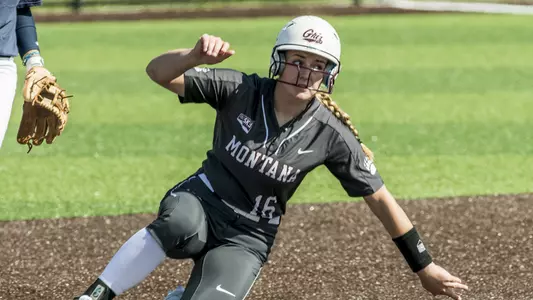
Origin Stories :: Brooklyn Weisgram
2/28/2019 6:00:00 PM | Softball
Regan Dias had no idea. There she was, standing on second base in the bottom of the sixth inning of her team's game against Montana last Saturday at the Silicon Valley Classic. There were two outs, and Santa Clara was threatening to start a rally.
One run was in, and the Broncos had players on first and second. They trailed the Grizzlies 5-1, but momentum was shifting to the home dugout.
There was a freshman in centerfield for Montana, making her first collegiate start at the position after playing the season's first 11 games in right. Dias had no idea who Brooklyn Weisgram was or what might be going through the freshman's mind.
Had she known, it would have been this: "Every time a girl gets on second, I'm like, I dare you to test me," says Weisgram of her mindset with a runner in scoring position. "Try to take home and let's see what happens."
Had Dias known, she may have reached third when Hannah Russell sent a 2-2 pitch up the middle off Griz starter Tristin Achenbach and called it good. Leave the bases loaded and bring the tying run to the plate.
But Santa Clara coach Lisa Dodd was waving wildly for Dias to sprint toward home. After all, it was a freshman in center. How could Dodd have known she was sending Dias into certain trouble? Little did she know she had just challenged the wrong player.
"I know as soon as I let go of the ball if it's going to be there or not. When I know it's on, I can celebrate before it's even there. I already know it's happening," says Weisgram, who should be court-ordered to register her right arm in whatever state she plays softball. It's that much of a weapon.
Dias never had a chance. McKenna Tjaden applied the tag, and the rally was over, the defensive notation in the scorebook getting put down as 8-2. Get used to it.
"She's always had a naturally strong arm," says Weisgram's dad, Brent. "I remember when we used to play dodgeball or have a snowball fight. You wanted to be careful if you were on the opposite end of that throw."
A great diving catch in the outfield? It robs a player of a base hit and likely leaves the batter shaking her head and mumbling under her breath about bad luck. But throw someone out on the bases? That takes a little piece of their soul.
"Diving catches are super exhilarating, but there is something special about throwing a girl out at home and saving that run from going in," says Weisgram. "Boom. Gotcha!"
The last Origin Story, that of Tjaden, left this question dangling in the air: If you haven't grown up in Southern California, with year-round softball, access to elite-level coaching and teammates who are all bound for Division I programs, what chance does a girl have?
Weisgram? She spent her first 10 years in North Dakota. North Dakota! Let's use that as we start stacking the odds against her getting here. And she spent those years not playing sports. As a 10-year-old in Southern California, you probably already have a private hitting coach and personal trainer.
Want to increase the odds? Then go back even farther, to tiny Valier, Montana, which sits in the middle of the pentagon formed by Conrad, Shelby, Cut Bank, Browning and Choteau. In other words, pretty much in the middle of nowhere.
It's where Brent Weisgram was, back in the day, a sophomore at Valier High, one of 14 (14!) in his class. Jen was a freshman. He was possibly smitten. But before he could allow it to take hold, a guy with Widhalm in his blood had to take the prudent steps before any potential courtship could commence.
"My mom was originally a Widhalm, and in that area I think Widhalms make up about half the population," says Brent. "So not only was it a small pool, Jen was one of only a handful that I wasn't related to.
"We used to joke that I'd come home and have to ask my mom, Are we related to this girl? before I could even get a chance. We got together when she was a freshman and I was a sophomore, and the rest is history. We've been together ever since."
He would go on to Concordia College, in Moorhead, Minnesota, where he would play football for the Cobbers for four years. Jen would follow, attending MSU Moorhead. And they would set up home across the Red River in Fargo. Then came Brooklyn. Then Kali.
But as time went on, Montana and family beckoned them home. The move west became a reality when Jen was hired on as a consultant by Choice Hotels International. Her new job's home base: Missoula.
Let's pause here and set the scene: When the Weisgrams unpacked their things in their new home, there were zero pieces of softball gear. Not even a glove. Brooklyn Weisgram was about to enter sixth grade. And Southern California would have grinned collectively. Ha! Good luck catching up.
But she had no intention of trying to catch up. Softball wasn't even on her radar. Neither were sports in general. And somehow Brooklyn Weisgram batted a team-best .455 over five games for the Grizzlies last weekend at the Silicon Valley Classic and probably still has Regan Dias wondering what happened.
The Weisgrams didn't choose their new home in Missoula based on their potential next-door neighbors, but their decision -- because the master bath had separate his and hers sinks? because they liked the countertops in the kitchen? because a new washer-dryer was included? -- would change a life.
Because living next door was Kendall Rauk, who would play softball at Big Sky High and go on to compete collegiately at Eastern Arizona College. "She's the one who got me into softball. She got me into playing, and I fell in love with it," says Weisgram.
Adds her dad: "We encouraged her to give it a shot. When you're a kid moving into a new town, there is no better way to meet new friends than through sports and meeting new teammates. We got her a mitt and got her signed up. From there it kind of took off."
So Weisgram picked up ball, bat and glove in sixth grade, and Tjaden had a travel-ball teammate who committed to a Division I softball program as an eighth grader. And yet here Weisgram is, batting .294 through 15 games as a true freshman. Without the athletic perks of being raised in Southern California.
It's why Montana coach Melanie Meuchel and her program haven't leased a timeshare in Huntington Beach and left an assistant coach there for the duration of the offseason in search of talent and the next class of Grizzlies.
She knows weather and level of competition can be important, but they are not the only way to blossom into a Division I talent.
So you're saying you can get it done as a Montana player?
"You can get it done as any kind of player if you're willing to put forth the time and effort," says Meuchel. "Athletes are everywhere. Ball players are everywhere.
"Brooklyn is a gifted athlete and she had the right work ethic. She has determination, and she wanted it. It takes special things from people in areas where softball might not be as known, but there are players who can compete and be a major factor in a Division I program."
Hers is a story that has a hint of the nature vs. nurture debate. Yes, her dad was a college athlete -- the nature -- but in Weisgram's case, it's almost all about the latter, as in how she nurtured (or took advantage of) the opportunities that came her way to develop into the player she is today.
Her trajectory changed the day her dad and a coaching friend of his started brainstorming ideas for ways they could overcome one of Montana's biggest limiters: the inability to play outside all year round.
Then it came to him. He was the Chief Operations Officer for the Montana Food Bank Network. And he oversaw a warehouse that his daughter describes as "a small Costco." Hmm, indoor batting cage anyone?
"We were looking for a place where the kids (on our teams) could work out during the winter, and I was able to get approval to build a hitting cage," says Weisgram.
"My buddy found a craigslist offering out of Idaho for a pitching machine and batting cage net. Next thing you know, we were up drilling holes and putting up nets, and we threw a hitting cage together."
So yes, Brooklyn Weisgram is a mostly self-made player. She had the good building blocks from which to start, but were they more important than her decision to visit Championship Training two nights a week to work on her upper-body strength and her agility and flexibility?
Were they more important than drilling and drilling and drilling on proper throwing technique? Were they more important than the hours, hundreds of them, she put into dialing in her swing at that batting cage?
"That was huge for Brooklyn," says Brent, who was coaching his other daughter's travel team at the time. "Once we got the hitting cage up and running, we had our team out hitting twice a week all winter long, and Brooklyn would come out and hit every night with them.
"She would sit in my conference room and do homework until the other kids were done hitting, as late as 9 or 10 at night. She'd stick around just so she could get another round of cuts in. To be able to do that for so many years really helped."
What was it Meuchel said? Ah yes: You can get it done as any kind of player if you're willing to put forth the time and effort.
She started playing travel ball on a smaller team, the Lady Osprey, before moving up to the Montana Avalanche, which had sent Dani Walker and Katie Jo Waletzko to the Grizzlies as part of the program's first freshman class back in 2015.
And she began to make coaches take notice, as the Avalanche traveled to Florida, to Hillsboro, Oregon, to the Tri-Cities in Washington. They weren't the biggest recruiting showcases, but they attracted enough coaches to be seen.
But she only ever had eyes on Montana's softball program. Not only had her parents, who had season tickets to football and basketball, raised her in a Grizzly household, her second cousin, Alex Wardlow, was also a freshman on the inaugural team in 2015.
That gave Weisgram an inside, intimate look at everything then head coach Jamie Pinkerton and Meuchel, his assistant, had constructed. And Weisgram wanted in.
"I knew all the girls, so it was cool," she says. "I saw the social aspect they all had and the big friendship group they had. It's something I wanted."
Perhaps she wanted it too much. She had other suitors, coaches from other schools who wanted her in their uniform, but her mind was made up. She was all in on an opportunity that hadn't even been extended her way yet.
"I would encourage her that she needed to be getting back with these other coaches, to talk to them and go visit their schools, but she kept turning them down. She wouldn't do it," says Brent. "She just said, 'No, I'm fine. I'm going to play for the Griz.' "
She had the advantage of being local, meaning Montana's coaches could catch some of her high school games, and she gave them every reason to keep coming back two springs ago, her junior year.
"Everything clicked. It was amazing, probably the best hitting of my life. I was averaging probably a home run a game," she says.
That summer, before her senior year, she had her Roy Hobbs moment at one of Montana's camps. She hit one over the towering scoreboard in left-center. But Pinkerton was Pinkerton, his cards always kept close to the vest, as was his way. If he was interested, he didn't want to be too open about it.
"He told her, just hold tight. I take my time doing my recruiting, but I'm interested. Just be patient," Brent says. But, dude, she hit one over the scoreboard! Did you not just see that?
And then Pinkerton was gone, hired away by Iowa State. "He left, and I was like, Oh no," says Brooklyn.
"In the interim, between when Jamie resigned and they hired Mel, we were on pins and needles," says Brent. "It was a stressful time. Who was going to get it? And would they already have their own recruits?"
Meuchel got the job, which likely produced a loud WHEW! from the Weisgrams.
It was a coach who had already been following the player for a while. Weisgram didn't need to start over with a new coach or, worse, have to track down those other coaches, at other schools, that she'd long ago told were wasting their time pursuing her and ask them for another chance.
"I knew she was somebody who could develop into something very good at Montana. I liked her game and style," said Meuchel.
"What caught my attention first was her arm strength and sense of game defensively. Those stood out to me. She has the ability to throw the ball with a lot of velocity and pinpoint. She's good at putting it where she wants it to go."
But still, it was no sure thing that Weisgram would be signed by Montana. It took some meetings between coach and player. This was Meuchel's dream job after all, in her hometown, and this would be her first class. She wanted to be careful with her roster and the makeup and dynamics of the players.
If it took more than one minute for Meuchel to realize that Weisgram was a player she had to have, it would be a surprise. It took a lot less than that -- way less -- for Weisgram to accept the offer to become a Grizzly.
"It wasn't even a hesitation. I accepted on the spot," Weisgram says. "As soon as I got in my car, I called my mom. As soon as she asked how it went, I just started crying I was so excited. Then I said, 'Don't tell Dad!' I want to call him and tell him.
"When I called him, I could tell he was tearing up over the phone. He's not a very emotional person, so that was an exciting feeling. That may have been the coolest thing."
"It was pretty emotional," Brent says. "I had a gut feeling it was going to happen, but until it does, you worry as a parent. You kind of have to pinch yourself and go, Wow, this is really happening."
Her defensive presence for Montana, first in right field in the fall and to start this season, now in center, was expected. That she hit .455 in six games during the fall exhibition season and is off to a solid start this spring was not.
It's not that Meuchel didn't think Weisgram wasn't a good hitter. It's just that she's learned over the years that hitting is the one skill she only trusts to evaluate once a player gets to college and starts to face high-level pitching on a regular basis.
"Defensively I felt like she would be able to play right away. Offensively, it's always hard to know about freshmen coming in," says Meuchel. "What are they going to do and how are they going to do it when they're facing elite pitching week in and week out?"
Montana's first extra-base hit of the season? Off Weisgram's bat. The team's second home run of the spring? Courtesy of Weisgram.
"I'm proud of the way she's come out and played. She's a baller," says Meuchel. "Every day she gets out on the field, I don't question what she is going to give. I don't ever have to question her focus at practice."
Baller. It's a term that ignores borders and climate and level of competitive opportunities. If you have it, the descriptor just fits. It's a term that Meuchel has used for all six of her freshmen, collectively and individually.
They come from Oregon, California, Idaho, Washington and Nevada, the team's freshmen do. And one from Montana. But where they come from isn't as important now as what they bring to the team. What matters is what those backgrounds have produced in each of them.
"In order for a team to really click, you need the strengths that different people bring and the different values each individual brings," says Meuchel. "Where they're from, their personality, their ability. All those different things come together to strengthen the team."
In Weisgram's case, she gets the credit for creating something where it's not always found. A neighbor got it going. Her drive, her work ethic, her determination to reach a goal made it happen. That's the background she brings to the Grizzlies.
"I've always had a deep love of the game," she says. "I think that pushed me, for sure, to pursue my dreams." Now she's living them.
One run was in, and the Broncos had players on first and second. They trailed the Grizzlies 5-1, but momentum was shifting to the home dugout.
There was a freshman in centerfield for Montana, making her first collegiate start at the position after playing the season's first 11 games in right. Dias had no idea who Brooklyn Weisgram was or what might be going through the freshman's mind.
Had she known, it would have been this: "Every time a girl gets on second, I'm like, I dare you to test me," says Weisgram of her mindset with a runner in scoring position. "Try to take home and let's see what happens."
Had Dias known, she may have reached third when Hannah Russell sent a 2-2 pitch up the middle off Griz starter Tristin Achenbach and called it good. Leave the bases loaded and bring the tying run to the plate.
But Santa Clara coach Lisa Dodd was waving wildly for Dias to sprint toward home. After all, it was a freshman in center. How could Dodd have known she was sending Dias into certain trouble? Little did she know she had just challenged the wrong player.
"I know as soon as I let go of the ball if it's going to be there or not. When I know it's on, I can celebrate before it's even there. I already know it's happening," says Weisgram, who should be court-ordered to register her right arm in whatever state she plays softball. It's that much of a weapon.
Dias never had a chance. McKenna Tjaden applied the tag, and the rally was over, the defensive notation in the scorebook getting put down as 8-2. Get used to it.
"She's always had a naturally strong arm," says Weisgram's dad, Brent. "I remember when we used to play dodgeball or have a snowball fight. You wanted to be careful if you were on the opposite end of that throw."
A great diving catch in the outfield? It robs a player of a base hit and likely leaves the batter shaking her head and mumbling under her breath about bad luck. But throw someone out on the bases? That takes a little piece of their soul.
"Diving catches are super exhilarating, but there is something special about throwing a girl out at home and saving that run from going in," says Weisgram. "Boom. Gotcha!"
The last Origin Story, that of Tjaden, left this question dangling in the air: If you haven't grown up in Southern California, with year-round softball, access to elite-level coaching and teammates who are all bound for Division I programs, what chance does a girl have?
Weisgram? She spent her first 10 years in North Dakota. North Dakota! Let's use that as we start stacking the odds against her getting here. And she spent those years not playing sports. As a 10-year-old in Southern California, you probably already have a private hitting coach and personal trainer.
Want to increase the odds? Then go back even farther, to tiny Valier, Montana, which sits in the middle of the pentagon formed by Conrad, Shelby, Cut Bank, Browning and Choteau. In other words, pretty much in the middle of nowhere.
It's where Brent Weisgram was, back in the day, a sophomore at Valier High, one of 14 (14!) in his class. Jen was a freshman. He was possibly smitten. But before he could allow it to take hold, a guy with Widhalm in his blood had to take the prudent steps before any potential courtship could commence.
"My mom was originally a Widhalm, and in that area I think Widhalms make up about half the population," says Brent. "So not only was it a small pool, Jen was one of only a handful that I wasn't related to.
"We used to joke that I'd come home and have to ask my mom, Are we related to this girl? before I could even get a chance. We got together when she was a freshman and I was a sophomore, and the rest is history. We've been together ever since."
He would go on to Concordia College, in Moorhead, Minnesota, where he would play football for the Cobbers for four years. Jen would follow, attending MSU Moorhead. And they would set up home across the Red River in Fargo. Then came Brooklyn. Then Kali.
But as time went on, Montana and family beckoned them home. The move west became a reality when Jen was hired on as a consultant by Choice Hotels International. Her new job's home base: Missoula.
Let's pause here and set the scene: When the Weisgrams unpacked their things in their new home, there were zero pieces of softball gear. Not even a glove. Brooklyn Weisgram was about to enter sixth grade. And Southern California would have grinned collectively. Ha! Good luck catching up.
But she had no intention of trying to catch up. Softball wasn't even on her radar. Neither were sports in general. And somehow Brooklyn Weisgram batted a team-best .455 over five games for the Grizzlies last weekend at the Silicon Valley Classic and probably still has Regan Dias wondering what happened.
The Weisgrams didn't choose their new home in Missoula based on their potential next-door neighbors, but their decision -- because the master bath had separate his and hers sinks? because they liked the countertops in the kitchen? because a new washer-dryer was included? -- would change a life.
Because living next door was Kendall Rauk, who would play softball at Big Sky High and go on to compete collegiately at Eastern Arizona College. "She's the one who got me into softball. She got me into playing, and I fell in love with it," says Weisgram.
Adds her dad: "We encouraged her to give it a shot. When you're a kid moving into a new town, there is no better way to meet new friends than through sports and meeting new teammates. We got her a mitt and got her signed up. From there it kind of took off."
So Weisgram picked up ball, bat and glove in sixth grade, and Tjaden had a travel-ball teammate who committed to a Division I softball program as an eighth grader. And yet here Weisgram is, batting .294 through 15 games as a true freshman. Without the athletic perks of being raised in Southern California.
It's why Montana coach Melanie Meuchel and her program haven't leased a timeshare in Huntington Beach and left an assistant coach there for the duration of the offseason in search of talent and the next class of Grizzlies.
She knows weather and level of competition can be important, but they are not the only way to blossom into a Division I talent.
So you're saying you can get it done as a Montana player?
"You can get it done as any kind of player if you're willing to put forth the time and effort," says Meuchel. "Athletes are everywhere. Ball players are everywhere.
"Brooklyn is a gifted athlete and she had the right work ethic. She has determination, and she wanted it. It takes special things from people in areas where softball might not be as known, but there are players who can compete and be a major factor in a Division I program."
Hers is a story that has a hint of the nature vs. nurture debate. Yes, her dad was a college athlete -- the nature -- but in Weisgram's case, it's almost all about the latter, as in how she nurtured (or took advantage of) the opportunities that came her way to develop into the player she is today.
Her trajectory changed the day her dad and a coaching friend of his started brainstorming ideas for ways they could overcome one of Montana's biggest limiters: the inability to play outside all year round.
Then it came to him. He was the Chief Operations Officer for the Montana Food Bank Network. And he oversaw a warehouse that his daughter describes as "a small Costco." Hmm, indoor batting cage anyone?
"We were looking for a place where the kids (on our teams) could work out during the winter, and I was able to get approval to build a hitting cage," says Weisgram.
"My buddy found a craigslist offering out of Idaho for a pitching machine and batting cage net. Next thing you know, we were up drilling holes and putting up nets, and we threw a hitting cage together."
So yes, Brooklyn Weisgram is a mostly self-made player. She had the good building blocks from which to start, but were they more important than her decision to visit Championship Training two nights a week to work on her upper-body strength and her agility and flexibility?
Were they more important than drilling and drilling and drilling on proper throwing technique? Were they more important than the hours, hundreds of them, she put into dialing in her swing at that batting cage?
"That was huge for Brooklyn," says Brent, who was coaching his other daughter's travel team at the time. "Once we got the hitting cage up and running, we had our team out hitting twice a week all winter long, and Brooklyn would come out and hit every night with them.
"She would sit in my conference room and do homework until the other kids were done hitting, as late as 9 or 10 at night. She'd stick around just so she could get another round of cuts in. To be able to do that for so many years really helped."
What was it Meuchel said? Ah yes: You can get it done as any kind of player if you're willing to put forth the time and effort.
She started playing travel ball on a smaller team, the Lady Osprey, before moving up to the Montana Avalanche, which had sent Dani Walker and Katie Jo Waletzko to the Grizzlies as part of the program's first freshman class back in 2015.
And she began to make coaches take notice, as the Avalanche traveled to Florida, to Hillsboro, Oregon, to the Tri-Cities in Washington. They weren't the biggest recruiting showcases, but they attracted enough coaches to be seen.
But she only ever had eyes on Montana's softball program. Not only had her parents, who had season tickets to football and basketball, raised her in a Grizzly household, her second cousin, Alex Wardlow, was also a freshman on the inaugural team in 2015.
That gave Weisgram an inside, intimate look at everything then head coach Jamie Pinkerton and Meuchel, his assistant, had constructed. And Weisgram wanted in.
"I knew all the girls, so it was cool," she says. "I saw the social aspect they all had and the big friendship group they had. It's something I wanted."
Perhaps she wanted it too much. She had other suitors, coaches from other schools who wanted her in their uniform, but her mind was made up. She was all in on an opportunity that hadn't even been extended her way yet.
"I would encourage her that she needed to be getting back with these other coaches, to talk to them and go visit their schools, but she kept turning them down. She wouldn't do it," says Brent. "She just said, 'No, I'm fine. I'm going to play for the Griz.' "
She had the advantage of being local, meaning Montana's coaches could catch some of her high school games, and she gave them every reason to keep coming back two springs ago, her junior year.
"Everything clicked. It was amazing, probably the best hitting of my life. I was averaging probably a home run a game," she says.
That summer, before her senior year, she had her Roy Hobbs moment at one of Montana's camps. She hit one over the towering scoreboard in left-center. But Pinkerton was Pinkerton, his cards always kept close to the vest, as was his way. If he was interested, he didn't want to be too open about it.
"He told her, just hold tight. I take my time doing my recruiting, but I'm interested. Just be patient," Brent says. But, dude, she hit one over the scoreboard! Did you not just see that?
And then Pinkerton was gone, hired away by Iowa State. "He left, and I was like, Oh no," says Brooklyn.
"In the interim, between when Jamie resigned and they hired Mel, we were on pins and needles," says Brent. "It was a stressful time. Who was going to get it? And would they already have their own recruits?"
Meuchel got the job, which likely produced a loud WHEW! from the Weisgrams.
It was a coach who had already been following the player for a while. Weisgram didn't need to start over with a new coach or, worse, have to track down those other coaches, at other schools, that she'd long ago told were wasting their time pursuing her and ask them for another chance.
"I knew she was somebody who could develop into something very good at Montana. I liked her game and style," said Meuchel.
"What caught my attention first was her arm strength and sense of game defensively. Those stood out to me. She has the ability to throw the ball with a lot of velocity and pinpoint. She's good at putting it where she wants it to go."
But still, it was no sure thing that Weisgram would be signed by Montana. It took some meetings between coach and player. This was Meuchel's dream job after all, in her hometown, and this would be her first class. She wanted to be careful with her roster and the makeup and dynamics of the players.
If it took more than one minute for Meuchel to realize that Weisgram was a player she had to have, it would be a surprise. It took a lot less than that -- way less -- for Weisgram to accept the offer to become a Grizzly.
"It wasn't even a hesitation. I accepted on the spot," Weisgram says. "As soon as I got in my car, I called my mom. As soon as she asked how it went, I just started crying I was so excited. Then I said, 'Don't tell Dad!' I want to call him and tell him.
"When I called him, I could tell he was tearing up over the phone. He's not a very emotional person, so that was an exciting feeling. That may have been the coolest thing."
"It was pretty emotional," Brent says. "I had a gut feeling it was going to happen, but until it does, you worry as a parent. You kind of have to pinch yourself and go, Wow, this is really happening."
Her defensive presence for Montana, first in right field in the fall and to start this season, now in center, was expected. That she hit .455 in six games during the fall exhibition season and is off to a solid start this spring was not.
It's not that Meuchel didn't think Weisgram wasn't a good hitter. It's just that she's learned over the years that hitting is the one skill she only trusts to evaluate once a player gets to college and starts to face high-level pitching on a regular basis.
"Defensively I felt like she would be able to play right away. Offensively, it's always hard to know about freshmen coming in," says Meuchel. "What are they going to do and how are they going to do it when they're facing elite pitching week in and week out?"
Montana's first extra-base hit of the season? Off Weisgram's bat. The team's second home run of the spring? Courtesy of Weisgram.
"I'm proud of the way she's come out and played. She's a baller," says Meuchel. "Every day she gets out on the field, I don't question what she is going to give. I don't ever have to question her focus at practice."
Baller. It's a term that ignores borders and climate and level of competitive opportunities. If you have it, the descriptor just fits. It's a term that Meuchel has used for all six of her freshmen, collectively and individually.
They come from Oregon, California, Idaho, Washington and Nevada, the team's freshmen do. And one from Montana. But where they come from isn't as important now as what they bring to the team. What matters is what those backgrounds have produced in each of them.
"In order for a team to really click, you need the strengths that different people bring and the different values each individual brings," says Meuchel. "Where they're from, their personality, their ability. All those different things come together to strengthen the team."
In Weisgram's case, she gets the credit for creating something where it's not always found. A neighbor got it going. Her drive, her work ethic, her determination to reach a goal made it happen. That's the background she brings to the Grizzlies.
"I've always had a deep love of the game," she says. "I think that pushed me, for sure, to pursue my dreams." Now she's living them.
Players Mentioned

P
/ Softball
C
/ Softball
OF
/ Softball
C
/ Softball
OF
/ Softball
OF
/ SoftballUM vs Weber State Highlights
Saturday, April 04
Griz Softball vs. Seattle Highlights - 3/24/26
Monday, March 30
2026 Griz Softball Hype Video
Monday, March 30
2006 Griz Basketball Flashback: NCAA Tournament Win Over Nevada
Monday, March 30