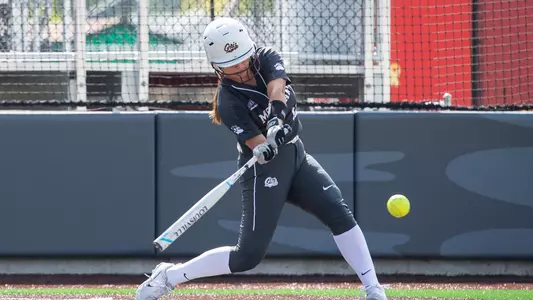
Origin Stories :: McKenna Tjaden
2/7/2019 5:46:00 PM | Softball
It was just before 5:30 p.m. on Wednesday when Duane Tjaden made his way from the UPS facility in downtown Los Angeles where he works to his car in the parking lot.
Ahead of him: a 67-mile commute to Murrieta, where he and his wife Andrea have lived for 20 years and went about raising their three daughters, Justine, Madison and McKenna.
"I'm kind of getting off late, which is not good," he said. "Now it's going to be a two-and-a-half-hour commute."
And we pause here for a collective shudder, with most of us knowing that's the time equivalent of living in Belgrade and working in Missoula and making that drive morning and night, every day.
But only covering a third of the distance because of the traffic. "After doing this for 20 years, it's kind of the thing you do."
It wasn't always like that. Duane, Andrea, Justine and Madison used to live closer to Los Angeles, but it was a two-bedroom house that they had to shoehorn themselves into.
When McKenna declared her intention of joining the family, the time was right to make a move. So they looked south and east and found Murrieta.
"It was a newer city, it had a little slower pace than where we'd been living closer to Los Angeles, and it was more affordable," said Tjaden, who's been working for UPS since he was 18 but would have lost his accrued seniority in the company had he switched hubs. So he continued working in Los Angeles.
"For all the plusses that came with the move, my commute was the only downfall."
Then the subject changes and he's asked about his daughters. Justine attended Hawaii and is now a nurse in Southern California. Madison graduated from Arizona State and will soon be starting her career as a teacher.
And McKenna is in her first year as a member of the Montana softball team. All those miles behind the wheel? They kind of melt away when he considers the end result.
"I couldn't be happier for McKenna or my other daughters," he said. "They've grown up to be great young adults, so it's a sacrifice I didn't mind making."
The family's story is part of the Southern California paradox.
It's a place so idyllic in so many ways that it has something that appeals to almost everyone. Which is why it can feel like everyone lives there. Or is on I-15. And at the end of the day, Duane Tjaden has a two-and-a-half-hour commute just to get home.
But the sun had shone from the moment it rose on Wednesday to the minute it set. And it was 54 degrees, in early February, when he pointed his car toward Murrieta.
It's the maddening SoCal give-and-take. It gives you the weather but it takes away some of your time to truly enjoy it.
"If you want to go to the beach in the morning and the mountains in the afternoon, you can do that," he says of Southern California's offerings, if you can handle the road angst it would take to pull off that type of double. And let's make sure we're on the road by this time to beat the worst of the traffic.
It would be perfect ... if so many millions of other people weren't attracted to the same thing and always getting in the way because they want to be somewhere 15 minutes ago.
It's a common sentiment of so many new Grizzlies who come from the region, that they arrive in Missoula and feel like they escaped Southern California and its hectic, full-throttle pace of life and can finally relax in their new environment.
"In Missoula I can drive 15 minutes and be anywhere I want to be," says Tjaden, whose name is pronounced JADE-en, but she's heard YAY-den, like Ron Burgundy might say it, even CHAD-en, like nobody in their right mind would say it.
"Back home I can drive 15 minutes and still be on the same street."
And that's the paradox of the nation's Eden, that things could be so perfect. But everybody else is thinking the same thing. And Duane Tjaden just spent another minute sitting in traffic because of it.
But the Southern California environment has resulted in this fact (and it's not debatable): over the years it's become an incubator for the greatest collection of multi-sport talent ever to come out of a single region. On a global scale. No one denies this. And the trickle-down reaches Montana.
McKenna Tjaden? She's not the only Griz athlete from Murrieta. She's not even the only Montana athlete from her high school. Brooklyn Van Bebber is a freshman on the golf team. Caitlin Rogers is in her second year on the soccer team. Both walked the hallways at Murrieta Valley High with Tjaden.
It comes down to three things. "Numbers, weather and the level of coaching that's available," says Tjaden. "I grew up playing softball nearly 12 months a year. We'd get two weeks off at Christmas and then two weeks in August and that was it."
The weather allows for that. The numbers allow for this: She played softball with girls who would end up going on to play at Oklahoma, Washington, Oregon and UCLA.
But you've got to keep up.
"The poor kids don't get a break, which is sad in my opinion," says Duane. But he and Andrea also did everything they could to give their daughters the same opportunity as every one of their SoCal neighbors, all 20-plus million of them.
Justine was a pitcher, until her junior year, when a life-threatening onset of Lemierre's syndrome landed her in the ICU at Rady Children's Hospital in San Diego for five weeks, three in a medically induced coma.
The resulting nerve damage to her leg ended her playing career, but the experience and the nurses who helped her make it through gave her a greater purpose in life. She wants to do the same thing.
Madison was a pitcher as well, before going all in on soccer. "We were all just straight sports," says McKenna. When the youngest finally picked up ball and glove, she naturally gravitated to catcher.
"I didn't want to be like my sisters, so I chose catching," says Tjaden, who got her start at the position by being her sisters' backstop. "It was scary. They were big and I was so tiny."
What was at first an act of sisterly resistance soon became a passion. At that age, she had little competition. You're volunteering to play catcher? Really? Thank you, thank you, thank you!
"I liked being somewhat in control. Every pitch you're in it. Other than pitching, it's the one position where you don't get bored," she says, noting that bruising and welts and jammed fingers are the price a catcher pays for being in on all that action.
"Blocking might be the hardest, because your job is to allow the ball to hit you. Even though you have all the gear, it can still hurt, especially in the cold."
Duane may have been a conscientious objector to the system that was in place, but that doesn't mean he sacrificed his daughters' futures by limiting their opportunities as a means of protest.
McKenna had a hitting coach by the time she was 10 and the last four years got additional position-specific training with Jen Schroeder, who played at UCLA and now runs the Softball Performance Workshop.
More than 300 catchers make their way through the facility's doors every week, hoping to give themselves an edge.
Only in Southern California, right? It's both a positive, that that level of coaching is available, and a negative, that an entire economy has emerged in response to the oftentimes cutthroat world of youth sports.
"It's super competitive. It's a lot of work, let's put it that way," says Duane, who owned a boat before every summer weekend became a trip to some distant softball or soccer field instead of the water. So he sold it.
"We don't regret it. We've been to some great places because of it. Travel softball and soccer kind of became a hobby for the family."
"It's a great place if you want to raise athletes," adds McKenna, which is why every sport at every school west of the Mississippi -- and plenty of those east of it -- has a recruiter who knows their way around Southern California.
Naturally, things got out of control, especially when it came to softball. Want to ratchet up the pressure on a girl? Or her parents? Have one of her 14-year-old friends commit to a Division I program. No, really.
"My friends started committing freshman year of high school or even eighth grade," says Tjaden. "How do you know if something's the right fit as an eighth grader?
"This is kind of off the subject, but my friends in eighth grade were not my friends by my junior year of high school. You change so much during that time. How would you know what you wanted?"
Coaches spoke out against early recruiting, but they also had no choice but to do it.
"These kids don't even know what they want for dinner at (that) age and we're asking them to decide where they want to go to college," Nebraska coach Rhonda Revelle told ESPN last year.
Unable to stop themselves as long as the NCAA's rules allowed it, the coaches begged for change, for the benefit of everyone, and the NCAA delivered. Less than a year ago it became official: no recruiting contact until Sept. 1 of a prospect's junior year of high school.
Of course it wouldn't have impacted Tjaden. Nobody was asking her to commit as an eighth or ninth grader. And that's where the old system failed the kids. They weren't able to develop at their own pace.
It didn't allow for late bloomers.
"I was one of the last people to be recruited out of my friend group or my teammates," she says. "I wasn't that good as an eighth grader.
"I developed more as a player my sophomore and junior year." So when Montana reached out to her, "I was more excited than I was worried about the weather. I was just happy somebody was interested in me."
The person who was interested was former Griz coach Jamie Pinkerton, who was in Southern California in July 2017 to look at Tjaden and another prospect.
It was during that trip that Iowa State reached out to him about its opening at head coach.
Pinkerton would take the job with Cyclones, agreeing to return to the program where he'd been an assistant prior to being hired at Montana, which he'd led to the NCAA tournament the previous spring.
The coach did the best he could to make things right with Tjaden, which meant he left her information atop his empty desk at Montana, where it would be when the next coach moved in.
And there it would sit for August. And September. And October, until Melanie Meuchel, Pinkerton's assistant, was announced as the Grizzlies' new coach.
That was good news for Tjaden. Meuchel knew about her and had seen her play at a tournament in Colorado. It was the best possible scenario.
"I always looked forward to my phone calls from her," says Tjaden. "I always knew she cared about me. It was like talking to my mom.
"She's always looking out for the team and wants the best for her players, and that was different than some other coaches I talked to. She was into me and wanted me, and that came across the phone."
Just weeks after Meuchel was hired, Tjaden was in Missoula on her official visit, her first time in Montana. She committed before she left town.
"I knew from talking to Mel on the phone that I would like playing for her," says Tjaden. The rest of it was an easy sell.
"On my visit she told me about the grit of Montana and how if people are from Montana, they love Montana. That drew me here."
So she signed, another product of the Southern California system heading north.
When Montana opened its fall exhibition season in September, 10 months after she signed her NLI, Tjaden didn't play in the Grizzlies' first of two games against MSU Billings.
She started Game 2 at catcher and went 3 for 3 with a double and two RBIs as Montana won by shutout.
"She has a little bit of similarity to Madison Saacke to me," says Meuchel, recalling her catcher who graduated out of the program last spring. "They have an awareness and knowledge of the game that's not outwardly spoken all the time, but they process the game very well.
"There is a quiet about her, but it's almost like she's processing and is one step ahead with what she's doing. That makes for a successful catcher. If you're thinking about that pitch and that play, you're already a step behind."
Tjaden caught four innings in her debut, getting paired up with starter Maddy Stensby before both gave way to the new battery of Michaela Hood and Reilly Williams.
Stensby allowed two hits and struck out six of the 15 batters she and Tjaden faced.
"One of my favorite things is a strikeout, whether they swing and miss or watch it go by," says Tjaden. "It makes me feel good the pitcher did so well and that I was part of it too. I like being there for the pitcher and helping her in any way I can."
Helping her in any way I can. It's the parenting creed, internalized by Duane Tjaden from Day One as a father, boiled down to its most fundamental.
"I call him my best friend," says McKenna. "He was always my biggest supporter and always the one who played catch with me.
"He was always waking up early, taking me to softball. He was always the one pushing me through the hard times, even though he had a big work load every week."
But it was just some extra driving, right? A small sacrifice to see his daughters have the chance to succeed in life.
Why would this week be any different, when Montana opens its season on Friday morning, a few long interstate miles away in Davis?
"This is how excited we are. After work on Thursday I'm going to go home, sleep for a few hours, then we'll drive through the night, seven or eight hours, to get to Davis for the team's first game," says Duane.
After all the sacrifices over the years that got her to this point, his daughter is playing her first college softball game this weekend. It's not like a little driving time has ever gotten in the way.
Ahead of him: a 67-mile commute to Murrieta, where he and his wife Andrea have lived for 20 years and went about raising their three daughters, Justine, Madison and McKenna.
"I'm kind of getting off late, which is not good," he said. "Now it's going to be a two-and-a-half-hour commute."
And we pause here for a collective shudder, with most of us knowing that's the time equivalent of living in Belgrade and working in Missoula and making that drive morning and night, every day.
But only covering a third of the distance because of the traffic. "After doing this for 20 years, it's kind of the thing you do."
It wasn't always like that. Duane, Andrea, Justine and Madison used to live closer to Los Angeles, but it was a two-bedroom house that they had to shoehorn themselves into.
When McKenna declared her intention of joining the family, the time was right to make a move. So they looked south and east and found Murrieta.
"It was a newer city, it had a little slower pace than where we'd been living closer to Los Angeles, and it was more affordable," said Tjaden, who's been working for UPS since he was 18 but would have lost his accrued seniority in the company had he switched hubs. So he continued working in Los Angeles.
"For all the plusses that came with the move, my commute was the only downfall."
Then the subject changes and he's asked about his daughters. Justine attended Hawaii and is now a nurse in Southern California. Madison graduated from Arizona State and will soon be starting her career as a teacher.
And McKenna is in her first year as a member of the Montana softball team. All those miles behind the wheel? They kind of melt away when he considers the end result.
"I couldn't be happier for McKenna or my other daughters," he said. "They've grown up to be great young adults, so it's a sacrifice I didn't mind making."
The family's story is part of the Southern California paradox.
It's a place so idyllic in so many ways that it has something that appeals to almost everyone. Which is why it can feel like everyone lives there. Or is on I-15. And at the end of the day, Duane Tjaden has a two-and-a-half-hour commute just to get home.
But the sun had shone from the moment it rose on Wednesday to the minute it set. And it was 54 degrees, in early February, when he pointed his car toward Murrieta.
It's the maddening SoCal give-and-take. It gives you the weather but it takes away some of your time to truly enjoy it.
"If you want to go to the beach in the morning and the mountains in the afternoon, you can do that," he says of Southern California's offerings, if you can handle the road angst it would take to pull off that type of double. And let's make sure we're on the road by this time to beat the worst of the traffic.
It would be perfect ... if so many millions of other people weren't attracted to the same thing and always getting in the way because they want to be somewhere 15 minutes ago.
It's a common sentiment of so many new Grizzlies who come from the region, that they arrive in Missoula and feel like they escaped Southern California and its hectic, full-throttle pace of life and can finally relax in their new environment.
"In Missoula I can drive 15 minutes and be anywhere I want to be," says Tjaden, whose name is pronounced JADE-en, but she's heard YAY-den, like Ron Burgundy might say it, even CHAD-en, like nobody in their right mind would say it.
"Back home I can drive 15 minutes and still be on the same street."
And that's the paradox of the nation's Eden, that things could be so perfect. But everybody else is thinking the same thing. And Duane Tjaden just spent another minute sitting in traffic because of it.
But the Southern California environment has resulted in this fact (and it's not debatable): over the years it's become an incubator for the greatest collection of multi-sport talent ever to come out of a single region. On a global scale. No one denies this. And the trickle-down reaches Montana.
McKenna Tjaden? She's not the only Griz athlete from Murrieta. She's not even the only Montana athlete from her high school. Brooklyn Van Bebber is a freshman on the golf team. Caitlin Rogers is in her second year on the soccer team. Both walked the hallways at Murrieta Valley High with Tjaden.
It comes down to three things. "Numbers, weather and the level of coaching that's available," says Tjaden. "I grew up playing softball nearly 12 months a year. We'd get two weeks off at Christmas and then two weeks in August and that was it."
The weather allows for that. The numbers allow for this: She played softball with girls who would end up going on to play at Oklahoma, Washington, Oregon and UCLA.
But you've got to keep up.
"The poor kids don't get a break, which is sad in my opinion," says Duane. But he and Andrea also did everything they could to give their daughters the same opportunity as every one of their SoCal neighbors, all 20-plus million of them.
Justine was a pitcher, until her junior year, when a life-threatening onset of Lemierre's syndrome landed her in the ICU at Rady Children's Hospital in San Diego for five weeks, three in a medically induced coma.
The resulting nerve damage to her leg ended her playing career, but the experience and the nurses who helped her make it through gave her a greater purpose in life. She wants to do the same thing.
Madison was a pitcher as well, before going all in on soccer. "We were all just straight sports," says McKenna. When the youngest finally picked up ball and glove, she naturally gravitated to catcher.
"I didn't want to be like my sisters, so I chose catching," says Tjaden, who got her start at the position by being her sisters' backstop. "It was scary. They were big and I was so tiny."
What was at first an act of sisterly resistance soon became a passion. At that age, she had little competition. You're volunteering to play catcher? Really? Thank you, thank you, thank you!
"I liked being somewhat in control. Every pitch you're in it. Other than pitching, it's the one position where you don't get bored," she says, noting that bruising and welts and jammed fingers are the price a catcher pays for being in on all that action.
"Blocking might be the hardest, because your job is to allow the ball to hit you. Even though you have all the gear, it can still hurt, especially in the cold."
Duane may have been a conscientious objector to the system that was in place, but that doesn't mean he sacrificed his daughters' futures by limiting their opportunities as a means of protest.
McKenna had a hitting coach by the time she was 10 and the last four years got additional position-specific training with Jen Schroeder, who played at UCLA and now runs the Softball Performance Workshop.
More than 300 catchers make their way through the facility's doors every week, hoping to give themselves an edge.
Only in Southern California, right? It's both a positive, that that level of coaching is available, and a negative, that an entire economy has emerged in response to the oftentimes cutthroat world of youth sports.
"It's super competitive. It's a lot of work, let's put it that way," says Duane, who owned a boat before every summer weekend became a trip to some distant softball or soccer field instead of the water. So he sold it.
"We don't regret it. We've been to some great places because of it. Travel softball and soccer kind of became a hobby for the family."
"It's a great place if you want to raise athletes," adds McKenna, which is why every sport at every school west of the Mississippi -- and plenty of those east of it -- has a recruiter who knows their way around Southern California.
Naturally, things got out of control, especially when it came to softball. Want to ratchet up the pressure on a girl? Or her parents? Have one of her 14-year-old friends commit to a Division I program. No, really.
"My friends started committing freshman year of high school or even eighth grade," says Tjaden. "How do you know if something's the right fit as an eighth grader?
"This is kind of off the subject, but my friends in eighth grade were not my friends by my junior year of high school. You change so much during that time. How would you know what you wanted?"
Coaches spoke out against early recruiting, but they also had no choice but to do it.
"These kids don't even know what they want for dinner at (that) age and we're asking them to decide where they want to go to college," Nebraska coach Rhonda Revelle told ESPN last year.
Unable to stop themselves as long as the NCAA's rules allowed it, the coaches begged for change, for the benefit of everyone, and the NCAA delivered. Less than a year ago it became official: no recruiting contact until Sept. 1 of a prospect's junior year of high school.
Of course it wouldn't have impacted Tjaden. Nobody was asking her to commit as an eighth or ninth grader. And that's where the old system failed the kids. They weren't able to develop at their own pace.
It didn't allow for late bloomers.
"I was one of the last people to be recruited out of my friend group or my teammates," she says. "I wasn't that good as an eighth grader.
"I developed more as a player my sophomore and junior year." So when Montana reached out to her, "I was more excited than I was worried about the weather. I was just happy somebody was interested in me."
The person who was interested was former Griz coach Jamie Pinkerton, who was in Southern California in July 2017 to look at Tjaden and another prospect.
It was during that trip that Iowa State reached out to him about its opening at head coach.
Pinkerton would take the job with Cyclones, agreeing to return to the program where he'd been an assistant prior to being hired at Montana, which he'd led to the NCAA tournament the previous spring.
The coach did the best he could to make things right with Tjaden, which meant he left her information atop his empty desk at Montana, where it would be when the next coach moved in.
And there it would sit for August. And September. And October, until Melanie Meuchel, Pinkerton's assistant, was announced as the Grizzlies' new coach.
That was good news for Tjaden. Meuchel knew about her and had seen her play at a tournament in Colorado. It was the best possible scenario.
"I always looked forward to my phone calls from her," says Tjaden. "I always knew she cared about me. It was like talking to my mom.
"She's always looking out for the team and wants the best for her players, and that was different than some other coaches I talked to. She was into me and wanted me, and that came across the phone."
Just weeks after Meuchel was hired, Tjaden was in Missoula on her official visit, her first time in Montana. She committed before she left town.
"I knew from talking to Mel on the phone that I would like playing for her," says Tjaden. The rest of it was an easy sell.
"On my visit she told me about the grit of Montana and how if people are from Montana, they love Montana. That drew me here."
So she signed, another product of the Southern California system heading north.
When Montana opened its fall exhibition season in September, 10 months after she signed her NLI, Tjaden didn't play in the Grizzlies' first of two games against MSU Billings.
She started Game 2 at catcher and went 3 for 3 with a double and two RBIs as Montana won by shutout.
"She has a little bit of similarity to Madison Saacke to me," says Meuchel, recalling her catcher who graduated out of the program last spring. "They have an awareness and knowledge of the game that's not outwardly spoken all the time, but they process the game very well.
"There is a quiet about her, but it's almost like she's processing and is one step ahead with what she's doing. That makes for a successful catcher. If you're thinking about that pitch and that play, you're already a step behind."
Tjaden caught four innings in her debut, getting paired up with starter Maddy Stensby before both gave way to the new battery of Michaela Hood and Reilly Williams.
Stensby allowed two hits and struck out six of the 15 batters she and Tjaden faced.
"One of my favorite things is a strikeout, whether they swing and miss or watch it go by," says Tjaden. "It makes me feel good the pitcher did so well and that I was part of it too. I like being there for the pitcher and helping her in any way I can."
Helping her in any way I can. It's the parenting creed, internalized by Duane Tjaden from Day One as a father, boiled down to its most fundamental.
"I call him my best friend," says McKenna. "He was always my biggest supporter and always the one who played catch with me.
"He was always waking up early, taking me to softball. He was always the one pushing me through the hard times, even though he had a big work load every week."
But it was just some extra driving, right? A small sacrifice to see his daughters have the chance to succeed in life.
Why would this week be any different, when Montana opens its season on Friday morning, a few long interstate miles away in Davis?
"This is how excited we are. After work on Thursday I'm going to go home, sleep for a few hours, then we'll drive through the night, seven or eight hours, to get to Davis for the team's first game," says Duane.
After all the sacrifices over the years that got her to this point, his daughter is playing her first college softball game this weekend. It's not like a little driving time has ever gotten in the way.
Players Mentioned

P
/ Softball
C
/ Softball
P
/ Softball
C
/ Softball
C
/ SoftballThursday, June 04
Friday, May 01
Friday, May 01
Friday, May 01