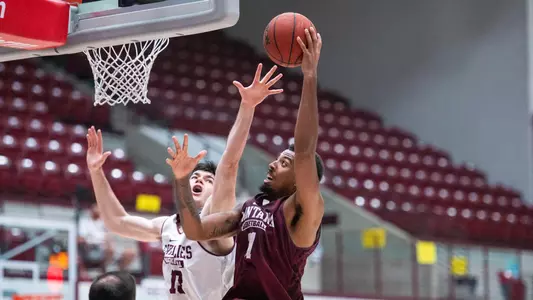
Photo by: Derek Johnson
Patience, flexibility remain paramount as Montana begins 2020-21 season prep
10/14/2020 1:54:00 PM | Men's Basketball
A year ago prior to his team's first preseason practice, head coach Travis DeCuire emphasized the word patience. It was something DeCuire was learning he would have to become good at, after graduating a class of veteran seniors who had become player-coaches as much as they were traditional student-athletes.
If only DeCuire knew then that last year's comment would be a precursor for what was to come in October 2020, when patience will once again be paramount, albeit for partially different reasons.
Montana will hold its first official preseason practice on Wednesday afternoon, gearing up for a 2020-21 men's basketball season that will look unlike any other.
Below are 10 things for fans to watch for as basketball season inches closer:
1. A season unlike any other
It's not hyperbolic to say that none of us have ever seen anything like the last several months, and likely, what's still to come in the months ahead. Plenty has changed since Montana's chase for a Big Sky Conference three-peat came to an abrupt halt in mid-March in Boise, Idaho.
For one, face masks are now a necessity when leaving one's house or entering Dahlberg Arena. The student-athletes have gaiter-style masks that they wear around their necks while on the court and are required to fully wear when on the sidelines or in between drills; the coaching staff will be seen wearing a mask at all times.
In fact, you'll see anyone associated with the men's basketball program wearing a mask at all times off the court, too, and to them, it's just a small part in trying to care for those around them, in addition to ensuring they can do more of what they love to do.
They've seen what's happened nationally in the college and professional football circles. It's not lost on them that they, too, will likely be affected by postponements and cancelations over the next several months, but they're doing all that they can to stay on the court.
As for the season itself, the NCAA announced last month that competition can begin Wednesday, Nov. 25. That's a 15-day delay from the original start date, but the two weeks allow for more time to learn about the pandemic, figure out testing procedures, and most importantly, get people off of campus. The NCAA estimates that 75 percent of schools will have student off of campus by Thanksgiving, hence the Nov. 25 start date. Montana is in the majority, with the university shifting the semester up a week in August and having all final exams complete by the Thanksgiving holiday.
The schedule is still a work in progress – more on that later – and testing procedures and social distancing are as much of a coaches' job duties this year as are the X's and O's, but for now, all signs are pointing toward a 2020-21 season that will look much different than any before.
"Given the role that basketball plays in college athletics, I always knew there would be a strong effort to make the season happen," DeCuire said. "I've always felt there would be a start to the season. The biggest question is will there be an end, which is still to be determined."
2. Patience will be key
Coaches are creatures of habit, so a pandemic isn't ideal. They're also planners. While most people live week-to-week, if not by the day, coaches are often looking months, if not years in advance. That's how they're forced to operate in the business, especially when it comes to recruiting and scheduling.
Not so fast. By now DeCuire estimates that he would have practice plans for all 30 of his team's NCAA-allotted practices written out. He says he's already torn up the first 15 and started over.
"Everything's day to day right now," DeCuire said. "Nothing is normal or concrete. Our ability to be flexible is going to be important, and probably our biggest challenge."
Like student-athletes across the country, Montana has been affected by COVID-19. Even if the Griz student-athletes are taking care of themselves, even being around someone who tests positive can force a full shutdown. It's being seen on a daily basis across the country, which is again why DeCuire is preaching patience and flexibility.
"We have to be prepared to stop and start, stop and start," the seventh-year head coach said. "We've already been affected by that, and there's no working around it."
3. Conditioning is the name of the game early on
While Wednesday is considered the unofficial start to the 2020-21 basketball season, Montana has been in the gym for the past several months. Previously, the NCAA allowed eight hours of work per week, but Wednesday – 42 days before the start of basketball season – the number increased to 20. It allows more time for the team to work together – be it on the court, in the weight room or in the film room.
The focus in the coming weeks will be the same as it usually is this time of year: introduce concepts, break old habits, create new ones, so on and so on. The big difference this year will be conditioning.
DeCuire has noticed his team isn't nearly in as good of physical shape as years past. The shutdown in the spring plays a large role, with most gyms and facilities closing down for extended periods of time. So, too, does the lack of consistency, with the team forced to take several days or weeks off at a time due to COVID-19.
Now comes the balance of introducing players to the system and getting them in game shape, without overworking them.
"We need the hours, but I'm not sure we can handle them right now," DeCuire said. "We have to pay attention to where they're at both physically and mentally. Maybe that means trying to do more with less (time), possibly shortening workouts or working in chunks."
4. A different-looking roster
Fans will need to brush up on the roster this fall, as a lot has changed. Gone are four key pieces from last year's team, including All-Big Sky players Sayeed Pridgett and Kendal Manuel. Pridgett was a two-time first-team selection who finished his career ranked fourth in school history for scoring.
Returning is just one upperclassman: Mack Anderson, a junior from Bozeman, who averaged 11.9 minutes, 3.3 points and 1.8 rebounds per game a season ago.
The following bullets will show how much has changed:
5. That's not much coming back. Why is there still optimism?
So why be optimistic about the group, despite all that's been lost? Well for one Montana has a strong track record of being good, even when the cards were stacked against it. Think back to 2014-15 and DeCuire's first season. The Griz were picked to finish eighth in the conference; they ended up winning a regular-season title. Or the 2017-18 season, when Montana had just one senior as was coming off of a .500 season only to run through the conference and win regular-season and tournament championships. Even last year, after graduating a group that had the best two-year stretch in school history, Montana was in position to win again going into the final week of the season.
The truth is, whether Montana is the unanimous favorite or a heavy underdog in the midst of a rebuild, the Griz show up year in and year out. It's why they've played in the NCAA tournament five times in the past decade and have advanced to the conference championship game in all but one season under DeCuire.
6. Plus, there's still plenty of talent
You might be thinking to yourself, History is great and all, but I need a little more reason to believe a team that returns so little can be expected to do big things.
OK, fine. Let's start at the top.
Michael Steadman. If you forgot about him, we'll let it slide, because it has been a while since he arrived to campus. The 6-10 forward had to sit out last year after transferring from San Jose State, and since then he's learned Montana's system, dropped 20 pounds (in a good way) and earned his bachelor's degree in business management.
He was a force during his lone season at San Jose State, leading the Spartans for scoring (13.2 points per game) and rebounding (8.5 per game) and ranking third in the Mountain West for shooting (.483). There's a lot of hype for the graduate transfer, and for good reason.
"He's really changed his body and has learned how to score on a high percentage of his touches," DeCuire said of Steadman. "He's grown in terms of how to play the game when the ball isn't in his hands. We're excited to have him on the floor."
Next, let's talk about the Cams, who both transferred to Montana in the spring.
Cameron Satterwhite, like Steadman, is a graduate transfer who has one year of immediate eligibility. The coaching staff was drawn to him for two main reasons: First, he knows the league, having played two years for Northern Arizona. Second, he has NCAA tournament experience, being part of Loyola Chicago's historic run to the Final Four in 2018. Last year for NAU, Satterwhite averaged 9.0 points per game on .427 shooting, ranking third on the team with 30 3-pointers. Cameron Parker will be a junior after beginning his career at Sacred Heart. After a debut season that earned him NEC All-Rookie Team honors, Parker averaged 10.2 points and 0.9 steals per game as a sophomore, in addition to a 7.8 assists-per-game average that would have ranked fourth nationally had he not missed the final two months of the season due to injury. In December, he dished out an NCAA single-game record 24 assists.
While the transfers are expected to make an immediate presence, another big piece returning for Montana is its sophomore class. The trio of Derrick Carter-Hollinger, Kyle Owens and Josh Vazquez combined to start a school-record 40 games as true freshmen, playing three valuable roles. Carter-Hollinger shot .597 from the floor and was named the league's Freshman of the Year; Owens was big on both ends, averaging 4.6 points and 2.3 rebounds per game, and scoring in double figures five times; Vazquez ranked sixth in Big Sky play with 1.6 steals per game and ranked second on the team for 3-pointers.
Truth is, Montana is young, but not as young as it may look. The sophomore class has the experience of most upperclassmen, and while the transfers might not have experience on the current roster, between Steadman, Satterwhite, Parker and Darius Henderson – who will be eligible mid-season after transferring from UMass Lowell last winter – there's a solid group of guys who have Division-I experience.
"These guys are bigger than most think," DeCuire said. "You can't replace playing time, you can't replace experience, and these guys have it. It's huge to have guys who are confident and who have been part of big-time Division-I basketball, which is why we went out and got them."
Gallery: (10-7-2020) MBB: September Practices
7. What about the freshmen?
Montana had a four-person signing class last November, bringing in California natives Robby Beasley (6-3 guard from Dublin) and Brandon Whitney (6-1 guard from Mission Hills) and Australians Josh Bannan (6-9 forward from Victoria) and Hunter Clarke (6-5 guard from Kaleen). With several spots to fill, expect to see several of them getting playing time early on.
"They're well coached," DeCuire said of the freshman class. "They have done as good a job as anyone has of picking up information and adjusting to it. They make adjustments that allow them to compete for roles, which is what we expect when we bring guys like them in."
The class grew this fall when Hellgate graduate Dylan Holst was added to the roster as a walk-on. Fans will likely remember his name as he is the son of former Griz head coach Don Holst, who led Montana to a pair of Big Sky Conference championships in the late 1990s and early 2000s.
8. Competition will be at a premium
Four players started 20 or more games in 2019-20. None of them are back, meaning there are several spots up for grabs. Rather than it be a concern, though, DeCuire is excited about the fluidity, because it increases the level of competition on a day-to-day basis.
"Right now, all of the jobs are open for competition, all five jobs are available," DeCuire said. "It's creating a highly competitive environment."
9. Depth will be tested like never before
DeCuire has never been known to play a deep lineup. By the middle of most seasons, his rotation is generally whittled down to seven or eight players. In fact, over the past three seasons, Montana has never had more than eight players average more than 10 minutes per game.
That could change this year, and it may be out of DeCuire's control.
"This season is going to be different," DeCuire said. "Teams can't rely on just a few players. The team with the most depth, and the teams who handle COVID protocols the best, will be the ones who will have the most success."
Depth will be a necessity, especially if COVID-19 restricts a student-athlete from playing on a given night.
"Be ready for guys with limited roles to look up and find themselves playing competitive minutes when they least expect it," DeCuire said. "This is one of those years where you will have to have all 15 guys prepared to play. Even if they go five, six, seven games without playing, they might look up one night and we need them."
DeCuire believes the depth plays to Montana's advantage. Even if he generally doesn't use a long lineup, he feels like he has the pieces to do so. Even more, he likes his team's versatility.
"I think we can be a pretty deep team in terms of talent, and I think we can be a deep team in terms of versatility," he said. "We have a lot of guys who can play a lot of different positions, and can go with a lot of different lineups."
10. What will the schedule look like?
The question every fan wants to know is what the schedule will look like. It's one DeCuire, himself, would like to know as well. Remember the whole planning years in advance? Not this year.
Montana is six weeks away from the start of the basketball season, and still has several holes in its schedule. The Grizzlies aren't alone, with very few schedules across the country complete at this point.
Part of the issue is competition dates. With the start of the season being pushed back 15 days, it eliminates four or five possible games, with teams being capped at 26 or 27, depending on if they play in a multi-team event. The other part is the unknown. There are still so many uncertainties with testing, travel and finances, that it's making teams hesitant to take a trip to Missoula or pay as much to have Montana come to them.
A reformatted Big Sky Conference schedule is expected to be released in the coming days, but as for a non-conference slate? It's still a work in progress.
"We'll likely have fewer dates, and we're really limited in our region in terms of which teams will play us," DeCuire said. "But this much I know: It's going to be as competitive as it's ever been."
Gallery: (9-2-2020) MBB: August Practices
If only DeCuire knew then that last year's comment would be a precursor for what was to come in October 2020, when patience will once again be paramount, albeit for partially different reasons.
Montana will hold its first official preseason practice on Wednesday afternoon, gearing up for a 2020-21 men's basketball season that will look unlike any other.
Below are 10 things for fans to watch for as basketball season inches closer:
1. A season unlike any other
It's not hyperbolic to say that none of us have ever seen anything like the last several months, and likely, what's still to come in the months ahead. Plenty has changed since Montana's chase for a Big Sky Conference three-peat came to an abrupt halt in mid-March in Boise, Idaho.
For one, face masks are now a necessity when leaving one's house or entering Dahlberg Arena. The student-athletes have gaiter-style masks that they wear around their necks while on the court and are required to fully wear when on the sidelines or in between drills; the coaching staff will be seen wearing a mask at all times.
In fact, you'll see anyone associated with the men's basketball program wearing a mask at all times off the court, too, and to them, it's just a small part in trying to care for those around them, in addition to ensuring they can do more of what they love to do.
They've seen what's happened nationally in the college and professional football circles. It's not lost on them that they, too, will likely be affected by postponements and cancelations over the next several months, but they're doing all that they can to stay on the court.
As for the season itself, the NCAA announced last month that competition can begin Wednesday, Nov. 25. That's a 15-day delay from the original start date, but the two weeks allow for more time to learn about the pandemic, figure out testing procedures, and most importantly, get people off of campus. The NCAA estimates that 75 percent of schools will have student off of campus by Thanksgiving, hence the Nov. 25 start date. Montana is in the majority, with the university shifting the semester up a week in August and having all final exams complete by the Thanksgiving holiday.
The schedule is still a work in progress – more on that later – and testing procedures and social distancing are as much of a coaches' job duties this year as are the X's and O's, but for now, all signs are pointing toward a 2020-21 season that will look much different than any before.
"Given the role that basketball plays in college athletics, I always knew there would be a strong effort to make the season happen," DeCuire said. "I've always felt there would be a start to the season. The biggest question is will there be an end, which is still to be determined."
2. Patience will be key
Coaches are creatures of habit, so a pandemic isn't ideal. They're also planners. While most people live week-to-week, if not by the day, coaches are often looking months, if not years in advance. That's how they're forced to operate in the business, especially when it comes to recruiting and scheduling.
Not so fast. By now DeCuire estimates that he would have practice plans for all 30 of his team's NCAA-allotted practices written out. He says he's already torn up the first 15 and started over.
"Everything's day to day right now," DeCuire said. "Nothing is normal or concrete. Our ability to be flexible is going to be important, and probably our biggest challenge."
Like student-athletes across the country, Montana has been affected by COVID-19. Even if the Griz student-athletes are taking care of themselves, even being around someone who tests positive can force a full shutdown. It's being seen on a daily basis across the country, which is again why DeCuire is preaching patience and flexibility.
"We have to be prepared to stop and start, stop and start," the seventh-year head coach said. "We've already been affected by that, and there's no working around it."
3. Conditioning is the name of the game early on
While Wednesday is considered the unofficial start to the 2020-21 basketball season, Montana has been in the gym for the past several months. Previously, the NCAA allowed eight hours of work per week, but Wednesday – 42 days before the start of basketball season – the number increased to 20. It allows more time for the team to work together – be it on the court, in the weight room or in the film room.
The focus in the coming weeks will be the same as it usually is this time of year: introduce concepts, break old habits, create new ones, so on and so on. The big difference this year will be conditioning.
DeCuire has noticed his team isn't nearly in as good of physical shape as years past. The shutdown in the spring plays a large role, with most gyms and facilities closing down for extended periods of time. So, too, does the lack of consistency, with the team forced to take several days or weeks off at a time due to COVID-19.
Now comes the balance of introducing players to the system and getting them in game shape, without overworking them.
"We need the hours, but I'm not sure we can handle them right now," DeCuire said. "We have to pay attention to where they're at both physically and mentally. Maybe that means trying to do more with less (time), possibly shortening workouts or working in chunks."
4. A different-looking roster
Fans will need to brush up on the roster this fall, as a lot has changed. Gone are four key pieces from last year's team, including All-Big Sky players Sayeed Pridgett and Kendal Manuel. Pridgett was a two-time first-team selection who finished his career ranked fourth in school history for scoring.
Returning is just one upperclassman: Mack Anderson, a junior from Bozeman, who averaged 11.9 minutes, 3.3 points and 1.8 rebounds per game a season ago.
The following bullets will show how much has changed:
- Montana is one of 23 teams across the entire country that brings back five or fewer letterwinners from last year's roster.
- Montana is one of 23 teams nationally with 10 or more underclassmen (freshmen or sophomores) on its roster.
- Montana is one of 22 teams nationally with nine or more newcomers, or players on roster who have yet to play for the program.
- Montana has only two seniors, neither who has played a game for the Griz
5. That's not much coming back. Why is there still optimism?
So why be optimistic about the group, despite all that's been lost? Well for one Montana has a strong track record of being good, even when the cards were stacked against it. Think back to 2014-15 and DeCuire's first season. The Griz were picked to finish eighth in the conference; they ended up winning a regular-season title. Or the 2017-18 season, when Montana had just one senior as was coming off of a .500 season only to run through the conference and win regular-season and tournament championships. Even last year, after graduating a group that had the best two-year stretch in school history, Montana was in position to win again going into the final week of the season.
The truth is, whether Montana is the unanimous favorite or a heavy underdog in the midst of a rebuild, the Griz show up year in and year out. It's why they've played in the NCAA tournament five times in the past decade and have advanced to the conference championship game in all but one season under DeCuire.
When it comes to coaching, @CoachDeCuire is as good as they come!#GrizHoops #GoGriz pic.twitter.com/exS45bSQUg
— Montana Griz BB (@MontanaGrizBB) August 20, 2020
6. Plus, there's still plenty of talent
You might be thinking to yourself, History is great and all, but I need a little more reason to believe a team that returns so little can be expected to do big things.
OK, fine. Let's start at the top.
Michael Steadman. If you forgot about him, we'll let it slide, because it has been a while since he arrived to campus. The 6-10 forward had to sit out last year after transferring from San Jose State, and since then he's learned Montana's system, dropped 20 pounds (in a good way) and earned his bachelor's degree in business management.
He was a force during his lone season at San Jose State, leading the Spartans for scoring (13.2 points per game) and rebounding (8.5 per game) and ranking third in the Mountain West for shooting (.483). There's a lot of hype for the graduate transfer, and for good reason.
"He's really changed his body and has learned how to score on a high percentage of his touches," DeCuire said of Steadman. "He's grown in terms of how to play the game when the ball isn't in his hands. We're excited to have him on the floor."
Next, let's talk about the Cams, who both transferred to Montana in the spring.
Cameron Satterwhite, like Steadman, is a graduate transfer who has one year of immediate eligibility. The coaching staff was drawn to him for two main reasons: First, he knows the league, having played two years for Northern Arizona. Second, he has NCAA tournament experience, being part of Loyola Chicago's historic run to the Final Four in 2018. Last year for NAU, Satterwhite averaged 9.0 points per game on .427 shooting, ranking third on the team with 30 3-pointers. Cameron Parker will be a junior after beginning his career at Sacred Heart. After a debut season that earned him NEC All-Rookie Team honors, Parker averaged 10.2 points and 0.9 steals per game as a sophomore, in addition to a 7.8 assists-per-game average that would have ranked fourth nationally had he not missed the final two months of the season due to injury. In December, he dished out an NCAA single-game record 24 assists.
While the transfers are expected to make an immediate presence, another big piece returning for Montana is its sophomore class. The trio of Derrick Carter-Hollinger, Kyle Owens and Josh Vazquez combined to start a school-record 40 games as true freshmen, playing three valuable roles. Carter-Hollinger shot .597 from the floor and was named the league's Freshman of the Year; Owens was big on both ends, averaging 4.6 points and 2.3 rebounds per game, and scoring in double figures five times; Vazquez ranked sixth in Big Sky play with 1.6 steals per game and ranked second on the team for 3-pointers.
Truth is, Montana is young, but not as young as it may look. The sophomore class has the experience of most upperclassmen, and while the transfers might not have experience on the current roster, between Steadman, Satterwhite, Parker and Darius Henderson – who will be eligible mid-season after transferring from UMass Lowell last winter – there's a solid group of guys who have Division-I experience.
"These guys are bigger than most think," DeCuire said. "You can't replace playing time, you can't replace experience, and these guys have it. It's huge to have guys who are confident and who have been part of big-time Division-I basketball, which is why we went out and got them."
7. What about the freshmen?
Montana had a four-person signing class last November, bringing in California natives Robby Beasley (6-3 guard from Dublin) and Brandon Whitney (6-1 guard from Mission Hills) and Australians Josh Bannan (6-9 forward from Victoria) and Hunter Clarke (6-5 guard from Kaleen). With several spots to fill, expect to see several of them getting playing time early on.
"They're well coached," DeCuire said of the freshman class. "They have done as good a job as anyone has of picking up information and adjusting to it. They make adjustments that allow them to compete for roles, which is what we expect when we bring guys like them in."
The class grew this fall when Hellgate graduate Dylan Holst was added to the roster as a walk-on. Fans will likely remember his name as he is the son of former Griz head coach Don Holst, who led Montana to a pair of Big Sky Conference championships in the late 1990s and early 2000s.
🏆 𝐂𝐡𝐚𝐦𝐩𝐢𝐨𝐧𝐬𝐡𝐢𝐩 𝐂𝐮𝐥𝐭𝐮𝐫𝐞 🏆
— Montana Griz BB (@MontanaGrizBB) October 13, 2020
Over the past 3 decades, every four-year #GrizHoops player has won a conference championship! #GoGriz pic.twitter.com/YZhKyLi6Ik
8. Competition will be at a premium
Four players started 20 or more games in 2019-20. None of them are back, meaning there are several spots up for grabs. Rather than it be a concern, though, DeCuire is excited about the fluidity, because it increases the level of competition on a day-to-day basis.
"Right now, all of the jobs are open for competition, all five jobs are available," DeCuire said. "It's creating a highly competitive environment."
9. Depth will be tested like never before
DeCuire has never been known to play a deep lineup. By the middle of most seasons, his rotation is generally whittled down to seven or eight players. In fact, over the past three seasons, Montana has never had more than eight players average more than 10 minutes per game.
That could change this year, and it may be out of DeCuire's control.
"This season is going to be different," DeCuire said. "Teams can't rely on just a few players. The team with the most depth, and the teams who handle COVID protocols the best, will be the ones who will have the most success."
Depth will be a necessity, especially if COVID-19 restricts a student-athlete from playing on a given night.
"Be ready for guys with limited roles to look up and find themselves playing competitive minutes when they least expect it," DeCuire said. "This is one of those years where you will have to have all 15 guys prepared to play. Even if they go five, six, seven games without playing, they might look up one night and we need them."
DeCuire believes the depth plays to Montana's advantage. Even if he generally doesn't use a long lineup, he feels like he has the pieces to do so. Even more, he likes his team's versatility.
"I think we can be a pretty deep team in terms of talent, and I think we can be a deep team in terms of versatility," he said. "We have a lot of guys who can play a lot of different positions, and can go with a lot of different lineups."
10. What will the schedule look like?
The question every fan wants to know is what the schedule will look like. It's one DeCuire, himself, would like to know as well. Remember the whole planning years in advance? Not this year.
Montana is six weeks away from the start of the basketball season, and still has several holes in its schedule. The Grizzlies aren't alone, with very few schedules across the country complete at this point.
Part of the issue is competition dates. With the start of the season being pushed back 15 days, it eliminates four or five possible games, with teams being capped at 26 or 27, depending on if they play in a multi-team event. The other part is the unknown. There are still so many uncertainties with testing, travel and finances, that it's making teams hesitant to take a trip to Missoula or pay as much to have Montana come to them.
A reformatted Big Sky Conference schedule is expected to be released in the coming days, but as for a non-conference slate? It's still a work in progress.
"We'll likely have fewer dates, and we're really limited in our region in terms of which teams will play us," DeCuire said. "But this much I know: It's going to be as competitive as it's ever been."
Players Mentioned

F
/ Men's Basketball
F
/ Men's Basketball
G
/ Men's Basketball
F
/ Men's Basketball
G
/ Men's Basketball
F
/ Men's Basketball
G
/ Men's Basketball
G
/ Men's Basketball
F
/ Men's Basketball
G
/ Men's Basketball
G
/ Men's Basketball
G
/ Men's Basketball
F
/ Men's Basketball
G
/ Men's Basketball
G
/ Men's BasketballMonday, March 30
Monday, March 30
Monday, March 30
Monday, March 30