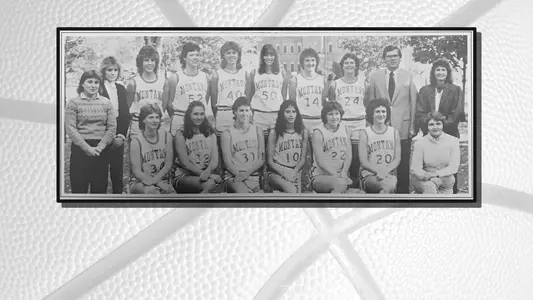
Lady Griz Rewind :: 1984-85
5/29/2020 5:45:00 PM | Women's Basketball
In the annals of Lady Griz basketball -- there have been 176 players to take the court over the last four-plus decades -- only one of them would have been out there that day.
It was a nice autumn afternoon in 1984 and the season was soon going to open, so Margaret Williams did what only Margaret Williams would have done: she hopped on her bike and rode to Lolo Pass.
"She was a fitness nut. Still is. She mountain bikes, skis. She is 50 and still doing jumps and stuff," says her coach, Robin Selvig, who hosts Williams, a lawyer in Sandpoint, Idaho, for a ride in the Rattlesnake now and then.
"She's bit it a few times. She needs to slow down."
Even though the Lady Griz were winning in the early 80s -- they went 27-4 the season before and advanced to the Sweet 16 of the NCAA tournament -- it was a different time, and Williams was a different type of college athlete.
Consider: She spent a previous summer not taking classes and lifting and hooping in preparation for the season ahead, the trinity of expectations for today's players, but working on a fishing boat in Alaska.
It was miserable, it was hard, but it allowed her to earn enough money for a custom-built bike by Bill Stevenson, a builder of steel frames in Olympia, Wash., which is where Williams lived prior to becoming a Lady Griz as a freshman in 1982-83.
It was that bike that Williams rode to Lolo Pass that day. As she was making her way back to Missoula, she was running on empty. Her head was down as she pushed on.
What happened next "was a bit unfortunate," she says in her understated way. She never saw the truck that was parked on the side of the road, the one used by the crew that was doing some road maintenance.
She isn't sure what exactly it was on the truck that she hit, but it impacted her abdomen with enough force that it pushed her pancreas into her spine, essentially splitting it in two. Williams: Doubtful (fractured pancreas).
"I was just training, getting in some miles," she says today, wife, mother of two daughters and self-employed lawyer who specializes in family law and child protection.
The workers tossed her bike, the steel frame broken in two places from the impact, into the back of the truck and drove her to the hospital.
Williams was in pain, but most of her focus was on that bike frame. She called Ruth Fugleberg, a senior when Williams was a freshman, and asked for help. Not for herself but for her bike, which the guys who dropped her off were just going to leave outside the hospital. The nerve!
"I made Ruth come to the emergency room and bring my bike inside. They thought I was crazy, but it was a Stevenson. It was in pieces, but I still insisted they bring it in and not leave it outside," she says.
And so began the 1984-85 season, the one with a lot to live up to.
The previous year's team had won the Mountain West Athletic Conference with a 14-0 league record, hosted and won the postseason tournament and then defeated Oregon State in Missoula in front of more than 4,000 fans in a first-round game of the NCAA tournament.
Cheri Bratt and Doris Deden-Hasquet, the first Lady Griz players to reach 1,000 career points, were gone, but the backcourt in 1984-85 was going to be solid, with Williams, then a junior, at the point and senior Barb Kavanagh at the two-guard.
Senior forward Anita Novak had been honorable mention all-league the season before, and junior center Sharla Muralt was ready to move into a starting role after averaging 9.6 points and 4.8 rebounds off the bench the season before.
Williams played all 30 games as a freshman in 1982-83, the season that ended with a trip to Northeast Louisiana in what was Montana's first trip to the NCAA tournament.
She started all 30 games, averaging more than 29 minutes, on the Sweet 16 team of 1983-84 that lost to eventual national champion USC.
The only reason Williams was playing for Montana and not Idaho was that Selvig made a timely phone call.
Her dad, William, who served on the Washington Supreme Court from 1979 to 1985, the last two years as Chief Justice, had played football for the Vandals, but Montana had its advantages as well.
Her uncle, Jerry, was Montana's football coach from 1955-57, before he moved on to coaching defensive backs for the Philadelphia Eagles and winning a 1960 NFL Championship.
And longtime Griz supporter Bob O'Conner, who passed away in 2012 at the age of 90, was a friend of Williams' dad, from their time together at Idaho.
It was he who tipped Selvig off about a lightning-quick guard from Olympia.
"He kind of gave Rob a heads up," says Williams, who was recruited in the days when tryouts were permitted in the form of playing with the members of the current team.
"I came out and went full-court with the current players. After that, he offered.
"I still couldn't decide. My dad played football at U of I, but I liked Montana and I liked Rob. I said, all right, whichever coach calls first, that's where I'm going. Rob called first, and I'm sure glad he did. You can't top playing for Rob Selvig."
But as she sat there, lying in the emergency room in what should have been the start of her junior season, she wondered what it all meant for her future.
"I lied to the ER guys. I said it didn't hurt when it did. I was in heavy denial because I didn't want to miss any of the season," she says.
She was bedridden for 10 days, "then we started preseason conditioning with my pancreas split in half. It was brutal."
She's a lawyer, not a doctor, but she gives it her best shot anyway. "You eat something and your digestive juices start working and the pancreas starts leaking and you start digesting yourself in your abdominal cavity," she explains in layman terms, in very uncomfortable layman terms.
That she was practicing with the team when the season officially opened in October should be memorialized these days with a postseason accolade: the Margaret Williams Toughness Award.
Of course few would be worthy. It's a lot to live up to.
"I still remember it. Dawn Silliker drove the right-side baseline. Rob was all about defense and I loved taking charges. Instinctually I slid down without thinking about it and held my ground. Dawn came and just tagged me," Williams says.
Her season was over. She even had to drop out of school for a period of time.
The first surgery, back in Olympia, came in November. "They removed a giant cyst that had developed and rearranged some intestines to make sure they drained the right place," she says.
The second came in February, when 55 percent of her pancreas, still fractured into two halves, was removed.
She thought she could come back for the 1984-85 season after the first surgery, but she guesses she was down to 100 pounds at that time -- "I couldn't eat anything, and you just waste away." She was a shell of her former self.
"I remember I shot my first free throw attempt after my first surgery, when I was thinking I could come back. I gave it everything I had and made it made three-quarters of the way to the basket. I was like, Uh-oh," she says.
It was the month the Lady Griz, the healthy ones, opened the season with a 75-52 home win over Washington State, with Novak going for 21 points and eight rebounds, Kavanagh 18 points and six assists.
With Williams out, Kavanagh slid over to the point, where she would play all season. Freshman guard Cheryl Brandell, from Olympia High, same as Williams, and Silliker, a freshman forward from Whitefish, rounded out the starting five.
Brandell would play 33 minutes in her collegiate debut.
"I was very pleased with our freshmen," Selvig said after the game. "Cheryl played especially well under the circumstances. She didn't know she was going to start until that night, and she went out and played with a great deal of composure."
Selvig also said before the season, "I don't know what a good year would be for us."
Montana followed with a 71-60 home win over Great Falls, with Muralt scoring 25 points and grabbing 19 rebounds, then the program record and only one off the record of today, then moved to 3-0 with a 72-46 home win over Nevada.
The Lady Griz opened Eastern Montana's tournament (now MSU Billings) with a win over Utah State, then lost in the championship game to North Dakota, then a strong Division II program, 49-46.
Montana went 22 for 60 (.367) and 2 for 10 from the free throw line while turning the ball over 18 times.
"I remember that being one ugly game. We couldn't make a shot. I remember we were using some kind of Mikasa, a different ball than we were used to, but that's not an excuse. We just couldn't score," says Selvig.
It would be the final season at North Dakota for coach Gary Schwartz, who would wind up at Montana State the following year.
Montana bounced back with wins over Colorado and Minnesota in the Lady Griz Insurance Classic, with Silliker earning MVP honors, then hit the road the next day for a trip of games at Washington State, Washington and Puget Sound.
Montana got the better of Washington State for the second time, 71-56, then lost at Washington two days later, 69-57, shooting 35.1 percent, Selvig's reserves getting outscored by the home team's by 35.
The original box scores from that era are priceless, if we can assume Selvig kept them and turned them into Montana's sports information staff upon his team's return.
The box score from the Washington game is covered with Selvig's unmistakable penmanship. "4th game 6 days." "Bench - 37-2." Notes for himself, about scheduling, about production.
Of course that was a good Washington team. The win moved the Huskies, whose only loss had come by nine to then No. 3 Long Beach State, to 7-1.
Montana went into the break with a 74-43 win at Puget Sound and an 8-2 record.
The Lady Griz opened January with a three-game road trip to the Bay Area, falling 74-63 at California, then winning twice at Santa Clara's tournament, 92-69 over Pacific and 66-65 in overtime over the host Broncos.
The box score from Cal had more insight from Selvig. The Bears' 42 free throw attempts were circled, as were the five fives on Montana's side of the box score, indicating five players fouled out. In heavy ink and underlined twice: "5 FO!!"
It should be noted, in the spirit of fairness and balance, that Montana later that season won 58-40 at Boise State. The Lady Griz got to the line 24 times to Boise's one. There is no writing on that box score, a game obviously well and properly officiated.
The win over Santa Clara came courtesy of Kavanagh, who scored four points in the final eight seconds of overtime to deliver a win for the Lady Griz.
Her two free throws made it 65-64 with eight seconds left. After Santa Clara missed the front end of a one-and-one, Muralt grabbed the rebound, threw an outlet pass to Kavanagh at midcourt, and the senior dribbled to 16 feet and hit the winning jumper at the buzzer.
"She wasn't fast and quick, but she was a really good basketball player," Selvig says. "It wasn't a speed and quickness deal for her. It was skills and intelligence."
Back then he said, "Barb is as intelligent as any player I've ever coached. Her athletic ability is average. What she has is basketball sense."
In Montana's magical season of 1983-84, when the Lady Griz went a perfect 14-0 through league, Eastern Washington was finishing 12-2 and Idaho was giving Montana its toughest games, a four-point win for the Lady Griz in Moscow, and five-point win in Missoula.
Montana opened its 1984-85 league schedule with a road trip to those two schools, and it did not go well.
In the preseason, Selvig said, "Defensively we have a long ways to go to be as good as we were last season."
The Lady Griz, who had led the nation in scoring defense two of the previous three years, were not there yet. They lost 89-74 to the Eagles, with 6-2 center Brenda Souther going for 34 points on 16-of-19 shooting, and 85-76 to the Vandals, who shot 59.6 percent to improve to 15-0.
"These are good teams but not good enough teams to give up 80 points to," Selvig said at the time.
"(Eastern Washington) did what they wanted offensively, inside, outside, on the break. We didn't stop anything. We were beaten at every position. I was embarrassed by our defense."
It was the first time in Selvig's then seventh year that Montana had given up 80 or more points in consecutive games. And Montana was in a 0-2 hole in league.
The Lady Griz responded with five straight wins, including a sweep of Weber State and Idaho State on the road, when Novak became the third player in program history to reach 1,000 career points, and a 22-point home win over Montana State, making Selvig 15-0 against the Bobcats.
The victory over MSU extended Montana's home-court winning streak to 46 games, dating back to January 1982 and a loss in the second Lady Griz Classic to Drake.
And just in time for Idaho to come calling.
It was turning out to be a special season for the Vandals, who were then 20-1, their only loss by five points at Eastern Washington.
They had a pair of 6-foot-4 starters in Mary Raese and Mary Westerwelle, and a trio of talented perimeter players around them.
And they did the unthinkable. They came to Missoula and built a 46-30 halftime lead.
"We were in shock at halftime," Selvig said. "We were starting to question whether or not there was anything we could do to stop them."
Idaho shot 60.4 percent for the game against one of the nation's traditionally toughest defensive teams in a venue that rarely gave up wins.
Montana, down 70-56 with seven minutes left, came back late in the second half, but Idaho would win 78-76.
The bigs combined for 26 points and 11 rebounds. The four primary perimeter players: 22 for 34 and 50 points.
"They had the twin towers, they had good guards, they had everything that season, just a really good basketball team," Selvig says today.
One day later Montana found itself down at the half again, 36-27 to Eastern Washington.
The Lady Griz would outscore the Eagles 35-26 in the second half to force overtime. Natalie Streeter, now starting in the backcourt with Kavanagh in place of Brandell, scored eight of her 10 points in the extra session as Montana survived 78-71.
The Lady Griz did not hold their first lead in the game until overtime. Souther had 18 points and 18 rebounds for the Eagles, Novak 17 points for Montana.
EWU coach Bill Smithpeters did his best after the game to get his point across without saying so much that he would get in trouble.
"They earned it," he said. "They fought back. I won't agree with the way it turned out. Playing at home has certain advantages, and they took full advantage of it."
Montana would win its final six league games to finish 11-3, tied for second with Eastern Washington, two games behind Idaho, which ended the regular season 26-1.
The Lady Griz held their final five regular-season opponents to 32.2 percent shooting and took that improved defense into the Mountain West Athletic Conference tournament at Moscow.
Facing Eastern Washington for the third time -- the Eagles entered the game averaging 88 points -- Montana never trailed and got late free throws from Kavanagh and Streeter to win 66-65 in the semifinals.
Souther was held to 14 points on 6-of-17 shooting.
That led to a third meeting with Idaho, and the Vandals played as perfectly as a team could be expected to play.
Raese and Westerwelle combined to score 40 points on 18-of-24 shooting, and the Vandals improved to 28-1 with an 80-57 win. They led 37-20 at the half and shot 56.9 percent with just eight turnovers.
In three wins that season against Montana, Idaho averaged 81.0 points on 58.9 percent shooting and assisted on more than 72 percent of its baskets.
Montana was awarded a bid to the National Women's Invitational Tournament, the NWIT as it was known back then, an eight-team consolation tournament, first for the AIAW, then the NCAA, held in Amarillo, Texas, from 1969 to 1996.
In 1998 it was rebranded as the Women's National Invitation Tournament and expanded. Today it matches the NCAA tournament with a 64-team field.
Back in 1985, the NCAA tournament was still 32 teams, the NWIT just eight, meaning Montana was one of the last 40 teams in the nation playing that season.
The Lady Griz were the NWIT's No. 7 seed and would play games against No. 2 Florida, No. 6 West Texas State and No. 5 West Virginia.
"I liked that somebody was doing something for women's basketball," Selvig says. "Amarillo made it a big deal. There was a banquet the night you got there and each of the teams did a skit.
"It was really good for the teams that came there. If you didn't make the NCAAs, you hoped to get an invite to the NIT because the quality of opponents was really good."
Montana opened with a 70-49 loss to Florida that had Selvig fired up afterwards. "Offensively we were a joke," he said, after his team shot 33.3 percent and turned the ball over 19 times.
"We played like we were just down here for the trip and nothing else. We were passing the ball around like it was a hot potato. Barb was the only one playing with confidence. It was just ridiculous."
Montana would give up halftime leads in its next two games but compete better in a 71-66 loss to West Texas State and 62-60 loss to West Virginia, a game the Mountaineers won on a shot with five seconds left.
"I feel a lot better," Selvig said after his team's second game in Amarillo. "I'm really proud of the way we played."
Idaho would earn the No. 5 seed in the eight-team West Regional of the NCAA tournament and lose 74-51 to No. 4 USC, which would fall 75-72 in its next game to top-seeded Long Beach State.
The Vandals finished the season 28-2. They had an average margin of victory of 19.7 and scored 80 or more points 16 times.
The NWIT was the end of the road for Kavanagh and Novak and provided valuable extra games for Silliker, Brandell and Marti Leibenguth, three freshmen who finished in the team's top seven in scoring.
Silliker started 31 of 32 games, Brandell 14, and Leibenguth averaged more than 18 minutes off the bench.
"The one good thing about going to the NIT was those young kids got some experience," Selvig said. "Marti played really well. It was a little bit of a springboard of things to come for her."
That offseason would also mark the return of Williams, who was cleared to begin playing again that summer.
"I finally got the green light at Lady Griz overnight camp to go full court. None of my teammates wanted to touch me, so I could go coast to coast whenever I got the ball," she says.
"They were too scared to hit me and hurt me. For a couple days I was an all-American. Then they realized they could put a body on me."
Williams, then a redshirt junior, would start all 31 games the next season, when Montana went 27-4 and returned to the NCAA tournament. She was voted second-team all-league as a fifth-year senior in 1986-87 to put a bow on her return.
"Rob was really good. He said he just wanted me to be able to have a normal life in terms of my health. Once we realized I could come back, he said, when you're ready, your spot is there," Williams says.
"He let me heal up and be confident that I would be ready to play again."
Soon enough she was the same old player, dishing assists and being a pest on defense, same as she had been.
Before Williams' senior year, Selvig said, "The pride and intensity that she has on defense makes everyone on the court a better player."
She would travel the world after graduation, then attend law school at Oregon. But even then, a professional career wasn't calling to her quite yet.
The law school graduate first worked as a river guide. The one, the only. Always.
It was a nice autumn afternoon in 1984 and the season was soon going to open, so Margaret Williams did what only Margaret Williams would have done: she hopped on her bike and rode to Lolo Pass.
"She was a fitness nut. Still is. She mountain bikes, skis. She is 50 and still doing jumps and stuff," says her coach, Robin Selvig, who hosts Williams, a lawyer in Sandpoint, Idaho, for a ride in the Rattlesnake now and then.
"She's bit it a few times. She needs to slow down."
Even though the Lady Griz were winning in the early 80s -- they went 27-4 the season before and advanced to the Sweet 16 of the NCAA tournament -- it was a different time, and Williams was a different type of college athlete.
Consider: She spent a previous summer not taking classes and lifting and hooping in preparation for the season ahead, the trinity of expectations for today's players, but working on a fishing boat in Alaska.
It was miserable, it was hard, but it allowed her to earn enough money for a custom-built bike by Bill Stevenson, a builder of steel frames in Olympia, Wash., which is where Williams lived prior to becoming a Lady Griz as a freshman in 1982-83.
It was that bike that Williams rode to Lolo Pass that day. As she was making her way back to Missoula, she was running on empty. Her head was down as she pushed on.
What happened next "was a bit unfortunate," she says in her understated way. She never saw the truck that was parked on the side of the road, the one used by the crew that was doing some road maintenance.
She isn't sure what exactly it was on the truck that she hit, but it impacted her abdomen with enough force that it pushed her pancreas into her spine, essentially splitting it in two. Williams: Doubtful (fractured pancreas).
"I was just training, getting in some miles," she says today, wife, mother of two daughters and self-employed lawyer who specializes in family law and child protection.
The workers tossed her bike, the steel frame broken in two places from the impact, into the back of the truck and drove her to the hospital.
Williams was in pain, but most of her focus was on that bike frame. She called Ruth Fugleberg, a senior when Williams was a freshman, and asked for help. Not for herself but for her bike, which the guys who dropped her off were just going to leave outside the hospital. The nerve!
"I made Ruth come to the emergency room and bring my bike inside. They thought I was crazy, but it was a Stevenson. It was in pieces, but I still insisted they bring it in and not leave it outside," she says.
And so began the 1984-85 season, the one with a lot to live up to.
The previous year's team had won the Mountain West Athletic Conference with a 14-0 league record, hosted and won the postseason tournament and then defeated Oregon State in Missoula in front of more than 4,000 fans in a first-round game of the NCAA tournament.
Cheri Bratt and Doris Deden-Hasquet, the first Lady Griz players to reach 1,000 career points, were gone, but the backcourt in 1984-85 was going to be solid, with Williams, then a junior, at the point and senior Barb Kavanagh at the two-guard.
Senior forward Anita Novak had been honorable mention all-league the season before, and junior center Sharla Muralt was ready to move into a starting role after averaging 9.6 points and 4.8 rebounds off the bench the season before.
Williams played all 30 games as a freshman in 1982-83, the season that ended with a trip to Northeast Louisiana in what was Montana's first trip to the NCAA tournament.
She started all 30 games, averaging more than 29 minutes, on the Sweet 16 team of 1983-84 that lost to eventual national champion USC.
The only reason Williams was playing for Montana and not Idaho was that Selvig made a timely phone call.
Her dad, William, who served on the Washington Supreme Court from 1979 to 1985, the last two years as Chief Justice, had played football for the Vandals, but Montana had its advantages as well.
Her uncle, Jerry, was Montana's football coach from 1955-57, before he moved on to coaching defensive backs for the Philadelphia Eagles and winning a 1960 NFL Championship.
And longtime Griz supporter Bob O'Conner, who passed away in 2012 at the age of 90, was a friend of Williams' dad, from their time together at Idaho.
It was he who tipped Selvig off about a lightning-quick guard from Olympia.
"He kind of gave Rob a heads up," says Williams, who was recruited in the days when tryouts were permitted in the form of playing with the members of the current team.
"I came out and went full-court with the current players. After that, he offered.
"I still couldn't decide. My dad played football at U of I, but I liked Montana and I liked Rob. I said, all right, whichever coach calls first, that's where I'm going. Rob called first, and I'm sure glad he did. You can't top playing for Rob Selvig."
But as she sat there, lying in the emergency room in what should have been the start of her junior season, she wondered what it all meant for her future.
"I lied to the ER guys. I said it didn't hurt when it did. I was in heavy denial because I didn't want to miss any of the season," she says.
She was bedridden for 10 days, "then we started preseason conditioning with my pancreas split in half. It was brutal."
She's a lawyer, not a doctor, but she gives it her best shot anyway. "You eat something and your digestive juices start working and the pancreas starts leaking and you start digesting yourself in your abdominal cavity," she explains in layman terms, in very uncomfortable layman terms.
That she was practicing with the team when the season officially opened in October should be memorialized these days with a postseason accolade: the Margaret Williams Toughness Award.
Of course few would be worthy. It's a lot to live up to.
"I still remember it. Dawn Silliker drove the right-side baseline. Rob was all about defense and I loved taking charges. Instinctually I slid down without thinking about it and held my ground. Dawn came and just tagged me," Williams says.
Her season was over. She even had to drop out of school for a period of time.
The first surgery, back in Olympia, came in November. "They removed a giant cyst that had developed and rearranged some intestines to make sure they drained the right place," she says.
The second came in February, when 55 percent of her pancreas, still fractured into two halves, was removed.
She thought she could come back for the 1984-85 season after the first surgery, but she guesses she was down to 100 pounds at that time -- "I couldn't eat anything, and you just waste away." She was a shell of her former self.
"I remember I shot my first free throw attempt after my first surgery, when I was thinking I could come back. I gave it everything I had and made it made three-quarters of the way to the basket. I was like, Uh-oh," she says.
It was the month the Lady Griz, the healthy ones, opened the season with a 75-52 home win over Washington State, with Novak going for 21 points and eight rebounds, Kavanagh 18 points and six assists.
With Williams out, Kavanagh slid over to the point, where she would play all season. Freshman guard Cheryl Brandell, from Olympia High, same as Williams, and Silliker, a freshman forward from Whitefish, rounded out the starting five.
Brandell would play 33 minutes in her collegiate debut.
"I was very pleased with our freshmen," Selvig said after the game. "Cheryl played especially well under the circumstances. She didn't know she was going to start until that night, and she went out and played with a great deal of composure."
Selvig also said before the season, "I don't know what a good year would be for us."
Montana followed with a 71-60 home win over Great Falls, with Muralt scoring 25 points and grabbing 19 rebounds, then the program record and only one off the record of today, then moved to 3-0 with a 72-46 home win over Nevada.
The Lady Griz opened Eastern Montana's tournament (now MSU Billings) with a win over Utah State, then lost in the championship game to North Dakota, then a strong Division II program, 49-46.
Montana went 22 for 60 (.367) and 2 for 10 from the free throw line while turning the ball over 18 times.
"I remember that being one ugly game. We couldn't make a shot. I remember we were using some kind of Mikasa, a different ball than we were used to, but that's not an excuse. We just couldn't score," says Selvig.
It would be the final season at North Dakota for coach Gary Schwartz, who would wind up at Montana State the following year.
Montana bounced back with wins over Colorado and Minnesota in the Lady Griz Insurance Classic, with Silliker earning MVP honors, then hit the road the next day for a trip of games at Washington State, Washington and Puget Sound.
Montana got the better of Washington State for the second time, 71-56, then lost at Washington two days later, 69-57, shooting 35.1 percent, Selvig's reserves getting outscored by the home team's by 35.
The original box scores from that era are priceless, if we can assume Selvig kept them and turned them into Montana's sports information staff upon his team's return.
The box score from the Washington game is covered with Selvig's unmistakable penmanship. "4th game 6 days." "Bench - 37-2." Notes for himself, about scheduling, about production.
Of course that was a good Washington team. The win moved the Huskies, whose only loss had come by nine to then No. 3 Long Beach State, to 7-1.
Montana went into the break with a 74-43 win at Puget Sound and an 8-2 record.
The Lady Griz opened January with a three-game road trip to the Bay Area, falling 74-63 at California, then winning twice at Santa Clara's tournament, 92-69 over Pacific and 66-65 in overtime over the host Broncos.
The box score from Cal had more insight from Selvig. The Bears' 42 free throw attempts were circled, as were the five fives on Montana's side of the box score, indicating five players fouled out. In heavy ink and underlined twice: "5 FO!!"
It should be noted, in the spirit of fairness and balance, that Montana later that season won 58-40 at Boise State. The Lady Griz got to the line 24 times to Boise's one. There is no writing on that box score, a game obviously well and properly officiated.
The win over Santa Clara came courtesy of Kavanagh, who scored four points in the final eight seconds of overtime to deliver a win for the Lady Griz.
Her two free throws made it 65-64 with eight seconds left. After Santa Clara missed the front end of a one-and-one, Muralt grabbed the rebound, threw an outlet pass to Kavanagh at midcourt, and the senior dribbled to 16 feet and hit the winning jumper at the buzzer.
"She wasn't fast and quick, but she was a really good basketball player," Selvig says. "It wasn't a speed and quickness deal for her. It was skills and intelligence."
Back then he said, "Barb is as intelligent as any player I've ever coached. Her athletic ability is average. What she has is basketball sense."
In Montana's magical season of 1983-84, when the Lady Griz went a perfect 14-0 through league, Eastern Washington was finishing 12-2 and Idaho was giving Montana its toughest games, a four-point win for the Lady Griz in Moscow, and five-point win in Missoula.
Montana opened its 1984-85 league schedule with a road trip to those two schools, and it did not go well.
In the preseason, Selvig said, "Defensively we have a long ways to go to be as good as we were last season."
The Lady Griz, who had led the nation in scoring defense two of the previous three years, were not there yet. They lost 89-74 to the Eagles, with 6-2 center Brenda Souther going for 34 points on 16-of-19 shooting, and 85-76 to the Vandals, who shot 59.6 percent to improve to 15-0.
"These are good teams but not good enough teams to give up 80 points to," Selvig said at the time.
"(Eastern Washington) did what they wanted offensively, inside, outside, on the break. We didn't stop anything. We were beaten at every position. I was embarrassed by our defense."
It was the first time in Selvig's then seventh year that Montana had given up 80 or more points in consecutive games. And Montana was in a 0-2 hole in league.
The Lady Griz responded with five straight wins, including a sweep of Weber State and Idaho State on the road, when Novak became the third player in program history to reach 1,000 career points, and a 22-point home win over Montana State, making Selvig 15-0 against the Bobcats.
The victory over MSU extended Montana's home-court winning streak to 46 games, dating back to January 1982 and a loss in the second Lady Griz Classic to Drake.
And just in time for Idaho to come calling.
It was turning out to be a special season for the Vandals, who were then 20-1, their only loss by five points at Eastern Washington.
They had a pair of 6-foot-4 starters in Mary Raese and Mary Westerwelle, and a trio of talented perimeter players around them.
And they did the unthinkable. They came to Missoula and built a 46-30 halftime lead.
"We were in shock at halftime," Selvig said. "We were starting to question whether or not there was anything we could do to stop them."
Idaho shot 60.4 percent for the game against one of the nation's traditionally toughest defensive teams in a venue that rarely gave up wins.
Montana, down 70-56 with seven minutes left, came back late in the second half, but Idaho would win 78-76.
The bigs combined for 26 points and 11 rebounds. The four primary perimeter players: 22 for 34 and 50 points.
"They had the twin towers, they had good guards, they had everything that season, just a really good basketball team," Selvig says today.
One day later Montana found itself down at the half again, 36-27 to Eastern Washington.
The Lady Griz would outscore the Eagles 35-26 in the second half to force overtime. Natalie Streeter, now starting in the backcourt with Kavanagh in place of Brandell, scored eight of her 10 points in the extra session as Montana survived 78-71.
The Lady Griz did not hold their first lead in the game until overtime. Souther had 18 points and 18 rebounds for the Eagles, Novak 17 points for Montana.
EWU coach Bill Smithpeters did his best after the game to get his point across without saying so much that he would get in trouble.
"They earned it," he said. "They fought back. I won't agree with the way it turned out. Playing at home has certain advantages, and they took full advantage of it."
Montana would win its final six league games to finish 11-3, tied for second with Eastern Washington, two games behind Idaho, which ended the regular season 26-1.
The Lady Griz held their final five regular-season opponents to 32.2 percent shooting and took that improved defense into the Mountain West Athletic Conference tournament at Moscow.
Facing Eastern Washington for the third time -- the Eagles entered the game averaging 88 points -- Montana never trailed and got late free throws from Kavanagh and Streeter to win 66-65 in the semifinals.
Souther was held to 14 points on 6-of-17 shooting.
That led to a third meeting with Idaho, and the Vandals played as perfectly as a team could be expected to play.
Raese and Westerwelle combined to score 40 points on 18-of-24 shooting, and the Vandals improved to 28-1 with an 80-57 win. They led 37-20 at the half and shot 56.9 percent with just eight turnovers.
In three wins that season against Montana, Idaho averaged 81.0 points on 58.9 percent shooting and assisted on more than 72 percent of its baskets.
Montana was awarded a bid to the National Women's Invitational Tournament, the NWIT as it was known back then, an eight-team consolation tournament, first for the AIAW, then the NCAA, held in Amarillo, Texas, from 1969 to 1996.
In 1998 it was rebranded as the Women's National Invitation Tournament and expanded. Today it matches the NCAA tournament with a 64-team field.
Back in 1985, the NCAA tournament was still 32 teams, the NWIT just eight, meaning Montana was one of the last 40 teams in the nation playing that season.
The Lady Griz were the NWIT's No. 7 seed and would play games against No. 2 Florida, No. 6 West Texas State and No. 5 West Virginia.
"I liked that somebody was doing something for women's basketball," Selvig says. "Amarillo made it a big deal. There was a banquet the night you got there and each of the teams did a skit.
"It was really good for the teams that came there. If you didn't make the NCAAs, you hoped to get an invite to the NIT because the quality of opponents was really good."
Montana opened with a 70-49 loss to Florida that had Selvig fired up afterwards. "Offensively we were a joke," he said, after his team shot 33.3 percent and turned the ball over 19 times.
"We played like we were just down here for the trip and nothing else. We were passing the ball around like it was a hot potato. Barb was the only one playing with confidence. It was just ridiculous."
Montana would give up halftime leads in its next two games but compete better in a 71-66 loss to West Texas State and 62-60 loss to West Virginia, a game the Mountaineers won on a shot with five seconds left.
"I feel a lot better," Selvig said after his team's second game in Amarillo. "I'm really proud of the way we played."
Idaho would earn the No. 5 seed in the eight-team West Regional of the NCAA tournament and lose 74-51 to No. 4 USC, which would fall 75-72 in its next game to top-seeded Long Beach State.
The Vandals finished the season 28-2. They had an average margin of victory of 19.7 and scored 80 or more points 16 times.
The NWIT was the end of the road for Kavanagh and Novak and provided valuable extra games for Silliker, Brandell and Marti Leibenguth, three freshmen who finished in the team's top seven in scoring.
Silliker started 31 of 32 games, Brandell 14, and Leibenguth averaged more than 18 minutes off the bench.
"The one good thing about going to the NIT was those young kids got some experience," Selvig said. "Marti played really well. It was a little bit of a springboard of things to come for her."
That offseason would also mark the return of Williams, who was cleared to begin playing again that summer.
"I finally got the green light at Lady Griz overnight camp to go full court. None of my teammates wanted to touch me, so I could go coast to coast whenever I got the ball," she says.
"They were too scared to hit me and hurt me. For a couple days I was an all-American. Then they realized they could put a body on me."
Williams, then a redshirt junior, would start all 31 games the next season, when Montana went 27-4 and returned to the NCAA tournament. She was voted second-team all-league as a fifth-year senior in 1986-87 to put a bow on her return.
"Rob was really good. He said he just wanted me to be able to have a normal life in terms of my health. Once we realized I could come back, he said, when you're ready, your spot is there," Williams says.
"He let me heal up and be confident that I would be ready to play again."
Soon enough she was the same old player, dishing assists and being a pest on defense, same as she had been.
Before Williams' senior year, Selvig said, "The pride and intensity that she has on defense makes everyone on the court a better player."
She would travel the world after graduation, then attend law school at Oregon. But even then, a professional career wasn't calling to her quite yet.
The law school graduate first worked as a river guide. The one, the only. Always.

Friday, June 19
Thursday, June 04
Friday, May 01
Friday, May 01