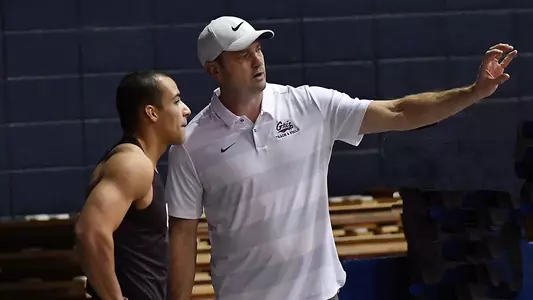
Brian Schweyen steps aside, never to be replaced
8/20/2020 1:18:00 AM | Men's Track and Field, Women's Track and Field
Brian Schweyen tends to resort to analogies when he's not sure he is getting his point across, and that can be beneficial considering he's most often talking about the esoteric sport of track and field, something he's coached at Montana for 22 of the last 23 years.
There is the one about all the flakes of gold lying in the grass that athletes tend to miss as they search for the big, shiny nugget that may or may not be out there, that may or may not be found.
How, if they would pay attention and recognize their importance, those mostly ignored flakes would add up over time, their accrued value far surpassing that of any one-time discovery.
The analogies he uses with his athletes work just as well on the subject of life, which is another reason he uses them. He sees that as his greater purpose, knowing track and field, and athletics in general, has the potential to lay the groundwork for a lifetime of success.
He continues: When asked about the biggest challenge of his job, he again goes analogy, how he starts each day eating breakfast and filling up on coaching credits.
In the hours he spends working with his athletes, some of them take more out of him than others, forcing him to dip into the limited amount of coaching credits he has available.
On the best of days, he ends it with a small surplus, able to give everyone what they need and ask from him. On the difficult days, he is empty before lunch. Then it becomes a struggle to give everyone what they need, namely the best of him. When he can't, he feels he's let them down.
To see Schweyen work a practice or a meet is to wonder how he does it, how he is able to give so much of himself day after day, with so many athletes taking a piece of him, then using it to become the best version of themselves, if only for one jump, one race, one throw.
Adam Bork, once coached by Schweyen, then a fellow assistant, now Schweyen's most trusted sidekick, says he sees it all the time, how distance runners, throwers, jumpers, sprinters, hurdlers, all of them make a beeline for Schweyen on meet day when they need that final little something.
Somehow he understands 80-plus athletes well enough to know just what they need in that pressure-filled moment. So they keep going back and keep finding him. And he keeps giving.
"Athletes from every event area go to Brian during competition for reassurance or just a strong high-five or motivation because he connects with people so well and is such a motivating person to be around," Bork says.
"They make one last stop to have even 10 seconds with him before their competition just to get that little bit of something special from him. That's one of the things that made him such a good coach."
Made. We'll get to that.
There is more: He says, in a way that has not even a touch of braggadocio, that he has a full set of encyclopedias of knowledge at the ready.
When freshmen arrive, he cracks open the first volume with them, regardless of event area, giving them as much information as they can handle. He knows when they are ready to move on to something more advanced.
He says the goal is to get through every volume with an athlete by the end of their career. The best use him for all he's got. Not surprisingly, their names can be found in the record book. Others never get past that first volume. He says that's fine, that he can still make them successful.
To describe the different athletes that come through his program, he has come up with a more recent analogy, about how most athletes want the big house on the hill and are willing to put in the initial investment of time and work to build the exterior.
But when it comes to addressing the inside of the home, when the tedious work to finish it off comes -- in other words, the technique training in track and field that can take years to master -- some abandon the project, some give it minimal effort, some pay attention to the details and are rewarded in full.
And they get the house they deserve. Some are empty shells. Some look good on the outside but are not well put together once someone pokes around inside. Others are meticulously appointed, the envy of the neighborhood.
And then there are some who don't want the house on the hill. They are comfortable with a tidy place down in the valley. But that doesn't mean the interior can't be spectacular. And they can be perfectly happy there.
Last week Schweyen announced his resignation. As of Sept. 4, he will no longer be the track and field coach for the Grizzlies. He has no analogy this time, just straight talk.
"I felt like this was my purpose, working with these athletes and helping them learn about themselves and what they are capable of," he says. "That's what I'm going to miss. I don't know how I am going to replace that."
He was an accidental coach, more the result of happenstance than the pursuit of a career. Hundreds of athletes, first in his work as an event coach, later as a head coach, benefitted from the stars aligning as they did more than two decades ago.
He was living in Missoula, training for the decathlon, his wife an assistant coach with the Lady Griz basketball program. He was a volunteer coach with the Grizzlies when time allowed. It was a way to stay involved, to give back but not necessarily a calling he felt he needed to answer.
In 1997, second-year coach Tom Raunig had an opening. Assistant coach Mike Ramos, a former NCAA decathlon champion at Washington, had given up his position.
"A full-time position fell in my lap. Mike told me, 'You're going to know real quick if you're a coach or not. You'll know within four years,'" Schweyen says. "I said, 'I won't be here for four years.'"
What he didn't know was that he had a gift for it. And that his gift would give back to him as much as it gave to others. He would stay on as an assistant for 10 years.
He separated himself not so much in his knowledge of technique, though there was that, but in his ability to see things in people that they couldn't see themselves, of what was possible if they would just believe with him and work towards it.
Even before he was being paid to do it.
Still pursuing the decathlon in the mid-90s, he found himself training frequently with Griz newcomer Troy McDonough, who had arrived in Missoula in the fall of 1994 from Elko, Nev.
Ramos had told McDonough he needed to look beyond the Big Sky Conference. Schweyen, who was an indoor all-American in 1990 in the high jump at Montana State, convinced him to expand his vision even more, to look even higher.
"He was the first person who told me I could be an all-American, just from workouts we had done together and the first decathlon I did," McDonough says. "He just said it matter-of-factly. You couldn't help but believe he was right.
"So even before he was my coach, he was putting ideas in my head and giving me confidence. That's where I set my sights. It was way before I was capable of making a dent nationally, but he had planted the seeds."
In the spring of 1999, McDonough, then a fifth-year senior, placed fourth at nationals. He was an all-American. With him those two days in Boise was Schweyen, now his coach, who had known it was possible all along.
McDonough would later marry Andrea Grove, a former all-America distance runner at Minnesota who was competing professionally and training in Missoula.
She wanted to get into coaching. She had her doubts. Schweyen didn't. He saw something in her that she didn't see.
She was hired at Connecticut. She turned her success there into the job at Iowa State. In 2014, her women's cross country team finished second at the NCAA championships.
She went on to North Carolina and is now the cross country and head track and field coach at Toledo.
"If it wasn't for Brian, she would not even be in the coaching profession today," says McDonough. "He was the first person who believed in her and advocated on her behalf that led to her first job."
He doesn't know the genesis of his gift, but he has his theories, of how when he was growing up, he always thought, I can do that. And when people said he couldn't, "I said BS," he says.
Coming out of East Helena, he played basketball for a season at Northern Montana College before switching to Montana State for track and field.
"Honestly he could have played basketball here. His overall athletic ability was just outstanding," says Dale Kennedy, who coached track and field at MSU from 1981 to 2018.
He was playing basketball, at least some form of it, when the Bobcat coaches got a glimpse of that athleticism. It was a YouTube moment before there ever was such a thing. Twitter would have made him a viral star.
"I saw him throw the ball off the wall near the old record board once and catch it and dunk it," said Tom Eitel back in 2006, upon Schweyen's induction into the Montana State Hall of Fame.
Using his own analogy, Schweyen, the athlete, wanted the big house on the hill. He wanted Big Sky championships, he wanted to go to nationals. He would invest in the land and the structure, then get busy finishing the interior as only the best were willing to do, down to every last detail.
"The other thing that sticks out is his competitiveness," says Kennedy. "He was always such a great competitor. It was tough in a head-to-head competition to beat him."
Eitel again, in 2006: "He could visualize better than anybody I've ever seen. He could think about what needed to be done and transfer it over. Mentally, I've never had anyone like him."
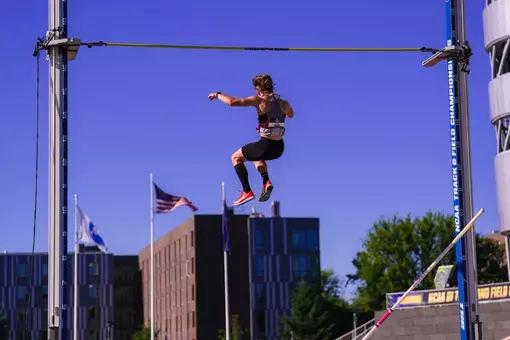
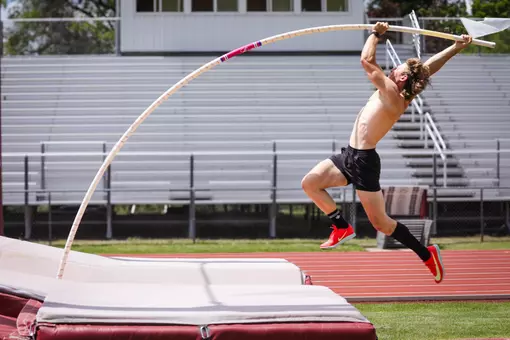
He would become a six-time Big Sky champion, four times in the pole vault, two times in the high jump. He placed fourth at the 1990 NCAA indoor championships, going 7-4.5.
He has one other bit of impressive trivia attached to his name.
He and former Washington State coach Rick Sloan, who competed at UCLA and placed seventh in the decathlon at the 1968 Olympics in Mexico City, are the only two people in the world to ever go 17 feet in the pole vault and seven feet in the high jump on the same day.
"He did that in a Bobcat-Grizzly dual meet," says Kennedy. "That dual was always hotly contested and we were trying to score points, so he did both."
He only competed in one decathlon during his time at Montana State and spent his first few years after graduation not doing much formal training of any kind, at least not the type to give him the foundation for what he decided to try to do next.
He wanted back in, to track and field, to the competitive arena. He decided to become a decathlete. Enter: the naysayers.
"You can't become a decathlete. You're too old. You're 24 and you haven't trained for three years," says Schweyen.
"That's what I loved. I said, 'Watch me.' Ten months of training and I went to the U.S. Championships and finished eighth. When people said, You can't, that's when my mind went to a higher level."
You can see why the whole coaching thing may not have worked out. Schweyen was a rare athlete, both in physical ability and competitiveness and mental toughness.
How would he deal with college athletes who were not wired like him? How would he react when they melted at a time he would have become an even tougher competitor? When they skipped a workout or didn't give it the effort it needed?
The skeptics probably gave it a month, just enough time to get through the honeymoon period. Then he'd either storm off, or they would. Either way, it wasn't meant to last.
"I've been criticized that I expect my athletes to be like me, of always thinking bigger. I don't think that's a fault. I'm going to work to make them think that way, because they have to to be successful at some point in their life," he says.
It worked because underneath the ability, the drive, the tough exterior is a man whose heart belies his other qualities. His characteristics are not necessarily simpatico.
"Performance mattered, but he truly cared about his athletes. He cared about the person first," says Sammy Evans, a three-event record holder at Montana.
After getting hired by Raunig prior to the 1997-98 season, he set about making his event areas -- the multis, the throws and the jumps -- a dominant presence in the Big Sky and an annual presence at nationals.
He coached McDonough (in 1999), Bork (in 2001 and '02) and Andrew Levin (in 2005) to all-America finishes in the decathlon.
He doubled up in 2001, when Suzanne Krings placed eighth in the pole vault at indoor nationals and again in 2005, when Dane Brubaker finished eighth in the javelin.
Dominant? How about 2002, when Montana hosted the Big Sky outdoor championships and his athletes scored 118 of the team's 158 points as the Grizzlies finished second to Weber State.
His group on its own would have finished third, behind Weber State and Northern Arizona. That night he cried himself to sleep, so happy for his athletes but so disappointed it couldn't have resulted in a team championship.
Bork won the decathlon at the '02 Big Sky championships by nearly 400 points. Fellow Grizzlies finished third (Bryan Anderson) and fourth (Trevor Gunlock), with Anderson returning to win the high jump, Louis Patrick the long jump, with Gunlock placing second.
"One of the things he did best was connecting with the athletes and getting them to see the larger picture of what their talent level could be," Bork says.
"He gets people to believe in themselves, to really set their goals high. He knew how to connect with athletes as individuals, even with so many different personalities."
Starting with Anderson's title in 2002, Montana would win six straight high jump titles at Big Sky outdoor championships, with Jas Gill and Ryan Grinnell claiming the next five.
Over time, he began refining his coaching techniques. He started making things simpler for his athletes, picking out the one thing that could make the biggest difference and focusing on that.
Once they mastered that, they advanced to the next thing. Little victories every day, the flakes of gold that are so easy to miss when we're seeking the big breakthrough.
It sounds simple, too simple. Not a lot of coaches would have the confidence to strip it down to something so easily understood and worked on.
"It's an insecurity we all have as young coaches," he says, "the insecurity that they have to let their athletes know that they know everything.
"One day you realize you don't need them to know that you think you know everything. All you need to do is get them to do this one simple thing today. If you can get them to do that, it's a major success. When we come back tomorrow, we're going to add one more simple thing."
He had it dialed in, and the results proved it over and over again. Then, after 10 years, Schweyen was gone, off to pursue his painting career full-time.
After one season without Schweyen, Raunig stepped down. A national search was conducted. Of the finalists, none was a good fit. So the administration reached out to Schweyen.
Would he come back for one year, to get the program stabilized, before another search was done?
Yes, he would, and he stayed 12 more years, unable to leave once he was back. Why? "The love of working with these athletes, watching them grow, improve, get better, believing that what you're telling them is possible."
Now in charge of the entire thing, he built not just a schedule that started with fall training and advanced through indoor to outdoor, he developed a process that created champions. It wasn't for the meek. It was geared toward the committed.
"A monster mentality. They built you up to be the strongest, the toughest," says Evans, who is working in the fitness and personal training professions in Phoenix while training for next summer's U.S. Olympic Trials.
"It's a familiar pattern, but that's what Montana athletes need to hear, knowing where so many of them come from and what they are up against," says Lindsey Hall, a 2014 all-American in the heptathlon and current assistant coach at Utah State.
"The mindset that Brian created to set us off to do our damage is what made him so powerful as a head coach. He used that chip-on-the-shoulder mentality, then he said, run with that and make it your own."
Starting in 2010, Schweyen's second year as head coach, his women's team would have four top-three finishes over the next eight years at both the Big Sky indoor and outdoor championships.
The men's team placed third at the 2014 indoor championships, second at the 2016 outdoor championships.
He did it largely using the formula that had worked at Montana State when Schweyen was an athlete, when Kennedy was coaching the women's team, Rob Stark the men's, though they mostly coached in tandem while sharing the same pool of volunteer assistant coaches.
They turned Montana State into a Big Sky power by taking in-state athletes, like Schweyen, and turning them into something special.
"You had to have the ability to develop kids out of Montana," says Kennedy. "Brian came up in a program based on recruiting primarily Montana kids. We had a hard time getting kids out of state. It was about getting the best kids out of Montana and developing them.
"He grew up in that philosophy. When he became a coach, we both began to get some out-of-state kids, but always the bread and butter of both programs has been the home-grown Montana kids."
Few athletes Schweyen had in his 12 years as head coach matched that better than Evans. Before she was someone training for the U.S. Olympic Trials, she was a senior at Havre High. Her best performance in the triple jump that year was 35 feet, four inches. That's 35 feet, four inches.
She ranked 15th among Montana high school athletes that spring.
She came to Montana and promptly ... got worse. Not literally, but her marks went down, which is part of the process.
"You're learning so much that your performance isn't going to be good," Evans says. "You're not even going to be putting up the marks you did in high school because you're changing so many things.
"He made sure when you weren't feeling good about yourself, he would hold you up for you. That was the No. 1 thing he did for me."
As a freshman, Evans continued to make the cut for bus trips, even after going 34-6.25 at Washington State in her third collegiate meet, during the 2013 indoor season.
She asked if someone else, who was performing better, should take her spot. She didn't think she was earning the right to travel, not with limited seating, not with her marks.
"We keep bringing you because you're going to be good. You're going to be one of the best," she remembers Schweyen telling her, sowing seeds of hope and promise among the weeds of doubt that were threatening to hold her down.
She broke 38 feet for the first time at the indoor championships her freshman year to finish fifth. By outdoor she had broken 40 feet. She made regionals as a sophomore, junior and senior.
"I never would have been a conference champion and definitely wouldn't have gone to regionals without Brian. He just builds people's confidence up," says Evans. "That was the No. 1 thing he did.
"I don't think we realized it, because that's all we were around. I didn't realize how unique and special that actually was until I started meeting other athletes who had competed at other schools."
And repeat. And repeat. And repeat.
"I've always believed that there is something special within Montanans, a work ethic and drive that I've always appreciated," says Schweyen. "So I made a point of getting the best Montana athletes I could, believing that hard work is going to come through and they're going to be a success.
"We had to see potential, even if they hadn't done anything. But we know they had it. Now we've got to get them believing that they are way better than they ever thought they could be. That's the path we tried to travel with those athletes."
When Hall arrived prior to the 2009-10 season out of Missoula's Big Sky High, there was the expectation that she was going to be great. Schweyen didn't skirt the issue.
He told her early her freshman year: You can be an all-American.
Some coaches may have waited to see what she became at the collegiate level. Give her a year, see how she adjusts to being a full-time track and field athlete, then reassess. Then set the goals.
"If you wait until they show you something, it's too late. That has always been our foundation," says Schweyen.
"I believe in planting that seed of what they are capable of early so that they start thinking about it and wrapping their head around it."
Hall went to regionals as a freshman and, though there were plenty of ups and downs, physically and mentally, it was the start of a five-year career that will land her in the Grizzly Sports Hall of Fame one day.
And it all started with an open, honest -- perhaps eye-opening for her -- conversation early in her freshman year. We see something in you. We're going to do everything we can to help you reach it. If you buy in and trust us, you'll reach highs you never dared dream of.
"That's something that's really special," she says. "This is what you're capable of. This is the vision you should be having. Let's talk about being an all-American now and work toward that.
"Not everyone's end game is all-American, and Brian communicates that early on. He finds that talent in Montana and utilizes the ones that come here with the mentality of working hard. Then he shows them how to work hard for other people, and that's how they succeed."
There are two other success stories that need to be told to more clearly reveal the full scope of Schweyen and how he was able to get the best out of drastically different personalities and different athletes, those of Nicole Stroot and Erika McLeod.
Stroot arrived in 2013-14 out of Superior, someone who only made the team as a walk-on the summer before after a pop-in visit to Montana's coaches' offices.
After photo day that fall, Schweyen was identifying the newcomers, or at least trying to. He was asked about Stroot and could not remember her name. There was no shame in that. After all, she had been allowed to join the team more than she had been recruited.
No one thought much of her, mainly because nobody knew much about her. That would change.
If she was another of the hoped-for diamonds in the rough, McLeod, from Butte, was just a diamond, with much expected of her. Schweyen even said before she arrived, not soon after Hall's uniform had been turned in for the final time, that McLeod was going to break all of Hall's records.
Theirs was a shared journey that took very different paths. Stroot, as a freshman, was asked to give the shot put a try. She did. She looked like a natural. She was asked to give the high jump a try. She did. She looked like a natural. All of a sudden Montana had another multi-event athlete.
She put her head down and got to work.
For all the expectations placed on McLeod, she thought she was ready for them, the talk about Big Sky championships, about regionals, nationals, all-America finishes.
Then her freshman season arrived. She placed 14th in the pentathlon at the indoor championships, 11th at the outdoor championships in the heptathlon. It was an inauspicious start.
"The first word that comes to mind is accountability," says McLeod. "For any athlete, from a bottom-line standpoint, you go into a collegiate level and it's an opportunity. It's what you do with that opportunity.
"I didn't take advantage of that opportunity my freshman year. Brian was giving me every opportunity I needed. That's what made him such a fantastic coach, helping us understand that he can only guide us so far before we have to want to transition into our own."
The moment McLeod took off and never looked back was at the Big Sky indoor championships as a sophomore.
Going into the 800 meters, the final of the pentathlon's five events, McLeod was in second place, trailing the leader by 130 points. It meant McLeod, whose PR was 2:22, would have to win the 800 by at least nine seconds.
Not impossible but certainly improbable.
"My sophomore year I had a clear understanding of everything. He was there 110 percent for me, but I had to meet him halfway," she says.
"(Before the 800 meters), I was warming up and pretty nervous. He came up to me and said, 'If I had to put my money on anybody, I'd put it on you getting it done.' That became the tone of our relationship. We had a lot of trust in what we were doing."
McLeod ran an adjusted 2:12, a 10-second PR in a big moment, the leader a 2:27. She had her first multi-events title.
But Schweyen wasn't done. It wasn't long after the indoor championships that he started getting McLeod focused on the outdoor season. He punched in some marks on his phone for the heptathlon and showed them to McLeod. He told her that that's what she could be doing by May.
"She looked at them and kind of laughed a little bit," he says. "I saved those numbers, and when that conference meet was over (and McLeod had scored 5,541 points to come within 62 of Hall's record), I showed it to her.
"I think I was maybe 14 points off from what she got. Three months prior, those marks to her were unattainable. She had the ability to buy in. That's the biggest part. They have to buy in. And when they do, they deserve the credit for what they achieve."
Some coaches may have lost something in their relationship with McLeod after a freshman season that did not meet expectations.
Schweyen had seen it before in other athletes, who did not get it right away, who needed more time, so he waited, patiently, and kept working with her and on her until she came to see what he was seeing, of what was possible.
"I didn't understand the work that something like that would take. I always considered myself a hard worker but at the collegiate level, it's so different," she says. "You don't understand the amount of sacrifices.
"He said, 'The best athletes are the best at everything. The best at nutrition, the best at recovery, the best at weight-training. I really took that to heart. Brian was so big on details. I learned from him what that looks like on and off the track."
At the same time, the conversations with Stroot were a bit different. Work ethic and sacrifices were never an issue. Confidence was. With both athletes, the conversations, so different, were constant. He refused to let either slip away, refused to allow either to accept anything but their best.
"He believed in me when maybe I didn't," says Stroot. "He challenged me in a way that I didn't think was possible for me to compete at that level. Once you achieve it, you realize he was right the whole time."
At the 2017 Big Sky indoor championships, McLeod, then a junior, won the pentathlon. Stroot, a senior, finished second.
"That's the biggest part I'll miss, the nurturing and molding of that process," Schweyen says. "There is nothing more enjoyable than watching young athletes be successful.
"When they get to the end of their careers and achieve things they never thought were possible, that's a recipe for them to go out into life and be really successful."
Stroot graduated in four years with honors. She is in her final year of vet school at Oregon State.
"It's crazy to think how much I grew through that program, the work ethic and believing in yourself and what you can do and what your mind can do," says Stroot. "I did things I didn't think I was capable of doing."
Hall says one measure of a coach is whether his or her athletes tap into the lessons learned after their days of competing are complete. "I think there were so many student-athletes who were impacted by Brian," she says.
"What stands out is how he got to know people and understand them so that he could give them what they needed," says McLeod. "That's rare in a coach.
"He saw you as a person before he saw you as an athlete and he worked from there. That's why he was so successful."
Schweyen's decision to step away, understandable and unable to be second-guessed, is a collective disappointment that radiates from the first athletes he coached in the 90s to those on last year's team, the final collection of his box set, to the ones he'll now never get the chance to coach.
"He changed so many athletes' lives," says Bork. "That will be a big loss for people who won't get to experience that."
He was uniquely and so perfectly positioned where he was, a Montanan coaching at Montana who loved nothing more than getting in-state kids, like he had once been, to be something they never dreamed they could become. (A close second: Doing the same thing with out-of-state kids.)
He had a gift, he knew a secret code, neither of which can be passed down to whomever comes next. What he had he takes with him.
He did it, not with a stopwatch or holding a whistle or a clipboard, but with his voice, the one that sold dreams. All it took was some belief and years and years of hard work. Those who bought in were almost always rewarded.
"It's a great loss, not only to the Montana track and field program but it's a loss for the Big Sky Conference. He will be missed," said Kennedy.
"It will be tough to replace Brian Schweyen. There is only one."
There is the one about all the flakes of gold lying in the grass that athletes tend to miss as they search for the big, shiny nugget that may or may not be out there, that may or may not be found.
How, if they would pay attention and recognize their importance, those mostly ignored flakes would add up over time, their accrued value far surpassing that of any one-time discovery.
The analogies he uses with his athletes work just as well on the subject of life, which is another reason he uses them. He sees that as his greater purpose, knowing track and field, and athletics in general, has the potential to lay the groundwork for a lifetime of success.
He continues: When asked about the biggest challenge of his job, he again goes analogy, how he starts each day eating breakfast and filling up on coaching credits.
In the hours he spends working with his athletes, some of them take more out of him than others, forcing him to dip into the limited amount of coaching credits he has available.
On the best of days, he ends it with a small surplus, able to give everyone what they need and ask from him. On the difficult days, he is empty before lunch. Then it becomes a struggle to give everyone what they need, namely the best of him. When he can't, he feels he's let them down.
To see Schweyen work a practice or a meet is to wonder how he does it, how he is able to give so much of himself day after day, with so many athletes taking a piece of him, then using it to become the best version of themselves, if only for one jump, one race, one throw.
Adam Bork, once coached by Schweyen, then a fellow assistant, now Schweyen's most trusted sidekick, says he sees it all the time, how distance runners, throwers, jumpers, sprinters, hurdlers, all of them make a beeline for Schweyen on meet day when they need that final little something.
Somehow he understands 80-plus athletes well enough to know just what they need in that pressure-filled moment. So they keep going back and keep finding him. And he keeps giving.
"Athletes from every event area go to Brian during competition for reassurance or just a strong high-five or motivation because he connects with people so well and is such a motivating person to be around," Bork says.
"They make one last stop to have even 10 seconds with him before their competition just to get that little bit of something special from him. That's one of the things that made him such a good coach."
Made. We'll get to that.
There is more: He says, in a way that has not even a touch of braggadocio, that he has a full set of encyclopedias of knowledge at the ready.
When freshmen arrive, he cracks open the first volume with them, regardless of event area, giving them as much information as they can handle. He knows when they are ready to move on to something more advanced.
He says the goal is to get through every volume with an athlete by the end of their career. The best use him for all he's got. Not surprisingly, their names can be found in the record book. Others never get past that first volume. He says that's fine, that he can still make them successful.
To describe the different athletes that come through his program, he has come up with a more recent analogy, about how most athletes want the big house on the hill and are willing to put in the initial investment of time and work to build the exterior.
But when it comes to addressing the inside of the home, when the tedious work to finish it off comes -- in other words, the technique training in track and field that can take years to master -- some abandon the project, some give it minimal effort, some pay attention to the details and are rewarded in full.
And they get the house they deserve. Some are empty shells. Some look good on the outside but are not well put together once someone pokes around inside. Others are meticulously appointed, the envy of the neighborhood.
And then there are some who don't want the house on the hill. They are comfortable with a tidy place down in the valley. But that doesn't mean the interior can't be spectacular. And they can be perfectly happy there.
Last week Schweyen announced his resignation. As of Sept. 4, he will no longer be the track and field coach for the Grizzlies. He has no analogy this time, just straight talk.
"I felt like this was my purpose, working with these athletes and helping them learn about themselves and what they are capable of," he says. "That's what I'm going to miss. I don't know how I am going to replace that."
He was an accidental coach, more the result of happenstance than the pursuit of a career. Hundreds of athletes, first in his work as an event coach, later as a head coach, benefitted from the stars aligning as they did more than two decades ago.
He was living in Missoula, training for the decathlon, his wife an assistant coach with the Lady Griz basketball program. He was a volunteer coach with the Grizzlies when time allowed. It was a way to stay involved, to give back but not necessarily a calling he felt he needed to answer.
In 1997, second-year coach Tom Raunig had an opening. Assistant coach Mike Ramos, a former NCAA decathlon champion at Washington, had given up his position.
"A full-time position fell in my lap. Mike told me, 'You're going to know real quick if you're a coach or not. You'll know within four years,'" Schweyen says. "I said, 'I won't be here for four years.'"
What he didn't know was that he had a gift for it. And that his gift would give back to him as much as it gave to others. He would stay on as an assistant for 10 years.
He separated himself not so much in his knowledge of technique, though there was that, but in his ability to see things in people that they couldn't see themselves, of what was possible if they would just believe with him and work towards it.
Even before he was being paid to do it.
Still pursuing the decathlon in the mid-90s, he found himself training frequently with Griz newcomer Troy McDonough, who had arrived in Missoula in the fall of 1994 from Elko, Nev.
Ramos had told McDonough he needed to look beyond the Big Sky Conference. Schweyen, who was an indoor all-American in 1990 in the high jump at Montana State, convinced him to expand his vision even more, to look even higher.
"He was the first person who told me I could be an all-American, just from workouts we had done together and the first decathlon I did," McDonough says. "He just said it matter-of-factly. You couldn't help but believe he was right.
"So even before he was my coach, he was putting ideas in my head and giving me confidence. That's where I set my sights. It was way before I was capable of making a dent nationally, but he had planted the seeds."
In the spring of 1999, McDonough, then a fifth-year senior, placed fourth at nationals. He was an all-American. With him those two days in Boise was Schweyen, now his coach, who had known it was possible all along.
McDonough would later marry Andrea Grove, a former all-America distance runner at Minnesota who was competing professionally and training in Missoula.
She wanted to get into coaching. She had her doubts. Schweyen didn't. He saw something in her that she didn't see.
She was hired at Connecticut. She turned her success there into the job at Iowa State. In 2014, her women's cross country team finished second at the NCAA championships.
She went on to North Carolina and is now the cross country and head track and field coach at Toledo.
"If it wasn't for Brian, she would not even be in the coaching profession today," says McDonough. "He was the first person who believed in her and advocated on her behalf that led to her first job."
He doesn't know the genesis of his gift, but he has his theories, of how when he was growing up, he always thought, I can do that. And when people said he couldn't, "I said BS," he says.
Coming out of East Helena, he played basketball for a season at Northern Montana College before switching to Montana State for track and field.
"Honestly he could have played basketball here. His overall athletic ability was just outstanding," says Dale Kennedy, who coached track and field at MSU from 1981 to 2018.
He was playing basketball, at least some form of it, when the Bobcat coaches got a glimpse of that athleticism. It was a YouTube moment before there ever was such a thing. Twitter would have made him a viral star.
"I saw him throw the ball off the wall near the old record board once and catch it and dunk it," said Tom Eitel back in 2006, upon Schweyen's induction into the Montana State Hall of Fame.
Using his own analogy, Schweyen, the athlete, wanted the big house on the hill. He wanted Big Sky championships, he wanted to go to nationals. He would invest in the land and the structure, then get busy finishing the interior as only the best were willing to do, down to every last detail.
"The other thing that sticks out is his competitiveness," says Kennedy. "He was always such a great competitor. It was tough in a head-to-head competition to beat him."
Eitel again, in 2006: "He could visualize better than anybody I've ever seen. He could think about what needed to be done and transfer it over. Mentally, I've never had anyone like him."
He would become a six-time Big Sky champion, four times in the pole vault, two times in the high jump. He placed fourth at the 1990 NCAA indoor championships, going 7-4.5.
He has one other bit of impressive trivia attached to his name.
He and former Washington State coach Rick Sloan, who competed at UCLA and placed seventh in the decathlon at the 1968 Olympics in Mexico City, are the only two people in the world to ever go 17 feet in the pole vault and seven feet in the high jump on the same day.
"He did that in a Bobcat-Grizzly dual meet," says Kennedy. "That dual was always hotly contested and we were trying to score points, so he did both."
He only competed in one decathlon during his time at Montana State and spent his first few years after graduation not doing much formal training of any kind, at least not the type to give him the foundation for what he decided to try to do next.
He wanted back in, to track and field, to the competitive arena. He decided to become a decathlete. Enter: the naysayers.
"You can't become a decathlete. You're too old. You're 24 and you haven't trained for three years," says Schweyen.
"That's what I loved. I said, 'Watch me.' Ten months of training and I went to the U.S. Championships and finished eighth. When people said, You can't, that's when my mind went to a higher level."
You can see why the whole coaching thing may not have worked out. Schweyen was a rare athlete, both in physical ability and competitiveness and mental toughness.
How would he deal with college athletes who were not wired like him? How would he react when they melted at a time he would have become an even tougher competitor? When they skipped a workout or didn't give it the effort it needed?
The skeptics probably gave it a month, just enough time to get through the honeymoon period. Then he'd either storm off, or they would. Either way, it wasn't meant to last.
"I've been criticized that I expect my athletes to be like me, of always thinking bigger. I don't think that's a fault. I'm going to work to make them think that way, because they have to to be successful at some point in their life," he says.
It worked because underneath the ability, the drive, the tough exterior is a man whose heart belies his other qualities. His characteristics are not necessarily simpatico.
"Performance mattered, but he truly cared about his athletes. He cared about the person first," says Sammy Evans, a three-event record holder at Montana.
After getting hired by Raunig prior to the 1997-98 season, he set about making his event areas -- the multis, the throws and the jumps -- a dominant presence in the Big Sky and an annual presence at nationals.
He coached McDonough (in 1999), Bork (in 2001 and '02) and Andrew Levin (in 2005) to all-America finishes in the decathlon.
He doubled up in 2001, when Suzanne Krings placed eighth in the pole vault at indoor nationals and again in 2005, when Dane Brubaker finished eighth in the javelin.
Dominant? How about 2002, when Montana hosted the Big Sky outdoor championships and his athletes scored 118 of the team's 158 points as the Grizzlies finished second to Weber State.
His group on its own would have finished third, behind Weber State and Northern Arizona. That night he cried himself to sleep, so happy for his athletes but so disappointed it couldn't have resulted in a team championship.
Bork won the decathlon at the '02 Big Sky championships by nearly 400 points. Fellow Grizzlies finished third (Bryan Anderson) and fourth (Trevor Gunlock), with Anderson returning to win the high jump, Louis Patrick the long jump, with Gunlock placing second.
"One of the things he did best was connecting with the athletes and getting them to see the larger picture of what their talent level could be," Bork says.
"He gets people to believe in themselves, to really set their goals high. He knew how to connect with athletes as individuals, even with so many different personalities."
Starting with Anderson's title in 2002, Montana would win six straight high jump titles at Big Sky outdoor championships, with Jas Gill and Ryan Grinnell claiming the next five.
Over time, he began refining his coaching techniques. He started making things simpler for his athletes, picking out the one thing that could make the biggest difference and focusing on that.
Once they mastered that, they advanced to the next thing. Little victories every day, the flakes of gold that are so easy to miss when we're seeking the big breakthrough.
It sounds simple, too simple. Not a lot of coaches would have the confidence to strip it down to something so easily understood and worked on.
"It's an insecurity we all have as young coaches," he says, "the insecurity that they have to let their athletes know that they know everything.
"One day you realize you don't need them to know that you think you know everything. All you need to do is get them to do this one simple thing today. If you can get them to do that, it's a major success. When we come back tomorrow, we're going to add one more simple thing."
He had it dialed in, and the results proved it over and over again. Then, after 10 years, Schweyen was gone, off to pursue his painting career full-time.
After one season without Schweyen, Raunig stepped down. A national search was conducted. Of the finalists, none was a good fit. So the administration reached out to Schweyen.
Would he come back for one year, to get the program stabilized, before another search was done?
Yes, he would, and he stayed 12 more years, unable to leave once he was back. Why? "The love of working with these athletes, watching them grow, improve, get better, believing that what you're telling them is possible."
Now in charge of the entire thing, he built not just a schedule that started with fall training and advanced through indoor to outdoor, he developed a process that created champions. It wasn't for the meek. It was geared toward the committed.
"A monster mentality. They built you up to be the strongest, the toughest," says Evans, who is working in the fitness and personal training professions in Phoenix while training for next summer's U.S. Olympic Trials.
"It's a familiar pattern, but that's what Montana athletes need to hear, knowing where so many of them come from and what they are up against," says Lindsey Hall, a 2014 all-American in the heptathlon and current assistant coach at Utah State.
"The mindset that Brian created to set us off to do our damage is what made him so powerful as a head coach. He used that chip-on-the-shoulder mentality, then he said, run with that and make it your own."
Starting in 2010, Schweyen's second year as head coach, his women's team would have four top-three finishes over the next eight years at both the Big Sky indoor and outdoor championships.
The men's team placed third at the 2014 indoor championships, second at the 2016 outdoor championships.
He did it largely using the formula that had worked at Montana State when Schweyen was an athlete, when Kennedy was coaching the women's team, Rob Stark the men's, though they mostly coached in tandem while sharing the same pool of volunteer assistant coaches.
They turned Montana State into a Big Sky power by taking in-state athletes, like Schweyen, and turning them into something special.
"You had to have the ability to develop kids out of Montana," says Kennedy. "Brian came up in a program based on recruiting primarily Montana kids. We had a hard time getting kids out of state. It was about getting the best kids out of Montana and developing them.
"He grew up in that philosophy. When he became a coach, we both began to get some out-of-state kids, but always the bread and butter of both programs has been the home-grown Montana kids."
Few athletes Schweyen had in his 12 years as head coach matched that better than Evans. Before she was someone training for the U.S. Olympic Trials, she was a senior at Havre High. Her best performance in the triple jump that year was 35 feet, four inches. That's 35 feet, four inches.
She ranked 15th among Montana high school athletes that spring.
She came to Montana and promptly ... got worse. Not literally, but her marks went down, which is part of the process.
"You're learning so much that your performance isn't going to be good," Evans says. "You're not even going to be putting up the marks you did in high school because you're changing so many things.
"He made sure when you weren't feeling good about yourself, he would hold you up for you. That was the No. 1 thing he did for me."
As a freshman, Evans continued to make the cut for bus trips, even after going 34-6.25 at Washington State in her third collegiate meet, during the 2013 indoor season.
She asked if someone else, who was performing better, should take her spot. She didn't think she was earning the right to travel, not with limited seating, not with her marks.
"We keep bringing you because you're going to be good. You're going to be one of the best," she remembers Schweyen telling her, sowing seeds of hope and promise among the weeds of doubt that were threatening to hold her down.
She broke 38 feet for the first time at the indoor championships her freshman year to finish fifth. By outdoor she had broken 40 feet. She made regionals as a sophomore, junior and senior.
"I never would have been a conference champion and definitely wouldn't have gone to regionals without Brian. He just builds people's confidence up," says Evans. "That was the No. 1 thing he did.
"I don't think we realized it, because that's all we were around. I didn't realize how unique and special that actually was until I started meeting other athletes who had competed at other schools."
And repeat. And repeat. And repeat.
"I've always believed that there is something special within Montanans, a work ethic and drive that I've always appreciated," says Schweyen. "So I made a point of getting the best Montana athletes I could, believing that hard work is going to come through and they're going to be a success.
"We had to see potential, even if they hadn't done anything. But we know they had it. Now we've got to get them believing that they are way better than they ever thought they could be. That's the path we tried to travel with those athletes."
When Hall arrived prior to the 2009-10 season out of Missoula's Big Sky High, there was the expectation that she was going to be great. Schweyen didn't skirt the issue.
He told her early her freshman year: You can be an all-American.
Some coaches may have waited to see what she became at the collegiate level. Give her a year, see how she adjusts to being a full-time track and field athlete, then reassess. Then set the goals.
"If you wait until they show you something, it's too late. That has always been our foundation," says Schweyen.
"I believe in planting that seed of what they are capable of early so that they start thinking about it and wrapping their head around it."
Hall went to regionals as a freshman and, though there were plenty of ups and downs, physically and mentally, it was the start of a five-year career that will land her in the Grizzly Sports Hall of Fame one day.
And it all started with an open, honest -- perhaps eye-opening for her -- conversation early in her freshman year. We see something in you. We're going to do everything we can to help you reach it. If you buy in and trust us, you'll reach highs you never dared dream of.
"That's something that's really special," she says. "This is what you're capable of. This is the vision you should be having. Let's talk about being an all-American now and work toward that.
"Not everyone's end game is all-American, and Brian communicates that early on. He finds that talent in Montana and utilizes the ones that come here with the mentality of working hard. Then he shows them how to work hard for other people, and that's how they succeed."
There are two other success stories that need to be told to more clearly reveal the full scope of Schweyen and how he was able to get the best out of drastically different personalities and different athletes, those of Nicole Stroot and Erika McLeod.
Stroot arrived in 2013-14 out of Superior, someone who only made the team as a walk-on the summer before after a pop-in visit to Montana's coaches' offices.
After photo day that fall, Schweyen was identifying the newcomers, or at least trying to. He was asked about Stroot and could not remember her name. There was no shame in that. After all, she had been allowed to join the team more than she had been recruited.
No one thought much of her, mainly because nobody knew much about her. That would change.
If she was another of the hoped-for diamonds in the rough, McLeod, from Butte, was just a diamond, with much expected of her. Schweyen even said before she arrived, not soon after Hall's uniform had been turned in for the final time, that McLeod was going to break all of Hall's records.
Theirs was a shared journey that took very different paths. Stroot, as a freshman, was asked to give the shot put a try. She did. She looked like a natural. She was asked to give the high jump a try. She did. She looked like a natural. All of a sudden Montana had another multi-event athlete.
She put her head down and got to work.
For all the expectations placed on McLeod, she thought she was ready for them, the talk about Big Sky championships, about regionals, nationals, all-America finishes.
Then her freshman season arrived. She placed 14th in the pentathlon at the indoor championships, 11th at the outdoor championships in the heptathlon. It was an inauspicious start.
"The first word that comes to mind is accountability," says McLeod. "For any athlete, from a bottom-line standpoint, you go into a collegiate level and it's an opportunity. It's what you do with that opportunity.
"I didn't take advantage of that opportunity my freshman year. Brian was giving me every opportunity I needed. That's what made him such a fantastic coach, helping us understand that he can only guide us so far before we have to want to transition into our own."
The moment McLeod took off and never looked back was at the Big Sky indoor championships as a sophomore.
Going into the 800 meters, the final of the pentathlon's five events, McLeod was in second place, trailing the leader by 130 points. It meant McLeod, whose PR was 2:22, would have to win the 800 by at least nine seconds.
Not impossible but certainly improbable.
"My sophomore year I had a clear understanding of everything. He was there 110 percent for me, but I had to meet him halfway," she says.
"(Before the 800 meters), I was warming up and pretty nervous. He came up to me and said, 'If I had to put my money on anybody, I'd put it on you getting it done.' That became the tone of our relationship. We had a lot of trust in what we were doing."
McLeod ran an adjusted 2:12, a 10-second PR in a big moment, the leader a 2:27. She had her first multi-events title.
But Schweyen wasn't done. It wasn't long after the indoor championships that he started getting McLeod focused on the outdoor season. He punched in some marks on his phone for the heptathlon and showed them to McLeod. He told her that that's what she could be doing by May.
"She looked at them and kind of laughed a little bit," he says. "I saved those numbers, and when that conference meet was over (and McLeod had scored 5,541 points to come within 62 of Hall's record), I showed it to her.
"I think I was maybe 14 points off from what she got. Three months prior, those marks to her were unattainable. She had the ability to buy in. That's the biggest part. They have to buy in. And when they do, they deserve the credit for what they achieve."
Some coaches may have lost something in their relationship with McLeod after a freshman season that did not meet expectations.
Schweyen had seen it before in other athletes, who did not get it right away, who needed more time, so he waited, patiently, and kept working with her and on her until she came to see what he was seeing, of what was possible.
"I didn't understand the work that something like that would take. I always considered myself a hard worker but at the collegiate level, it's so different," she says. "You don't understand the amount of sacrifices.
"He said, 'The best athletes are the best at everything. The best at nutrition, the best at recovery, the best at weight-training. I really took that to heart. Brian was so big on details. I learned from him what that looks like on and off the track."
At the same time, the conversations with Stroot were a bit different. Work ethic and sacrifices were never an issue. Confidence was. With both athletes, the conversations, so different, were constant. He refused to let either slip away, refused to allow either to accept anything but their best.
"He believed in me when maybe I didn't," says Stroot. "He challenged me in a way that I didn't think was possible for me to compete at that level. Once you achieve it, you realize he was right the whole time."
At the 2017 Big Sky indoor championships, McLeod, then a junior, won the pentathlon. Stroot, a senior, finished second.
"That's the biggest part I'll miss, the nurturing and molding of that process," Schweyen says. "There is nothing more enjoyable than watching young athletes be successful.
"When they get to the end of their careers and achieve things they never thought were possible, that's a recipe for them to go out into life and be really successful."
Stroot graduated in four years with honors. She is in her final year of vet school at Oregon State.
"It's crazy to think how much I grew through that program, the work ethic and believing in yourself and what you can do and what your mind can do," says Stroot. "I did things I didn't think I was capable of doing."
Hall says one measure of a coach is whether his or her athletes tap into the lessons learned after their days of competing are complete. "I think there were so many student-athletes who were impacted by Brian," she says.
"What stands out is how he got to know people and understand them so that he could give them what they needed," says McLeod. "That's rare in a coach.
"He saw you as a person before he saw you as an athlete and he worked from there. That's why he was so successful."
Schweyen's decision to step away, understandable and unable to be second-guessed, is a collective disappointment that radiates from the first athletes he coached in the 90s to those on last year's team, the final collection of his box set, to the ones he'll now never get the chance to coach.
"He changed so many athletes' lives," says Bork. "That will be a big loss for people who won't get to experience that."
He was uniquely and so perfectly positioned where he was, a Montanan coaching at Montana who loved nothing more than getting in-state kids, like he had once been, to be something they never dreamed they could become. (A close second: Doing the same thing with out-of-state kids.)
He had a gift, he knew a secret code, neither of which can be passed down to whomever comes next. What he had he takes with him.
He did it, not with a stopwatch or holding a whistle or a clipboard, but with his voice, the one that sold dreams. All it took was some belief and years and years of hard work. Those who bought in were almost always rewarded.
"It's a great loss, not only to the Montana track and field program but it's a loss for the Big Sky Conference. He will be missed," said Kennedy.
"It will be tough to replace Brian Schweyen. There is only one."
Players Mentioned

Jumps
/ Women's Track and Field
Multi-events
/ Women's Track and Field
Multi-events
/ Women's Track and FieldFriday, June 19
Thursday, June 04
Friday, May 01
Friday, May 01