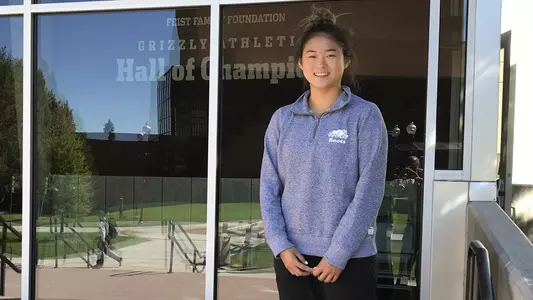
The Craig Hall Chronicles :: Camellia Xu
9/11/2020 6:49:00 PM | Soccer
When Wei Wei Xu and Vivian Zhou emigrated from China to Canada in 2001, they did so to give their children -- both of them still unborn -- opportunities they never had.
And a life they could have only dreamed of.
Both grew up poor but managed to put themselves through the Beijing Film Academy, where they met.
They were living in the city in 1989 when protests began to spring up in April, students speaking out against inflation, political corruption, the stifling of free speech.
As the spring grew warmer, the uprisings continued to increase in number and intensity. The world began to take notice. It was a compelling David-and-Goliath moment.
"We were young. We wanted our voice to be heard," says Vivian, who grew up speaking Mandarin, then learned Cantonese before picking up English. She speaks it well but in a deliberate, thoughtful manner, pausing often to get the words right.
"You don't hesitate to join the protest. You want to contribute your passion, you want something to change, you want to be heard. If something change, that would be so great. You witnessed everything."
In early June, with more and more students and their supporters putting their hopes into action and their dreams into demands, martial law was declared. The Chinese Communist Party had seen enough.
The People's Liberation Army, both troops and tanks, was sent in to secure Beijing. David had no chance.
The Tiananmen Square Massacre took place on June 4. Hundreds of protestors were killed. Some believe the number to be in the thousands. The rest scattered to safety. It was a forcible end to the protests.
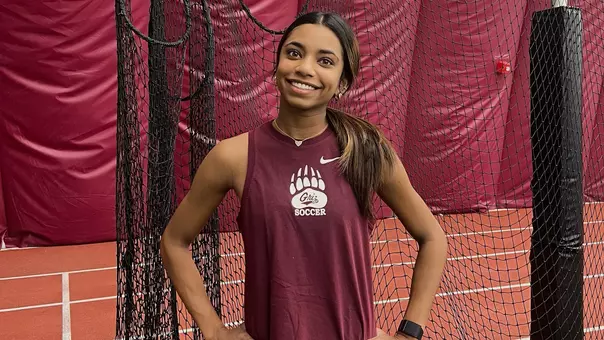
"After that day, they said, we're not going to have kids in this country. We're going to work out butts off and find somewhere safer for our kids to grow up," says the older of those two children, Camellia Xu, a freshman goalkeeper on the Montana soccer team.
They moved from Beijing, south to Guangzhou. He worked as an assistant director in the film industry. She became a voice-over actress, putting new words to Western movies.
They thought that was their lot in life, until he began to work with crewmen from Singapore, Taiwan, Hong Kong. "They had conversations. Immigration kind of stuff," says Vivian.
They were unaware. They had believed it was only possible to get out, to start new somewhere else, if there was a relative in another country, someone who could act as a sponsor. That that was not the case opened a door. "We think, oh, that a very good idea," she says.
The process takes years. During that time he opened his own production studio, began making a name for himself for his studio's television commercials. Business boomed. They were financially becoming more and more stable.
They still dreamed of leaving the country, but ...
"We do same job in Canada as in China? That's impossible," says Vivian. Their immigration papers were approved. "We have to make a decision."
Canada had opened its arms to the family.
"When we first landed in Vancouver, we just fell in love with this city and this country," she says. "I stayed to start a new life." That was 2001. Their first of two daughters was born in 2002. She hasn't visited her parents' homeland since the age of two.
Her father would spend the first decade of her life more in China than in Canada, providing for the family by operating his business, there for a two-month project, back home with the family for a month. Repeat.
"I understood what he was doing," says Camellia. "It was ingrained in my head that what my dad was doing was for the family. I'm so grateful for it. What he did was more than I ever could have asked for."
Those opportunities they sought for their children? It was what they knew, music, dance, acting, the arts. Sports? "Oh, no, no, no," Vivian says.
She wasn't against the idea. She just didn't know much about it. Sports had never been part of her life.
Always supportive, she is still coming to terms with it, nearly two decades later, of seeing her daughter -- who says, "I like to run through kids, which sounds horrifying" -- being combative as a goalkeeper.
It wasn't long ago her daughter was playing a match in Portland. She got hit, went to the ground, stayed there. A trainer sprinted out to check on her.
"At that moment, I feel like the blood all go up here," Vivian says, pointing to the top of her head. "So suddenly I was passed out.
"The other parents check on me. Everybody just laugh. Hey Cam, your mom! She feels so embarrassed. Most of the time, her dad will go to watch her game."
They settled in Port Moody, 10 miles east of Vancouver, where ice hockey is the sport of choice in the province. Every other sport is so far down the list of popularity, there is no second.
Cam tried skating. Loved it. Showed an aptitude for it, which would repeat itself with nearly every sport she tried on for size (outside of rhythmic gymnastics: "I absolutely hated it, the leotards and everything about it.")
One of her instructors approached Vivian after a practice. Said her daughter could be good, really good at ice hockey. Her old-world mentalities couldn't reconcile with the revelation.
"What? Hockey player? A boys' sport? A girl can play?" she recalls saying.
"(Cam) very serious. Oh, no, no. I heard hockey players got up early, around 5 o'clock for training. They travel a lot. And hockey is more violent with the fights. Maybe choose other sport, like swimming, gymnastics."
She did, tennis as well, and she was good enough at that sport that she made the provincial tennis team.
She did not begin playing soccer until the age of eight, which should read like a balm for any parents who are worried their girls are not juggling soccer balls a month after they've learned to walk.
Her first team? The Snowflakes. Her first game? It went about as well as you'd expect for a newcomer after two practices.
"So funny," says Vivian. "The second half she go to the other side. Coach said, 'Camellia, that side. You need to shoot at that side.' All the other kids have experience how to play soccer. She brand new. Cam, the other side!"
Still: "I got my first taste of soccer and was hooked," Cam says.
She was big for her age, had speed that was at odds with her background, of parents who had never been into sports, and she had energy, so much energy, the memory of which Vivian responds to with a rueful laugh and shake of her head.
And she wanted not just the ball but the spotlight and all that comes with it. "My desire to play soccer was, I want all the glory," she says. "I wanted to score all the goals."
But this was youth soccer, the most egalitarian of sports. In other words, somebody had to be the goalkeeper.
One day it was her turn. Cam, you're tall. You can kick a ball. You're going to stand in net for this game, her coach told her, doing nothing to add to the attractiveness of the position.
Stand in net for this game, as if it was simply a spot on the field that, by rule, had to be held down, not an important component of the outcome, a position everybody had to suffer through so the rest of the team could, you know, have fun.
"You do nothing the whole game, and that's not what I wanted to do," she says. "I'm pretty sure at some point I sat down. What am I doing? This isn't soccer.
"I hated it, but I was good at it." The Camellia Xu epitaph, to one day be inscribed on the crossbar of one of the goals at South Campus Stadium after she adds her name to the list of Grizzly greats.
She hated it only as long as it took her to realize that there was glory to be had in defending a goal as much as there was in attacking one.
"Oh my god, you saved the game! I thought, maybe I'll stick with this," she says. Not only that, the position matched up with her personality and her physicality.
"I was really fearless as a kid. Kids would run at me and I'd run right at them and run right through them. Other kids were scared of the ball. I was not scared of the ball."
Somewhere, Vivian Zhou gasps in disbelief, that this is her daughter, so different. Somewhere, Montana goalkeeper coach J. Landham nods his head and dreams of the seasons ahead.
As for her rise up the soccer ladder, just know this: It's complicated, just like it is in the U.S.
There are the base leagues, where you sign up and play in your age group and no one is cut. Above that, there are bronze, silver and gold select teams, those a player has to go through a tryout to make.
At U13, gold is split once again, this time into two teams. Beyond that is Team British Columbia, recognition that you're the best at a position in your age group in a province of five million.
All the while Vancouver Whitecaps FC is watching, monitoring, evaluating, one of the country's three National Training Centers funded by Canada Soccer.
It's part of the feeder system into the Canadian U20 junior national team and senior national team. It's the kind of place an aspiring player doesn't reach out to. They contact you.
"College coaches fly in to see the club. That's how reputable Whitecaps FC is," says Xu.
She got an email one day. She went through a trial phase, a very long trial phase. Then she got another email. She was in.
She lived at home, but the rest of her life was there. Lifting in the morning. Then school. Then training in the afternoon. Then finally back home, a life in full motion.
Here is the math: There are three National Training Centers in Canada. She was one of three goalkeepers training with Whitecaps her senior year, an '02 along with an '03 and '04.
The best goalkeeper in the U20 pool in Canada? That would be Anna Karpenko, who is a freshman at Harvard. That's not our evaluation, that's Xu's.
"She's so good, it's insane. She's next level. She's been dominating that position for so long," she says.
It's a matter of perspective. She is in a pool of maybe eight goalkeepers in Canada in the U20 age group who have been chosen, "but there are fewer people in Canada than in California."
Yet, "just to make one of those teams or even a camp would be amazing."
In 2014, Whitecaps hired Ryan Clark -- "the man, the myth, the legend," says Xu -- as the club's Manager of Collegiate Transition. He has one primary job. Get Whitecap players into college programs.
It was Xu's abilities and Clark's connections that got her set up with both LSU and Houston, the final two schools on her list.
You might be asking yourself: After being the primary caretaker for her daughters, wouldn't Vivian be the type to try to convince her oldest daughter to remain close to home? Or at least nudge her in that direction?
After all, Simon Fraser University borders Port Moody. She could live at home! The University of British Columbia is less than 20 miles away.
To understand why her mom gave Camellia the green light to go wherever she wanted to go, you need to jump back to when Vivian was the same age, living with her family near Shanghai.
"My parents, they hope I can stay closer with them, hopefully not too far away," she says. "But I choose to leave the hometown and go to Beijing."
She is asked if she has ever had regrets about her decision. "No, no, no. I'm so happy we live in North America.
"I'm so glad my parents let me leave, so I have more opportunity to experience my life. To Camellia, everything is open. It's your choice. You make your decision. You choose what you want, your interest, your passion. Follow your heart. Whatever you do, we always support you."
That choice came down to two schools, until her decision was made for her, the day Brian Lee, who led LSU to six NCAA tournaments in 14 years, departed for Rice. It was Houston by default.
"They had given me an idea about money and how they see me in the program. Everything was looking great," she says.
Remember that as we go from south Texas to Canada, from Vancouver by plane to Toronto, where Xu's family landed, ready to enjoy a long loop of a vacation down to Washington D.C. and back up through New York and Boston the summer before her senior year.
When they landed and picked up the van that would haul them on their journey, no one thought much about it. It had Montana plates.
It was on that trip that Xu got a phone call from Houston coach Diego Bocanegra. His athletic department had undergone a change in finances. He could no longer promise her what had been offered.
He didn't need to be so upfront. He could have let the fall play out, then break the news to her right before signing day, when she would have had no other option but to take the bad news and put pen to paper anyway.
"I'm grateful for him being so open and honest with me," says Xu, whose vacation was ruined nonetheless. "I broke down in tears then and there. I cried for two days.
"Then I panicked. I'm on summer vacation heading into my senior year and I've just learned the offer I was going to take is no longer there." There were no Plan B's at that point.
When she returned home, she turned into a sophomore all over again, mass-emailing every school she could think of, asking if they had any interest.
Almost all of the replies were the same: We think you're amazing, but we're out of scholarship money. "No one was recruiting seniors at that point," says Xu.
On the day her email arrived in the in-box of second-year Montana coach Chris Citowicki, he and his team had just returned from opening the 2019 season with a pair of road draws against North Dakota and North Dakota State.
He briefly looked at the recruiting video, saw it was a goalkeeper and sent it to Landham.
On that day, his recruiting for the class of 2020 was done. Complete. He was already focused on 2021s, '22s. Landham snapped him out of that idea, screaming from across the hall in excitement.
They began talking about the program's remaining scholarship money.
"The organization she comes from is what first sparked my interest," Landham says. "We know Whitecaps has a team culture that is similar to ours, one that is both deliberate and defined.
"So if she had made it to that environment and had been chosen by them, that made me press the play button, because we get a lot of videos."
It wasn't just a highlight tape, a collection of diving saves and getting enough of a finger on a ball to redirect it over the crossbar. It had been put together to showcase her overall skills.
It had been put together by someone who knew what the Landhams of the world would be looking for.
"It wasn't just short clips of saves. It was the moments leading up to saves that showed me she knows how to make good decisions," says Landham. "At this level, a good decision versus a bad decision is a save versus a goal.
"She checked all the most important boxes. Decision-making, capability, distribution." And she was suddenly and unexpectedly available. "We knew we needed to move quickly."
Other coaches had replied to her emails, asking to set up a phone call, only to tell her they didn't have much to offer, which was a waste of time for both sides.
So she wasn't expecting much when Landham did the same thing.
When they connected, it wasn't just Landham on the other end, it was Landham, Citowicki and assistant coach Katie Benz.
"I didn't think all three coaches were going to be on," Xu says. "Within five minutes I knew I really, really liked these coaches. They were what I thought I should have been experiencing before. Why am I only seeing this now?"
At some point, her mom listened in on a call. She had the same reaction.
"Chris's passion for the soccer is so different than the other coaches we talked to before," Vivian says. "So different. I don't know how to describe it. The first conversation, oh, that's probably the right place for Camellia to be, in this program."
College recruiting is rarely only between a coach and a player. The necessary relationships are much more extensive than that. In soccer, so much of it has to do with the clubs those players are in and the coaches who run them. Get in right with them and let the pipeline open.
There is no guarantee of anything ever coming from it again, but this was a double win. A high-level goalkeeper from a club where it's nice to have made some in-roads.
"We've wanted to break into that club and develop some relationships to get more of those players," says Citowicki. "Whitecaps is one of the top clubs in Canada."
Within two days, a visit was set up, on Homecoming weekend, one week after she and her mom took a trip to Boone, North Carolina, to visit Appalachian State.
She wanted to visit Appalachian State first. She had a feeling about Montana, and if her hunch was correct, she didn't want it to be spoiled by a trip to a school that did not match up.
In other words, she had an order in her head. She wanted to save what she thought would be the best for last.
"Within two hours, I fell in love with this place," she says. "I told my mom I wanted to go here. She was like, 'I already know that. I can see it on your face.'"
She attended her first-ever football game. Then she sat down in Citowicki's office and got the full pitch and an offer. So what did she think?
"I said, I'll think about it, but inside I was like, yes, yes, yes, yes," she says. "The only reason was I had to go back and tell Ryan (Clark) first. Are you sure? I've never been more positive in my life.
"I called and on their end they just started cheering. They really made a dream come true of playing college soccer."
She is one of the better goalkeepers in Canada. It tells you how good Claire Howard is that Xu speaks about the fifth-year senior the way she does.
"I came in knowing full well who Claire Howard was. She is an absolute powerhouse," says Xu. "I came here seeing her as an idol. She almost glowed when I saw her. She is who I want to be.
"She has so much confidence in her own game. I aspire to be like that. So consistent. It's like watching poetry in motion."
It wasn't until Citowicki was able to spend more time with Xu that he had that moment of realization, the ah-ha, I knew there was a connection between us.
He was born in Poland and his family fled the country when he was two, with stops in Italy and South Africa before settling in Australia.
He came to the U.S. in his late teens, seeking the promise of everything America had to offer to those willing to work for it.
It wasn't to become rich or powerful. It's to do what he's doing now, in a place like this. How do you thank a country for that?
Had he grown up in the U.S., he would have gone all in on attending the United State Military Academy, better known as West Point.
"There is just something about service and serving your country that I'm really drawn to," he says.
Had she not risen to the level she did, had she not had the opportunity to play college soccer, Xu would have gone all in on attending Royal Military College, the military college of the Canadian Armed Forces.
She still plans on enlisting in some capacity after graduating from Montana.
"My parents moving here and giving me the opportunity to grow up in Canada and the Western environment, I'm so grateful for it," she says.
"I often think about what life would be like if I had grown up in China. A lot of the possibilities would not have been possible. I want to enlist because I love my country and everything it's given me."
"There are a lot of cool similarities between us that I appreciate," says Citowicki. "She's been a blessing. I can't believe we got her here. She's an exceptionally high-level goalkeeper who is going to be very, very good.
"The more you talk to her and get to know her, who she is as a person is pretty special too. There is a maturity to her that you normally don't find in a freshman."
So Montana's next great goalkeeper, in a long line of them, is Chinese by ethnicity but was born and raised in Canada. Now she's in the United States pursuing her dreams.
Constant through it all is that family name, Xu. Think that might reveal anything, about how this is going to all work out? She is asked the pronunciation. "Zoo," she says. "Like Zootown." Home already.
And a life they could have only dreamed of.
Both grew up poor but managed to put themselves through the Beijing Film Academy, where they met.
They were living in the city in 1989 when protests began to spring up in April, students speaking out against inflation, political corruption, the stifling of free speech.
As the spring grew warmer, the uprisings continued to increase in number and intensity. The world began to take notice. It was a compelling David-and-Goliath moment.
"We were young. We wanted our voice to be heard," says Vivian, who grew up speaking Mandarin, then learned Cantonese before picking up English. She speaks it well but in a deliberate, thoughtful manner, pausing often to get the words right.
"You don't hesitate to join the protest. You want to contribute your passion, you want something to change, you want to be heard. If something change, that would be so great. You witnessed everything."
In early June, with more and more students and their supporters putting their hopes into action and their dreams into demands, martial law was declared. The Chinese Communist Party had seen enough.
The People's Liberation Army, both troops and tanks, was sent in to secure Beijing. David had no chance.
The Tiananmen Square Massacre took place on June 4. Hundreds of protestors were killed. Some believe the number to be in the thousands. The rest scattered to safety. It was a forcible end to the protests.
"After that day, they said, we're not going to have kids in this country. We're going to work out butts off and find somewhere safer for our kids to grow up," says the older of those two children, Camellia Xu, a freshman goalkeeper on the Montana soccer team.
They moved from Beijing, south to Guangzhou. He worked as an assistant director in the film industry. She became a voice-over actress, putting new words to Western movies.
They thought that was their lot in life, until he began to work with crewmen from Singapore, Taiwan, Hong Kong. "They had conversations. Immigration kind of stuff," says Vivian.
They were unaware. They had believed it was only possible to get out, to start new somewhere else, if there was a relative in another country, someone who could act as a sponsor. That that was not the case opened a door. "We think, oh, that a very good idea," she says.
The process takes years. During that time he opened his own production studio, began making a name for himself for his studio's television commercials. Business boomed. They were financially becoming more and more stable.
They still dreamed of leaving the country, but ...
"We do same job in Canada as in China? That's impossible," says Vivian. Their immigration papers were approved. "We have to make a decision."
Canada had opened its arms to the family.
"When we first landed in Vancouver, we just fell in love with this city and this country," she says. "I stayed to start a new life." That was 2001. Their first of two daughters was born in 2002. She hasn't visited her parents' homeland since the age of two.
Her father would spend the first decade of her life more in China than in Canada, providing for the family by operating his business, there for a two-month project, back home with the family for a month. Repeat.
"I understood what he was doing," says Camellia. "It was ingrained in my head that what my dad was doing was for the family. I'm so grateful for it. What he did was more than I ever could have asked for."
Those opportunities they sought for their children? It was what they knew, music, dance, acting, the arts. Sports? "Oh, no, no, no," Vivian says.
She wasn't against the idea. She just didn't know much about it. Sports had never been part of her life.
Always supportive, she is still coming to terms with it, nearly two decades later, of seeing her daughter -- who says, "I like to run through kids, which sounds horrifying" -- being combative as a goalkeeper.
It wasn't long ago her daughter was playing a match in Portland. She got hit, went to the ground, stayed there. A trainer sprinted out to check on her.
"At that moment, I feel like the blood all go up here," Vivian says, pointing to the top of her head. "So suddenly I was passed out.
"The other parents check on me. Everybody just laugh. Hey Cam, your mom! She feels so embarrassed. Most of the time, her dad will go to watch her game."
They settled in Port Moody, 10 miles east of Vancouver, where ice hockey is the sport of choice in the province. Every other sport is so far down the list of popularity, there is no second.
Cam tried skating. Loved it. Showed an aptitude for it, which would repeat itself with nearly every sport she tried on for size (outside of rhythmic gymnastics: "I absolutely hated it, the leotards and everything about it.")
One of her instructors approached Vivian after a practice. Said her daughter could be good, really good at ice hockey. Her old-world mentalities couldn't reconcile with the revelation.
"What? Hockey player? A boys' sport? A girl can play?" she recalls saying.
"(Cam) very serious. Oh, no, no. I heard hockey players got up early, around 5 o'clock for training. They travel a lot. And hockey is more violent with the fights. Maybe choose other sport, like swimming, gymnastics."
She did, tennis as well, and she was good enough at that sport that she made the provincial tennis team.
She did not begin playing soccer until the age of eight, which should read like a balm for any parents who are worried their girls are not juggling soccer balls a month after they've learned to walk.
Her first team? The Snowflakes. Her first game? It went about as well as you'd expect for a newcomer after two practices.
"So funny," says Vivian. "The second half she go to the other side. Coach said, 'Camellia, that side. You need to shoot at that side.' All the other kids have experience how to play soccer. She brand new. Cam, the other side!"
Still: "I got my first taste of soccer and was hooked," Cam says.
She was big for her age, had speed that was at odds with her background, of parents who had never been into sports, and she had energy, so much energy, the memory of which Vivian responds to with a rueful laugh and shake of her head.
And she wanted not just the ball but the spotlight and all that comes with it. "My desire to play soccer was, I want all the glory," she says. "I wanted to score all the goals."
But this was youth soccer, the most egalitarian of sports. In other words, somebody had to be the goalkeeper.
One day it was her turn. Cam, you're tall. You can kick a ball. You're going to stand in net for this game, her coach told her, doing nothing to add to the attractiveness of the position.
Stand in net for this game, as if it was simply a spot on the field that, by rule, had to be held down, not an important component of the outcome, a position everybody had to suffer through so the rest of the team could, you know, have fun.
"You do nothing the whole game, and that's not what I wanted to do," she says. "I'm pretty sure at some point I sat down. What am I doing? This isn't soccer.
"I hated it, but I was good at it." The Camellia Xu epitaph, to one day be inscribed on the crossbar of one of the goals at South Campus Stadium after she adds her name to the list of Grizzly greats.
She hated it only as long as it took her to realize that there was glory to be had in defending a goal as much as there was in attacking one.
"Oh my god, you saved the game! I thought, maybe I'll stick with this," she says. Not only that, the position matched up with her personality and her physicality.
"I was really fearless as a kid. Kids would run at me and I'd run right at them and run right through them. Other kids were scared of the ball. I was not scared of the ball."
Somewhere, Vivian Zhou gasps in disbelief, that this is her daughter, so different. Somewhere, Montana goalkeeper coach J. Landham nods his head and dreams of the seasons ahead.
As for her rise up the soccer ladder, just know this: It's complicated, just like it is in the U.S.
There are the base leagues, where you sign up and play in your age group and no one is cut. Above that, there are bronze, silver and gold select teams, those a player has to go through a tryout to make.
At U13, gold is split once again, this time into two teams. Beyond that is Team British Columbia, recognition that you're the best at a position in your age group in a province of five million.
All the while Vancouver Whitecaps FC is watching, monitoring, evaluating, one of the country's three National Training Centers funded by Canada Soccer.
It's part of the feeder system into the Canadian U20 junior national team and senior national team. It's the kind of place an aspiring player doesn't reach out to. They contact you.
"College coaches fly in to see the club. That's how reputable Whitecaps FC is," says Xu.
She got an email one day. She went through a trial phase, a very long trial phase. Then she got another email. She was in.
She lived at home, but the rest of her life was there. Lifting in the morning. Then school. Then training in the afternoon. Then finally back home, a life in full motion.
Here is the math: There are three National Training Centers in Canada. She was one of three goalkeepers training with Whitecaps her senior year, an '02 along with an '03 and '04.
The best goalkeeper in the U20 pool in Canada? That would be Anna Karpenko, who is a freshman at Harvard. That's not our evaluation, that's Xu's.
"She's so good, it's insane. She's next level. She's been dominating that position for so long," she says.
It's a matter of perspective. She is in a pool of maybe eight goalkeepers in Canada in the U20 age group who have been chosen, "but there are fewer people in Canada than in California."
Yet, "just to make one of those teams or even a camp would be amazing."
In 2014, Whitecaps hired Ryan Clark -- "the man, the myth, the legend," says Xu -- as the club's Manager of Collegiate Transition. He has one primary job. Get Whitecap players into college programs.
It was Xu's abilities and Clark's connections that got her set up with both LSU and Houston, the final two schools on her list.
You might be asking yourself: After being the primary caretaker for her daughters, wouldn't Vivian be the type to try to convince her oldest daughter to remain close to home? Or at least nudge her in that direction?
After all, Simon Fraser University borders Port Moody. She could live at home! The University of British Columbia is less than 20 miles away.
To understand why her mom gave Camellia the green light to go wherever she wanted to go, you need to jump back to when Vivian was the same age, living with her family near Shanghai.
"My parents, they hope I can stay closer with them, hopefully not too far away," she says. "But I choose to leave the hometown and go to Beijing."
She is asked if she has ever had regrets about her decision. "No, no, no. I'm so happy we live in North America.
"I'm so glad my parents let me leave, so I have more opportunity to experience my life. To Camellia, everything is open. It's your choice. You make your decision. You choose what you want, your interest, your passion. Follow your heart. Whatever you do, we always support you."
That choice came down to two schools, until her decision was made for her, the day Brian Lee, who led LSU to six NCAA tournaments in 14 years, departed for Rice. It was Houston by default.
"They had given me an idea about money and how they see me in the program. Everything was looking great," she says.
Remember that as we go from south Texas to Canada, from Vancouver by plane to Toronto, where Xu's family landed, ready to enjoy a long loop of a vacation down to Washington D.C. and back up through New York and Boston the summer before her senior year.
When they landed and picked up the van that would haul them on their journey, no one thought much about it. It had Montana plates.
It was on that trip that Xu got a phone call from Houston coach Diego Bocanegra. His athletic department had undergone a change in finances. He could no longer promise her what had been offered.
He didn't need to be so upfront. He could have let the fall play out, then break the news to her right before signing day, when she would have had no other option but to take the bad news and put pen to paper anyway.
"I'm grateful for him being so open and honest with me," says Xu, whose vacation was ruined nonetheless. "I broke down in tears then and there. I cried for two days.
"Then I panicked. I'm on summer vacation heading into my senior year and I've just learned the offer I was going to take is no longer there." There were no Plan B's at that point.
When she returned home, she turned into a sophomore all over again, mass-emailing every school she could think of, asking if they had any interest.
Almost all of the replies were the same: We think you're amazing, but we're out of scholarship money. "No one was recruiting seniors at that point," says Xu.
On the day her email arrived in the in-box of second-year Montana coach Chris Citowicki, he and his team had just returned from opening the 2019 season with a pair of road draws against North Dakota and North Dakota State.
He briefly looked at the recruiting video, saw it was a goalkeeper and sent it to Landham.
On that day, his recruiting for the class of 2020 was done. Complete. He was already focused on 2021s, '22s. Landham snapped him out of that idea, screaming from across the hall in excitement.
They began talking about the program's remaining scholarship money.
"The organization she comes from is what first sparked my interest," Landham says. "We know Whitecaps has a team culture that is similar to ours, one that is both deliberate and defined.
"So if she had made it to that environment and had been chosen by them, that made me press the play button, because we get a lot of videos."
It wasn't just a highlight tape, a collection of diving saves and getting enough of a finger on a ball to redirect it over the crossbar. It had been put together to showcase her overall skills.
It had been put together by someone who knew what the Landhams of the world would be looking for.
"It wasn't just short clips of saves. It was the moments leading up to saves that showed me she knows how to make good decisions," says Landham. "At this level, a good decision versus a bad decision is a save versus a goal.
"She checked all the most important boxes. Decision-making, capability, distribution." And she was suddenly and unexpectedly available. "We knew we needed to move quickly."
Other coaches had replied to her emails, asking to set up a phone call, only to tell her they didn't have much to offer, which was a waste of time for both sides.
So she wasn't expecting much when Landham did the same thing.
When they connected, it wasn't just Landham on the other end, it was Landham, Citowicki and assistant coach Katie Benz.
"I didn't think all three coaches were going to be on," Xu says. "Within five minutes I knew I really, really liked these coaches. They were what I thought I should have been experiencing before. Why am I only seeing this now?"
At some point, her mom listened in on a call. She had the same reaction.
"Chris's passion for the soccer is so different than the other coaches we talked to before," Vivian says. "So different. I don't know how to describe it. The first conversation, oh, that's probably the right place for Camellia to be, in this program."
College recruiting is rarely only between a coach and a player. The necessary relationships are much more extensive than that. In soccer, so much of it has to do with the clubs those players are in and the coaches who run them. Get in right with them and let the pipeline open.
There is no guarantee of anything ever coming from it again, but this was a double win. A high-level goalkeeper from a club where it's nice to have made some in-roads.
"We've wanted to break into that club and develop some relationships to get more of those players," says Citowicki. "Whitecaps is one of the top clubs in Canada."
Within two days, a visit was set up, on Homecoming weekend, one week after she and her mom took a trip to Boone, North Carolina, to visit Appalachian State.
She wanted to visit Appalachian State first. She had a feeling about Montana, and if her hunch was correct, she didn't want it to be spoiled by a trip to a school that did not match up.
In other words, she had an order in her head. She wanted to save what she thought would be the best for last.
"Within two hours, I fell in love with this place," she says. "I told my mom I wanted to go here. She was like, 'I already know that. I can see it on your face.'"
She attended her first-ever football game. Then she sat down in Citowicki's office and got the full pitch and an offer. So what did she think?
"I said, I'll think about it, but inside I was like, yes, yes, yes, yes," she says. "The only reason was I had to go back and tell Ryan (Clark) first. Are you sure? I've never been more positive in my life.
"I called and on their end they just started cheering. They really made a dream come true of playing college soccer."
She is one of the better goalkeepers in Canada. It tells you how good Claire Howard is that Xu speaks about the fifth-year senior the way she does.
"I came in knowing full well who Claire Howard was. She is an absolute powerhouse," says Xu. "I came here seeing her as an idol. She almost glowed when I saw her. She is who I want to be.
"She has so much confidence in her own game. I aspire to be like that. So consistent. It's like watching poetry in motion."
It wasn't until Citowicki was able to spend more time with Xu that he had that moment of realization, the ah-ha, I knew there was a connection between us.
He was born in Poland and his family fled the country when he was two, with stops in Italy and South Africa before settling in Australia.
He came to the U.S. in his late teens, seeking the promise of everything America had to offer to those willing to work for it.
It wasn't to become rich or powerful. It's to do what he's doing now, in a place like this. How do you thank a country for that?
Had he grown up in the U.S., he would have gone all in on attending the United State Military Academy, better known as West Point.
"There is just something about service and serving your country that I'm really drawn to," he says.
Had she not risen to the level she did, had she not had the opportunity to play college soccer, Xu would have gone all in on attending Royal Military College, the military college of the Canadian Armed Forces.
She still plans on enlisting in some capacity after graduating from Montana.
"My parents moving here and giving me the opportunity to grow up in Canada and the Western environment, I'm so grateful for it," she says.
"I often think about what life would be like if I had grown up in China. A lot of the possibilities would not have been possible. I want to enlist because I love my country and everything it's given me."
"There are a lot of cool similarities between us that I appreciate," says Citowicki. "She's been a blessing. I can't believe we got her here. She's an exceptionally high-level goalkeeper who is going to be very, very good.
"The more you talk to her and get to know her, who she is as a person is pretty special too. There is a maturity to her that you normally don't find in a freshman."
So Montana's next great goalkeeper, in a long line of them, is Chinese by ethnicity but was born and raised in Canada. Now she's in the United States pursuing her dreams.
Constant through it all is that family name, Xu. Think that might reveal anything, about how this is going to all work out? She is asked the pronunciation. "Zoo," she says. "Like Zootown." Home already.
Players Mentioned

G
/ Soccer
G
/ SoccerFriday, June 19
Thursday, June 04
Friday, May 01
Friday, May 01