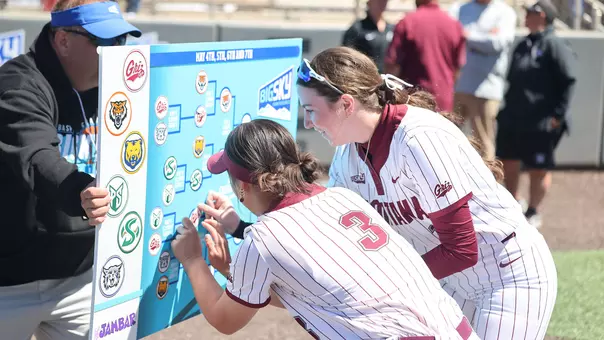
Photo by: Derek Johnson
Origin Stories :: Elise Ontiveros
1/22/2021 7:43:00 PM | Softball
It was always the blinds that gave them away.
Nearly every day in the summer, once free of parental supervision, the four of them would convene and convert the family home in Bakersfield into an indoor ballpark, moving the furniture around to make room for a diamond, the ball a rolled-up sock, the little wooden bat a remnant of a trip to a Cal Ripken tournament by the boy, the one outnumbered by three sisters.
The ground rules were understood but that didn't mean there weren't disagreements that could turn into arguments. It was family after all, love and competitiveness filling the room in equal measure. The oldest, the one who would become an all-America pitcher at Cal, and the youngest, the one who is in her first year at Montana, the fearless outfielder, always teamed up and nearly always won.
"That was our favorite pastime," says Nisa Ontiveros, the oldest, the one who was named the espnW national player of the week as a senior five springs ago after throwing a 16-strikeout one-hitter in California's 1-0 victory at Stanford, the middle win in a three-game sweep for a Bears team that was on its way to making the NCAA tournament.
"They wanted us to stay in the house, so we became creative. Sitting around wasn't really for us. The best part was when our mom or dad would pull into the driveway. It was the fastest we've ever cleaned the house. It was spotless. Those were some fun times."
But the blinds always took a pounding. And always gave it away that the house, so in order when the first of the parents arrived home from work, had just moments before been in such disarray. If they weren't broken or sitting on the floor in a tangled mess, the blinds were hanging askew, made that way by a rolled up sock and a solid hit by Nisa. Or Eric Jr. Or Mia. Or Elise.
"They blamed it on the vacuum cleaner or the dogs," says their mom, Kristi, who may not have caught those games but has missed little else of her children's activities, most often sporting, during their lifetimes. "Whatever my kids did, I was there. I would be there no matter what."
The three girls? All would become Division I athletes. The oldest concluded her career at Cal in 2016, first-team All-Pac-12, first-team all-region, third-team all-America as a senior. The middle, Mia, is in her first year playing soccer at Texas Southern after spending one season at Humboldt State, one at Fresno City College, where the forward was a six-goal scorer.
The boy, second in line overall, went military. He's now stationed at Fort Bragg in North Carolina, a member of the well-known and prestigious 82nd Airborne Division, you know, the one whose mission is to "within 18 hours of notification, strategically deploy, conduct forcible entry parachute assault and secure key objectives for follow-on military operations in support of U.S. national interests."
It's a clan of achievers, those four children, and as tight as can be. "We're extremely close. There have been a lot of friends we've had that said they've never seen a family as close as ours," says the youngest of the four. "I thought it was normal to be that close with your siblings and your parents, but I guess it's not as normal as I thought it was."
This is California, but it's no Earl Woods story, of setting a child on a path to presumed greatness from Day One, the end goal more important than the journey it takes to get there. Or the Marv Marinovich approach. Or LaVar Ball.
Eric and Kristi, who met while both were attending Bakersfield College, had no real plan other than to not mess it up. They just crossed their fingers and hoped for the best. "We just got lucky," she says. "We just said, here's how we're going to raise four kids, and we were very blessed they came out the way they did. They are extremely close and have great memories, something they can cherish."
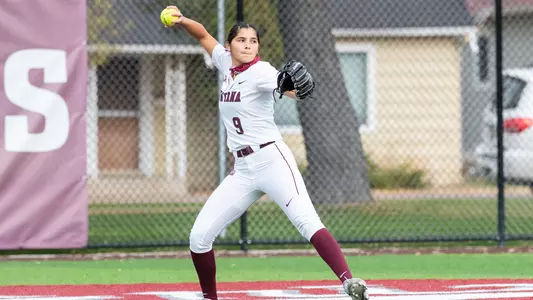
We're here for the fourth, Elise, the one her current coach, Melanie Meuchel, says will go through walls to make a play in the outfield, putting herself in harm's way to protect her pitcher and help her team.
That's all she was doing at the end of her freshman year, when her travel-ball team was trying to secure a place at Premier Girls Fastpitch nationals, when that ball was approaching the fence in a must-win game, when Ontiveros followed every instinct she had. She made the catch, then dove over the outfield fence to prevent a collision.
Everything about her story has a thread connecting it back to family. That one too. She attended Cal's games for years, watching her sister pitch and taking it all in, particularly the effort required to compete at the Pac-12 level, to see seven players behind the pitcher working as one to have her back.
"She saw the extra effort that some of my teammates would go out and do, and that became her perspective," says Nisa. "I'm going to get anything and everything I can. I wish I could have played with her. She is a special outfielder."
Nisa, whose desire to help people directed her career choice, got her master's degree at USC. Today she is the freshman counselor at Cape Fear High in Fayetteville, N.C. Fort Bragg sits just outside of town. Nearby are her brother, his wife and their two kids.
It was hard to tell, but it's possible her voice cracked on Thursday, her emotions touched. There was a hesitancy in her reply, a halt in the conversation. She'd just been told why her youngest sister plays the way she does.
"I would say it kind of came from watching my sister," says Elise. "My mom always said about the outfield, help your pitcher out how you would want Nisa to be helped out by her outfield. So every time I play, it's give your pitcher 100 percent, because she's giving you 100 percent. If I have to fly over a fence, I'm going to fly over a fence."
She calls herself a late bloomer, Elise does, but that does not seem like it's an accurate descriptor. Let's call it delayed. And it has to do with family as well.
Some kids play travel ball as young as 8U or 10U. She didn't join a team until she was a freshman in high school. She wanted to follow every step of her sister's career at Cal, not miss out by playing her own game-packed schedule every spring.
That devotion went the other way as well. Yes, Nisa chose Cal for its academics, but she had every top-25 team in the country on her when she was coming out of Ridgeview High. Rather, she chose the school four hours from home not so much because she wanted her family to be able to watch her play but because she didn't want to miss out on what her three younger siblings were doing.
"I went home on any weekends we didn't have softball," she says. "All of them have a special place in my heart for different reasons."
You know what else she got to do? Once her postgame responsibilities with the team were done, she found her family.
"We had our team talk and things we needed to do on the field, then coach would release us, and I was able to go hug my family and celebrate the successes I had with them because they were on my side the whole time," she says. "That's what I see in Montana. It's very much a family environment."
That all sounds natural, right? Daughter plays, family watches, then they gather afterwards. But that's not the case in all programs. Even in pre-COVID times, some -- more than you would expect -- operated in a bubble. Family was nothing but a distraction to the mission, the task at hand. Review the game, prepare for the next one, and okay, you can wave to them in the stands but then get your focus right.
In other words, the anti-Ontiveros approach.
"That's how Mel won me over, the fact that she lets us go with our parents and be with them if they traveled with us," says Elise. "You'd be surprised how many schools don't let their players do that. They are big on focusing on the game."
Family? Meuchel's dad, Dennis, isn't just a volunteer assistant coach. He's been an integral part of his daughter's staff since she was hired in October 2017. She doesn't just put up with family as a necessary part of her program. She encourages and celebrates it. The more the merrier.
Ontiveros? She wanted more than to have her family be allowed alongside her for the ride. She wanted in her college program an extension of those games in the house back in the day. Competitive, yes, but good times as well. Is that even possible at the Division I level?
Ontiveros wasn't committed when she made her official visit in September 2019, which is rare for a high school senior.
"When I got here and started hanging out with the girls and saw their practice, it was very family-oriented, which is very, very big for me," she says. "That's probably the main part that sold it on me. That's what I needed to get a feel of. I've heard a lot of stories of girls going to college and not getting along with their teammates or there is drama. It kind of ruins the whole experience.
"You could just tell when they were around each other, the vibes and everything around them was so positive. Even when they did hacky-sack before practice, they were all getting along. There wasn't a group over here talking and a group over there. They were always interacting with each other. You could really see the team dynamic."
The thread of family can date back to Eric's father, to Edward Ontiveros, who played minor league baseball in the Houston Astros organization. Eric's brother, Steve, made his Major League debut in 1973 as a 21-year-old with the San Francisco Giants. In four years with the Giants and four more with the Cubs, he collected 600 hits while mostly playing third base.
He lives in San Diego now. When his niece made her way south to play in tournaments, she got the benefit of his wisdom.
"I have never second-guessed him," she says. "It's a privilege. A lot of people don't get that. Whatever he tells me to do, I'm 100 percent bought into it. Any little struggle, if I'm ever in a slump, he automatically helps me out of it. The next game I'm out hitting bombs again."
At 5-foot-11, Ontiveros could pass for a softball player, or volleyball player, or basketball player, or soccer player, or middle-distance runner on the track. She's tried most of them.
"She's fast. She can get out and roll," says Meuchel. "Give her a couple of bases and she can flat roll. She's a very good athlete."
As for that athleticism, it comes more from one side of the family than the other. Okay, all of it. "I added absolutely nothing," joked Kristi. "I had nothing to contribute to that part of it. That is completely from the Ontiveros side of the family."
She is more like her oldest sister -- Mia and Eric Jr. are more closely aligned on the personality spectrum -- but it was Mia she grew up playing with, given their age difference of less than two years. And it was primarily soccer and softball. And following the career of their big sister.
"When she was pitching and the scouts were in the stands watching her, we would sneak behind them and look at their radar guns," says Elise, who is eight years younger than Nisa. "When she committed, it was before I even knew how to spell committed.
"We were excited for her, but I didn't have the complete concept of it. I just knew she had gotten what she had been working for her whole life. It was big, exciting moment."
That Mia ultimately chose to go all in on soccer was a surprise to everyone. They were not quite sure about this ball sport that did not include a bat.
"She just wanted to be different. She really likes running and is more of an aggressive person, so she likes that side of soccer," says Elise. "Everyone was like, what? Are you sure? My parents never questioned her decision. Soccer? Okay, we'll go with it if that's what you want."
Elise followed in Nisa's footsteps and dedicated herself to softball, a shortstop in the making. Until the day she was on a team that had limited numbers of outfielders and the coaches saw their shortstop had some serious speed.
"Once I got out there, I fell in love with it," she says. Her mom later asked her if she wanted her to talk to the coaches about getting her back to the infield. "No!"
That's where she was in that PGF qualifier at the end of her freshman year, just tracking down a ball that looked uncatchable, a term Ontiveros does not have in her vocabulary. All she thinks about, over her own well-being, is supporting her pitcher, the way her sister's outfielders took care of theirs.
"It's a big tournament in the softball world. I knew it was going over, but I knew I could reach it," she says of the play that resulted in a fractured back.
She knew she had gotten hurt but not how badly. So she kept playing. That game and the rest of the summer. It must have been a strange sight, in the heat of a Bakersfield summer, a player with an heating pad wrapped around her midsection. But that's the only thing that would bring any sort of relief.
The first doctor said she was just going through some growing pains. Finally she went to a doctor who took an x-ray, an MRI. He let her know she had been playing the entire summer with a fractured back.
"It was very uncomfortable. Every swing I took, every step. I had to wear a heating pad that wraps around you, tape it to my back in 100-degree weather," she says.
That's the player Meuchel spotted, the one who doesn't let things like walls or injury setbacks get in her way of what she wants. The coach thought she would be the perfect player for Montana.
Her sister did too. After graduating from Cal ("the best four years of my life," she calls them), Nisa, in addition to getting her master's degree from USC and playing in Italy, joined the coaching staff at Cal State Bakersfield for the 2018 and '19 seasons.
In the latter, the Roadrunners twice faced Montana, first in Sacramento, later in San Jose. CSUB won the first meeting 3-2, Montana the second 7-3, with five runs in the top of the seventh. Both games took place before the Grizzlies had made recruiting inroads with Ontiveros' youngest sister.
"At the time I wasn't very aware of it, but (later) recalling the games we played them, it was all very positive thoughts," says Nisa.
"They were scrappy, they fought to the end. They were definitely a team that stood out to me. I thought, that's how Elise plays."
Because she had made a relatively late entry into the more visible travel-ball scene, Ontiveros was still uncommitted the summer before her senior year. She had interest but nothing had been decided upon.
Then Montana showed up, in the person of Meuchel at one of Ontiveros's games. "My coach came down to me and said, 'Hey, the University of Montana is here watching you.' In my head I'm like, Montana? I had never thought of them, only California schools," she says.
She got home that night, did some online research into the school and softball program and thought, I would love this. Within days she had set up a phone call with Meuchel. It would be the first time she had talked to a college coach on the phone. She remembers her sisters listened through the door.
"I was very, very nervous. We ended up talking for an hour. She made it easy to talk to her," Ontiveros says. When she got off the phone, she ran downstairs and delivered the news. "'Oh my gosh, mom, I want to go there.' And I hadn't even seen the campus. It was all based off an hour-long phone call with Coach Mel. It was top on my list."
A less secure coach may have been intimidated by the news. Ontiveros was coming on her official visit in September. And she was bringing not only her mom but her sister, the one who had played in the Pac-12, who had coached at Bakersfield. Tough audience to win over, someone who wasn't going to be dazzled by any bright lights. She knew what she was there to find out.
Meuchel may be somewhat soft-spoken and gentle in disposition -- off the field anyway, when she is not in the heat of competition -- but she is fiercely proud of the program she helped build with Jamie Pinkerton and later inherited. She was ready to sell its merits to anyone, including Nisa Ontiveros.
"I'm a protective sister and know (Elise) pretty well, so there were a lot of questions I knew I wanted to ask," she says. "I even had them listed in my phone so I wouldn't forget anything."
The family arrived -- on a home football weekend, remember those days? -- with a game plan. Elise's job was to experience campus, get a feel for the overall atmosphere of the school and Missoula and picture what her life would be like. We'll ask the important questions, Elise was told. "I was like, okay, I'll leave you to it."
Nisa says she probably asked thousands of questions. Meuchel loved it, coach to coach. "I really enjoyed that because that was true depth."
"They had been on previous visits where the coaches couldn't answer some of the questions that were asked," says Elise. "Mel answered everything 100 percent confidently. It made everyone very comfortable with me coming here."
Before the visit was over, mom and two daughters met up and reviewed. "They told me their insights, what Mel told them. I told them what I thought about the campus, the atmosphere, the girls, the coaches, everything. All of us teaming together, it was really easy for me to make my decision."
"They checked every one of our boxes," says Kristi, whose life is a little less stressful these days. As you might imagine, watching your daughter take the ball as the starting pitcher in the Pac-12 comes with its challenges.
"When Nisa was in the circle, I was on edge every single pitch. With Elise, I'm only on edge when I see the ball go to the outfield or she's up to bat. I think I can enjoy the game a little bit more now."
That's how Ontiveros got here. But what about now, as the team practices for the season ahead? What is in store for the outfielder?
Brooklyn Weisgram is back. Julie Phelps started much of last season as well, what there was of it. And Jaxie Klucewich got time in the outfield this fall, during the team's scrimmages.
Asked about Ontiveros's projected role, Meuchel goes into coach mode. "I look for Elise to add to our defense," she says, not giving us what we want, certainly not moving us. We want goosebumps and the coach isn't delivering.
"She has the arm strength to play any of the three positions. If she continues to work like she's working, she'll find some time." Still nothing. She's pressed and finally gives us what we're looking for.
This is the good stuff. "She is a very athletic kid who has game-savvy about her. I've seen her go through fences to go get balls, rob home runs. She'll run through a wall to win. She plays very hard." Now the coach's words are hitting the right spot.
More please: "She loves to compete. She's enjoyable to watch because she gets the game. I always feel like she is a step ahead in the game. If her team played three games in a day, it was enjoyable to watch all three games and watch her compete."
As for her offense, Ontiveros makes it sound like she's back home, talking trash to her siblings while one of them rolls up that sock. Just mind the blinds please.
"You might strike me out, but I won't let you strike me out twice. And I will not strike out watching. I'll be swinging 100 percent," she says.
She is nowhere near Bakersfield, in any sense, but Ontiveros feels right at home with what she found in Meuchel's program. When she was growing up, everything was a competition, from who could get their chores done first to the games played when their parents were away.
But underneath all of it, pulsing every hour of every day without stop, was love of family. When they were together, they wanted to beat each other. When they were apart, they were each other's biggest fans.
Do all of Meuchel's players want to be on the field for every pitch? Yes. Ontiveros is no different. And she'll compete like it in practice. But even in her first year, teammates have become like extended sisters.
"In the past, if you were trying to beat me out for my position, you don't like me," she says. "It's not like that here. We all support each other 100 percent, no matter what. Competitive but supportive, like family."
Like home.
Nearly every day in the summer, once free of parental supervision, the four of them would convene and convert the family home in Bakersfield into an indoor ballpark, moving the furniture around to make room for a diamond, the ball a rolled-up sock, the little wooden bat a remnant of a trip to a Cal Ripken tournament by the boy, the one outnumbered by three sisters.
The ground rules were understood but that didn't mean there weren't disagreements that could turn into arguments. It was family after all, love and competitiveness filling the room in equal measure. The oldest, the one who would become an all-America pitcher at Cal, and the youngest, the one who is in her first year at Montana, the fearless outfielder, always teamed up and nearly always won.
"That was our favorite pastime," says Nisa Ontiveros, the oldest, the one who was named the espnW national player of the week as a senior five springs ago after throwing a 16-strikeout one-hitter in California's 1-0 victory at Stanford, the middle win in a three-game sweep for a Bears team that was on its way to making the NCAA tournament.
"They wanted us to stay in the house, so we became creative. Sitting around wasn't really for us. The best part was when our mom or dad would pull into the driveway. It was the fastest we've ever cleaned the house. It was spotless. Those were some fun times."
But the blinds always took a pounding. And always gave it away that the house, so in order when the first of the parents arrived home from work, had just moments before been in such disarray. If they weren't broken or sitting on the floor in a tangled mess, the blinds were hanging askew, made that way by a rolled up sock and a solid hit by Nisa. Or Eric Jr. Or Mia. Or Elise.
"They blamed it on the vacuum cleaner or the dogs," says their mom, Kristi, who may not have caught those games but has missed little else of her children's activities, most often sporting, during their lifetimes. "Whatever my kids did, I was there. I would be there no matter what."
The three girls? All would become Division I athletes. The oldest concluded her career at Cal in 2016, first-team All-Pac-12, first-team all-region, third-team all-America as a senior. The middle, Mia, is in her first year playing soccer at Texas Southern after spending one season at Humboldt State, one at Fresno City College, where the forward was a six-goal scorer.
The boy, second in line overall, went military. He's now stationed at Fort Bragg in North Carolina, a member of the well-known and prestigious 82nd Airborne Division, you know, the one whose mission is to "within 18 hours of notification, strategically deploy, conduct forcible entry parachute assault and secure key objectives for follow-on military operations in support of U.S. national interests."
It's a clan of achievers, those four children, and as tight as can be. "We're extremely close. There have been a lot of friends we've had that said they've never seen a family as close as ours," says the youngest of the four. "I thought it was normal to be that close with your siblings and your parents, but I guess it's not as normal as I thought it was."
This is California, but it's no Earl Woods story, of setting a child on a path to presumed greatness from Day One, the end goal more important than the journey it takes to get there. Or the Marv Marinovich approach. Or LaVar Ball.
Eric and Kristi, who met while both were attending Bakersfield College, had no real plan other than to not mess it up. They just crossed their fingers and hoped for the best. "We just got lucky," she says. "We just said, here's how we're going to raise four kids, and we were very blessed they came out the way they did. They are extremely close and have great memories, something they can cherish."
We're here for the fourth, Elise, the one her current coach, Melanie Meuchel, says will go through walls to make a play in the outfield, putting herself in harm's way to protect her pitcher and help her team.
That's all she was doing at the end of her freshman year, when her travel-ball team was trying to secure a place at Premier Girls Fastpitch nationals, when that ball was approaching the fence in a must-win game, when Ontiveros followed every instinct she had. She made the catch, then dove over the outfield fence to prevent a collision.
Everything about her story has a thread connecting it back to family. That one too. She attended Cal's games for years, watching her sister pitch and taking it all in, particularly the effort required to compete at the Pac-12 level, to see seven players behind the pitcher working as one to have her back.
"She saw the extra effort that some of my teammates would go out and do, and that became her perspective," says Nisa. "I'm going to get anything and everything I can. I wish I could have played with her. She is a special outfielder."
Nisa, whose desire to help people directed her career choice, got her master's degree at USC. Today she is the freshman counselor at Cape Fear High in Fayetteville, N.C. Fort Bragg sits just outside of town. Nearby are her brother, his wife and their two kids.
It was hard to tell, but it's possible her voice cracked on Thursday, her emotions touched. There was a hesitancy in her reply, a halt in the conversation. She'd just been told why her youngest sister plays the way she does.
"I would say it kind of came from watching my sister," says Elise. "My mom always said about the outfield, help your pitcher out how you would want Nisa to be helped out by her outfield. So every time I play, it's give your pitcher 100 percent, because she's giving you 100 percent. If I have to fly over a fence, I'm going to fly over a fence."
She calls herself a late bloomer, Elise does, but that does not seem like it's an accurate descriptor. Let's call it delayed. And it has to do with family as well.
Some kids play travel ball as young as 8U or 10U. She didn't join a team until she was a freshman in high school. She wanted to follow every step of her sister's career at Cal, not miss out by playing her own game-packed schedule every spring.
That devotion went the other way as well. Yes, Nisa chose Cal for its academics, but she had every top-25 team in the country on her when she was coming out of Ridgeview High. Rather, she chose the school four hours from home not so much because she wanted her family to be able to watch her play but because she didn't want to miss out on what her three younger siblings were doing.
"I went home on any weekends we didn't have softball," she says. "All of them have a special place in my heart for different reasons."
You know what else she got to do? Once her postgame responsibilities with the team were done, she found her family.
"We had our team talk and things we needed to do on the field, then coach would release us, and I was able to go hug my family and celebrate the successes I had with them because they were on my side the whole time," she says. "That's what I see in Montana. It's very much a family environment."
That all sounds natural, right? Daughter plays, family watches, then they gather afterwards. But that's not the case in all programs. Even in pre-COVID times, some -- more than you would expect -- operated in a bubble. Family was nothing but a distraction to the mission, the task at hand. Review the game, prepare for the next one, and okay, you can wave to them in the stands but then get your focus right.
In other words, the anti-Ontiveros approach.
"That's how Mel won me over, the fact that she lets us go with our parents and be with them if they traveled with us," says Elise. "You'd be surprised how many schools don't let their players do that. They are big on focusing on the game."
Family? Meuchel's dad, Dennis, isn't just a volunteer assistant coach. He's been an integral part of his daughter's staff since she was hired in October 2017. She doesn't just put up with family as a necessary part of her program. She encourages and celebrates it. The more the merrier.
Ontiveros? She wanted more than to have her family be allowed alongside her for the ride. She wanted in her college program an extension of those games in the house back in the day. Competitive, yes, but good times as well. Is that even possible at the Division I level?
Ontiveros wasn't committed when she made her official visit in September 2019, which is rare for a high school senior.
"When I got here and started hanging out with the girls and saw their practice, it was very family-oriented, which is very, very big for me," she says. "That's probably the main part that sold it on me. That's what I needed to get a feel of. I've heard a lot of stories of girls going to college and not getting along with their teammates or there is drama. It kind of ruins the whole experience.
"You could just tell when they were around each other, the vibes and everything around them was so positive. Even when they did hacky-sack before practice, they were all getting along. There wasn't a group over here talking and a group over there. They were always interacting with each other. You could really see the team dynamic."
The thread of family can date back to Eric's father, to Edward Ontiveros, who played minor league baseball in the Houston Astros organization. Eric's brother, Steve, made his Major League debut in 1973 as a 21-year-old with the San Francisco Giants. In four years with the Giants and four more with the Cubs, he collected 600 hits while mostly playing third base.
He lives in San Diego now. When his niece made her way south to play in tournaments, she got the benefit of his wisdom.
"I have never second-guessed him," she says. "It's a privilege. A lot of people don't get that. Whatever he tells me to do, I'm 100 percent bought into it. Any little struggle, if I'm ever in a slump, he automatically helps me out of it. The next game I'm out hitting bombs again."
At 5-foot-11, Ontiveros could pass for a softball player, or volleyball player, or basketball player, or soccer player, or middle-distance runner on the track. She's tried most of them.
"She's fast. She can get out and roll," says Meuchel. "Give her a couple of bases and she can flat roll. She's a very good athlete."
As for that athleticism, it comes more from one side of the family than the other. Okay, all of it. "I added absolutely nothing," joked Kristi. "I had nothing to contribute to that part of it. That is completely from the Ontiveros side of the family."
She is more like her oldest sister -- Mia and Eric Jr. are more closely aligned on the personality spectrum -- but it was Mia she grew up playing with, given their age difference of less than two years. And it was primarily soccer and softball. And following the career of their big sister.
"When she was pitching and the scouts were in the stands watching her, we would sneak behind them and look at their radar guns," says Elise, who is eight years younger than Nisa. "When she committed, it was before I even knew how to spell committed.
"We were excited for her, but I didn't have the complete concept of it. I just knew she had gotten what she had been working for her whole life. It was big, exciting moment."
That Mia ultimately chose to go all in on soccer was a surprise to everyone. They were not quite sure about this ball sport that did not include a bat.
"She just wanted to be different. She really likes running and is more of an aggressive person, so she likes that side of soccer," says Elise. "Everyone was like, what? Are you sure? My parents never questioned her decision. Soccer? Okay, we'll go with it if that's what you want."
Elise followed in Nisa's footsteps and dedicated herself to softball, a shortstop in the making. Until the day she was on a team that had limited numbers of outfielders and the coaches saw their shortstop had some serious speed.
"Once I got out there, I fell in love with it," she says. Her mom later asked her if she wanted her to talk to the coaches about getting her back to the infield. "No!"
That's where she was in that PGF qualifier at the end of her freshman year, just tracking down a ball that looked uncatchable, a term Ontiveros does not have in her vocabulary. All she thinks about, over her own well-being, is supporting her pitcher, the way her sister's outfielders took care of theirs.
"It's a big tournament in the softball world. I knew it was going over, but I knew I could reach it," she says of the play that resulted in a fractured back.
She knew she had gotten hurt but not how badly. So she kept playing. That game and the rest of the summer. It must have been a strange sight, in the heat of a Bakersfield summer, a player with an heating pad wrapped around her midsection. But that's the only thing that would bring any sort of relief.
The first doctor said she was just going through some growing pains. Finally she went to a doctor who took an x-ray, an MRI. He let her know she had been playing the entire summer with a fractured back.
"It was very uncomfortable. Every swing I took, every step. I had to wear a heating pad that wraps around you, tape it to my back in 100-degree weather," she says.
That's the player Meuchel spotted, the one who doesn't let things like walls or injury setbacks get in her way of what she wants. The coach thought she would be the perfect player for Montana.
Her sister did too. After graduating from Cal ("the best four years of my life," she calls them), Nisa, in addition to getting her master's degree from USC and playing in Italy, joined the coaching staff at Cal State Bakersfield for the 2018 and '19 seasons.
In the latter, the Roadrunners twice faced Montana, first in Sacramento, later in San Jose. CSUB won the first meeting 3-2, Montana the second 7-3, with five runs in the top of the seventh. Both games took place before the Grizzlies had made recruiting inroads with Ontiveros' youngest sister.
"At the time I wasn't very aware of it, but (later) recalling the games we played them, it was all very positive thoughts," says Nisa.
"They were scrappy, they fought to the end. They were definitely a team that stood out to me. I thought, that's how Elise plays."
Because she had made a relatively late entry into the more visible travel-ball scene, Ontiveros was still uncommitted the summer before her senior year. She had interest but nothing had been decided upon.
Then Montana showed up, in the person of Meuchel at one of Ontiveros's games. "My coach came down to me and said, 'Hey, the University of Montana is here watching you.' In my head I'm like, Montana? I had never thought of them, only California schools," she says.
She got home that night, did some online research into the school and softball program and thought, I would love this. Within days she had set up a phone call with Meuchel. It would be the first time she had talked to a college coach on the phone. She remembers her sisters listened through the door.
"I was very, very nervous. We ended up talking for an hour. She made it easy to talk to her," Ontiveros says. When she got off the phone, she ran downstairs and delivered the news. "'Oh my gosh, mom, I want to go there.' And I hadn't even seen the campus. It was all based off an hour-long phone call with Coach Mel. It was top on my list."
A less secure coach may have been intimidated by the news. Ontiveros was coming on her official visit in September. And she was bringing not only her mom but her sister, the one who had played in the Pac-12, who had coached at Bakersfield. Tough audience to win over, someone who wasn't going to be dazzled by any bright lights. She knew what she was there to find out.
Meuchel may be somewhat soft-spoken and gentle in disposition -- off the field anyway, when she is not in the heat of competition -- but she is fiercely proud of the program she helped build with Jamie Pinkerton and later inherited. She was ready to sell its merits to anyone, including Nisa Ontiveros.
"I'm a protective sister and know (Elise) pretty well, so there were a lot of questions I knew I wanted to ask," she says. "I even had them listed in my phone so I wouldn't forget anything."
The family arrived -- on a home football weekend, remember those days? -- with a game plan. Elise's job was to experience campus, get a feel for the overall atmosphere of the school and Missoula and picture what her life would be like. We'll ask the important questions, Elise was told. "I was like, okay, I'll leave you to it."
Nisa says she probably asked thousands of questions. Meuchel loved it, coach to coach. "I really enjoyed that because that was true depth."
"They had been on previous visits where the coaches couldn't answer some of the questions that were asked," says Elise. "Mel answered everything 100 percent confidently. It made everyone very comfortable with me coming here."
Before the visit was over, mom and two daughters met up and reviewed. "They told me their insights, what Mel told them. I told them what I thought about the campus, the atmosphere, the girls, the coaches, everything. All of us teaming together, it was really easy for me to make my decision."
"They checked every one of our boxes," says Kristi, whose life is a little less stressful these days. As you might imagine, watching your daughter take the ball as the starting pitcher in the Pac-12 comes with its challenges.
"When Nisa was in the circle, I was on edge every single pitch. With Elise, I'm only on edge when I see the ball go to the outfield or she's up to bat. I think I can enjoy the game a little bit more now."
That's how Ontiveros got here. But what about now, as the team practices for the season ahead? What is in store for the outfielder?
Brooklyn Weisgram is back. Julie Phelps started much of last season as well, what there was of it. And Jaxie Klucewich got time in the outfield this fall, during the team's scrimmages.
Asked about Ontiveros's projected role, Meuchel goes into coach mode. "I look for Elise to add to our defense," she says, not giving us what we want, certainly not moving us. We want goosebumps and the coach isn't delivering.
"She has the arm strength to play any of the three positions. If she continues to work like she's working, she'll find some time." Still nothing. She's pressed and finally gives us what we're looking for.
This is the good stuff. "She is a very athletic kid who has game-savvy about her. I've seen her go through fences to go get balls, rob home runs. She'll run through a wall to win. She plays very hard." Now the coach's words are hitting the right spot.
More please: "She loves to compete. She's enjoyable to watch because she gets the game. I always feel like she is a step ahead in the game. If her team played three games in a day, it was enjoyable to watch all three games and watch her compete."
As for her offense, Ontiveros makes it sound like she's back home, talking trash to her siblings while one of them rolls up that sock. Just mind the blinds please.
"You might strike me out, but I won't let you strike me out twice. And I will not strike out watching. I'll be swinging 100 percent," she says.
She is nowhere near Bakersfield, in any sense, but Ontiveros feels right at home with what she found in Meuchel's program. When she was growing up, everything was a competition, from who could get their chores done first to the games played when their parents were away.
But underneath all of it, pulsing every hour of every day without stop, was love of family. When they were together, they wanted to beat each other. When they were apart, they were each other's biggest fans.
Do all of Meuchel's players want to be on the field for every pitch? Yes. Ontiveros is no different. And she'll compete like it in practice. But even in her first year, teammates have become like extended sisters.
"In the past, if you were trying to beat me out for my position, you don't like me," she says. "It's not like that here. We all support each other 100 percent, no matter what. Competitive but supportive, like family."
Like home.
Players Mentioned



Thursday, June 04
Friday, May 01
Friday, May 01
Friday, May 01