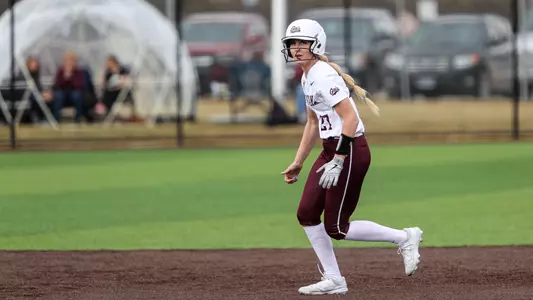
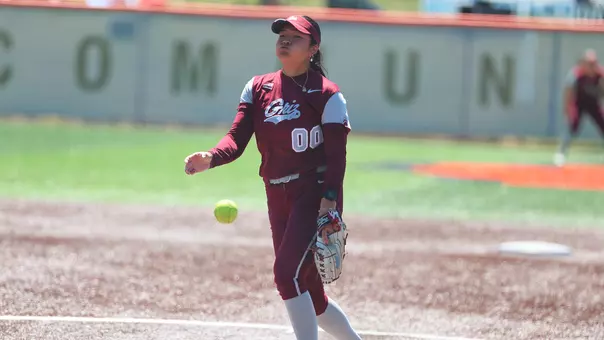
Photo by: Derek Johnson
Origin Stories :: Grace Hardy
3/25/2022 3:51:00 PM | Softball
You could start and finish the Grace Hardy story simply by talking to Montana softball coach Melanie Meuchel.
How the Griz softball program started in 2015, right when the Hardy sisters, first Sierrah, then Grace, were coming of age themselves in the sport in their hometown of Missoula.
How Grace was a bat girl on that very first team, how she took pitching lessons from Kenzie Cole, the program's first senior and first graduate.
"They were making a name for themselves as much as Griz softball was starting to make a name for ourselves as well," says Meuchel, an assistant coach at Montana for three years before becoming the program's second head coach.
"When we first started recruiting, we'd watch local girls play, so we watched her sister play and knew of the family. Grace was someone we knew we wanted to have here. We knew for quite some time she was someone who had the skillset to play at this level."
How she rose through the age ranks of the Montana Avalanche, her dad coaching her along the way, how she played her final two years of travel ball with the Northwest Bullets in Oregon because of the whatever it takes we'll do support of her parents, how she starred at Sentinel High School.
How she can pitch. Or play shortstop. Or third base, the position she'll likely land on as a Grizzly. How she had her first career hit last Saturday in Game 1 of a doubleheader against Providence, a two-run pinch-hit double down the left-field line. And how that seemed to put a nice bow on the entire story.
"Grace has been around the program a long time. She is a Missoulian who loves to play the game of softball. The more you get to know her, the more you notice how passionate she is about the game," says Meuchel.
"She has a very supportive family but her desire to play the game is also very self-driven. We're really excited for her future and that she is part of our program."
You could stop reading right now and have a pretty good feel for the Hardy story: local girl lives the dream, plays for local team, wears the uniform of the girls she grew up idolizing. The end.
Or you could talk to Hardy and discover just a little bit more, get beyond the what and dig into the why, connect a few more dots, pull back the curtain a few more folds.
How Sierrah picked up the javelin as a junior at Hellgate High, the sport of her dad, Clint, in his one year at Jamestown College in North Dakota, how that became her passion, taking over the spot in her heart that softball had held for years.
How she threw four years at Eastern Washington and is now adding a fifth year at Montana as she finishes up a master's degree in accounting, a post-graduation job already lined up.
How Grace, the precocious one, was a maddening four years behind, forced to watch her sister play actual softball while she was stuck in tee-ball.
"I hated it because it was so slow compared to watching my sister play. I quit. I couldn't do it. I was too competitive and it was too nonchalant," she says. It's instructive to note she was in the second grade at the time.
Of course there is always more to the story, which is why you keep digging. So you dial up her mom, Andi. "It was too easy and they wouldn't let them have snacks. The coaches weren't into snacks, so she said, never again."
It was the lone exception to the rule that you discover drives the family: "There is no quitting in the Hardy house," says Grace, and you notice that you type it in all capital letters as you re-listen to the recorded conversation afterwards to best capture the conviction in her voice.
It didn't mean you stick with something for life or the girls would still be playing soccer, volleyball, basketball and probably dancing in the theater. But if you start something, you finish it. You honor the commitment. To your teammates, to your coaches. You start a season, you see it through.
"You finish what you start and never let a team down. You fulfill your obligation. You don't have to do it again, but you have to finish. That's as simple as it was," says Andi.
First Grace, now Andi. She talks about it with the same force of belief, like it's not something that was read one day in a parenting handbook, considered a good idea and passed down to her two girls but something that goes deeper, DNA-level deeper. They don't talk it, they own it.
And you could stop there and call it good, and you would have a better, more complete picture than if you had only talked to Meuchel. Or only added a conversation with Grace, then one with Andi.
Then Andi calls back, not one minute after you've hung up with her. She knows you're about to call Clint as you keep digging, for the even deeper roots that give this story life. She says to ask him about his mom.
So you do.
"Working hard for everything you want in life," Clint says, as you learn more, how he was the oldest of four children raised by a single mom in Charlo, Mont. How she was wheelchair-bound for most of those years.
How she kept working. How she gave those children, if not everything they ever wanted then at least everything they needed. How she got them to every practice, to everything they wanted to do, and if not her then someone who could, extended family and friends as part of a team.
How he took it in all those years, not knowing it would become the basis for his own parenting decades later, experience becoming beliefs, beliefs turning into action.
"It was tough for her. We could see how much she had to sacrifice for us, so when we were doing sports and stuff, it was about giving it your all, always being 100 percent bought in, whether it was practice or lifting weights," he says.
"That probably had a huge way in how I raised both of my girls."
It's why he accepted a scholarship to throw the javelin at Jamestown College in North Dakota, swayed not just by the recruiting pitch of legendary coach Rollie Greeno but by the chance to reduce the financial burden on his mom and family, even if it meant moving more than 900 miles to the east.
That lasted one year. "I decided I needed to get a job and start working. I always say, I finished college at Montana Rail Link." It's where he still works, a supervisor of tie and steel gangs.
You ask if he has regrets, about not finishing school, of not maxing out his athletic eligibility and potential, of passing on the chance to overcome an injury and double up by playing football as well at Jamestown, the sport he loved more than throwing the javelin.
And the picture, the story of Grace Hardy, gets clearer, more complete by the minute.
"Of course you always have regrets. I keep telling my kids, you only get four years to compete. There are always bad days at practice but you can never go back after you decide to give it up," he says.
Andi is from Dixon, a speck on the map hard against the Flathead River, separated from Charlo by the National Bison Range.
They are both the type of small towns that are the center of the universe for those who grow up there, the provider of everything a kid could want.
That's not to say a larger city like Missoula offers a better life. But the expanded opportunities can't be denied, especially when it comes to balls and bats and track ovals and volleyballs and basketballs.
"I had no problems raising my kids there, but my husband wanted them to have a bigger sports experience, so we raised them in Missoula," says Andi, who was one year behind Clint at Charlo High and friends with his younger sister.
He started at Montana Rail Link on the tie and steel gangs, a job that comes with a winter layoff, when the snow keeps the work from being performed on the lines.
So he headed that first winter to Alaska. If he learned it mostly from his mom, this was a graduate-level course in what it meant to work hard.
"I was on a catcher-processor boat. I spent 40-some days in the Bering Sea. I still say it was the toughest job I ever had in my life, especially mentally," he says. "Eighteen hours on, six off. That's how you rolled up there.
"When I came back to work here and I was on a tie gang, my first couple of days back it was the end of the work day after eight hours. It wouldn't have even been lunchtime up there yet."
No surprise here: They would be no plop in front of the TV and waste away the days, these girls.
"We thought it was really important that our kids played sports," says Andi, who competed in basketball and volleyball at Charlo High and on the track and field team.
"(Clint) was on the road all the time, so I put them in everything I could put them in."
Sierrah came first, which meant she got to graduate first from tee-ball to something more fast-paced, more competitive, more appealing. Grace saw it, which is why she had no time for tee-ball when her time arrived. Perhaps if there had been snacks.
So she put it behind her and picked another outdoor sport: soccer. "I'm a fair-weather person, so I was hoping they'd end up playing an indoor sport. But they loved softball, so we did whatever it took to make it happen," says Andi.
Yes, Grace would return to softball, but not until the mom of one of Sierrah's teammates got involved.
"She was at a tournament watching his sister's team. One of the other moms thought she might like to pitch," recalls Andi. "That's how it all started for Grace. She started throwing a ball down our hallway.
"She just wandered around with a Nerf ball in her pitching motion. For two years of her life, that's how she walked."
They arrived from Charlo and Dixon with the small-town Montana mentality, that the best athletes just play everything, sports as seasonal but the benefits carrying from one to the next, a healthy well-roundedness. It's special, beautiful, and the best of them become local legends.
When they got their girls into sports in Missoula, they entered a new, foreign world. While it's nothing like the dog-eat-dog world of competitive youth sports in areas with larger populations, it was still an eye-opener.
"I remember one time Sierrah was playing and I told Andi, this isn't Charlo anymore," says Clint. "If we don't have our kids play travel ball, they won't play in high school here.
"Once they decided they wanted to keep competing, it soon pretty much took over our lives. It was great family time, every step of the way. You're always together and you always know where your kids are."
He could have just handed the girls over to other coaches. He just as easily could have told them they didn't have to try their best or could quit if it got too hard. Of course none of that had any chance of happening.
"My wife likes to say when I'm all in, I'm all in, like I'm addicted to it almost," Clint says. "It's probably true. I usually want to know everything about it. I guess it's just my nature.
"I just want my kids to be their best, and as a coach I wanted to be the best. I was always a football guy, but since I didn't have boys, softball became my sport with my kids. Pretty soon I'm watching college games trying to learn everything about the game as I'm coaching it."
In early 2013, after years of speculation, it was announced that the University of Montana would be adding a softball program, to begin playing in 2015.
In August 2013 it was announced that Jamie Pinkerton would be the program's first head coach. Three weeks later he hired his first assistant coach: Melanie Meuchel.
"I think it really changed softball in the state but especially in Missoula," says Clint.
Division I softball became not just something that was available to other people in other places, like some distant fantasy world that only others got to experience. Now it was here, in their backyard. It changed goals and dreams of what was possible.
Katie Jo Waletzko, of Missoula, was a freshman on the original team in 2015. Her family was friends with the Hardys, which gave them an inside look at softball at the next level, at a team that would be playing in the NCAA tournament by 2017.
"It was exciting. It was nice to see the insides of it a little bit through Katie Jo," says Clint.
Grace adds, "Katie Jo played with my sister, then she came here, so we came to a lot of games when I was younger. Like a lot of games. Like every single one of them."
What she could only previously see on TV, usually when the Women's College World Series rolled around, now seemed accessible. A wall had been broken down, a barrier for entry had been removed.
"Once I got to middle school it was, oh, I want to go here," says Grace. "It was a challenge I wanted. I wanted to be as good as those players when I got older.
"I didn't think it was an unreachable thing, but I definitely think it's a mindset you have to work towards. You have to be willing to put in the time."
She -- and her family -- had no idea what that truly meant until the summer of her sophomore year at Sentinel.
After the Avalanche team of 16s won the 18 division at the Montana state tournament, Hardy got on with the Washington Angels, just before they headed to Southern California for a Premier Girls Fastpitch event.
If the move from small-town Montana to Missoula and the step up in athletics was an eye-opener, this was something else entirely, an escalation they had never expected.
"When we saw the competition level, I just thought that if Grace wants to go to the college level, you have to be on a team that plays in Southern California in the PGFs," says Clint.
If Katie Jo Waletzko gave them an inside look at Division I softball, a former teammate on Avalanche, River Mahler, showed them what it would take to get there.
The family had moved to Washington and now she was playing for the Northwest Bullets, on her way to Stanford, where she'll be a freshman next year.
Her mom, who played for Washington, told the Hardys, "'Grace needs to be down here playing this kind of competition.' She introduced us to some coaches with the Bullets," says Clint. Grace tried out later that summer and was offered a spot. "That's how we got started with them."
Now they were in it. Deep. Ten-hour car trips. Homework at the airport.
"A pretty expensive endeavor but we were all in," says Andi. "I thought it was excessive, but I was along for the ride and whatever we had to do. And Grace did it. She did a lot of hard work to make it happen.
"Looking back, I think it was good for all of us. When you enter the Division I world, it's different. I think it prepared all of us mentally for how college softball would go."
All the while, Grace Hardy was doing it for a chance to play for Montana, to play for the Grizzlies, the teams she grew up cheering for.
She went to the program's camps, which became more than just an opportunity to improve. Every one felt like a tryout, which brings its own level of pressure.
"I felt like I needed to succeed, but Mel was always saying, just be yourself. She tells us that even today. Don't try to be something you aren't," says Grace.
"It just relaxes you. It lets you have more fun doing it because when you have more fun doing it, you're usually better off."
Spoiler alert: It worked out. She's here. She's a Grizzly. She hasn't played much this year, but her time is coming. And she's thankful for the soft entry.
"The biggest adjustment has been the speed of the game. I moved to the Northwest Bullets so I could play the faster pace of game. This is a whole other speed of the game," she says.
"My mind was moving 1,000 miles an hour during the fall when I was trying to pick up on all the new things. It's definitely slowed down for me. It's something you have to get used to."
When softball is done, the business management and entrepreneurship major would like to follow in the footsteps of her mom, who opened a hair salon when Grace was in kindergarten.
She now operates near campus, Altruist Salon and Boutique, the name her employees agreed upon when she asked them to come up with some words to describe the business and how they view one another as a team.
You've just got to know: Would Grace dare open her own business, something that competes with her mom's place?
"I probably wouldn't, just because I'm going to need a lot of her help. It's about staying loyal to people," she says, another look at the result of the work imprinted by her parents.
But her parents also taught her competitiveness and how it's not a bad thing, how it's okay to strive for more and more. And Grace keeps talking.
"They always pushed me. They are happy for your success but always want more for you," she says. "I have a feeling I'm going to end up taking over her salon, so she probably won't even be in the picture."
Bold words. Yep, Clint and Andi are reaping what they've sown. And they wouldn't want it any other way.
How the Griz softball program started in 2015, right when the Hardy sisters, first Sierrah, then Grace, were coming of age themselves in the sport in their hometown of Missoula.
How Grace was a bat girl on that very first team, how she took pitching lessons from Kenzie Cole, the program's first senior and first graduate.
"They were making a name for themselves as much as Griz softball was starting to make a name for ourselves as well," says Meuchel, an assistant coach at Montana for three years before becoming the program's second head coach.
"When we first started recruiting, we'd watch local girls play, so we watched her sister play and knew of the family. Grace was someone we knew we wanted to have here. We knew for quite some time she was someone who had the skillset to play at this level."
How she rose through the age ranks of the Montana Avalanche, her dad coaching her along the way, how she played her final two years of travel ball with the Northwest Bullets in Oregon because of the whatever it takes we'll do support of her parents, how she starred at Sentinel High School.
How she can pitch. Or play shortstop. Or third base, the position she'll likely land on as a Grizzly. How she had her first career hit last Saturday in Game 1 of a doubleheader against Providence, a two-run pinch-hit double down the left-field line. And how that seemed to put a nice bow on the entire story.
"Grace has been around the program a long time. She is a Missoulian who loves to play the game of softball. The more you get to know her, the more you notice how passionate she is about the game," says Meuchel.
"She has a very supportive family but her desire to play the game is also very self-driven. We're really excited for her future and that she is part of our program."
You could stop reading right now and have a pretty good feel for the Hardy story: local girl lives the dream, plays for local team, wears the uniform of the girls she grew up idolizing. The end.
Or you could talk to Hardy and discover just a little bit more, get beyond the what and dig into the why, connect a few more dots, pull back the curtain a few more folds.
How Sierrah picked up the javelin as a junior at Hellgate High, the sport of her dad, Clint, in his one year at Jamestown College in North Dakota, how that became her passion, taking over the spot in her heart that softball had held for years.
How she threw four years at Eastern Washington and is now adding a fifth year at Montana as she finishes up a master's degree in accounting, a post-graduation job already lined up.
How Grace, the precocious one, was a maddening four years behind, forced to watch her sister play actual softball while she was stuck in tee-ball.
"I hated it because it was so slow compared to watching my sister play. I quit. I couldn't do it. I was too competitive and it was too nonchalant," she says. It's instructive to note she was in the second grade at the time.
Of course there is always more to the story, which is why you keep digging. So you dial up her mom, Andi. "It was too easy and they wouldn't let them have snacks. The coaches weren't into snacks, so she said, never again."
It was the lone exception to the rule that you discover drives the family: "There is no quitting in the Hardy house," says Grace, and you notice that you type it in all capital letters as you re-listen to the recorded conversation afterwards to best capture the conviction in her voice.
It didn't mean you stick with something for life or the girls would still be playing soccer, volleyball, basketball and probably dancing in the theater. But if you start something, you finish it. You honor the commitment. To your teammates, to your coaches. You start a season, you see it through.
"You finish what you start and never let a team down. You fulfill your obligation. You don't have to do it again, but you have to finish. That's as simple as it was," says Andi.
First Grace, now Andi. She talks about it with the same force of belief, like it's not something that was read one day in a parenting handbook, considered a good idea and passed down to her two girls but something that goes deeper, DNA-level deeper. They don't talk it, they own it.
And you could stop there and call it good, and you would have a better, more complete picture than if you had only talked to Meuchel. Or only added a conversation with Grace, then one with Andi.
Then Andi calls back, not one minute after you've hung up with her. She knows you're about to call Clint as you keep digging, for the even deeper roots that give this story life. She says to ask him about his mom.
So you do.
"Working hard for everything you want in life," Clint says, as you learn more, how he was the oldest of four children raised by a single mom in Charlo, Mont. How she was wheelchair-bound for most of those years.
How she kept working. How she gave those children, if not everything they ever wanted then at least everything they needed. How she got them to every practice, to everything they wanted to do, and if not her then someone who could, extended family and friends as part of a team.
How he took it in all those years, not knowing it would become the basis for his own parenting decades later, experience becoming beliefs, beliefs turning into action.
"It was tough for her. We could see how much she had to sacrifice for us, so when we were doing sports and stuff, it was about giving it your all, always being 100 percent bought in, whether it was practice or lifting weights," he says.
"That probably had a huge way in how I raised both of my girls."
It's why he accepted a scholarship to throw the javelin at Jamestown College in North Dakota, swayed not just by the recruiting pitch of legendary coach Rollie Greeno but by the chance to reduce the financial burden on his mom and family, even if it meant moving more than 900 miles to the east.
That lasted one year. "I decided I needed to get a job and start working. I always say, I finished college at Montana Rail Link." It's where he still works, a supervisor of tie and steel gangs.
You ask if he has regrets, about not finishing school, of not maxing out his athletic eligibility and potential, of passing on the chance to overcome an injury and double up by playing football as well at Jamestown, the sport he loved more than throwing the javelin.
And the picture, the story of Grace Hardy, gets clearer, more complete by the minute.
"Of course you always have regrets. I keep telling my kids, you only get four years to compete. There are always bad days at practice but you can never go back after you decide to give it up," he says.
Andi is from Dixon, a speck on the map hard against the Flathead River, separated from Charlo by the National Bison Range.
They are both the type of small towns that are the center of the universe for those who grow up there, the provider of everything a kid could want.
That's not to say a larger city like Missoula offers a better life. But the expanded opportunities can't be denied, especially when it comes to balls and bats and track ovals and volleyballs and basketballs.
"I had no problems raising my kids there, but my husband wanted them to have a bigger sports experience, so we raised them in Missoula," says Andi, who was one year behind Clint at Charlo High and friends with his younger sister.
He started at Montana Rail Link on the tie and steel gangs, a job that comes with a winter layoff, when the snow keeps the work from being performed on the lines.
So he headed that first winter to Alaska. If he learned it mostly from his mom, this was a graduate-level course in what it meant to work hard.
"I was on a catcher-processor boat. I spent 40-some days in the Bering Sea. I still say it was the toughest job I ever had in my life, especially mentally," he says. "Eighteen hours on, six off. That's how you rolled up there.
"When I came back to work here and I was on a tie gang, my first couple of days back it was the end of the work day after eight hours. It wouldn't have even been lunchtime up there yet."
No surprise here: They would be no plop in front of the TV and waste away the days, these girls.
"We thought it was really important that our kids played sports," says Andi, who competed in basketball and volleyball at Charlo High and on the track and field team.
"(Clint) was on the road all the time, so I put them in everything I could put them in."
Sierrah came first, which meant she got to graduate first from tee-ball to something more fast-paced, more competitive, more appealing. Grace saw it, which is why she had no time for tee-ball when her time arrived. Perhaps if there had been snacks.
So she put it behind her and picked another outdoor sport: soccer. "I'm a fair-weather person, so I was hoping they'd end up playing an indoor sport. But they loved softball, so we did whatever it took to make it happen," says Andi.
Yes, Grace would return to softball, but not until the mom of one of Sierrah's teammates got involved.
"She was at a tournament watching his sister's team. One of the other moms thought she might like to pitch," recalls Andi. "That's how it all started for Grace. She started throwing a ball down our hallway.
"She just wandered around with a Nerf ball in her pitching motion. For two years of her life, that's how she walked."
They arrived from Charlo and Dixon with the small-town Montana mentality, that the best athletes just play everything, sports as seasonal but the benefits carrying from one to the next, a healthy well-roundedness. It's special, beautiful, and the best of them become local legends.
When they got their girls into sports in Missoula, they entered a new, foreign world. While it's nothing like the dog-eat-dog world of competitive youth sports in areas with larger populations, it was still an eye-opener.
"I remember one time Sierrah was playing and I told Andi, this isn't Charlo anymore," says Clint. "If we don't have our kids play travel ball, they won't play in high school here.
"Once they decided they wanted to keep competing, it soon pretty much took over our lives. It was great family time, every step of the way. You're always together and you always know where your kids are."
He could have just handed the girls over to other coaches. He just as easily could have told them they didn't have to try their best or could quit if it got too hard. Of course none of that had any chance of happening.
"My wife likes to say when I'm all in, I'm all in, like I'm addicted to it almost," Clint says. "It's probably true. I usually want to know everything about it. I guess it's just my nature.
"I just want my kids to be their best, and as a coach I wanted to be the best. I was always a football guy, but since I didn't have boys, softball became my sport with my kids. Pretty soon I'm watching college games trying to learn everything about the game as I'm coaching it."
In early 2013, after years of speculation, it was announced that the University of Montana would be adding a softball program, to begin playing in 2015.
In August 2013 it was announced that Jamie Pinkerton would be the program's first head coach. Three weeks later he hired his first assistant coach: Melanie Meuchel.
"I think it really changed softball in the state but especially in Missoula," says Clint.
Division I softball became not just something that was available to other people in other places, like some distant fantasy world that only others got to experience. Now it was here, in their backyard. It changed goals and dreams of what was possible.
Katie Jo Waletzko, of Missoula, was a freshman on the original team in 2015. Her family was friends with the Hardys, which gave them an inside look at softball at the next level, at a team that would be playing in the NCAA tournament by 2017.
"It was exciting. It was nice to see the insides of it a little bit through Katie Jo," says Clint.
Grace adds, "Katie Jo played with my sister, then she came here, so we came to a lot of games when I was younger. Like a lot of games. Like every single one of them."
What she could only previously see on TV, usually when the Women's College World Series rolled around, now seemed accessible. A wall had been broken down, a barrier for entry had been removed.
"Once I got to middle school it was, oh, I want to go here," says Grace. "It was a challenge I wanted. I wanted to be as good as those players when I got older.
"I didn't think it was an unreachable thing, but I definitely think it's a mindset you have to work towards. You have to be willing to put in the time."
She -- and her family -- had no idea what that truly meant until the summer of her sophomore year at Sentinel.
After the Avalanche team of 16s won the 18 division at the Montana state tournament, Hardy got on with the Washington Angels, just before they headed to Southern California for a Premier Girls Fastpitch event.
If the move from small-town Montana to Missoula and the step up in athletics was an eye-opener, this was something else entirely, an escalation they had never expected.
"When we saw the competition level, I just thought that if Grace wants to go to the college level, you have to be on a team that plays in Southern California in the PGFs," says Clint.
If Katie Jo Waletzko gave them an inside look at Division I softball, a former teammate on Avalanche, River Mahler, showed them what it would take to get there.
The family had moved to Washington and now she was playing for the Northwest Bullets, on her way to Stanford, where she'll be a freshman next year.
Her mom, who played for Washington, told the Hardys, "'Grace needs to be down here playing this kind of competition.' She introduced us to some coaches with the Bullets," says Clint. Grace tried out later that summer and was offered a spot. "That's how we got started with them."
Now they were in it. Deep. Ten-hour car trips. Homework at the airport.
"A pretty expensive endeavor but we were all in," says Andi. "I thought it was excessive, but I was along for the ride and whatever we had to do. And Grace did it. She did a lot of hard work to make it happen.
"Looking back, I think it was good for all of us. When you enter the Division I world, it's different. I think it prepared all of us mentally for how college softball would go."
All the while, Grace Hardy was doing it for a chance to play for Montana, to play for the Grizzlies, the teams she grew up cheering for.
She went to the program's camps, which became more than just an opportunity to improve. Every one felt like a tryout, which brings its own level of pressure.
"I felt like I needed to succeed, but Mel was always saying, just be yourself. She tells us that even today. Don't try to be something you aren't," says Grace.
"It just relaxes you. It lets you have more fun doing it because when you have more fun doing it, you're usually better off."
Spoiler alert: It worked out. She's here. She's a Grizzly. She hasn't played much this year, but her time is coming. And she's thankful for the soft entry.
"The biggest adjustment has been the speed of the game. I moved to the Northwest Bullets so I could play the faster pace of game. This is a whole other speed of the game," she says.
"My mind was moving 1,000 miles an hour during the fall when I was trying to pick up on all the new things. It's definitely slowed down for me. It's something you have to get used to."
When softball is done, the business management and entrepreneurship major would like to follow in the footsteps of her mom, who opened a hair salon when Grace was in kindergarten.
She now operates near campus, Altruist Salon and Boutique, the name her employees agreed upon when she asked them to come up with some words to describe the business and how they view one another as a team.
You've just got to know: Would Grace dare open her own business, something that competes with her mom's place?
"I probably wouldn't, just because I'm going to need a lot of her help. It's about staying loyal to people," she says, another look at the result of the work imprinted by her parents.
But her parents also taught her competitiveness and how it's not a bad thing, how it's okay to strive for more and more. And Grace keeps talking.
"They always pushed me. They are happy for your success but always want more for you," she says. "I have a feeling I'm going to end up taking over her salon, so she probably won't even be in the picture."
Bold words. Yep, Clint and Andi are reaping what they've sown. And they wouldn't want it any other way.
Players Mentioned

INF
/ SoftballFriday, June 19
Thursday, June 04
Friday, May 01
Friday, May 01