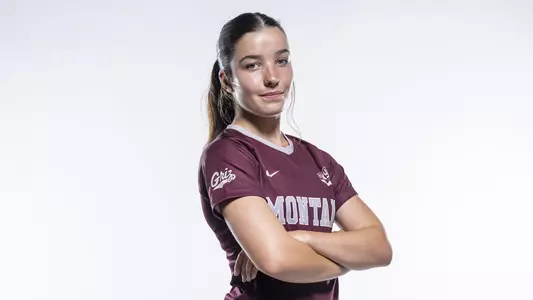
The Craig Hall Chronicles :: Emma Pascoe
8/26/2022 6:38:00 PM | Soccer
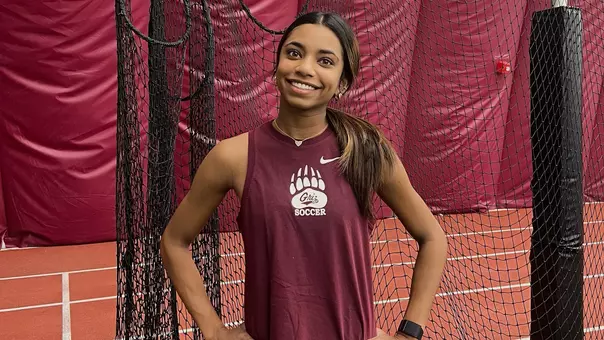
Yes, Emma Pascoe is Canadian, from up there in Langley, which is tucked in between Vancouver and British Columbia's border with Washington, so let's get the requisite hockey question and answer out of the way.
Did she play the sport? She did, early on, but she didn't like wearing all the gear, all those thick pads all over the place, the bulky breezers, the heavy skates. She preferred either tennis, which required nothing more than a racket in her hand, or soccer: jersey, socks, shin guards, cleats and let's go.
Of course, her mom is the manager of a hockey rink. And the weather app on her phone still shows Missoula's temperature in Celsius. And she's not changing it.
Yes, Emma Pascoe is Canadian, and if you try to define her through that cultural lens – and through that lens only – you're going to miss seeing who she is, who she truly is if you look deep enough, if you allow the years to roll back, if you set the story not in Canada but Jamaica.
That's where her grandparents were living, Randy Pascoe's parents, before Randy was born. They're the ones who started this whole thing, who put in motion something that would come to define the family through generations, that would become not just a belief but make its way into the family's very blood.
They wanted something better than they had in Jamaica, not just for themselves but for their children who were not even born yet. So, they headed north, to Canada, to Ontario, to what they thought would be a better life, for them, for those who would follow.
They departed Jamaica with almost nothing, in their hands or to their names. They arrived with just as much. They were chasing a dream, a hope. The picture captured all of it, the fear, the uncertainty, the opportunity.
In the photo, in this new world of snow, he's front and center. His wife is holding on to his arm. At least that's what it looks like at first glance. Look closer, in their eyes. She's not holding on as much as she's bracing him up.
"My dad was like a deer in the headlights, thinking, what in God's name have I done? Whereas my mom was brimming with optimism," says Randy. "They came to form a better life, not only for them, but they were thinking about their future children. They were determined."
They got together with some relatives, pooled their limited resources and rented a place to live, the foundation of what they would build. He became an electrician and worked for Canada Post. She worked at a bank.
They began making their way, one day at a time, on the path toward something better, something they could pass on, pass down.
"They formed a wonderful life for their kids," says Randy, Emma's dad. "They are the epitome of coming from a very challenging environment to an environment where they did not know what to expect. To see them forge a life like that was wonderful for me growing up."
The message, lived more than just spoken: take what we've done, make it better, then hand it off to your own kids. Ensure it continues.
That philosophy, of making things better for those around you, found its sporting outlet for Randy on the soccer field. He wasn't a goal scorer as much as he was a facilitator for those around him, setting them up to be successful, then celebrating their achievements.
A life philosophy, incarnate and wearing cleats.
"I loved the midfield because I could set other people up," he says. "The joy I get in watching Emma is her ability to make the players around her better. A lot of it is her pure unselfishness.
"She can score, but she is also that player who will thread that perfect ball through, making sure someone else can score a goal. That's always been her approach to the game."
He played the sport growing up, made enough money competing as a young adult to put himself through college. No silver spoons here, just golden feet.
Matches, and the way they were played, reflected the makeup of the team on which he found himself at the time. "The game is very structured today. Back then, it was very culture-based," he says.
The Spanish team? "They had a certain style of soccer, where everyone was moving around the person with the ball. The person who had the ball just had to look around at who to pass to."
The English team? "They were run-and-kick and played a certain brand. I remember they would get angry all the time."
The Italian team was a mixture of the two. Then everyone would retreat to the changing room and break out in song. "I never spoke Italian, but I would sing along anyway. It was some of the funnest times in my life and some of the best memories. It was just a wonderful, wonderful experience."
Interesting thing about that team's benefactors: they paid more money to those players who were involved in the build-up of a goal than the player who simply had the final touch.
"They rewarded you for setting up other players," says Randy. "They paid more for people who made runs off the ball or who were effective at setting goals up. They would reward the goal-scorer less than the effort it took to score the goal. That really created an unselfish culture."
Randy and Deb married, discovered they had their first child on the way, and he knew what needed to be done.
It wasn't going to be enough to provide them opportunities where they were. He would do what his parents did, with less risk, of course, and uproot from Ontario and relocate to British Columbia, all for quality of life, to make things better for who would become Ben, then Emma.
He got a job at BC Hydro, running power systems, "so I always joked with my dad that I one-upped him," says Randy, whose dad certainly approved, because that was always the goal. But it wasn't just for work that Randy and Deb moved. It was to find a better life for those children.
"I think I had it in my blood. It was sort of built into me, if an opportunity were to present itself, I wouldn't hesitate," he says.
"When you live in an area and you go bike riding and you're picking grit out of your teeth, then you see another area where it's 1,000 times cleaner, you know it's a wonderful place to raise your children. It's a very unique place where we live."
If you're wondering when this article might get around to, you know, the actual subject, then you don't yet know the Pascoes. All of this has been about Emma. She inherited it. She's a carrier.
If Randy and Deb had any doubts, they were set aside that day so many years ago when Fluffy, their daughter's stuffed elephant, started showing the wear and tear of its age. And wouldn't she just like to get a new one?
"She looked me in the eye and said, no, I want to leave this for my daughter or son when I have kids," says Randy, who knew his mission had been accomplished.
"The theme of leaving it better for the next generation has always been important to our family. How do you build toward that next generation?"
They put her in every sport available. Her interests naturally whittled that list down to tennis and soccer, then finally just soccer because of the team aspect.
"I didn't care what my kids did. I just cared that they were happy," Randy says.
And he was never happier in sport than on the soccer field, playing the midfield, and if every match could have been like that one four decades ago, he wouldn't have ever needed anything else.
"I remember one game specifically, even though it was 40-some-odd years ago. We got on the field against an English team, and we were just in sync that day," he says. "I can't explain it. We had so many perfect sequences. The other team couldn't touch the ball. Everyone was firing on all cylinders.
"To me that's what soccer's about. It's about getting to that higher level as a collective unit, then everyone feeling really good."
As she developed as a midfielder, dad kept his distance, until daughter asked for help. Then it was off to the nearby turf fields at the Langley Event Center.
"If I didn't think something was right or I wanted to learn something from the game, my dad would take me out to the field that night and walk through it and help me figure it out," Emma says. "I'm very fortunate."
It's why the freshmen who join the Montana soccer program do not enter the program as equals. Some have physical gifts and strengths, some are fitter, some just have a better soccer mind, some can see things others can't.
After Montana played Trinity Western in its lone exhibition match, a school located in her hometown, she had a meeting with the coaching staff to go over her play.
She told them how, given Delaney Lou Schorr's length, she wanted to play a ball a bit off Schorr's body, something that wouldn't work for a shorter player like Skyleigh Thompson. Put it in a place where Schorr could connect with the ball but her defender couldn't, giving Schorr the advantage.
Citowicki's head did everything but explode. He lives for insight like that, but it's usually him trying to relay it to others.
"She's so analytical. Before the ball gets to her, she has so many pictures in her brain," says Citowicki. "The amount of times the ball has come into her at practice and someone is pressing her and without even looking she's looked ahead and knows the angles and everything that's happening.
"She has such a brain for the game. It's so much fun to watch her right now. I can't wait to get her to the point where she can start influencing games that way too."
But those sessions at the field were never just about soccer. Time alone between father and daughter never is. It's the gift that comes with fatherhood, even if it has to come later in life, after physical skills have eroded a bit.
"I'm in my 50s now. I still got it occasionally, I just can't do it for too long," says Randy. "I've loved every second about being on the field with her. I view it as the times we have our best talks.
"When you start talking about soccer, you're talking about life. That's the beauty of soccer to me. It's just the vehicle. It can lead to so many good things."
She played for Fraser Valley, was identified by the Vancouver Whitecaps in 8th grade, spent a few years there, then advanced to the British Columbia Provincial Program.
There is a reason Citowicki has tethered his program to the Whitecaps, where Pascoe played alongside Julia Grosso and Jordyn Huitema, two players who helped lead Canada to the gold medal at the Tokyo Olympics last summer.
It started with Camellia Xu, the first Whitecaps player to become a Grizzly under Citowicki.
"Okay, we need to send one of us up there for a showcase or a week of training," says Citowicki of his coaching staff. "These kids are all extremely high level, residential academy players who are getting prepped for national team stuff.
"(Former assistant coach J. Landham) decides to go up and he's texting me about this one girl, Emma Pascoe." And he brings up the name of Avery Adams, who was playing for Montana at the time and becoming a first-team All-Big Sky Conference midfielder as a junior and senior.
"At the time, we still had Avery and Avery is just smooth on the ball. She can play the ball under pressure, she can turn out. Here is this player who can get out of things like Avery can get out of things. If she continues developing, she'd be a wonderful player for us."
It was Xu and to a lesser extent, because of when she transferred into the program from Nebraska, Molly Quarry who played matchmaker. Both were Whitecap players, both had played alongside Pascoe.
"I'm hearing from Cam and Molly, 'When we were at Whitecaps, we loved Emma. She's one of our favorite people, one of our favorite players,' " says Citowicki.
But it wouldn't be as simple of a transaction as we like you, you like us, let's sign the paperwork. Pascoe may be a freshman in college but she is mature beyond her years when she talks about what she wanted in a college program.
Some of it she learned from her family's history, some of it from her dad's talks those evenings alone on the field, some of it from teams she played on in her past, for better or for worse.
She had a stronger grasp of culture and what it means to a soccer team than most players her age. "I've learned that the culture of the team is so important. When you have good culture, it really resonates on the team and how it plays. That's why it's so important to me, the most important thing."
"Emma has worked so very hard to create this opportunity for herself, but she never forgets her roots," her dad says. "She learned early in her career that culture wins soccer games."
He describes how there are key moments in a match, how a player breaks down the wing and knows she is at a bad angle but shoots at a critical point instead of laying it off for someone else to take a better shot. Self over team when it's the opposite that wins.
"In the heat of competition, will you have players who will play for each other, or will you have a selfishness on the team?" he asks.
Montana's answer: The Grizzlies have won three Big Sky Conference tournaments in four years under Citowicki, going 6-1 in the heat of that competition, with three goals allowed in seven matches. Culture, plus a healthy helping of talent, did that.
The Pascoes looked at schools in Canada, in the U.S., not looking at uniforms or facilities but rather for culture, which most coaches talk about, but the posers can be heard from a mile away.
"We had some calls and knew it was a good decision not to go there," Randy says. "What I liked about Chris was that he understood that the locker room culture was key. If you don't set a good culture, you're not going to get success.
"That very much blended with what we wanted for our daughter and what we know wins soccer games and breeds success. It's not enough to win. If you win but you have certain players who were left out and not everybody raised their own level, it's not a wonderful environment. It's not really winning."
Sure, she wants to play, which she has yet to do through three regular-season matches – she's a competitor after all – but she knows where she stands within the program. There are older players, more experienced players, players more ready to help Montana win today ahead of her.
It won't change how hard she works or how she views her role, which she sees in a bigger picture than most freshmen are able to. She wants to leave it better than she found it, to pass the Montana soccer program on to the next generation of Grizzlies so they can do things she never dreamed of.
That's just in her blood, from grandparents on down.
"It was natural. Like being raised with parents who made sure they left better for us, we as parents leave better for our kids," says Randy.
"I have great faith that Emma knows part of her responsibility is to help Chris grow the program and win a lot of soccer games. That applies both on and off the field. She really has no motives other than winning soccer games and making the program stronger."
Did she play the sport? She did, early on, but she didn't like wearing all the gear, all those thick pads all over the place, the bulky breezers, the heavy skates. She preferred either tennis, which required nothing more than a racket in her hand, or soccer: jersey, socks, shin guards, cleats and let's go.
Of course, her mom is the manager of a hockey rink. And the weather app on her phone still shows Missoula's temperature in Celsius. And she's not changing it.
Yes, Emma Pascoe is Canadian, and if you try to define her through that cultural lens – and through that lens only – you're going to miss seeing who she is, who she truly is if you look deep enough, if you allow the years to roll back, if you set the story not in Canada but Jamaica.
That's where her grandparents were living, Randy Pascoe's parents, before Randy was born. They're the ones who started this whole thing, who put in motion something that would come to define the family through generations, that would become not just a belief but make its way into the family's very blood.
They wanted something better than they had in Jamaica, not just for themselves but for their children who were not even born yet. So, they headed north, to Canada, to Ontario, to what they thought would be a better life, for them, for those who would follow.
They departed Jamaica with almost nothing, in their hands or to their names. They arrived with just as much. They were chasing a dream, a hope. The picture captured all of it, the fear, the uncertainty, the opportunity.
In the photo, in this new world of snow, he's front and center. His wife is holding on to his arm. At least that's what it looks like at first glance. Look closer, in their eyes. She's not holding on as much as she's bracing him up.
"My dad was like a deer in the headlights, thinking, what in God's name have I done? Whereas my mom was brimming with optimism," says Randy. "They came to form a better life, not only for them, but they were thinking about their future children. They were determined."
They got together with some relatives, pooled their limited resources and rented a place to live, the foundation of what they would build. He became an electrician and worked for Canada Post. She worked at a bank.
They began making their way, one day at a time, on the path toward something better, something they could pass on, pass down.
"They formed a wonderful life for their kids," says Randy, Emma's dad. "They are the epitome of coming from a very challenging environment to an environment where they did not know what to expect. To see them forge a life like that was wonderful for me growing up."
The message, lived more than just spoken: take what we've done, make it better, then hand it off to your own kids. Ensure it continues.
That philosophy, of making things better for those around you, found its sporting outlet for Randy on the soccer field. He wasn't a goal scorer as much as he was a facilitator for those around him, setting them up to be successful, then celebrating their achievements.
A life philosophy, incarnate and wearing cleats.
"I loved the midfield because I could set other people up," he says. "The joy I get in watching Emma is her ability to make the players around her better. A lot of it is her pure unselfishness.
"She can score, but she is also that player who will thread that perfect ball through, making sure someone else can score a goal. That's always been her approach to the game."
He played the sport growing up, made enough money competing as a young adult to put himself through college. No silver spoons here, just golden feet.
Matches, and the way they were played, reflected the makeup of the team on which he found himself at the time. "The game is very structured today. Back then, it was very culture-based," he says.
The Spanish team? "They had a certain style of soccer, where everyone was moving around the person with the ball. The person who had the ball just had to look around at who to pass to."
The English team? "They were run-and-kick and played a certain brand. I remember they would get angry all the time."
The Italian team was a mixture of the two. Then everyone would retreat to the changing room and break out in song. "I never spoke Italian, but I would sing along anyway. It was some of the funnest times in my life and some of the best memories. It was just a wonderful, wonderful experience."
Interesting thing about that team's benefactors: they paid more money to those players who were involved in the build-up of a goal than the player who simply had the final touch.
"They rewarded you for setting up other players," says Randy. "They paid more for people who made runs off the ball or who were effective at setting goals up. They would reward the goal-scorer less than the effort it took to score the goal. That really created an unselfish culture."
Randy and Deb married, discovered they had their first child on the way, and he knew what needed to be done.
It wasn't going to be enough to provide them opportunities where they were. He would do what his parents did, with less risk, of course, and uproot from Ontario and relocate to British Columbia, all for quality of life, to make things better for who would become Ben, then Emma.
He got a job at BC Hydro, running power systems, "so I always joked with my dad that I one-upped him," says Randy, whose dad certainly approved, because that was always the goal. But it wasn't just for work that Randy and Deb moved. It was to find a better life for those children.
"I think I had it in my blood. It was sort of built into me, if an opportunity were to present itself, I wouldn't hesitate," he says.
"When you live in an area and you go bike riding and you're picking grit out of your teeth, then you see another area where it's 1,000 times cleaner, you know it's a wonderful place to raise your children. It's a very unique place where we live."
If you're wondering when this article might get around to, you know, the actual subject, then you don't yet know the Pascoes. All of this has been about Emma. She inherited it. She's a carrier.
If Randy and Deb had any doubts, they were set aside that day so many years ago when Fluffy, their daughter's stuffed elephant, started showing the wear and tear of its age. And wouldn't she just like to get a new one?
"She looked me in the eye and said, no, I want to leave this for my daughter or son when I have kids," says Randy, who knew his mission had been accomplished.
"The theme of leaving it better for the next generation has always been important to our family. How do you build toward that next generation?"
They put her in every sport available. Her interests naturally whittled that list down to tennis and soccer, then finally just soccer because of the team aspect.
"I didn't care what my kids did. I just cared that they were happy," Randy says.
And he was never happier in sport than on the soccer field, playing the midfield, and if every match could have been like that one four decades ago, he wouldn't have ever needed anything else.
"I remember one game specifically, even though it was 40-some-odd years ago. We got on the field against an English team, and we were just in sync that day," he says. "I can't explain it. We had so many perfect sequences. The other team couldn't touch the ball. Everyone was firing on all cylinders.
"To me that's what soccer's about. It's about getting to that higher level as a collective unit, then everyone feeling really good."
As she developed as a midfielder, dad kept his distance, until daughter asked for help. Then it was off to the nearby turf fields at the Langley Event Center.
"If I didn't think something was right or I wanted to learn something from the game, my dad would take me out to the field that night and walk through it and help me figure it out," Emma says. "I'm very fortunate."
It's why the freshmen who join the Montana soccer program do not enter the program as equals. Some have physical gifts and strengths, some are fitter, some just have a better soccer mind, some can see things others can't.
After Montana played Trinity Western in its lone exhibition match, a school located in her hometown, she had a meeting with the coaching staff to go over her play.
She told them how, given Delaney Lou Schorr's length, she wanted to play a ball a bit off Schorr's body, something that wouldn't work for a shorter player like Skyleigh Thompson. Put it in a place where Schorr could connect with the ball but her defender couldn't, giving Schorr the advantage.
Citowicki's head did everything but explode. He lives for insight like that, but it's usually him trying to relay it to others.
"She's so analytical. Before the ball gets to her, she has so many pictures in her brain," says Citowicki. "The amount of times the ball has come into her at practice and someone is pressing her and without even looking she's looked ahead and knows the angles and everything that's happening.
"She has such a brain for the game. It's so much fun to watch her right now. I can't wait to get her to the point where she can start influencing games that way too."
But those sessions at the field were never just about soccer. Time alone between father and daughter never is. It's the gift that comes with fatherhood, even if it has to come later in life, after physical skills have eroded a bit.
"I'm in my 50s now. I still got it occasionally, I just can't do it for too long," says Randy. "I've loved every second about being on the field with her. I view it as the times we have our best talks.
"When you start talking about soccer, you're talking about life. That's the beauty of soccer to me. It's just the vehicle. It can lead to so many good things."
She played for Fraser Valley, was identified by the Vancouver Whitecaps in 8th grade, spent a few years there, then advanced to the British Columbia Provincial Program.
There is a reason Citowicki has tethered his program to the Whitecaps, where Pascoe played alongside Julia Grosso and Jordyn Huitema, two players who helped lead Canada to the gold medal at the Tokyo Olympics last summer.
It started with Camellia Xu, the first Whitecaps player to become a Grizzly under Citowicki.
"Okay, we need to send one of us up there for a showcase or a week of training," says Citowicki of his coaching staff. "These kids are all extremely high level, residential academy players who are getting prepped for national team stuff.
"(Former assistant coach J. Landham) decides to go up and he's texting me about this one girl, Emma Pascoe." And he brings up the name of Avery Adams, who was playing for Montana at the time and becoming a first-team All-Big Sky Conference midfielder as a junior and senior.
"At the time, we still had Avery and Avery is just smooth on the ball. She can play the ball under pressure, she can turn out. Here is this player who can get out of things like Avery can get out of things. If she continues developing, she'd be a wonderful player for us."
It was Xu and to a lesser extent, because of when she transferred into the program from Nebraska, Molly Quarry who played matchmaker. Both were Whitecap players, both had played alongside Pascoe.
"I'm hearing from Cam and Molly, 'When we were at Whitecaps, we loved Emma. She's one of our favorite people, one of our favorite players,' " says Citowicki.
But it wouldn't be as simple of a transaction as we like you, you like us, let's sign the paperwork. Pascoe may be a freshman in college but she is mature beyond her years when she talks about what she wanted in a college program.
Some of it she learned from her family's history, some of it from her dad's talks those evenings alone on the field, some of it from teams she played on in her past, for better or for worse.
She had a stronger grasp of culture and what it means to a soccer team than most players her age. "I've learned that the culture of the team is so important. When you have good culture, it really resonates on the team and how it plays. That's why it's so important to me, the most important thing."
"Emma has worked so very hard to create this opportunity for herself, but she never forgets her roots," her dad says. "She learned early in her career that culture wins soccer games."
He describes how there are key moments in a match, how a player breaks down the wing and knows she is at a bad angle but shoots at a critical point instead of laying it off for someone else to take a better shot. Self over team when it's the opposite that wins.
"In the heat of competition, will you have players who will play for each other, or will you have a selfishness on the team?" he asks.
Montana's answer: The Grizzlies have won three Big Sky Conference tournaments in four years under Citowicki, going 6-1 in the heat of that competition, with three goals allowed in seven matches. Culture, plus a healthy helping of talent, did that.
The Pascoes looked at schools in Canada, in the U.S., not looking at uniforms or facilities but rather for culture, which most coaches talk about, but the posers can be heard from a mile away.
"We had some calls and knew it was a good decision not to go there," Randy says. "What I liked about Chris was that he understood that the locker room culture was key. If you don't set a good culture, you're not going to get success.
"That very much blended with what we wanted for our daughter and what we know wins soccer games and breeds success. It's not enough to win. If you win but you have certain players who were left out and not everybody raised their own level, it's not a wonderful environment. It's not really winning."
Sure, she wants to play, which she has yet to do through three regular-season matches – she's a competitor after all – but she knows where she stands within the program. There are older players, more experienced players, players more ready to help Montana win today ahead of her.
It won't change how hard she works or how she views her role, which she sees in a bigger picture than most freshmen are able to. She wants to leave it better than she found it, to pass the Montana soccer program on to the next generation of Grizzlies so they can do things she never dreamed of.
That's just in her blood, from grandparents on down.
"It was natural. Like being raised with parents who made sure they left better for us, we as parents leave better for our kids," says Randy.
"I have great faith that Emma knows part of her responsibility is to help Chris grow the program and win a lot of soccer games. That applies both on and off the field. She really has no motives other than winning soccer games and making the program stronger."
Players Mentioned

D
/ Soccer
M
/ Soccer
D
/ Soccer
F
/ Soccer
F
/ Soccer
G
/ SoccerFriday, June 19
Thursday, June 04
Friday, May 01
Friday, May 01