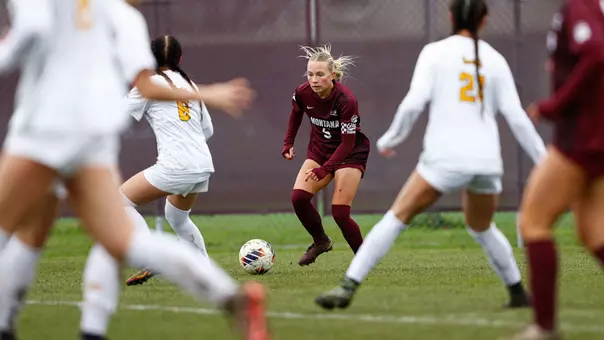
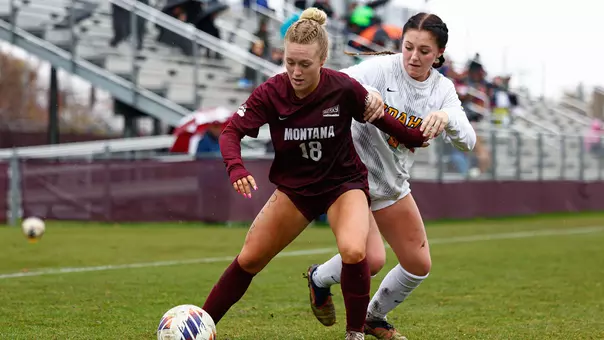
Photo by: © John Sieber
8/1/2023 10:46:00 AM | Soccer
Nothing like the onset of a global pandemic for a student just beginning to study population health to really understand what exactly she's getting herself into, the subject matter going from academic to real life, the education from the classroom to extensive coverage on the nightly news.
Maps, charts, projections, experts, death counts, transmission rates, everyone's attention. This had it all.
That was the case for Montana fifth-year senior Maysa Walters back in the late winter and spring of 2020 when she was a freshman at New Mexico and Covid-19 was becoming the biggest thing in the world. It certainly gave her instructors something to talk about.
"I think that opened a lot of people's eyes to public health. I know it did mine. It gave me deeper insight of what I was getting into," the future PhD says.
It's not what she arrived at New Mexico in the fall of 2019 intending to study, but one of the fittest people you'll ever meet, the future exercise science major, was, like a lot of aspiring scientists, undone by chemistry. She wasn't the first, she won't be the last. It managed to take all the fun out of it.
"I took a general chemistry course and thought, this is not for me. When it starts to get that molecular, you start to lose me," she says. "I didn't want to go into a field that was so science-based, but I was still interested in the health side of things."
She changed course from exercise science to public health, going from microscopic to big picture, from individual to community. It all started with an introduction to epidemiology class and picking up some new terms, some new ideas: incidence, prevalence, cost of illness, burden of disease.
"It's looking at health trends in certain areas. Why does this street have an increased rate of disease and nowhere else has that high of a rate?
"So, you start looking deeper into it. Is it an environmental health issue? Is it the water they are drinking? You dive into why health trends are the way they are. That's where I wanted to go. That's what I became interested in," she says.
While she was working toward a degree in population health with minors in sustainability studies and psychology, she picked up a pair of Mountain West Conference championships with the Lobos and played in two NCAA tournaments, advancing to the second round in spring 2021, a first for the program.
It brought her two worlds, of student-athlete, together. Covid-19 was not just the subject of the day in the classroom, it also forced the fall 2020 soccer season to be played in the spring of 2021. New Mexico advanced past Navy in front of a sparse, masked-up crowd of maybe 100 fans in Wilson, N.C.
It was all about using the information at hand to make the best decisions possible for the greater good while acknowledging that life must go on in the background. That's the study of public health.
She earned her degree in just three years. Before she put her name in the portal as a graduate transfer, seeking not just an advanced degree but a new soccer experience, she made a trip to Missoula and met with Tony Ward, chair of Montana's School of Public and Community Health Sciences.
It was going to work. The player who was raised in Billings was going to become a Grizzly and pursue a Master of Public Health degree. "I have loved being in the program here. I couldn't be happier with where I am," says Walters, who will complete her degree requirements in the spring.
She was voted by her teammates as Montana's Newcomer of the Year after the 2022 season, after she tied for the Big Sky Conference lead in assists with six, after scoring a pair of goals and starting and playing in 19 of 20 matches.
It was enough that she was contacted by Rochester (Minn.) United FC of the Women's Premier Soccer League. Would she like to play for the team during its summer schedule? She would and she did, scoring the team's first goal of the season against MapleBrook Fury.
"They paid for housing and food, and I had an old club teammate who was living in Rochester who I lived with, which made it great. A really fun summer," says Walters, who couldn't move to Rochester and not reach out to the world-famous Mayo Clinic, you know, since she was in the area.
She had no in with anybody, just an extensive directory of a place that employs more than 40,000 people and her belief that a girl has to make her own breaks in life. "I emailed their division of epidemiology. Most of my positions have come from me reaching out to somebody," she says.
She was connected and then paired with Dr. Ellen Goode, who has the type of resume that can be a bit overwhelming: degrees from Cornell, Cal and Washington, three additional certificates, two completed post-doctoral fellowships.
"She was fantastic. She taught me so much. I was intimidated at first but they couldn't have been more welcoming. I felt like I fit right in," says Walters, who is still doing some remote work for the unit.
She is eyeing professional soccer, something overseas for a year, then hopefully returning to Missoula to begin working toward that PhD, which would have her in school another five years, until she starts pushing 30. "I can't even fathom that, but I like to learn and I like the research side of things," she says.
First, there is the matter of the season at hand. While the program is far from broken, there were things that needed to be fixed in the offseason, flaws that came to light last fall, when Montana finished sixth in the Big Sky, its lowest since 2013 after entering the season picked second.
The No. 6 seed Grizzlies showed their potential in the Big Sky quarterfinals in Greeley, Colo., with a 3-0 destruction of No. 3 Portland State. But the winning play was never found two days later in a 1-0 loss to No. 2 Idaho, despite Montana having the upper hand on the box score.
The Grizzlies outshot the Vandals 15-9 and had a one-sided 12-1 advantage in corners. But a defensive turnover led to Idaho scoring the match's lone goal, with 15 seconds remaining in the first overtime period. And that was that.
"When the season ended last year, it was really disappointing. We didn't finish where we needed to," Walters says. "We knew we were good enough but at the end of the day, we weren't good enough. We didn't win."
Walters arrived in Missoula from Albuquerque last summer, a veteran player but still a newcomer, and patiently bided her time. Other players had been here longer, had invested more, had seen plenty of success. She filled her role on the field, deferred to others off it.
No more. "I definitely wanted to respect the girls who had been here longer than me. My voice was on the field through how I played, not necessarily off the field. This year I've grown into a different leadership style. I have more of a voice on and off the field," she says.
She only has one season left of collegiate soccer. She's not going to allow a minute of it to slip away, from the opening day of practice until the final whistle of the team's final match has been blown.
"I'm going to hold the team to a very high standard on the field. Finding where I fit has been really important for our leadership group and myself. Being able to fill my role the best I can is really important to me."
Montana will face a challenging nonconference schedule, including matches against Ohio State, Oklahoma and Oregon State, then will move into league, where the Grizzlies weren't good enough last year to contend for a championship.
Montana went 3-4-1 in the Big Sky and needed help from Idaho on the final day of the regular season just to make the six-team Big Sky tournament.
The issue wasn't talent. It was a lack of urgency, of starting off slowly, the tendency to wait until the opponent struck before Montana picked up its game and started to fight back. That approach can only work so often in any sport, particularly one like soccer.
In eight league matches, Montana allowed its opponent to score the opening goal six times. The Grizzlies rallied to win two of those matches but dropped the other four. Come out flat, concede a goal, fight like crazy to rally. It wasn't a winning formula then, it wouldn't be this season either.
It's just different when you're a fifth-year senior, when you've seen what leads to success and what doesn't, when you can look at the calendar and see the end of your collegiate career just a few months away. There is no time to waste.
"We are neck and neck with every team. We need to go into every game like we're there to win. Why does it take us going down 1-0 for us to decide, oh, we want to score now," Walters says.
"Being a bit more proactive and finishing our chances is going to be huge and getting everybody on the same page that this is our standard. We win at Montana and we want to continue to win at Montana. I think we have that mindset." She'll make sure of it.
Players Mentioned

M
/ SoccerMonday, November 02
Monday, November 02
Monday, November 02
Tuesday, October 27