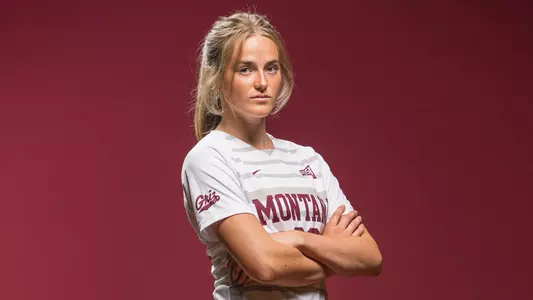
The Craig Hall Chronicles :: Taija Anderson
8/2/2023 10:49:00 AM | Soccer
She came out of nowhere. That's how Montana coach Chris Citowicki describes the recruiting story of Taija Anderson, and it's true. She came to his attention by an email that showed up in his in-box one day, a player from a state that previously had sent only two players to the Grizzlies over three decades.
It's the story of her life, really. Ask her where she lived growing up and she pauses. Thinks. Thinks some more, then starts rattling off states likes she's putting together a TripTik.
There were two moves within Utah before she was five, then the list really starts to take off: "We moved to Texas, then Kentucky, then Michigan, Louisiana, Florida, then back to Utah," she says.
"Alabama for four years. Loved Alabama. Then Utah, then South Carolina, North Carolina, Florida again, then back to Utah in seventh grade."
She wasn't in a military family. Her dad was a salesman, still is, of home alarms back in the day. Ryan Anderson would hit a market, sell it for all he could, then up and move the entire gang, wife Wendy and children Treyhton, Taija, EvRhett and Indierose to the next state.
Those names? Yep, they're a bit unique. And that was planned, from a Ryan Anderson who seemed to come across another Ryan Anderson every time he turned around. Or went to a new track to race dirt bikes growing up in Utah.
He was good. Really good. State champion good in the 250cc class, multiple times, the type of racer that had everybody else on the starting line looking up and down the row of helmets trying to figure out who they were battling with for second, because the winner was already known.
Then one day he raced out of state and some dude, another Ryan Anderson, racing novice class and not doing well, soiled the name within racing circles. He heard the whispers. Man, Ryan's gotten slow. No, he hasn't. Ryan be fast. The other Ryan be slow.
That type of confusion wasn't going to pass down to his children, though Anastasia? Really, Wendy? "That's not good," Ryan told her. "Let's just call her Taija." Oh, I like that, she agreed.
He sold until he could sell no more, then the Andersons and the two families that were sharing the same sell-move-sell-move lifestyle, families that might as well been blood relatives from those 14 years of itineration, would up and relocate.
The kids? Yep, they became resilient. There was no other way. It was either that or close yourself off completely, go deeper and deeper into a shell. That wasn't Taija. "I'm thankful for the life I got to live. It was adventurous. It made me more social, more outgoing. I'm me because of it," she says.
Join the Montana Grizzlies in July as a freshman? Intimidating? Overwhelming? Please. This is the girl who stayed put in Utah the previous four months, going all home alone at her grandmother's place after her family moved once again, this time down to Arizona.
"What may be hard for some people, she's turned into a strength," says Citowicki. "Put her in anything and she is going to connect with people. What a fun thing to bring in as a freshman. She's fun-loving and unpredictable. She just brings a joyful energy to her class and to this team."
You wonder: At what cost, this upbringing, of not ever feeling connected to a place, of having friendships that come and go, none of them extending long enough to form strong roots? All these years later, Ryan is asked, was it worth it?
"For what it did for our kids, I would do it again in a heartbeat. It made my kids chameleons. It made them really good with people. It helped them understand different cultures and different types of people," he says. "They had to make friends in all sorts of different areas."
But Taija, she had it the hardest. It wasn't just friends she would make and have to leave behind, she had teammates, the bond of friendship taken up a notch or two on the soccer field. "None of my other kids were into sports, so that made it harder on her than anyone else," he says.
For all the personal benefits it led to, it wreaked havoc on her soccer development. Because where does a new girl in town land? She would make the top team but always started on the bench, always having to prove herself. She would work her way into some playing time, then some more, then she was starting, just in time to move to a new city, a new club, a new team. And repeat. Back to the start.
"She had to fight. That's been her thing, and she's always found a way to fight to the top. She'd start on the bench and before we'd move, she was starting every game. That kid is something else," Ryan says.
"She just loves the game and is crazy motivated. She's always had to claw her way and fight. That's what I told Chris. You're never going to have to ask her to give you everything. She is always going to give you everything she has."
Potential? Loads of it, untapped. "She has a little bit of Eliza Bentler in her. Sometimes I don't know what Eliza is going to do, but I know the ball ends up in the goal. Taija is unpredictable at times. I like what she could potentially contribute to this program," Citowicki says. "She loves going at people 1v1."
She's got her dad's blood in her. He moved to a new state, a new market and had this hanging over his head every morning he work up: I need to win the day. There is no other option. It's on me and no one else. It's the life of a door-to-door salesman.
Except, he's not a born salesman. He just has those things that translate well. "The only thing that makes me a good door-to-door salesman is having tenacity and not giving up," he says. "I think Taija got a lot of those qualities from me and her mom. Her mom is a fighter too. Taija got it and utilized it."
First, on the dance floor, because how many of these articles, whether they be for soccer, basketball or softball, start out with dancing before it ever leads to competing on a field or a court?
"Every mom wants her kid to dance, to be able to dress them up all cute," Ryan says. Then one day his daughter gets home from school with some big news: I've been playing soccer at school at recess and I really like it.
"You do?" Ryan asked. "Taija couldn't walk and chew bubble gum without falling over. We put her in a rec league and her first game she was taking the ball from girls. She scored a couple goals. She was just so natural from the get-go. It never stopped from there. She found it, loved it and went with it.
"And I'd rather watch soccer than dance, right? Let's go."
When he wasn't racing dirt bikes, he was playing soccer himself growing up, always the fastest kid in the school. When he was a senior, he'd stop by his sisters' practices, where he first bumped into Gabe Smart, who played at BYU and was dipping her toe into the coaching pool for the first time.
They hit it off, played on teams together, kept in touch as Smart went from Director of Coaching for the Avalanche Soccer Club to head coach at Utah Valley to assistant at Utah while the Andersons were going everywhere else. Who knows when a family friend with that kind of experience might come in handy?
It was Kat Nichols, in Alabama, who really started this whole thing, who took that initial interest of an 11-year-old and turned it into a girl who would become a Division I player. It wasn't a meteoric rise. Instead, it was up, down, reset, up, down, reset, over and over as the family relocated.
Finally, a landing spot in Utah. "I promised Taija I wouldn't move her teams again," says Ryan. She finally had sporting stability, allowing her to go from Utah Celtic FC to Sparta United and finally Avalanche, the club Smart told them they had to be on if Taija was going to not only improve but be seen.
She is only the third player from Utah to be a Grizzly, joining McKenzie Warren and Raquel Watts, but she isn't a girl of the West. All that time on the eastern side of the country had her looking that direction when schools started noticing this player who was getting better by the day.
Grambling offered her. Mississippi State invited her to an ID camp. Utah schools reached out, but she told them all the same thing. I'm not staying here, not in Utah. She liked the vibe back east.
Then Covid arrived, and it hit her age group particularly hard. They weren't being seen, right when they needed to be seen. And when college soccer came out the other side, coaches were told that current players could have an extra year of eligibility, which changed the entire team-building dynamic.
Programs had to weigh one season of a fifth-year senior versus an incoming freshman. And would that fifth-year senior want to come back for an extra season? And how long would everyone have to wait to find out?
It led to a cat-and-mouse game in the recruiting world, or more like a shell game. What you thought was there had somehow disappeared in the blink of an eye.
"It was already hard enough to get a Division I scholarship or spot to play, and then you had students who didn't have to leave. That made it tough," says Ryan. "We took her to some big schools and a few of them really broke our hearts. The competition was so high."
She made the US Youth Soccer ODP West Region team, played in Florida at nationals on a team that didn't lose and still wasn't able to get anything locked up.
Boy, did European opportunities begin to sound really good right about then, a different avenue to continue playing soccer after high school. The Andersons learned about one, were intrigued, and Taija was sold, enough that she ended all U.S. recruiting.
She had made up her mind. She was going to be on the move once again after graduation, this time on her own.
Come over to Italy! Hellas Verona! You'll have an opportunity to try out not for one, not for two but for three different teams! This is a sure thing! Italy, baby! Trust us!
The tryout? For one team and it didn't lead to anything. "It was kind of a mess, kind of a bust," says Ryan. His daughter? She no longer had much in the way of offers back home, not after ending most communication. Grambling was still interested, a couple of Division II schools in Hawaii.
And the sands of the hourglass were mostly on the bottom half by now. Time was ticking. Teams were solidifying their rosters, and she wasn't on one.
"I was really stressed out. I didn't know what I was going to do," she says. What she did was start over. She made a list of her top 10 schools and reached out, long trained by Smart since the family's return to Utah, now taking every piece of advice the coach had to offer.
"She was amazing. We could call her and bounce ideas off of her all the time," says Ryan, whose wife's grandmother's side of the family is from Montana, landing the Grizzlies on Taija's top 10.
He was a loving father but also fine with this next of life's lessons, this coming from a guy whose livelihood required him to knock on your door and convince you that you needed what he was offering.
He was like the baseball player who leads the major leagues in batting at .348 but still technically fails more often than he succeeds.
"I think everyone should be a door-to-door salesman. It helps with every aspect of your life," he says. "It's good for her to have challenges and not have a win every single time."
In the end, she did win. The day after she emailed her top 10 schools, Citowicki replied back. He had a fifth-year senior who was no longer returning in 2023, so he had an opening. He liked what he saw, and he had long wanted to break into the Utah recruiting scene, one of the deepest in the West.
"I made a bunch of reference calls. Her club coach had a lot of really good things to say about her, both as a player and as a person and what she could provide to this team," says Citowicki.
"That's the feedback I got from her coaches, that she won't be your leading scorer but she should get you 3-5 goals every season. To have someone who can consistently put up numbers, that's the difference between finishing in the middle and winning everything."
Anderson was in rough shape, emotionally, psychologically, when she arrived in Missoula last winter, wondering if the prospect of playing Division I soccer was slipping through her fingers. The recruiting game, which can reduce people to players, a uniform number and nothing more, was wearing on her.
"When I went to other colleges, I wasn't in love. Yeah, that would be okay," she says. But no player dreams of college soccer hoping it will be okay. They want the best, something transformational.
"Then I came here and the coaches were amazing. I felt like more than a soccer player. Then the community and the team and the passion they have for each other and the game, it was amazing.
"The coaches are the right amount of pushing you to be a better player and driving you to be a better person too. I struggle with joy in soccer sometimes. Coming here and seeing they make sure it is joyful, it's really relieving."
Her confidence is down at the moment, not unusual for a freshman in her first week of practice. Everything is faster, more precise, more skilled, the players bigger, stronger, quicker than anything she's experienced before.
"Wow, they are really good, but I'm here for a reason. That's what I keep telling myself," she says. "I want to get as good as them, so I just have to get better. It's so weird going from a senior and being one of the best on the team to being a freshman. It's a total culture shock. We got this."
It's not a new position or situation. She's been here before, having moved, joined a team, moved, joined a team, moved, joined a team. It's never held her back before.
"It's been amazing to me to watch her level rise. She'll work until she's No. 1 or close to it," says her dad. "Her curve of improvement over the next year is going to be wild. I'll say that right now."
Ryan and family? They are back on the move, this time in Arizona. He's been up since 4 a.m., working deep into the evening. Again.
He's moved on to helping homeowners and businesses who still have cast-iron sewer pipes upgrade their system before time and usage forces them to do a major excavation.
See, he's got this system that can rehabilitate the existing pipe, then his guys can insert a new pipe inside of it, adding years and years and avoiding thousands and thousands of dollars.
Always the salesman.
What he no longer has to do is sell his daughter on herself. He knows where she's been and what she's done, the pressures she's faced as the new kid in town, the new player on the team and how she's always risen to the occasion, looked at the difficulties and overcome them anyway.
She's proved herself time and time again. Now? It's all about her. She has nothing left to prove to anyone. She's earned this opportunity. It's hers to enjoy, hers alone.
"For me, she's already enough. I called her when she got up there. You're enough with who you are. Whatever you do from here forward, it's for you. It's not for me or mom or anyone else but you. Make happen whatever you want to make happen," Ryan says.
"I want her to know she is enough. Moving forward, whatever she takes out of it, it's up to her."
It's the story of her life, really. Ask her where she lived growing up and she pauses. Thinks. Thinks some more, then starts rattling off states likes she's putting together a TripTik.
There were two moves within Utah before she was five, then the list really starts to take off: "We moved to Texas, then Kentucky, then Michigan, Louisiana, Florida, then back to Utah," she says.
"Alabama for four years. Loved Alabama. Then Utah, then South Carolina, North Carolina, Florida again, then back to Utah in seventh grade."
She wasn't in a military family. Her dad was a salesman, still is, of home alarms back in the day. Ryan Anderson would hit a market, sell it for all he could, then up and move the entire gang, wife Wendy and children Treyhton, Taija, EvRhett and Indierose to the next state.
Those names? Yep, they're a bit unique. And that was planned, from a Ryan Anderson who seemed to come across another Ryan Anderson every time he turned around. Or went to a new track to race dirt bikes growing up in Utah.
He was good. Really good. State champion good in the 250cc class, multiple times, the type of racer that had everybody else on the starting line looking up and down the row of helmets trying to figure out who they were battling with for second, because the winner was already known.
Then one day he raced out of state and some dude, another Ryan Anderson, racing novice class and not doing well, soiled the name within racing circles. He heard the whispers. Man, Ryan's gotten slow. No, he hasn't. Ryan be fast. The other Ryan be slow.
That type of confusion wasn't going to pass down to his children, though Anastasia? Really, Wendy? "That's not good," Ryan told her. "Let's just call her Taija." Oh, I like that, she agreed.
He sold until he could sell no more, then the Andersons and the two families that were sharing the same sell-move-sell-move lifestyle, families that might as well been blood relatives from those 14 years of itineration, would up and relocate.
The kids? Yep, they became resilient. There was no other way. It was either that or close yourself off completely, go deeper and deeper into a shell. That wasn't Taija. "I'm thankful for the life I got to live. It was adventurous. It made me more social, more outgoing. I'm me because of it," she says.
Join the Montana Grizzlies in July as a freshman? Intimidating? Overwhelming? Please. This is the girl who stayed put in Utah the previous four months, going all home alone at her grandmother's place after her family moved once again, this time down to Arizona.
"What may be hard for some people, she's turned into a strength," says Citowicki. "Put her in anything and she is going to connect with people. What a fun thing to bring in as a freshman. She's fun-loving and unpredictable. She just brings a joyful energy to her class and to this team."
You wonder: At what cost, this upbringing, of not ever feeling connected to a place, of having friendships that come and go, none of them extending long enough to form strong roots? All these years later, Ryan is asked, was it worth it?
"For what it did for our kids, I would do it again in a heartbeat. It made my kids chameleons. It made them really good with people. It helped them understand different cultures and different types of people," he says. "They had to make friends in all sorts of different areas."
But Taija, she had it the hardest. It wasn't just friends she would make and have to leave behind, she had teammates, the bond of friendship taken up a notch or two on the soccer field. "None of my other kids were into sports, so that made it harder on her than anyone else," he says.
For all the personal benefits it led to, it wreaked havoc on her soccer development. Because where does a new girl in town land? She would make the top team but always started on the bench, always having to prove herself. She would work her way into some playing time, then some more, then she was starting, just in time to move to a new city, a new club, a new team. And repeat. Back to the start.
"She had to fight. That's been her thing, and she's always found a way to fight to the top. She'd start on the bench and before we'd move, she was starting every game. That kid is something else," Ryan says.
"She just loves the game and is crazy motivated. She's always had to claw her way and fight. That's what I told Chris. You're never going to have to ask her to give you everything. She is always going to give you everything she has."
Potential? Loads of it, untapped. "She has a little bit of Eliza Bentler in her. Sometimes I don't know what Eliza is going to do, but I know the ball ends up in the goal. Taija is unpredictable at times. I like what she could potentially contribute to this program," Citowicki says. "She loves going at people 1v1."
She's got her dad's blood in her. He moved to a new state, a new market and had this hanging over his head every morning he work up: I need to win the day. There is no other option. It's on me and no one else. It's the life of a door-to-door salesman.
Except, he's not a born salesman. He just has those things that translate well. "The only thing that makes me a good door-to-door salesman is having tenacity and not giving up," he says. "I think Taija got a lot of those qualities from me and her mom. Her mom is a fighter too. Taija got it and utilized it."
First, on the dance floor, because how many of these articles, whether they be for soccer, basketball or softball, start out with dancing before it ever leads to competing on a field or a court?
"Every mom wants her kid to dance, to be able to dress them up all cute," Ryan says. Then one day his daughter gets home from school with some big news: I've been playing soccer at school at recess and I really like it.
"You do?" Ryan asked. "Taija couldn't walk and chew bubble gum without falling over. We put her in a rec league and her first game she was taking the ball from girls. She scored a couple goals. She was just so natural from the get-go. It never stopped from there. She found it, loved it and went with it.
"And I'd rather watch soccer than dance, right? Let's go."
When he wasn't racing dirt bikes, he was playing soccer himself growing up, always the fastest kid in the school. When he was a senior, he'd stop by his sisters' practices, where he first bumped into Gabe Smart, who played at BYU and was dipping her toe into the coaching pool for the first time.
They hit it off, played on teams together, kept in touch as Smart went from Director of Coaching for the Avalanche Soccer Club to head coach at Utah Valley to assistant at Utah while the Andersons were going everywhere else. Who knows when a family friend with that kind of experience might come in handy?
It was Kat Nichols, in Alabama, who really started this whole thing, who took that initial interest of an 11-year-old and turned it into a girl who would become a Division I player. It wasn't a meteoric rise. Instead, it was up, down, reset, up, down, reset, over and over as the family relocated.
Finally, a landing spot in Utah. "I promised Taija I wouldn't move her teams again," says Ryan. She finally had sporting stability, allowing her to go from Utah Celtic FC to Sparta United and finally Avalanche, the club Smart told them they had to be on if Taija was going to not only improve but be seen.
She is only the third player from Utah to be a Grizzly, joining McKenzie Warren and Raquel Watts, but she isn't a girl of the West. All that time on the eastern side of the country had her looking that direction when schools started noticing this player who was getting better by the day.
Grambling offered her. Mississippi State invited her to an ID camp. Utah schools reached out, but she told them all the same thing. I'm not staying here, not in Utah. She liked the vibe back east.
Then Covid arrived, and it hit her age group particularly hard. They weren't being seen, right when they needed to be seen. And when college soccer came out the other side, coaches were told that current players could have an extra year of eligibility, which changed the entire team-building dynamic.
Programs had to weigh one season of a fifth-year senior versus an incoming freshman. And would that fifth-year senior want to come back for an extra season? And how long would everyone have to wait to find out?
It led to a cat-and-mouse game in the recruiting world, or more like a shell game. What you thought was there had somehow disappeared in the blink of an eye.
"It was already hard enough to get a Division I scholarship or spot to play, and then you had students who didn't have to leave. That made it tough," says Ryan. "We took her to some big schools and a few of them really broke our hearts. The competition was so high."
She made the US Youth Soccer ODP West Region team, played in Florida at nationals on a team that didn't lose and still wasn't able to get anything locked up.
Boy, did European opportunities begin to sound really good right about then, a different avenue to continue playing soccer after high school. The Andersons learned about one, were intrigued, and Taija was sold, enough that she ended all U.S. recruiting.
She had made up her mind. She was going to be on the move once again after graduation, this time on her own.
Come over to Italy! Hellas Verona! You'll have an opportunity to try out not for one, not for two but for three different teams! This is a sure thing! Italy, baby! Trust us!
The tryout? For one team and it didn't lead to anything. "It was kind of a mess, kind of a bust," says Ryan. His daughter? She no longer had much in the way of offers back home, not after ending most communication. Grambling was still interested, a couple of Division II schools in Hawaii.
And the sands of the hourglass were mostly on the bottom half by now. Time was ticking. Teams were solidifying their rosters, and she wasn't on one.
"I was really stressed out. I didn't know what I was going to do," she says. What she did was start over. She made a list of her top 10 schools and reached out, long trained by Smart since the family's return to Utah, now taking every piece of advice the coach had to offer.
"She was amazing. We could call her and bounce ideas off of her all the time," says Ryan, whose wife's grandmother's side of the family is from Montana, landing the Grizzlies on Taija's top 10.
He was a loving father but also fine with this next of life's lessons, this coming from a guy whose livelihood required him to knock on your door and convince you that you needed what he was offering.
He was like the baseball player who leads the major leagues in batting at .348 but still technically fails more often than he succeeds.
"I think everyone should be a door-to-door salesman. It helps with every aspect of your life," he says. "It's good for her to have challenges and not have a win every single time."
In the end, she did win. The day after she emailed her top 10 schools, Citowicki replied back. He had a fifth-year senior who was no longer returning in 2023, so he had an opening. He liked what he saw, and he had long wanted to break into the Utah recruiting scene, one of the deepest in the West.
"I made a bunch of reference calls. Her club coach had a lot of really good things to say about her, both as a player and as a person and what she could provide to this team," says Citowicki.
"That's the feedback I got from her coaches, that she won't be your leading scorer but she should get you 3-5 goals every season. To have someone who can consistently put up numbers, that's the difference between finishing in the middle and winning everything."
Anderson was in rough shape, emotionally, psychologically, when she arrived in Missoula last winter, wondering if the prospect of playing Division I soccer was slipping through her fingers. The recruiting game, which can reduce people to players, a uniform number and nothing more, was wearing on her.
"When I went to other colleges, I wasn't in love. Yeah, that would be okay," she says. But no player dreams of college soccer hoping it will be okay. They want the best, something transformational.
"Then I came here and the coaches were amazing. I felt like more than a soccer player. Then the community and the team and the passion they have for each other and the game, it was amazing.
"The coaches are the right amount of pushing you to be a better player and driving you to be a better person too. I struggle with joy in soccer sometimes. Coming here and seeing they make sure it is joyful, it's really relieving."
Her confidence is down at the moment, not unusual for a freshman in her first week of practice. Everything is faster, more precise, more skilled, the players bigger, stronger, quicker than anything she's experienced before.
"Wow, they are really good, but I'm here for a reason. That's what I keep telling myself," she says. "I want to get as good as them, so I just have to get better. It's so weird going from a senior and being one of the best on the team to being a freshman. It's a total culture shock. We got this."
It's not a new position or situation. She's been here before, having moved, joined a team, moved, joined a team, moved, joined a team. It's never held her back before.
"It's been amazing to me to watch her level rise. She'll work until she's No. 1 or close to it," says her dad. "Her curve of improvement over the next year is going to be wild. I'll say that right now."
Ryan and family? They are back on the move, this time in Arizona. He's been up since 4 a.m., working deep into the evening. Again.
He's moved on to helping homeowners and businesses who still have cast-iron sewer pipes upgrade their system before time and usage forces them to do a major excavation.
See, he's got this system that can rehabilitate the existing pipe, then his guys can insert a new pipe inside of it, adding years and years and avoiding thousands and thousands of dollars.
Always the salesman.
What he no longer has to do is sell his daughter on herself. He knows where she's been and what she's done, the pressures she's faced as the new kid in town, the new player on the team and how she's always risen to the occasion, looked at the difficulties and overcome them anyway.
She's proved herself time and time again. Now? It's all about her. She has nothing left to prove to anyone. She's earned this opportunity. It's hers to enjoy, hers alone.
"For me, she's already enough. I called her when she got up there. You're enough with who you are. Whatever you do from here forward, it's for you. It's not for me or mom or anyone else but you. Make happen whatever you want to make happen," Ryan says.
"I want her to know she is enough. Moving forward, whatever she takes out of it, it's up to her."

Players Mentioned

F
/ Soccer
F
/ SoccerLady Griz Basketball Locker Room Unveiling - 5/1/26
Friday, May 01
Griz Track & Field - Montana Open Highlights - 4/25/26
Friday, May 01
Griz Softball vs. Idaho State Game-Winning Hit - 3/25/26
Friday, May 01
Griz Softball Championship Series Promo
Friday, May 01