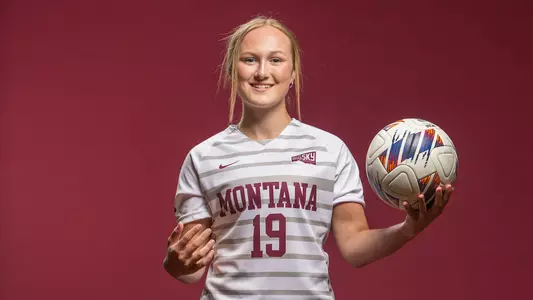
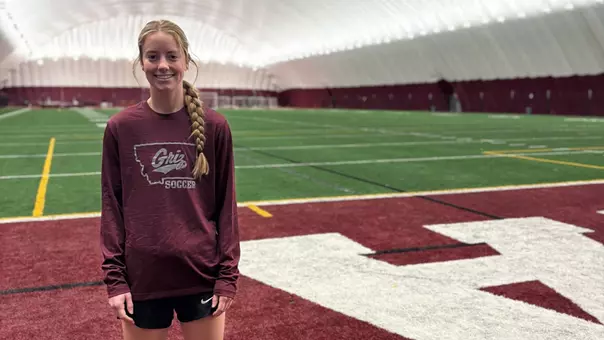
Photo by: UM Photo/Tommy Martino
The Craig Hall Chronicles :: Abby Smith
8/25/2023 7:26:00 PM | Soccer
She's there, right in front of you. You just haven't noticed her, carrying gear to and from the bench on game day, cheering on her teammates as Montana has opened the season 3-0-0 for just the third time in program history.
She's injured, which means she's like a ghost, a name on the roster but nobody you've seen in bodily form, at least not on the field in competition. You've seen her or maybe you haven't. Either way, you move on with your day.
Like Lucie Rokos, protagonist in last week's entry in the Craig Hall Chronicles, she'll miss this season, continue returning to health through the fall and winter, then bring it in the spring, again out of view. You're just going to have to wait to see it.
She's a goal-scorer's goal-scorer. There are some players who can put the ball in the net if they are in the right place at the right time. And then there are those players who make it the right place at the right time by skill and force of will. She's one of those.
When she gets possession of the ball, there is no stress, no anxiety, no rush to get rid of it. All she has on her mind is: score, score, score. She's going forward. Hard.
"As soon as she gets the ball at her feet it's how do I get it in the back of the net? For other players it's how do I protect the ball? How do I keep from getting it taken away from me? How do I get it safely to someone else in open space?
"When the ball is at her feet, her objective is how do I break through the defenders who are in front of me to get it there? That's always been the case. Her mentality is to score goals."
He should know. That's her dad, Josh, talking. He wants to emphasize that his daughter is not a selfish player. She loves to spread the ball, include her teammates, but get told enough times by enough coaches that the best thing you can do to help the team is to take the shot, and it starts to stick.
But we're getting ahead of ourselves. That's the case for a healthy Abby Smith, which she hasn't been in more than a year.
It hit her last August at the start of her final high school season at Crescent Valley High in Corvallis, Oregon, the pain in her hip. She made it through the season with a combination of pain, ice, pain, tape, pain, ibuprofen, pain and the magic hands of her physical therapist. Did we mention pain?
By the end, she wasn't practicing, just playing on fumes. And that was enough to help Crescent Valley to the Class 5A state championship match in November, the Raiders coming up one goal short but Smith getting named Player of the Game. She is that kind of talent. Win, lose, draw, it still shines forth.
The postseason diagnosis: Torn labrum. Fairly easy fix and straightforward recovery, ready by fall. Then, some advice: You might want to consider undergoing a PAO, the innocuous abbreviation hiding a procedure that is anything but: periacetabular osteotomy.
She had a torn labrum but that was simply a symptom of a larger, graver issue: hip dysplasia.
Fix the labrum and it is likely to keep tearing, the root of the problem going unaddressed. But correct the hip dysplasia and it was a 50-50 game of chance on whether she would ever return to being the soccer player she had become and wanted to continue being at the NCAA Division I level.
Or, she could do nothing. She could play college soccer with a torn labrum, like she had last fall at Crescent Valley, a shell of herself, then spend the rest of her life dealing with debilitating arthritis. There was no easy answer.
But we're getting ahead of ourselves, because this Abby Smith is a junior in high school. She hasn't been injured and she's just taught herself how to edit videos, which she has sent to Division III coaches. And Division II coaches. And, finally, after getting up the nerve, to Division I coaches.
She was there all this time, in Corvallis but off the main highway of soccer in the state, playing for a club in town, then one day going for it and joining Capital FC up the road in Salem. It was a step up but still kept her off the radar of most college coaches.
To do that, to get on their radar, she would have had to travel even farther up the road, to Portland, to an ECNL team. While it wouldn't guarantee a future as a Division I player, it would have upped the odds in her favor, of being seen, noticed, contacted, recruited.
This is one Craig Hall Chronicle where a family said, no thanks, we'll stick with what we're doing. We're not chasing after that, not at that price.
"Family is super important to us and having quality time is super important. While we certainly wanted Abby to play at the highest level she could, having her travel to Portland three days a week didn't work with our family schedule and having dinners together and doing other things as a family," says Josh.
"We did what we could within the club systems she played on. Getting her the opportunity to play at the highest level she could locally is how we chose to do it. She's fortunate it worked out as well as it did. She has some God-given talent that she worked really, really hard to develop on her own."
She didn't know where she fit in with her age-group peers who were being recruited. So, she took it upon herself to learn some basic video editing, took the games her dad had shot over the years, pieced some highlights together and sent them off.
To Montana? Of course! That was the school that had included that sweet sticker in the recruiting materials that had arrived in the family mailbox when she was younger. Personal stories have swung on more arcane happenstances, right? Right?
"That was kind of my trial run," she says. "Montana seemed like a really cool place." Cool enough that she sent Griz coach Chris Citowicki her video, along with an attachment of a wing and a prayer. She hit SEND, then thought, well, it was worth a shot, even if I don't hear back, which I won't.
What happened behind the scenes would have blown her away. "This kid scores goals, looks really good. Not ECNL but from the look of it, she is scoring goals and is looking good and is hyper-motivated, extremely committed to everything she does, which is exciting," Citowicki recalls thinking at the time.
He forwarded the email and highlights across the hall, to assistant coach Ashley Herndon, who directs the team's attack and its players. After a few minutes, she yelled back, "Wow! I'm really impressed with this one."
Citowicki emailed back a day or two later and wrote: Let's talk. He may as well have written: you may now freak out, lose your mind, go crazy.
Were you surprised he got back to you? "I was shocked," she says. "He emailed me back and wanted to set up a phone call. I was freaking out to my parents. It was this whole thing in our house."
There we go again, getting ahead of ourselves. Let's go back to the beginning, to that 1.3 acres of property the Smiths own, the bulk of which is an open grass field, and what better way to teach Brayden, two years his sister's elder, and Abby that this is life: sports, competition and being active.
And doing it together, dad, mom, brother, sister, dogs. A unit united.
When Brayden played baseball, she needed to play as well. When he played football, she needed to play as well. When he got pitched to, she needed to get pitched to as well.
That's why she's not a softball player today. Her first organized ball-and-bat sport as a 5-year-old was tee-ball. Excuse me? Who needs a tee to hit a ball? Just pitch it to me in the air. No? Okay, I'm out.
"When Brayden started playing baseball, Abby was, I want to play, I want to play," says Josh. "She had a natural gift of hand-eye coordination of hitting the ball."
But little patience for whatever this tee-ball sport was supposed to be. "She never got into softball after that. Soccer turned out to be the better option for her, but I think she could have been a pretty good softball player as well."
One day she heard it, from not far away, the thump … thump … thump of a soccer ball being kicked between two people, her neighbors, dad and daughter. She went to investigate. She discovered her love and her future.
"She always took opportunities to play. She never said no to playing soccer," Josh says. "It started early. She has loved that game as long as I can remember.
"It became apparent by middle school that she was a very gifted soccer player and had a lot of potential."
It wasn't due to naivete that she remained local for her club soccer, first in Corvallis, then in Salem. It was a family decision. They would invest all they could but weren't willing to sacrifice time, time together not as parent and daughter in a car for hours each week but time together as a family.
"It's no judgment on families who choose to do that," says Josh. "If you look at the statistics, kids who play ECNL and high-level teams, they have higher odds of being able to play at that level."
They chose Option B and came out the other side better for it. "She loves the sport so much and was very determined to play in college. She was super blessed and fortunate to land at Montana. Really cool to see all that hard work and effort make her dream come true."
Before there was a phone call with Montana, there was Smith, then a freshman, asking a coach: what do I have to do to become a Division I soccer player? To that coach's credit, they didn't fill her with sunshine. She was told, this, this, this and this are what you need to improve upon.
She should have that list framed. She wouldn't be here, a Grizzly, without it. "I'm thankful that coach was straightforward with me. Here's what you need to do.
"Pretty fulfilling when you work on something a bunch of times, then you see the hard work pay off. Looked up YouTube videos on how to do certain things, curls and bending the ball, and started practicing over and over again until I got good at it. Then in games, more and more goals were coming."
She can also thank Covid. For as much as the pandemic took away, it gifted her with time and opportunity, which she had to take on her own. No one was forcing her. She did and she made the most of it.
"That was a breakout time for her, when a lot of teams were shut down," says Josh. "We live about a mile from the high school. She'd get her schoolwork done and then go down and just work.
"She'd run, she'd shoot, she'd dribble, she'd set up drills. She took those years with Covid and really pushed herself. It's been cool to watch her get herself to the point where she can play at a high level like (Montana). She's probably one of the hardest working kids I've ever met."
Everyone knew that, could see that, the sweat equity invested. What they didn't know was where she fit on the recruiting landscape. Was she a Division III-level player? Division II? Division I?
Then: Citowicki reached out. And: Abby Smith lost it.
"I was trying to get to know my options," she says. "As someone who wasn't playing at the ECNL or GA level, I really didn't know what level I could play at. Until I heard my options, I honestly didn't know what the college soccer route was going to look like for me."
Would Smith, on the first day of class her junior year at Crescent Valley, before she ever put those videos together, be surprised at where she's landed as a first-year college player? "I would have been shocked. I thought Division I soccer would be a stretch.
"I'm not playing at the highest levels, so that's not going to work out for me. It wasn't until I started communicating with coaches that I realized that it could be a reality for me."
And now that Division I coach, the first one to reach out to her and set up a call, wanted to get her on the phone. It was the opposite of most recruiting pitches, this one of coach convincing player that, yes, you're really good, good enough to be playing Division I soccer.
As she would come to learn, it was also the opposite of most calls she would field going forward, from coaches who wanted to learn about the player. Citowicki? He'd seen the film. He was sold on the player. He needed to be sold on the person.
The coach got into the profession in the first place nearly two decades ago after watching the movie Miracle, about Herb Brooks and the 1980 U.S. Olympic hockey team that shocked the world, or at least the USSR.
One of Brooks's goosebump lines: I'm not looking for the best players. I'm looking for the right ones. It's become Citowicki's foundation of program building.
"Chris's was different than any other call. Hey, we liked your video. I'm trying to get to know you because we care about the culture in this program. We've seen you can play. I want to get to know you to see if it would be a good fit before we move forward in the recruiting process," Smith says.
It's an open dialog but it also has a psychological twist to it. Imagine being told you're good enough as a player but we need to determine if you have the quality of character we're looking for. Conversations ensue. And then the coach tells you that you'd be a perfect fit.
That lands heavy on a girl, in a good way, being told she is worthy. "One hundred percent," she says. "When Chris said he wanted to learn about me as a person because he cared about the culture of his team, that was a total game changer for me and made me want to come to Montana even more."
Hmmm, so that's how he does it.
"I remember her coming downstairs and saying, I really like this coach and this program," recalls Josh. "I think this could be really cool. She met with other coaches and visited other schools but that first impression Chris left her with, it really felt like home early on.
"Chris does such a fantastic job forming relationships with players. I've seen your highlight reel, I know you can play. Tell me about your family, tell me about what you like doing. It was as much about Abby as a person as it was about her ability to play soccer.
"Other schools made her compelling offers, but being part of a family-based team environment was a huge draw. That was what struck us about Montana, the way the coaches interact with the players."
An offer was made. An offer was accepted. A hip was fine, then a hip was damaged by a torn labrum. And a major decision had to be made. Go for the quick fix, the one that might keep repeating itself, or go all the way, the one that had no guarantees she would ever play high-level soccer.
She was scheduled to undergo labrum surgery in February. The doctor called them in and said this might be a mistake, that her hip dysplasia was only going to add more and more strain on her repaired labrum, increasing the chances that she would tear it again. And again.
What timing. She'd spent the previous summer going to ID camps, at each stop learning more and more that she was good, really good, even if she didn't have the fancy playing resume. Her talent and work ethic had allowed her to bridge the gap, the highlight video finishing the job.
November turned to December, which turned to January and February. Only a few surgeons in the entire state could perform a PAO and they were booked months out.
A girl, one who was voted first-team all-state in January, can only do so many bench presses: 105 pounds in early December, 115 in mid-February, 120 in March, 125 a few weeks later. Nice but still simple sugars for someone used to filling up on the more lasting stuff.
"It was a long wait from November. No soccer, no running, no hiking, no training of any sort, just lifting," she says. "I went from training all out to nothing."
As with any major surgery, there were significant risks involved, if not so much life and death at least the loss of soccer as she knew it, which would be a death in and of itself.
There could be damage to the sciatic and femoral nerves, nothing an active athlete should ever mess around with, much less us laypersons. High-level sports might be out the window, Abby Smith going from Montana Grizzly to Montana intramural participant, just like that.
"I was weighing the odds in my favor," she says. "I'm a glass-half-full kind of person."
It was the right choice, even if it was the one no one could easily make. "As her parents, we wanted the least invasive, the quickest recovery, the least scary option you can go with," says Josh, speaking for his wife, Jessica.
But they couldn't argue with the facts. The easy way out would only lead to recurring injuries throughout the rest of her career, would lead to issues down the road later in life.
The scary option was the only option. "It was the right decision for the long term," says Josh. "We saw a lot of maturity from Abby in that. She is a pretty logical, process-oriented kid. Yes, I won't play my freshman year but it will give me the best opportunity to play past that."
April 12 was the big day. She was told she should expect to be on crutches for eight to 12 weeks. Ha. Ha.
Two and half weeks after surgery she was back doing upper-body lifting. At six weeks she was told, yeah, this looks really good, go ahead and start putting weight on your leg while still using crutches. Seven weeks out, she was off crutches completely, way ahead of schedule.
Nine weeks out from surgery, she was doing … squats and deadlifts? A few days after that, running on an Alter G at 70 percent body weight? Then jogging on the track?
"I've already finished my return to running, return to sprinting and I'm getting back to soccer stuff within the upcoming month, maybe get into practices by the end of October," she says.
A nod, here, to her parents, who arrived in Oregon as kids from Minnesota (Josh) and Indiana (Jessica), met at church and bonded over being physically active, him a lifter of weights and possessor of Hulk Hogan biceps, she a runner of marathons and creator of healthy dinners that fueled all four of them.
Brayden played football through eighth grade, swam competitively in high school, now is starting his junior year at Oregon State, his dad's alma mater, where Josh was a business major before being hired at graduation by Hewlett-Packard. He now works as a project manager for Walmart Health.
When Covid arrived in Oregon in March 2020, they did what you might expect: They backed the cars out of the garage and turned it into one of Corvallis's nicest gyms, starting small and simple and adding and adding until it had just about anything an athlete could want.
It's been put to good use. She walks up to you for this interview in an incongruous way, a sweet, welcoming smile but like she, even at 5-foot-3, could fold you into a pretzel if she chose to. You start off asking her if she wants to arm wrestle. She sets her elbow on the table, ready to go and you recoil.
Does she think you were serious? Does she think she would win? "I think I might. I think so." You do, too. You change the subject, knowing Falstaff was right, that the better part of valor is discretion. After all, she's rolling with five screws in her hip. What have you done lately?
She had the same indoctrination to the team that Rokos had. Hey, I'm Abby, I'm pretty good. You're going to have to take my word for it. I'll show you in a few more months. It's something she now knows as fact, that she belongs here, has the talent to be here. She can't wait to show it off, to them, to you.
"Lucie and I have had those conversations. It's really helpful to have another incoming freshman in the same position. It's not just me. We're on the same page," says Smith, who just might be interested in a career in physical therapy after all she's been through.
"We picture ourselves in the drills, accepting this is our role right now. Nothing we can do will speed up the process. You have to let the body heal." And, "Spring is my go time. Nothing's stopping me come spring."
That's when the goal-scorer's goal-scorer will get to show her stuff. "My mind is always on the back of the net. I get the ball, I'm figuring out how to get it in the net. If I'm in the midfield, I'm trying to figure out how to get it to somebody so they can get it in the net.
"I like it. It's a whole lot of adrenaline. You might get a whole bunch of shots and they are not working. Then you get that one. You only need one to score." Her chance is coming. You'll see.
She's injured, which means she's like a ghost, a name on the roster but nobody you've seen in bodily form, at least not on the field in competition. You've seen her or maybe you haven't. Either way, you move on with your day.
Like Lucie Rokos, protagonist in last week's entry in the Craig Hall Chronicles, she'll miss this season, continue returning to health through the fall and winter, then bring it in the spring, again out of view. You're just going to have to wait to see it.
She's a goal-scorer's goal-scorer. There are some players who can put the ball in the net if they are in the right place at the right time. And then there are those players who make it the right place at the right time by skill and force of will. She's one of those.
When she gets possession of the ball, there is no stress, no anxiety, no rush to get rid of it. All she has on her mind is: score, score, score. She's going forward. Hard.
"As soon as she gets the ball at her feet it's how do I get it in the back of the net? For other players it's how do I protect the ball? How do I keep from getting it taken away from me? How do I get it safely to someone else in open space?
"When the ball is at her feet, her objective is how do I break through the defenders who are in front of me to get it there? That's always been the case. Her mentality is to score goals."
He should know. That's her dad, Josh, talking. He wants to emphasize that his daughter is not a selfish player. She loves to spread the ball, include her teammates, but get told enough times by enough coaches that the best thing you can do to help the team is to take the shot, and it starts to stick.
But we're getting ahead of ourselves. That's the case for a healthy Abby Smith, which she hasn't been in more than a year.
It hit her last August at the start of her final high school season at Crescent Valley High in Corvallis, Oregon, the pain in her hip. She made it through the season with a combination of pain, ice, pain, tape, pain, ibuprofen, pain and the magic hands of her physical therapist. Did we mention pain?
By the end, she wasn't practicing, just playing on fumes. And that was enough to help Crescent Valley to the Class 5A state championship match in November, the Raiders coming up one goal short but Smith getting named Player of the Game. She is that kind of talent. Win, lose, draw, it still shines forth.
The postseason diagnosis: Torn labrum. Fairly easy fix and straightforward recovery, ready by fall. Then, some advice: You might want to consider undergoing a PAO, the innocuous abbreviation hiding a procedure that is anything but: periacetabular osteotomy.
She had a torn labrum but that was simply a symptom of a larger, graver issue: hip dysplasia.
Fix the labrum and it is likely to keep tearing, the root of the problem going unaddressed. But correct the hip dysplasia and it was a 50-50 game of chance on whether she would ever return to being the soccer player she had become and wanted to continue being at the NCAA Division I level.
Or, she could do nothing. She could play college soccer with a torn labrum, like she had last fall at Crescent Valley, a shell of herself, then spend the rest of her life dealing with debilitating arthritis. There was no easy answer.
But we're getting ahead of ourselves, because this Abby Smith is a junior in high school. She hasn't been injured and she's just taught herself how to edit videos, which she has sent to Division III coaches. And Division II coaches. And, finally, after getting up the nerve, to Division I coaches.
She was there all this time, in Corvallis but off the main highway of soccer in the state, playing for a club in town, then one day going for it and joining Capital FC up the road in Salem. It was a step up but still kept her off the radar of most college coaches.
To do that, to get on their radar, she would have had to travel even farther up the road, to Portland, to an ECNL team. While it wouldn't guarantee a future as a Division I player, it would have upped the odds in her favor, of being seen, noticed, contacted, recruited.
This is one Craig Hall Chronicle where a family said, no thanks, we'll stick with what we're doing. We're not chasing after that, not at that price.
"Family is super important to us and having quality time is super important. While we certainly wanted Abby to play at the highest level she could, having her travel to Portland three days a week didn't work with our family schedule and having dinners together and doing other things as a family," says Josh.
"We did what we could within the club systems she played on. Getting her the opportunity to play at the highest level she could locally is how we chose to do it. She's fortunate it worked out as well as it did. She has some God-given talent that she worked really, really hard to develop on her own."
She didn't know where she fit in with her age-group peers who were being recruited. So, she took it upon herself to learn some basic video editing, took the games her dad had shot over the years, pieced some highlights together and sent them off.
To Montana? Of course! That was the school that had included that sweet sticker in the recruiting materials that had arrived in the family mailbox when she was younger. Personal stories have swung on more arcane happenstances, right? Right?
"That was kind of my trial run," she says. "Montana seemed like a really cool place." Cool enough that she sent Griz coach Chris Citowicki her video, along with an attachment of a wing and a prayer. She hit SEND, then thought, well, it was worth a shot, even if I don't hear back, which I won't.
What happened behind the scenes would have blown her away. "This kid scores goals, looks really good. Not ECNL but from the look of it, she is scoring goals and is looking good and is hyper-motivated, extremely committed to everything she does, which is exciting," Citowicki recalls thinking at the time.
He forwarded the email and highlights across the hall, to assistant coach Ashley Herndon, who directs the team's attack and its players. After a few minutes, she yelled back, "Wow! I'm really impressed with this one."
Citowicki emailed back a day or two later and wrote: Let's talk. He may as well have written: you may now freak out, lose your mind, go crazy.
Were you surprised he got back to you? "I was shocked," she says. "He emailed me back and wanted to set up a phone call. I was freaking out to my parents. It was this whole thing in our house."
There we go again, getting ahead of ourselves. Let's go back to the beginning, to that 1.3 acres of property the Smiths own, the bulk of which is an open grass field, and what better way to teach Brayden, two years his sister's elder, and Abby that this is life: sports, competition and being active.
And doing it together, dad, mom, brother, sister, dogs. A unit united.
When Brayden played baseball, she needed to play as well. When he played football, she needed to play as well. When he got pitched to, she needed to get pitched to as well.
That's why she's not a softball player today. Her first organized ball-and-bat sport as a 5-year-old was tee-ball. Excuse me? Who needs a tee to hit a ball? Just pitch it to me in the air. No? Okay, I'm out.
"When Brayden started playing baseball, Abby was, I want to play, I want to play," says Josh. "She had a natural gift of hand-eye coordination of hitting the ball."
But little patience for whatever this tee-ball sport was supposed to be. "She never got into softball after that. Soccer turned out to be the better option for her, but I think she could have been a pretty good softball player as well."
One day she heard it, from not far away, the thump … thump … thump of a soccer ball being kicked between two people, her neighbors, dad and daughter. She went to investigate. She discovered her love and her future.
"She always took opportunities to play. She never said no to playing soccer," Josh says. "It started early. She has loved that game as long as I can remember.
"It became apparent by middle school that she was a very gifted soccer player and had a lot of potential."
It wasn't due to naivete that she remained local for her club soccer, first in Corvallis, then in Salem. It was a family decision. They would invest all they could but weren't willing to sacrifice time, time together not as parent and daughter in a car for hours each week but time together as a family.
"It's no judgment on families who choose to do that," says Josh. "If you look at the statistics, kids who play ECNL and high-level teams, they have higher odds of being able to play at that level."
They chose Option B and came out the other side better for it. "She loves the sport so much and was very determined to play in college. She was super blessed and fortunate to land at Montana. Really cool to see all that hard work and effort make her dream come true."
Before there was a phone call with Montana, there was Smith, then a freshman, asking a coach: what do I have to do to become a Division I soccer player? To that coach's credit, they didn't fill her with sunshine. She was told, this, this, this and this are what you need to improve upon.
She should have that list framed. She wouldn't be here, a Grizzly, without it. "I'm thankful that coach was straightforward with me. Here's what you need to do.
"Pretty fulfilling when you work on something a bunch of times, then you see the hard work pay off. Looked up YouTube videos on how to do certain things, curls and bending the ball, and started practicing over and over again until I got good at it. Then in games, more and more goals were coming."
She can also thank Covid. For as much as the pandemic took away, it gifted her with time and opportunity, which she had to take on her own. No one was forcing her. She did and she made the most of it.
"That was a breakout time for her, when a lot of teams were shut down," says Josh. "We live about a mile from the high school. She'd get her schoolwork done and then go down and just work.
"She'd run, she'd shoot, she'd dribble, she'd set up drills. She took those years with Covid and really pushed herself. It's been cool to watch her get herself to the point where she can play at a high level like (Montana). She's probably one of the hardest working kids I've ever met."
Everyone knew that, could see that, the sweat equity invested. What they didn't know was where she fit on the recruiting landscape. Was she a Division III-level player? Division II? Division I?
Then: Citowicki reached out. And: Abby Smith lost it.
"I was trying to get to know my options," she says. "As someone who wasn't playing at the ECNL or GA level, I really didn't know what level I could play at. Until I heard my options, I honestly didn't know what the college soccer route was going to look like for me."
Would Smith, on the first day of class her junior year at Crescent Valley, before she ever put those videos together, be surprised at where she's landed as a first-year college player? "I would have been shocked. I thought Division I soccer would be a stretch.
"I'm not playing at the highest levels, so that's not going to work out for me. It wasn't until I started communicating with coaches that I realized that it could be a reality for me."
And now that Division I coach, the first one to reach out to her and set up a call, wanted to get her on the phone. It was the opposite of most recruiting pitches, this one of coach convincing player that, yes, you're really good, good enough to be playing Division I soccer.
As she would come to learn, it was also the opposite of most calls she would field going forward, from coaches who wanted to learn about the player. Citowicki? He'd seen the film. He was sold on the player. He needed to be sold on the person.
The coach got into the profession in the first place nearly two decades ago after watching the movie Miracle, about Herb Brooks and the 1980 U.S. Olympic hockey team that shocked the world, or at least the USSR.
One of Brooks's goosebump lines: I'm not looking for the best players. I'm looking for the right ones. It's become Citowicki's foundation of program building.
"Chris's was different than any other call. Hey, we liked your video. I'm trying to get to know you because we care about the culture in this program. We've seen you can play. I want to get to know you to see if it would be a good fit before we move forward in the recruiting process," Smith says.
It's an open dialog but it also has a psychological twist to it. Imagine being told you're good enough as a player but we need to determine if you have the quality of character we're looking for. Conversations ensue. And then the coach tells you that you'd be a perfect fit.
That lands heavy on a girl, in a good way, being told she is worthy. "One hundred percent," she says. "When Chris said he wanted to learn about me as a person because he cared about the culture of his team, that was a total game changer for me and made me want to come to Montana even more."
Hmmm, so that's how he does it.
"I remember her coming downstairs and saying, I really like this coach and this program," recalls Josh. "I think this could be really cool. She met with other coaches and visited other schools but that first impression Chris left her with, it really felt like home early on.
"Chris does such a fantastic job forming relationships with players. I've seen your highlight reel, I know you can play. Tell me about your family, tell me about what you like doing. It was as much about Abby as a person as it was about her ability to play soccer.
"Other schools made her compelling offers, but being part of a family-based team environment was a huge draw. That was what struck us about Montana, the way the coaches interact with the players."
An offer was made. An offer was accepted. A hip was fine, then a hip was damaged by a torn labrum. And a major decision had to be made. Go for the quick fix, the one that might keep repeating itself, or go all the way, the one that had no guarantees she would ever play high-level soccer.
She was scheduled to undergo labrum surgery in February. The doctor called them in and said this might be a mistake, that her hip dysplasia was only going to add more and more strain on her repaired labrum, increasing the chances that she would tear it again. And again.
What timing. She'd spent the previous summer going to ID camps, at each stop learning more and more that she was good, really good, even if she didn't have the fancy playing resume. Her talent and work ethic had allowed her to bridge the gap, the highlight video finishing the job.
November turned to December, which turned to January and February. Only a few surgeons in the entire state could perform a PAO and they were booked months out.
A girl, one who was voted first-team all-state in January, can only do so many bench presses: 105 pounds in early December, 115 in mid-February, 120 in March, 125 a few weeks later. Nice but still simple sugars for someone used to filling up on the more lasting stuff.
"It was a long wait from November. No soccer, no running, no hiking, no training of any sort, just lifting," she says. "I went from training all out to nothing."
As with any major surgery, there were significant risks involved, if not so much life and death at least the loss of soccer as she knew it, which would be a death in and of itself.
There could be damage to the sciatic and femoral nerves, nothing an active athlete should ever mess around with, much less us laypersons. High-level sports might be out the window, Abby Smith going from Montana Grizzly to Montana intramural participant, just like that.
"I was weighing the odds in my favor," she says. "I'm a glass-half-full kind of person."
It was the right choice, even if it was the one no one could easily make. "As her parents, we wanted the least invasive, the quickest recovery, the least scary option you can go with," says Josh, speaking for his wife, Jessica.
But they couldn't argue with the facts. The easy way out would only lead to recurring injuries throughout the rest of her career, would lead to issues down the road later in life.
The scary option was the only option. "It was the right decision for the long term," says Josh. "We saw a lot of maturity from Abby in that. She is a pretty logical, process-oriented kid. Yes, I won't play my freshman year but it will give me the best opportunity to play past that."
April 12 was the big day. She was told she should expect to be on crutches for eight to 12 weeks. Ha. Ha.
Two and half weeks after surgery she was back doing upper-body lifting. At six weeks she was told, yeah, this looks really good, go ahead and start putting weight on your leg while still using crutches. Seven weeks out, she was off crutches completely, way ahead of schedule.
Nine weeks out from surgery, she was doing … squats and deadlifts? A few days after that, running on an Alter G at 70 percent body weight? Then jogging on the track?
"I've already finished my return to running, return to sprinting and I'm getting back to soccer stuff within the upcoming month, maybe get into practices by the end of October," she says.
A nod, here, to her parents, who arrived in Oregon as kids from Minnesota (Josh) and Indiana (Jessica), met at church and bonded over being physically active, him a lifter of weights and possessor of Hulk Hogan biceps, she a runner of marathons and creator of healthy dinners that fueled all four of them.
Brayden played football through eighth grade, swam competitively in high school, now is starting his junior year at Oregon State, his dad's alma mater, where Josh was a business major before being hired at graduation by Hewlett-Packard. He now works as a project manager for Walmart Health.
When Covid arrived in Oregon in March 2020, they did what you might expect: They backed the cars out of the garage and turned it into one of Corvallis's nicest gyms, starting small and simple and adding and adding until it had just about anything an athlete could want.
It's been put to good use. She walks up to you for this interview in an incongruous way, a sweet, welcoming smile but like she, even at 5-foot-3, could fold you into a pretzel if she chose to. You start off asking her if she wants to arm wrestle. She sets her elbow on the table, ready to go and you recoil.
Does she think you were serious? Does she think she would win? "I think I might. I think so." You do, too. You change the subject, knowing Falstaff was right, that the better part of valor is discretion. After all, she's rolling with five screws in her hip. What have you done lately?
She had the same indoctrination to the team that Rokos had. Hey, I'm Abby, I'm pretty good. You're going to have to take my word for it. I'll show you in a few more months. It's something she now knows as fact, that she belongs here, has the talent to be here. She can't wait to show it off, to them, to you.
"Lucie and I have had those conversations. It's really helpful to have another incoming freshman in the same position. It's not just me. We're on the same page," says Smith, who just might be interested in a career in physical therapy after all she's been through.
"We picture ourselves in the drills, accepting this is our role right now. Nothing we can do will speed up the process. You have to let the body heal." And, "Spring is my go time. Nothing's stopping me come spring."
That's when the goal-scorer's goal-scorer will get to show her stuff. "My mind is always on the back of the net. I get the ball, I'm figuring out how to get it in the net. If I'm in the midfield, I'm trying to figure out how to get it to somebody so they can get it in the net.
"I like it. It's a whole lot of adrenaline. You might get a whole bunch of shots and they are not working. Then you get that one. You only need one to score." Her chance is coming. You'll see.
Players Mentioned
D
/ Soccer
F
/ SoccerLady Griz Basketball Locker Room Unveiling - 5/1/26
Friday, May 01
Griz Track & Field - Montana Open Highlights - 4/25/26
Friday, May 01
Griz Softball vs. Idaho State Game-Winning Hit - 3/25/26
Friday, May 01
Griz Softball Championship Series Promo
Friday, May 01