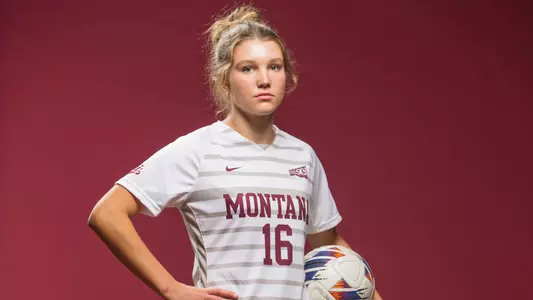
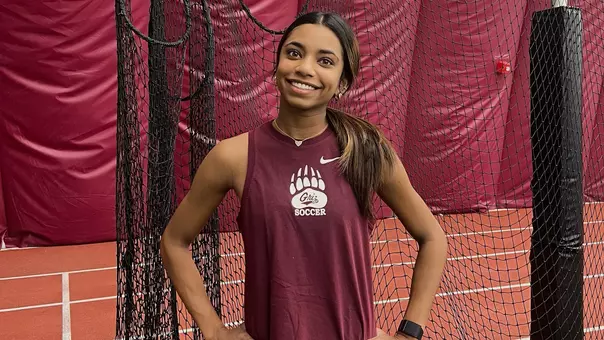
Photo by: UM Photo/Tommy Martino
The Craig Hall Chronicles :: Riley Carolan
8/4/2023 4:52:00 PM | Soccer
Riley Carolan gets done talking, after going deep during a lengthy interview, and there is just one question that remains to be asked.
If she put her dad over here and her mom over there and drew a line between them, where would she land on the spectrum? Is she more Brett or is she more Amy?
She's more Brett, right? Gotta be. She's a Division I soccer player and he was a professional athlete. He played college football at Washington State, then spent two years with the San Francisco 49ers, one more with the Miami Dolphins.
He was a 49er when San Francisco won Super Bowl XXIX in Miami that memorable night of January 29, 1995.
Two seasons later, he caught a touchdown pass from Dan Marino. Dan Marino! On the sideline, his first-year coach Jimmy Johnson (Jimmy Johnson!) celebrated as the Dolphins moved to 3-0 with a home victory over the Jets.
Is she two-thirds up the line toward Brett? More?
"Tough question," she says. "I would say I am very close to the middle. I'm grateful for both. My dad, his work ethic, especially in sports, is something I've always admired, being mentally and physically tough.
"My mom, I get her level-headedness. I'd like to say I get a little of her intelligence and decision-making."
She's both, then, when you see her on the field, holding down a center back position. She's been told she looks like a linebacker pursuing a ball-carrier when she gets up to full speed. That's Brett, who was 6-foot-4, 240-some pounds when he played in the NFL.
But her brilliance goes beyond the physical. It's her vision, her ability to read situations and make the right read, the right play. That's Amy, and the more you hear Brett talk about his wife, you get the feeling that the more Quinn, their son, and Riley trend toward mom, that's probably for the better.
"I'm very lucky," Brett says. "Amy is very driven and is way smarter than me, and that's not me being sarcastic. She is way more intelligent than me, way better read. She is way tougher than me too. The kids got that angle too. Riley is a strong woman, like her mom."
That Quinn is entering his third fall as a tight end on the football team at Northern Arizona and Riley is a freshman at Montana, call it a team effort, a parenting win. "We were a good combination with the kids," Brett says.
They were always there, for every game. If not on the sideline watching, then coaching, no matter the sport. (Lacrosse? Okay!) Or in Amy's case, serving as team manager year after year for Seattle United.
These were not helicopter parents, hovering over their kids, clearing the path for them, fighting every battle, making things as easy as possible.
The reason is more pure and it goes deep. And it goes back in time.
Reggie Carolan was born and raised in Marin County, that piece of paradise in California. He wanted to pursue forestry, so he landed at Idaho, where he played football, basketball and ran track, as stud athletes did back in those days, the late 50s and early 60s.
He was drafted by San Diego, played two seasons for the Chargers, then moved on to Kansas City. He and the Chiefs lost 35-10 to Green Bay in January 1967 in what would later be known as Super Bowl I.
He was 6-foot-6, 230-some pounds, which explains a lot as it applies to the sports part of this story, but it was January 2, 1983, when he died at the age of 43, when Brett was 11, that gives the family dynamic piece of this article its foundation.
No one saw it coming, of course, so Brett hadn't asked his dad everything he could have, about football, about playing in college, about becoming a professional, about playing in the NFL, about a young man simply navigating his way through life. There will always be time for that, right?
"When you're that young, you don't think about losing a parent. I was really heartbroken," he says. "That's why I took a very proactive approach with our kids. We were very involved.
"Amy was manager with Riley's soccer team for years. I coached the kids in lacrosse, basketball, soccer, football. We wanted to be with them and be in their lives. I didn't want to be working all the time and not going to games. We wanted to be actively involved."
Lose a parent at a young age and that time with your own children is something that will never be taken for granted. Or wasted. Or squandered. It's simply too precious, here today, gone tomorrow simply through the rapid passage of time.
Carolan channeled Steve Prefontaine while growing up, also in Marin County: To give anything less than your best is to sacrifice the gift.
"I knew I had something in me and knew I'd be cheating myself if I didn't put forth all of my effort," he says. "I really started working my tail off starting my freshman year. I really put my head down."
This was the 80s, still the recruiting Dark Ages compared to today. He played for a strong enough program and in a strong enough league that college coaches came calling, not knowing who they might discover, what diamonds they might find in the rough.
"College coaches would come pound the pavement. My coaches would put in a good word, the (college) coaches would look at film and call you out to the hall and look at you and talk to you, and it would just take off from there," he says.
He was recruited to Washington State by Dennis Erickson's staff, signed with the school not long after Timm Rosenbach, now a member of Montana's football coaching staff, led the Cougars to a win in the 1988 Aloha Bowl to complete a 9-3 season.
Carolan had been recruited by Weber State coach Mike Price as well, which made for an easy transition when Price was hired at Washington State to replace Erickson, who was grabbed by Miami.
In 1992, when Carolan was a junior, Washington State went 9-3 and ended the season with a satisfying 42-23 thumping of Washington and a three-point win over Utah in the Copper Bowl.
As a senior in 1993, Carolan was voted second-team All-Pac-10 at tight end. "I was a receiver who wasn't as fast who got moved down. It was great because then I could run routes against slower guys, the linebackers instead of corners," he says.
The more long-term win? Mutual friends set Brett and Amy up. They went to the Washington State-UCLA basketball game that winter, and it hardly mattered that the Bruins pulled out a 99-91 win. "Very lucky," Carolan repeats, not about UCLA's victory but about himself and his good fortune.
He signed a free agent contract with the 49ers and spent that first season as a valuable scout-team member as San Francisco went 13-3 during the regular season.
Before the NFC Championship game, he played the role of Dallas Cowboy tight end Jay Novacek, who was all sorts of trouble for opponents during his career. Carolan ran Novacek's routes against Deion Sanders, blocked Ken Norton.
That preparation helped San Francisco to a 38-28 victory, which led to an easy 49-26 win over San Diego in the Super Bowl.
After a second season in San Francisco, Carolan moved on to Miami, where Johnson was in his first year after replacing Hall of Fame coach Don Shula. In the third game of the season, Marino, himself a future Hall of Famer who would throw 420 career TDs, found Carolan for his first and only NFL touchdown.
The game ball sits on the Carolans' mantle in Seattle, signed by Marino. "Congratulations on your first touchdown, my 357th."
He signed another free agent contract with San Francisco for what would have been his fourth year in the NFL, but he had gotten deep enough into the world of financial advising that he finally put football to rest.
"If you're not 100 percent committed, you're going to get really hurt in the NFL. I either needed to get back to 100 percent commitment or start my next career," says Carolan, who relocated with Amy back to her home territory of Seattle.
"We felt it was the right move for us to get back to the Northwest. Her family was from up here. We got into our jobs and got connected."
Given all that, it's no surprise that both Quinn and Riley fell hard for sports. Their parents certainly weren't going to stand in their way. "There are a lot of really, really good things that are taught that will carry them to be successful in life. My wife and I love what athletics can bring to the table," Brett says.
The kids played about everything they could, Quinn eventually focusing on lacrosse, for which he won a state title as a freshman at O'Dea High, and football, which would take him to Northern Arizona.
His younger sister tried just about everything as well. Then there were just two, select lacrosse and select soccer, the latter being Seattle United, where she spent a full 10 years, unusual for club soccer, which speaks to the quality of the coaching and the environment.
"Growing up, I had a lot of options for where I wanted to play. Lucky enough, I found the best fit for me right away," says Riley. "I never left and my team stayed pretty solid. I went in with four of the same girls I finished with."
Had she grown up on the East Coast, with the head start it has on the sport, Carolan certainly would have developed into a force of a lacrosse player. And she was still good, "but my strong suit has always been soccer," she says. "It allowed me to play out my strengths more than lacrosse did."
She spent six years at Seattle United playing outside back, the last four at center back. It's there where you can see her parents, Riley situated right in the middle of that connecting spectrum, just like she explained.
"You have to have that tenacity to go for a tackle and then the ability to make those decisions if you should tackle of if you should delay," she says. "You're also controlling the people in front of you, so communication is a big thing as a center back."
We now interrupt this story to bring you the same news that has disrupted Craig Hall Chronicle storylines since this series began more than a decade ago. Another ACL tear. Fun.
The summer before Carolan's junior year at Bishop Blanchet, the same high school attended by her mom, who is a self-employed event planner ("It's not easy but she makes it look easy," her daughter says), she was playing in a Sunday match, one day after playing a full match on Saturday as well.
She planted, her cleats dug in, she went to turn and the cleats didn't budge. Game over.
There was the usual grasping of straws, of thinking it wasn't as bad as it appeared to be. Maybe it was minor, a tweak, a relatively simple dislocation. But when Riley Carolan goes down, she's down for a very good reason. Or a bad one.
"Everyone says they didn't believe it was me at first. I usually don't stay on the ground for too long if I do get hit hard enough to get me on the ground," she says. When she didn't get up for a few minutes, when the game was stopped and her coaches made their way onto the field, it had to be serious.
You ask her dad if it's easier to deal with an injury, given the number and severity of them he experienced from teammates and opponents on the football field, if he has an emotional detachment to them, if they are just a matter of routine in sports.
Mostly no, but there is something that does kick in once the reality of the situation sets in. Because time's a-wastin'.
"It's hard to see your kid go down like that," says Brett, who had to help Quinn navigate his own knee injury not long before Riley suffered hers. She says, "He literally passed his crutches and ice bags to me."
Brett continues: "At the end of the day, once you get through the emotional part of it, Amy and I put our heads together and just took proactive steps.
"With both of our kids, there is one way to do it and only one way. You're going to rehab because you want to be healthy for the rest of your life. Whether you ever play again, you have to rehab."
It wasn't long after the injury, less than two hours, that she was on the sideline, an ice compressor wrapped around her injured knee. It's all about saving time and getting back to full health, not sitting by idly. It's the NFL wiring still in his head.
"We had ice circulating around her knee within an hour and a half of the injury. That allowed the swelling to go down, which allowed us to get pictures quicker, which allowed us to see the surgeon quicker and get on the docket," Brett says.
Reason No. 2,467 (estimated) that Riley Carolan has been thankful for her parents over the years: "Instead of everyone freaking out, they knew it was time to get down to business. Let's get you right. They were very positive, my rock through the whole thing."
It was, first, about getting back to health just to live life. The next step, returning to sport, would answer a critical question: Do you want to keep playing?
"You hit it one way, to get 100 percent healthy, then you decide if you want to continue to play," says Brett. "This injury will help you answer: do you really want it?
"Does it really hurt to watch your friends and teammates play without you? If so, that means you want to play. Both kids had to persevere. That's parenting. You adapt and go with the flow."
Yeah, about that timing. It wasn't ideal. She had video (note to Brett: that's how the kids do it nowadays in the recruiting game) but every coach who had ever looked in her direction suddenly wouldn't make eye contact. That's what knee injuries do. You're damaged goods until you prove otherwise.
Or until you contact Montana coach Chris Citowicki.
The coach had had a bad day, but the kind of bad day most coaches would love to have. Citowicki's Grizzlies, who he thought had a real shot, had just lost to Washington State 3-0 in Pullman in the opening round of the 2021 NCAA tournament.
Montana had the match's first good chance to score, putting a ball off the crossbar. Washington State took a 1-0 lead into halftime. It remained that way, in OMG THERE'S A CHANCE territory, until back-to-back goals in the 79th and 83rd minutes put the game out of reach.
Citowicki, whose team was closing the gap on Washington State but still wasn't quite there, was gutted. "This isn't fun anymore. I'm miserable on the bus. I've been miserable before but this is deep misery. I don't want to talk to anyone or have anything to do with anyone," he says.
He needed to take his mind off the match or he would have spent the next four hours on the ride back to Missoula playing the match's key moments over and over again in his head. He needed a distraction. He opened his email.
He found one from Riley Carolan, a 5-foot-10 defender. He watched her video. "Huh, she's pretty good," he recalls. "She cheered me up immediately. I told (assistant coaches J. Landham and Ashley Herndon), that's the kind of defender I want."
That's long been the issue of the first-round match in the NCAA tournament. Montana's opponent has tended to be taller, faster, stronger. Not overwhelmingly so but enough that the Grizzlies needed to become more like the Cougars if they truly wanted a chance to pull off an upset.
One player during Citowicki's tenure at Montana who did match up well against Washington State, in 2018: Taryn Miller. Now he was watching the second coming on his phone.
"We've closed the gap and I want to close it even more. I watched Riley's video and thought, that's the type of person who can help us do it," Citowicki says. "She's tall, athletic, good in the air, the type of player who can help us in that game."
Time stops for nothing, not even a player in the early stages of ACL recovery, so recruitment would have to move forward. She made a list. What do you want in a college experience?
"She wanted four seasons, plenty of academic majors, solid soccer program with good coaches. She wanted a good football team," says her dad. "She basically used that list to begin reaching out."
You've got to know that Carolan grew up making the cross-state trek from Seattle to Pullman every fall for home football games. She couldn't get enough of the atmosphere, how the Cougars meant so much to so many. She remembers the vibe.
"It's a college town to its core," she says. "Seeing how much pride that town has in its athletics and its teams, it was cool to see. When I came to visit here, Missoula had the same appeal to me. That's what I wanted to be a part of." Even when she visited in January? "I still fell in love with it."
But what about the other side, Montana's coaches? They had seen video. When she arrived, she did so without crutches but was still months away from (potentially, fingers crossed) being her old self. Certainly, they would take a wait-and-see approach as well, right?
Nah, they wanted her as is, with the hope that she would recover just fine. An offer was made before she even left town. They didn't want to lose her and knew if she came back as good as before, more and more programs would come in and try to elbow Montana out of the way.
"Being in that vulnerable spot of being injured and not playing and these girls and this coaching staff still taking me in and taking a chance on me really made me feel good," she says.
This was a case where a dad with Brett's experience paid off.
"I think she could have played at a lot of places, but there is a right fit for everyone," he says. "She had a staff that believed in her. Why not go where you're wanted and kick butt, right?
"Get a degree, have four years of the time of your life, be part of a program that's going to the NCAAs and win with coaches who understand the 360 view. At the end of the day, that's what it is. Hit it off, never look back. Own your decisions and take it to the fullest."
She remembers that first tackle, after she'd been cleared to return to play. Half of her brain was screaming, pleading, Don't do it! You're not ready! The other half: Please do it! You're ready!
"It's trusting the rehab and what I put into it and how hard I worked every day to get back. You have that first training where you don't think about it and I used that as a little boost to myself," she says. "I'm such a competitive person at heart, it was pretty quick for me to get back into that head space."
She passed the Beep Test earlier this week, first try, a prerequisite to joining full team activities. No one who knows the Carolans would have expected anything less.
"When I decided that I wanted to play collegiately, (my dad) was very quick with the expectations that were going to be set and that I had to have for myself. He didn't sugar-coat it. I had to take care of myself and start training as if I was already a Division I athlete," Riley says.
He helped her prepare for the Beep Test, grabbing the tape measure and laying out the boundaries. He even jumped in himself, the glory days still shining in the back of his mind. Got to 15 on the way to 30, started 16 and felt a pop in his calf.
"He plays softball for older men and was a little sore going into it and cramped up a bit," says Riley. Yikes, "older men"? Is that what we're supposed to be saying? "You're right. Go with 'young to old.'"
He rehabbed himself, gave it a month and a half, then joined her again. Hit 30. He's eligible, coach. "He pushed through," says Riley. "He is where I get that grit from."
After she arrived in town in July, she got a tattoo on her arm. It's just one word, a powerful one: Revival.
When she returned from injury in the summer of 2022, Citowicki was able to see his commit play in person for the first time. Carolan scored twice, on a header and on a penalty kick. She may have never been as excited on the soccer field as she was that day.
"It was my time to prove to them that they made the right decision and show them I was grateful for them taking a chance on me," she says.
Revival: "It quite literally means come back to life, come back to the present. You can always find new beginnings anywhere. It was prevalent through my ACL process and also getting here to Montana, a new beginning."
A new beginning but just the next tale of the Carolan family.
If she put her dad over here and her mom over there and drew a line between them, where would she land on the spectrum? Is she more Brett or is she more Amy?
She's more Brett, right? Gotta be. She's a Division I soccer player and he was a professional athlete. He played college football at Washington State, then spent two years with the San Francisco 49ers, one more with the Miami Dolphins.
He was a 49er when San Francisco won Super Bowl XXIX in Miami that memorable night of January 29, 1995.
Two seasons later, he caught a touchdown pass from Dan Marino. Dan Marino! On the sideline, his first-year coach Jimmy Johnson (Jimmy Johnson!) celebrated as the Dolphins moved to 3-0 with a home victory over the Jets.
Is she two-thirds up the line toward Brett? More?
"Tough question," she says. "I would say I am very close to the middle. I'm grateful for both. My dad, his work ethic, especially in sports, is something I've always admired, being mentally and physically tough.
"My mom, I get her level-headedness. I'd like to say I get a little of her intelligence and decision-making."
She's both, then, when you see her on the field, holding down a center back position. She's been told she looks like a linebacker pursuing a ball-carrier when she gets up to full speed. That's Brett, who was 6-foot-4, 240-some pounds when he played in the NFL.
But her brilliance goes beyond the physical. It's her vision, her ability to read situations and make the right read, the right play. That's Amy, and the more you hear Brett talk about his wife, you get the feeling that the more Quinn, their son, and Riley trend toward mom, that's probably for the better.
"I'm very lucky," Brett says. "Amy is very driven and is way smarter than me, and that's not me being sarcastic. She is way more intelligent than me, way better read. She is way tougher than me too. The kids got that angle too. Riley is a strong woman, like her mom."
That Quinn is entering his third fall as a tight end on the football team at Northern Arizona and Riley is a freshman at Montana, call it a team effort, a parenting win. "We were a good combination with the kids," Brett says.
They were always there, for every game. If not on the sideline watching, then coaching, no matter the sport. (Lacrosse? Okay!) Or in Amy's case, serving as team manager year after year for Seattle United.
These were not helicopter parents, hovering over their kids, clearing the path for them, fighting every battle, making things as easy as possible.
The reason is more pure and it goes deep. And it goes back in time.
Reggie Carolan was born and raised in Marin County, that piece of paradise in California. He wanted to pursue forestry, so he landed at Idaho, where he played football, basketball and ran track, as stud athletes did back in those days, the late 50s and early 60s.
He was drafted by San Diego, played two seasons for the Chargers, then moved on to Kansas City. He and the Chiefs lost 35-10 to Green Bay in January 1967 in what would later be known as Super Bowl I.
He was 6-foot-6, 230-some pounds, which explains a lot as it applies to the sports part of this story, but it was January 2, 1983, when he died at the age of 43, when Brett was 11, that gives the family dynamic piece of this article its foundation.
No one saw it coming, of course, so Brett hadn't asked his dad everything he could have, about football, about playing in college, about becoming a professional, about playing in the NFL, about a young man simply navigating his way through life. There will always be time for that, right?
"When you're that young, you don't think about losing a parent. I was really heartbroken," he says. "That's why I took a very proactive approach with our kids. We were very involved.
"Amy was manager with Riley's soccer team for years. I coached the kids in lacrosse, basketball, soccer, football. We wanted to be with them and be in their lives. I didn't want to be working all the time and not going to games. We wanted to be actively involved."
Lose a parent at a young age and that time with your own children is something that will never be taken for granted. Or wasted. Or squandered. It's simply too precious, here today, gone tomorrow simply through the rapid passage of time.
Carolan channeled Steve Prefontaine while growing up, also in Marin County: To give anything less than your best is to sacrifice the gift.
"I knew I had something in me and knew I'd be cheating myself if I didn't put forth all of my effort," he says. "I really started working my tail off starting my freshman year. I really put my head down."
This was the 80s, still the recruiting Dark Ages compared to today. He played for a strong enough program and in a strong enough league that college coaches came calling, not knowing who they might discover, what diamonds they might find in the rough.
"College coaches would come pound the pavement. My coaches would put in a good word, the (college) coaches would look at film and call you out to the hall and look at you and talk to you, and it would just take off from there," he says.
He was recruited to Washington State by Dennis Erickson's staff, signed with the school not long after Timm Rosenbach, now a member of Montana's football coaching staff, led the Cougars to a win in the 1988 Aloha Bowl to complete a 9-3 season.
Carolan had been recruited by Weber State coach Mike Price as well, which made for an easy transition when Price was hired at Washington State to replace Erickson, who was grabbed by Miami.
In 1992, when Carolan was a junior, Washington State went 9-3 and ended the season with a satisfying 42-23 thumping of Washington and a three-point win over Utah in the Copper Bowl.
As a senior in 1993, Carolan was voted second-team All-Pac-10 at tight end. "I was a receiver who wasn't as fast who got moved down. It was great because then I could run routes against slower guys, the linebackers instead of corners," he says.
The more long-term win? Mutual friends set Brett and Amy up. They went to the Washington State-UCLA basketball game that winter, and it hardly mattered that the Bruins pulled out a 99-91 win. "Very lucky," Carolan repeats, not about UCLA's victory but about himself and his good fortune.
He signed a free agent contract with the 49ers and spent that first season as a valuable scout-team member as San Francisco went 13-3 during the regular season.
Before the NFC Championship game, he played the role of Dallas Cowboy tight end Jay Novacek, who was all sorts of trouble for opponents during his career. Carolan ran Novacek's routes against Deion Sanders, blocked Ken Norton.
That preparation helped San Francisco to a 38-28 victory, which led to an easy 49-26 win over San Diego in the Super Bowl.
After a second season in San Francisco, Carolan moved on to Miami, where Johnson was in his first year after replacing Hall of Fame coach Don Shula. In the third game of the season, Marino, himself a future Hall of Famer who would throw 420 career TDs, found Carolan for his first and only NFL touchdown.
The game ball sits on the Carolans' mantle in Seattle, signed by Marino. "Congratulations on your first touchdown, my 357th."
He signed another free agent contract with San Francisco for what would have been his fourth year in the NFL, but he had gotten deep enough into the world of financial advising that he finally put football to rest.
"If you're not 100 percent committed, you're going to get really hurt in the NFL. I either needed to get back to 100 percent commitment or start my next career," says Carolan, who relocated with Amy back to her home territory of Seattle.
"We felt it was the right move for us to get back to the Northwest. Her family was from up here. We got into our jobs and got connected."
Given all that, it's no surprise that both Quinn and Riley fell hard for sports. Their parents certainly weren't going to stand in their way. "There are a lot of really, really good things that are taught that will carry them to be successful in life. My wife and I love what athletics can bring to the table," Brett says.
The kids played about everything they could, Quinn eventually focusing on lacrosse, for which he won a state title as a freshman at O'Dea High, and football, which would take him to Northern Arizona.
His younger sister tried just about everything as well. Then there were just two, select lacrosse and select soccer, the latter being Seattle United, where she spent a full 10 years, unusual for club soccer, which speaks to the quality of the coaching and the environment.
"Growing up, I had a lot of options for where I wanted to play. Lucky enough, I found the best fit for me right away," says Riley. "I never left and my team stayed pretty solid. I went in with four of the same girls I finished with."
Had she grown up on the East Coast, with the head start it has on the sport, Carolan certainly would have developed into a force of a lacrosse player. And she was still good, "but my strong suit has always been soccer," she says. "It allowed me to play out my strengths more than lacrosse did."
She spent six years at Seattle United playing outside back, the last four at center back. It's there where you can see her parents, Riley situated right in the middle of that connecting spectrum, just like she explained.
"You have to have that tenacity to go for a tackle and then the ability to make those decisions if you should tackle of if you should delay," she says. "You're also controlling the people in front of you, so communication is a big thing as a center back."
We now interrupt this story to bring you the same news that has disrupted Craig Hall Chronicle storylines since this series began more than a decade ago. Another ACL tear. Fun.
The summer before Carolan's junior year at Bishop Blanchet, the same high school attended by her mom, who is a self-employed event planner ("It's not easy but she makes it look easy," her daughter says), she was playing in a Sunday match, one day after playing a full match on Saturday as well.
She planted, her cleats dug in, she went to turn and the cleats didn't budge. Game over.
There was the usual grasping of straws, of thinking it wasn't as bad as it appeared to be. Maybe it was minor, a tweak, a relatively simple dislocation. But when Riley Carolan goes down, she's down for a very good reason. Or a bad one.
"Everyone says they didn't believe it was me at first. I usually don't stay on the ground for too long if I do get hit hard enough to get me on the ground," she says. When she didn't get up for a few minutes, when the game was stopped and her coaches made their way onto the field, it had to be serious.
You ask her dad if it's easier to deal with an injury, given the number and severity of them he experienced from teammates and opponents on the football field, if he has an emotional detachment to them, if they are just a matter of routine in sports.
Mostly no, but there is something that does kick in once the reality of the situation sets in. Because time's a-wastin'.
"It's hard to see your kid go down like that," says Brett, who had to help Quinn navigate his own knee injury not long before Riley suffered hers. She says, "He literally passed his crutches and ice bags to me."
Brett continues: "At the end of the day, once you get through the emotional part of it, Amy and I put our heads together and just took proactive steps.
"With both of our kids, there is one way to do it and only one way. You're going to rehab because you want to be healthy for the rest of your life. Whether you ever play again, you have to rehab."
It wasn't long after the injury, less than two hours, that she was on the sideline, an ice compressor wrapped around her injured knee. It's all about saving time and getting back to full health, not sitting by idly. It's the NFL wiring still in his head.
"We had ice circulating around her knee within an hour and a half of the injury. That allowed the swelling to go down, which allowed us to get pictures quicker, which allowed us to see the surgeon quicker and get on the docket," Brett says.
Reason No. 2,467 (estimated) that Riley Carolan has been thankful for her parents over the years: "Instead of everyone freaking out, they knew it was time to get down to business. Let's get you right. They were very positive, my rock through the whole thing."
It was, first, about getting back to health just to live life. The next step, returning to sport, would answer a critical question: Do you want to keep playing?
"You hit it one way, to get 100 percent healthy, then you decide if you want to continue to play," says Brett. "This injury will help you answer: do you really want it?
"Does it really hurt to watch your friends and teammates play without you? If so, that means you want to play. Both kids had to persevere. That's parenting. You adapt and go with the flow."
Yeah, about that timing. It wasn't ideal. She had video (note to Brett: that's how the kids do it nowadays in the recruiting game) but every coach who had ever looked in her direction suddenly wouldn't make eye contact. That's what knee injuries do. You're damaged goods until you prove otherwise.
Or until you contact Montana coach Chris Citowicki.
The coach had had a bad day, but the kind of bad day most coaches would love to have. Citowicki's Grizzlies, who he thought had a real shot, had just lost to Washington State 3-0 in Pullman in the opening round of the 2021 NCAA tournament.
Montana had the match's first good chance to score, putting a ball off the crossbar. Washington State took a 1-0 lead into halftime. It remained that way, in OMG THERE'S A CHANCE territory, until back-to-back goals in the 79th and 83rd minutes put the game out of reach.
Citowicki, whose team was closing the gap on Washington State but still wasn't quite there, was gutted. "This isn't fun anymore. I'm miserable on the bus. I've been miserable before but this is deep misery. I don't want to talk to anyone or have anything to do with anyone," he says.
He needed to take his mind off the match or he would have spent the next four hours on the ride back to Missoula playing the match's key moments over and over again in his head. He needed a distraction. He opened his email.
He found one from Riley Carolan, a 5-foot-10 defender. He watched her video. "Huh, she's pretty good," he recalls. "She cheered me up immediately. I told (assistant coaches J. Landham and Ashley Herndon), that's the kind of defender I want."
That's long been the issue of the first-round match in the NCAA tournament. Montana's opponent has tended to be taller, faster, stronger. Not overwhelmingly so but enough that the Grizzlies needed to become more like the Cougars if they truly wanted a chance to pull off an upset.
One player during Citowicki's tenure at Montana who did match up well against Washington State, in 2018: Taryn Miller. Now he was watching the second coming on his phone.
"We've closed the gap and I want to close it even more. I watched Riley's video and thought, that's the type of person who can help us do it," Citowicki says. "She's tall, athletic, good in the air, the type of player who can help us in that game."
Time stops for nothing, not even a player in the early stages of ACL recovery, so recruitment would have to move forward. She made a list. What do you want in a college experience?
"She wanted four seasons, plenty of academic majors, solid soccer program with good coaches. She wanted a good football team," says her dad. "She basically used that list to begin reaching out."
You've got to know that Carolan grew up making the cross-state trek from Seattle to Pullman every fall for home football games. She couldn't get enough of the atmosphere, how the Cougars meant so much to so many. She remembers the vibe.
"It's a college town to its core," she says. "Seeing how much pride that town has in its athletics and its teams, it was cool to see. When I came to visit here, Missoula had the same appeal to me. That's what I wanted to be a part of." Even when she visited in January? "I still fell in love with it."
But what about the other side, Montana's coaches? They had seen video. When she arrived, she did so without crutches but was still months away from (potentially, fingers crossed) being her old self. Certainly, they would take a wait-and-see approach as well, right?
Nah, they wanted her as is, with the hope that she would recover just fine. An offer was made before she even left town. They didn't want to lose her and knew if she came back as good as before, more and more programs would come in and try to elbow Montana out of the way.
"Being in that vulnerable spot of being injured and not playing and these girls and this coaching staff still taking me in and taking a chance on me really made me feel good," she says.
This was a case where a dad with Brett's experience paid off.
"I think she could have played at a lot of places, but there is a right fit for everyone," he says. "She had a staff that believed in her. Why not go where you're wanted and kick butt, right?
"Get a degree, have four years of the time of your life, be part of a program that's going to the NCAAs and win with coaches who understand the 360 view. At the end of the day, that's what it is. Hit it off, never look back. Own your decisions and take it to the fullest."
She remembers that first tackle, after she'd been cleared to return to play. Half of her brain was screaming, pleading, Don't do it! You're not ready! The other half: Please do it! You're ready!
"It's trusting the rehab and what I put into it and how hard I worked every day to get back. You have that first training where you don't think about it and I used that as a little boost to myself," she says. "I'm such a competitive person at heart, it was pretty quick for me to get back into that head space."
She passed the Beep Test earlier this week, first try, a prerequisite to joining full team activities. No one who knows the Carolans would have expected anything less.
"When I decided that I wanted to play collegiately, (my dad) was very quick with the expectations that were going to be set and that I had to have for myself. He didn't sugar-coat it. I had to take care of myself and start training as if I was already a Division I athlete," Riley says.
He helped her prepare for the Beep Test, grabbing the tape measure and laying out the boundaries. He even jumped in himself, the glory days still shining in the back of his mind. Got to 15 on the way to 30, started 16 and felt a pop in his calf.
"He plays softball for older men and was a little sore going into it and cramped up a bit," says Riley. Yikes, "older men"? Is that what we're supposed to be saying? "You're right. Go with 'young to old.'"
He rehabbed himself, gave it a month and a half, then joined her again. Hit 30. He's eligible, coach. "He pushed through," says Riley. "He is where I get that grit from."
After she arrived in town in July, she got a tattoo on her arm. It's just one word, a powerful one: Revival.
When she returned from injury in the summer of 2022, Citowicki was able to see his commit play in person for the first time. Carolan scored twice, on a header and on a penalty kick. She may have never been as excited on the soccer field as she was that day.
"It was my time to prove to them that they made the right decision and show them I was grateful for them taking a chance on me," she says.
Revival: "It quite literally means come back to life, come back to the present. You can always find new beginnings anywhere. It was prevalent through my ACL process and also getting here to Montana, a new beginning."
A new beginning but just the next tale of the Carolan family.
Players Mentioned

D
/ SoccerLady Griz Basketball Locker Room Unveiling - 5/1/26
Friday, May 01
Griz Track & Field - Montana Open Highlights - 4/25/26
Friday, May 01
Griz Softball vs. Idaho State Game-Winning Hit - 3/25/26
Friday, May 01
Griz Softball Championship Series Promo
Friday, May 01