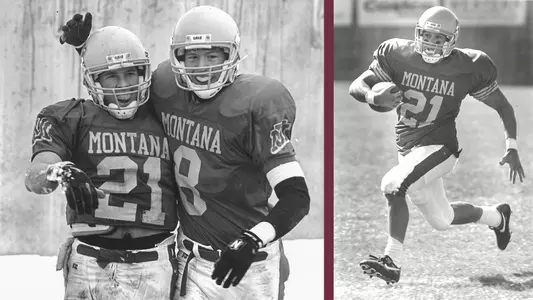
The Hall of Famers: Scott Gurnsey
10/3/2024 7:10:00 PM | Football
When Montana football was bursting onto the national scene in the late 80' and early 90's Scott Gurnsey established himself as a fixture in the Grizzly lineup as a four-year letterman between 1991 and 1994.
During that time (and more often than not in the biggest games on the biggest stages) he also established himself in the opponent's endzone, setting a school record for career receiving yards before it was all said and done.
Then after graduation he began a radio career as Montana's football analyst, and for nearly 30 years he established himself in the hearts, minds, and ears of fans statewide as an affable but educated sidekick to the legendary Mick Holien as they painted the picture from left to right on your radio dial.
He's been there – either on the field or in the booth – for some of the most iconic moments in Grizzly history. Catching 2,950 yards worth of passes (if you include his big-time playoff games – a total that would still be third in school history), calling national championship wins, going 20-10 against Montana State as a player and broadcaster… If you can name the moment, he was probably there in some way, shape or form.
There was the time Montana was trailing South Dakota State 38-7 in the third quarter of the 1993 season opener and the Griz stormed back. SDSU took a 48-45 lead with 1:26 to play and it looked grim for the Grizzlies. But a guy named Dave Dickenson went deep on 4th and 2 from the 42 and connected with Gurnsey in the endzone to win a thriller.
And another time in the 1994 quarterfinal against McNeese State where Dickenson was injured. The Cowboys took a 28-27 lead with 4:13 to play. Montana's defense then stepped up and held the Cowboys on 4th and 1 at their own 12-yard line. When the offense took the field, Gurnsey's name was called with a 20-yard catch that sparked a six-play drive, eventually leading to a 37-yard game-winning field goal with eight seconds to play. That field goal sent Montana to the 1-AA semifinal for the first time in school history.
The 2001 national championship, "The Streak" against the rivals, 14 Big Sky titles, five more national championship appearances, dozens of playoff games. He's been there for it all.
Gurnsey is not a born and raised Montanan, but if there ever was an adopted son, he is it. Loyal to the program that brought him to Missoula, loyal to the Treasure State, and loyal to the Grizzly community to this day.
This weekend, his legendary career on the field and his dedication to the program for three decades behind the mic will be celebrated when he is officially inducted into the Grizzly Sports Hall of Fame.
GoGriz.com sat down with Gurnsey for a Q&A ahead of the festivities.
Thanks for taking the time, Gurns. Unlike a lot of other inductees, you've remained intimately close to the Grizzly program since your playing days got over. Now that you've had some time to chew on the fact that your name will be etched next to some of the greats you both played with and came before, what does it mean to you to become a Grizzly Sports Hall of Famer?
I used this word over and over again when I can remember it, but it's surreal. It's one of those things that I don't think is on anybody's mind when they step foot on campus, like that's the goal to get in the Hall of Fame one day.
I just think you come here, you're scared, you don't know what you're doing. You try to figure things out and get on the field and hope you do well, and your team wins more than they lose, and maybe you get to the playoffs, maybe win a national championship, and what have you. But, was never a thing that ever entered my mind, and I don't think that it entered my mind until probably 10 years after I was done playing.
I've looked in the programs, and I've seen all of the people, the guys, the gals, the coaches, trainers, support staff, and what have you that are in there. And I just kind of shake my head and giggle a little bit. Like, oh my gosh, I'm gonna be in there too. It's weird, and it's cool, and it's just surreal.
We had a little fun this summer at the GSA Golf Tournament up in Fort Benton when we surprised you with the news you'd be inducted into the hall of fame. Tell us about that day and what it meant to you.
My buddy Chris Halko puts on the tournament up there. I try to make it every year and I end up staying a night or two. I got up there early that morning and went to the golf course and nobody was there.
Lo and behold, I find out everybody's at the Union Hotel in Fort Benton having breakfast. So, I start practicing my putting because I can always do that. Then everybody starts to show up, and you're milling around and talking to people and making sure you're checked in.
Then all of a sudden Halko grabs the mic. 'All right, everybody, everybody come inside and let's go over the rules.' And I'm thinking to myself, it's crammed in there. It's hot. I don't need to hear this. I've heard it every year. So, I'm just gonna hang out by the golf carts. Then Riley Corcoran comes at me with, 'hey Gurns, you gotta come in here. There's something going on.' So I say okay, whatever.
I go in there and Kent Haslam, gets up there and starts talking. He says, 'one of the, one of the special things I get to do is tell people they are in the Hall of Fame.' And I was like… Oh.. Okay… and he does his spiel and calls me up there. It was pretty cool to be there with a bunch of friends, some good Griz people, and even a few Cat fans too. I don't know how they got invited, but I guess their money is as good as anybody's.
It was a cool deal, and it put me on the spot, which is a good thing. Everybody needs to be put on the spot every once in a while.
Well, let's talk a little ball. You got to play a big part of Grizzly football when it exploded from humble beginnings and turned into a national championship contender under the legendary Don Read. Coming all the way from Tumwater, Washington, tell us about how you ended up at Montana in the first place and what it was like riding that wave of success that culminated in the national title the year after you graduated.
As a kid in junior high, you start getting recruited and you start getting letters from places like UCLA and Florida. It's just informational stuff, congratulating you on a good year and what have you. But I kept track of all those letters, and I had a map of the 50 states and I'd put a star on the map where the schools were. There were like 40 schools on there, and Montana was the last to contact me. I didn't know really know anything about Montana or that it was so close. Like, driving distance. Then I learned that the reason they were so late in recruiting is because they just went to the semifinals in the playoffs and were behind in recruiting.
That '89 season they had guys like Grady Bennett, Mike Trevathan, Matt Clark, and those guys. And I think that's when Montana got a sniff of how fun the playoffs can be and having that be the goal, then turn it into reality after some middle of the road years. 1990 was supposed to be a good year. We beat Oregon State on the road then had some losses. 91 was tough. 92 we started one and five but won-out and finished six and five.
Then Dave Dickenson burst on the scene, and we started getting a sniff of those playoffs again, and we got it going pretty good. But back then the endzones had grass, we didn't have two levels of seating in the stadium, and it was just quaint. Now it's grown into the massiveness that it is, but it was so fun to be a part of.
Even after winning the national championship in 95, which I wasn't a part of, but I was still fairly close to the team, it was all very new and exciting. Having three playoff games at home, feeling what the football program meant to the community and the businesses, and feeling what it was like on campus when you have good sports programs, it was a lot different, and it was exciting. I guess I wouldn't know any different since then, especially with the football program doing well.
But those early years were special. Don Read man, he's got some coaching tree. A lot of guys went on to do some great things. It's amazing.
Well, you certainly had an amazing career. But after that was over Mick Holien asks you to join him on the airwaves and serve as the color guy on the radio broadcasts. How did that come to fruition and what was it like jumping feet-first into radio?
Mick came into the bar when I was working on a Saturday night. He had, just gotten done with a wedding reception and he walked in. We had been friends through athletics and knew some of the same people. Didn't really know too much about him back then, but we had become acquainted.
Mick was just a nice, nice guy. And, and he walked in and ordered a beer, or whatever he ordered. And,
and he said, Gurns, (Brian) Salonen is retiring. I need a new color guy. You want to do it?
And I said, Well… I'd love to do it. Hang on a second.
So, I went into the back, and I called my boss at Coca Cola, Dennis Anderson, and I told him what had just happened. And I said I'm gonna have to miss some Fridays for travel and all that stuff. And he goes, What do you think? And then he goes, it sounds like it'd be good for our business, and I think you should do it. So I walked back out and said, I'm in. It was that easy. I had no background, didn't study sportscasting or public speaking or anything like that. But I was still so newly done playing, and I knew a lot about the program, the offense we were running, the players. I mean, it was probably just a natural fit and I'm just lucky enough Mick asked me to do it.
It was a great way for me to give back, make a little bit of money, and get to go to all the games. It was an awesome run, traveling with the team but it takes a toll on you. That late night travel, and being on the road is really cool, but it really kind of isn't. But all in all, it was a great experience.
Well, as Mick would say, you guys painted the picture from left to right on the radio dial for a lot of big moments in Grizzly history. What are your favorite memories? I'm sure you could write a book about it, and you probably should write a book someday. But what are some of the favorite memories of just being in the booth with Mick and having that experience?
Oh gosh, the playoff games at home, the Appalachian State game in the snow was a great one. Us coming out in copper jerseys against the Cats was pretty awesome.
But I don't know, a lot of times when, when maybe a kid would break a record or, you know, do something really special. Make a play to win the game, those kinds of things. It was special when the kids did something really good.
Well, when you get a chance to reflect on it all, it's been a heck of a run Gurns. You came here from Washington and made Montana your home, and it's still your home. You played a special part in this place's legacy, so what does that mean to you?
When you're a kid and you dream of playing college football, and you think about where you want to go. You start when you're really little, and then you get into high school and you start seeing how good of a player you are, and maybe you're not going to make it to Alabama.
But I think that in my case, I couldn't have been put into a more perfect situation, with teammates, with coaches, with Missoula. You can think about what could have been, but I don't because I don't know how much better it could have been, and it sure could have been a heck of a lot worse. What a special place.
I was lucky enough to come from a great program in high school at Tumwater and was super lucky to come to another great one at Montana. My football experiences are nothing but good times.
During that time (and more often than not in the biggest games on the biggest stages) he also established himself in the opponent's endzone, setting a school record for career receiving yards before it was all said and done.
Then after graduation he began a radio career as Montana's football analyst, and for nearly 30 years he established himself in the hearts, minds, and ears of fans statewide as an affable but educated sidekick to the legendary Mick Holien as they painted the picture from left to right on your radio dial.
He's been there – either on the field or in the booth – for some of the most iconic moments in Grizzly history. Catching 2,950 yards worth of passes (if you include his big-time playoff games – a total that would still be third in school history), calling national championship wins, going 20-10 against Montana State as a player and broadcaster… If you can name the moment, he was probably there in some way, shape or form.
There was the time Montana was trailing South Dakota State 38-7 in the third quarter of the 1993 season opener and the Griz stormed back. SDSU took a 48-45 lead with 1:26 to play and it looked grim for the Grizzlies. But a guy named Dave Dickenson went deep on 4th and 2 from the 42 and connected with Gurnsey in the endzone to win a thriller.
And another time in the 1994 quarterfinal against McNeese State where Dickenson was injured. The Cowboys took a 28-27 lead with 4:13 to play. Montana's defense then stepped up and held the Cowboys on 4th and 1 at their own 12-yard line. When the offense took the field, Gurnsey's name was called with a 20-yard catch that sparked a six-play drive, eventually leading to a 37-yard game-winning field goal with eight seconds to play. That field goal sent Montana to the 1-AA semifinal for the first time in school history.
The 2001 national championship, "The Streak" against the rivals, 14 Big Sky titles, five more national championship appearances, dozens of playoff games. He's been there for it all.
Gurnsey is not a born and raised Montanan, but if there ever was an adopted son, he is it. Loyal to the program that brought him to Missoula, loyal to the Treasure State, and loyal to the Grizzly community to this day.
This weekend, his legendary career on the field and his dedication to the program for three decades behind the mic will be celebrated when he is officially inducted into the Grizzly Sports Hall of Fame.
GoGriz.com sat down with Gurnsey for a Q&A ahead of the festivities.
Thanks for taking the time, Gurns. Unlike a lot of other inductees, you've remained intimately close to the Grizzly program since your playing days got over. Now that you've had some time to chew on the fact that your name will be etched next to some of the greats you both played with and came before, what does it mean to you to become a Grizzly Sports Hall of Famer?
I used this word over and over again when I can remember it, but it's surreal. It's one of those things that I don't think is on anybody's mind when they step foot on campus, like that's the goal to get in the Hall of Fame one day.
I just think you come here, you're scared, you don't know what you're doing. You try to figure things out and get on the field and hope you do well, and your team wins more than they lose, and maybe you get to the playoffs, maybe win a national championship, and what have you. But, was never a thing that ever entered my mind, and I don't think that it entered my mind until probably 10 years after I was done playing.
I've looked in the programs, and I've seen all of the people, the guys, the gals, the coaches, trainers, support staff, and what have you that are in there. And I just kind of shake my head and giggle a little bit. Like, oh my gosh, I'm gonna be in there too. It's weird, and it's cool, and it's just surreal.
We had a little fun this summer at the GSA Golf Tournament up in Fort Benton when we surprised you with the news you'd be inducted into the hall of fame. Tell us about that day and what it meant to you.
My buddy Chris Halko puts on the tournament up there. I try to make it every year and I end up staying a night or two. I got up there early that morning and went to the golf course and nobody was there.
Lo and behold, I find out everybody's at the Union Hotel in Fort Benton having breakfast. So, I start practicing my putting because I can always do that. Then everybody starts to show up, and you're milling around and talking to people and making sure you're checked in.
Then all of a sudden Halko grabs the mic. 'All right, everybody, everybody come inside and let's go over the rules.' And I'm thinking to myself, it's crammed in there. It's hot. I don't need to hear this. I've heard it every year. So, I'm just gonna hang out by the golf carts. Then Riley Corcoran comes at me with, 'hey Gurns, you gotta come in here. There's something going on.' So I say okay, whatever.
I go in there and Kent Haslam, gets up there and starts talking. He says, 'one of the, one of the special things I get to do is tell people they are in the Hall of Fame.' And I was like… Oh.. Okay… and he does his spiel and calls me up there. It was pretty cool to be there with a bunch of friends, some good Griz people, and even a few Cat fans too. I don't know how they got invited, but I guess their money is as good as anybody's.
It was a cool deal, and it put me on the spot, which is a good thing. Everybody needs to be put on the spot every once in a while.
Well, let's talk a little ball. You got to play a big part of Grizzly football when it exploded from humble beginnings and turned into a national championship contender under the legendary Don Read. Coming all the way from Tumwater, Washington, tell us about how you ended up at Montana in the first place and what it was like riding that wave of success that culminated in the national title the year after you graduated.
As a kid in junior high, you start getting recruited and you start getting letters from places like UCLA and Florida. It's just informational stuff, congratulating you on a good year and what have you. But I kept track of all those letters, and I had a map of the 50 states and I'd put a star on the map where the schools were. There were like 40 schools on there, and Montana was the last to contact me. I didn't know really know anything about Montana or that it was so close. Like, driving distance. Then I learned that the reason they were so late in recruiting is because they just went to the semifinals in the playoffs and were behind in recruiting.
That '89 season they had guys like Grady Bennett, Mike Trevathan, Matt Clark, and those guys. And I think that's when Montana got a sniff of how fun the playoffs can be and having that be the goal, then turn it into reality after some middle of the road years. 1990 was supposed to be a good year. We beat Oregon State on the road then had some losses. 91 was tough. 92 we started one and five but won-out and finished six and five.
Then Dave Dickenson burst on the scene, and we started getting a sniff of those playoffs again, and we got it going pretty good. But back then the endzones had grass, we didn't have two levels of seating in the stadium, and it was just quaint. Now it's grown into the massiveness that it is, but it was so fun to be a part of.
Even after winning the national championship in 95, which I wasn't a part of, but I was still fairly close to the team, it was all very new and exciting. Having three playoff games at home, feeling what the football program meant to the community and the businesses, and feeling what it was like on campus when you have good sports programs, it was a lot different, and it was exciting. I guess I wouldn't know any different since then, especially with the football program doing well.
But those early years were special. Don Read man, he's got some coaching tree. A lot of guys went on to do some great things. It's amazing.
Well, you certainly had an amazing career. But after that was over Mick Holien asks you to join him on the airwaves and serve as the color guy on the radio broadcasts. How did that come to fruition and what was it like jumping feet-first into radio?
Mick came into the bar when I was working on a Saturday night. He had, just gotten done with a wedding reception and he walked in. We had been friends through athletics and knew some of the same people. Didn't really know too much about him back then, but we had become acquainted.
Mick was just a nice, nice guy. And, and he walked in and ordered a beer, or whatever he ordered. And,
and he said, Gurns, (Brian) Salonen is retiring. I need a new color guy. You want to do it?
And I said, Well… I'd love to do it. Hang on a second.
So, I went into the back, and I called my boss at Coca Cola, Dennis Anderson, and I told him what had just happened. And I said I'm gonna have to miss some Fridays for travel and all that stuff. And he goes, What do you think? And then he goes, it sounds like it'd be good for our business, and I think you should do it. So I walked back out and said, I'm in. It was that easy. I had no background, didn't study sportscasting or public speaking or anything like that. But I was still so newly done playing, and I knew a lot about the program, the offense we were running, the players. I mean, it was probably just a natural fit and I'm just lucky enough Mick asked me to do it.
It was a great way for me to give back, make a little bit of money, and get to go to all the games. It was an awesome run, traveling with the team but it takes a toll on you. That late night travel, and being on the road is really cool, but it really kind of isn't. But all in all, it was a great experience.
Well, as Mick would say, you guys painted the picture from left to right on the radio dial for a lot of big moments in Grizzly history. What are your favorite memories? I'm sure you could write a book about it, and you probably should write a book someday. But what are some of the favorite memories of just being in the booth with Mick and having that experience?
Oh gosh, the playoff games at home, the Appalachian State game in the snow was a great one. Us coming out in copper jerseys against the Cats was pretty awesome.
But I don't know, a lot of times when, when maybe a kid would break a record or, you know, do something really special. Make a play to win the game, those kinds of things. It was special when the kids did something really good.
Well, when you get a chance to reflect on it all, it's been a heck of a run Gurns. You came here from Washington and made Montana your home, and it's still your home. You played a special part in this place's legacy, so what does that mean to you?
When you're a kid and you dream of playing college football, and you think about where you want to go. You start when you're really little, and then you get into high school and you start seeing how good of a player you are, and maybe you're not going to make it to Alabama.
But I think that in my case, I couldn't have been put into a more perfect situation, with teammates, with coaches, with Missoula. You can think about what could have been, but I don't because I don't know how much better it could have been, and it sure could have been a heck of a lot worse. What a special place.
I was lucky enough to come from a great program in high school at Tumwater and was super lucky to come to another great one at Montana. My football experiences are nothing but good times.
Thursday, June 04
Friday, May 01
Monday, March 30
Monday, March 30