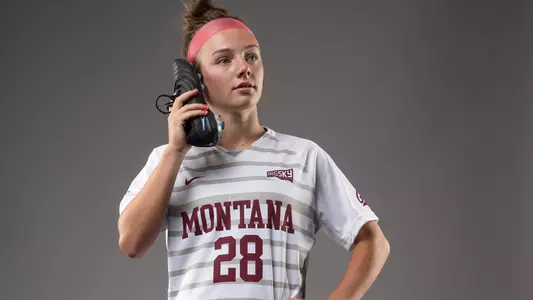
Photo by: Ryan Brennecke/ University of Mo
The Craig Hall Chronicles :: Ashlyn Sandow
8/21/2024 7:45:00 PM | Soccer
What a dreamer this one is, the girl who watched Big Hero 6, who saw Aunt Cass living above the Lucky Cat Café, working the bakery by day before retreating to her cozy residence upstairs, then decided that's what she wanted to do as well. Because how perfect would that be?
It had to be in Washington, because she loves the rain. The sun? That's fine but that brings expectations, that you have to get out and do something or the opportunity the day provided has been wasted. Who needs that kind of pressure? Not Ashlyn Sandow, that's for sure. Rainy days neutralize everything.
So, it would be a bakery and she'd live above it and it would be in a rainy location and she would be surrounded by those aromas of her own making, from her expert hands and fingers, from sunup to sundown. It would be a simple life, a good life. And it would be perfect.
After all, a girl can dream, can't she? Indeed, she can, but she also has to be willing to pivot, to recalibrate, because dreams tend to butt up against reality, sometimes for the better, sometimes not.
"We aren't good bakers," she admits, bringing freshman teammate and bestie Emma Widmor into this dream, the one that extinguishes as quickly as it arrived once she admits their cookies tend to turn into pancakes and who knows what exactly happened with that layered cake.
Some dreams live on, some die hard. Besides, she wants to be a surgeon.
She's here, at Montana, because she's a dreamer, but it's not the story you might be thinking. It was somewhere else, another program, the one that was going to perfect in every way, that filled her head at night as she slowly came to soccer prominence in her hometown of Boise.
She'd been a gymnast for nearly her entire life, a good one, state champion good, college material for sure, and who can say that Olympic potential didn't cross the minds of her coaches growing up. She was the perfect package: small, which helps, but also fast and explosive, which turns small into superstar.
"A bunch of girls would go, then Ashlyn would go and you'd be like, okay, that was a lot different. She just had that something where she could bounce off the floor, hit the vault just right. It just looked so much different," says her dad, Cory.
But this was soccer now and she had just started playing at a competitive level in the ninth grade after she had set gymnastics aside for good, and she knew where she was going to play collegiately, brushing off the hard truths of her club coaches that she was way behind her peers and, well, college soccer isn't in the cards for everyone who holds a dream. Don't get your hopes too high.
But she knew where she was headed: Power 5. So, she signed up for their camps, two of them at two different schools. Before that, her parents had an idea: Maybe use another camp as a warm-up, a practice experience just to see what it's like before, you know, jumping into the real thing.
"Hey, I hear Missoula is pretty cool. They have a soccer program. Let's go up and check it out," her dad suggested. Her reply, years later: "My parents had to really convince me to come here. I was never going to go to Montana."
She attended, loved it, but it was her first-ever college camp, and wouldn't every other camp be just like it? How the coaches did the impossible and made every player feel like they were the most important camper there, how they learned the players' names, made everyone better while upping their love for the game? How they sent them on their way thinking that was about the greatest thing ever?
Wasn't every camp like that? And if it was like that at Montana, just think what it would be like at a Power 5 camp. Twice as good? Three times better? More? Can't wait!
The next camp: Basically a ruse that came with a steep registration fee, the coaches' attention on one player and one player only, everyone else just background filler, there as required by NCAA mandate in order to get the It Girl on campus and under their coaching for a day, to win her over.
She left wondering if they had even seen her, had even known a player by the name of Ashlyn Sandow had been on campus and at their camp, had kicked a ball right in front of them. Okay, it wasn't Montana, just probably an outlier. Better camps ahead!
The next: She was told (as a ninth grader), you're not big enough for our back line and you're not as good as some of the other midfielders we're looking at, but thanks for coming. [Insert sound of a balloon deflating.]
In that moment, her dream changed, the focus of what she wanted from a staff and program shifting from the name on the front of the uniform to how a program made her feel, how it valued her. And just like that, Montana had become her dream destination.
"I was a freshman and they paid as much attention to me as any of the other girls. It felt open and welcoming. After that, Montana was the school to beat for me. Every other camp never compared," she says. "Environment was a big thing for me and I loved it here."
Hers is a story of forks in the road, of sporting decisions that had a life-changing should-I-stay-or-should-I-go finality to them.
In other words, it's been an eventful journey to go from where she started to taking the field last Friday for the Grizzlies against Colorado College and a fan in the stands saying to no one in particular that that freshman outside back might be the most athletic-looking player she'd ever seen.
If only that fan knew the whole story. Now she will.
Sandow's mom, Johnna, was born in upstate New York and eventually landed in Coeur d'Alene, later getting an opportunity to join the Boise State gymnastics team as a walk-on.
All she made of the opportunity was to become a two-time Big West Conference Gymnast of the Year and an all-American as a senior after placing 13th in the all-around at the NCAA championships. She was inducted into the Boise State Hall of Fame in 2007.
(And while we're here, let's get this straight: It's pronounced JOHN-ah, to the confusion of baristas across Boise. Large, black coffee for Joanna. And repeat. And while we're talking about needlessly adding extra vowels to names, no need to add an e to Cory's. They like their names just the way they are, thank you very much.)
That was all history, her life as a gymnast, when she met him as a graduate student, both studying biology, their professional lives today, hers in fish biology, his in stream ecology.
And when Ashlyn arrived, their oldest of two, wouldn't you know it? She was a natural in gymnastics from the start, back when it was fun and carefree and practicing four hours at a time five days a week was more joy than chore. Running, jumping, landing, flipping, all of it a kid's playhouse.
And when she was asked if she wanted to add in another hour on top of that for extra conditioning? Mom, Dad, can I, please!?
"I was pretty good," she admits. How good? "I won state a lot, all-around for my age-group. I thought that was going to be my thing."
The outside pressures would start adding on as she got older and got better, accomplished more, Johnna's daughter taking after mom, who remained active in the sport as a judge. "I felt it because it was my mom's sport and she had been super good and everyone knew her," Ashlyn says.
"She was a celebrity a little bit, so all the judges would know my name and the coaches at other facilities."
The weight of it all started increasing, of being Johnna's daughter and the external expectations that came with it, the added pressure from fulfilling those expectations, which had people expecting more, more, more, plus the time demands while she was still trying to play a little soccer on the side.
Here we need to clear Johnna's name because she did nothing to add to the pressure, only to release it. "Despite Johnna's success, she hasn't been a tiger mom in any of this," says Cory. "It was more being in that gymnastics world."
"She and I had that talk a lot," says Ashlyn. "She told me, 'We don't care what you do as long as you love it.' She could see that gymnastics was becoming more of a stressor than a love for me."
She'd go to competitions, leave all her emotions in her gear bag off to the side, make everything look easy, then put it all back on again when it came time to practice, a weighted vest.
There was a time when she was just better than everybody else, faster, stronger, more explosive. As she aged, the sport required more of her, bigger skills that are as much mental as physical, back tumbling, big releases on bar, back handsprings on the beam.
"As you get to higher levels, there is more demand for skills that require more and more of the kids," Cory says. "She was dreading all of it.
"She'd go out and do it perfectly in competition, so she had some competitive spark in her that squashed those doubts. Her mind just took over. It starts wearing on you and isn't a lot of fun. Competing is fun but all the hours up to that have not been fun."
If gymnastics was her job, the soccer she got to play on the side was a fun hobby that kept looking more and more appealing, a team sport that sat in stark contrast to the individual attention that came from everyone in the facility watching the girl on the beam. And how would she perform?
On the soccer field she was one of 11, able to blend in. When the team succeeded, everyone won. When the team came up short, all felt it the same.
Ashlyn Sandow was at a crossroads.
"Soccer kept pulling her back. She was hungry to be in a sport where all the focus wasn't just on her. Her and her teammates were going to accomplish this goal. We're going to work together to make this thing happen. It helped defuse some of the pressure she was putting on herself," says Cory.
"We're all in this together. Let's go kick some butt and have some fun while doing it. I think that's what more brought her to soccer, that team element."
The first fork in the road had arrived. To the left: gymnastics, the sport she had devoted 12 years of her life to, the sport she had been so accomplished in, the legacy girl carrying on a proud family tradition but the one that was slowly losing some of its joy, replaced by fears she had never faced before in the sport.
To the right: soccer, a sport that was replacing that joy, the one that celebrated team over individual, so light and fun compared to the heaviness of high-level gymnastics.
But she had devoted so much of herself to gymnastics, so many hours. Didn't that mean something? If she stopped now, had it all been for naught? It was a tough spot for an eighth grader.
"Do I want to fight through that fear or do I want to take a chance with soccer and see how far I can go with that? That was probably the toughest decision of my life," she says. "My parents took a backseat in the decision and gave me confidence that they wouldn't care what I chose, which was nice."
Soccer won out but Sandow was behind, so far behind her peers. She had the athleticism but was lacking experience from all the time she had given to gymnastics. But what she had going for her was something she had internalized from the world of gymnastics.
Her soccer club asked her to train for 90 minutes with the team three days per week. She was coming from a world where she would be at the gym for 20-plus hours each week. Ninety minutes for an entire training session? That was a warm-up. No one was better suited to take matters into her own hands.
She was driven by the passion she was developing for a new sport, one she was playing at more and more competitive levels, driven by the belief in the back of her mind that she was playing from behind, playing catch-up while going up against players who had given soccer what she had given gymnastics.
The demands of her former sport had set her up to succeed in her new sport. "Through that gymnastics training, that's where that work ethic was first developed and where she found, where are my limits, how far can I go?" Cory says.
"When she transitioned to soccer in eighth and ninth grade, she was really hungry to be good at soccer. She always wanted to learn more and do extra."
Her greatest fear? That her lack of experience might show up on the field, might prove costly to her team, might have her teammates wondering if this gymnast-turned-soccer-player was suited for her new sport.
"I think that drives her as well, that she might feel that she is letting her team down when she mistimes a run or has a bad pass out of the midfield or doesn't get the shape right to set a strong defense," Cory says.
"She doesn't want to have her team lose faith in her. I think she might fear letting the team down more than losing. Losing isn't something that she can totally control, but she can control how hard she is working and what she does off the field so the team believes in her."
And dreamers are going to dream, right? New sport but she still expected it to take her somewhere special. She told her club coaches so, this newbie to competitive soccer.
"Once she made the decision to play soccer, then it became, okay, now I want to play college soccer," Cory says. "Her club coaches told her, it doesn't happen for everyone. Your dreams could be this, but it could be totally different in the end."
She wasn't going to hear it. She signed up for camps at Power 5 schools in the Northwest, threw in Montana as a chance to get her feet wet, then over time realized she had been prioritizing the wrong things.
Where other college coaches ignored or dismissed her – Really? 5-foot-3? Get out of here! – "Chris was like, we love you. We love your attitude and how much you want to learn, what your competitive spirit is, that you're not afraid to go against other people," Cory says. "They believed she belonged.
"Driving back to Boise, we get a call from her old club coach. We just got a call from Chris. He's asking about you and where your head's at."
It was in Montana. It would never leave.
Okay, that's not 100 percent true. And that's a story Citowicki has never heard.
Sandow, Timberline High's Female Athlete of the Year as a senior, could have excelled at probably anything she tried and applied herself to. (Okay, anything outside of basketball, born as she and her younger brother Jackson were to parents on the shorter side. Cory and Johnna straight-up told them, "You're never getting tall, you two.")
Track and field? No one saw that coming and it just about stole her heart, the vibe totally team-centered and even athlete-centered, all athletes from all schools cheering for all athletes from all schools. And it combined the right elements from gymnastics.
What made her a star in the vault, the fast approach, the explosion off the springboard, the body awareness in space, made her a natural for the triple jump. Again, when she did it, it just looked different than most of the other competitors.
Where soccer was a flow sport, filled with wins and losses every time a player touches the ball, reading and reacting, the triple jump could be, if not perfected, then studied and improved upon, just like the vault or the beam, in the pursuit of perfection, personal bests the easy feedback.
She got good, then she got really good, going 37 feet, 4 inches as a junior, the type of mark that would draw the attention of college recruiters from just about any program in the country, given that 41 feet was the cut to make NCAA regionals last spring.
It never quite became, Montana who? But she says it got to 50-50 in her mind, track and field closing the gap that much. The Grizzlies didn't do anything wrong. She was just falling for this sport that combined what she loved about soccer and about gymnastics.
Here it was again, another fork in the road. "I was loving track and loving jumping. I was figuring everything out and jumping became really fun. That caused trouble for me my junior year. Do I want to go to that bigger school for jumping or do I value the connection I had with Montana?
"That was a big decision for me, too. I'm glad I chose this one." She reaffirmed her commitment to Montana and got love in return. But only love, not specifics on where the Grizzlies planned on playing her. Where every other player had a position listed on the 2024 roster, she was listed as ATHLETE.
It was her own personal torture chamber while also being the nicest thing a website could affirm. She's played everything but goalkeeper in her club and high school career and Citowicki didn't know yet where he would use Sandow for her freshman season.
Did he know how Sandow, who is driven by the need to feel prepared, the fear of not knowing what her future might hold, would react? Maybe so. "I always feel bad if I'm not doing enough and I never feel like I'm doing enough, which is hard," says Sandow, the program's latest Taylor Hansen.
"I was doing three workouts per day because I was stressed I wasn't doing enough. I kept doing extra things to make sure I was ready."
But for what position? CAN SOMEONE PLEASE TELL ME WHAT POSITION I NEED TO PREPARE FOR? "That was super hard because I didn't know what to work on. I like visualizing a lot, and now I'm going in and don't know what to expect," she says. "I like to feel prepared."
It was mid-summer before Citowicki made up his mind. "She can play anywhere. That was part of her frustration when I was recruiting her," he says. "Any position you put her in, she'll be great."
His final answer: outside back. Okay, not what she was expecting and not what she had prepared for, but it's a position she knew well enough and had done well enough playing. Simply be faster and stronger than the attacking players from the other team, get the ball going the other direction. Not that hard. The perfect position for an ATHLETE.
Then she joined her new team. "I thought defending was be faster than everyone, be stronger than everyone. Just push them off the ball and get the ball back." She learned some hard lessons.
"Shape is super important, so now I have to change my thinking. It's a huge learning process. It's a big challenge and I'm excited for it. In high school you get away with things because you're fast. Here, if you're out of position by a foot, it might be over for you.
"(Associate head coach J. Landham) says that defense is way more intelligent than people think it is. There is so much that goes into it that I never realized before. It's slowly coming. After the Gonzaga game, I was mentally exhausted from so much thinking."
She'll get it, learn it, get really good at it, make you think she's been playing the position her entire life. After the Gonzaga exhibition match in Columbia Falls, Citowicki approached Sandow and got a checklist of everything she had done wrong and what she had done to correct it, all during the match. He didn't need to say a thing.
"She coached herself through the whole thing. Her IQ is through the roof, her game sense is through the roof," Citowicki says. "She lives in the moment, realizes the mistake, fixes it for the next one. Just amazing. So easy to work with. She has a huge future. So mature, so professional but still so young."
You'll notice he uses a general "future," not "huge future as an outside back." He wants to reserve the right to move Sandow around the chessboard as he sees fit in seasons ahead. If change happens, she'll embrace it and be at her best, no matter where it is, just like one sport couldn't contain her.
"You look 'Griz' up in the dictionary and there is a picture of Ally Henrikson," Citowicki says. "In the future, that will be Ashlyn Sandow. She's it. That's a big compliment to give somebody. She's got it."
Just give her the assignment, Chris, and she'll dream it into reality. Just maybe not the bakery.
It had to be in Washington, because she loves the rain. The sun? That's fine but that brings expectations, that you have to get out and do something or the opportunity the day provided has been wasted. Who needs that kind of pressure? Not Ashlyn Sandow, that's for sure. Rainy days neutralize everything.
So, it would be a bakery and she'd live above it and it would be in a rainy location and she would be surrounded by those aromas of her own making, from her expert hands and fingers, from sunup to sundown. It would be a simple life, a good life. And it would be perfect.
After all, a girl can dream, can't she? Indeed, she can, but she also has to be willing to pivot, to recalibrate, because dreams tend to butt up against reality, sometimes for the better, sometimes not.
"We aren't good bakers," she admits, bringing freshman teammate and bestie Emma Widmor into this dream, the one that extinguishes as quickly as it arrived once she admits their cookies tend to turn into pancakes and who knows what exactly happened with that layered cake.
Some dreams live on, some die hard. Besides, she wants to be a surgeon.
She's here, at Montana, because she's a dreamer, but it's not the story you might be thinking. It was somewhere else, another program, the one that was going to perfect in every way, that filled her head at night as she slowly came to soccer prominence in her hometown of Boise.
She'd been a gymnast for nearly her entire life, a good one, state champion good, college material for sure, and who can say that Olympic potential didn't cross the minds of her coaches growing up. She was the perfect package: small, which helps, but also fast and explosive, which turns small into superstar.
"A bunch of girls would go, then Ashlyn would go and you'd be like, okay, that was a lot different. She just had that something where she could bounce off the floor, hit the vault just right. It just looked so much different," says her dad, Cory.
But this was soccer now and she had just started playing at a competitive level in the ninth grade after she had set gymnastics aside for good, and she knew where she was going to play collegiately, brushing off the hard truths of her club coaches that she was way behind her peers and, well, college soccer isn't in the cards for everyone who holds a dream. Don't get your hopes too high.
But she knew where she was headed: Power 5. So, she signed up for their camps, two of them at two different schools. Before that, her parents had an idea: Maybe use another camp as a warm-up, a practice experience just to see what it's like before, you know, jumping into the real thing.
"Hey, I hear Missoula is pretty cool. They have a soccer program. Let's go up and check it out," her dad suggested. Her reply, years later: "My parents had to really convince me to come here. I was never going to go to Montana."
She attended, loved it, but it was her first-ever college camp, and wouldn't every other camp be just like it? How the coaches did the impossible and made every player feel like they were the most important camper there, how they learned the players' names, made everyone better while upping their love for the game? How they sent them on their way thinking that was about the greatest thing ever?
Wasn't every camp like that? And if it was like that at Montana, just think what it would be like at a Power 5 camp. Twice as good? Three times better? More? Can't wait!
The next camp: Basically a ruse that came with a steep registration fee, the coaches' attention on one player and one player only, everyone else just background filler, there as required by NCAA mandate in order to get the It Girl on campus and under their coaching for a day, to win her over.
She left wondering if they had even seen her, had even known a player by the name of Ashlyn Sandow had been on campus and at their camp, had kicked a ball right in front of them. Okay, it wasn't Montana, just probably an outlier. Better camps ahead!
The next: She was told (as a ninth grader), you're not big enough for our back line and you're not as good as some of the other midfielders we're looking at, but thanks for coming. [Insert sound of a balloon deflating.]
In that moment, her dream changed, the focus of what she wanted from a staff and program shifting from the name on the front of the uniform to how a program made her feel, how it valued her. And just like that, Montana had become her dream destination.
"I was a freshman and they paid as much attention to me as any of the other girls. It felt open and welcoming. After that, Montana was the school to beat for me. Every other camp never compared," she says. "Environment was a big thing for me and I loved it here."
Hers is a story of forks in the road, of sporting decisions that had a life-changing should-I-stay-or-should-I-go finality to them.
In other words, it's been an eventful journey to go from where she started to taking the field last Friday for the Grizzlies against Colorado College and a fan in the stands saying to no one in particular that that freshman outside back might be the most athletic-looking player she'd ever seen.
If only that fan knew the whole story. Now she will.
Sandow's mom, Johnna, was born in upstate New York and eventually landed in Coeur d'Alene, later getting an opportunity to join the Boise State gymnastics team as a walk-on.
All she made of the opportunity was to become a two-time Big West Conference Gymnast of the Year and an all-American as a senior after placing 13th in the all-around at the NCAA championships. She was inducted into the Boise State Hall of Fame in 2007.
(And while we're here, let's get this straight: It's pronounced JOHN-ah, to the confusion of baristas across Boise. Large, black coffee for Joanna. And repeat. And while we're talking about needlessly adding extra vowels to names, no need to add an e to Cory's. They like their names just the way they are, thank you very much.)
That was all history, her life as a gymnast, when she met him as a graduate student, both studying biology, their professional lives today, hers in fish biology, his in stream ecology.
And when Ashlyn arrived, their oldest of two, wouldn't you know it? She was a natural in gymnastics from the start, back when it was fun and carefree and practicing four hours at a time five days a week was more joy than chore. Running, jumping, landing, flipping, all of it a kid's playhouse.
And when she was asked if she wanted to add in another hour on top of that for extra conditioning? Mom, Dad, can I, please!?
"I was pretty good," she admits. How good? "I won state a lot, all-around for my age-group. I thought that was going to be my thing."
The outside pressures would start adding on as she got older and got better, accomplished more, Johnna's daughter taking after mom, who remained active in the sport as a judge. "I felt it because it was my mom's sport and she had been super good and everyone knew her," Ashlyn says.
"She was a celebrity a little bit, so all the judges would know my name and the coaches at other facilities."
The weight of it all started increasing, of being Johnna's daughter and the external expectations that came with it, the added pressure from fulfilling those expectations, which had people expecting more, more, more, plus the time demands while she was still trying to play a little soccer on the side.
Here we need to clear Johnna's name because she did nothing to add to the pressure, only to release it. "Despite Johnna's success, she hasn't been a tiger mom in any of this," says Cory. "It was more being in that gymnastics world."
"She and I had that talk a lot," says Ashlyn. "She told me, 'We don't care what you do as long as you love it.' She could see that gymnastics was becoming more of a stressor than a love for me."
She'd go to competitions, leave all her emotions in her gear bag off to the side, make everything look easy, then put it all back on again when it came time to practice, a weighted vest.
There was a time when she was just better than everybody else, faster, stronger, more explosive. As she aged, the sport required more of her, bigger skills that are as much mental as physical, back tumbling, big releases on bar, back handsprings on the beam.
"As you get to higher levels, there is more demand for skills that require more and more of the kids," Cory says. "She was dreading all of it.
"She'd go out and do it perfectly in competition, so she had some competitive spark in her that squashed those doubts. Her mind just took over. It starts wearing on you and isn't a lot of fun. Competing is fun but all the hours up to that have not been fun."
If gymnastics was her job, the soccer she got to play on the side was a fun hobby that kept looking more and more appealing, a team sport that sat in stark contrast to the individual attention that came from everyone in the facility watching the girl on the beam. And how would she perform?
On the soccer field she was one of 11, able to blend in. When the team succeeded, everyone won. When the team came up short, all felt it the same.
Ashlyn Sandow was at a crossroads.
"Soccer kept pulling her back. She was hungry to be in a sport where all the focus wasn't just on her. Her and her teammates were going to accomplish this goal. We're going to work together to make this thing happen. It helped defuse some of the pressure she was putting on herself," says Cory.
"We're all in this together. Let's go kick some butt and have some fun while doing it. I think that's what more brought her to soccer, that team element."
The first fork in the road had arrived. To the left: gymnastics, the sport she had devoted 12 years of her life to, the sport she had been so accomplished in, the legacy girl carrying on a proud family tradition but the one that was slowly losing some of its joy, replaced by fears she had never faced before in the sport.
To the right: soccer, a sport that was replacing that joy, the one that celebrated team over individual, so light and fun compared to the heaviness of high-level gymnastics.
But she had devoted so much of herself to gymnastics, so many hours. Didn't that mean something? If she stopped now, had it all been for naught? It was a tough spot for an eighth grader.
"Do I want to fight through that fear or do I want to take a chance with soccer and see how far I can go with that? That was probably the toughest decision of my life," she says. "My parents took a backseat in the decision and gave me confidence that they wouldn't care what I chose, which was nice."
Soccer won out but Sandow was behind, so far behind her peers. She had the athleticism but was lacking experience from all the time she had given to gymnastics. But what she had going for her was something she had internalized from the world of gymnastics.
Her soccer club asked her to train for 90 minutes with the team three days per week. She was coming from a world where she would be at the gym for 20-plus hours each week. Ninety minutes for an entire training session? That was a warm-up. No one was better suited to take matters into her own hands.
She was driven by the passion she was developing for a new sport, one she was playing at more and more competitive levels, driven by the belief in the back of her mind that she was playing from behind, playing catch-up while going up against players who had given soccer what she had given gymnastics.
The demands of her former sport had set her up to succeed in her new sport. "Through that gymnastics training, that's where that work ethic was first developed and where she found, where are my limits, how far can I go?" Cory says.
"When she transitioned to soccer in eighth and ninth grade, she was really hungry to be good at soccer. She always wanted to learn more and do extra."
Her greatest fear? That her lack of experience might show up on the field, might prove costly to her team, might have her teammates wondering if this gymnast-turned-soccer-player was suited for her new sport.
"I think that drives her as well, that she might feel that she is letting her team down when she mistimes a run or has a bad pass out of the midfield or doesn't get the shape right to set a strong defense," Cory says.
"She doesn't want to have her team lose faith in her. I think she might fear letting the team down more than losing. Losing isn't something that she can totally control, but she can control how hard she is working and what she does off the field so the team believes in her."
And dreamers are going to dream, right? New sport but she still expected it to take her somewhere special. She told her club coaches so, this newbie to competitive soccer.
"Once she made the decision to play soccer, then it became, okay, now I want to play college soccer," Cory says. "Her club coaches told her, it doesn't happen for everyone. Your dreams could be this, but it could be totally different in the end."
She wasn't going to hear it. She signed up for camps at Power 5 schools in the Northwest, threw in Montana as a chance to get her feet wet, then over time realized she had been prioritizing the wrong things.
Where other college coaches ignored or dismissed her – Really? 5-foot-3? Get out of here! – "Chris was like, we love you. We love your attitude and how much you want to learn, what your competitive spirit is, that you're not afraid to go against other people," Cory says. "They believed she belonged.
"Driving back to Boise, we get a call from her old club coach. We just got a call from Chris. He's asking about you and where your head's at."
It was in Montana. It would never leave.
Okay, that's not 100 percent true. And that's a story Citowicki has never heard.
Sandow, Timberline High's Female Athlete of the Year as a senior, could have excelled at probably anything she tried and applied herself to. (Okay, anything outside of basketball, born as she and her younger brother Jackson were to parents on the shorter side. Cory and Johnna straight-up told them, "You're never getting tall, you two.")
Track and field? No one saw that coming and it just about stole her heart, the vibe totally team-centered and even athlete-centered, all athletes from all schools cheering for all athletes from all schools. And it combined the right elements from gymnastics.
What made her a star in the vault, the fast approach, the explosion off the springboard, the body awareness in space, made her a natural for the triple jump. Again, when she did it, it just looked different than most of the other competitors.
Where soccer was a flow sport, filled with wins and losses every time a player touches the ball, reading and reacting, the triple jump could be, if not perfected, then studied and improved upon, just like the vault or the beam, in the pursuit of perfection, personal bests the easy feedback.
She got good, then she got really good, going 37 feet, 4 inches as a junior, the type of mark that would draw the attention of college recruiters from just about any program in the country, given that 41 feet was the cut to make NCAA regionals last spring.
It never quite became, Montana who? But she says it got to 50-50 in her mind, track and field closing the gap that much. The Grizzlies didn't do anything wrong. She was just falling for this sport that combined what she loved about soccer and about gymnastics.
Here it was again, another fork in the road. "I was loving track and loving jumping. I was figuring everything out and jumping became really fun. That caused trouble for me my junior year. Do I want to go to that bigger school for jumping or do I value the connection I had with Montana?
"That was a big decision for me, too. I'm glad I chose this one." She reaffirmed her commitment to Montana and got love in return. But only love, not specifics on where the Grizzlies planned on playing her. Where every other player had a position listed on the 2024 roster, she was listed as ATHLETE.
It was her own personal torture chamber while also being the nicest thing a website could affirm. She's played everything but goalkeeper in her club and high school career and Citowicki didn't know yet where he would use Sandow for her freshman season.
Did he know how Sandow, who is driven by the need to feel prepared, the fear of not knowing what her future might hold, would react? Maybe so. "I always feel bad if I'm not doing enough and I never feel like I'm doing enough, which is hard," says Sandow, the program's latest Taylor Hansen.
"I was doing three workouts per day because I was stressed I wasn't doing enough. I kept doing extra things to make sure I was ready."
But for what position? CAN SOMEONE PLEASE TELL ME WHAT POSITION I NEED TO PREPARE FOR? "That was super hard because I didn't know what to work on. I like visualizing a lot, and now I'm going in and don't know what to expect," she says. "I like to feel prepared."
It was mid-summer before Citowicki made up his mind. "She can play anywhere. That was part of her frustration when I was recruiting her," he says. "Any position you put her in, she'll be great."
His final answer: outside back. Okay, not what she was expecting and not what she had prepared for, but it's a position she knew well enough and had done well enough playing. Simply be faster and stronger than the attacking players from the other team, get the ball going the other direction. Not that hard. The perfect position for an ATHLETE.
Then she joined her new team. "I thought defending was be faster than everyone, be stronger than everyone. Just push them off the ball and get the ball back." She learned some hard lessons.
"Shape is super important, so now I have to change my thinking. It's a huge learning process. It's a big challenge and I'm excited for it. In high school you get away with things because you're fast. Here, if you're out of position by a foot, it might be over for you.
"(Associate head coach J. Landham) says that defense is way more intelligent than people think it is. There is so much that goes into it that I never realized before. It's slowly coming. After the Gonzaga game, I was mentally exhausted from so much thinking."
She'll get it, learn it, get really good at it, make you think she's been playing the position her entire life. After the Gonzaga exhibition match in Columbia Falls, Citowicki approached Sandow and got a checklist of everything she had done wrong and what she had done to correct it, all during the match. He didn't need to say a thing.
"She coached herself through the whole thing. Her IQ is through the roof, her game sense is through the roof," Citowicki says. "She lives in the moment, realizes the mistake, fixes it for the next one. Just amazing. So easy to work with. She has a huge future. So mature, so professional but still so young."
You'll notice he uses a general "future," not "huge future as an outside back." He wants to reserve the right to move Sandow around the chessboard as he sees fit in seasons ahead. If change happens, she'll embrace it and be at her best, no matter where it is, just like one sport couldn't contain her.
"You look 'Griz' up in the dictionary and there is a picture of Ally Henrikson," Citowicki says. "In the future, that will be Ashlyn Sandow. She's it. That's a big compliment to give somebody. She's got it."
Just give her the assignment, Chris, and she'll dream it into reality. Just maybe not the bakery.

Players Mentioned



Lady Griz Basketball Locker Room Unveiling - 5/1/26
Friday, May 01
Griz Track & Field - Montana Open Highlights - 4/25/26
Friday, May 01
Griz Softball vs. Idaho State Game-Winning Hit - 3/25/26
Friday, May 01
Griz Softball Championship Series Promo
Friday, May 01