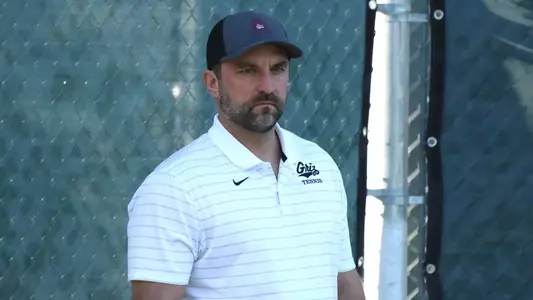
12/27/2025 11:40:00 AM | General, Men's Tennis
"Tennis saved me," the 2025 GoGriz.com Person of the Year said earlier this month, at the end of a year-long heater highlighted by a spring tour de force that saw Montana men's tennis coach Jason Brown lead the Grizzlies to the Big Sky Conference tournament title and the program's second NCAA tournament appearance, earning him both Big Sky and ITA Mountain Region Coach of the Year honors.
To see him now, to witness him leading his team past Northern Arizona in the Big Sky championship match in April, a month after falling 7-0 to the Lumberjacks in Flagstaff in the regular season, to watch him prepare his guys to face Texas in Austin in May in the NCAAs, is to think he was born to do this, making it look so natural that you might believe he's been doing it for most of his life.
But it wasn't that long ago that tennis truly did save him, from a lifestyle that filled his bank account but not his cup, the act of swinging a racket, which he had set aside for a decade and a half to dive deeper and deeper into the world of gambling, as a successful player, as a consultant, as part-owner of some casinos, bringing to light a diagnosis in late 2012 of Hodgkin Lymphoma.
"I don't want to be cliché, but I decided I needed to do something that was going to fulfill me," he said, of what came from those six long months, from diagnosis to final treatment and the all-clear signal, weeks built around chemotherapy treatments, then radiation, all of it giving him time, which he now viewed in a different light, to ponder his future.
"When you have something bad happen, it provides some real clarity. It made me focus on family and pursuing coaching and way less on trying to make money."
Oddly enough, it was tennis that was his entry to gambling in a roundabout way, the University of Montana student, who had tried out to make then coach Kris Nord's Grizzly tennis team in the early 90s as a walk-on, later working at Bob Ward's as a way to pay the bills, stringing rackets and pairing people up with the right set of golf clubs.
A local tennis player arrived one day, and they got to talking, which led to an invitation. "He owned a (poker) game at Stockman's. You should come down and check it out," Brown recalls. It was after the night was over that he could have heard Mike McDermott's voice running through his mind. Listen, here's the thing. If you can't spot the sucker in your first half hour at the table, then you are the sucker.
"I lost like $30. I was devastated. I'm the dumbest player who ever lived. What was I thinking? I can't afford to do this. I can't believe I lost so much money. I'm never doing this again," Brown said, laying down some pretty famous last words – I'm never doing this again -- uttered by plenty of people who have left the table in frustration over the decades.
The guy showed up again the next day at Bob Ward's, told Brown he had some good instincts, that he had only done a couple of things wrong, that he should give it one more try. Brown did, that very night, won $300, maybe $400, one night's winnings enough to pay a month's rent. How many rackets do you have to string to make $400? the guy asked Brown. "He said, I'll see you tomorrow night."
So began a 20-year run that had him doing a bit of everything, from playing both online and live games, consulting for an internet poker company that blew up, traveling frequently, his upbringing in the small Montana town of Conrad giving him everything he needed to make it big but also burdening him with the one thing that kept him from the top.
His dad was a foreman on a ranch, "way less sexy than Yellowstone," he said, Brown and his younger brother taken care of by his mostly stay-at-home mom. "Very low-income. Small towns have a way of isolating you from knowing you're poor. I didn't have any concept.
"I always loved games. Growing up a poor kid, you end up playing a lot of board games, a lot of card games when it's freezing cold. If it wasn't sports, you were playing some version of a game."
Now he was doing it on a larger scale, traveling to find bigger games, to Vegas, where he once made the World Series of Poker final table, seated alongside the early faces of the sport when it became a TV sensation, the lure of easy money bringing a new round of suckers to the online games that flourished in the late 90s and early 2000s, players who eventually made their way to Vegas. Easy pickings.
"Before the really smart people got into it, it wasn't that hard (to make money)," he says. "I had really good emotional control. I liked it from an analytics side."
But growing up without, money was always meaningful to him. He could never disassociate himself from its actual value. "The separator from the good players to the greats is that for the greats, money is just a tool. I never got there. Money always meant something for me. I could go down to Las Vegas and win an amount of money that really changed my life in Montana in the late 90s.
"For the people who are really, really good, the money is just a tool. It comes and goes and they don't care. I didn't have that, so I peaked out at being very good. I never got to that elite level. I never separated enough from the money to be great."
It was also Conrad that gave Brown his start in tennis, the type of small town where eight courts and their nets can be the site of any sort of made-up games and activities for the local kids, unless someone happens to know the sport of tennis, which Greg Jensen did, who could turn that concrete, the lines 78 feet in length, 27 and 36 feet in width, into a source of dreams.
"He was a longtime teacher and coach. Took me under his wing, probably the kindest, nicest person I've ever met," says Brown, who played basketball for legendary Conrad coach Fred Lamoreaux, then played for, played against and coached under Nord when Brown arrived in Missoula. Call it Brown's personal triumvirate of influence, those three coaches.
"Three people who shaped what I've tried to do in sport and also my life. Took pieces of all three of those guys and tried to meld them into the best version I can. I fall short all the time, but I'm trying. Three exceptional people who knew sport was a great way to impact people."
The type of town where the seasons are marked by high school sports, the nights of Friday shining in the fall, the cars lining up outside the high school gym in the winter, the football and basketball stars hitting the track in the spring. "Our lives were filtered through sports. Then you slowly realize when you look at your mom, who's 4-foot-11, that you're not going to the NBA, so I veered into tennis," says Brown.
"It probably took me three months of dedicated tennis to become the best player in Conrad. It didn't take much. The individual aspect of it fascinated me, then I had some success right away, some small-high-school success, but way more success than I was having in any other sport at that point. Once I had some success, I became obsessed with it."
There wasn't much debate about where he would attend college, not after Lamoreaux had loaded his son, Rhett, and Brown into the family car for so many winter trips, nearly 200 miles each way, to Missoula to watch the Grizzlies play basketball and his daughter, Robyn, play in the band. Each one, the destination a packed fieldhouse, more magical than the last.
"We'd come and sit way up at the top, soaking in every second. From 10 years old, I knew I wanted to be here. I still feel like it's the coolest place on earth. I love Missoula," says Brown.
He had a full academic scholarship as a freshman, when he tried to walk on to Nord's Grizzlies. He didn't make the cut. "He tried out and came really close to making the roster. But he still kept a relationship with the guys and hit with them," said Nord, the 2023 GoGriz.com Person of the Year.
One of Nord's players in the early 90s was Tyler Thompson, who arrived from Bismarck, N.D. "What I do remember is (Jason's) incredible excitement for the sport, which hasn't been tampered at all. That was the most evident thing, how cool he thought tennis was and how fascinated about it he was," said Thompson, who has made a career out of tennis.
Thompson was an assistant coach at William and Mary from 1997 to 2001, the head coach at Minnesota from 2001-12, the head coach at William and Mary from 2013-18 before becoming the associate head coach at North Carolina. Under Thompson and head coach Brian Kalbas, the winningest active coach in the nation, the Tar Heels have gone 195-16 in dual matches, 81-3 in the ACC.
North Carolina won the NCAA championship in 2023, but three decades prior to that, Thompson and Brown were just wide-eyed tennis fanatics at Montana, where they decided they'd stumbled upon some sort of nirvana.
"We've talked a lot about the parallels of our upbringings. We knew so little about the world of tennis growing up," said Thompson. "I remember getting to Montana and just finding it incredible that almost everybody had won a state championship. Both of us had our minds blown seeing the level of tennis not just at Montana but in the Big Sky.
"We grew up in places where you literally couldn't hit a ball for seven months. Neither of us had exposure to higher levels of tennis growing up. You continue to have the curtain pulled back a little bit. We both have that appreciation of having worked our way up the industry."
Before Brown was Montana's head coach or Nord's assistant coach or schooling strangers in poker games, he was a college student just trying to make money after his scholarship ran out, so he picked up an easy side job of teaching an HHP tennis class at Montana.
One of his students, who thought maybe she could just make an entire degree out of HHP classes, like tennis and step aerobics, had moved to Missoula a few years prior, when she was 14, from Chicago, and Missoula and Montana were fine but she was a big-city girl. She didn't plan on being around long after graduating from Hellgate High.
But she opted to attend college just down the street from where she had gone to high school, then she signed up for an HHP tennis class. And Jenny is still here, she and Jason married a quarter century once 2026 rolls around.
"Tennis sounded fun, so I took his class. That's how we met, not that you'd know it from my tennis ability. I thought he was a really cool guy, incredibly kind, like he is now, and so thoughtful. He was that way when he was really young, too," she says.
She worked at Sorella's, then more salon than spa, in college, heard the owner might try to sell, so she and her sister joined forces, then went all in when they bought the old Independent Telephone Building as their spa's new home. "That made it feel like a much bigger thing. That isn't something you just walk away from," she said, until they did, in 2021, COVID and a building fire speeding up the process.
"Twenty-five years felt like a good number," she says. "I did it for 25 years, then decided it was time for something different. Still not positive what that looks like. I'm working for somebody else now. I get to go home at the end of the day and not worry about all the things that come with owning a business."
Like her husband, she is all in on Missoula, even after all these years. "We talk about it all the time, getting to live where we do. Such a wonderful thing. You sacrifice some things but getting to live somewhere we love makes it worth it."
Two sons arrived, one now a junior at Montana, who started a vintage clothing company when he was in high school, the younger following his own passions, dance, theater, art, now a student at Parsons School of Design in New York studying architecture, young adult career arcs that would not have been possible for their father at their age.
"In a small town, you have a couple of choices. You could do sports or be a Future Farmers of America kid and work on the ranch. None of this other stuff existed," he said. "Missoula is so diverse and has so many things you can explore. They tried everything and both found their niche, which has been cool to see. In the end, that's all you want for your kids."
When the Peak Racquet Club opened in Missoula in 2010, wife gifted husband a membership, getting a tennis racket back in Brown's hands for the first time in 15 years and getting him back in Nord's orbit, since the Grizzlies began using the Peak as well as their base of operations for most of the year.
The year 2012 changed everything for Brown, both professionally and personally. For starters, one of Nord's all-time favorite players, Carl Kuschke, had finished his eligibility that spring and would be around for the summer and needed a training partner.
"Kris asked if I could take care of him, so we hung out and played tennis every day. Went out for meals, up to Flathead Lake," says Brown, who finally had his ticket for entry to the team that he didn't get punched as a freshman more than two decades prior. And it was exquisite. "That eased me into it. Okay, I really like Griz Tennis. I really like the energy these guys bring. I just thought it was amazing. I still do."
Also in 2012: A growth formed near his collarbone on the right side. He was playing more and more with the Griz players and the mass was starting to catch and pinch when he extended upwards, then powered through on his serve, which is awful to type, so it must have been 10 times worse to actually experience.
"I was driving back from the Peak and it started bothering me, so I whipped around in the parking lot in front of Paul's Pancake Parlor and went to Now Care. She basically diagnosed me on the spot and told me I needed to get a biopsy. She said, you've got Hodgkin Lymphoma. It's curable but you're in for it," Brown said.
Jenny adds, "It definitely rocked our world. It makes you think about your priorities and what's important and what you want to be doing with your life. With Jason's previous lifestyle, he was up at night. The whole scene was not the healthiest."
Treatment lasted six months, from start to finish. It was 12 months before he began to feel normal again. Everything he'd known was shifting under his feet.
Over the years, as more and more money flowed in, poker changed, from good old boys to the bros. "When TV started showing up and it got more and more popular, it went from guys you'd picture hanging around the Oxford, these older guys, to a bunch of guys from the Ivy League," says Brown. "In one year, the smart people started to show up. They discovered this was a way to make money.
"The only redeeming quality of (gambling) for me was monetarily. When I got sick, it didn't feel right to me anymore. Beating people out of money at a game is a really, really hollow existence. I ran into a brick wall with it. I decided I wanted to do something where I felt I was giving back to society in some way. Being around tennis filled me with a feeling of a higher purpose."
Nord's program was there, ready to welcome him in, to give him that renewed sense of purpose.
Brown, now back to full health, joined Nord and the Grizzlies for a 2013-14 season that would be one of the most memorable of Nord's long career. Montana got hot late in the season and rolled through the Big Sky Conference tournament, winning 4-1 and 4-0 over Northern Arizona and Weber State to win the championship and advance to the NCAAs for the first time.
Brown says he was just along for the ride, that he had little to do with it, that it was that team's seniors doing it for Nord. The coach gives Brown more credit than he gives himself. "He was younger, a little more upbeat, more tech-savvy and I needed all those things around me," said Nord. "I think we were a really good mix for the guys on the team."
This new life was everything Brown thought it would be and then some. Their dreams would become his dreams. He would pour his life into theirs and he would he get double in return, something he'd never experienced in his previous professional life, though those lessons learned from holding cards in his hands, of playing the odds, of being patient, of weathering the storms, applied quite well to coaching.
In fact, he's writing a book about it, how the rules of success in gambling apply to sport. "The analytics side is what I like about tennis," he said. "I like to find ways to win, ways you can win repeatedly. You can get lucky and do it once but that's not going to sustain you over the course of a season. There is no system to beating roulette.
"I learned right away that if I put my money in good and didn't win, I was always okay with that. That was a clear line for me. It's the same thing with tennis. Hey, you did the right thing. Maybe you missed the last shot, but you're going to win that point nine times out of 10. We're okay with that."
Say a guy is serving from the deuce court and hits his first serve into the net. You take two steps forward, knowing a big-kick second serve is coming, that the guy is always slow to move toward the center of the court. You attack the second serve right off the bounce, sending it to the corner of the ad court.
If the ball is placed well enough and the opponent is still able to get a racket on it, the probability is that he will hit four times wide or into the net. Point over. Two times he'll hit a lob, one that will go long, one that will be set up on a platter for you to pound back in his direction. And one time he's going to hit a perfect lob that lands on the baseline, one that you may or may not be able to do anything with.
That's the outlier. That's the one you have to be willing to accept, that those moments in a match happen and it is not a reason, despite the emotions involved, to change the overall strategy. It's the wishy-washy who flounder, the uncommitted.
"There are times when tragic things happen in the gambling world," says Brown. "You'd think, why me? I got two aces and put all my money in against two kings. If it came up again, I'm going to do it again. That one-out-of-five chance is going to get you sometimes. That's part of it. It's the same thing in sport. You do things that are going to work over the long run, then hope those key moments go your way."
Oisin Shaffrey, who played for the Grizzlies from 2018 to '22, terms it, "playing the percentage play. I remember my second year, we would plan the first three or four shots of a rally. That's where his mind would be, planning and plotting out strategies. Serve this slice serve to the left against this opponent, then hit to the open court, then come in. There was a lot of detail in how we'd approach matches."
Thompson works under Kalbas at North Carolina, a coach with nearly 800 wins, the National Coach of the Year in 1998, 2010 and '23, a six-time ACC Coach of the Year, so you'd think it would take a lot for a peer outside the UNC program to impress Kalbas's associate head coach.
After all, the Tar Heels played in the national semifinals in May, falling to eventual national champion Georgia, the same Bulldog team North Carolina defeated in Athens in the regular season. The year before that, the Tar Heels lost in Super Regionals. The year before that, North Carolina won the national championship.
Still, Brown has managed to impress his longtime friend with his unique background and how he's applied it to his new job, the pair reconnecting on a professional level after Brown began coaching.
"His ability to see pattern recognition is beyond what anybody in our industry has. Whatever the sport happens to be, coaching is pattern recognition and being able to identify trends and weaknesses," said Thompson. "His mind is attuned to that more than anybody who's only been a coach for their entire career."
It's not well known, but Brown, who has come up with his own proprietary mathematical formulas, has been hired to provide analytic reports for some of the biggest names in men's professional tennis, a surprising turn of events for a student who bailed on his intended pharmacy major as an undergrad once he had to face down college chemistry. Instead, his degree is in humanities and global religion.
In addition to being a two-time Big Sky Conference Coach of the Year, he might be the most interesting person in college tennis.
"I think you learn a lot about yourself sitting at a poker table," adds Thompson. "How to be patient, how to be disciplined, how to keep your emotions in check. I think he brings all of that forward in his coaching. It makes him a more complete coach."
It was all a learning process for Brown early on, working under Nord's wing, seeing how the longtime coach designed practices, got the most out of his guys at the most trying of times, during the offseason, during early-morning conditioning, how he demanded they both compete and act on the court, at the highest level but also with class, no matter how tense the situation, no matter the outcome.
Jared Burnham went up against Nord and the Grizzlies every spring for almost two decades as the coach at Weber State, then Montana State, then Eastern Washington.
"You always knew what you were going to get. Kris's guys were always well-coached and they fought hard. That also made it enjoyable," said Burnham, now the tennis director at The Peak in Hayden, Idaho. "There was no BS, which I really enjoyed. Kris was always big on how the guys acted on the court. Even when I was at Montana State, they came, they competed hard and everybody shook hands after."
It wasn't only Nord imparting lessons on Brown, who was taking it all in from every direction like a sponge. Opposing coaches made their mark as well, like late in Burnham's tenure at Weber State, when Montana pulled out a 4-3 win over the Wildcats in the Big Sky semifinals, storming back from a 3-1 deficit. That night, Nord, Brown and Burnham met up for dinner.
"Tough loss for us," says Burnham. "I've always been, you have half an hour, an hour, then you move on. Living in the last match doesn't do you any good for the next one." It's something Brown remembers vividly to this day, how Burnham processed the loss, then moved on, result not affecting relationships. "If I remember, Jason bought us all sushi that night. We sat and talked about everything but tennis."
Montana returned to the Big Sky championship match again in 2017, only to fall to Idaho, Nord in charge, Brown his trusted aide. For the last time, it turned out.
When former Montana women's golf coach Matt Higgins stepped down in early August 2017, it left UM's administration in a tough spot, with not enough time to find a suitable replacement before the start of the fall golf season. Nord said, I'll coach the golf team for a semester, which should give you enough time to do a more thorough search. Interim coach for the men's team that fall? Jason Brown.
"I was ready. I think it was all part of his master plan. He had turned a lot of the recruiting over to me, so it was a fairly easy transition," says Brown. "I think he was always worried someone would come in and take over this program that he'd run for 35-plus years that he didn't want, who didn't represent what he wanted. I think he would have stayed on for 80 years if he hadn't found the right person."
It was now Brown's program, at least for the interim, but it still had Nord's fingerprints all over it. "To this day, I center a lot of my goals around, is this something Kris would do? Would Kris like this? I still think about it a lot."
Nord took to golf and was named that sport's full-time coach in January 2018. Brown, still coaching with an interim tag, led Montana that spring to a 14-6 record, a 9-2 Big Sky finish. The Grizzlies got rolling late, winning eight straight matches before falling to Idaho in the Big Sky championship match for the second consecutive season. The interim was voted the Big Sky Coach of the Year.
"I think that made it easy for them to not have to go searching (for a new coach)," joked Brown. "I never in a million years thought I'd end up coaching at this level. I never saw this coming because I never thought Kris would retire. I never knew him doing anything else."
One of Montana's wins that year: a 4-0 demolition of Burnham's Montana State team. The Grizzlies had a pair of 6-2 wins in doubles and won singles in short order. "Kris was pretty old school. Jason was more in tune with, for lack of a better term, the guys' feelings. Kris was more, show up every day and work hard. Jason is probably a little more loving by nature and now that probably works a little bit better."
One of Brown's first recruits was Shaffrey, out of Dublin, Ireland. He had been speaking to five or 10 schools from around the country when he got on the phone with Brown for the first time. It helped that Peter Mimnagh-Fleming had played for Nord while Brown was the program's assistant coach.
"The deal-breaker for me was when I spoke to Jason," says Shaffrey, who was training back home with Mimnagh-Fleming at the time. "Some coaches won't give you the time of day. You'll speak with an assistant and when you do speak to the head coach, they are short with their responses and don't seem like they are overly interested.
"Jason was super charismatic, very curious, asked a lot of questions about me and was very thorough in questions I asked him. You have to go with a gut feeling. It's a leap of faith but you take what you've learned into account."
Shaffrey was a freshman on Brown's first team after having the interim tag removed, in 2018-19. Now he was simply head coach. And he had a melting pot of players that he had to blend together, U.S. players from Montana and Washington, Shaffrey from Ireland, others from England, Sweden, Greece, New Zealand and British Columbia.
"The most difficult thing of being a head coach is trying to understand all of your players and have them mesh and make a cohesive group," said Shaffrey. "It didn't matter if you were the best player on the team or a reserve or lower down, Jason gave everyone his time and effort, which is super rare. He made everyone feel important and cared for. He did a good job of making everyone feel valued."
By 2022, Brown had Montana nationally ranked and winning 15 matches. In 2024, it was 14 wins. But for all that overall success, the Grizzlies only managed to win a single Big Sky tournament match after making the championship in 2018.
More than anything, he wanted to make Nord proud, which led to Brown putting more and more pressure on himself, which, not surprisingly, trickled down to the players. The results showed it. Late April became the team's annual proving ground, when tenseness prevailed, more L's coming than W's.
This past season, Montana wrapped up the regular season with a 7-0 drubbing of Montana State to move to 16-6. The Grizzlies would take the No. 3 seed to the Big Sky tournament in Phoenix, giving them more expectations. Time for Brown to get all wound up, to get all edgy, to pass that pressure down to his players. Except this April would be different. Call it the evolution of a coach.
"The first time I ever went as a coach (in 2014), we won. After that, we lost every time. I felt this pressure build up and knew it was affecting the team negatively," he said. "In coaching, there is this pressure balloon that inflates and deflates. Our job is to deflate the balloon. In the past, I may have been blowing some air into that thing."
Instead of focusing on how all the fall tournaments, how all the spring matches had led to this moment in time, one they'd always remember, inflating that balloon to nearly exploding, he had them focus on the journey they'd been on just to get there, to win 16 matches, to get the No. 3 seed. That was pretty fantastic in and of itself, wasn't it? And he was thankful for all of it, no matter what happened next.
"I said to the guys, listen, we had a great season. Nationally ranked, set a school record for wins. Whether we lose first round or win this thing, it's been an amazing year. You should be proud. Now let's go let it hang out," he said.
Quarterfinals: Montana 4, Sacramento State 0
Semifinals: Montana 4, Idaho State 1
Championship: Montana 4, Northern Arizona 2
"They played their absolute best tennis when it mattered," says Brown. "I was okay with however it was going to work out, so I wasn't nervous at all." The players responded in kind. "Those guys played unbelievably well. They dug in together. It was magical."
Watching the live scoring from the championship match against Northern Arizona, a team that defeated Montana at elevation in Flagstaff just the month prior during the regular season, was Scott Potter, tennis director at The Peak in Missoula since 2010 when it opened, who played at Montana State and remains a Bobcat to his core but has appreciated the growth of the Griz program over the last 15 years.
Potter was monitoring the title match on his phone last spring while watching his daughter play volleyball.
"As much as a Bobcat as I am, I'm watching the score in Phoenix. As soon as Tommy Bittner won, I let out a YES!" as everyone turned and stared. "I was so happy for Jason and his team. Kris knew who he was passing the program off to and that Jason would build on what he had done.
"The respect I have for Kris is immense. The respect I have for the person who took over the program is just as immense. He's building his own legacy."
Part of that has been Brown's program putting a stranglehold on the annual Dusten Hollist Award, presented each spring to the Montana team with the best GPA. Brown's guys won it again in April, at 3.80, making it seven straight years. So, in a three-week span, Brown's team won the Big Sky, won the Hollist, then played at Texas in the NCAA tournament. Winners, all around.
It's all part of Brown's recruiting pitch, not just to players but their parents. "I tell them, I have two sons. I know your son is important to you and he's going to be treated that way here. They will be valued for more than their ability in sport," he says.
As Brown views it, he's had the ideal build-up to becoming a coach. He's been a father and he's dealt with something in his life that made winning or losing a game or match seem pretty insignificant.
"Two things I think you have to have to coach well," he says. "I think you have to be a parent and have the perspective that at the end of the day, this is just sport. What we're doing is important, the most important thing, but not important at all at the same time. My guys' ability to hit a ball in or out does not diminish their value in any way."
Shaffrey became a first-team All-Big Sky player under Brown's coaching and graduated with a 3.83 GPA as a management information systems major. He took a job at PricewaterhouseCoopers in New York after graduation, worked there for three and a half years. This fall he moved to San Francisco, still getting his tennis in by playing in corporate leagues and finding matches against former college players.
"I want to see them succeed after this," says Brown. "If they get a 3.9 as a double major, the path is a lot clearer than if they get a 2.1."
They would appear to be an odd couple, Brown and Thompson, both presenting on the same day at the ITA Coaches Convention in Tempe, Ariz., earlier this month. But that's only if you don't know their history, one that dates back more than 30 years, a friendship that never ended, now professionals just trying to do their best work, no matter the level.
"He goes into every day with an appreciation and a gratitude for being Montana's coach and for being where he is," says Thompson. "It's infectious for the guys on the team. I think he's developed one of the best cultures in the country. Montana is lucky to have him. It's cool that Kris recognized that in him and chose him to succeed him."
All Brown really wanted to do, after taking over for Nord in an interim role, then in a permanent one, was to make the former Griz coach proud, to build on what he inherited. Mission accomplished. "The program is moving up and away," says Nord. "He's taking it to another level. He's done a great job of recruiting talent and the right talent. They are good kids, good ambassadors for the university.
"They compete hard, they support each other and are dialed in. That's what you want."
It's been a coaching journey like few others for the 2025 GoGriz.com Person of the Year, in love with the sport, then setting it aside, then picking it up again so many years later, falling in love with it all over again but for different reasons, now not just for rackets but for relationships, now doing it better than just about anyone. Sport as savior, tennis as testament.
"It was such a good change for him," says Jenny. "He was ready for something different. He wanted to do something that filled him up and made him feel like he was making a difference. Coaching has really done that for him."
To see him now, to witness him leading his team past Northern Arizona in the Big Sky championship match in April, a month after falling 7-0 to the Lumberjacks in Flagstaff in the regular season, to watch him prepare his guys to face Texas in Austin in May in the NCAAs, is to think he was born to do this, making it look so natural that you might believe he's been doing it for most of his life.
But it wasn't that long ago that tennis truly did save him, from a lifestyle that filled his bank account but not his cup, the act of swinging a racket, which he had set aside for a decade and a half to dive deeper and deeper into the world of gambling, as a successful player, as a consultant, as part-owner of some casinos, bringing to light a diagnosis in late 2012 of Hodgkin Lymphoma.
"I don't want to be cliché, but I decided I needed to do something that was going to fulfill me," he said, of what came from those six long months, from diagnosis to final treatment and the all-clear signal, weeks built around chemotherapy treatments, then radiation, all of it giving him time, which he now viewed in a different light, to ponder his future.
"When you have something bad happen, it provides some real clarity. It made me focus on family and pursuing coaching and way less on trying to make money."
Oddly enough, it was tennis that was his entry to gambling in a roundabout way, the University of Montana student, who had tried out to make then coach Kris Nord's Grizzly tennis team in the early 90s as a walk-on, later working at Bob Ward's as a way to pay the bills, stringing rackets and pairing people up with the right set of golf clubs.
A local tennis player arrived one day, and they got to talking, which led to an invitation. "He owned a (poker) game at Stockman's. You should come down and check it out," Brown recalls. It was after the night was over that he could have heard Mike McDermott's voice running through his mind. Listen, here's the thing. If you can't spot the sucker in your first half hour at the table, then you are the sucker.
"I lost like $30. I was devastated. I'm the dumbest player who ever lived. What was I thinking? I can't afford to do this. I can't believe I lost so much money. I'm never doing this again," Brown said, laying down some pretty famous last words – I'm never doing this again -- uttered by plenty of people who have left the table in frustration over the decades.
The guy showed up again the next day at Bob Ward's, told Brown he had some good instincts, that he had only done a couple of things wrong, that he should give it one more try. Brown did, that very night, won $300, maybe $400, one night's winnings enough to pay a month's rent. How many rackets do you have to string to make $400? the guy asked Brown. "He said, I'll see you tomorrow night."
So began a 20-year run that had him doing a bit of everything, from playing both online and live games, consulting for an internet poker company that blew up, traveling frequently, his upbringing in the small Montana town of Conrad giving him everything he needed to make it big but also burdening him with the one thing that kept him from the top.
His dad was a foreman on a ranch, "way less sexy than Yellowstone," he said, Brown and his younger brother taken care of by his mostly stay-at-home mom. "Very low-income. Small towns have a way of isolating you from knowing you're poor. I didn't have any concept.
"I always loved games. Growing up a poor kid, you end up playing a lot of board games, a lot of card games when it's freezing cold. If it wasn't sports, you were playing some version of a game."
Now he was doing it on a larger scale, traveling to find bigger games, to Vegas, where he once made the World Series of Poker final table, seated alongside the early faces of the sport when it became a TV sensation, the lure of easy money bringing a new round of suckers to the online games that flourished in the late 90s and early 2000s, players who eventually made their way to Vegas. Easy pickings.
"Before the really smart people got into it, it wasn't that hard (to make money)," he says. "I had really good emotional control. I liked it from an analytics side."
But growing up without, money was always meaningful to him. He could never disassociate himself from its actual value. "The separator from the good players to the greats is that for the greats, money is just a tool. I never got there. Money always meant something for me. I could go down to Las Vegas and win an amount of money that really changed my life in Montana in the late 90s.
"For the people who are really, really good, the money is just a tool. It comes and goes and they don't care. I didn't have that, so I peaked out at being very good. I never got to that elite level. I never separated enough from the money to be great."
It was also Conrad that gave Brown his start in tennis, the type of small town where eight courts and their nets can be the site of any sort of made-up games and activities for the local kids, unless someone happens to know the sport of tennis, which Greg Jensen did, who could turn that concrete, the lines 78 feet in length, 27 and 36 feet in width, into a source of dreams.
"He was a longtime teacher and coach. Took me under his wing, probably the kindest, nicest person I've ever met," says Brown, who played basketball for legendary Conrad coach Fred Lamoreaux, then played for, played against and coached under Nord when Brown arrived in Missoula. Call it Brown's personal triumvirate of influence, those three coaches.
"Three people who shaped what I've tried to do in sport and also my life. Took pieces of all three of those guys and tried to meld them into the best version I can. I fall short all the time, but I'm trying. Three exceptional people who knew sport was a great way to impact people."
The type of town where the seasons are marked by high school sports, the nights of Friday shining in the fall, the cars lining up outside the high school gym in the winter, the football and basketball stars hitting the track in the spring. "Our lives were filtered through sports. Then you slowly realize when you look at your mom, who's 4-foot-11, that you're not going to the NBA, so I veered into tennis," says Brown.
"It probably took me three months of dedicated tennis to become the best player in Conrad. It didn't take much. The individual aspect of it fascinated me, then I had some success right away, some small-high-school success, but way more success than I was having in any other sport at that point. Once I had some success, I became obsessed with it."
There wasn't much debate about where he would attend college, not after Lamoreaux had loaded his son, Rhett, and Brown into the family car for so many winter trips, nearly 200 miles each way, to Missoula to watch the Grizzlies play basketball and his daughter, Robyn, play in the band. Each one, the destination a packed fieldhouse, more magical than the last.
"We'd come and sit way up at the top, soaking in every second. From 10 years old, I knew I wanted to be here. I still feel like it's the coolest place on earth. I love Missoula," says Brown.
He had a full academic scholarship as a freshman, when he tried to walk on to Nord's Grizzlies. He didn't make the cut. "He tried out and came really close to making the roster. But he still kept a relationship with the guys and hit with them," said Nord, the 2023 GoGriz.com Person of the Year.
One of Nord's players in the early 90s was Tyler Thompson, who arrived from Bismarck, N.D. "What I do remember is (Jason's) incredible excitement for the sport, which hasn't been tampered at all. That was the most evident thing, how cool he thought tennis was and how fascinated about it he was," said Thompson, who has made a career out of tennis.
Thompson was an assistant coach at William and Mary from 1997 to 2001, the head coach at Minnesota from 2001-12, the head coach at William and Mary from 2013-18 before becoming the associate head coach at North Carolina. Under Thompson and head coach Brian Kalbas, the winningest active coach in the nation, the Tar Heels have gone 195-16 in dual matches, 81-3 in the ACC.
North Carolina won the NCAA championship in 2023, but three decades prior to that, Thompson and Brown were just wide-eyed tennis fanatics at Montana, where they decided they'd stumbled upon some sort of nirvana.
"We've talked a lot about the parallels of our upbringings. We knew so little about the world of tennis growing up," said Thompson. "I remember getting to Montana and just finding it incredible that almost everybody had won a state championship. Both of us had our minds blown seeing the level of tennis not just at Montana but in the Big Sky.
"We grew up in places where you literally couldn't hit a ball for seven months. Neither of us had exposure to higher levels of tennis growing up. You continue to have the curtain pulled back a little bit. We both have that appreciation of having worked our way up the industry."
Before Brown was Montana's head coach or Nord's assistant coach or schooling strangers in poker games, he was a college student just trying to make money after his scholarship ran out, so he picked up an easy side job of teaching an HHP tennis class at Montana.
One of his students, who thought maybe she could just make an entire degree out of HHP classes, like tennis and step aerobics, had moved to Missoula a few years prior, when she was 14, from Chicago, and Missoula and Montana were fine but she was a big-city girl. She didn't plan on being around long after graduating from Hellgate High.
But she opted to attend college just down the street from where she had gone to high school, then she signed up for an HHP tennis class. And Jenny is still here, she and Jason married a quarter century once 2026 rolls around.
"Tennis sounded fun, so I took his class. That's how we met, not that you'd know it from my tennis ability. I thought he was a really cool guy, incredibly kind, like he is now, and so thoughtful. He was that way when he was really young, too," she says.
She worked at Sorella's, then more salon than spa, in college, heard the owner might try to sell, so she and her sister joined forces, then went all in when they bought the old Independent Telephone Building as their spa's new home. "That made it feel like a much bigger thing. That isn't something you just walk away from," she said, until they did, in 2021, COVID and a building fire speeding up the process.
"Twenty-five years felt like a good number," she says. "I did it for 25 years, then decided it was time for something different. Still not positive what that looks like. I'm working for somebody else now. I get to go home at the end of the day and not worry about all the things that come with owning a business."
Like her husband, she is all in on Missoula, even after all these years. "We talk about it all the time, getting to live where we do. Such a wonderful thing. You sacrifice some things but getting to live somewhere we love makes it worth it."
Two sons arrived, one now a junior at Montana, who started a vintage clothing company when he was in high school, the younger following his own passions, dance, theater, art, now a student at Parsons School of Design in New York studying architecture, young adult career arcs that would not have been possible for their father at their age.
"In a small town, you have a couple of choices. You could do sports or be a Future Farmers of America kid and work on the ranch. None of this other stuff existed," he said. "Missoula is so diverse and has so many things you can explore. They tried everything and both found their niche, which has been cool to see. In the end, that's all you want for your kids."
When the Peak Racquet Club opened in Missoula in 2010, wife gifted husband a membership, getting a tennis racket back in Brown's hands for the first time in 15 years and getting him back in Nord's orbit, since the Grizzlies began using the Peak as well as their base of operations for most of the year.
The year 2012 changed everything for Brown, both professionally and personally. For starters, one of Nord's all-time favorite players, Carl Kuschke, had finished his eligibility that spring and would be around for the summer and needed a training partner.
"Kris asked if I could take care of him, so we hung out and played tennis every day. Went out for meals, up to Flathead Lake," says Brown, who finally had his ticket for entry to the team that he didn't get punched as a freshman more than two decades prior. And it was exquisite. "That eased me into it. Okay, I really like Griz Tennis. I really like the energy these guys bring. I just thought it was amazing. I still do."
Also in 2012: A growth formed near his collarbone on the right side. He was playing more and more with the Griz players and the mass was starting to catch and pinch when he extended upwards, then powered through on his serve, which is awful to type, so it must have been 10 times worse to actually experience.
"I was driving back from the Peak and it started bothering me, so I whipped around in the parking lot in front of Paul's Pancake Parlor and went to Now Care. She basically diagnosed me on the spot and told me I needed to get a biopsy. She said, you've got Hodgkin Lymphoma. It's curable but you're in for it," Brown said.
Jenny adds, "It definitely rocked our world. It makes you think about your priorities and what's important and what you want to be doing with your life. With Jason's previous lifestyle, he was up at night. The whole scene was not the healthiest."
Treatment lasted six months, from start to finish. It was 12 months before he began to feel normal again. Everything he'd known was shifting under his feet.
Over the years, as more and more money flowed in, poker changed, from good old boys to the bros. "When TV started showing up and it got more and more popular, it went from guys you'd picture hanging around the Oxford, these older guys, to a bunch of guys from the Ivy League," says Brown. "In one year, the smart people started to show up. They discovered this was a way to make money.
"The only redeeming quality of (gambling) for me was monetarily. When I got sick, it didn't feel right to me anymore. Beating people out of money at a game is a really, really hollow existence. I ran into a brick wall with it. I decided I wanted to do something where I felt I was giving back to society in some way. Being around tennis filled me with a feeling of a higher purpose."
Nord's program was there, ready to welcome him in, to give him that renewed sense of purpose.
Brown, now back to full health, joined Nord and the Grizzlies for a 2013-14 season that would be one of the most memorable of Nord's long career. Montana got hot late in the season and rolled through the Big Sky Conference tournament, winning 4-1 and 4-0 over Northern Arizona and Weber State to win the championship and advance to the NCAAs for the first time.
Brown says he was just along for the ride, that he had little to do with it, that it was that team's seniors doing it for Nord. The coach gives Brown more credit than he gives himself. "He was younger, a little more upbeat, more tech-savvy and I needed all those things around me," said Nord. "I think we were a really good mix for the guys on the team."
This new life was everything Brown thought it would be and then some. Their dreams would become his dreams. He would pour his life into theirs and he would he get double in return, something he'd never experienced in his previous professional life, though those lessons learned from holding cards in his hands, of playing the odds, of being patient, of weathering the storms, applied quite well to coaching.
In fact, he's writing a book about it, how the rules of success in gambling apply to sport. "The analytics side is what I like about tennis," he said. "I like to find ways to win, ways you can win repeatedly. You can get lucky and do it once but that's not going to sustain you over the course of a season. There is no system to beating roulette.
"I learned right away that if I put my money in good and didn't win, I was always okay with that. That was a clear line for me. It's the same thing with tennis. Hey, you did the right thing. Maybe you missed the last shot, but you're going to win that point nine times out of 10. We're okay with that."
Say a guy is serving from the deuce court and hits his first serve into the net. You take two steps forward, knowing a big-kick second serve is coming, that the guy is always slow to move toward the center of the court. You attack the second serve right off the bounce, sending it to the corner of the ad court.
If the ball is placed well enough and the opponent is still able to get a racket on it, the probability is that he will hit four times wide or into the net. Point over. Two times he'll hit a lob, one that will go long, one that will be set up on a platter for you to pound back in his direction. And one time he's going to hit a perfect lob that lands on the baseline, one that you may or may not be able to do anything with.
That's the outlier. That's the one you have to be willing to accept, that those moments in a match happen and it is not a reason, despite the emotions involved, to change the overall strategy. It's the wishy-washy who flounder, the uncommitted.
"There are times when tragic things happen in the gambling world," says Brown. "You'd think, why me? I got two aces and put all my money in against two kings. If it came up again, I'm going to do it again. That one-out-of-five chance is going to get you sometimes. That's part of it. It's the same thing in sport. You do things that are going to work over the long run, then hope those key moments go your way."
Oisin Shaffrey, who played for the Grizzlies from 2018 to '22, terms it, "playing the percentage play. I remember my second year, we would plan the first three or four shots of a rally. That's where his mind would be, planning and plotting out strategies. Serve this slice serve to the left against this opponent, then hit to the open court, then come in. There was a lot of detail in how we'd approach matches."
Thompson works under Kalbas at North Carolina, a coach with nearly 800 wins, the National Coach of the Year in 1998, 2010 and '23, a six-time ACC Coach of the Year, so you'd think it would take a lot for a peer outside the UNC program to impress Kalbas's associate head coach.
After all, the Tar Heels played in the national semifinals in May, falling to eventual national champion Georgia, the same Bulldog team North Carolina defeated in Athens in the regular season. The year before that, the Tar Heels lost in Super Regionals. The year before that, North Carolina won the national championship.
Still, Brown has managed to impress his longtime friend with his unique background and how he's applied it to his new job, the pair reconnecting on a professional level after Brown began coaching.
"His ability to see pattern recognition is beyond what anybody in our industry has. Whatever the sport happens to be, coaching is pattern recognition and being able to identify trends and weaknesses," said Thompson. "His mind is attuned to that more than anybody who's only been a coach for their entire career."
It's not well known, but Brown, who has come up with his own proprietary mathematical formulas, has been hired to provide analytic reports for some of the biggest names in men's professional tennis, a surprising turn of events for a student who bailed on his intended pharmacy major as an undergrad once he had to face down college chemistry. Instead, his degree is in humanities and global religion.
In addition to being a two-time Big Sky Conference Coach of the Year, he might be the most interesting person in college tennis.
"I think you learn a lot about yourself sitting at a poker table," adds Thompson. "How to be patient, how to be disciplined, how to keep your emotions in check. I think he brings all of that forward in his coaching. It makes him a more complete coach."
It was all a learning process for Brown early on, working under Nord's wing, seeing how the longtime coach designed practices, got the most out of his guys at the most trying of times, during the offseason, during early-morning conditioning, how he demanded they both compete and act on the court, at the highest level but also with class, no matter how tense the situation, no matter the outcome.
Jared Burnham went up against Nord and the Grizzlies every spring for almost two decades as the coach at Weber State, then Montana State, then Eastern Washington.
"You always knew what you were going to get. Kris's guys were always well-coached and they fought hard. That also made it enjoyable," said Burnham, now the tennis director at The Peak in Hayden, Idaho. "There was no BS, which I really enjoyed. Kris was always big on how the guys acted on the court. Even when I was at Montana State, they came, they competed hard and everybody shook hands after."
It wasn't only Nord imparting lessons on Brown, who was taking it all in from every direction like a sponge. Opposing coaches made their mark as well, like late in Burnham's tenure at Weber State, when Montana pulled out a 4-3 win over the Wildcats in the Big Sky semifinals, storming back from a 3-1 deficit. That night, Nord, Brown and Burnham met up for dinner.
"Tough loss for us," says Burnham. "I've always been, you have half an hour, an hour, then you move on. Living in the last match doesn't do you any good for the next one." It's something Brown remembers vividly to this day, how Burnham processed the loss, then moved on, result not affecting relationships. "If I remember, Jason bought us all sushi that night. We sat and talked about everything but tennis."
Montana returned to the Big Sky championship match again in 2017, only to fall to Idaho, Nord in charge, Brown his trusted aide. For the last time, it turned out.
When former Montana women's golf coach Matt Higgins stepped down in early August 2017, it left UM's administration in a tough spot, with not enough time to find a suitable replacement before the start of the fall golf season. Nord said, I'll coach the golf team for a semester, which should give you enough time to do a more thorough search. Interim coach for the men's team that fall? Jason Brown.
"I was ready. I think it was all part of his master plan. He had turned a lot of the recruiting over to me, so it was a fairly easy transition," says Brown. "I think he was always worried someone would come in and take over this program that he'd run for 35-plus years that he didn't want, who didn't represent what he wanted. I think he would have stayed on for 80 years if he hadn't found the right person."
It was now Brown's program, at least for the interim, but it still had Nord's fingerprints all over it. "To this day, I center a lot of my goals around, is this something Kris would do? Would Kris like this? I still think about it a lot."
Nord took to golf and was named that sport's full-time coach in January 2018. Brown, still coaching with an interim tag, led Montana that spring to a 14-6 record, a 9-2 Big Sky finish. The Grizzlies got rolling late, winning eight straight matches before falling to Idaho in the Big Sky championship match for the second consecutive season. The interim was voted the Big Sky Coach of the Year.
"I think that made it easy for them to not have to go searching (for a new coach)," joked Brown. "I never in a million years thought I'd end up coaching at this level. I never saw this coming because I never thought Kris would retire. I never knew him doing anything else."
One of Montana's wins that year: a 4-0 demolition of Burnham's Montana State team. The Grizzlies had a pair of 6-2 wins in doubles and won singles in short order. "Kris was pretty old school. Jason was more in tune with, for lack of a better term, the guys' feelings. Kris was more, show up every day and work hard. Jason is probably a little more loving by nature and now that probably works a little bit better."
One of Brown's first recruits was Shaffrey, out of Dublin, Ireland. He had been speaking to five or 10 schools from around the country when he got on the phone with Brown for the first time. It helped that Peter Mimnagh-Fleming had played for Nord while Brown was the program's assistant coach.
"The deal-breaker for me was when I spoke to Jason," says Shaffrey, who was training back home with Mimnagh-Fleming at the time. "Some coaches won't give you the time of day. You'll speak with an assistant and when you do speak to the head coach, they are short with their responses and don't seem like they are overly interested.
"Jason was super charismatic, very curious, asked a lot of questions about me and was very thorough in questions I asked him. You have to go with a gut feeling. It's a leap of faith but you take what you've learned into account."
Shaffrey was a freshman on Brown's first team after having the interim tag removed, in 2018-19. Now he was simply head coach. And he had a melting pot of players that he had to blend together, U.S. players from Montana and Washington, Shaffrey from Ireland, others from England, Sweden, Greece, New Zealand and British Columbia.
"The most difficult thing of being a head coach is trying to understand all of your players and have them mesh and make a cohesive group," said Shaffrey. "It didn't matter if you were the best player on the team or a reserve or lower down, Jason gave everyone his time and effort, which is super rare. He made everyone feel important and cared for. He did a good job of making everyone feel valued."
By 2022, Brown had Montana nationally ranked and winning 15 matches. In 2024, it was 14 wins. But for all that overall success, the Grizzlies only managed to win a single Big Sky tournament match after making the championship in 2018.
More than anything, he wanted to make Nord proud, which led to Brown putting more and more pressure on himself, which, not surprisingly, trickled down to the players. The results showed it. Late April became the team's annual proving ground, when tenseness prevailed, more L's coming than W's.
This past season, Montana wrapped up the regular season with a 7-0 drubbing of Montana State to move to 16-6. The Grizzlies would take the No. 3 seed to the Big Sky tournament in Phoenix, giving them more expectations. Time for Brown to get all wound up, to get all edgy, to pass that pressure down to his players. Except this April would be different. Call it the evolution of a coach.
"The first time I ever went as a coach (in 2014), we won. After that, we lost every time. I felt this pressure build up and knew it was affecting the team negatively," he said. "In coaching, there is this pressure balloon that inflates and deflates. Our job is to deflate the balloon. In the past, I may have been blowing some air into that thing."
Instead of focusing on how all the fall tournaments, how all the spring matches had led to this moment in time, one they'd always remember, inflating that balloon to nearly exploding, he had them focus on the journey they'd been on just to get there, to win 16 matches, to get the No. 3 seed. That was pretty fantastic in and of itself, wasn't it? And he was thankful for all of it, no matter what happened next.
"I said to the guys, listen, we had a great season. Nationally ranked, set a school record for wins. Whether we lose first round or win this thing, it's been an amazing year. You should be proud. Now let's go let it hang out," he said.
Quarterfinals: Montana 4, Sacramento State 0
Semifinals: Montana 4, Idaho State 1
Championship: Montana 4, Northern Arizona 2
"They played their absolute best tennis when it mattered," says Brown. "I was okay with however it was going to work out, so I wasn't nervous at all." The players responded in kind. "Those guys played unbelievably well. They dug in together. It was magical."
Watching the live scoring from the championship match against Northern Arizona, a team that defeated Montana at elevation in Flagstaff just the month prior during the regular season, was Scott Potter, tennis director at The Peak in Missoula since 2010 when it opened, who played at Montana State and remains a Bobcat to his core but has appreciated the growth of the Griz program over the last 15 years.
Potter was monitoring the title match on his phone last spring while watching his daughter play volleyball.
"As much as a Bobcat as I am, I'm watching the score in Phoenix. As soon as Tommy Bittner won, I let out a YES!" as everyone turned and stared. "I was so happy for Jason and his team. Kris knew who he was passing the program off to and that Jason would build on what he had done.
"The respect I have for Kris is immense. The respect I have for the person who took over the program is just as immense. He's building his own legacy."
Part of that has been Brown's program putting a stranglehold on the annual Dusten Hollist Award, presented each spring to the Montana team with the best GPA. Brown's guys won it again in April, at 3.80, making it seven straight years. So, in a three-week span, Brown's team won the Big Sky, won the Hollist, then played at Texas in the NCAA tournament. Winners, all around.
It's all part of Brown's recruiting pitch, not just to players but their parents. "I tell them, I have two sons. I know your son is important to you and he's going to be treated that way here. They will be valued for more than their ability in sport," he says.
As Brown views it, he's had the ideal build-up to becoming a coach. He's been a father and he's dealt with something in his life that made winning or losing a game or match seem pretty insignificant.
"Two things I think you have to have to coach well," he says. "I think you have to be a parent and have the perspective that at the end of the day, this is just sport. What we're doing is important, the most important thing, but not important at all at the same time. My guys' ability to hit a ball in or out does not diminish their value in any way."
Shaffrey became a first-team All-Big Sky player under Brown's coaching and graduated with a 3.83 GPA as a management information systems major. He took a job at PricewaterhouseCoopers in New York after graduation, worked there for three and a half years. This fall he moved to San Francisco, still getting his tennis in by playing in corporate leagues and finding matches against former college players.
"I want to see them succeed after this," says Brown. "If they get a 3.9 as a double major, the path is a lot clearer than if they get a 2.1."
They would appear to be an odd couple, Brown and Thompson, both presenting on the same day at the ITA Coaches Convention in Tempe, Ariz., earlier this month. But that's only if you don't know their history, one that dates back more than 30 years, a friendship that never ended, now professionals just trying to do their best work, no matter the level.
"He goes into every day with an appreciation and a gratitude for being Montana's coach and for being where he is," says Thompson. "It's infectious for the guys on the team. I think he's developed one of the best cultures in the country. Montana is lucky to have him. It's cool that Kris recognized that in him and chose him to succeed him."
All Brown really wanted to do, after taking over for Nord in an interim role, then in a permanent one, was to make the former Griz coach proud, to build on what he inherited. Mission accomplished. "The program is moving up and away," says Nord. "He's taking it to another level. He's done a great job of recruiting talent and the right talent. They are good kids, good ambassadors for the university.
"They compete hard, they support each other and are dialed in. That's what you want."
It's been a coaching journey like few others for the 2025 GoGriz.com Person of the Year, in love with the sport, then setting it aside, then picking it up again so many years later, falling in love with it all over again but for different reasons, now not just for rackets but for relationships, now doing it better than just about anyone. Sport as savior, tennis as testament.
"It was such a good change for him," says Jenny. "He was ready for something different. He wanted to do something that filled him up and made him feel like he was making a difference. Coaching has really done that for him."
Tuesday, October 20
Tuesday, October 20
Monday, October 19
Saturday, October 17