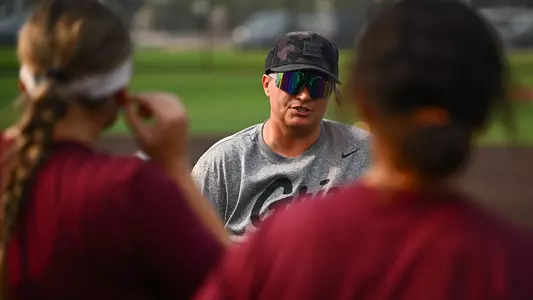
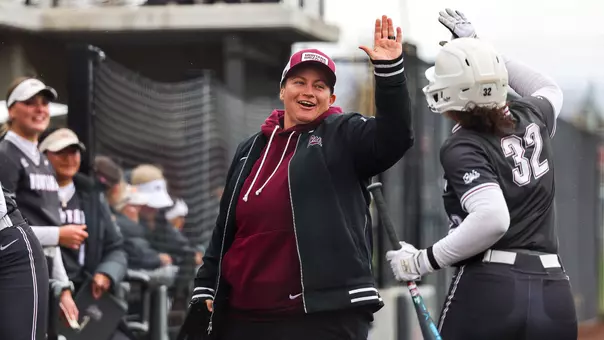
Photo by: Ryan Brennecke/ University of Mo
In Stef they trust
2/6/2025 5:53:00 PM | Softball
She came not wielding a sledge hammer, with the idea that she was going to tear the whole thing down and reassemble it from the ground up as she and she alone thought it should be done.
Rather, she arrived with arms as open as her ears, listening, then turning that into a plan of attack, more mender than martinet, a unifier, a servant-leader, intent not on rebuilding the Montana softball program as much as remaking it, not simply in the image she held but the one they did as well.
That's how she hooked Presley Jantzi, Montana's leading hitter a year ago, second-team All-Big Sky Conference for a program that won a single league game last spring.
It's a dicey position to be in, a returning senior with a new coach coming in who may want to invest more in young players than in those who only have one year left to give to the program, the coach's vision more focused on something years from now than on the season ahead, on what it can become given time, something Jantzi didn't have a lot of.
And now this new coach, her new coach for what was going to be her final year of collegiate softball, was on the phone and asking, what did she think needed to be changed? What did she like from previous years, what things did Jantzi think worked and what didn't?
It took her just minutes to realize she wasn't about to be cast off. Rather, valued in a big way. Stef Ewing's arms, even over the phone, were extended wide and Jantzi cozied right up.
"I was excited but also nervous (between the end of the season and the hiring of Ewing in late June). You don't know what you're walking into with only one year left," said Jantzi. "This is my last year to play the sport I love, so I hope I get somebody who loves it as much as I do and really wants to be here."
There are fits between coach and university, ones that make a person say, yeah, that person is exactly where she is supposed to be. Then there is Ewing and Montana, a beautiful union that came out of nowhere, from that day back in May when it was announced a Division I head coaching job was open.
She fell for it long before she was one of two finalists to interview on campus, through talking to people and doing her own research. Then she came to town, then she was here in the fall, hosting tailgates before home football games, more and more recruits to sway, before taking them onto the field.
This wasn't a sales job. This was Ewing saying, if you don't like this, all of it, if you don't want this as your college experience, I don't know what to tell you.
Former Montana soccer coach Betsy Duerksen used to take potential Grizzlies up into the Rattlesnake, knowing if that didn't win them over, maybe this wasn't the place for them.
Ewing had her own measuring stick. If the facilities, if the classic college campus, if Missoula, if western Montana, if the energy before kickoff and the thousands of fans who make their way to the stadium on home Saturdays didn't win the recruit over, maybe this wasn't the program for her.
"If we bring recruits on a fall weekend and they're meh, then they shouldn't be here," says Jantzi, who has friends on just about every other Big Sky team, most of them wishing they could be in her shoes.
"My friends love coming to Montana. They should be jealous that I don't just get to play softball at a cool place, I get to have a cool life in an amazing place. That's what made Stef fall in love with it, the facilities and the environment."
And now this coach, the one she had never heard of or met before, was on a phone call with Jantzi that was scheduled for 10 minutes but stretched well past 30.
"I was so open to change that it steered me away from being scared and turned it into excitement," says Jantzi, who went into the phone call ready to listen, not expecting to be engaged in a conversation about how they were going to make this thing right, not simply what Ewing, The Coach, was going to do.
"That's when I was almost instantly like, okay, she is going to click with us fast because she was so willing to hear from us, especially the seniors. She gave me an idea of, this is what I want to do. It made me latch on. I was ready for change, so whatever she was throwing at me was great."
Oh, to be able to go back to that first practice of the fall, with so many returners conditioned over one, two or three seasons prior to things being done a particular way, the communication happening as it did, the results – 19 Division I wins over the previous two years – showing it wasn't working.
Here was this coach, who they'd come to learn was a borderline Michelin-rated chef, who was fine sugar-coating things in her kitchen but never on the field. She was honest, direct, all of it packaged in a way that didn't push players away but instead motivated them to be the best versions of themselves. At least try. Her coaching came from what she saw in them and then tried to get out of them.
"It's her mentality that draws you in," says Jantzi. "When she came in it was like, I'm here to make you not just a better player but a better person. I think people latched onto that really quick.
"At practice, if you make a mistake, she comes up to you with ways to fix it, small things. She just has this mentality of, I'm here to win but I'm going to treat you as a person first, then I'm going to take that into softball. If you can do that, you're a better player."
What Ewing inherited was a way of playing softball at Montana that was broken, if not simply inefficient. The Grizzlies had the ability to pound the ball last season, a program-record 88 doubles, 122 extra-base hits, more than either of Montana's best seasons, of 2016 and '17.
But Jamie Pinkerton's 2016 team scored a program-record 322 runs, 119 more than last year's Montana team. The 2017 team scored 61 more runs. The former Griz coach knew that scoring one run per inning would win a 7-6 game every time against a team that relied on a pair of three-run home runs.
It wasn't small ball, it was smart ball. Get somebody on, advance the runner, put pressure on the defense. Create a bit of chaos, create a run here, a run there. All of a sudden, a team is ahead 4-1.
"Stef really encourages increasing the speed of the game and the quality of things," says Jantzi. "If you strike out but take eight or nine pitches, you can come in with good information to pass on to a teammate. She always wants quality at-bats out of you."
That extends to the defensive side of things, of pitchers limiting walks, of fielders making the right throw every time, all the time. "If you make a bad throw, she's going to let you know that wasn't up to her standard," and when players love a coach that much, there are no more motivating words. I think you can do better. I believe in you.
If Ewing's arrival sparked a program rebirth, it's Montana's new indoor practice facility, large enough for the Grizzlies to have scrimmaged inside three times last weekend, that has allowed the thing to burn on at a high intensity through the winter, the harshest of which has hit just recently.
Montana Tough looks great on a t-shirt but it doesn't help in making a slick 9-to-4-to-5 relay to gun down a runner trying to stretch a double into a triple on the opening weekend of games. The Grizzlies have never been more prepared for the opening weekend of February.
"I usually didn't see the ball in the air through the first two weeks of practice," says Jantzi, Montana's right-fielder. "When we'd go on our first trip, I'd taken maybe 10 fly balls." Now she can take as many as she wants. Imagine that.
They're comfortable and practicing at a higher level because of it, all of them at the same time instead of practicing in shifts at the smaller indoor hitting facility, where practices used to be shoehorned when the weather required it.
"I don't wear sleeves to practice because we're warm," says Jantzi. "There have been fewer injuries. It feels like a full softball field inside of a dome. It gives us the same advantage as teams who have sunshine.
"It's built us up as a team as well. We didn't used to get to do team defense (unless Grizzly Softball Field was clear of snow). The bubble has allowed us to be together and practice as a unit. It's really brought us together and helped us develop because we get to see things we normally didn't get to see in winter."
One other thing Ewing gets: when you're a team up north and are traveling extensively through the first five or six weekends of the season, maintaining energy and enthusiasm and excitement for the games ahead is more mission critical than getting in that third hour of practice on a cold January afternoon.
Get in, get it done, get out. Then rest and recover and keep everything else in your life locked in. Remove the stress.
"She slims things down while keeping the quality high," says Jantzi. "We haven't had three-hour practices this season. We have an hour and a half filled with all good stuff. We get out and go."
For all of Jantzi's excitement about the season to come, there is still a ticking clock over her head, over the seniors' heads. Tick-tock. Tick-tock. Oh, that she was a junior and had two more seasons of this. Or a sophomore with three. Or a freshman with four.
Ewing is building something and they are all on the ground floor. Jantzi and her senior teammates are only going to be able to take this thing so far before they have to turn in their uniforms for the final time, knowing bigger and better things are on the horizon, after they're gone.
"I've taken the approach, as long as we're having fun and good results come within the game, then I'm satisfied with that. As long as we're making improvements, that's all I'm looking for," she says.
At some point down the road, in a season ahead, Ewing would look at this weekend's GCU Kickoff Classic as five games she wants to win. Building that type of team will take time. This year it's just, get a little bit better today, get a little bit better today, get a little bit better today, the focus on April and Big Sky play.
If April and May of seasons past have taught us anything about Big Sky softball, it's that the team that's playing the best at that time of the year is the team that wins, no matter what their results from February and March reveal.
"She said, I want to look back after each of our games and see that we made one step toward being better, one step closer to winning a Big Sky Conference championship," says Jantzi. "She's more end-game. She wants our best softball to begin in April. This preseason is a step to get us prepped."
If Montana were to beat American Athletic Conference favorite Wichita State on Saturday in Phoenix? That would be pretty awesome. But you know what would be even sweeter? Opening league play by going to Big Sky favorite Northern Colorado and winning two of three. Heck, make it a sweep.
By that time, the growth process would have mostly been navigated. The Grizzlies will be who the Grizzlies will be.
"This team has a different purpose," says Jantzi, meaning all eyes on April and early May. "Stef always talks about the road to success. What steps can we take? Conference is when you want to win and you're done with the stepping stones."
It will likely be Montana teams not yet constructed that will win 40 games for the first time in program history, will win an NCAA tournament game or two for the first time. Jantzi will be gone by then but never forgotten, not with what they've done and will do in the months ahead.
"Being a senior and starting fresh is hard, but people are going to look back and say, that was the first class that embraced those new ideas, then put those onto the younger players," says Jantzi. "We have something to prove and a new team to show, not just a new coaching staff. We're going to play ball differently than we have in the past.
"It's hard to realize I'm about to be done, but I'm glad I'm able to experience something different, a different type of energy. I'm hoping that translates for years and years with Stef." Is there any doubt?
Rather, she arrived with arms as open as her ears, listening, then turning that into a plan of attack, more mender than martinet, a unifier, a servant-leader, intent not on rebuilding the Montana softball program as much as remaking it, not simply in the image she held but the one they did as well.
That's how she hooked Presley Jantzi, Montana's leading hitter a year ago, second-team All-Big Sky Conference for a program that won a single league game last spring.
It's a dicey position to be in, a returning senior with a new coach coming in who may want to invest more in young players than in those who only have one year left to give to the program, the coach's vision more focused on something years from now than on the season ahead, on what it can become given time, something Jantzi didn't have a lot of.
And now this new coach, her new coach for what was going to be her final year of collegiate softball, was on the phone and asking, what did she think needed to be changed? What did she like from previous years, what things did Jantzi think worked and what didn't?
It took her just minutes to realize she wasn't about to be cast off. Rather, valued in a big way. Stef Ewing's arms, even over the phone, were extended wide and Jantzi cozied right up.
"I was excited but also nervous (between the end of the season and the hiring of Ewing in late June). You don't know what you're walking into with only one year left," said Jantzi. "This is my last year to play the sport I love, so I hope I get somebody who loves it as much as I do and really wants to be here."
There are fits between coach and university, ones that make a person say, yeah, that person is exactly where she is supposed to be. Then there is Ewing and Montana, a beautiful union that came out of nowhere, from that day back in May when it was announced a Division I head coaching job was open.
She fell for it long before she was one of two finalists to interview on campus, through talking to people and doing her own research. Then she came to town, then she was here in the fall, hosting tailgates before home football games, more and more recruits to sway, before taking them onto the field.
This wasn't a sales job. This was Ewing saying, if you don't like this, all of it, if you don't want this as your college experience, I don't know what to tell you.
Former Montana soccer coach Betsy Duerksen used to take potential Grizzlies up into the Rattlesnake, knowing if that didn't win them over, maybe this wasn't the place for them.
Ewing had her own measuring stick. If the facilities, if the classic college campus, if Missoula, if western Montana, if the energy before kickoff and the thousands of fans who make their way to the stadium on home Saturdays didn't win the recruit over, maybe this wasn't the program for her.
"If we bring recruits on a fall weekend and they're meh, then they shouldn't be here," says Jantzi, who has friends on just about every other Big Sky team, most of them wishing they could be in her shoes.
"My friends love coming to Montana. They should be jealous that I don't just get to play softball at a cool place, I get to have a cool life in an amazing place. That's what made Stef fall in love with it, the facilities and the environment."
And now this coach, the one she had never heard of or met before, was on a phone call with Jantzi that was scheduled for 10 minutes but stretched well past 30.
"I was so open to change that it steered me away from being scared and turned it into excitement," says Jantzi, who went into the phone call ready to listen, not expecting to be engaged in a conversation about how they were going to make this thing right, not simply what Ewing, The Coach, was going to do.
"That's when I was almost instantly like, okay, she is going to click with us fast because she was so willing to hear from us, especially the seniors. She gave me an idea of, this is what I want to do. It made me latch on. I was ready for change, so whatever she was throwing at me was great."
Oh, to be able to go back to that first practice of the fall, with so many returners conditioned over one, two or three seasons prior to things being done a particular way, the communication happening as it did, the results – 19 Division I wins over the previous two years – showing it wasn't working.
Here was this coach, who they'd come to learn was a borderline Michelin-rated chef, who was fine sugar-coating things in her kitchen but never on the field. She was honest, direct, all of it packaged in a way that didn't push players away but instead motivated them to be the best versions of themselves. At least try. Her coaching came from what she saw in them and then tried to get out of them.
"It's her mentality that draws you in," says Jantzi. "When she came in it was like, I'm here to make you not just a better player but a better person. I think people latched onto that really quick.
"At practice, if you make a mistake, she comes up to you with ways to fix it, small things. She just has this mentality of, I'm here to win but I'm going to treat you as a person first, then I'm going to take that into softball. If you can do that, you're a better player."
What Ewing inherited was a way of playing softball at Montana that was broken, if not simply inefficient. The Grizzlies had the ability to pound the ball last season, a program-record 88 doubles, 122 extra-base hits, more than either of Montana's best seasons, of 2016 and '17.
But Jamie Pinkerton's 2016 team scored a program-record 322 runs, 119 more than last year's Montana team. The 2017 team scored 61 more runs. The former Griz coach knew that scoring one run per inning would win a 7-6 game every time against a team that relied on a pair of three-run home runs.
It wasn't small ball, it was smart ball. Get somebody on, advance the runner, put pressure on the defense. Create a bit of chaos, create a run here, a run there. All of a sudden, a team is ahead 4-1.
"Stef really encourages increasing the speed of the game and the quality of things," says Jantzi. "If you strike out but take eight or nine pitches, you can come in with good information to pass on to a teammate. She always wants quality at-bats out of you."
That extends to the defensive side of things, of pitchers limiting walks, of fielders making the right throw every time, all the time. "If you make a bad throw, she's going to let you know that wasn't up to her standard," and when players love a coach that much, there are no more motivating words. I think you can do better. I believe in you.
If Ewing's arrival sparked a program rebirth, it's Montana's new indoor practice facility, large enough for the Grizzlies to have scrimmaged inside three times last weekend, that has allowed the thing to burn on at a high intensity through the winter, the harshest of which has hit just recently.
Montana Tough looks great on a t-shirt but it doesn't help in making a slick 9-to-4-to-5 relay to gun down a runner trying to stretch a double into a triple on the opening weekend of games. The Grizzlies have never been more prepared for the opening weekend of February.
"I usually didn't see the ball in the air through the first two weeks of practice," says Jantzi, Montana's right-fielder. "When we'd go on our first trip, I'd taken maybe 10 fly balls." Now she can take as many as she wants. Imagine that.
They're comfortable and practicing at a higher level because of it, all of them at the same time instead of practicing in shifts at the smaller indoor hitting facility, where practices used to be shoehorned when the weather required it.
"I don't wear sleeves to practice because we're warm," says Jantzi. "There have been fewer injuries. It feels like a full softball field inside of a dome. It gives us the same advantage as teams who have sunshine.
"It's built us up as a team as well. We didn't used to get to do team defense (unless Grizzly Softball Field was clear of snow). The bubble has allowed us to be together and practice as a unit. It's really brought us together and helped us develop because we get to see things we normally didn't get to see in winter."
One other thing Ewing gets: when you're a team up north and are traveling extensively through the first five or six weekends of the season, maintaining energy and enthusiasm and excitement for the games ahead is more mission critical than getting in that third hour of practice on a cold January afternoon.
Get in, get it done, get out. Then rest and recover and keep everything else in your life locked in. Remove the stress.
"She slims things down while keeping the quality high," says Jantzi. "We haven't had three-hour practices this season. We have an hour and a half filled with all good stuff. We get out and go."
For all of Jantzi's excitement about the season to come, there is still a ticking clock over her head, over the seniors' heads. Tick-tock. Tick-tock. Oh, that she was a junior and had two more seasons of this. Or a sophomore with three. Or a freshman with four.
Ewing is building something and they are all on the ground floor. Jantzi and her senior teammates are only going to be able to take this thing so far before they have to turn in their uniforms for the final time, knowing bigger and better things are on the horizon, after they're gone.
"I've taken the approach, as long as we're having fun and good results come within the game, then I'm satisfied with that. As long as we're making improvements, that's all I'm looking for," she says.
At some point down the road, in a season ahead, Ewing would look at this weekend's GCU Kickoff Classic as five games she wants to win. Building that type of team will take time. This year it's just, get a little bit better today, get a little bit better today, get a little bit better today, the focus on April and Big Sky play.
If April and May of seasons past have taught us anything about Big Sky softball, it's that the team that's playing the best at that time of the year is the team that wins, no matter what their results from February and March reveal.
"She said, I want to look back after each of our games and see that we made one step toward being better, one step closer to winning a Big Sky Conference championship," says Jantzi. "She's more end-game. She wants our best softball to begin in April. This preseason is a step to get us prepped."
If Montana were to beat American Athletic Conference favorite Wichita State on Saturday in Phoenix? That would be pretty awesome. But you know what would be even sweeter? Opening league play by going to Big Sky favorite Northern Colorado and winning two of three. Heck, make it a sweep.
By that time, the growth process would have mostly been navigated. The Grizzlies will be who the Grizzlies will be.
"This team has a different purpose," says Jantzi, meaning all eyes on April and early May. "Stef always talks about the road to success. What steps can we take? Conference is when you want to win and you're done with the stepping stones."
It will likely be Montana teams not yet constructed that will win 40 games for the first time in program history, will win an NCAA tournament game or two for the first time. Jantzi will be gone by then but never forgotten, not with what they've done and will do in the months ahead.
"Being a senior and starting fresh is hard, but people are going to look back and say, that was the first class that embraced those new ideas, then put those onto the younger players," says Jantzi. "We have something to prove and a new team to show, not just a new coaching staff. We're going to play ball differently than we have in the past.
"It's hard to realize I'm about to be done, but I'm glad I'm able to experience something different, a different type of energy. I'm hoping that translates for years and years with Stef." Is there any doubt?
Players Mentioned
OF
/ SoftballGriz Softball vs. Seattle Highlights - 3/24/26
Monday, March 30
2026 Griz Softball Hype Video
Monday, March 30
2006 Griz Basketball Flashback: NCAA Tournament Win Over Nevada
Monday, March 30
Name The Person: Griz Basketball
Monday, March 30