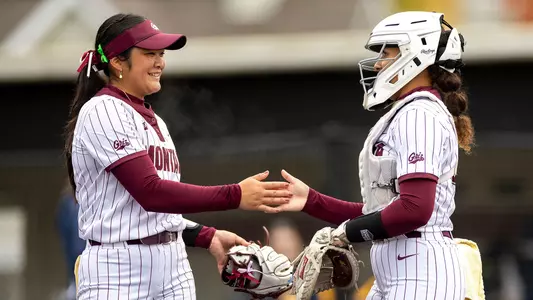
Photo by: Marley Barboeisel/University of
Fresh faces, strong arms: Kong leads new-look staff
1/23/2026 5:13:00 PM | Softball
It wasn't the role she necessarily came here for, but sometimes the role finds the person instead of the other way around.
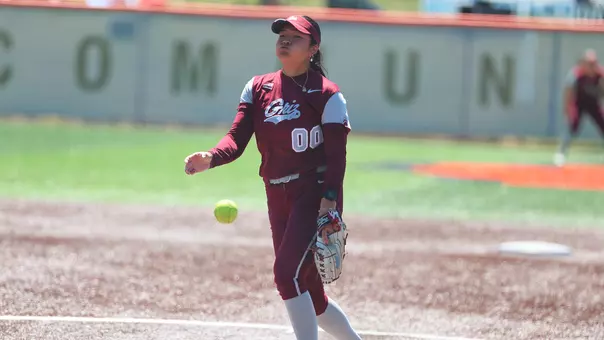
Junior Kaiana Kong is uniquely qualified to be the leader of this year's Montana pitching staff, the talented group's only upperclassman, who went 31-3 over two seasons with a 1.42 ERA at Western Washington as the Vikings made a pair of NCAA Division II World Series appearances.
But her position within the group, the one that has everyone else in the bullpen looking her direction for leadership, isn't based so much on experience and resume as it is on the characteristics Kong brought from her hometown of Ewa Beach, Hawaii, to Western Washington, now to Missoula.
"When you have someone like Kong in the bullpen, who comes every day ready to work and holds herself to such a high standard, it makes everybody else in the bullpen immediately better," said coach Stef Ewing, whose team opens the season in less than two weeks, against Saint Louis in San Diego.
"The way she goes about what she does every single day has elevated everybody in the bullpen."
It's partly a testament to her home, meaning Hawaii, but mostly a nod to her parents, Thomas and Noreen, the former a member of the Honolulu Police Department, the latter a teacher at the kindergarten level.
"It's kind of a Hawaiian thing," she says. "Let's put our head down and go to work every day. Success comes to the people who work the hardest and who have good hearts. That's how I grew up."
Her dad emphasized to Kong and her older brother the Big 3: Hard work, hard work and hard work, in no particular order. It was her mom's touch that gave Kong that magnetic quality, the one that has her teammates naturally gravitating toward her.
"My mom taught me more relationship skills," Kong says. "Building relationships with teammates, finding the people that mean the most to you and sticking by their side, being dependable and someone they can lean on. It's a good mix for me."
That's how the role found her, of leading a staff that includes fellow transfer Carah Sweet, a sophomore who pitched last season at Sacred Heart, sophomore Cameryn Ortega, the only player on this year's team who pitched a year ago for the Grizzlies, and freshmen Brooklynn Braun and Audri Elias.
Kong has yet to throw a Division I pitch, has yet to play a regular-season game for the Grizzlies but she'll be looked to and counted on as Montana goes into Year 2 under Ewing.
"I feel like I have that epiphany every day," said Kong. "Being able to lead a bullpen is something I've always dreamed of, especially at the Division I level. It's super nice getting to experience this with all of them."
She played club softball growing up, skipped the part where she joined a travel-ball team based on the mainland, so she was off the radar both because of her home state and because any trips her team did make were to lesser-viewed tournaments, not the showcases that are on every college coach's calendar.
And she admits she wasn't a star pitcher at the time anyway. "I don't think my talent was as good as it evolved during my collegiate career," she says. Her college of choice, then, came down to "finding family and team chemistry." Western Washington it was.
She and the Vikings won 52 games when she was a freshman, Western Washington getting past Cal State San Marcos 2-1 in the West Regional final, Kong getting the save against the last of Ewing's San Marcos teams before she accepted the job at Montana.
"I saw how she was able to make teams super successful, the rebirth of a program and a program going in a different direction, see places it's never seen," said Kong, who was honorable mention All-American as a freshman.
"There was a little thought in the back of my mind, hey, maybe I can use this as a stepping stone," but she remained a Viking, went 15-2 last season as a sophomore as Western Washington again made the World Series.
"After my second year, I had a change of heart. Maybe I could level myself up. I wanted more purpose, which for me is playing for a bigger community and Montana has that, with Missoula and the Griz."
Kong had a 1.44 ERA last season. Montana's was 7.88, 294th out of 300 Division I teams on the national scale, which had Ewing and pitching coach Megan Casper setting up a war room in Ewing's home when the portal opened after the season. All they had on their minds was pitching, pitching, pitching.
"You don't have a successful season in this sport unless you have pitching," said Ewing, so every time they hit refresh – Casper on her computer, Ewing on hers, with an iPad off to the side – and saw the name of another pitcher, they got to work, hunting for clips, doing research, making phone calls.
They would put a video up on the home's television and go through a multiple choice. Was this pitcher a yes? A no? A maybe? "We're in the position we're in now because of the amount of work that was put in," said Ewing. Casper adds: "We had to do that. There was no other option."
Neither wanted to go through what they did last season, of having to go to position players to find depth for the circle, of having one player – Siona Halwani – being the pitcher of record in seven of the team's first 10 games, which toasted her for the rest of the season.
A staff – and by extension, a team – is only as good as the options it has in the circle. The more the better. Because of injury and lack of depth, the Grizzlies last season had limited buttons they could push.
"Last year we could sit (in the office) and scout for hours but there were only so many pitches that worked last year on our staff," said Casper. "I know this batter can't hit this pitch, but we don't have anybody who can throw that pitch. We were kind of handcuffed.
"It doesn't matter if you have all the information in the world if you don't have the tools to execute it. Now we have the tools where we're going to be able to exploit batters with the information we have, which feels really cool."
"We're going to be able to go into a series and say, this is the profile we need to throw to for this game, so these are our pitchers who are going to match up best," said Ewing. "We were never able to do any type of match-ups last year. Information in the circle is power. That's what makes it exciting."
Braun and Elias were already signed but Montana needed more from the portal, more experience, more arms, more variety in the pitchers' strengths. When Ewing signed Kong and Sweet, the direction of the program changed dramatically.
"I had a call with Coach Megan and our personalities mixed really well," said Kong. "Then coming here and seeing what Coach Stef wants to do with the program really interested me."
In Montana's first day of fall games, Kong and Braun combined to strike out eight in a win. Later that day, Elias and Sweet struck out nine while throwing a two-hitter. Two games, no hit-by-pitches, no wild pitches, just three runs allowed over 14 innings, an average of fewer than four pitches per batter.
Later in October, Kong set down the first 15 batters she faced against North Idaho before allowing her only hit, a single up the middle to lead off the top of the sixth.
"I think you saw a glimpse of it in the fall, where we could get out of situations. The walk-to-strikeout ratio, the lack of hit-by-pitches, things that really stacked the deck against us last year," said Ewing, whose team had a 2.24 WHIP in 2025.
"Quick innings is a big deal. The longer the defense is out there, the more likely it is they are going to fall asleep. It doesn't set you up to have quality innings. This fall we had a ton of quality innings. We got out of situations."
Casper was new to this last year, a full-time Division I pitching coach, not that long removed from pitching collegiately herself. While some people may be born to coach, all of them need seasoning that only comes from time in the profession.
"I'm more confident in myself and my decisions based on what I see," she says. "The pitches I'm calling, planning bullpens, telling Stef what I think the pitchers need.
"I don't get as shook up about things going wrong. I'm more consistent and not afraid to tell them the hard truth anymore. I used to be uncomfortable doing that but it doesn't do anyone any good to hold back. I'm more secure in what I'm doing."
Montana's staff threw exactly 5,600 pitches last season, an average of nearly 20 per inning. The Grizzlies walked 178 batters, hit 45 and gave up 80 home runs, 21 more than any other team in program history. The entire season was labored.
"We use the term 'snooze pitch.' The hitter didn't even have to honor it because it was so obviously out of the zone. We threw so many snooze pitches last year that when we did finally throw something over the plate, it looked this big," says Ewing, her hands holding an imaginary beach ball.
"We were searching for anything last year that could keep us in a game. It felt like scramble mode. Those are old worries."
This year there may be two outs by the time you settle back into your seat after a between-innings stretch.
"Last year we tried to nick a corner and it was ball, ball, ball, ball, ball," said Ewing. "This year we are not messing around with attacking hitters and going after the zone. It's trusting your stuff to throw it through the zone instead of around the zone. It's a big thing, that attack mindset."
Montana got through last year by simplifying things, pitching to one side of the plate or the other. Now Ewing uses terms like quadrants, levels, planes, mixing speeds. "It's really nice," she said.
"We can go hard and down and off-speed with Kong, then you can complement that with Carah, who's really spin-y. You couldn't have two more different looks for hitters."
Ortega got thrown into the deep end as a freshman last season, getting the start in Montana's second game of the season, not ideal no matter how talented the player is. Now comes the payoff, that trial by fire speeding up the development process. No one threw more pitches for the Grizzlies last year.
"You talk about development and how much you grow, Cam has matured three years in one year. Now it's like having a senior in the bullpen," said Ewing. "She looks good and is throwing with confidence."
Braun and Elias? They won't have to go through quite the same things as freshmen, though they are good enough that Ewing will get them innings when the season opens early next month at the UC San Diego La Jolla Invitational.
"We're going to be able to do so much more with this year's staff, with the way we throw pitches and the locations we call," said Ewing. "When we game-plan on how we're going to attack a hitter, our pitchers can handle it. Our ability to execute is way better."
Last year was survival mode. Get through the opening-day doubleheader. Get through opening weekend. Get through February, the non-conference. It had Montana's staff running on empty by the time Big Sky games arrived.
Ewing will go to San Diego next month with five healthy pitchers, which she can use not just to try to win games in February but to space out appearances, to monitor pitch counts, all to best position the team to be competitive come late March, April and the Big Sky tournament in early May.
That's when you'll feel the power of Kong, likely the starting pitcher in two of three games in a league series, giving off the vibe that Montana had when Michaela Hood strode to the circle, Tristin Achenbach, the anticipation that a quality start, maybe even something special, was at hand.
"Whenever she's in the circle, we will have a chance to win," said Ewing of Kong. "We could never say that last year." And that power of belief will trickle down to her teammates. It already has. "The whole team believes it, too," added Casper.
Junior Kaiana Kong is uniquely qualified to be the leader of this year's Montana pitching staff, the talented group's only upperclassman, who went 31-3 over two seasons with a 1.42 ERA at Western Washington as the Vikings made a pair of NCAA Division II World Series appearances.
But her position within the group, the one that has everyone else in the bullpen looking her direction for leadership, isn't based so much on experience and resume as it is on the characteristics Kong brought from her hometown of Ewa Beach, Hawaii, to Western Washington, now to Missoula.
"When you have someone like Kong in the bullpen, who comes every day ready to work and holds herself to such a high standard, it makes everybody else in the bullpen immediately better," said coach Stef Ewing, whose team opens the season in less than two weeks, against Saint Louis in San Diego.
"The way she goes about what she does every single day has elevated everybody in the bullpen."
It's partly a testament to her home, meaning Hawaii, but mostly a nod to her parents, Thomas and Noreen, the former a member of the Honolulu Police Department, the latter a teacher at the kindergarten level.
"It's kind of a Hawaiian thing," she says. "Let's put our head down and go to work every day. Success comes to the people who work the hardest and who have good hearts. That's how I grew up."
Her dad emphasized to Kong and her older brother the Big 3: Hard work, hard work and hard work, in no particular order. It was her mom's touch that gave Kong that magnetic quality, the one that has her teammates naturally gravitating toward her.
"My mom taught me more relationship skills," Kong says. "Building relationships with teammates, finding the people that mean the most to you and sticking by their side, being dependable and someone they can lean on. It's a good mix for me."
That's how the role found her, of leading a staff that includes fellow transfer Carah Sweet, a sophomore who pitched last season at Sacred Heart, sophomore Cameryn Ortega, the only player on this year's team who pitched a year ago for the Grizzlies, and freshmen Brooklynn Braun and Audri Elias.
Kong has yet to throw a Division I pitch, has yet to play a regular-season game for the Grizzlies but she'll be looked to and counted on as Montana goes into Year 2 under Ewing.
"I feel like I have that epiphany every day," said Kong. "Being able to lead a bullpen is something I've always dreamed of, especially at the Division I level. It's super nice getting to experience this with all of them."
She played club softball growing up, skipped the part where she joined a travel-ball team based on the mainland, so she was off the radar both because of her home state and because any trips her team did make were to lesser-viewed tournaments, not the showcases that are on every college coach's calendar.
And she admits she wasn't a star pitcher at the time anyway. "I don't think my talent was as good as it evolved during my collegiate career," she says. Her college of choice, then, came down to "finding family and team chemistry." Western Washington it was.
She and the Vikings won 52 games when she was a freshman, Western Washington getting past Cal State San Marcos 2-1 in the West Regional final, Kong getting the save against the last of Ewing's San Marcos teams before she accepted the job at Montana.
"I saw how she was able to make teams super successful, the rebirth of a program and a program going in a different direction, see places it's never seen," said Kong, who was honorable mention All-American as a freshman.
"There was a little thought in the back of my mind, hey, maybe I can use this as a stepping stone," but she remained a Viking, went 15-2 last season as a sophomore as Western Washington again made the World Series.
"After my second year, I had a change of heart. Maybe I could level myself up. I wanted more purpose, which for me is playing for a bigger community and Montana has that, with Missoula and the Griz."
Kong had a 1.44 ERA last season. Montana's was 7.88, 294th out of 300 Division I teams on the national scale, which had Ewing and pitching coach Megan Casper setting up a war room in Ewing's home when the portal opened after the season. All they had on their minds was pitching, pitching, pitching.
"You don't have a successful season in this sport unless you have pitching," said Ewing, so every time they hit refresh – Casper on her computer, Ewing on hers, with an iPad off to the side – and saw the name of another pitcher, they got to work, hunting for clips, doing research, making phone calls.
They would put a video up on the home's television and go through a multiple choice. Was this pitcher a yes? A no? A maybe? "We're in the position we're in now because of the amount of work that was put in," said Ewing. Casper adds: "We had to do that. There was no other option."
Neither wanted to go through what they did last season, of having to go to position players to find depth for the circle, of having one player – Siona Halwani – being the pitcher of record in seven of the team's first 10 games, which toasted her for the rest of the season.
A staff – and by extension, a team – is only as good as the options it has in the circle. The more the better. Because of injury and lack of depth, the Grizzlies last season had limited buttons they could push.
"Last year we could sit (in the office) and scout for hours but there were only so many pitches that worked last year on our staff," said Casper. "I know this batter can't hit this pitch, but we don't have anybody who can throw that pitch. We were kind of handcuffed.
"It doesn't matter if you have all the information in the world if you don't have the tools to execute it. Now we have the tools where we're going to be able to exploit batters with the information we have, which feels really cool."
"We're going to be able to go into a series and say, this is the profile we need to throw to for this game, so these are our pitchers who are going to match up best," said Ewing. "We were never able to do any type of match-ups last year. Information in the circle is power. That's what makes it exciting."
Braun and Elias were already signed but Montana needed more from the portal, more experience, more arms, more variety in the pitchers' strengths. When Ewing signed Kong and Sweet, the direction of the program changed dramatically.
"I had a call with Coach Megan and our personalities mixed really well," said Kong. "Then coming here and seeing what Coach Stef wants to do with the program really interested me."
In Montana's first day of fall games, Kong and Braun combined to strike out eight in a win. Later that day, Elias and Sweet struck out nine while throwing a two-hitter. Two games, no hit-by-pitches, no wild pitches, just three runs allowed over 14 innings, an average of fewer than four pitches per batter.
Later in October, Kong set down the first 15 batters she faced against North Idaho before allowing her only hit, a single up the middle to lead off the top of the sixth.
"I think you saw a glimpse of it in the fall, where we could get out of situations. The walk-to-strikeout ratio, the lack of hit-by-pitches, things that really stacked the deck against us last year," said Ewing, whose team had a 2.24 WHIP in 2025.
"Quick innings is a big deal. The longer the defense is out there, the more likely it is they are going to fall asleep. It doesn't set you up to have quality innings. This fall we had a ton of quality innings. We got out of situations."
Casper was new to this last year, a full-time Division I pitching coach, not that long removed from pitching collegiately herself. While some people may be born to coach, all of them need seasoning that only comes from time in the profession.
"I'm more confident in myself and my decisions based on what I see," she says. "The pitches I'm calling, planning bullpens, telling Stef what I think the pitchers need.
"I don't get as shook up about things going wrong. I'm more consistent and not afraid to tell them the hard truth anymore. I used to be uncomfortable doing that but it doesn't do anyone any good to hold back. I'm more secure in what I'm doing."
Montana's staff threw exactly 5,600 pitches last season, an average of nearly 20 per inning. The Grizzlies walked 178 batters, hit 45 and gave up 80 home runs, 21 more than any other team in program history. The entire season was labored.
"We use the term 'snooze pitch.' The hitter didn't even have to honor it because it was so obviously out of the zone. We threw so many snooze pitches last year that when we did finally throw something over the plate, it looked this big," says Ewing, her hands holding an imaginary beach ball.
"We were searching for anything last year that could keep us in a game. It felt like scramble mode. Those are old worries."
This year there may be two outs by the time you settle back into your seat after a between-innings stretch.
"Last year we tried to nick a corner and it was ball, ball, ball, ball, ball," said Ewing. "This year we are not messing around with attacking hitters and going after the zone. It's trusting your stuff to throw it through the zone instead of around the zone. It's a big thing, that attack mindset."
Montana got through last year by simplifying things, pitching to one side of the plate or the other. Now Ewing uses terms like quadrants, levels, planes, mixing speeds. "It's really nice," she said.
"We can go hard and down and off-speed with Kong, then you can complement that with Carah, who's really spin-y. You couldn't have two more different looks for hitters."
Ortega got thrown into the deep end as a freshman last season, getting the start in Montana's second game of the season, not ideal no matter how talented the player is. Now comes the payoff, that trial by fire speeding up the development process. No one threw more pitches for the Grizzlies last year.
"You talk about development and how much you grow, Cam has matured three years in one year. Now it's like having a senior in the bullpen," said Ewing. "She looks good and is throwing with confidence."
Braun and Elias? They won't have to go through quite the same things as freshmen, though they are good enough that Ewing will get them innings when the season opens early next month at the UC San Diego La Jolla Invitational.
"We're going to be able to do so much more with this year's staff, with the way we throw pitches and the locations we call," said Ewing. "When we game-plan on how we're going to attack a hitter, our pitchers can handle it. Our ability to execute is way better."
Last year was survival mode. Get through the opening-day doubleheader. Get through opening weekend. Get through February, the non-conference. It had Montana's staff running on empty by the time Big Sky games arrived.
Ewing will go to San Diego next month with five healthy pitchers, which she can use not just to try to win games in February but to space out appearances, to monitor pitch counts, all to best position the team to be competitive come late March, April and the Big Sky tournament in early May.
That's when you'll feel the power of Kong, likely the starting pitcher in two of three games in a league series, giving off the vibe that Montana had when Michaela Hood strode to the circle, Tristin Achenbach, the anticipation that a quality start, maybe even something special, was at hand.
"Whenever she's in the circle, we will have a chance to win," said Ewing of Kong. "We could never say that last year." And that power of belief will trickle down to her teammates. It already has. "The whole team believes it, too," added Casper.
Players Mentioned
P
/ Softball
P
/ Softball
P
/ Softball
P
/ Softball
P
/ Softball
P
/ SoftballLady Griz Basketball Locker Room Unveiling - 5/1/26
Friday, May 01
Griz Track & Field - Montana Open Highlights - 4/25/26
Friday, May 01
Griz Softball vs. Idaho State Game-Winning Hit - 3/25/26
Friday, May 01
Griz Softball Championship Series Promo
Friday, May 01