11/3/2026 1:49:00 PM | Women's Basketball
He knew that once he left the stadium, once he helped close down the bar, once he made the joyous did-that-really-happen? walk back to his hotel room and once he finally closed his eyes and fell asleep, the moment would be done, gone, never to feel quite the same way ever again.
That's why Ace Sauerwein, better known to you as the play-by-play voice of the Lady Griz basketball team, did everything he could to keep the moment alive, to make it last as long as possible.
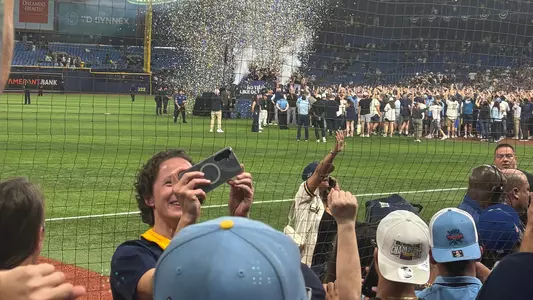
After the Milwaukee Brewers – his Milwaukee Brewers – won the World Series title last week, their first, Sauerwein, who was in attendance for Games 4 and 5 at Tropicana Field in St. Petersburg, watched the trophy presentation from atop a table at the stadium's ultra-exclusive Left Field Ledge party area.
Rays fans had long since abandoned the area, turning the stadium over to the thousands of Brewers faithful who came, who saw their team conquer, who then celebrated like people do who wonder if a World Series championship will ever happen in their lifetimes.
They celebrated for themselves, for those who couldn't be there but were doing the same thing in living rooms across Wisconsin, for family and friends passed on, whose lives came to an end before the one thing they had long hoped for had finally happened, had finally came true.
With the team now in the locker room but with people mingling, just because they didn't want to leave, Sauerwein returned to his seat and called everyone who mattered to him, his dad, his mom, his best friends from high school, his girlfriend, tears on both ends because, you know, that's sports.
"I made all the calls to people I couldn't watch it with, just to say, holy crap, we did it," Sauerwein said after he returned home to Missoula.
He followed fellow fans to a bar across the street from Tropicana Field, total strangers in everyday life now connected on a unique level, of shared victory, of memories of forgettable seasons, of those that ended in heartbreak in the postseason, now forgotten.
They were champions, the team, the fans, hugs, high-fives, a high nobody needed anything from the bar to reach. "I don't know what else but sports really does that," he said.
Finally, 2:30 a.m., closing time, and that walk back to the hotel on a night that couldn't have been more perfect, then a deep, contented sleep that went right through his alarm, a missed flight home, maybe knowing that once he awoke, it would be a new day and who would ever want the last one to end?
He was born in Red Wing, in Minnesota, the width of the Mississippi River from Wisconsin, raised in River Falls, now on the Wisconsin side but still just 40-some miles from Minneapolis and St. Paul, home of the Twins, the Vikings, the Timberwolves, the Wild.
But his sporting North Star always shone from the southeast, above Green Bay every winter, above Milwaukee during the summer months, his baseball fandom passed down from his great-grandmother, to her daughter, to her daughter, to Sauerwein, Bob Uecker the radio voice that connected generations.
"He's a huge reason I got into play-by-play," says Sauerwein, who is going into his fifth season calling Lady Griz games.
The 1982 Brewers team made the World Series, lost in seven games, but that was more than a decade before Sauerwein was born. They teased him in his teens and into his 20s, winning National League Central Division titles in 2011, '18, '21, '23, '24 and '25.
He wanted it badly last year, even went to Milwaukee for Games 1 and 2 of the Brewers' National League Championship Series against the Dodgers, only to watch as his team put up one run in both games en route to being swept in four games.
But true fandom means you keep coming back for more, keep believing this is the year, that this would finally be the fall when it wasn't someone else. Instead it would be you.
They won 103 games during the regular season, more than any other Major League team, survived a tense Divisional Series against the Padres, three wins coming by a margin of four runs, to set up a rematch against those same Dodgers, the reigning World Series champions.
Los Angeles had the money, Milwaukee had the mojo, the right stuff facilitated by manager Pat Murphy, who took the unusual route to World Series champion by coaching for more than two decades at the college level, first at Notre Dame, then at Arizona State.
"You have to be a certain type of player to play for Murph and to play here," longtime Brewer Christian Yelich said in August.
The coach, largely at odds with most of his MLB peers, preaches connection between teammates, group over individual, a college approach most wouldn't think would work at the professional level. "It had to be the right recipe of players who would take to a coach like that," says Sauerwein.
Against the Dodgers and to the delight of most of a country that loves to jeer Goliath, the Brewers proved to be unbreakable, unfazable, relentless with a colorful cast of characters, blue-collar brothers of those '82 Brewers, who gave a city down on its luck something to rally around.
They trailed against the Dodgers in Game 1. Didn't matter. They trailed in Game 2. Didn't matter. They trailed in Game 3. Didn't matter. Fell behind 4-0 in Game 4. Didn't matter. One team looked washed, the other like a team of destiny. Milwaukee won four games to none.
And in Missoula, Ace Sauerwein thought, I have to be there if they win it all. "I don't care how it's going to unfold, I had to go. It might be another 44 years. I might not be able to experience it again. Maybe it won't happen again."
He had an uncle who passed away in December, big Brewers fan, childless, some of the inheritance trickling down to Sauerwein, who could have used that money for anything. He chose to invest in the potential memory of a lifetime. "He would have wanted me to go," he said of his late uncle.
He and a friend put down $3,100 per ticket but refundable if the World Series didn't extend that long, for two seats for Game 6 in Milwaukee, playing the odds that it wouldn't wrap up in five or fewer games.
The World Series opened in Milwaukee, the Brewers winning 3-2 in Game 1, 5-4 in Game 2, the next three games scheduled for St. Petersburg. He had his ticket for Game 6, but what if it didn't go that long?
"Once Milwaukee won the first two games, I thought, I have to go to Tampa. I don't want to bank on it getting back to Milwaukee," Sauerwein said.
He booked his airline travel before Game 3, then watched from Missoula as the Brewers had their one comfortable win of the postseason, a 10-1 victory that left the Brewers one win away, holding a 3-0 series lead.
He hopped on Gametime and started scanning for a ticket for Game 4, other Brewer fans doing the same thing, the prices going up and up as Game 3 got closer and closer to the end. He wasn't the only one who wanted to see this in person. He pulled the trigger, got a seat behind the third-base dugout.
Game 4 would approach epic levels, the type of tenseness that only a low-scoring, extra-inning game in the postseason can produce, Milwaukee tying the score at 2-2 in the top of the fifth and the game staying that way until the top of the 12th, when postseason marvel Cooper Pratt hit a solo home run.
Milwaukee was three outs away, but the bullpen was mostly spent, Abner Uribe, Aaron Ashby and Trevor Megill, the team's Big 3 of the late innings, already used and unavailable.
The dream deflated quickly. Throwing error, single, single, single, single. Final score: Tampa Bay 4, Milwaukee 3.
"Do I go home and hope they go to a Game 6? I couldn't. I was too invested. If I went home and they won in five, I'd never forgive myself," Sauerwein said, so he stayed, a fan going all in.
Game 5 felt like an unstoppable denouement, the loss the night before just a pebble on the road to a title, Jacob Misiorowski mostly untouchable, the ball then being passed to JoJo Romero, to Uribe, to Megill for the final six outs. Tampa Bay felt defeated well before the ninth ever arrived.
But this was the team that went 56-106 when Sauerwein was six years old and just being welcomed into the family obsession. He was 11 before he saw the Brewers finish the season with a winning record. He was in his late-teens when Milwaukee went 68-94 and 73-89 in back-to-back seasons.
That type of fandom leaves emotional scars, has a guy carrying some baggage, even when his team, in a potential World Series clincher, goes up 4-0 in the top of the sixth, even while his pitching staff is holding the home team to four hits over nine innings.
He wasn't ready to go there, to believe fully, not quite yet. "They were so bad in my childhood, I never thought they'd win it," he said. "Logically, yes, it looked good in the seventh, eighth and ninth innings but it's impossible to feel comfortable. I didn't believe it until the final out."
He had spent the entire game next to an older gentleman, who was there with his family, sports bonding people who otherwise would have nothing in common, nothing to connect over. In the row below him, a guy with his son, all Milwaukee fans.
"The guy sitting next to me, we were talking all game. He brought me into his family," Sauerwein said. "After the final out, we both had tears welling up, I turned to him and gave him just the biggest hug in the world. The guy below me with his son, hugged him too."
Sports are different in Wisconsin, more local, Chicago and its teams creating a southern border, Minnesota and its teams bordering the west, Lake Michigan the east, Lake Superior and the UP the north. Fans are penned in and hold hard to their in-state teams.
This team, in particular, made the connection even easier, even stronger. Ashby, who looked like Sandy Koufax, pitched at Crowder College. NLCS MVP Jake Bauers was set to retire a while back, until he and his wife found out she was pregnant and he decided he needed the health insurance.
Megill does nothing to hide what might very well be an early-onset beer belly, connecting quite well with the average Wisconsin dad. Sal Frelick vowed at the team's victory parade last week that he was going to drink 100,000 beers, one for each fan in attendance.
That team, which fully embraced The Murphy Doctrine, of us over me, lost five times after Labor Day, didn't allow an opponent to score more than four runs in the postseason while going 11-2, never flinched despite playing 110 of its 120 postseason innings in games that were within two runs.
What a ride. What a team, not only history-making but memorable, names to be passed down to a new generation. "The team has a normal-person vibe to it. There isn't an Aaron Judge, a Shohei Ohtani," said Sauerwein. "They speak the language of Wisconsinites, and that hits home on another level."
He watched the on-field trophy celebration from atop a table, one normally used to host only those fans willing to pay big for the spot, now deserted and taken over by fans wanting to get as close to the field as possible.
He hung around, made those holy-crap-we-did-it phone calls, followed the crowd to the bar across the street, stayed out too late and overslept and missed his 8 a.m. flight but who cares? "Eight-year-old me never would have believed they'd do it. I'm still processing it," he says.
Were there more practical things, more responsible, he could have done with his money, something Dave Ramsey would have approved of? Sure, but at what cost of dreams? What he got to experience – who knows, maybe for the only time in his life because that's sports – was priceless.
"I could have bought a new car or taken a trip to Europe but all those things combined wouldn't have hit the emotional high I had Wednesday night when they won the whole thing," Sauerwein said. "Nothing I could have spent money on would have made me that happy. It was the whole package."
Monday, November 02
Monday, November 02
Monday, November 02
Tuesday, October 27