Morton carrying on championship legacy
8/21/2026 6:48:00 PM | Soccer
There is this thing that Grace Morton does at practice, when something new is introduced, a fresh tactic presented, when she encounters a perspective on the game of soccer she has never heard before, which can happen often. She is a freshman after all.
She has questions, like a lot of the players do. After all, they are learning mostly new ways under first-year coach Stuart Gore. She is the rare player, and an even more rare freshman, who wants answers, not in an I-need-convincing way but in an I-really-want-to-know kind of way.
She's a coach's delight in that sense, a player who's engaged, listening, always listening, always wondering, forever curious. "She's got more questions than a quiz team," says Gore, who started Morton in Montana's season opener against Bucknell last week.
"She always has a question about what we're trying to do. She wants to understand it, so she asks questions that other players are probably thinking but don't ask. You've got to love that about her. She doesn't want to do anything wrong, so she has questions about this, this and this."
He also describes her as "hard-working, tough, a ball of energy." And if you knew the family story, you'd think, oh my gosh, she is just like her dad, just as Chris Morton was just like his dad, Chris the youngest of four children, Grace the youngest of three, the strongest, toughest branches on the family tree.
Robert Morton is a worthy subject of his own story, but the future aerospace engineer will have to serve as launching pad in this one, born on the East Coast before joining the Air Force, before moving to Colorado for college, USC for a master's degree in the field of aerospace engineering.
His mind wasn't geared for the humanities or the social sciences. "He was very analytical and that probably rubbed off on me," says Chris of his dad. "I found myself applying the same type of analysis and questions. How do things work? How do we make them work better?"
Robert moved his family north to the Bay Area, where he began working for Lockheed Martin, on "black projects," the kind of things he couldn't talk about at home, his building the one with the windows blacked out, where the daily trash was burned, never thrown in a dumpster. Spies, spies everywhere.
He worked on the ironically named Peacekeeper Missile, the one that could deliver up to 10 nuclear warheads and be programed to land on a dime, the one that kept the Cold War more staring contest than anything apocalyptic, helped develop the landing gear for the B1 bomber.
It's why, when Chris's friends were out playing baseball, he was being introduced to the still novel concept of weight training by his dad, because what would happen if …? If he worked on explosive training? On plyometrics? What happens to the body if you do daily all-out hill sprints?
What happened is he got into soccer, then into football. One coach wanted him at linebacker, one at running back, one at safety. And, hey, didn't he used to play soccer? "I was one of the only kids around who knew how to kick the ball soccer-style, and I could kick the ball far," he says.
When most high school kickers were landing the ball at the 10- or 20-yard line, Chris Morton was pinning teams in the end zone, not even allowing a kick return, the kid with the "million-dollar foot," as one of his coaches described him.
But it was running the ball that did it for him, all that off-the-field work leaving pancaked defenders in his wake as he racked up 1,000-yard seasons, 20-plus touchdowns as a senior, Chris Morton showing a running back two years his junior, Pat Tillman, how it was done.
College programs begged for him to come to campus, none more so than Idaho State, who had him on a visit, handed him a Merril Hoge football card, letting him know he could be the next Bengal to make the NFL, right about the time Hoge was running over Denver for 120 yards in a playoff game.
Wasn't long after he returned home to San Jose that the envelop arrived, the one with the full-sized photo of Hoge, the one signed by Hoge. Hey Chris, come break my records.
Heady stuff, but he wanted to challenge himself at a higher level, this guy who was power-cleaning 320 pounds in high school. He chose Oregon State. "It was the Pac-10. I wanted to play against some of the best teams in the country and be exposed to that level of talent and competitiveness," he said.
He arrived on campus for the winter quarter after the 1990 season, was told he was the fifth-string fullback, which is like setting fire to dry kindling. He benched 350 pounds that spring, had a back squat of 500, went from fifth to fourth to third to second to first by the time spring drills were completed.
The Oregon State football yearbook said "Chris turned out to be the Beavers' biggest surprise of spring drills." When the 1991 season opened, he was the only true freshman listed No. 1 on the depth chart.
He would carry the ball 89 times for 353 yards, four yards a rush. Against No. 7 Cal, he went for 64 yards on eight carries, leading Lindy's, the newsstand bible of the sport at the time, to list Morton as the nation's 17th-best fullback.
On the path to a perfect story, life has a way of putting boulders in the way, just to see what a guy is made of. Family events, a new position coach, a two-quarter stopover at nearby Linn-Benton Community College to get his academics back in order, the search for a new school, a new team.
This was the early 90s. There was no transfer portal, no typing in a guy's name and immediately watching highlights online. "It was gorilla marketing. VHS tapes, letters of endorsement from teammates. Probably sent 20 of them out. Transferring was not an easy process," he said.
Montana offered him, as did New Mexico. Iowa State showed interest. But it was the Grizzlies who had the best-suited plan for him, with 6-foot-3 Bert Wilberger projected to start at quarterback in 1993, a pocket passer who would be at his best with a complementary strong running game.
Chris Morton was sold. But then Dave Dickenson happened. Montana would throw for more than 360 yards per game in 1993, with Dickenson cracking 4,000 yards and tossing 36 touchdowns while running for 15 more. Fullback? Ha! Who needed a fullback when you can run another receiver into space?
"He was smaller stature, didn't look like a college-level quarterback," said Morton of Dickenson. "But in practices he started exhibiting all these different abilities that you couldn't quite measure on physical testing. Eyes behind his head, great scrambling ability."
So, Morton redshirted and then proceeded to make a name for himself on the scout team while going up against Montana's first-team defense.
"I had a great time with it. I gave them a handful," he says, leading defensive coordinator Jerome Souers to ask head coach Don Read, if you're not going to use him on offense, can I have him for my defense?
It was another story Morton told this week from Havre, where his first-born, Matt, a former soccer player turned kicker, who played first at San Jose City College, then Culver-Stockton in Missouri, is now on the team at MSU Northern, which is coached by … Jerome Souers.
When he made the connection – oh, you're that Chris Morton – Souers emailed him: Oh, yeah, I remember you. You were the running back no one man could take down.
Running back was what he believed he was, so he stayed with it. "I got stubborn. One of my favorite things to do in the world was run the football. I decided to stick with that," he said. "If I had a son in that situation, I would advise him to switch to defense, but the past is the past."
He excelled on special teams because who would you rather have as a wedge-buster than this 5-foot-10, 220-pounder? He played in eight games in 1994, in nine games in 1995, scoring four touchdowns, as Dickenson guided Montana to its first national championship.
"Those were amazing years. A very proud time to be a Grizzly," he said.
Off the field, Morton was taking his inquisitive mind and digging into his health and human performance degree and studying exercise science at the feet of sprint coach and kinesiology expert Krzysztof Mackala, one of the giants in the field.
Morton's dad had recently passed away but his spirit lived on as his son asked in the academic setting, what would happen if … "I applied those things in my pursuits, more biology-based, exercise physiology-based," he said.
He got the necessary certifications and returned to the Bay Area, took the ideas he had rattling around in his head and worked with the baseball team at De Anza College, had them running with parachutes dragging behind them, working with resistance bands, today the norm, back then still an oddity.
He tested the team both pre and post on quickness, agility, vertical jump, saw that it worked, got an endorsement from the coach and went back to gorilla marketing, just as he had when leaving Oregon State, willing to travel anywhere and work with anyone. He named his new venture Extreme Training.
It eventually led to a training facility, which he and his wife, Mhairi, opened in 2000. After Matt was born in 2003, Emily in 2005 and Grace in 2007, it became the kids' second home, this dreamland of footballs everywhere, soccer balls, boxes for vertical jumps, resistance bands. Training became their norm.
"Over the years we worked with thousands of kids, so they were just always around that environment," says Morton. "Grace was exposed to that at a young age."
Matt was big into soccer, the girls as well, plus gymnastics – put Grace back then on the uneven bars and just stand back and enjoy – and soon it was the age-old parenting conundrum. We're both working, you kids are into everything, you need to be everywhere all the time. Let's get these sports dialed in.
Which one do you like best? "I'm very competitive," Grace says. "Gymnastics is very competitive but I liked the idea of a team sport where you play together."
Did she say she likes it competitive? How about in San Jose, where there more than a million people, where there is a robust soccer culture, at the top levels more survival of the fittest.
"California has its plusses and minuses," said Chris, whose family packed up and departed the Bay Area for Eagle, Idaho, less than a year ago, once their youngest finished high school.
"Soccer is very competitive and they play year-round. It really shaped her. You have to fight back, you have to play hard because the player next to you could take your spot, so you have to be a step ahead. As long as it doesn't weed a player out."
Our protagonist didn't get weeded out, even while playing two years up for most of her pre-teen years. She joined De Anza Force, later Bay Area Surf ECNL, then dug into the recruiting process, three decades and a world of difference from her dad's experience. No more VHS tapes sent through the mail.
"Things were different. You can create highlights on your phone. The technology is different but the concept is still the same," he said. "It's about being proactive. If you have things that make you stand out, capture that and put it together."
De Anza played a more passive style, one that didn't highlight Morton's strengths, her aggressiveness, the way she attacked the goal. Bay Area Surf wanted all of her. "The coach saw she was feisty, played hard, was explosive, had great foot skill," said Morton.
The summer before Morton's senior year, she had interest and offers, but before she made a decision, her dad said, you know, there's this place. "He said, I think you'd like it there and it might give you another option," Grace recalls.
Chris Morton hadn't been to Missoula since leaving after graduation in the mid-90s and now he was returning and Montana had a successful soccer program and how could things get any better?
"It was really cool. Washington-Grizzly Stadium was amazing," said Morton, who was shown the football team's meeting room inside the Washington-Grizzly Champions Center, the one named in honor of the 1995 national championship team. "It was cool to see the pictures.
"I also liked the fact some things haven't changed, like the clock tower. Some of campus still has those traditions that are really neat. It's a beautiful campus. Great place for a kid to go to school."
But Grace Morton had to play her way there and only had a summer ID camp to do it, while facing the prospect that Montana was essentially done recruiting for her class. And her dad was once told he was a fifth-string fullback.
"I did really well and I ended up loving the place," she says. "(Coach Chris Citowicki) talked to me and offered me after the camp. He said, we were going to end our class but I really want you as a player."
Montana didn't have much scholarship money left and the Mortons were planning on moving to Idaho last fall, in what could have been Morton's freshman season, so everyone agreed to sign the paperwork with her class but delay her arrival to Missoula until this past January.
She spent the fall training with her dad at his facility and watching her new team's matches from afar as the Grizzlies won the Big Sky Conference for a third straight year, then made the NCAA tournament. And now her family was moving closer to Montana and this was about as ideal as it could get, right?
But on the path to a perfect story, life has a way of putting boulders in the way, just to see what a girl is made of. "Definitely a shocker. I found out from a tweet," she says of Montana's December coaching change.
"I got a little discouraged in that moment. I really love the place and the school. Just because part of it fell apart doesn't mean it can't build back up. I took that chance with it."
She had the perfect sounding board right under her roof. Her dad was recruited to Oregon State when Dave Kragthorpe was the head coach. When Morton arrived on campus, Kragthorpe was gone, replaced by Jerry Pettibone.
He was recruited to Montana by a team that saw him as a big part of its future plans. Then, you know, Dave Dickenson. These things happen. The big question: How are you going to respond?
"This isn't new," he told her. "You try to bring in the element of perseverance and encourage your child to just relax, it's okay. Adjust and don't overreact. There is a way to navigate through this and still keep your path intact. Perseverance is key. Keep moving ahead."
She did just that, training through the first part of the spring semester without a head coach, then adjusting to the new ways of Gore.
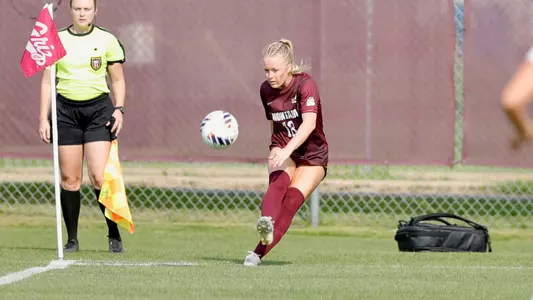
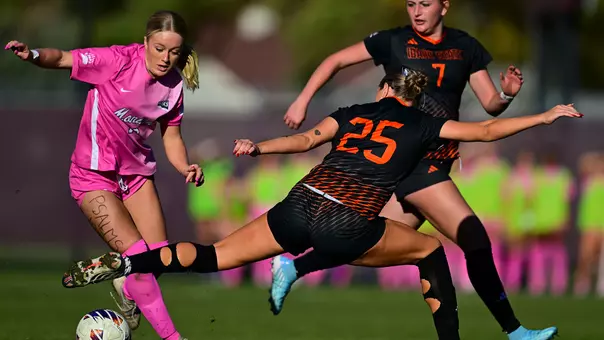
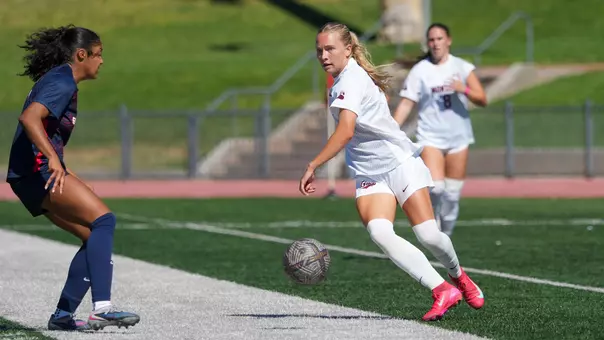
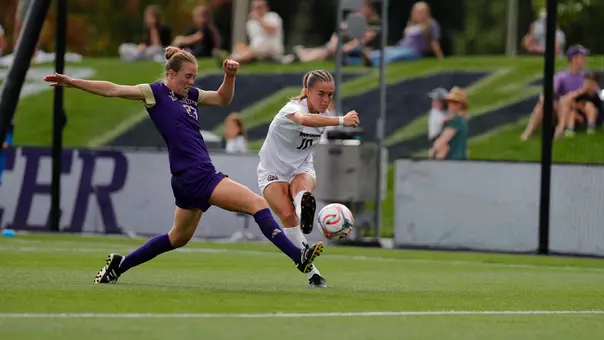
She started against Bucknell last week, playing 60 minutes, putting the potential equalizer deep in the second half off the crossbar. On Thursday night in Seattle, she almost scored Montana's first goal in the closing seconds of the second half, sending it just wide right.
"Great attacking player, gets forward, wants to go at people, never scared to shoot, plays bigger than she is," said Gore. "She's not the biggest by size but she is definitely made of granite. She is feisty and wants to get in the attack and is never afraid to express herself in the way she plays."
The next chapter of the Morton story has begun.
She has questions, like a lot of the players do. After all, they are learning mostly new ways under first-year coach Stuart Gore. She is the rare player, and an even more rare freshman, who wants answers, not in an I-need-convincing way but in an I-really-want-to-know kind of way.
She's a coach's delight in that sense, a player who's engaged, listening, always listening, always wondering, forever curious. "She's got more questions than a quiz team," says Gore, who started Morton in Montana's season opener against Bucknell last week.
"She always has a question about what we're trying to do. She wants to understand it, so she asks questions that other players are probably thinking but don't ask. You've got to love that about her. She doesn't want to do anything wrong, so she has questions about this, this and this."
He also describes her as "hard-working, tough, a ball of energy." And if you knew the family story, you'd think, oh my gosh, she is just like her dad, just as Chris Morton was just like his dad, Chris the youngest of four children, Grace the youngest of three, the strongest, toughest branches on the family tree.
Robert Morton is a worthy subject of his own story, but the future aerospace engineer will have to serve as launching pad in this one, born on the East Coast before joining the Air Force, before moving to Colorado for college, USC for a master's degree in the field of aerospace engineering.
His mind wasn't geared for the humanities or the social sciences. "He was very analytical and that probably rubbed off on me," says Chris of his dad. "I found myself applying the same type of analysis and questions. How do things work? How do we make them work better?"
Robert moved his family north to the Bay Area, where he began working for Lockheed Martin, on "black projects," the kind of things he couldn't talk about at home, his building the one with the windows blacked out, where the daily trash was burned, never thrown in a dumpster. Spies, spies everywhere.
He worked on the ironically named Peacekeeper Missile, the one that could deliver up to 10 nuclear warheads and be programed to land on a dime, the one that kept the Cold War more staring contest than anything apocalyptic, helped develop the landing gear for the B1 bomber.
It's why, when Chris's friends were out playing baseball, he was being introduced to the still novel concept of weight training by his dad, because what would happen if …? If he worked on explosive training? On plyometrics? What happens to the body if you do daily all-out hill sprints?
What happened is he got into soccer, then into football. One coach wanted him at linebacker, one at running back, one at safety. And, hey, didn't he used to play soccer? "I was one of the only kids around who knew how to kick the ball soccer-style, and I could kick the ball far," he says.
When most high school kickers were landing the ball at the 10- or 20-yard line, Chris Morton was pinning teams in the end zone, not even allowing a kick return, the kid with the "million-dollar foot," as one of his coaches described him.
But it was running the ball that did it for him, all that off-the-field work leaving pancaked defenders in his wake as he racked up 1,000-yard seasons, 20-plus touchdowns as a senior, Chris Morton showing a running back two years his junior, Pat Tillman, how it was done.
College programs begged for him to come to campus, none more so than Idaho State, who had him on a visit, handed him a Merril Hoge football card, letting him know he could be the next Bengal to make the NFL, right about the time Hoge was running over Denver for 120 yards in a playoff game.
Wasn't long after he returned home to San Jose that the envelop arrived, the one with the full-sized photo of Hoge, the one signed by Hoge. Hey Chris, come break my records.
Heady stuff, but he wanted to challenge himself at a higher level, this guy who was power-cleaning 320 pounds in high school. He chose Oregon State. "It was the Pac-10. I wanted to play against some of the best teams in the country and be exposed to that level of talent and competitiveness," he said.
He arrived on campus for the winter quarter after the 1990 season, was told he was the fifth-string fullback, which is like setting fire to dry kindling. He benched 350 pounds that spring, had a back squat of 500, went from fifth to fourth to third to second to first by the time spring drills were completed.
The Oregon State football yearbook said "Chris turned out to be the Beavers' biggest surprise of spring drills." When the 1991 season opened, he was the only true freshman listed No. 1 on the depth chart.
He would carry the ball 89 times for 353 yards, four yards a rush. Against No. 7 Cal, he went for 64 yards on eight carries, leading Lindy's, the newsstand bible of the sport at the time, to list Morton as the nation's 17th-best fullback.
On the path to a perfect story, life has a way of putting boulders in the way, just to see what a guy is made of. Family events, a new position coach, a two-quarter stopover at nearby Linn-Benton Community College to get his academics back in order, the search for a new school, a new team.
This was the early 90s. There was no transfer portal, no typing in a guy's name and immediately watching highlights online. "It was gorilla marketing. VHS tapes, letters of endorsement from teammates. Probably sent 20 of them out. Transferring was not an easy process," he said.
Montana offered him, as did New Mexico. Iowa State showed interest. But it was the Grizzlies who had the best-suited plan for him, with 6-foot-3 Bert Wilberger projected to start at quarterback in 1993, a pocket passer who would be at his best with a complementary strong running game.
Chris Morton was sold. But then Dave Dickenson happened. Montana would throw for more than 360 yards per game in 1993, with Dickenson cracking 4,000 yards and tossing 36 touchdowns while running for 15 more. Fullback? Ha! Who needed a fullback when you can run another receiver into space?
"He was smaller stature, didn't look like a college-level quarterback," said Morton of Dickenson. "But in practices he started exhibiting all these different abilities that you couldn't quite measure on physical testing. Eyes behind his head, great scrambling ability."
So, Morton redshirted and then proceeded to make a name for himself on the scout team while going up against Montana's first-team defense.
"I had a great time with it. I gave them a handful," he says, leading defensive coordinator Jerome Souers to ask head coach Don Read, if you're not going to use him on offense, can I have him for my defense?
It was another story Morton told this week from Havre, where his first-born, Matt, a former soccer player turned kicker, who played first at San Jose City College, then Culver-Stockton in Missouri, is now on the team at MSU Northern, which is coached by … Jerome Souers.
When he made the connection – oh, you're that Chris Morton – Souers emailed him: Oh, yeah, I remember you. You were the running back no one man could take down.
Running back was what he believed he was, so he stayed with it. "I got stubborn. One of my favorite things to do in the world was run the football. I decided to stick with that," he said. "If I had a son in that situation, I would advise him to switch to defense, but the past is the past."
He excelled on special teams because who would you rather have as a wedge-buster than this 5-foot-10, 220-pounder? He played in eight games in 1994, in nine games in 1995, scoring four touchdowns, as Dickenson guided Montana to its first national championship.
"Those were amazing years. A very proud time to be a Grizzly," he said.
Off the field, Morton was taking his inquisitive mind and digging into his health and human performance degree and studying exercise science at the feet of sprint coach and kinesiology expert Krzysztof Mackala, one of the giants in the field.
Morton's dad had recently passed away but his spirit lived on as his son asked in the academic setting, what would happen if … "I applied those things in my pursuits, more biology-based, exercise physiology-based," he said.
He got the necessary certifications and returned to the Bay Area, took the ideas he had rattling around in his head and worked with the baseball team at De Anza College, had them running with parachutes dragging behind them, working with resistance bands, today the norm, back then still an oddity.
He tested the team both pre and post on quickness, agility, vertical jump, saw that it worked, got an endorsement from the coach and went back to gorilla marketing, just as he had when leaving Oregon State, willing to travel anywhere and work with anyone. He named his new venture Extreme Training.
It eventually led to a training facility, which he and his wife, Mhairi, opened in 2000. After Matt was born in 2003, Emily in 2005 and Grace in 2007, it became the kids' second home, this dreamland of footballs everywhere, soccer balls, boxes for vertical jumps, resistance bands. Training became their norm.
"Over the years we worked with thousands of kids, so they were just always around that environment," says Morton. "Grace was exposed to that at a young age."
Matt was big into soccer, the girls as well, plus gymnastics – put Grace back then on the uneven bars and just stand back and enjoy – and soon it was the age-old parenting conundrum. We're both working, you kids are into everything, you need to be everywhere all the time. Let's get these sports dialed in.
Which one do you like best? "I'm very competitive," Grace says. "Gymnastics is very competitive but I liked the idea of a team sport where you play together."
Did she say she likes it competitive? How about in San Jose, where there more than a million people, where there is a robust soccer culture, at the top levels more survival of the fittest.
"California has its plusses and minuses," said Chris, whose family packed up and departed the Bay Area for Eagle, Idaho, less than a year ago, once their youngest finished high school.
"Soccer is very competitive and they play year-round. It really shaped her. You have to fight back, you have to play hard because the player next to you could take your spot, so you have to be a step ahead. As long as it doesn't weed a player out."
Our protagonist didn't get weeded out, even while playing two years up for most of her pre-teen years. She joined De Anza Force, later Bay Area Surf ECNL, then dug into the recruiting process, three decades and a world of difference from her dad's experience. No more VHS tapes sent through the mail.
"Things were different. You can create highlights on your phone. The technology is different but the concept is still the same," he said. "It's about being proactive. If you have things that make you stand out, capture that and put it together."
De Anza played a more passive style, one that didn't highlight Morton's strengths, her aggressiveness, the way she attacked the goal. Bay Area Surf wanted all of her. "The coach saw she was feisty, played hard, was explosive, had great foot skill," said Morton.
The summer before Morton's senior year, she had interest and offers, but before she made a decision, her dad said, you know, there's this place. "He said, I think you'd like it there and it might give you another option," Grace recalls.
Chris Morton hadn't been to Missoula since leaving after graduation in the mid-90s and now he was returning and Montana had a successful soccer program and how could things get any better?
"It was really cool. Washington-Grizzly Stadium was amazing," said Morton, who was shown the football team's meeting room inside the Washington-Grizzly Champions Center, the one named in honor of the 1995 national championship team. "It was cool to see the pictures.
"I also liked the fact some things haven't changed, like the clock tower. Some of campus still has those traditions that are really neat. It's a beautiful campus. Great place for a kid to go to school."
But Grace Morton had to play her way there and only had a summer ID camp to do it, while facing the prospect that Montana was essentially done recruiting for her class. And her dad was once told he was a fifth-string fullback.
"I did really well and I ended up loving the place," she says. "(Coach Chris Citowicki) talked to me and offered me after the camp. He said, we were going to end our class but I really want you as a player."
Montana didn't have much scholarship money left and the Mortons were planning on moving to Idaho last fall, in what could have been Morton's freshman season, so everyone agreed to sign the paperwork with her class but delay her arrival to Missoula until this past January.
She spent the fall training with her dad at his facility and watching her new team's matches from afar as the Grizzlies won the Big Sky Conference for a third straight year, then made the NCAA tournament. And now her family was moving closer to Montana and this was about as ideal as it could get, right?
But on the path to a perfect story, life has a way of putting boulders in the way, just to see what a girl is made of. "Definitely a shocker. I found out from a tweet," she says of Montana's December coaching change.
"I got a little discouraged in that moment. I really love the place and the school. Just because part of it fell apart doesn't mean it can't build back up. I took that chance with it."
She had the perfect sounding board right under her roof. Her dad was recruited to Oregon State when Dave Kragthorpe was the head coach. When Morton arrived on campus, Kragthorpe was gone, replaced by Jerry Pettibone.
He was recruited to Montana by a team that saw him as a big part of its future plans. Then, you know, Dave Dickenson. These things happen. The big question: How are you going to respond?
"This isn't new," he told her. "You try to bring in the element of perseverance and encourage your child to just relax, it's okay. Adjust and don't overreact. There is a way to navigate through this and still keep your path intact. Perseverance is key. Keep moving ahead."
She did just that, training through the first part of the spring semester without a head coach, then adjusting to the new ways of Gore.
She started against Bucknell last week, playing 60 minutes, putting the potential equalizer deep in the second half off the crossbar. On Thursday night in Seattle, she almost scored Montana's first goal in the closing seconds of the second half, sending it just wide right.
"Great attacking player, gets forward, wants to go at people, never scared to shoot, plays bigger than she is," said Gore. "She's not the biggest by size but she is definitely made of granite. She is feisty and wants to get in the attack and is never afraid to express herself in the way she plays."
The next chapter of the Morton story has begun.
Players Mentioned

M
/ SoccerMonday, October 12
Monday, October 12
Saturday, October 10
Tuesday, October 06