Meet the Griz: Ciara Lozier
8/14/2011 12:00:00 AM | Soccer
Aug. 14, 2011
"Defend Tacoma." That's what the T-shirt says. It's perfect for a city with a complex.
CNN published a study a few years back. Tacoma topped the list as the most stressful city in the country. It even beat out Detroit.
The city covers the entire menu of stressors: high suicide and crime rates, homelessness, high unemployment and gloomy weather, then tops it off with the Tacoma Aroma.
But for those who live there, it creates a population of fighters, defenders of the city they cherish.
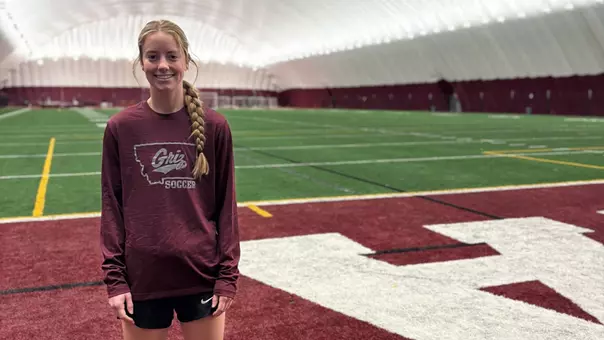
Ciara Lozier loves her hometown. She's the one wearing the T-shirt.
Lozier arrived in Missoula a few weeks back, ready to begin her career as a Montana soccer player. She packed what every freshman needs for her first year in college.
She also brought along an injured back and a willingness to fight through the pain that it's caused for most of the last decade.
Places like Tacoma seem to create a toughness in the people they produce. Lozier as an export is no different.
She injured her back while rafting as a nine year old. An incident on a velcro wall two days later made it permanent.
She has lived with the back pain -- and more important to this article, played with the back pain -- ever since, saying "I've lived with pain pretty much since the third grade. I've just grown used to it." That's the toughness that Tacoma instilled in her.
The day before the Grizzlies were scheduled to hold their first round of practices earlier this month, the 29 players on the team went through the routine steps of passing a physical that would clear them to start training.
Going through the long list of questions, Lozier answered yes to "Have you ever had a back injury?" and moved along with her day.
She was less than 24 hours away from fulfilling her dream of becoming a Division I soccer player and helping first-year coach Mark Plakorus turn the Grizzlies into a winning program.
Two weeks later she has yet to practice even once with her new team. Instead of working to become a starter and growing familiar with her teammates on the field, she is on a first-name basis with doctors and physical therapists.
"They told me it shouldn't be like this," Lozier says. "That I shouldn't be living my life in pain.
"It's frustrating. I'm used to dealing with it, and I could be playing and dealing with it fine right now, but I'm not being allowed to."
And that brings up a number of questions, the answers to which put you on one side of the fence or the other.
Do you side with the athlete, who played through the pain well enough over the years to make herself into a Division I soccer player?
Are the doctors, trainers and physical therapists keeping an athlete from her dream, or are they trying to save her from herself?
In full disclosure, it's more than just a bad back. To make it less painful, Lozier unconsciously adjusted her walking and running forms over the years to put less strain on her back, and now she has bad knees as well.
These days she walks around campus with legs that are covered with what looks like an entire roll of kinesio tape.
"I had no idea," she says of her bad knees, while dropping a delicious hint of Tacoma sarcasm. "I thought it was because I was running every day trying to get into shape for the season."
So Lozier is taking baby steps. Literally. She's relearning how to walk and run correctly under the trained eye of her physical therapist.
In Malcolm Gladwell's book Outliers, he claims that to master any specific task takes 10,000 hours of practice. Lozier is walking up and down the hallway of Craig Hall every day, trying to speed up the process by 1,000 percent, because she wants back on the field in the worst way.
When she is at South Campus Stadium for the team's practices, she walks the length of the field, then employs her new-look jog for the endlines, all while having to endure the cruel sight of her teammates practicing just a corner kick away.
She's sitting out, but she does not feel any different than she did while playing at a high level for Stadium High and for Washington Premier.
"It never really registered (over the years) that there's a problem," Lozier says, though the Tacoma in her makes it sound like she's not convinced.
When she uses her new walk, her knees don't hurt, but her back still does. When she changes to a slightly different gait, her back doesn't hurt, but her knees start to ache.
No one -- not Lozier, not Plakorus, not the doctors -- knows when she finally will be cleared to play.
In the meantime, time and opportunity are slipping away from an athlete who is ready to compete. How much for a T-shirt that says "Defend Ciara"?