The education of Taylor Goligoski
12/14/2015 7:49:00 AM | Women's Basketball
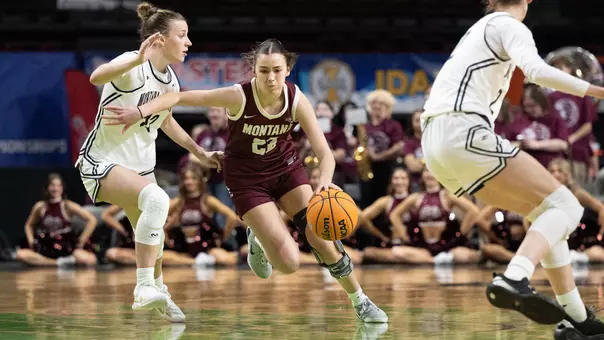
Taylor Goligoski, big-game hunter, college softball prospect, daughter of a professional athlete, caught the ball on the wing at the maroon and silver scrimmage at Dahlberg Arena in late October. And then did something she's been pulling off since the age of 5.
She made the Lady Griz fans in attendance think to themselves, Wow, she's going to be something special, so quickly and easily did she beat her on-ball defender off the dribble.
A split second later, intent on getting to the basket, a move that helped her become the Gatorade Player of the Year in Montana as a sophomore and senior at Hamilton High, she dribbled into two help defenders. The 5-foot-8 guard's shot was summarily rejected.
The Montana coaching staff thought, Okay, this is going to take some work.
And so the education of Taylor Goligoski has begun.
There are cautionary tales from the program. Tianna Ware, to use a recent example, could out-athleticism every player on the floor every time she stepped on the court. But she rarely played in her career, the basketball side never quite syncing up with her speed, quickness and hops.
There have been other players, not as athletic, who have thrived, their skills matching up with the needs of the team and their position. They may have lacked the flash but never for minutes, and the wins piled up.
Goligoski is redshirting, a yearlong breather for someone for whom sports have always been easy. A four-year starter at shortstop on Hamilton's softball team, she was good enough to earn a scholarship offer from Montana coach Jamie Pinkerton.
A four-year starter for the Broncs' basketball team, she led Hamilton to a runner-up finish at the Class A state tournament as a junior, then went one step further and won the state title as a senior. Interest came from BYU, Utah and every Big Sky Conference program within 500 miles.
And yet she sits and watches from the end of the bench. Based on nothing more than the eyeball test, she's the best athlete on the team. But on the depth chart, she's behind every other guard in the program. Will there ever be a reconciliation?
She's got the size of a point guard, the skills of a two guard and a game built on her ability to run past, jump over and out-quick anybody the other team might throw her way. But that was then. This is now.
"Not playing is different, but I think this year will be good for me. I don't know the offense well enough to do a really good job in a game," she says. "I'd be so focused on what I have to do for that play that I wouldn't be focused on playing basketball.
"For four years I've been doing one thing" -- by which she means getting to the basket, a skill that allowed her to three times be named all-state. "I could just jump over everybody. Now I have to adjust."
Will she? Will she be able to recalibrate a skill set that worked so well at the prep level? How much say will that little devil on her shoulder have -- Go! They can't guard you! -- when at the same time her coach is asking her to run the play, to see what better opportunities might present?
"Taylor can create her own shot, and that's a great plus," says Robin Selvig, whose 38 years on the sideline have given him a wait-and-see patience. He's seen about everything, from prep stars who haven't worked out at the college level to unheralded high school players who've thrived.
"But you can't do that quite as easily at this level, and you can't do it every single time. She has to learn when she truly has an opportunity to go make a play and improve her ability to read when she can use those skills."
Everyone at the scrimmage saw her athleticism. There was also the 1-for-9 shooting on a number of forced shots and three turnovers. Icarus flying too close to the sun. She will need to de-program, then re-program, but she has the foundation on which to build that would be the envy of most.
Her dad, Jason, was there. He's a father first, but he also played six seasons of professional baseball, as high as Double A, with the Chicago White Sox, Boston, Colorado and Arizona. Done playing, he spent a number of years as a scout for the Diamondbacks, trying to spot what-could-be talent.
"When I look at Taylor as a scout, nothing really stands out as weak," he says. "She can run, she can jump, she can dribble, she can shoot, she can defend.
"That's what's going to enable her to have a great career at Montana. People are going to love watching her play. Every night she is going to show them something different."
From one perspective, so many questions. Can she defend at this level? Can she develop point-guard skills to better expand her game? Can she set up her teammates through her passing? From another perspective, so much potential.
If she can learn and adapt her game, if the two sides can harmonize, she might be the most exciting player to wear a Lady Griz uniform in years. If not?
-----
She was born in Hamilton, in the spring of 1996, but Goligoski was raised a child of baseball: New Haven, Conn.; Yuma, Ariz.; Victorville, Calif.; Tulsa, Okla. And finally Vancouver, Wash., where her dad took a job as a scout for Arizona once his playing days were over.
In New Haven there was a teammate of Jason's by the name of Todd Helton, who would retire after the 2013 season with 2,519 hits and a uniform number retired by the Colorado Rockies. Taylor's godfather is Aaron Sele, winner of 148 games in 15 big league seasons with six teams.
In the end there was a Triple A contract offered up by Arizona, with the unofficial addendum that ever getting called up -- he was now closer to 30 than 20 -- was beyond a longshot. By that time Jason, Kari and Taylor had been joined by Hunter. Tanner would arrive later.
"I always told myself I wanted to play baseball until I stagnated," says Jason, who was selected in the eighth round by the White Sox in the 1993 draft. He retired in 1998. "Once I felt I didn't have a true opportunity to go up to the big leagues, I was going to hang it up.
"Within a day, Arizona called me and said they wanted to keep me in the organization."
Even though the family would retreat back to Hamilton each offseason, Goligoski turned down the opportunity to become the first manager of the Missoula Osprey, who began playing in 1999. The next day came an offer to become the organization's scout for the Northwest.
"The only problem was they wanted me on the I-5 corridor, so we moved to Vancouver. At that point Taylor was three years away from starting school. I told them once she's in school, I'm moving my family back to Montana," he says.
That much was nonnegotiable. "I love what Montana has to offer. I like the small communities where everybody looks after each other, and I love hunting and fishing. Going and playing in almost every state in the nation, there is no place like Montana."
With Goligoski out of baseball and three kids now to raise, the knee-jerk assumption might be that he forced his kids into sports so that he could experience the thrills of competition vicariously through his progeny. Turns out he took just the opposite approach and should probably write a how-to manual.
Taylor has followed in her dad's footsteps -- he had both baseball and basketball offers coming out of Hamilton; he ultimately chose to play the former at Washington State -- as both a multi-sport athlete and pursuer of big game.
Hunter, the middle child? The Hamilton High senior long ago gave up sports and hunting, and now puts his energies into other pursuits, with the full, unconditional support of his parents.
"Every kid is talented in one way or another. As a parent, you have to help them find their niche. Hunter is fairly athletic, but he doesn't have that competitive gene. I tried him in everything, and he doesn't like it. He hasn't hunted since he was 12," says Jason, who was born in Hamilton.
"Hunter loves acting. He's a quiet kid, but he can do things in front of an audience that leave me in awe. I get a lot of pleasure watching him be good at something that's different than any of my other kids. Sports aren't for everybody."
But they were for Taylor, who, according to Jason's mom, had better coordination at 2 than her dad possessed at that age.
"You could see at a young age that she had the coordination and athleticism to be a really good athlete," Jason says. "But it was always up to her. I never had to push Taylor. She was always the one saying, Dad, let's go to the gym. Let go out to the field and hit some ground balls.
"She had that it gene. God gives a lot of people talent, but what do they do with it? The biggest thing you can accomplish is to get the most out of what God gave you. That's what I've tried to instill in my kids and the other kids I coach."
She excelled in both basketball and softball, and the first scholarship offer she received was from Pinkerton. The basketball offer from the Lady Griz would come later. Which got her to wondering: She loved both sports. She played both at Hamilton. Why not try to play both at Montana?
"I kept telling her, Taylor, it's not that easy," says Jason, who coaches Hamilton's softball team. "It's like a job now, and they're paying you with your scholarship. You owe it to Robin and the basketball team to give them the best Taylor Goligoski you can be.
"When she told me in the fall that she's not going to play softball, I told her, Taylor I'm proud of you. That's a good decision. You owe it to that program to give it everything you've got."
-----
And so she has, and the education has begun.
It's still the same sport, the same court, the same ball, but the game needs to be approached and played differently. Drives that used to finish at the basket may now need to end 10 feet out, with either a pass or an open jump shot. Help defenders that used to be 5-foot-5 might now be 6-feet or taller.
Defense, the bedrock of the Lady Griz program, is based on communication, working as one with four teammates, doing your assignment, your one-fifth, no longer just an individual pursuit of shutting down the one opposing player to whom you've been assigned.
"Size is the major difference," she says. "It's a whole new level than what I'm used to. Teams help a lot more. When you get past one person, there is always someone else there."
Not that Goligoski's athleticism hasn't been allowed to surface now and then, because not every shot is going to come directly from a play that's been called from the bench. Sometimes a girl just needs to break offense and take advantage of those special skills God gifted her.
"(Robin's) totally cool with that," Goligoski says. "If it doesn't work, he can get a little mad, but usually he says it's a good shot."
Because she's a redshirt, all this work -- the give and take between player and coach, the player and the game -- goes on behind the scenes, at the team's daily practices. Will she adapt? Can she adapt? What will emerge from behind the curtain at next year's maroon and silver scrimmage?
There are baby steps. A pull-up jumper here, a draw and dish there, two plays that would have finished at the basket at Hamilton. Maybe she can learn to just take what's available and be fine with that.
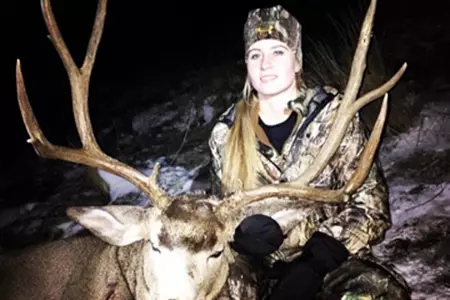
A story: Since an early age Goligoski has been tagging along with her dad on hunts, first for ducks and geese, later for larger game, like deer and elk. She was hooked.
In the fall of 2014, despite less than a one-tenth-of-one-percent chance, she drew a special permit from Montana Fish, Wildlife and Parks to hunt mule deer in District 270, an area between Hamilton and Darby, where those without the special permit can only pursue white tail deer.
"There were a lot of (mule deer)," says Goligoski. "I saw a bigger buck than the one I shot, but I figured I'd better shoot the one I did, which was still a really big deer. But there was a nicer one out there."
Taking the sure thing at the expense of the spectacular? Maybe, just maybe, this is going to work out after all.
She made the Lady Griz fans in attendance think to themselves, Wow, she's going to be something special, so quickly and easily did she beat her on-ball defender off the dribble.
A split second later, intent on getting to the basket, a move that helped her become the Gatorade Player of the Year in Montana as a sophomore and senior at Hamilton High, she dribbled into two help defenders. The 5-foot-8 guard's shot was summarily rejected.
The Montana coaching staff thought, Okay, this is going to take some work.
And so the education of Taylor Goligoski has begun.
There are cautionary tales from the program. Tianna Ware, to use a recent example, could out-athleticism every player on the floor every time she stepped on the court. But she rarely played in her career, the basketball side never quite syncing up with her speed, quickness and hops.
There have been other players, not as athletic, who have thrived, their skills matching up with the needs of the team and their position. They may have lacked the flash but never for minutes, and the wins piled up.
Goligoski is redshirting, a yearlong breather for someone for whom sports have always been easy. A four-year starter at shortstop on Hamilton's softball team, she was good enough to earn a scholarship offer from Montana coach Jamie Pinkerton.
A four-year starter for the Broncs' basketball team, she led Hamilton to a runner-up finish at the Class A state tournament as a junior, then went one step further and won the state title as a senior. Interest came from BYU, Utah and every Big Sky Conference program within 500 miles.
And yet she sits and watches from the end of the bench. Based on nothing more than the eyeball test, she's the best athlete on the team. But on the depth chart, she's behind every other guard in the program. Will there ever be a reconciliation?
She's got the size of a point guard, the skills of a two guard and a game built on her ability to run past, jump over and out-quick anybody the other team might throw her way. But that was then. This is now.
"Not playing is different, but I think this year will be good for me. I don't know the offense well enough to do a really good job in a game," she says. "I'd be so focused on what I have to do for that play that I wouldn't be focused on playing basketball.
"For four years I've been doing one thing" -- by which she means getting to the basket, a skill that allowed her to three times be named all-state. "I could just jump over everybody. Now I have to adjust."
Will she? Will she be able to recalibrate a skill set that worked so well at the prep level? How much say will that little devil on her shoulder have -- Go! They can't guard you! -- when at the same time her coach is asking her to run the play, to see what better opportunities might present?
"Taylor can create her own shot, and that's a great plus," says Robin Selvig, whose 38 years on the sideline have given him a wait-and-see patience. He's seen about everything, from prep stars who haven't worked out at the college level to unheralded high school players who've thrived.
"But you can't do that quite as easily at this level, and you can't do it every single time. She has to learn when she truly has an opportunity to go make a play and improve her ability to read when she can use those skills."
Everyone at the scrimmage saw her athleticism. There was also the 1-for-9 shooting on a number of forced shots and three turnovers. Icarus flying too close to the sun. She will need to de-program, then re-program, but she has the foundation on which to build that would be the envy of most.
Her dad, Jason, was there. He's a father first, but he also played six seasons of professional baseball, as high as Double A, with the Chicago White Sox, Boston, Colorado and Arizona. Done playing, he spent a number of years as a scout for the Diamondbacks, trying to spot what-could-be talent.
"When I look at Taylor as a scout, nothing really stands out as weak," he says. "She can run, she can jump, she can dribble, she can shoot, she can defend.
"That's what's going to enable her to have a great career at Montana. People are going to love watching her play. Every night she is going to show them something different."
From one perspective, so many questions. Can she defend at this level? Can she develop point-guard skills to better expand her game? Can she set up her teammates through her passing? From another perspective, so much potential.
If she can learn and adapt her game, if the two sides can harmonize, she might be the most exciting player to wear a Lady Griz uniform in years. If not?
-----
She was born in Hamilton, in the spring of 1996, but Goligoski was raised a child of baseball: New Haven, Conn.; Yuma, Ariz.; Victorville, Calif.; Tulsa, Okla. And finally Vancouver, Wash., where her dad took a job as a scout for Arizona once his playing days were over.
In New Haven there was a teammate of Jason's by the name of Todd Helton, who would retire after the 2013 season with 2,519 hits and a uniform number retired by the Colorado Rockies. Taylor's godfather is Aaron Sele, winner of 148 games in 15 big league seasons with six teams.
In the end there was a Triple A contract offered up by Arizona, with the unofficial addendum that ever getting called up -- he was now closer to 30 than 20 -- was beyond a longshot. By that time Jason, Kari and Taylor had been joined by Hunter. Tanner would arrive later.
"I always told myself I wanted to play baseball until I stagnated," says Jason, who was selected in the eighth round by the White Sox in the 1993 draft. He retired in 1998. "Once I felt I didn't have a true opportunity to go up to the big leagues, I was going to hang it up.
"Within a day, Arizona called me and said they wanted to keep me in the organization."
Even though the family would retreat back to Hamilton each offseason, Goligoski turned down the opportunity to become the first manager of the Missoula Osprey, who began playing in 1999. The next day came an offer to become the organization's scout for the Northwest.
"The only problem was they wanted me on the I-5 corridor, so we moved to Vancouver. At that point Taylor was three years away from starting school. I told them once she's in school, I'm moving my family back to Montana," he says.
That much was nonnegotiable. "I love what Montana has to offer. I like the small communities where everybody looks after each other, and I love hunting and fishing. Going and playing in almost every state in the nation, there is no place like Montana."
With Goligoski out of baseball and three kids now to raise, the knee-jerk assumption might be that he forced his kids into sports so that he could experience the thrills of competition vicariously through his progeny. Turns out he took just the opposite approach and should probably write a how-to manual.
Taylor has followed in her dad's footsteps -- he had both baseball and basketball offers coming out of Hamilton; he ultimately chose to play the former at Washington State -- as both a multi-sport athlete and pursuer of big game.
Hunter, the middle child? The Hamilton High senior long ago gave up sports and hunting, and now puts his energies into other pursuits, with the full, unconditional support of his parents.
"Every kid is talented in one way or another. As a parent, you have to help them find their niche. Hunter is fairly athletic, but he doesn't have that competitive gene. I tried him in everything, and he doesn't like it. He hasn't hunted since he was 12," says Jason, who was born in Hamilton.
"Hunter loves acting. He's a quiet kid, but he can do things in front of an audience that leave me in awe. I get a lot of pleasure watching him be good at something that's different than any of my other kids. Sports aren't for everybody."
But they were for Taylor, who, according to Jason's mom, had better coordination at 2 than her dad possessed at that age.
"You could see at a young age that she had the coordination and athleticism to be a really good athlete," Jason says. "But it was always up to her. I never had to push Taylor. She was always the one saying, Dad, let's go to the gym. Let go out to the field and hit some ground balls.
"She had that it gene. God gives a lot of people talent, but what do they do with it? The biggest thing you can accomplish is to get the most out of what God gave you. That's what I've tried to instill in my kids and the other kids I coach."
She excelled in both basketball and softball, and the first scholarship offer she received was from Pinkerton. The basketball offer from the Lady Griz would come later. Which got her to wondering: She loved both sports. She played both at Hamilton. Why not try to play both at Montana?
"I kept telling her, Taylor, it's not that easy," says Jason, who coaches Hamilton's softball team. "It's like a job now, and they're paying you with your scholarship. You owe it to Robin and the basketball team to give them the best Taylor Goligoski you can be.
"When she told me in the fall that she's not going to play softball, I told her, Taylor I'm proud of you. That's a good decision. You owe it to that program to give it everything you've got."
-----
And so she has, and the education has begun.
It's still the same sport, the same court, the same ball, but the game needs to be approached and played differently. Drives that used to finish at the basket may now need to end 10 feet out, with either a pass or an open jump shot. Help defenders that used to be 5-foot-5 might now be 6-feet or taller.
Defense, the bedrock of the Lady Griz program, is based on communication, working as one with four teammates, doing your assignment, your one-fifth, no longer just an individual pursuit of shutting down the one opposing player to whom you've been assigned.
"Size is the major difference," she says. "It's a whole new level than what I'm used to. Teams help a lot more. When you get past one person, there is always someone else there."
Not that Goligoski's athleticism hasn't been allowed to surface now and then, because not every shot is going to come directly from a play that's been called from the bench. Sometimes a girl just needs to break offense and take advantage of those special skills God gifted her.
"(Robin's) totally cool with that," Goligoski says. "If it doesn't work, he can get a little mad, but usually he says it's a good shot."
Because she's a redshirt, all this work -- the give and take between player and coach, the player and the game -- goes on behind the scenes, at the team's daily practices. Will she adapt? Can she adapt? What will emerge from behind the curtain at next year's maroon and silver scrimmage?
There are baby steps. A pull-up jumper here, a draw and dish there, two plays that would have finished at the basket at Hamilton. Maybe she can learn to just take what's available and be fine with that.
A story: Since an early age Goligoski has been tagging along with her dad on hunts, first for ducks and geese, later for larger game, like deer and elk. She was hooked.
In the fall of 2014, despite less than a one-tenth-of-one-percent chance, she drew a special permit from Montana Fish, Wildlife and Parks to hunt mule deer in District 270, an area between Hamilton and Darby, where those without the special permit can only pursue white tail deer.
"There were a lot of (mule deer)," says Goligoski. "I saw a bigger buck than the one I shot, but I figured I'd better shoot the one I did, which was still a really big deer. But there was a nicer one out there."
Taking the sure thing at the expense of the spectacular? Maybe, just maybe, this is going to work out after all.
Players Mentioned

G
/ Women's BasketballLady Griz Basketball Locker Room Unveiling - 5/1/26
Friday, May 01
Griz Track & Field - Montana Open Highlights - 4/25/26
Friday, May 01
Griz Softball vs. Idaho State Game-Winning Hit - 3/25/26
Friday, May 01
Griz Softball Championship Series Promo
Friday, May 01