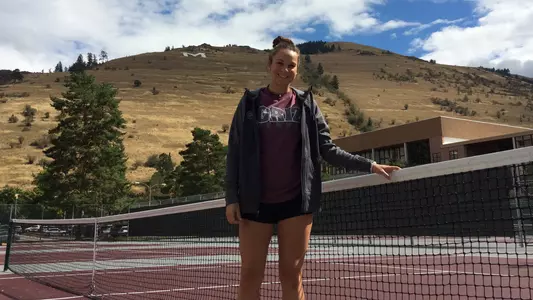
Hectic month leads to stability in Montana
9/8/2016 12:34:00 PM | Women's Tennis
There is never a good time for a Division I athlete to sit down with her new coach and hear that the program needs to go in another direction. It's even worse when that conversation takes place in the middle of July, when the nation's rosters are mostly set and the start of fall terms are approaching.
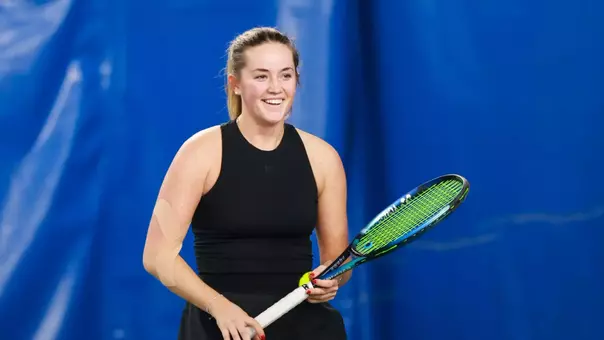
That was the case for Nathalie Joanlanne, who left her meeting with new Wisconsin women's tennis coach Kelcy McKenna less than two months ago with her head spinning.
Recruited to Madison out of Dallas, Pa., where she was the Pennsylvania Class AA state champion as a senior, Joanlanne, who competed for the Badgers last fall as a true freshman but missed the entire spring with a shoulder injury, was told she didn't fit into McKenna's plan for Wisconsin's future.
"I was in Madison taking summer classes when it all went down," says Joanlanne, who played last season for Tina Samara. The coach stepped down in June, and McKenna, after a single season as head coach at New Mexico, was brought in. New coach, new plan, one that didn't include Joanlanne.
"I sat down with her and we talked about my future on the team, and I wasn't really happy with what she projected for me. I love tennis, and I want to play, so I started looking at other options."
At the same time, ninth-year Montana women's tennis coach Steve Ascher had a numbers problem. A pair of international recruits hadn't worked out, and that left him entering the season with a team of just six, a dicey proposition in a sport where six is the barest of minimums.
But if last year, when Montana went 4-17 and missed the Big Sky Conference tournament for the first time since 1989, taught Ascher anything, it's that he'd rather go into a season with a like-minded group of six than add bodies simply to give depth to the roster. Six + 1 isn't always greater than six.
A champion of team chemistry and small-group dynamics, the two-time Big Sky Conference coach of the year was interested when Joanlanne reached out, but Ascher needed to know more.
"I emailed Steve, and he was quick to respond. He wanted to get me on the phone the next morning," says Joanlanne, a psychology major who found a fit with Ascher, who has a master's degree in clinical psychology.
"I'd never met a coach who combines psychology and tennis before, so we really hit it off. We talked about the mental side of the game, which we both believe in a lot. We were very parallel. We had a lot of the same viewpoints and ways we want things to go when I play.
"It clicked for me that this was the coach I needed, because I didn't have a lot of luck with my old coach. I needed someone who cared about my game and about me as a person. That was huge for me."
She visited Missoula and campus just three weeks ago and started classes with everybody else on Aug. 29, even though none of her professors could find her on their list of enrolled students. It wasn't until a few days later that she was officially accepted as a transfer.
"Those first few days were a little weird," she says. "I had to assure them that I'm not in their class yet, but I will be. Trust me."
Joanlanne, a sophomore, joins a now seven-player roster as Montana opens its fall tournament schedule this weekend at the three-day Cougar Classic in Pullman, Wash.
Ascher's 2016-17 team also includes seniors Anabel Carbo, Stanzi Stuijt and Hannah Sulz, juniors Cam Kincaid and Catherine Orfanos and sophomore Lidia Dukic.
Montana finished in the top three in the Big Sky Conference standings for six straight seasons, with the program's first regular-season title being earned in 2014, but last year's team struggled to a four-win spring, which ended without a trip to the Big Sky tournament.
"We had a lot of turnover within two years, and all of a sudden we didn't have anyone with more than one year of experience," says Ascher.
"The success we had in the past was the culmination of players going through a lot of adversity and tight matches and experiences, and we didn't have that to fall back on. They weren't quite ready or equipped to handle that kind of pressure, or even needed to put that pressure on their shoulders."
The start of the spring season had its successes -- wins over North Dakota and Montana State got Montana off to a 2-0 start in league -- but an aggressive schedule that would have challenged even the most experienced of Ascher's previous teams was too much.
The Grizzlies dropped 12 straight matches, 10 that resulted in scores of 7-0 or 6-1.
Montana snapped its losing streak with a 4-3 victory at Idaho State in late April and closed the season with a 4-3 loss on the road at Weber State, a team that a week later would advance to the semifinals of the Big Sky tournament.
"It came just a little bit too late, but the players got a ton of experience and learned a lot of life lessons about how to handle adversity," says Ascher.
"It was good for me as a coach, too. I'd never gone through anything like that. It was probably one of the hardest seasons I've gone through in 20 years of coaching."
Kincaid, who will be the only player not competing at Pullman this weekend, led Montana with a 10-11 singles record last spring. Dukic and Orfanos both won eight matches.
Joanlanne, a graduate of Wyoming Seminary Prep, went 7-6 in singles and 4-5 in doubles in tournament matches for Wisconsin last fall. She placed fifth in the C Flight at Minnesota's Gopher Invitational.
"I'm excited because the group dynamic with this team already feels much stronger than it did last year. It was a big piece for me to make sure the group dynamic is back," says Ascher.
Montana will compete in four tournaments this fall. Upcoming trips will have the Grizzlies at BYU, Long Beach State and Gonzaga.
"Our focus this weekend is establishing right away the mindset we want to compete with and that the idea of learning is at the forefront of what we do," says Ascher.
"I want to be able to work with the players through each match and help them set goals for what we want to do as a program to get better as we move forward."
That was the case for Nathalie Joanlanne, who left her meeting with new Wisconsin women's tennis coach Kelcy McKenna less than two months ago with her head spinning.
Recruited to Madison out of Dallas, Pa., where she was the Pennsylvania Class AA state champion as a senior, Joanlanne, who competed for the Badgers last fall as a true freshman but missed the entire spring with a shoulder injury, was told she didn't fit into McKenna's plan for Wisconsin's future.
"I was in Madison taking summer classes when it all went down," says Joanlanne, who played last season for Tina Samara. The coach stepped down in June, and McKenna, after a single season as head coach at New Mexico, was brought in. New coach, new plan, one that didn't include Joanlanne.
"I sat down with her and we talked about my future on the team, and I wasn't really happy with what she projected for me. I love tennis, and I want to play, so I started looking at other options."
At the same time, ninth-year Montana women's tennis coach Steve Ascher had a numbers problem. A pair of international recruits hadn't worked out, and that left him entering the season with a team of just six, a dicey proposition in a sport where six is the barest of minimums.
But if last year, when Montana went 4-17 and missed the Big Sky Conference tournament for the first time since 1989, taught Ascher anything, it's that he'd rather go into a season with a like-minded group of six than add bodies simply to give depth to the roster. Six + 1 isn't always greater than six.
A champion of team chemistry and small-group dynamics, the two-time Big Sky Conference coach of the year was interested when Joanlanne reached out, but Ascher needed to know more.
"I emailed Steve, and he was quick to respond. He wanted to get me on the phone the next morning," says Joanlanne, a psychology major who found a fit with Ascher, who has a master's degree in clinical psychology.
"I'd never met a coach who combines psychology and tennis before, so we really hit it off. We talked about the mental side of the game, which we both believe in a lot. We were very parallel. We had a lot of the same viewpoints and ways we want things to go when I play.
"It clicked for me that this was the coach I needed, because I didn't have a lot of luck with my old coach. I needed someone who cared about my game and about me as a person. That was huge for me."
She visited Missoula and campus just three weeks ago and started classes with everybody else on Aug. 29, even though none of her professors could find her on their list of enrolled students. It wasn't until a few days later that she was officially accepted as a transfer.
"Those first few days were a little weird," she says. "I had to assure them that I'm not in their class yet, but I will be. Trust me."
Joanlanne, a sophomore, joins a now seven-player roster as Montana opens its fall tournament schedule this weekend at the three-day Cougar Classic in Pullman, Wash.
Ascher's 2016-17 team also includes seniors Anabel Carbo, Stanzi Stuijt and Hannah Sulz, juniors Cam Kincaid and Catherine Orfanos and sophomore Lidia Dukic.
Montana finished in the top three in the Big Sky Conference standings for six straight seasons, with the program's first regular-season title being earned in 2014, but last year's team struggled to a four-win spring, which ended without a trip to the Big Sky tournament.
"We had a lot of turnover within two years, and all of a sudden we didn't have anyone with more than one year of experience," says Ascher.
"The success we had in the past was the culmination of players going through a lot of adversity and tight matches and experiences, and we didn't have that to fall back on. They weren't quite ready or equipped to handle that kind of pressure, or even needed to put that pressure on their shoulders."
The start of the spring season had its successes -- wins over North Dakota and Montana State got Montana off to a 2-0 start in league -- but an aggressive schedule that would have challenged even the most experienced of Ascher's previous teams was too much.
The Grizzlies dropped 12 straight matches, 10 that resulted in scores of 7-0 or 6-1.
Montana snapped its losing streak with a 4-3 victory at Idaho State in late April and closed the season with a 4-3 loss on the road at Weber State, a team that a week later would advance to the semifinals of the Big Sky tournament.
"It came just a little bit too late, but the players got a ton of experience and learned a lot of life lessons about how to handle adversity," says Ascher.
"It was good for me as a coach, too. I'd never gone through anything like that. It was probably one of the hardest seasons I've gone through in 20 years of coaching."
Kincaid, who will be the only player not competing at Pullman this weekend, led Montana with a 10-11 singles record last spring. Dukic and Orfanos both won eight matches.
Joanlanne, a graduate of Wyoming Seminary Prep, went 7-6 in singles and 4-5 in doubles in tournament matches for Wisconsin last fall. She placed fifth in the C Flight at Minnesota's Gopher Invitational.
"I'm excited because the group dynamic with this team already feels much stronger than it did last year. It was a big piece for me to make sure the group dynamic is back," says Ascher.
Montana will compete in four tournaments this fall. Upcoming trips will have the Grizzlies at BYU, Long Beach State and Gonzaga.
"Our focus this weekend is establishing right away the mindset we want to compete with and that the idea of learning is at the forefront of what we do," says Ascher.
"I want to be able to work with the players through each match and help them set goals for what we want to do as a program to get better as we move forward."
Players Mentioned

/ Women's Tennis

/ Women's Tennis

/ Women's Tennis

/ Women's Tennis

/ Women's Tennis

/ Women's Tennis

/ Women's Tennis
UM vs Weber State Highlights
Saturday, April 04
Griz Softball vs. Seattle Highlights - 3/24/26
Monday, March 30
2026 Griz Softball Hype Video
Monday, March 30
2006 Griz Basketball Flashback: NCAA Tournament Win Over Nevada
Monday, March 30