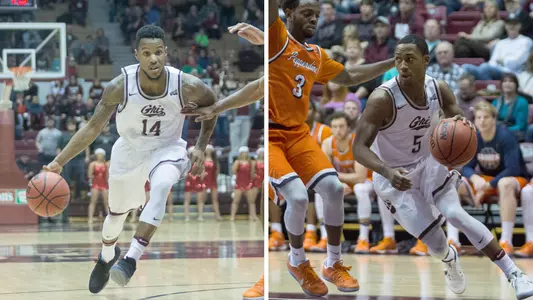
Off-court friendship leads to on-court success for Griz
1/23/2017 1:40:00 PM | Men's Basketball
By Glenn Junkert for GoGriz.com
A few city blocks south of Interstate 90, where it passes through Missoula, two newly committed Montana Grizzly basketball players became acquainted in a local restaurant.
During that summer of 2015 dinner, they discovered how similar their lives and interests were.
Walter Wright and Ahmaad Rorie had grown up within a few miles of the opposite ends of that interstate highway, their hometowns 2,943.7 miles apart. One was from Tacoma, Washington and the other from Waterbury, Connecticut.
"Ahmaad was my first (Griz basketball) host when I got here as a recruit," said Wright. "We ate (dinner), and from there we became roommates."
During that first dinner, a lot of stuff snapped into place for the two.
Ahmaad: "Our high school careers were similar... the AAU teams we played for and our high school teams. We were the best players on our high school teams, and we're both guards."
Walter: "And so it was really easy on the court to be able to play with him because I know what type of shots he likes, where his spots are and vice versa."
Ahmaad: "Guards just get along together, so it was easy from first meeting him. It wasn't difficult. It just clicked."
Despite hailing from opposite coasts, Wright, a senior, and Rorie, a sophomore, discovered that the mid-size cities of Tacoma and Waterbury are remarkably similar in working environment and lifestyle, with reputations as industrial centers where basketball was a means for a better life.
Walter: "Tough neighborhoods. Not a lot of opportunity."
Ahmaad: "We're both from the inner city."
Walter: "So we found our way. It was a gateway with basketball."
Ahmaad: "Since we're both from the inner city, it's either you (don't) go to school, or you go to school through basketball. There are not a lot of options. But you can definitely take positives out of that... and that's what we both did, going to school playing basketball, staying out of trouble for the most part. Definitely, our lives are similar in that way."
Walter: "It's crazy how similar we are in life. Everything we've been through... growing up in single-parent homes... he was raised by his mom, I was raised by my mom."
Ahmaad: "He visited Tacoma and he was able to see lots of stuff there."
Walter: "I actually was able to see how he lives and see his environment and be around his family and his friends. I mean, his mom was like my aunt. We developed that type of a relationship."
Walter: "And then our love of the game and all the things we like to do off the court. We've kind of got the same interests. We kind of went ahead in the same direction with basketball. He's very easy to relate to."
Ahmaad: "Definitely. I feel like him coming back to my home definitely helped to strengthen our friendship a lot more."
Each player cites successful pro players from their hometown as important role models.
Walter: "Anthony Ireland (Loyola Marymount). He's playing overseas right now. He plays in France. And Ryan Gomes (Providence/Boston Celtics & Minnesota Timberwolves). He was in the NBA for 10 years. He was one of my mentors throughout my time in high school. "
Ahmaad: "Isaiah Thomas of course (Univ. of Washington/Boston Celtics)... A lot. He's been like a mentor for me. I work out with him in the summer. I talk to him a lot. And Avery Bradley (U Washington/ Boston Celtics) as well. "
Since both players are from similar backgrounds, does their highly competitive approach to basketball naturally lead to potential confrontation when they play against each other in practice or pickup games?
Ahmaad: "Yeah, Yeah!"
Walter: "Oh Yeah! Especially when we go head to head."
Walter: "Against other people it was always us against everybody, and we tried to be the energy for our team and be the role models for our team... so we HAVE to compete."
Walter: "Remember our first week of practice?"
Ahmaad: "Oh yeah."
Walter: "It was like we didn't even know each other, and we were actually hating each other because of the way we were going at each other."
Now, however, Rorie and Wright channel their competitive energies together as lead point guards for the Griz.
Walter: "I think the team has picked up on that and it's like if we could compete so hard with each other, being the good friends that we are, we understood that everybody should be able to compete."
Statistics confirm their similar skills. The two are ranked at or near the top of the Big Sky Conference in several categories. They're currently tied for ninth in conference-only play with 3.5 assists per game. Rorie leads the conference with an assist-to-turnover ratio of 4.7, while Wright is ranked third with a 2.8 ratio. Rorie's .861 free throw percentage is sixth-best in the conference, while Wright's .846 percentage is ninth best. Rorie also has the sixth-best scoring average with a 20.9 pg. average, while Wright is ranked 22nd, with a 12.6 pg. average.
Despite their similarities, each player has trademark skills that have sharpened the Montana attack this season. Wright is a skilled ball-handler, effective via contorted dribble-enter drives that collapse opposing defenses or that force double teams when he drives into the key... at which point a quick-scoop backboard-kissing shot or an equally quick pass to an open teammate results in an easy score.
Wright's multi-directional ball-handling attacks have opened up the perimeter for Rorie, a fearless outside shooter with a lightning quick release. Rorie's a skilled pull-up shooter, from beyond the 3-point arc, or via an arrow-direct drive into the middle of the key for a soft-push floating shot. Rorie's quick first step usually forces defenders to play off a step, which then creates just enough space for longer jump shots from the top of the key.
Both players agree that their contrasting styles allow them to change the flow of the game against opponents, while also stretching and collapsing opposing defenses.
Ahmaad: "He gets to the basket a lot more than me. I like to shoot a lot more. I think that's pretty much the biggest difference. But there have been stretches where I feel like our differences allow us to actually get better. If he wasn't shooting I probably wouldn't get to the basket, so for him being able to shoot has opened things up for me."
Walter: "He might be a better defender on the ball. He's a pest on the ball. He's stronger, and he's able to shoot from outside. Once he gets going, that allows me to get going because I can see how he can change the game with his outside shot."
Both players emphasize that the fuel for their games is "All about chemistry," according to Wright. "Just finding each other's sweet spots on the floor... understanding what's a good shot at certain times during the game and just realizing that."
"We've been doing this our whole lives," Wright added, "being generals and floor leaders when we've been on the court. So that only makes it better when we've got two of us on the court instead of one."
Their shared goal of a Big Sky Championship and advancement are ahead of them... and within reach this year.
And for fans of the Montana Grizzlies, it's been fun watching two gifted basketball players from opposite ends of Interstate 90 take the off ramp at Missoula to hone their collegiate basketball careers.
A few city blocks south of Interstate 90, where it passes through Missoula, two newly committed Montana Grizzly basketball players became acquainted in a local restaurant.
During that summer of 2015 dinner, they discovered how similar their lives and interests were.
Walter Wright and Ahmaad Rorie had grown up within a few miles of the opposite ends of that interstate highway, their hometowns 2,943.7 miles apart. One was from Tacoma, Washington and the other from Waterbury, Connecticut.
"Ahmaad was my first (Griz basketball) host when I got here as a recruit," said Wright. "We ate (dinner), and from there we became roommates."
During that first dinner, a lot of stuff snapped into place for the two.
Ahmaad: "Our high school careers were similar... the AAU teams we played for and our high school teams. We were the best players on our high school teams, and we're both guards."
Walter: "And so it was really easy on the court to be able to play with him because I know what type of shots he likes, where his spots are and vice versa."
Ahmaad: "Guards just get along together, so it was easy from first meeting him. It wasn't difficult. It just clicked."
Despite hailing from opposite coasts, Wright, a senior, and Rorie, a sophomore, discovered that the mid-size cities of Tacoma and Waterbury are remarkably similar in working environment and lifestyle, with reputations as industrial centers where basketball was a means for a better life.
Walter: "Tough neighborhoods. Not a lot of opportunity."
Ahmaad: "We're both from the inner city."
Walter: "So we found our way. It was a gateway with basketball."
Ahmaad: "Since we're both from the inner city, it's either you (don't) go to school, or you go to school through basketball. There are not a lot of options. But you can definitely take positives out of that... and that's what we both did, going to school playing basketball, staying out of trouble for the most part. Definitely, our lives are similar in that way."
Walter: "It's crazy how similar we are in life. Everything we've been through... growing up in single-parent homes... he was raised by his mom, I was raised by my mom."
Ahmaad: "He visited Tacoma and he was able to see lots of stuff there."
Walter: "I actually was able to see how he lives and see his environment and be around his family and his friends. I mean, his mom was like my aunt. We developed that type of a relationship."
Walter: "And then our love of the game and all the things we like to do off the court. We've kind of got the same interests. We kind of went ahead in the same direction with basketball. He's very easy to relate to."
Ahmaad: "Definitely. I feel like him coming back to my home definitely helped to strengthen our friendship a lot more."
Each player cites successful pro players from their hometown as important role models.
Walter: "Anthony Ireland (Loyola Marymount). He's playing overseas right now. He plays in France. And Ryan Gomes (Providence/Boston Celtics & Minnesota Timberwolves). He was in the NBA for 10 years. He was one of my mentors throughout my time in high school. "
Ahmaad: "Isaiah Thomas of course (Univ. of Washington/Boston Celtics)... A lot. He's been like a mentor for me. I work out with him in the summer. I talk to him a lot. And Avery Bradley (U Washington/ Boston Celtics) as well. "
Since both players are from similar backgrounds, does their highly competitive approach to basketball naturally lead to potential confrontation when they play against each other in practice or pickup games?
Ahmaad: "Yeah, Yeah!"
Walter: "Oh Yeah! Especially when we go head to head."
Walter: "Against other people it was always us against everybody, and we tried to be the energy for our team and be the role models for our team... so we HAVE to compete."
Walter: "Remember our first week of practice?"
Ahmaad: "Oh yeah."
Walter: "It was like we didn't even know each other, and we were actually hating each other because of the way we were going at each other."
Now, however, Rorie and Wright channel their competitive energies together as lead point guards for the Griz.
Walter: "I think the team has picked up on that and it's like if we could compete so hard with each other, being the good friends that we are, we understood that everybody should be able to compete."
Statistics confirm their similar skills. The two are ranked at or near the top of the Big Sky Conference in several categories. They're currently tied for ninth in conference-only play with 3.5 assists per game. Rorie leads the conference with an assist-to-turnover ratio of 4.7, while Wright is ranked third with a 2.8 ratio. Rorie's .861 free throw percentage is sixth-best in the conference, while Wright's .846 percentage is ninth best. Rorie also has the sixth-best scoring average with a 20.9 pg. average, while Wright is ranked 22nd, with a 12.6 pg. average.
Despite their similarities, each player has trademark skills that have sharpened the Montana attack this season. Wright is a skilled ball-handler, effective via contorted dribble-enter drives that collapse opposing defenses or that force double teams when he drives into the key... at which point a quick-scoop backboard-kissing shot or an equally quick pass to an open teammate results in an easy score.
Wright's multi-directional ball-handling attacks have opened up the perimeter for Rorie, a fearless outside shooter with a lightning quick release. Rorie's a skilled pull-up shooter, from beyond the 3-point arc, or via an arrow-direct drive into the middle of the key for a soft-push floating shot. Rorie's quick first step usually forces defenders to play off a step, which then creates just enough space for longer jump shots from the top of the key.
Both players agree that their contrasting styles allow them to change the flow of the game against opponents, while also stretching and collapsing opposing defenses.
Ahmaad: "He gets to the basket a lot more than me. I like to shoot a lot more. I think that's pretty much the biggest difference. But there have been stretches where I feel like our differences allow us to actually get better. If he wasn't shooting I probably wouldn't get to the basket, so for him being able to shoot has opened things up for me."
Walter: "He might be a better defender on the ball. He's a pest on the ball. He's stronger, and he's able to shoot from outside. Once he gets going, that allows me to get going because I can see how he can change the game with his outside shot."
Both players emphasize that the fuel for their games is "All about chemistry," according to Wright. "Just finding each other's sweet spots on the floor... understanding what's a good shot at certain times during the game and just realizing that."
"We've been doing this our whole lives," Wright added, "being generals and floor leaders when we've been on the court. So that only makes it better when we've got two of us on the court instead of one."
Their shared goal of a Big Sky Championship and advancement are ahead of them... and within reach this year.
And for fans of the Montana Grizzlies, it's been fun watching two gifted basketball players from opposite ends of Interstate 90 take the off ramp at Missoula to hone their collegiate basketball careers.
Players Mentioned
G
/ Men's Basketball
G
/ Men's BasketballMonday, March 30
Monday, March 30
Monday, March 30
Monday, March 30