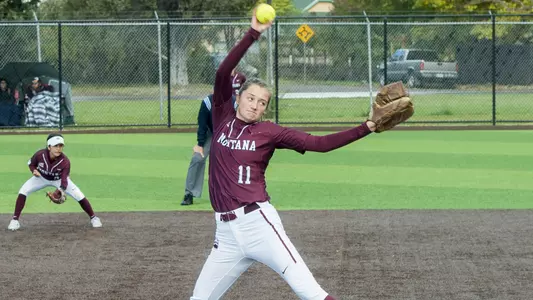
Origin stories :: Tristin Achenbach
1/24/2018 4:55:00 PM | Softball
It began, as dreams so often do, not organically, from the deep recesses of her imagination, but from something she saw. And wanted to become.
They arrived each spring at her home in Choteau, delivered by ESPN, Gators, Sooners, Wildcats, Bruins and Tigers, showing up in her living room in high definition, larger than life.
They were college softball players, modern-day deities to a girl who had gone all in on the sport, and they had reached the pinnacle of what was possible, the Women's College World Series.
"I loved watching all the big schools on TV," says Tristin Achenbach, a freshman right-hander on Montana's deep and talented pitching staff.
But before there could ever be a dream, there had to be an interest, then a love, then a passion, or the dream would never find a place to put down roots.
The interest arrived with tee-ball. The love came when that evolved into coach-pitch softball. Finally the passion, burning from the start, the day she delivered the first pitch of her own.
Patty Achenbach recognized it. She had played basketball at MSU Northern and knew as a mother she wanted not to tamp down that enthusiasm but to encourage and support it. He daughter wanted to throw it.
Recognizing her limitations as a softball-pitching sensi, she loaded her only daughter into the car one day and drove an hour to Great Falls, visiting the first place that came to mind when she knew she needed help: Barnes and Noble.
"She said she wanted to be a pitcher, and I didn't know anything about it, so we started looking at the sports books," she says. "I ended up buying one that had a chapter on pitching called The Baffled Parent's Guide to Coaching Youth Softball."
And so it began.
Mother and daughter would read a section, learning together the skills and art of making a softball hum, then go into the backyard and drill, then drill some more, always at the daughter's request, putting what they'd read into practice.
The daughter would throw, the mom would watch, comparing the motions to what they'd just read. And: repeat.
"That's basically how we got started," says Patty. Adds Tristin, "It was interesting, that's for sure. We were as successful as you can be with your mom teaching you from a book."
But the mother kept at it, soaking up every piece of advice from everyone willing to share their knowledge as she coached her first youth softball team, "so I kind of knew what to do to help those girls along," she says.
She doesn't remember when she first saw it, first realized that she might have a pitching prodigy on her hands. Tristin Achenbach was just better at this than almost anyone else. Everything case so easily.
"There were a lot of other girls who wanted to pitch. It just seemed very natural for Tristin, where some of the other girls seemed a little more robotic," says Patty. "That's when I thought, maybe she can do this."
There were hurdles to face, of course, none larger early on than the prospect of a pitch getting away from her and hitting the batter, who often was a friend. And if not a friend, then at least someone she had no interest in harming.
It might read like a cute anecdote today, the two-time Montana Gatorade Player of the Year now bringing heat as she does for the Grizzlies, but back then, it was enough of a crisis that a girl might need to consider another position.
"She was very emotional about it. She didn't like to hit the other little girls. I didn't know if mentally she would ever get past that," says Patty. "But she learned it was part of the game if she lost control and hit one of her friends in the batter's box."
There was another obstacle as well. Softball at that age, at least in Choteau, was only played two months of the year, and that's no way for love to become passion, which in turn would fuel the dream.
Nate, who also played basketball at MSU Northern, and Patty did what they could for their daughter There were the backyard sessions. And when weather turned nasty, the principal and elementary-school teacher took full advantage of their access to vacant gyms.
But they could only take their daughter so far.
Lindsey Graham was the top pitcher of her generation in Montana, and she took what was her Division I talent to then-Division II North Dakota State. And she was dominant.
She was a three-time NFCA All-American for the Bison and the North Central Conference Player of the Year in 2002, '03 and '04. In four seasons she won 95 games, collected 49 shutouts and 1,019 strikeouts, and finished with a career ERA of 1.11 over nearly 850 innings pitched.
Her return to Great Falls to begin teaching at C.M. Russell High and assisting with the school's softball team came in 2006-07, or right about the time the Achenbachs began their search for a private pitching coach for their daughter. In other words, serendipity defined.
"I knew from day one that she was going to be really good," says Graham, now Gustafson. "She had a lengthy body and a positive attitude. She was so coachable, and you love those types of kids.
"And she was an athlete, and that makes it easier to make adjustments. And she's smart, so she picked up on things quickly."
In addition to lessons with Gustafson, Achenbach sped up her development by joining the Great Falls Selects at age 9. And pitching was easy. Until it wasn't.
"When I was maybe 12, I was playing up with some sophomores on an older team, and I was pitching," says Achenbach. "They were better than me. I realized it wasn't as easy as it had seemed."
So she began practicing even harder, with even more focus. And nature played its ace as well, giving her the long legs and long arms needed to not just throw the ball but whip it past batters, hissing out of her hand on its way to the plate as it violently displaced 43 feet of air.
As a junior, pitching for the co-op Conrad-Choteau team, she went 23-0, with a 0.19 ERA. She threw 19 shutouts and 12 no-hitters, and pitched her team to its second straight Class B-C title.
By that time she was committed to Montana, making for a clean tale, but any good story needs a bit of drama, so let's introduce some.
Nate and Patty began their education careers in Geyser, 30 miles southeast of Great Falls, before moving to Choteau, where Collin, who plays basketball at Montana-Western, and Tristin were raised.
Senior year of high school can be a memorable period in life, and that can be especially true in small towns, where classmates in the same school in first grade are often classmates in the same school in grade 12, bonds tight from A to Z down the short list of surnames.
But Nate had a chance to become an associate principal at C.M. Russell and what would Tristin think about switching schools her final year?
"He talked to me a lot about it. It was hard. He didn't want to take me away from what I'd known my whole life," she says. "But I knew it was best for him. I wanted to do it for him."
While it took Achenbach away from Choteau, it teamed her up for the first time as actual player and coach with Gustafson, who had become the head coach years earlier at CMR.
"When I got the call that she was coming in, it was kind of one of those dream-come-true things," Gustafson says. "To work with her through the years, then be able to finish her career with her was just a highlight. It was awesome. I'm so grateful I got to have her for that year."
Achenbach went 17-1 last spring for the Rustlers, allowing only 27 hits the entire season while holding opponents to a .068 batting average. She ended the season with a 0.23 ERA and totaled 264 strikeouts in 122 1/3 innings.
And she and Gustafson became state champions together. "She's better than I was. She's more dominant," says the coach. "And I still think she has a huge upside. She's only going to get stronger and throw even harder."
Achenbach faced high-level competition each summer as a member of the Great Falls Selects, but you might be asking yourself, after looking at the comic-book numbers above, if she was challenged enough pitching in Montana to prepare her for college.
Or maybe even this: Was it fun, so often being the hammer in the hammer-and-nail relationship?
"I don't want to say it wasn't challenging, because every game starts 0-0. You still get nerves no matter who you're playing," says Achenbach.
"I never felt like I wasn't getting enough competition. I always felt like I had to be at my best. And if I wasn't competing with the hitter, I had to compete with myself. Yeah, maybe she can't hit me, but I still need to get it exactly where I want to throw it, so I was always out there competing."
Achenbach dreamed of playing college softball before Montana's program ever became reality. And when Jamie Pinkerton arrived, that closed the deal. She didn't bother taking any other visits, despite the recruiting interest she was shown.
"When Montana got a program, it was something to work for," she says. "I remember coming to my first game here, and it was such a cool environment. I loved it.
"I could have gone somewhere else, but I was pretty set on here. I loved Coach Pink and his philosophies, and the facilities."
Pinkerton had been Achenbach's primary recruiter and her most important tie to her future program, so she was as stunned as everyone else to get the text message on Aug. 1 from the coach, letting everyone know Iowa State was too good of an opportunity to pass up.
Classes would be starting in less than a month. "I didn't know what to think. It was a weird thing to go through. Everyone was like, wow, what's going on?" she says.
Pinkerton's assistant coach, Melanie Meuchel, guided the team through the fall as a national search to find Pinkerton's replacement was conducted.
Phone interviews were done with candidates from as far away as Memphis and Michigan, but in listening to Achenbach recount the fall, the coach the Grizzlies needed was already on staff.
"I didn't know any different, but it still felt like it was flowing," says Achenbach. "It felt right. She kept preaching that it wasn't broken, and I don't think it was, even with Pink leaving. She picked it up and just kept it going from the way they finished last year."
Achenbach showed flashes of dominance in her four appearances in the fall, striking out a team-high 23 batters in 15 innings of work and allowing just two earned runs for a 0.93 ERA. Going up against Carroll in her first exhibition start, she struck out eight of the first 11 batters she faced.
But she also walked seven in her four appearances, more than twice as many as her three healthy teammates combined.
"I was happy with how it went, but I saw room for improvement and areas where I can get better," she says. "It wasn't perfect and I can't be satisfied, but for a start it was fine.
"The big difference was the hitters' plate discipline was more than I was used to and the tighter strike zone. In high school they'll give you the corner. If you don't hit the strike zone here, it's a ball. So I need to work on getting ahead in counts and keeping my mental focus. You can't give away any pitches."
Montana had the Big Sky Conference's top pitching staff last year, and the main pieces, including Michaela Hood, the MVP of the Big Sky tournament, all returned.
And that's maybe the best part of this story, that no one is expecting Achenbach to come in and be the savior. It's not that she doesn't have the talent. It's that Montana doesn't need her to be. And that's a wonderful position to be in. The Grizzlies will take whatever she can give them.
"It's nice to come in and have the pitching staff we have. Everyone is so supportive," says Achenbach, words that should bring goosebumps to Meuchel, who's been the program's pitching coach since she was hired in September 2013 and building a special, cohesive unit ever since.
"I've learned so much from not only Mel but the pitching staff in general. Everyone is there to help each other and make each other better for the betterment of the team. It's a cool environment to be in."
Sure, Achenbach would love to go full circle and one day be that player on ESPN, pitching for the Grizzlies at the College World Series, but her goals are not that detailed or vivid. At least when she's not at home dreaming.
When pressed on what she wants to accomplish the next four seasons, she doesn't rattle off a bunch of numbers having to do with strikeouts or ERAs, or individual awards. Those may very well come, but they would be secondary, a bonus coming from larger successes.
It's something Bethany Olea started last spring as the first three-year player to graduate out of the program. And it's something Pinkerton accomplished as well. Achenbach just wants to keep it going and maybe even up the expectations a bit.
"I want to leave something behind that's memorable," she says. "Not even from a pitching standpoint but as a person and what I contribute to the team and what the team leaves behind."
Speaking of goosebumps.
They arrived each spring at her home in Choteau, delivered by ESPN, Gators, Sooners, Wildcats, Bruins and Tigers, showing up in her living room in high definition, larger than life.
They were college softball players, modern-day deities to a girl who had gone all in on the sport, and they had reached the pinnacle of what was possible, the Women's College World Series.
"I loved watching all the big schools on TV," says Tristin Achenbach, a freshman right-hander on Montana's deep and talented pitching staff.
But before there could ever be a dream, there had to be an interest, then a love, then a passion, or the dream would never find a place to put down roots.
The interest arrived with tee-ball. The love came when that evolved into coach-pitch softball. Finally the passion, burning from the start, the day she delivered the first pitch of her own.
Patty Achenbach recognized it. She had played basketball at MSU Northern and knew as a mother she wanted not to tamp down that enthusiasm but to encourage and support it. He daughter wanted to throw it.
Recognizing her limitations as a softball-pitching sensi, she loaded her only daughter into the car one day and drove an hour to Great Falls, visiting the first place that came to mind when she knew she needed help: Barnes and Noble.
"She said she wanted to be a pitcher, and I didn't know anything about it, so we started looking at the sports books," she says. "I ended up buying one that had a chapter on pitching called The Baffled Parent's Guide to Coaching Youth Softball."
And so it began.
Mother and daughter would read a section, learning together the skills and art of making a softball hum, then go into the backyard and drill, then drill some more, always at the daughter's request, putting what they'd read into practice.
The daughter would throw, the mom would watch, comparing the motions to what they'd just read. And: repeat.
"That's basically how we got started," says Patty. Adds Tristin, "It was interesting, that's for sure. We were as successful as you can be with your mom teaching you from a book."
But the mother kept at it, soaking up every piece of advice from everyone willing to share their knowledge as she coached her first youth softball team, "so I kind of knew what to do to help those girls along," she says.
She doesn't remember when she first saw it, first realized that she might have a pitching prodigy on her hands. Tristin Achenbach was just better at this than almost anyone else. Everything case so easily.
"There were a lot of other girls who wanted to pitch. It just seemed very natural for Tristin, where some of the other girls seemed a little more robotic," says Patty. "That's when I thought, maybe she can do this."
There were hurdles to face, of course, none larger early on than the prospect of a pitch getting away from her and hitting the batter, who often was a friend. And if not a friend, then at least someone she had no interest in harming.
It might read like a cute anecdote today, the two-time Montana Gatorade Player of the Year now bringing heat as she does for the Grizzlies, but back then, it was enough of a crisis that a girl might need to consider another position.
"She was very emotional about it. She didn't like to hit the other little girls. I didn't know if mentally she would ever get past that," says Patty. "But she learned it was part of the game if she lost control and hit one of her friends in the batter's box."
There was another obstacle as well. Softball at that age, at least in Choteau, was only played two months of the year, and that's no way for love to become passion, which in turn would fuel the dream.
Nate, who also played basketball at MSU Northern, and Patty did what they could for their daughter There were the backyard sessions. And when weather turned nasty, the principal and elementary-school teacher took full advantage of their access to vacant gyms.
But they could only take their daughter so far.
Lindsey Graham was the top pitcher of her generation in Montana, and she took what was her Division I talent to then-Division II North Dakota State. And she was dominant.
She was a three-time NFCA All-American for the Bison and the North Central Conference Player of the Year in 2002, '03 and '04. In four seasons she won 95 games, collected 49 shutouts and 1,019 strikeouts, and finished with a career ERA of 1.11 over nearly 850 innings pitched.
Her return to Great Falls to begin teaching at C.M. Russell High and assisting with the school's softball team came in 2006-07, or right about the time the Achenbachs began their search for a private pitching coach for their daughter. In other words, serendipity defined.
"I knew from day one that she was going to be really good," says Graham, now Gustafson. "She had a lengthy body and a positive attitude. She was so coachable, and you love those types of kids.
"And she was an athlete, and that makes it easier to make adjustments. And she's smart, so she picked up on things quickly."
In addition to lessons with Gustafson, Achenbach sped up her development by joining the Great Falls Selects at age 9. And pitching was easy. Until it wasn't.
"When I was maybe 12, I was playing up with some sophomores on an older team, and I was pitching," says Achenbach. "They were better than me. I realized it wasn't as easy as it had seemed."
So she began practicing even harder, with even more focus. And nature played its ace as well, giving her the long legs and long arms needed to not just throw the ball but whip it past batters, hissing out of her hand on its way to the plate as it violently displaced 43 feet of air.
As a junior, pitching for the co-op Conrad-Choteau team, she went 23-0, with a 0.19 ERA. She threw 19 shutouts and 12 no-hitters, and pitched her team to its second straight Class B-C title.
By that time she was committed to Montana, making for a clean tale, but any good story needs a bit of drama, so let's introduce some.
Nate and Patty began their education careers in Geyser, 30 miles southeast of Great Falls, before moving to Choteau, where Collin, who plays basketball at Montana-Western, and Tristin were raised.
Senior year of high school can be a memorable period in life, and that can be especially true in small towns, where classmates in the same school in first grade are often classmates in the same school in grade 12, bonds tight from A to Z down the short list of surnames.
But Nate had a chance to become an associate principal at C.M. Russell and what would Tristin think about switching schools her final year?
"He talked to me a lot about it. It was hard. He didn't want to take me away from what I'd known my whole life," she says. "But I knew it was best for him. I wanted to do it for him."
While it took Achenbach away from Choteau, it teamed her up for the first time as actual player and coach with Gustafson, who had become the head coach years earlier at CMR.
"When I got the call that she was coming in, it was kind of one of those dream-come-true things," Gustafson says. "To work with her through the years, then be able to finish her career with her was just a highlight. It was awesome. I'm so grateful I got to have her for that year."
Achenbach went 17-1 last spring for the Rustlers, allowing only 27 hits the entire season while holding opponents to a .068 batting average. She ended the season with a 0.23 ERA and totaled 264 strikeouts in 122 1/3 innings.
And she and Gustafson became state champions together. "She's better than I was. She's more dominant," says the coach. "And I still think she has a huge upside. She's only going to get stronger and throw even harder."
Achenbach faced high-level competition each summer as a member of the Great Falls Selects, but you might be asking yourself, after looking at the comic-book numbers above, if she was challenged enough pitching in Montana to prepare her for college.
Or maybe even this: Was it fun, so often being the hammer in the hammer-and-nail relationship?
"I don't want to say it wasn't challenging, because every game starts 0-0. You still get nerves no matter who you're playing," says Achenbach.
"I never felt like I wasn't getting enough competition. I always felt like I had to be at my best. And if I wasn't competing with the hitter, I had to compete with myself. Yeah, maybe she can't hit me, but I still need to get it exactly where I want to throw it, so I was always out there competing."
Achenbach dreamed of playing college softball before Montana's program ever became reality. And when Jamie Pinkerton arrived, that closed the deal. She didn't bother taking any other visits, despite the recruiting interest she was shown.
"When Montana got a program, it was something to work for," she says. "I remember coming to my first game here, and it was such a cool environment. I loved it.
"I could have gone somewhere else, but I was pretty set on here. I loved Coach Pink and his philosophies, and the facilities."
Pinkerton had been Achenbach's primary recruiter and her most important tie to her future program, so she was as stunned as everyone else to get the text message on Aug. 1 from the coach, letting everyone know Iowa State was too good of an opportunity to pass up.
Classes would be starting in less than a month. "I didn't know what to think. It was a weird thing to go through. Everyone was like, wow, what's going on?" she says.
Pinkerton's assistant coach, Melanie Meuchel, guided the team through the fall as a national search to find Pinkerton's replacement was conducted.
Phone interviews were done with candidates from as far away as Memphis and Michigan, but in listening to Achenbach recount the fall, the coach the Grizzlies needed was already on staff.
"I didn't know any different, but it still felt like it was flowing," says Achenbach. "It felt right. She kept preaching that it wasn't broken, and I don't think it was, even with Pink leaving. She picked it up and just kept it going from the way they finished last year."
Achenbach showed flashes of dominance in her four appearances in the fall, striking out a team-high 23 batters in 15 innings of work and allowing just two earned runs for a 0.93 ERA. Going up against Carroll in her first exhibition start, she struck out eight of the first 11 batters she faced.
But she also walked seven in her four appearances, more than twice as many as her three healthy teammates combined.
"I was happy with how it went, but I saw room for improvement and areas where I can get better," she says. "It wasn't perfect and I can't be satisfied, but for a start it was fine.
"The big difference was the hitters' plate discipline was more than I was used to and the tighter strike zone. In high school they'll give you the corner. If you don't hit the strike zone here, it's a ball. So I need to work on getting ahead in counts and keeping my mental focus. You can't give away any pitches."
Montana had the Big Sky Conference's top pitching staff last year, and the main pieces, including Michaela Hood, the MVP of the Big Sky tournament, all returned.
And that's maybe the best part of this story, that no one is expecting Achenbach to come in and be the savior. It's not that she doesn't have the talent. It's that Montana doesn't need her to be. And that's a wonderful position to be in. The Grizzlies will take whatever she can give them.
"It's nice to come in and have the pitching staff we have. Everyone is so supportive," says Achenbach, words that should bring goosebumps to Meuchel, who's been the program's pitching coach since she was hired in September 2013 and building a special, cohesive unit ever since.
"I've learned so much from not only Mel but the pitching staff in general. Everyone is there to help each other and make each other better for the betterment of the team. It's a cool environment to be in."
Sure, Achenbach would love to go full circle and one day be that player on ESPN, pitching for the Grizzlies at the College World Series, but her goals are not that detailed or vivid. At least when she's not at home dreaming.
When pressed on what she wants to accomplish the next four seasons, she doesn't rattle off a bunch of numbers having to do with strikeouts or ERAs, or individual awards. Those may very well come, but they would be secondary, a bonus coming from larger successes.
It's something Bethany Olea started last spring as the first three-year player to graduate out of the program. And it's something Pinkerton accomplished as well. Achenbach just wants to keep it going and maybe even up the expectations a bit.
"I want to leave something behind that's memorable," she says. "Not even from a pitching standpoint but as a person and what I contribute to the team and what the team leaves behind."
Speaking of goosebumps.
Players Mentioned
P
/ Softball
INF
/ SoftballThursday, June 04
Friday, May 01
Friday, May 01
Friday, May 01