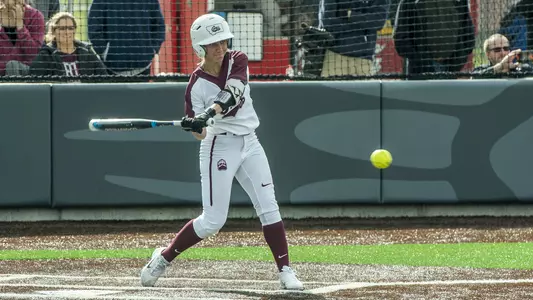
Origin stories :: Lexi Knauss
1/28/2018 3:28:00 PM | Softball
She was both precocious, a junior softball savant, and a realist, was Lexi Knauss while growing up in Meridian, Idaho, a few miles west of Boise.
She was the product of a baseball family. First, her dad, a transplanted Iowan via reporting orders to Mountain Home Air Force Base and still a player through parenthood, then her brother, Matthew, who was powerless to resist the call of the diamond. He loved the game as well.
When the family wasn't at home, talking about the sport or preparing for an upcoming game, maybe watching one on TV, they were at a field, daughter in tow, the bleachers and grassy areas outside the fence becoming a secondary residence.
But it wasn't just a place to while away the hours. Soon she was hooked as well, not just on what her dad or brother was doing, but on the intricacies of what was taking place before her, the movements of the nine players on defense, the decisions being made by base runners, the approach taken by hitters.
"She was always attending games, and she was always very interested in why players did what they did," says her dad, Michael, these days a civilian working as a manager in a semiconductor equipment manufacturing business. "Even as a really young kid, she understood the game.
"She would be sitting beside me watching a game, and they'd make a play and she would ask, Why did they do that? They should have done this. In a lot of cases I agreed with her. She was right."
The passion that was formed found a home on the softball field, a sport she and her friends at first played for fun. But it wasn't long before she was making a name for herself, which in the world of competitive youth sports made her a target, a potentially prized possession.
Yes, a possession, a reality that came as a surprise to her parents the day a Meridian all-star team faced one of the area's larger programs at a tournament. Knauss's team got outplayed, but she managed to stand out at the plate and at second base.
So much so that the coach of the opposing team made his way over to the parents of the Meridian players after the game, waving his card.
"He said, 'Who owns the little girl at second base? I want to talk to them.' That seemed kind of weird," says Michael. "We took his card and told him we'd call him if we were interested."
That led to the first of what would be many family discussions about the daughter's future. Clearly she had the talent, but what were her goals and interests? How much of an investment did she want to make? Was softball going to be a pastime for her, or something she wanted to take more seriously?
Michael and Shari weren't going to push their daughter in either direction. The decision, which ultimately would be an easy one to make, had to be hers. But once she made it, either to go all in or to just keep it recreational, their role would be to support it.
She wanted in. So after her eight-grade year, she was brought to her first college camp, at Oregon. It was for girls in high school and those going into ninth grade, meaning Knauss was one of the youngest players in attendance.
"It didn't work out real well for her," says Michael. "It didn't go horribly, but she realized she wasn't at that level."
Yes, she was a realist, someone who could honestly self-evaluate where she stood. But that didn't mean she had to accept it.
"On the way home, we thought, Well, she's probably not going to want to do this now," says Michael. "But it was just the opposite. It lit a fire under her. On the way home, she said, You know what, Dad? I've got to work harder. I've got to find a better team that challenges me and makes me better."
If her story needs a seminal moment, that long drive home from Eugene was it. The camp both opened her eyes and provided her a vision of what she wanted to become and the level she wanted to reach.
Softball couldn't be a local, small-scale pursuit any longer. She went out of the area to join travel teams with better players that faced better competition. She started playing in Portland, Seattle, Salt Lake City.
It was no longer a question of if she was going to play college softball. It became a simple matter of where.
"There was never any question of whether she wanted to play collegiate softball. It almost got to the point she'd get irritated if we'd ask her," says Michael.
"She'd be like, How many times do you need to ask me that question? The answer is always going to be yes."
With the if already decided, the where found its target when Knauss was a freshman at Meridian High. The father of one of her club teammates knew Jamie Pinkerton, who had just been hired by Montana to start a program from nothing.
It felt like the perfect pairing, the player who was working herself into a Division I prospect and the program that had big dreams.
"When I came up here for the first time, I thought, This place is so cool," Knauss says. "It's a lot like home but smaller. I'm super into the outdoors and fishing and hiking, so I thought it'd be a perfect fit."
But it wouldn't be that simple or of only her choosing. There were probably hundreds of players, if not more, in the Northwest who thought the same thing, that Montana would be a perfect fit.
So coming to Montana's camps became part of the investment in herself. Pinkerton and his assistant, Melanie Meuchel, wouldn't be attending any of her high school games, not in the spring, and the two coaches could only be in so many places during the travel-ball tournament season.
She'd make it easy for them. She would go where they were.
"I always got super nervous and anxious every time I went to a camp. I never really knew anyone there, so I was always on my own," says Knauss, which is pronounced cah-naus, not noss or cah-noss.
"I was trying to do my best to impress the coaches, because this is where I wanted to come. I came to the first camp they had and probably came to four or five of their camps in all."
Now there was interest on both sides, but Montana's did not yet match the level of Knauss's. They needed to see her outside of camp, in a game environment.
Imagine that setting: You're in high school. You want to play college softball. The coaches from the school you want to attend are at a summer or fall tournament. And you see them watching your game, evaluating, judging, determining if you're worthy of a spot on their team.
It's no wonder that Knauss these days thinks back so fondly to her high school team, when the game was fun and mostly stress-free.
She batted .552 as a senior, with 19 doubles, 11 home runs, 43 RBIs and 50 runs scored as Meridian High went 19-9 and advanced to the Class 5A state tournament. Knauss would be named the Gatorade Idaho Softball Player of the Year.
Travel ball was different. The friendships weren't deep, not with players coming together from different points, and everyone had the same agenda, to use it not so much as a way to get better but as a chance to be seen by college coaches.
"One time we were in Huntington Beach and it was a recruiting tournament, so you could bat whoever you wanted. Pinkerton was there and he told my coach, Hey, put her in. I want to see her hit," recalls Knauss.
"So I got put in and got out. I went up four more times after that, right in a row, just so he could see how I dealt with the pressure and with tough situations. I got out a lot. It wasn't discouraging, though, because he kept coming back."
Finally, both sides connected. A scholarship offer was made, then accepted.
"After I verballed, it was refreshing," says Knauss, who also took a visit to Mercer, located in too-far-away Georgia. "I could focus on softball again.
"That's why I loved playing high school. It might not have been as competitive, but I could just play the game and for my school. There wasn't the added pressure of having to do well because a coach might be watching."
Her arrival at Montana was not unlike the time she arrived at Oregon for her first college camp. She was entering ninth grade, and she was surrounded by older players who didn't have time for a young interloper.
But it wasn't like that at all last fall, when she found herself again surrounded by older players -- 11 seniors, 13 upperclassmen in all -- who viewed Knauss not as an outsider or a threat but someone who needed to be brought into the fold, and quickly. They needed to show her the Grizzly way.
It's the beauty of what's been getting built over the years. Those seniors, 10 of whom have been in the program since day one, have ownership, and they know where the program stands in 10 years will reflect on them just as much as where it stands today.
That's why Knauss is so important to them. As are Tristin Achenbach and Jessica McAlister. The freshmen need to be the next class to carry on what's been established, the values, the expectations. It's a rare approach, one made possible by the program's young age and a selfless senior class.
"Coming in, everyone was really supportive, and that was surprising," says Knauss. "I have a lot of friends who play at other schools who say their teammates can be so mean."
It should come as no surprise, then, that Knauss, feeling everything like full-on Grizzly from the opening day of fall practice, not a newcomer who had to be held at arm's length for her own good, hit .400 during the team's exhibition games in September and October.
She only played in six of eight games, but she tied for second with nine runs scored and tied for fourth with seven RBIs. She had a two-run double in her second at-bat of the fall and went 5 for 9 with six runs scored and four RBIs in her final two appearances.
"It's a special thing with this team, that they don't make it about themselves," says Knauss. "Every girl is in it for the team. They are in it for the long haul and the program as a whole."
Just don't underestimate her. The girl who rode back from Oregon more than four years ago, the one who turned disappointment into fire, is still there, deep down. There were more experienced players at that camp. They were better than she was. So she resolved to work even harder. It's happening again.
She's been practicing at shortstop and second base, positions held down the previous three seasons by Delene Colburn and Gabby Martinez. The former was a third-team NFCA All-Pacific Region selection last spring, the latter honorable mention All-Big Sky Conference.
But that doesn't make them untouchable or unassailable. To the contrary, because that's how programs reach a new level, when players push teammates and everyone's level rises.
"That's not going to stop me from working hard and trying to get some playing time," Knauss says. "Just because they're the starters doesn't mean I'm going to sit back and say, They can have it. I just know I have to work that much harder if I want to play."
And that should surprise no one at this point. Lexi Knauss has known no other way.
She was the product of a baseball family. First, her dad, a transplanted Iowan via reporting orders to Mountain Home Air Force Base and still a player through parenthood, then her brother, Matthew, who was powerless to resist the call of the diamond. He loved the game as well.
When the family wasn't at home, talking about the sport or preparing for an upcoming game, maybe watching one on TV, they were at a field, daughter in tow, the bleachers and grassy areas outside the fence becoming a secondary residence.
But it wasn't just a place to while away the hours. Soon she was hooked as well, not just on what her dad or brother was doing, but on the intricacies of what was taking place before her, the movements of the nine players on defense, the decisions being made by base runners, the approach taken by hitters.
"She was always attending games, and she was always very interested in why players did what they did," says her dad, Michael, these days a civilian working as a manager in a semiconductor equipment manufacturing business. "Even as a really young kid, she understood the game.
"She would be sitting beside me watching a game, and they'd make a play and she would ask, Why did they do that? They should have done this. In a lot of cases I agreed with her. She was right."
The passion that was formed found a home on the softball field, a sport she and her friends at first played for fun. But it wasn't long before she was making a name for herself, which in the world of competitive youth sports made her a target, a potentially prized possession.
Yes, a possession, a reality that came as a surprise to her parents the day a Meridian all-star team faced one of the area's larger programs at a tournament. Knauss's team got outplayed, but she managed to stand out at the plate and at second base.
So much so that the coach of the opposing team made his way over to the parents of the Meridian players after the game, waving his card.
"He said, 'Who owns the little girl at second base? I want to talk to them.' That seemed kind of weird," says Michael. "We took his card and told him we'd call him if we were interested."
That led to the first of what would be many family discussions about the daughter's future. Clearly she had the talent, but what were her goals and interests? How much of an investment did she want to make? Was softball going to be a pastime for her, or something she wanted to take more seriously?
Michael and Shari weren't going to push their daughter in either direction. The decision, which ultimately would be an easy one to make, had to be hers. But once she made it, either to go all in or to just keep it recreational, their role would be to support it.
She wanted in. So after her eight-grade year, she was brought to her first college camp, at Oregon. It was for girls in high school and those going into ninth grade, meaning Knauss was one of the youngest players in attendance.
"It didn't work out real well for her," says Michael. "It didn't go horribly, but she realized she wasn't at that level."
Yes, she was a realist, someone who could honestly self-evaluate where she stood. But that didn't mean she had to accept it.
"On the way home, we thought, Well, she's probably not going to want to do this now," says Michael. "But it was just the opposite. It lit a fire under her. On the way home, she said, You know what, Dad? I've got to work harder. I've got to find a better team that challenges me and makes me better."
If her story needs a seminal moment, that long drive home from Eugene was it. The camp both opened her eyes and provided her a vision of what she wanted to become and the level she wanted to reach.
Softball couldn't be a local, small-scale pursuit any longer. She went out of the area to join travel teams with better players that faced better competition. She started playing in Portland, Seattle, Salt Lake City.
It was no longer a question of if she was going to play college softball. It became a simple matter of where.
"There was never any question of whether she wanted to play collegiate softball. It almost got to the point she'd get irritated if we'd ask her," says Michael.
"She'd be like, How many times do you need to ask me that question? The answer is always going to be yes."
With the if already decided, the where found its target when Knauss was a freshman at Meridian High. The father of one of her club teammates knew Jamie Pinkerton, who had just been hired by Montana to start a program from nothing.
It felt like the perfect pairing, the player who was working herself into a Division I prospect and the program that had big dreams.
"When I came up here for the first time, I thought, This place is so cool," Knauss says. "It's a lot like home but smaller. I'm super into the outdoors and fishing and hiking, so I thought it'd be a perfect fit."
But it wouldn't be that simple or of only her choosing. There were probably hundreds of players, if not more, in the Northwest who thought the same thing, that Montana would be a perfect fit.
So coming to Montana's camps became part of the investment in herself. Pinkerton and his assistant, Melanie Meuchel, wouldn't be attending any of her high school games, not in the spring, and the two coaches could only be in so many places during the travel-ball tournament season.
She'd make it easy for them. She would go where they were.
"I always got super nervous and anxious every time I went to a camp. I never really knew anyone there, so I was always on my own," says Knauss, which is pronounced cah-naus, not noss or cah-noss.
"I was trying to do my best to impress the coaches, because this is where I wanted to come. I came to the first camp they had and probably came to four or five of their camps in all."
Now there was interest on both sides, but Montana's did not yet match the level of Knauss's. They needed to see her outside of camp, in a game environment.
Imagine that setting: You're in high school. You want to play college softball. The coaches from the school you want to attend are at a summer or fall tournament. And you see them watching your game, evaluating, judging, determining if you're worthy of a spot on their team.
It's no wonder that Knauss these days thinks back so fondly to her high school team, when the game was fun and mostly stress-free.
She batted .552 as a senior, with 19 doubles, 11 home runs, 43 RBIs and 50 runs scored as Meridian High went 19-9 and advanced to the Class 5A state tournament. Knauss would be named the Gatorade Idaho Softball Player of the Year.
Travel ball was different. The friendships weren't deep, not with players coming together from different points, and everyone had the same agenda, to use it not so much as a way to get better but as a chance to be seen by college coaches.
"One time we were in Huntington Beach and it was a recruiting tournament, so you could bat whoever you wanted. Pinkerton was there and he told my coach, Hey, put her in. I want to see her hit," recalls Knauss.
"So I got put in and got out. I went up four more times after that, right in a row, just so he could see how I dealt with the pressure and with tough situations. I got out a lot. It wasn't discouraging, though, because he kept coming back."
Finally, both sides connected. A scholarship offer was made, then accepted.
"After I verballed, it was refreshing," says Knauss, who also took a visit to Mercer, located in too-far-away Georgia. "I could focus on softball again.
"That's why I loved playing high school. It might not have been as competitive, but I could just play the game and for my school. There wasn't the added pressure of having to do well because a coach might be watching."
Her arrival at Montana was not unlike the time she arrived at Oregon for her first college camp. She was entering ninth grade, and she was surrounded by older players who didn't have time for a young interloper.
But it wasn't like that at all last fall, when she found herself again surrounded by older players -- 11 seniors, 13 upperclassmen in all -- who viewed Knauss not as an outsider or a threat but someone who needed to be brought into the fold, and quickly. They needed to show her the Grizzly way.
It's the beauty of what's been getting built over the years. Those seniors, 10 of whom have been in the program since day one, have ownership, and they know where the program stands in 10 years will reflect on them just as much as where it stands today.
That's why Knauss is so important to them. As are Tristin Achenbach and Jessica McAlister. The freshmen need to be the next class to carry on what's been established, the values, the expectations. It's a rare approach, one made possible by the program's young age and a selfless senior class.
"Coming in, everyone was really supportive, and that was surprising," says Knauss. "I have a lot of friends who play at other schools who say their teammates can be so mean."
It should come as no surprise, then, that Knauss, feeling everything like full-on Grizzly from the opening day of fall practice, not a newcomer who had to be held at arm's length for her own good, hit .400 during the team's exhibition games in September and October.
She only played in six of eight games, but she tied for second with nine runs scored and tied for fourth with seven RBIs. She had a two-run double in her second at-bat of the fall and went 5 for 9 with six runs scored and four RBIs in her final two appearances.
"It's a special thing with this team, that they don't make it about themselves," says Knauss. "Every girl is in it for the team. They are in it for the long haul and the program as a whole."
Just don't underestimate her. The girl who rode back from Oregon more than four years ago, the one who turned disappointment into fire, is still there, deep down. There were more experienced players at that camp. They were better than she was. So she resolved to work even harder. It's happening again.
She's been practicing at shortstop and second base, positions held down the previous three seasons by Delene Colburn and Gabby Martinez. The former was a third-team NFCA All-Pacific Region selection last spring, the latter honorable mention All-Big Sky Conference.
But that doesn't make them untouchable or unassailable. To the contrary, because that's how programs reach a new level, when players push teammates and everyone's level rises.
"That's not going to stop me from working hard and trying to get some playing time," Knauss says. "Just because they're the starters doesn't mean I'm going to sit back and say, They can have it. I just know I have to work that much harder if I want to play."
And that should surprise no one at this point. Lexi Knauss has known no other way.
Players Mentioned
P
/ Softball
INF
/ Softball
INF
/ Softball
INF
/ Softball
C/INF
/ SoftballLady Griz Basketball Locker Room Unveiling - 5/1/26
Friday, May 01
Griz Track & Field - Montana Open Highlights - 4/25/26
Friday, May 01
Griz Softball vs. Idaho State Game-Winning Hit - 3/25/26
Friday, May 01
Griz Softball Championship Series Promo
Friday, May 01