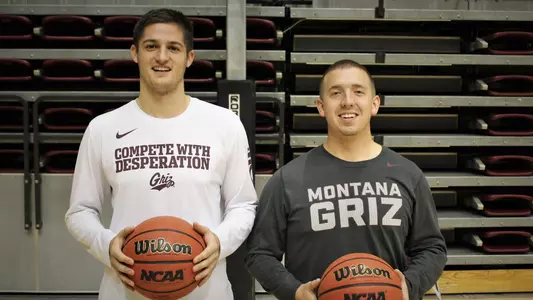
Bartels, Clarke keep Griz Hoops running
10/16/2018 6:36:00 PM | Men's Basketball
In Travis DeCuire's eyes, a key to a successful basketball program is growth. Fans have seen it on the court, with Montana winning 20-plus games three times in the past four seasons, including two Big Sky titles and an NCAA tournament appearance in 2018. Inside the walls of the program, DeCuire and his staff have felt it through support, be it financial, facilities upgrades or how the team operates on a daily basis.
"A lot of people look at growth as how many guys are in the NBA or how many guys are playing professionally," DeCuire said. "Those numbers are what they are, but there's more than just a few players per year that need to grow, from managers to assistant coaches to everyone within our program."
When an assistant coaching position opened up in July 2017, DeCuire elevated Jay Flores from director of operations to assistant coach. That opened up the ops position, but instead of filling it in a traditional role, DeCuire used it as another opportunity to grow those within his program.
"When Marlon (Stewart) left, I had a decision to make," DeCuire said. "Do I hire an ops as I elevate Jay, or do I find a way to restructure this to be advantageous to the young non-athlete that is a student within our program?"
Each assistant coach took on a little more responsibility, adding extra to their plate, sure, but also giving them more opportunity to develop and expand their skillset. Another key part was the role of Jesse Bartels, a three-year manager at the time, then beginning his second season as head manager.
Bartels was finishing his final year of his undergraduate degree at the University of Montana, and due to his stability – he arrived even before any of the current coaching staff did – and his work ethic, DeCuire used the open position as an opportunity to further develop the 22 year old.
DeCuire had seen it work firsthand before. At both Old Dominion and Cal, each manager moved on to be video coordinators or directors of operations at high levels. The same thing happened early in DeCuire's tenure at Montana, with the previous head manager getting an immediate opportunity to coach at the NAIA level.
Bartels took on an expanded role in 2017-18, handling a good portion of the team's travel while also overseeing the basketball managers – roles that include getting set up for practice, running film, and an assortment of 'other duties as assigned'.
"You just try to be the first one in and the last one out, and do whatever is needed," Bartels said.
Bartels graduated from Montana in May, and last March was honored as part of the team's Senior Night, recognizing the four years he gave to the program. His future was uncertain, and while he had some opportunities to venture elsewhere, there was a mutual desire to keep him at Montana.
So again, instead of hiring a full-time director of operations like most Division-I basketball programs, DeCuire instead made it work to hire two graduate assistants to fill the role.
Anderson Clarke grew up in a basketball family in Australia. Both his mother and father played and coached at a high level. So much so, that when he was 18, it brought him to the United States. His father, Marty, was hired as associate head coach at mid-major power St. Mary's, a position he held for five seasons. Clarke spent his final high school season in the States before playing four seasons at Division-II Concordia Irvine. It was in California that he was first introduced to Montana associate head coach Chris Cobb, a native of northern California.
One thing led to another, and without knowing much about Montana – the state or basketball program – Clarke made the move up north, sight unseen.
Now two young people are filling the role of one traditional job, and DeCuire again has the chance to mentor and develop eager up-and-comers.
The combination of Bartels and Clarke is a perfect match, as well. Bartels, who is working toward a master's degree in public administration, has a desire to work in an executive role for a Division-I or NBA team, focusing more on the front office or business side of the sport. Clarke, tracing back to his family history, wants to get into the coaching side.
"We're on two different paths, meaning everything gets done and both of us get to do what we want to do," Bartels said.
Clarke succinctly summed up his role as, "Making life easier for everyone else and doing whatever is needed,"
On a daily basis, that can range from watching film to sending recruiting mailouts to putting together stats charts at practice. A major part of his job is keeping tabs on each potential recruit the staff is evaluating, a daunting task that looks years in advance.
"I want to stay in coaching, and this is an awesome way for me to get my foot in the door," Clarke said. "It's not really coaching right now, but it is a lot of learning."
The biggest surprise to Clarke, who is studying international educational leadership, is the depth of planning it takes to run a Division-I program.
"The level of planning that goes into everything we do on a day-to-day basis was real eye opening," he said. "It's a lot more hands on and in-depth than I expected. A lot goes into each practice and every decision we make and everything we do."
Bartels, a Hamilton native and life-long Griz fan, came to the University of Montana as a freshman in 2013 and quickly learned that he missed being part of the game. After numerous emails his freshman year, attempting to get plugged in as a manager, he finally got an opportunity during the following summer, earning a tryout during summer camps.
He was barely into his involvement when Wayne Tinkle was hired as the head coach at Oregon State and most of the contacts Bartels had made moved on to Corvallis as well. In came DeCuire, and Bartels kept doing his job like nothing happened, which led to what is now his fifth season with the program.
"Being a Griz fan my entire life and knowing how special this place is, it's an honor to be part of it," he said. "The knowledge this staff has, and the networks they have, attracted me to stay with them and help build this program into what they want it to be, and what we together want it to be."
His role has expanded immensely, moving from a student manager to head manager to his current role as a graduate assistant. After getting a taste of planning travel a year ago, Bartels said that Flores has let go of the reins and fully turned it over to him this year.
That can nearly be a full-time job by itself, but Bartels also plays a large role in film breakdown – both for practices and for coaches to watch potential recruits – in addition to overseeing and mentoring the group of current managers.
In four years, it's difficult to single out one favorite memory. One that stands out was his first time traveling with the team, a trip to Weber State. The NIT trip that first year was also memorable; so was a trip to The Kennel to watch the Griz play Gonzaga. Even then, it's hard to top last year.
"Everything about last year, being able to be part of March Madness, was a dream come true," Bartels said.
Their responsibilities are full-time roles, and on top of that, Bartels and Clarke are also both in school, working toward master's degrees. That can make for stressful days, but it's all part of the job, and something neither would change.
"It's a lot of work," Clarke said. "Long days at work and then three more online classes at home. It's a lot of long days and little sleep, but it will be worth it in the long run."
DeCuire's decision to restructure his staff, supplanting the traditional director of operations role in place of developing some eager learners, also seems to be paying off, both in the long run and immediately.
"People look at managers and they think of guys getting balls and water," DeCuire said. "The reality is that the manager is managing the program. They're putting in as many hours as anyone else, and they're as valuable as anyone in the program because they're the liaison between the student-athlete and the staff.
"It's not an easy job to be successful with, and that's why a lot of the better managers move on to high positions. Some of the best coaches were managers, because they realized that X's and O's aren't always the biggest thing when it comes to managing basketball programs. We're lucky to have Jesse and Anderson."
"A lot of people look at growth as how many guys are in the NBA or how many guys are playing professionally," DeCuire said. "Those numbers are what they are, but there's more than just a few players per year that need to grow, from managers to assistant coaches to everyone within our program."
When an assistant coaching position opened up in July 2017, DeCuire elevated Jay Flores from director of operations to assistant coach. That opened up the ops position, but instead of filling it in a traditional role, DeCuire used it as another opportunity to grow those within his program.
"When Marlon (Stewart) left, I had a decision to make," DeCuire said. "Do I hire an ops as I elevate Jay, or do I find a way to restructure this to be advantageous to the young non-athlete that is a student within our program?"
Each assistant coach took on a little more responsibility, adding extra to their plate, sure, but also giving them more opportunity to develop and expand their skillset. Another key part was the role of Jesse Bartels, a three-year manager at the time, then beginning his second season as head manager.
Bartels was finishing his final year of his undergraduate degree at the University of Montana, and due to his stability – he arrived even before any of the current coaching staff did – and his work ethic, DeCuire used the open position as an opportunity to further develop the 22 year old.
DeCuire had seen it work firsthand before. At both Old Dominion and Cal, each manager moved on to be video coordinators or directors of operations at high levels. The same thing happened early in DeCuire's tenure at Montana, with the previous head manager getting an immediate opportunity to coach at the NAIA level.
Bartels took on an expanded role in 2017-18, handling a good portion of the team's travel while also overseeing the basketball managers – roles that include getting set up for practice, running film, and an assortment of 'other duties as assigned'.
"You just try to be the first one in and the last one out, and do whatever is needed," Bartels said.
Bartels graduated from Montana in May, and last March was honored as part of the team's Senior Night, recognizing the four years he gave to the program. His future was uncertain, and while he had some opportunities to venture elsewhere, there was a mutual desire to keep him at Montana.
So again, instead of hiring a full-time director of operations like most Division-I basketball programs, DeCuire instead made it work to hire two graduate assistants to fill the role.
Anderson Clarke grew up in a basketball family in Australia. Both his mother and father played and coached at a high level. So much so, that when he was 18, it brought him to the United States. His father, Marty, was hired as associate head coach at mid-major power St. Mary's, a position he held for five seasons. Clarke spent his final high school season in the States before playing four seasons at Division-II Concordia Irvine. It was in California that he was first introduced to Montana associate head coach Chris Cobb, a native of northern California.
One thing led to another, and without knowing much about Montana – the state or basketball program – Clarke made the move up north, sight unseen.
Now two young people are filling the role of one traditional job, and DeCuire again has the chance to mentor and develop eager up-and-comers.
The combination of Bartels and Clarke is a perfect match, as well. Bartels, who is working toward a master's degree in public administration, has a desire to work in an executive role for a Division-I or NBA team, focusing more on the front office or business side of the sport. Clarke, tracing back to his family history, wants to get into the coaching side.
"We're on two different paths, meaning everything gets done and both of us get to do what we want to do," Bartels said.
Clarke succinctly summed up his role as, "Making life easier for everyone else and doing whatever is needed,"
On a daily basis, that can range from watching film to sending recruiting mailouts to putting together stats charts at practice. A major part of his job is keeping tabs on each potential recruit the staff is evaluating, a daunting task that looks years in advance.
"I want to stay in coaching, and this is an awesome way for me to get my foot in the door," Clarke said. "It's not really coaching right now, but it is a lot of learning."
The biggest surprise to Clarke, who is studying international educational leadership, is the depth of planning it takes to run a Division-I program.
"The level of planning that goes into everything we do on a day-to-day basis was real eye opening," he said. "It's a lot more hands on and in-depth than I expected. A lot goes into each practice and every decision we make and everything we do."
Bartels, a Hamilton native and life-long Griz fan, came to the University of Montana as a freshman in 2013 and quickly learned that he missed being part of the game. After numerous emails his freshman year, attempting to get plugged in as a manager, he finally got an opportunity during the following summer, earning a tryout during summer camps.
He was barely into his involvement when Wayne Tinkle was hired as the head coach at Oregon State and most of the contacts Bartels had made moved on to Corvallis as well. In came DeCuire, and Bartels kept doing his job like nothing happened, which led to what is now his fifth season with the program.
"Being a Griz fan my entire life and knowing how special this place is, it's an honor to be part of it," he said. "The knowledge this staff has, and the networks they have, attracted me to stay with them and help build this program into what they want it to be, and what we together want it to be."
His role has expanded immensely, moving from a student manager to head manager to his current role as a graduate assistant. After getting a taste of planning travel a year ago, Bartels said that Flores has let go of the reins and fully turned it over to him this year.
That can nearly be a full-time job by itself, but Bartels also plays a large role in film breakdown – both for practices and for coaches to watch potential recruits – in addition to overseeing and mentoring the group of current managers.
In four years, it's difficult to single out one favorite memory. One that stands out was his first time traveling with the team, a trip to Weber State. The NIT trip that first year was also memorable; so was a trip to The Kennel to watch the Griz play Gonzaga. Even then, it's hard to top last year.
"Everything about last year, being able to be part of March Madness, was a dream come true," Bartels said.
Their responsibilities are full-time roles, and on top of that, Bartels and Clarke are also both in school, working toward master's degrees. That can make for stressful days, but it's all part of the job, and something neither would change.
"It's a lot of work," Clarke said. "Long days at work and then three more online classes at home. It's a lot of long days and little sleep, but it will be worth it in the long run."
DeCuire's decision to restructure his staff, supplanting the traditional director of operations role in place of developing some eager learners, also seems to be paying off, both in the long run and immediately.
"People look at managers and they think of guys getting balls and water," DeCuire said. "The reality is that the manager is managing the program. They're putting in as many hours as anyone else, and they're as valuable as anyone in the program because they're the liaison between the student-athlete and the staff.
"It's not an easy job to be successful with, and that's why a lot of the better managers move on to high positions. Some of the best coaches were managers, because they realized that X's and O's aren't always the biggest thing when it comes to managing basketball programs. We're lucky to have Jesse and Anderson."
Monday, March 30
Monday, March 30
Monday, March 30
Monday, March 30