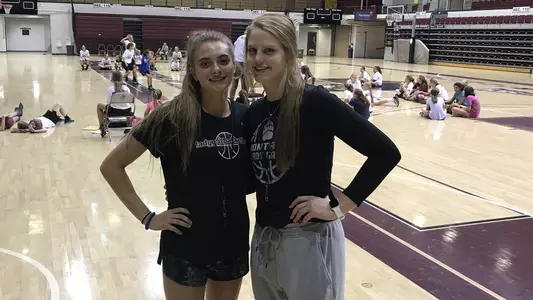
Different paths, same destination
7/3/2019 5:06:00 PM | Women's Basketball
In theory you could make the argument that Shelby Schweyen has everything she ever wanted sitting right in front of her, that missing a big chunk of her high school sporting career means little compared to the experiences she'll have the next four or five years playing for her mom and alongside her sister on the Lady Griz.
After all, she's been going to Montana's women's basketball games since she arrived in this world in time to take in the 2001-02 season.
Her mom was an assistant under Robin Selvig from the mid-90s until the legendary coach retired in the summer of 2016, when Shannon Schweyen was promoted to head coach.
Jordyn Schweyen, one year older than her sister, committed to the program first. Shelby would do the same a year later. And it was so perfect, so storybook, the girls photographed so many years ago in oversize Lady Griz uniforms wearing them for real as young women.
Everything else Shelby Schweyen did while she was a student at Sentinel High the last four years was just filler until she could realize her destiny, right, a whiling away of time?
Who cares if she played only two full volleyball seasons? Or only one basketball season at full strength? Or got to compete in two of four state track and field championships?
College and playing for the Lady Griz was always the thing that really mattered, right?
It brings her to tears when she attempts to tell you how wrong, how very wrong, you are.
It's a learned and mature perspective she now owns, one forced upon her when she tore her ACL during basketball season as a sophomore, then missed all but a handful of early-season volleyball matches as a senior due to more knee trouble.
It came from the dark places she not only visited but set up camp in as she watched the world -- and her teammates -- go on without her. It came from the worst kind of injury, the most frustrating, the one that gets misdiagnosed, human error compounding the recovery from the physical.
It's something that made its way to Helena, where Jamie Pickens, Montana's other incoming freshman and longtime friend of the Schweyen girls, was enjoying an idyllic prep career, 110 miles from Missoula but a world apart.
Three straight state championships to end her basketball career at Helena High. The Gatorade Montana Girls' Basketball Player of the Year as a junior and senior. A spot on the ESPN 100, a listing of the nation's top senior players.
And more: two times all-state in volleyball, three times in softball. And just because: Pickens placed second in the state at May's Class AA track and field championship in the javelin, throwing 129-5 as an event novice, a distance that would make her a Division I recruit in that sport.
And she did it all with a sense of appreciation, for the possibilities that each day, each competition, each opportunity afforded her. It was learned as well, but through association.
"When Shelby was getting hurt, I felt so bad for her, because we were pretty close," says Pickens. "It made me realize I was taking things for granted and wasn't enjoying every moment like I should have.
"I'd dread going to practice, then I'd remember that she was hurt and sitting out. I think it opened my eyes."
Schweyen never set out to be a trailblazer, unless it was to set the state abuzz as an athlete.
She was on Sentinel's state runner-up volleyball team as a freshman, then played on the Spartans' third-place basketball team before surpassing all of that with a standout performance at the state track and field championship.
Second place: 4x100 relay. Third place: high jump. Fourth place: 200 meters. Fifth place: long jump.
"A pretty athletic, talented, competitive athlete that was still pretty raw," is how her dad, Montana track and field coach Brian Schweyen, today describes what he saw out of his second daughter when she was a freshman.
"She was raw in the fine motor movements of sport to sport to sport, but from an unbiased standpoint of someone who's seen a lot of athletes, had she been healthy all the way through high school, I think she would be in the conversation as one of the better athletes the state has seen."
(Another athlete Schweyen puts on that list: Pickens, which says a lot about Montana's freshman class.)
A state volleyball title for Sentinel in the fall of 2016 was a tantalizing hint at what was to come as Schweyen moved into her sophomore year. More titles, more accolades, all of it.
Then one cold Montana night, which gets darker and darker when you learn the destruction it wrought, Sentinel was hosting Columbia Falls in what should have been a nondescript early-season basketball game, a warm-up on the road to a championship season.
In the first quarter, not long after her mom had taken her seat, Schweyen closed out on a Columbia Falls shooter and tripped herself off-balance in the process.
She put all her weight on her lead foot to catch herself while at the same time twisting to watch the shot make its way toward the basket. It was more load than her ACL could bear.
"Right away I felt my bones slide past each other and heard that big pop. Right away I knew what it was for sure," she says.
It came just a couple of months after Kayleigh Valley, the best player in the Big Sky Conference, did the same thing to her own knee at an early-season Lady Griz practice.
It's a common enough injury these days, particularly among female athletes, that it's easy to overlook the devastating results, both physical and emotional.
It's easier to gloss over the details and reduce it to: She'll be back in nine months, like it happens with a snap of the fingers, without giving any thought to what those nine months entail.
"I'd been around girls who had torn their ACLs, but I'd never really known the obstacles and darkness that follow and go with it," says Schweyen.
"I knew there would be a lot of obstacles to face, but I went to some places I don't ever want to go back to. It was tough. I learned a lot about myself and what I can do. I think I came out a better person."
While the time it takes varies from person to person, the recovery is somewhat straightforward. Surgery, rehab, baby steps, go. Some get there in as little as six months. Some take a full year.
She missed her sophomore track and field season and the most important summer recruiting period for basketball players.
She insists she's 100 percent happy at Montana, that it's a dream come true, but she still would have liked to know what other opportunities might have come her way. Can't a girl just be curious?
"Nothing probably would have changed my mind," she says, "but that's always in the back of your mind, that what if?"
She was able to make a return to the volleyball court later in the season her junior year, in time to enjoy the fruits of a second consecutive state championship, but that's a sport with movements that are more up and down, forward and backward, and there is a lack of contact with other players.
The return to the basketball court, where there is more cutting and change of pace, was slower. Beyond the physical was the mental hurdle. The basketball court is where Schweyen's injury had happened.
"I was always a little bit nervous, since basketball is where it happened. After a few games and a few weeks of practice, I started feeling like myself again," she says.
"The what-if started disappearing from the back of my mind. I was looking forward and not reflecting on the past anymore."
The season ended with a runner-up finish by four points to Pickens' Helena High team in the state championship game.
Then, finally, track and field season. She went 5-7 in the high jump at divisionals, then shook off a near disastrous start at state -- she needed to make her third and final attempt at 5-1, even then with the bar wobbling precariously after a touch -- before she could win, again at 5-7.
She was a champion in volleyball -- twice! -- and now a champion in track and field. She was trophy-less in basketball, but by that time she was a Lady Griz commit.
She'd made it all the way back, through the darkness, through the pain of physical therapy and rehab, past the mental challenges of putting all of one's faith back in a body that had revealed its frailties.
She was one year younger than a decorated graduating class at Sentinel, with one year to go as a Spartan. It wouldn't get any better this. Out of the shadows and into the spotlight as a senior, given her name, her talents and her past performances.
But there is a reason Pickens uses Schweyen's story as such a grounding example, of not taking things for granted. More was coming her way.
Early in Schweyen's final year as a volleyball player, she and Sentinel were facing Big Sky in a crosstown match. She came down on her repaired knee and felt something.
She'd felt "something" before, but it had always been an expected part of the recovery process. This was different. This was a little off.
"I shook it off and kept telling myself that it was no biggie, that it was just scar tissue," she says. "But I kept feeling this popping, so I was getting in my head, overreacting, thinking it was an ACL."
It didn't go away, so by the fourth set, she pulled herself out of the match.
Surgery. A tiny meniscus tear. Some clean-up of the ACL repair. Done. Should be ready for the start of basketball season. A setback but not as bad as before.
For as good as her knee should have started feeling during recovery, it never did. Something was still not right. She missed the rest of the volleyball season, then the start of basketball. Still, she was damaged and not getting better.
Her career was always supposed to be a string of successes at Sentinel, across multiple sports, then that was supposed to roll right into her career with the Lady Griz, like Pickens.
Now there were conversations taking place that no one could have anticipated.
"The toughest part was keeping her on a positive mindset and understanding that worst case scenario is that you don't ever play sports again," says her dad. "And that's okay. At some point everyone's sport career ends, and we never know when that day is.
"If she can't play again, that's okay. There is more to life than sports, but at that age for so many kids, sports are everything. It's their identity."
Because of an early start, Schweyen was done at school each day at 11:30 a.m., and that only made things worse. While she was at home, it felt like everyone else, at every school in every city everywhere, was going to practice, was doing what they loved.
And she was sidelined. And nobody knew what to do about it. "There was a lot of emptiness. The things I loved doing weren't there anymore," she says.
But nobody was going to just accept that she was injured and there was nothing that could be done about it. They found a specialist in Seattle and got an appointment.
"He pulled up my MRI and right away he saw the meniscus tear," says Schweyen. It wasn't the memory of the pain of the injury that brought on the tears last week. It was the thought of what could have been.
"It's frustrating knowing it had always been there and was just missed. Had it been fixed, my senior year would have been totally different. I could have had a final basketball season. I could have had a final track season."
Instead she sat. And perhaps you asked yourself, Is she just sitting out now so she's ready for her freshman season at Montana?
"Nothing could be farther from the truth," says her dad. "It destroyed her not being able to be out there playing. For as competitive as she is, she struggled through some tough times." Again.
Dad points to the missed competition. Daughter points to other things. The off-the-court time spent with your best friends. The chance to be the leader of a team. The opportunity to develop some confidence as a go-to basketball player in the sport she would be playing collegiately.
"It's not just the games, it's the experiences you share and make with your teammates. The bus rides, the dance parties in the locker room, the memories you make with friends you've known forever," she says.
"And I was finally going to be the leader. I was very excited for that. It was a new role I'd never done before, and I think it would have helped me in my college career. Losing my senior year was very tough, more difficult than the ACL."
Schweyen and Pickens were both on campus last week, working the Lady Griz overnight camp.
And they were where their paths have brought them. When camp had a late-afternoon break and the Lady Griz got the run of the court, Schweyen sat off to the side and watched her future teammates.
She can do most things in practice, but she is still on the long road back. She may redshirt this season, she may not, but it probably won't be for health reasons. She should be 100 percent by the time classes begin late next month.
But who even knows what 100 percent is for Schweyen? All anyone really has had is glimpses.
As for Pickens, three letters came to the mind of at least one person who was seeing her play in person for the first time: OMG. She is Big Sky-ready now. Today.
Most of the returning Lady Griz worked the camp. Most of them are remaining in Missoula for a bulk of the summer.
Maybe they feel the pressure of three straight non-Montana seasons and want to make it right. Maybe they see the major loss of talent the Big Sky had at the end of last season and want to be the team that steps into the void.
In either case, things feel ... different. Even Pickens has picked up on it.
"We were just talking about it. They said in past years, not a lot of players have stayed around. They want a change, and everyone is two feet in. Everyone wants to work 100 percent as hard as they can," she says.
"It's early to say, but it feels like I've played with them before, like we've played together for so long."
Brian Schweyen talks about it as a gift, the opportunity that his daughter has to make sporting memories beyond high school. He knows it's a chance only a handful of athletes get. As a coach, he learned it long ago, long before Shelby came along.
His daughter realizes it now as well.
Once upon a time it was so easy to see a future rolling out ahead of her, one both smooth and filled with success. Then the bumps in the road started arriving. Soon she was stranded, off to the side, broken down, while life rolled on without her.
So she keeps her focus on the future, on better days ahead. She's seen worse than having to pull out of a drill early, before it's done. At least she's out on the court, a talent ready to fully bloom, for the very first time.
"It's all given me a different perspective on life," she says. "Make sure you don't take anything for granted. Appreciate every day you're on the court. In a second it can be taken away."
After all, she's been going to Montana's women's basketball games since she arrived in this world in time to take in the 2001-02 season.
Her mom was an assistant under Robin Selvig from the mid-90s until the legendary coach retired in the summer of 2016, when Shannon Schweyen was promoted to head coach.
Jordyn Schweyen, one year older than her sister, committed to the program first. Shelby would do the same a year later. And it was so perfect, so storybook, the girls photographed so many years ago in oversize Lady Griz uniforms wearing them for real as young women.
Everything else Shelby Schweyen did while she was a student at Sentinel High the last four years was just filler until she could realize her destiny, right, a whiling away of time?
Who cares if she played only two full volleyball seasons? Or only one basketball season at full strength? Or got to compete in two of four state track and field championships?
College and playing for the Lady Griz was always the thing that really mattered, right?
It brings her to tears when she attempts to tell you how wrong, how very wrong, you are.
It's a learned and mature perspective she now owns, one forced upon her when she tore her ACL during basketball season as a sophomore, then missed all but a handful of early-season volleyball matches as a senior due to more knee trouble.
It came from the dark places she not only visited but set up camp in as she watched the world -- and her teammates -- go on without her. It came from the worst kind of injury, the most frustrating, the one that gets misdiagnosed, human error compounding the recovery from the physical.
It's something that made its way to Helena, where Jamie Pickens, Montana's other incoming freshman and longtime friend of the Schweyen girls, was enjoying an idyllic prep career, 110 miles from Missoula but a world apart.
Three straight state championships to end her basketball career at Helena High. The Gatorade Montana Girls' Basketball Player of the Year as a junior and senior. A spot on the ESPN 100, a listing of the nation's top senior players.
And more: two times all-state in volleyball, three times in softball. And just because: Pickens placed second in the state at May's Class AA track and field championship in the javelin, throwing 129-5 as an event novice, a distance that would make her a Division I recruit in that sport.
And she did it all with a sense of appreciation, for the possibilities that each day, each competition, each opportunity afforded her. It was learned as well, but through association.
"When Shelby was getting hurt, I felt so bad for her, because we were pretty close," says Pickens. "It made me realize I was taking things for granted and wasn't enjoying every moment like I should have.
"I'd dread going to practice, then I'd remember that she was hurt and sitting out. I think it opened my eyes."
Schweyen never set out to be a trailblazer, unless it was to set the state abuzz as an athlete.
She was on Sentinel's state runner-up volleyball team as a freshman, then played on the Spartans' third-place basketball team before surpassing all of that with a standout performance at the state track and field championship.
Second place: 4x100 relay. Third place: high jump. Fourth place: 200 meters. Fifth place: long jump.
"A pretty athletic, talented, competitive athlete that was still pretty raw," is how her dad, Montana track and field coach Brian Schweyen, today describes what he saw out of his second daughter when she was a freshman.
"She was raw in the fine motor movements of sport to sport to sport, but from an unbiased standpoint of someone who's seen a lot of athletes, had she been healthy all the way through high school, I think she would be in the conversation as one of the better athletes the state has seen."
(Another athlete Schweyen puts on that list: Pickens, which says a lot about Montana's freshman class.)
A state volleyball title for Sentinel in the fall of 2016 was a tantalizing hint at what was to come as Schweyen moved into her sophomore year. More titles, more accolades, all of it.
Then one cold Montana night, which gets darker and darker when you learn the destruction it wrought, Sentinel was hosting Columbia Falls in what should have been a nondescript early-season basketball game, a warm-up on the road to a championship season.
In the first quarter, not long after her mom had taken her seat, Schweyen closed out on a Columbia Falls shooter and tripped herself off-balance in the process.
She put all her weight on her lead foot to catch herself while at the same time twisting to watch the shot make its way toward the basket. It was more load than her ACL could bear.
"Right away I felt my bones slide past each other and heard that big pop. Right away I knew what it was for sure," she says.
It came just a couple of months after Kayleigh Valley, the best player in the Big Sky Conference, did the same thing to her own knee at an early-season Lady Griz practice.
It's a common enough injury these days, particularly among female athletes, that it's easy to overlook the devastating results, both physical and emotional.
It's easier to gloss over the details and reduce it to: She'll be back in nine months, like it happens with a snap of the fingers, without giving any thought to what those nine months entail.
"I'd been around girls who had torn their ACLs, but I'd never really known the obstacles and darkness that follow and go with it," says Schweyen.
"I knew there would be a lot of obstacles to face, but I went to some places I don't ever want to go back to. It was tough. I learned a lot about myself and what I can do. I think I came out a better person."
While the time it takes varies from person to person, the recovery is somewhat straightforward. Surgery, rehab, baby steps, go. Some get there in as little as six months. Some take a full year.
She missed her sophomore track and field season and the most important summer recruiting period for basketball players.
She insists she's 100 percent happy at Montana, that it's a dream come true, but she still would have liked to know what other opportunities might have come her way. Can't a girl just be curious?
"Nothing probably would have changed my mind," she says, "but that's always in the back of your mind, that what if?"
She was able to make a return to the volleyball court later in the season her junior year, in time to enjoy the fruits of a second consecutive state championship, but that's a sport with movements that are more up and down, forward and backward, and there is a lack of contact with other players.
The return to the basketball court, where there is more cutting and change of pace, was slower. Beyond the physical was the mental hurdle. The basketball court is where Schweyen's injury had happened.
"I was always a little bit nervous, since basketball is where it happened. After a few games and a few weeks of practice, I started feeling like myself again," she says.
"The what-if started disappearing from the back of my mind. I was looking forward and not reflecting on the past anymore."
The season ended with a runner-up finish by four points to Pickens' Helena High team in the state championship game.
Then, finally, track and field season. She went 5-7 in the high jump at divisionals, then shook off a near disastrous start at state -- she needed to make her third and final attempt at 5-1, even then with the bar wobbling precariously after a touch -- before she could win, again at 5-7.
She was a champion in volleyball -- twice! -- and now a champion in track and field. She was trophy-less in basketball, but by that time she was a Lady Griz commit.
She'd made it all the way back, through the darkness, through the pain of physical therapy and rehab, past the mental challenges of putting all of one's faith back in a body that had revealed its frailties.
She was one year younger than a decorated graduating class at Sentinel, with one year to go as a Spartan. It wouldn't get any better this. Out of the shadows and into the spotlight as a senior, given her name, her talents and her past performances.
But there is a reason Pickens uses Schweyen's story as such a grounding example, of not taking things for granted. More was coming her way.
Early in Schweyen's final year as a volleyball player, she and Sentinel were facing Big Sky in a crosstown match. She came down on her repaired knee and felt something.
She'd felt "something" before, but it had always been an expected part of the recovery process. This was different. This was a little off.
"I shook it off and kept telling myself that it was no biggie, that it was just scar tissue," she says. "But I kept feeling this popping, so I was getting in my head, overreacting, thinking it was an ACL."
It didn't go away, so by the fourth set, she pulled herself out of the match.
Surgery. A tiny meniscus tear. Some clean-up of the ACL repair. Done. Should be ready for the start of basketball season. A setback but not as bad as before.
For as good as her knee should have started feeling during recovery, it never did. Something was still not right. She missed the rest of the volleyball season, then the start of basketball. Still, she was damaged and not getting better.
Her career was always supposed to be a string of successes at Sentinel, across multiple sports, then that was supposed to roll right into her career with the Lady Griz, like Pickens.
Now there were conversations taking place that no one could have anticipated.
"The toughest part was keeping her on a positive mindset and understanding that worst case scenario is that you don't ever play sports again," says her dad. "And that's okay. At some point everyone's sport career ends, and we never know when that day is.
"If she can't play again, that's okay. There is more to life than sports, but at that age for so many kids, sports are everything. It's their identity."
Because of an early start, Schweyen was done at school each day at 11:30 a.m., and that only made things worse. While she was at home, it felt like everyone else, at every school in every city everywhere, was going to practice, was doing what they loved.
And she was sidelined. And nobody knew what to do about it. "There was a lot of emptiness. The things I loved doing weren't there anymore," she says.
But nobody was going to just accept that she was injured and there was nothing that could be done about it. They found a specialist in Seattle and got an appointment.
"He pulled up my MRI and right away he saw the meniscus tear," says Schweyen. It wasn't the memory of the pain of the injury that brought on the tears last week. It was the thought of what could have been.
"It's frustrating knowing it had always been there and was just missed. Had it been fixed, my senior year would have been totally different. I could have had a final basketball season. I could have had a final track season."
Instead she sat. And perhaps you asked yourself, Is she just sitting out now so she's ready for her freshman season at Montana?
"Nothing could be farther from the truth," says her dad. "It destroyed her not being able to be out there playing. For as competitive as she is, she struggled through some tough times." Again.
Dad points to the missed competition. Daughter points to other things. The off-the-court time spent with your best friends. The chance to be the leader of a team. The opportunity to develop some confidence as a go-to basketball player in the sport she would be playing collegiately.
"It's not just the games, it's the experiences you share and make with your teammates. The bus rides, the dance parties in the locker room, the memories you make with friends you've known forever," she says.
"And I was finally going to be the leader. I was very excited for that. It was a new role I'd never done before, and I think it would have helped me in my college career. Losing my senior year was very tough, more difficult than the ACL."
Schweyen and Pickens were both on campus last week, working the Lady Griz overnight camp.
And they were where their paths have brought them. When camp had a late-afternoon break and the Lady Griz got the run of the court, Schweyen sat off to the side and watched her future teammates.
She can do most things in practice, but she is still on the long road back. She may redshirt this season, she may not, but it probably won't be for health reasons. She should be 100 percent by the time classes begin late next month.
But who even knows what 100 percent is for Schweyen? All anyone really has had is glimpses.
As for Pickens, three letters came to the mind of at least one person who was seeing her play in person for the first time: OMG. She is Big Sky-ready now. Today.
Most of the returning Lady Griz worked the camp. Most of them are remaining in Missoula for a bulk of the summer.
Maybe they feel the pressure of three straight non-Montana seasons and want to make it right. Maybe they see the major loss of talent the Big Sky had at the end of last season and want to be the team that steps into the void.
In either case, things feel ... different. Even Pickens has picked up on it.
"We were just talking about it. They said in past years, not a lot of players have stayed around. They want a change, and everyone is two feet in. Everyone wants to work 100 percent as hard as they can," she says.
"It's early to say, but it feels like I've played with them before, like we've played together for so long."
Brian Schweyen talks about it as a gift, the opportunity that his daughter has to make sporting memories beyond high school. He knows it's a chance only a handful of athletes get. As a coach, he learned it long ago, long before Shelby came along.
His daughter realizes it now as well.
Once upon a time it was so easy to see a future rolling out ahead of her, one both smooth and filled with success. Then the bumps in the road started arriving. Soon she was stranded, off to the side, broken down, while life rolled on without her.
So she keeps her focus on the future, on better days ahead. She's seen worse than having to pull out of a drill early, before it's done. At least she's out on the court, a talent ready to fully bloom, for the very first time.
"It's all given me a different perspective on life," she says. "Make sure you don't take anything for granted. Appreciate every day you're on the court. In a second it can be taken away."
Players Mentioned

F
/ Women's Basketball
G
/ Women's Basketball
G
/ Women's Basketball
F
/ Women's BasketballFriday, June 19
Thursday, June 04
Friday, May 01
Friday, May 01