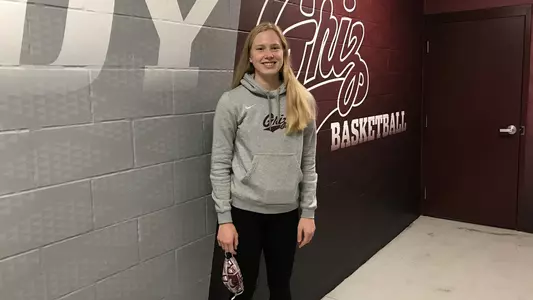
Freshman orientation with Willa Albrecht
10/16/2020 6:51:00 PM | Women's Basketball
Willa Albrecht wouldn't be here, in the most existential sense, according to family lore, had her dad not known how to read and react to an on-ball screen.
He was in Sheridan, Wyoming, that summer, doing graduate research on birds. He found his way most days to the local YMCA. Some older guys would gather at noon to play a little ball. They called it the Rawhide League.
She was in town as well, done studying and playing at Dartmouth, on her way to medical school, wrapping up some pre-requisites while back home. She was usually the only woman among the men in the midday games.
He wouldn't have known this: That Liz Walter had been the Ivy League Player of the Year in both 1987 and '88, averaging 17.0 points as a junior, 18.8 as a senior as the Big Green was winning five straight Ivy titles.
Her coach back then, Jacquie Hullah, who would turn her program's success at Dartmouth into the head job at Arizona State in 1993, remembers that player well, even today.
"I have so many fond memories of coaching Liz," says Hullah, now the head coach at Carnegie Mellon. "One of my favorites occurred during a practice her freshman year.
"I was challenging her to play better defense. She stopped, smiled and said, 'Coach, my philosophy of defense is to outscore your man!' She did just that."
She was still on top of her high-scoring game that summer back in Sheridan, lighting up the guys on a daily basis.
Dan Albrecht had played basketball as a freshman in high school back in his hometown of Sparta, Wisconsin. That was it for organized basketball. Anything else was just done for fun. Like the Rawhide League.
The story goes that on one of the days both Liz and Dan were playing at the Y, another player set a high ball screen for her. Dan got around it, blocked her shot and took it to the other end for an easy layup.
It didn't sit well.
Today her twin daughters are known for their athleticism. "Freaks of nature," their coach at Billings West, Charlie Johnson, says. Six feet, both, among the top basketball players and sprinters in the state, not always a traditional combination.
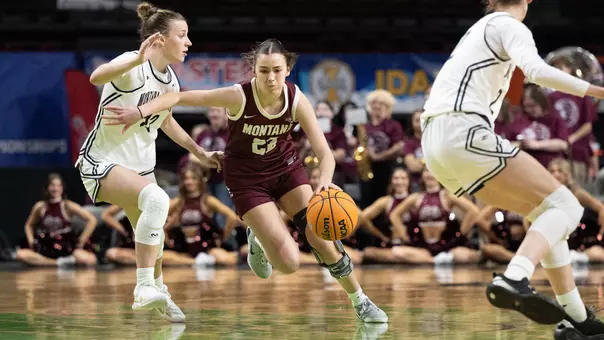
"Willa has athleticism that is hard to find at her size," says Lady Griz assistant coach Jordan Sullivan, who was asked this week to be a baseline measurement for those of us who have yet to see Albrecht in a game setting.
How would she as a player and Willa compare?
"She's way more athletic. Have you seen her calves? Have you seen mine? We're not on the same athletic playing field."
Willa and Maddie, who is a freshman at Lehigh, got some of that from their mom. Then they went back for seconds and thirds until they were told they'd reached their limit.
"She says we're a lot different," says Willa. "Not better or worse. She says she was never super athletic. She would just work super hard and outwork the competition. And she says she was super mean."
It worked. "She dominated the game on both ends of the court. She was a talented scorer, a tenacious rebounder and a fierce competitor. The bigger the game, the bigger she played," says Hullah.
The game at the Y that day wasn't big, but it was competition, with a winner and a loser. That meant she was all in. Then an out-of-towner, who hadn't played beyond ninth grade, showed her up.
"It about wanted to make her kill me, I think," says Dan. Instead, they got married, a dichotomous couple, she from a family of talkers, he the product of his German-Scandinavian heritage.
"His family talks but only when something needs to be said," says Liz of her in-laws.
To see Willa is to see those two sides come to life. Johnson describes her as "silent but deadly." Sullivan has come to calling the first-year player "Willa the Killa."
For this article, she took part in a conversation that went a few seconds shy of 40 minutes.
"I'm not sure we had 39 minutes of conversations in her four years," says Johnson. Her mom adds, "That's more than we get out of her in a month." Not a big talker, that Willa.
But soft-spoken, in this case, shouldn't be misconstrued as meekness or someone overly gentle in nature or lacking confidence.
Asked who among the Lady Griz would win a race of 100 meters should the team spend part of a practice at Dornblaser Field, Albrecht does not hesitate. "Me. No question."
She says she would expect a challenge from Sophia Stiles. Maybe Kyndall Keller or Jordyn Schweyen. "But my top-end speed is faster than theirs. I'd pull away."
There it is, the Killa part. It's coming out in practice, but slowly. Too slowly for some.
"She's just starting to get an idea of what she can be," says Sullivan. "She needs to unleash the beast. We're all like, stop harnessing! Just let it out. Let it go. Let it be free."
It's a big ask of someone who turned down the volleyball coaches at West High, who saw the size and strength and athleticism and fantasized about what that could do to a ball and an opponent.
At first, back in fifth grade, the turnoff was the pace of play. If a serve did make it over the net, it rarely made it back to the other side. Point over. Yawn.
Years later, when those coaches asked her about giving the sport a second chance, how were they supposed to know the sport's camaraderie, so inviting to some, was what would keep her from saying yes.
"I just didn't get all the cheering. I didn't think I could do all that. I get celebrating, but I think it's excessive in volleyball. It's over the top. I don't get it. At all," she says.
"That sounds like Willa," first-year Lady Griz coach Mike Petrino says. He can smile about it, but he also needs to address it. He doesn't need a cheerleader, but he needs his players to be expressive on the court.
Successful defenses at the college level are reliant on communication. The more vocal the better. "Your voice is part of your skillset," he says. "Her voice needs to be more active."
Her junior year, when West had six seniors, three of whom would go on to play college basketball, was ideal. She was a starter but just fine being a quiet, efficient cog on a team that would lose in the state championship game to Jamie Pickens and Helena High.
"Willa makes the right basketball play about 99 percent of the time," says Johnson.
When she and her sister were seniors, when it was "their time," to use the idea of players coming up through the system, waiting their time to blossom into vocal leaders, Johnson had everything mapped out in his head.
Both would average better than 15 points per game and the winning would continue. But that would happen only if he could get a round peg into a square hole. He probably could have forced it, but why?
"I think they could have been, but they had that mentality that they wanted to get others involved, too," says Johnson. "Once I started not being hard-headed about that, that's when we started skyrocketing."
After losing three of its first five games, West won 17 straight, including two wins by a combined 40 points as the Golden Bears won their quarterfinal and semifinal games at the state tournament, which is when their run came to an end, along with sports everywhere last March.
But this story begins before that summer in Sheridan, playing at the Y. It dates back to Liz Walter's dad, a pathologist, raised on the East Coast but called west by his love of fishing.
She had offers at more traditional Division I basketball schools, but she chose the Ivy League because it would set her up better for life when that orange ball stopped bouncing.
"I was pretty determined to make sure that I got an education, and I had some concerns that perhaps I would not be able to take the type of coursework I wanted. That made the Ivy League pretty attractive," she says.
It wasn't a culture shock, moving from Sheridan to Hanover, New Hampshire. But she missed the wide-open spaces where she'd been raised. Everywhere she went, it came with an obstructed-view seat of the sky.
"The trees made me claustrophobic. It was a pretty big adjustment for me," she says. The basketball court, however, felt like home, as it always did.
She would finish with 1,286 career points. She still ranks 11th in program history in scoring, seventh in rebounding. "Just a champion on and off the court," says Hullah.
She would go from Dartmouth to medical school at New Mexico to a residency at Yale, back on the East Coast in Connecticut, before she landed a job as a psychiatrist at Billings Clinic.
"I missed the West," she says. And the wide-open spaces. When Billings itself started to feel like there wasn't enough elbow room, the family moved outside of town to Molt a few years back and settled on a few hundred acres of open.
There are some horses and chickens. Mostly it's just open, blessed open.
After going to St. Olaf in Minnesota, Dan studied at North Dakota, Indiana and finally New Mexico, where he got his Ph.D. He is a professor of biology at Rocky Mountain College in Billings.
She had a hunch -- call it an early version of mother's intuition -- back then that she was working on twins. She thought she was getting a little bigger than she would have expected.
They told her it was because she was tall. She said, okay, they were the experts. Then they did the first ultrasound. "Nope, two," she says. "Whoa."
Going from zero to two was an adjustment. It only added to the new stress in their lives when Willa had to be flown to Stanford at the age of one day for a cardiac issue.
It was resolved within a few days, but "it was a difficult time," Liz says. "With that and twins and kids awake all night, I think both of us were thinking, that was a lot."
There is a belief that twins have an extra-special bond that none of us non-pairs could ever understand. And maybe that's true in some cases.
Willa, more pragmatic than mystical, says she and Maddie are close but that it comes mostly from a lifetime spent doing the same things together from their earliest memories, not that they are tethered together in a way none of us can recognize. To her, they are sisters, no more, no less.
When Maddie went on an official visit last year that took three days, it was the first time in their lives -- outside of that week-one visit to Stanford -- that they had been apart for more than a day.
"Just together all the time, doing the same things, mostly taking the same classes and being on the same teams. That's what made us tighter," she says.
There were pros -- having a go-to friend when they went someplace different or tried something new -- and cons -- always being compared to each other -- all of it resulting in a competitiveness in both of them that shown through in both athletics and academics.
"Since we were always doing the same thing, she pushed me to be better," Willa says. "If she did something, I wanted to do the same thing. And I wanted to be better than her at it."
At their games, their parents expressed their personalities. Dan sat and quietly took it all in. Liz? "If she sat through one of them, I'd be surprised," says Johnson. "She liked to pace back and forth. Dan was the opposite."
That's the player, the competitor, inside of her for life.
"I can be a little on the intense side sometimes," she says. "I wasn't so good at sitting still. Sometimes I'd mutter things, and I don't want to do that in polite company."
Willa would be most like their dad, Maddie their mom, though Dan stresses that's relative, just like on a scale of 1 to 100, five is more than four but both are far, far away from the top end of the scale.
"Liz and Maddie are a little more outwardly intense. Willa and I get the job done, just not in the same way," Dan says. "This is all relative. Both are pretty quiet kids."
With basketball taking up their winters but the fall and spring void of sports, both found the track as freshmen.
They were naturals, in the sprints, despite their size. Willa looks like she could eat up a 400 meters, strong and long as she is, but 200 was as far as she ever wanted to go. Even that felt like a bit much.
She never had a desire to try distance running, which by her definition was anything that involved going around more than one curve of the oval.
"The 400 is distance to me. I feel like the 300 hurdles would be distance, so I just went to sprints," she says.
She qualified for state in the 100 meters as a freshman. She missed out on finals by three one-thousandths of a second.
She and Maddie both competed in the 200 meters. Willa advanced to finals, where she finished eighth. Maddie was out in the prelims.
That's where the challenge of having twins comes or any kids who might be close in age and engaged in the same sports or activities, when there starts to be winners and losers.
Arm around one girl, consoling her, arm around the other, celebrating her achievement.
"You wanted each of them to have similar accomplishments and similar successes," says Liz. "That's not always the case, and it was hard."
Teams, even on the track, made that easier. Both made finals in the 100 and 200 meters as sophomores.
Then, something shared: They ran the first and second legs of West's 4x100-meter relay team that clocked a winning time of 47.56. It was a stadium record, a Class AA record, an all-class record.
As juniors, both were top three in the 100 and 200 meters. Bozeman's Delaney Bahn? She won both races and was recognized for her individual effort.
For Maddie and Willa? It was always "the twins" who finished second and third, always looked at as one, as if it was a collective effort, in a way that, unintentionally, always seemed to minimize the accomplishment of two separate people, as if they had somehow pulled each other along.
"That can be hard when you want them to be recognized as individuals," says their mom.
"It was really important to them as they moved into college that they go different places. They wanted to develop their own interests and be seen as separate."
They'll get that chance thanks to basketball and the 2,300 miles between Missoula and Bethlehem, which is where Lehigh, competing as it does in the Patriot League, is located in Pennsylvania.
They've always been seen together, playing together, compared to each other. Now, one is in the process of becoming Maddie. Just Maddie. The other Willa. Just Willa.
That either has a twin sister will soon no longer be their defining characteristic. It will become secondary, a mere novelty as they make their own way, write their own story in a book -- call it Part II -- that began in August.
"The one thing they were adamant about was they wanted to go to separate colleges. They are their own person, so I'm not surprised that they wanted to split up," says Johnson.
He understands why the assumption would have been that they wanted to play together in college. They were not just sisters but twins, and they played so well together on Johnson's teams.
They made that run to the state title game in 2018-19, when they came up against Pickens, whose team had won the state title the previous two seasons.
"I thought we could dethrone the champs," says Johnson, whose team lost an ugly game, 55-37. "Helena High played like they had been there. We played like we hadn't."
Last season there were the early losses to Helena Capital, Hellgate and Billings Central. Then the 17 straight wins.
The title game would have matched West, at 19-3, against Capital, at 21-1. The former had won its first two tournament games by a combined 40 points, the latter by 22.
"Two really good teams. I thought it was maybe going to be the best game in all the state tournaments," says Johnson.
The first domino to go, the suspension of the NBA, came on March 11, Wednesday of tournament week. The games continued but administrators kept one eye on the courts, one of the news.
Thursday's quarterfinals were played, then Friday's semifinals. That night the West girls returned to Brick Breeden Fieldhouse in Bozeman to watch the school's boys' team play Hellgate.
"It's one of those moments I hope I don't ever have to do again," says Johnson, who was sitting with the West High AD for the game.
"I got a ping on my phone that said there was a (confirmed COVID-19) case in Montana. I thought, uh-oh. Then the AD got the memo saying they were going to cancel the tournament."
He walked his team to a back hallway, probably breaking news that they were expecting but hoping would never come.
"Lots of shocked, stunned faces. Tears in the eyes. Sports is a great area to learn life lessons. That was one of them," he says.
"There was disbelief that we weren't going to have one more crack at Capital. I don't think Willa and Maddie were going to let us lose that game. They were playing at another level."
"I think we would have won," says Willa. "When we played them the first time, we lost by one point, and we got so much better by the end of the year.
"I think it would have been a close game but we would have won. Maybe by 10 or something like that."
After a final summer as The Twins, they went their separate ways, on the road to becoming Willa and Maddie.
Willa left first, for Missoula. Maddie left two weeks later, for Bethlehem.
"The idea of being apart, being your own person, was really appealing," Willa says. "I thought it would be really weird. I don't know what I was expecting it to be like, but it isn't as weird as I thought it would be."
There are players, who did just fine in high school, for whom college basketball is an unexpected blessing, a test they have yet to take but have the tools to pass easily. They just don't know it.
Without needing to (or realizing it), they didn't have to tap into their best stuff as a prep. They got the rebound without having to go all out, just because of their superior athleticism.
They could have scored 20 points but only needed to put up 10 because their team was balanced enough and their team won anyway.
They didn't need to be perfect communicators, because they could just fix it with a ridiculous blocked shot.
The college game, then, will (or should), bring out the best of those players, requiring a new level of play they didn't know they had.
That's Albrecht. "She has as big of an upside as anyone on this team," says Petrino, who doesn't say that it's mostly already there. She just needs to let it come out.
"She has no idea," adds Sullivan, "but she might be getting an idea of what she can be. Sometimes she does something and that's how you know she's capable. You're like, why aren't you doing that all the time?"
Silent but deadly is a fun idea. But it doesn't play effective team defense. Why didn't you call out that back screen!? Loud and deadly wins games and championships.
"What is she ever thinking? Does she want to smack me? Then smack me. You want to see that emotion," says Sullivan. "Some days I just want her to yell at me, fire off something."
She wants to see the beast unleashed, not just physically but vocally. Because there is a lot there, a lot there to like.
Albrecht can score from the perimeter. She can score inside. She can guard the perimeter, she can defend the post. And who would you rather have running the wing in transition?
"She is a little bit of everything, with extreme athleticism," says Sullivan.
Petrino, when asked about Albrecht, says it reminds him of the story about Calvin Coolidge, the nation's 30th president known for his quiet ways.
Someone seated at a dinner table with "Silent Cal" back in the 1920s told him of the bet they'd made, that they could get the president to say more than three words. "You lose," he said. That's Albrecht too.
It will be an interesting dilemma to watch play out, a player's nature versus the need for her to be more vocal on the court for the betterment of the team.
Coolidge one time said, "I have noticed that nothing I have never said ever did me any harm."
But that on-ball screen, like the one that's responsible for her being here, existentially speaking, in the first place? That needs to be called out, early and with gusto, or harm will ensue. That's just basketball.
He was in Sheridan, Wyoming, that summer, doing graduate research on birds. He found his way most days to the local YMCA. Some older guys would gather at noon to play a little ball. They called it the Rawhide League.
She was in town as well, done studying and playing at Dartmouth, on her way to medical school, wrapping up some pre-requisites while back home. She was usually the only woman among the men in the midday games.
He wouldn't have known this: That Liz Walter had been the Ivy League Player of the Year in both 1987 and '88, averaging 17.0 points as a junior, 18.8 as a senior as the Big Green was winning five straight Ivy titles.
Her coach back then, Jacquie Hullah, who would turn her program's success at Dartmouth into the head job at Arizona State in 1993, remembers that player well, even today.
"I have so many fond memories of coaching Liz," says Hullah, now the head coach at Carnegie Mellon. "One of my favorites occurred during a practice her freshman year.
"I was challenging her to play better defense. She stopped, smiled and said, 'Coach, my philosophy of defense is to outscore your man!' She did just that."
She was still on top of her high-scoring game that summer back in Sheridan, lighting up the guys on a daily basis.
Dan Albrecht had played basketball as a freshman in high school back in his hometown of Sparta, Wisconsin. That was it for organized basketball. Anything else was just done for fun. Like the Rawhide League.
The story goes that on one of the days both Liz and Dan were playing at the Y, another player set a high ball screen for her. Dan got around it, blocked her shot and took it to the other end for an easy layup.
It didn't sit well.
Today her twin daughters are known for their athleticism. "Freaks of nature," their coach at Billings West, Charlie Johnson, says. Six feet, both, among the top basketball players and sprinters in the state, not always a traditional combination.
"Willa has athleticism that is hard to find at her size," says Lady Griz assistant coach Jordan Sullivan, who was asked this week to be a baseline measurement for those of us who have yet to see Albrecht in a game setting.
How would she as a player and Willa compare?
"She's way more athletic. Have you seen her calves? Have you seen mine? We're not on the same athletic playing field."
Willa and Maddie, who is a freshman at Lehigh, got some of that from their mom. Then they went back for seconds and thirds until they were told they'd reached their limit.
"She says we're a lot different," says Willa. "Not better or worse. She says she was never super athletic. She would just work super hard and outwork the competition. And she says she was super mean."
It worked. "She dominated the game on both ends of the court. She was a talented scorer, a tenacious rebounder and a fierce competitor. The bigger the game, the bigger she played," says Hullah.
The game at the Y that day wasn't big, but it was competition, with a winner and a loser. That meant she was all in. Then an out-of-towner, who hadn't played beyond ninth grade, showed her up.
"It about wanted to make her kill me, I think," says Dan. Instead, they got married, a dichotomous couple, she from a family of talkers, he the product of his German-Scandinavian heritage.
"His family talks but only when something needs to be said," says Liz of her in-laws.
To see Willa is to see those two sides come to life. Johnson describes her as "silent but deadly." Sullivan has come to calling the first-year player "Willa the Killa."
For this article, she took part in a conversation that went a few seconds shy of 40 minutes.
"I'm not sure we had 39 minutes of conversations in her four years," says Johnson. Her mom adds, "That's more than we get out of her in a month." Not a big talker, that Willa.
But soft-spoken, in this case, shouldn't be misconstrued as meekness or someone overly gentle in nature or lacking confidence.
Asked who among the Lady Griz would win a race of 100 meters should the team spend part of a practice at Dornblaser Field, Albrecht does not hesitate. "Me. No question."
She says she would expect a challenge from Sophia Stiles. Maybe Kyndall Keller or Jordyn Schweyen. "But my top-end speed is faster than theirs. I'd pull away."
There it is, the Killa part. It's coming out in practice, but slowly. Too slowly for some.
"She's just starting to get an idea of what she can be," says Sullivan. "She needs to unleash the beast. We're all like, stop harnessing! Just let it out. Let it go. Let it be free."
It's a big ask of someone who turned down the volleyball coaches at West High, who saw the size and strength and athleticism and fantasized about what that could do to a ball and an opponent.
At first, back in fifth grade, the turnoff was the pace of play. If a serve did make it over the net, it rarely made it back to the other side. Point over. Yawn.
Years later, when those coaches asked her about giving the sport a second chance, how were they supposed to know the sport's camaraderie, so inviting to some, was what would keep her from saying yes.
"I just didn't get all the cheering. I didn't think I could do all that. I get celebrating, but I think it's excessive in volleyball. It's over the top. I don't get it. At all," she says.
"That sounds like Willa," first-year Lady Griz coach Mike Petrino says. He can smile about it, but he also needs to address it. He doesn't need a cheerleader, but he needs his players to be expressive on the court.
Successful defenses at the college level are reliant on communication. The more vocal the better. "Your voice is part of your skillset," he says. "Her voice needs to be more active."
Her junior year, when West had six seniors, three of whom would go on to play college basketball, was ideal. She was a starter but just fine being a quiet, efficient cog on a team that would lose in the state championship game to Jamie Pickens and Helena High.
"Willa makes the right basketball play about 99 percent of the time," says Johnson.
When she and her sister were seniors, when it was "their time," to use the idea of players coming up through the system, waiting their time to blossom into vocal leaders, Johnson had everything mapped out in his head.
Both would average better than 15 points per game and the winning would continue. But that would happen only if he could get a round peg into a square hole. He probably could have forced it, but why?
"I think they could have been, but they had that mentality that they wanted to get others involved, too," says Johnson. "Once I started not being hard-headed about that, that's when we started skyrocketing."
After losing three of its first five games, West won 17 straight, including two wins by a combined 40 points as the Golden Bears won their quarterfinal and semifinal games at the state tournament, which is when their run came to an end, along with sports everywhere last March.
But this story begins before that summer in Sheridan, playing at the Y. It dates back to Liz Walter's dad, a pathologist, raised on the East Coast but called west by his love of fishing.
She had offers at more traditional Division I basketball schools, but she chose the Ivy League because it would set her up better for life when that orange ball stopped bouncing.
"I was pretty determined to make sure that I got an education, and I had some concerns that perhaps I would not be able to take the type of coursework I wanted. That made the Ivy League pretty attractive," she says.
It wasn't a culture shock, moving from Sheridan to Hanover, New Hampshire. But she missed the wide-open spaces where she'd been raised. Everywhere she went, it came with an obstructed-view seat of the sky.
"The trees made me claustrophobic. It was a pretty big adjustment for me," she says. The basketball court, however, felt like home, as it always did.
She would finish with 1,286 career points. She still ranks 11th in program history in scoring, seventh in rebounding. "Just a champion on and off the court," says Hullah.
She would go from Dartmouth to medical school at New Mexico to a residency at Yale, back on the East Coast in Connecticut, before she landed a job as a psychiatrist at Billings Clinic.
"I missed the West," she says. And the wide-open spaces. When Billings itself started to feel like there wasn't enough elbow room, the family moved outside of town to Molt a few years back and settled on a few hundred acres of open.
There are some horses and chickens. Mostly it's just open, blessed open.
After going to St. Olaf in Minnesota, Dan studied at North Dakota, Indiana and finally New Mexico, where he got his Ph.D. He is a professor of biology at Rocky Mountain College in Billings.
She had a hunch -- call it an early version of mother's intuition -- back then that she was working on twins. She thought she was getting a little bigger than she would have expected.
They told her it was because she was tall. She said, okay, they were the experts. Then they did the first ultrasound. "Nope, two," she says. "Whoa."
Going from zero to two was an adjustment. It only added to the new stress in their lives when Willa had to be flown to Stanford at the age of one day for a cardiac issue.
It was resolved within a few days, but "it was a difficult time," Liz says. "With that and twins and kids awake all night, I think both of us were thinking, that was a lot."
There is a belief that twins have an extra-special bond that none of us non-pairs could ever understand. And maybe that's true in some cases.
Willa, more pragmatic than mystical, says she and Maddie are close but that it comes mostly from a lifetime spent doing the same things together from their earliest memories, not that they are tethered together in a way none of us can recognize. To her, they are sisters, no more, no less.
When Maddie went on an official visit last year that took three days, it was the first time in their lives -- outside of that week-one visit to Stanford -- that they had been apart for more than a day.
"Just together all the time, doing the same things, mostly taking the same classes and being on the same teams. That's what made us tighter," she says.
There were pros -- having a go-to friend when they went someplace different or tried something new -- and cons -- always being compared to each other -- all of it resulting in a competitiveness in both of them that shown through in both athletics and academics.
"Since we were always doing the same thing, she pushed me to be better," Willa says. "If she did something, I wanted to do the same thing. And I wanted to be better than her at it."
At their games, their parents expressed their personalities. Dan sat and quietly took it all in. Liz? "If she sat through one of them, I'd be surprised," says Johnson. "She liked to pace back and forth. Dan was the opposite."
That's the player, the competitor, inside of her for life.
"I can be a little on the intense side sometimes," she says. "I wasn't so good at sitting still. Sometimes I'd mutter things, and I don't want to do that in polite company."
Willa would be most like their dad, Maddie their mom, though Dan stresses that's relative, just like on a scale of 1 to 100, five is more than four but both are far, far away from the top end of the scale.
"Liz and Maddie are a little more outwardly intense. Willa and I get the job done, just not in the same way," Dan says. "This is all relative. Both are pretty quiet kids."
With basketball taking up their winters but the fall and spring void of sports, both found the track as freshmen.
They were naturals, in the sprints, despite their size. Willa looks like she could eat up a 400 meters, strong and long as she is, but 200 was as far as she ever wanted to go. Even that felt like a bit much.
She never had a desire to try distance running, which by her definition was anything that involved going around more than one curve of the oval.
"The 400 is distance to me. I feel like the 300 hurdles would be distance, so I just went to sprints," she says.
She qualified for state in the 100 meters as a freshman. She missed out on finals by three one-thousandths of a second.
She and Maddie both competed in the 200 meters. Willa advanced to finals, where she finished eighth. Maddie was out in the prelims.
That's where the challenge of having twins comes or any kids who might be close in age and engaged in the same sports or activities, when there starts to be winners and losers.
Arm around one girl, consoling her, arm around the other, celebrating her achievement.
"You wanted each of them to have similar accomplishments and similar successes," says Liz. "That's not always the case, and it was hard."
Teams, even on the track, made that easier. Both made finals in the 100 and 200 meters as sophomores.
Then, something shared: They ran the first and second legs of West's 4x100-meter relay team that clocked a winning time of 47.56. It was a stadium record, a Class AA record, an all-class record.
As juniors, both were top three in the 100 and 200 meters. Bozeman's Delaney Bahn? She won both races and was recognized for her individual effort.
For Maddie and Willa? It was always "the twins" who finished second and third, always looked at as one, as if it was a collective effort, in a way that, unintentionally, always seemed to minimize the accomplishment of two separate people, as if they had somehow pulled each other along.
"That can be hard when you want them to be recognized as individuals," says their mom.
"It was really important to them as they moved into college that they go different places. They wanted to develop their own interests and be seen as separate."
They'll get that chance thanks to basketball and the 2,300 miles between Missoula and Bethlehem, which is where Lehigh, competing as it does in the Patriot League, is located in Pennsylvania.
They've always been seen together, playing together, compared to each other. Now, one is in the process of becoming Maddie. Just Maddie. The other Willa. Just Willa.
That either has a twin sister will soon no longer be their defining characteristic. It will become secondary, a mere novelty as they make their own way, write their own story in a book -- call it Part II -- that began in August.
"The one thing they were adamant about was they wanted to go to separate colleges. They are their own person, so I'm not surprised that they wanted to split up," says Johnson.
He understands why the assumption would have been that they wanted to play together in college. They were not just sisters but twins, and they played so well together on Johnson's teams.
They made that run to the state title game in 2018-19, when they came up against Pickens, whose team had won the state title the previous two seasons.
"I thought we could dethrone the champs," says Johnson, whose team lost an ugly game, 55-37. "Helena High played like they had been there. We played like we hadn't."
Last season there were the early losses to Helena Capital, Hellgate and Billings Central. Then the 17 straight wins.
The title game would have matched West, at 19-3, against Capital, at 21-1. The former had won its first two tournament games by a combined 40 points, the latter by 22.
"Two really good teams. I thought it was maybe going to be the best game in all the state tournaments," says Johnson.
The first domino to go, the suspension of the NBA, came on March 11, Wednesday of tournament week. The games continued but administrators kept one eye on the courts, one of the news.
Thursday's quarterfinals were played, then Friday's semifinals. That night the West girls returned to Brick Breeden Fieldhouse in Bozeman to watch the school's boys' team play Hellgate.
"It's one of those moments I hope I don't ever have to do again," says Johnson, who was sitting with the West High AD for the game.
"I got a ping on my phone that said there was a (confirmed COVID-19) case in Montana. I thought, uh-oh. Then the AD got the memo saying they were going to cancel the tournament."
He walked his team to a back hallway, probably breaking news that they were expecting but hoping would never come.
"Lots of shocked, stunned faces. Tears in the eyes. Sports is a great area to learn life lessons. That was one of them," he says.
"There was disbelief that we weren't going to have one more crack at Capital. I don't think Willa and Maddie were going to let us lose that game. They were playing at another level."
"I think we would have won," says Willa. "When we played them the first time, we lost by one point, and we got so much better by the end of the year.
"I think it would have been a close game but we would have won. Maybe by 10 or something like that."
After a final summer as The Twins, they went their separate ways, on the road to becoming Willa and Maddie.
Willa left first, for Missoula. Maddie left two weeks later, for Bethlehem.
"The idea of being apart, being your own person, was really appealing," Willa says. "I thought it would be really weird. I don't know what I was expecting it to be like, but it isn't as weird as I thought it would be."
There are players, who did just fine in high school, for whom college basketball is an unexpected blessing, a test they have yet to take but have the tools to pass easily. They just don't know it.
Without needing to (or realizing it), they didn't have to tap into their best stuff as a prep. They got the rebound without having to go all out, just because of their superior athleticism.
They could have scored 20 points but only needed to put up 10 because their team was balanced enough and their team won anyway.
They didn't need to be perfect communicators, because they could just fix it with a ridiculous blocked shot.
The college game, then, will (or should), bring out the best of those players, requiring a new level of play they didn't know they had.
That's Albrecht. "She has as big of an upside as anyone on this team," says Petrino, who doesn't say that it's mostly already there. She just needs to let it come out.
"She has no idea," adds Sullivan, "but she might be getting an idea of what she can be. Sometimes she does something and that's how you know she's capable. You're like, why aren't you doing that all the time?"
Silent but deadly is a fun idea. But it doesn't play effective team defense. Why didn't you call out that back screen!? Loud and deadly wins games and championships.
"What is she ever thinking? Does she want to smack me? Then smack me. You want to see that emotion," says Sullivan. "Some days I just want her to yell at me, fire off something."
She wants to see the beast unleashed, not just physically but vocally. Because there is a lot there, a lot there to like.
Albrecht can score from the perimeter. She can score inside. She can guard the perimeter, she can defend the post. And who would you rather have running the wing in transition?
"She is a little bit of everything, with extreme athleticism," says Sullivan.
Petrino, when asked about Albrecht, says it reminds him of the story about Calvin Coolidge, the nation's 30th president known for his quiet ways.
Someone seated at a dinner table with "Silent Cal" back in the 1920s told him of the bet they'd made, that they could get the president to say more than three words. "You lose," he said. That's Albrecht too.
It will be an interesting dilemma to watch play out, a player's nature versus the need for her to be more vocal on the court for the betterment of the team.
Coolidge one time said, "I have noticed that nothing I have never said ever did me any harm."
But that on-ball screen, like the one that's responsible for her being here, existentially speaking, in the first place? That needs to be called out, early and with gusto, or harm will ensue. That's just basketball.
Players Mentioned

F
/ Women's Basketball
G
/ Women's Basketball
F
/ Women's Basketball
G
/ Women's Basketball
G
/ Women's BasketballThis Is Montana Grizzly Football
Monday, June 01
Lady Griz Basketball Locker Room Unveiling - 5/1/26
Friday, May 01
Griz Track & Field - Montana Open Highlights - 4/25/26
Friday, May 01
Griz Softball vs. Idaho State Game-Winning Hit - 3/25/26
Friday, May 01