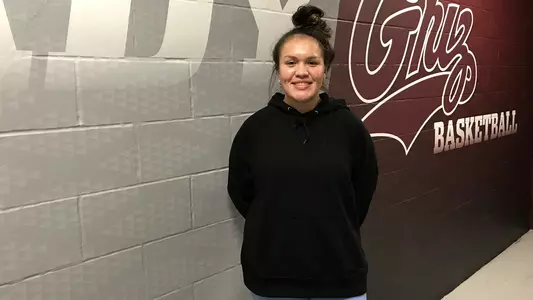
Freshman orientation with Joelnell Momberg
11/23/2020 10:08:00 AM | Women's Basketball
The hoops. It was the hoops, seemingly everywhere as Wade Davies made his way through Navajo Nation in Arizona more than two decades ago, there not for a project on basketball but health care, that he couldn't get out of his mind.
He grew up in Indiana, attended the state's university when Bobby Knight had not long before led the Hoosiers to their third national championship, in 1987, so Davies knew a devotion to the sport of basketball when he saw it.
That's why the hoops stood out. What he wanted to find out is why. Why were they so prevalent? Why was basketball something more than a sport to Navajo Nation? And to Native Americans in general? And how had it come to be?
And this article on Lady Griz freshman Joelnell Momberg was going to be epic, the result of a discussion with Davies about his new book (Native Hoops: The Rise of American Indian Basketball, 1895-1970), a sit-down with former Montana coach Robin Selvig and eight other interviews.
After all, Selvig was inducted in 2008 to the Montana Indian Athletic Hall of Fame for giving Native American girls from the state the opportunity to become Lady Griz. Of course he needed to be involved, with Momberg, of the Blackfeet Tribe, now the 10th to join the program.
All were going to be used as resources to set this article on a path that would eventually lead to Momberg: Native American, basketball player, Montanan. Another link in a classic tale, some that have ended in success, some in sorrow.
The storyline was all set. How Native Americans, dating back to the shameful boarding school days, had, in an act and expression of independence, made basketball their own, when most everything else they had to identify with in their past was being stripped away.
How basketball has thrived over the decades on reservations and how it has united its residents, becoming more than a game, making giants and legends of those who could play it best.
How Malia Kipp had come from Browning to Missoula in the early 90s, the first Native to join the Lady Griz and be coached by Selvig, how before one game during her senior year, the elders of the Blackfeet Tribe arrived to present her with an eagle feather, a rare public acknowledgement for a woman.
How Momberg arrived a few months ago, linking her to the larger story, of another young woman earning the opportunity, through basketball, to safely leave the reservation and its poverty and addiction behind, as if she had managed to escape something, sport as savior.
A bright light among so many dark tales, of how things could have turned out so differently had she not ever picked up a basketball, how it had pulled her out of a black hole that could have -- would have -- consumed her. Because that's life on the reservation, right?
That's where the mind goes, doesn't it, for some of us, maybe most of us, conditioned as we've become to equating reservation life with destitution, the absence of hope unless a basketball is involved, as if there is nothing else -- love, support, devotion -- that can propel a young girl forward?
As if Simarron Schildt, LeAnn Montes, Tamara Guardipee and Shanae Gilham, all former Lady Griz, were just the same person, fresh, new faces that arrived on campus on whom to attach the tired, stereotypical narrative, that their presence on the team is somehow more fragile than their teammates?
And now here comes Momberg.
And this article was going to fall into the same trap. Until Thursday, when Momberg's mom provided the 10th and final interview. Our talk was supposed to connect a few remaining dots, reveal a few fun memories of her daughter growing up, first in Browning, then Box Elder, finally Spokane.
In a calm, thoughtful voice over 30 minutes, she didn't just flip this project upside down. She forced a do-over, a restart, a scrapping of the entire layout. She kindly -- in a here-we-go-again way -- took issue with my ignorance. And I'm thankful she did. Her daughter deserved a better story.
She's read too many over the years, stories that are incomplete, written with a preconceived agenda, that pile on the negative while ignoring the positive. People read them, internalize them, and the damage is quietly done, yet again, both for the subject and the one at home doing the judging.
Davies' book? What did that have to do with Momberg waking up at 5:30 on another cold, dark, winter morning for yet another ball-handling and shooting session before school? Why isn't that the story, one of dedication, of a coach -- LaVon Myers -- who gave of himself while pushing a girl toward greatness?
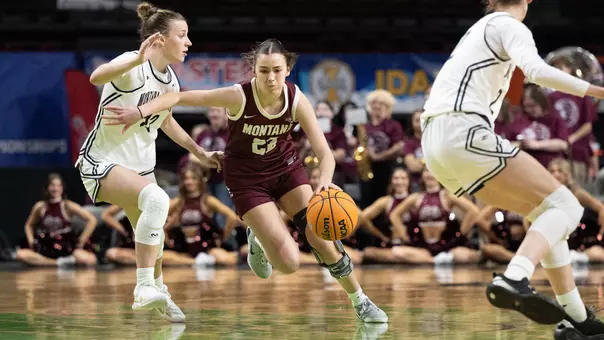
To see Momberg go through a dribbling drill now is to witness a wizard, someone who controls the ball like it's attached to her fingers with string. That skillset was earned, just like any other player. To overlook it would be to minimize the sacrifice, the hours given.
And really, what does it matter to this story what Selvig had to say this week about Dvera Tolbert, the last Native American to play for the Lady Griz? How is that relevant?
What does that have to do with Momberg coming to Montana's team camp after her sophomore year and dropping 10 3-pointers on Jamie Pickens and defending Class AA state champion Helena High, all because she wanted to show everyone that C was just a classification, not a determiner?
Or turning that performance into a scholarship offer the next day, on her way off campus and bound for home, the first of this year's five freshmen to commit?
Bria Dixson was given props for going to LA Fitness before school to work on her shot, hundreds of them per week, thousands over time. Why can't Momberg's hard work and the opportunity it led to be seen through the same prism? Why does her heritage have to come into play?
When Kyndall Keller was in elementary school, her dad started a travel-ball team. Those girls played together for years in a structured environment that ultimately led to something special. In 2018 and '19, Havre won back-to-back state championships.
When Momberg was in elementary school, her stepdad started a travel-ball team. Those girls played together for years in a structured environment that ultimately led to something special. In 2018 and '19, Box Elder won back-to-back state championships.
So why did it feel like the former's journey needed to be told differently than the latter's when the towns are just 22 miles apart? Both teams had put in the work, from coaches to players to supportive parents. Why shouldn't that be the story?
Bonnie Rosette says it is.
"It was because of the encounters, influences and supporters in her life that she is successful, not just as an Indigenous person but as a hard worker," she said as part of the conversation that changed the trajectory of this article.
"She's been around dedicated individuals who have provided countless opportunities for her to achieve her goals."
Which sounds a lot of like the groundwork for success detailed in every other Lady Griz Freshman Orientation article ever written. Or the soccer team's Craig Hall Chronicles. Or the softball team's Origin Stories series.
Yet the inclination was to tell it differently. And not really differently but making Momberg another in a line of Native Americans to play at Montana, as if their stories never vary, as if one picks up where the last one left off, bunched together out of convenience and nescience.
"I just hope it's not a story of her struggles as a Native American Indian when we all face struggles in some way or situation," added Rosette. "She is an extremely hard worker and that is what sets her apart."
All that being written, none of this should be perceived as an attempt to distance Momberg from her roots and what got her here, as if that part is inconsequential to her makeup.
She was raised in Browning, home of the Blackfeet, lived there through the third grade. Then the family moved to Box Elder, home of the Chippewa Cree Tribe. She was there until her senior year.
She embraces that part of her identity as tightly and dearly you might think she would. In that way, she fits the mold. She is fiercely proud of who she is and where she is from.
Indeed, when Lady Griz coach Mike Petrino asked Momberg if she would speak to the team last month on Columbus Day, the freshman jumped at the chance.
She talked about the pain she and all Native Americans feel at the myth of a man credited with discovering America and how so many people are fine overlooking the fact that there was a nation of people already here but viewed as lesser, displaceable, on the wrong end of manifest destiny.
And how outrage over Columbus Day is still viewed by some as controversial, as if it's open to discussion if the Indian Removal Act, signed into law by the president celebrated on the $20 bill in your pocket, every really happened or not.
And she spoke of how Native Americans are one, yes, but also made up of distinct tribes, each of them unique. And her frustrations that Natives seem to be the only ones who want to talk about the true history, when education is what is needed for people to truly understand how this all came to be.
That's what made this article so difficult, that dual nature of celebrating Momberg, the individual who put in the work to get here, no different than her teammates, and Momberg, the proud product of her community, which is quite different from those of her teammates.
It took three meetings with Momberg just to get me -- and probably both of us -- squared away on how we wanted this to go. But the right way is rarely the easy one.
"For me, Joelnell is her own story, one deep in pride about her identity as a Native American Indian basketball player rich in community, a community we often overlook when one doesn't look past the perpetual misconceptions created by media and society," says Rosette.
Momberg's mom brings up the story of Shoni Schimmel and how Dixson, smitten with the sweet-shooting star, used to go watch her when Schimmel played at Franklin High in Portland, the school Dixson would one day attend.
She went and watched the games with her dad because Schimmel was a butt-kicking basketball player, bound for Louisville and the WNBA. That she was raised on the Confederated Tribes of the Umatilla Indian Reservation in Mission, Ore., didn't matter at all to Dixson, just that Schimmel could ball.
But it mattered to Schimmel and those who raised her and sent busloads to Portland after she moved to the big city, her own personal cheering section, an individual with personal goals who forever would be part of -- and held up by -- a tight community. That's what Rosette has been trying to get at.
Celebrate her for being a basketball player and the work it took to get to this point. Celebrate the individual while never forgetting the village it took to get her here, something that shouldn't be left out, because it's important as well. Say again? "It's hard to explain," says Momberg, thus our three meetings.
"There is struggle but there is also a beauty and vibrant greatness in our stories that are often left untold," says Rosette. "Joelnell comes from an intricate, embedded community that played a vital role in who she is as a player and most importantly a person."
That's the delicate balance in this story: the individual and the backing she had by so many, the singling out of one while not overlooking the whole.
"She had the support, family and opportunity to thrive," adds Rosette. "Those around her became family and those values carried her to success."
In other words, she is just like every other Lady Griz freshman. But at the same time unique in a way that none of the others are. It's a lot to work through and get just right.
Of course we could always boil it down to this, a simpler, basketball-focused way of looking at Momberg: "I always know if I pass it to her at game point, it's game over," says her teammate, junior Abby Anderson.
Because even with all its complexities, this is still just a basketball story.
The first sign of trouble -- or that I was unintentionally stepping into a pot of hot water of my own creation -- was when I asked Rosette about her education. I knew she was accomplished. But I wanted to know something.
She went to Salish Kootenai College in Pablo, finished her degree at Montana-Western, then got her master's degree at Montana State.
In my mind, which is not her mind I would discover, she could have gone anywhere, done anything. That she returned to Browning to teach was instructive. But didn't she ever consider going somewhere else?
Success, she informed me, is not a location. It's following your heart and finding meaning in what you're doing, wherever you are.
"As Native people, we're always connected in serving our people," she says. "It's who we are and how we're raised. That's part of what brought about coming back and serving.
"Our heart lies in the service of making our communities better and stronger. Although we know we could be successful off reservation, that Indigenous connection is really deep. You can be impactful wherever you are. If it's meaningful to your heart, there is a reason why you return."
Her first-born -- welcome to the story, Joelnell -- got her first taste of basketball at Blackfeet Boarding Dorm, which is a misnomer to an outsider. It was a welcoming place that provided after-school activities. It's also where Momberg's grandma worked, loves, both sport and family, intermingling.
She won her first tournament prize, a sweater, as a kindergartner. She collected a tournament MVP award as a first grader while playing on BBD's fifth-grade team. In other words, you can get here from there.
"My children are all products of reservation institutions," says Rosette. "That's something we all take pride in. It doesn't matter where you come from, it's where you're headed."
When I told her about Davies' book and how I was looking forward to using what I'd learned to help tell her daughter's story, the silence that followed revealed everything.
The book was about basketball, the sport. Basketball, as I would learn, is a vehicle in Rosette's mind. It just happens to include a ball and two hoops, but it wouldn't have to.
"It's always been a tool. It's bigger than just basketball. It's who you are and how you live every day and how you go about putting that into the people around you," she says.
I was expecting: Joelnell has always been a baller! What I got: An article that began on Friday, now it's Saturday, it probably won't be done until Sunday.
"What you do through basketball, how does that service permeate into the community and the people and the tribe and those around you?" she asks. "What have you learned from that and how can you become a better person and how can you make those around you better?"
As assistant coach Jordan Sullivan explains it, "Joelnell's got guidance for the big picture, really good support for the big picture."
A quick aside about that name: Joelnell. It's a combination of her birth father's middle name and the last half of her mom's given name, Bonnell.
It's unusual and has led to people asking her if perhaps it's been misspelled. And how is it pronounced? It also led to that uncomfortable moment when Bonnie met Joel Rosette after she had had Joelnell and Kyla.
He was another first-generation college graduate, as she was. He attended Montana, then earned a law degree at New Mexico. Now he was back, giving back, just as she had chosen to do.
"The first time I met Joel, he asked what my children's names were," Bonnie says. "I avoided that question. When I finally revealed it, everybody thought, okay, this is a little weird."
Immaterial. They married anyway, moved the family, which would eventually become five kids under one roof -- welcome Tahlia, Jai-Quinn and Oliver -- to Box Elder prior to Momberg entering the fourth grade.
That Browning had a population of maybe 1,100 at the time they left tells you everything you need to know about Box Elder, which is officially a "census-designated place," a highfalutin term for an unincorporated community. In other words, it's pretty tiny.
Now it was home.
"When we moved to Box Elder, we were really going to rural, small-town Montana," says Bonnie. "What do we do now? We want to have opportunities for our children.
"In Montana they are limited. When you're in rural Montana, they are really limited."
There were no Blackfeet Boarding Dorms, but there was a school, at which Bonnie had started teaching, and it had a gym. And a basketball vibe. The girls' team at Box Elder High had won a state title as recently as 1998.
If they wanted to get back to that level, it couldn't be a four-month sport while so many other towns were turning it into a year-round pursuit. Something had to be done to close the gap, beyond just getting together for games of pick-up.
Joel Rosette had an idea. He would start an AAU basketball team. Not knowing what else to do, he sent his oldest step-daughter to school with some fliers to hang up around the building. "That was kind of the start of it all. We just wanted to do things for our children," says Bonnie.
They wouldn't have known anything about it when LaVon Myers, a native of Southern California, arrived up the road in Havre, ready to continue his basketball career at MSU Northern.
He would earn NAIA All-America honors as a Light while winning a pair of Frontier Conference championships with coach Shawn Huse. After his playing days were over, he remained in the area.
And Joel was always on the lookout for people to work with his girls. Bring her to the gym, Myers told him. The daily workout would begin at 6 a.m.
"I was like, what the heck. We'd have to get up at 5:30 in the morning," says Momberg. "I remember I was a little chubbier, and the workout was so hard."
Basketball went from a game of fun to one of skill, something that, while never mastered, could be improved upon, little by little, morning workout after morning workout.
It's what you see today, when she goes through a cones course, hardly needing to ever look down. She knows where the ball is at all times. It's second nature, an extension of her.
"They were simple, little fundamental drills, like dribbling through cones. That was the starting point of the difference in my basketball game, from what it was to what it is now," she says. "That little craftiness, I give credit to him."
It's Momberg who gets all the props for what she's become, but there is credit due all over the place. It's what Bonnie Rosette has been talking about this entire time.
Myers was raised in Compton, Calif. It didn't matter. He became family. That's how it works.
"He provided that shared perspective of working hard for those things you believe in," says Bonnie. "People see the successes in your life, but underneath, there are layers of impact that people have.
"What he instilled in them was you don't have to be the best athlete, but you can be the hardest working."
That's what Rosette was concerned about, when she learned something was being written about her daughter, that it would take the typical approach and leave out the important details.
She's read enough articles about reservation life and the challenges it brings, which she admits are there at all times, but not many that find the positives that can emerge. Myers was one of them.
This is what became of the hard work put in by so many: In March 2018, Box Elder defeated Winnett-Grass Range 52-34 in the Class C state title game, the school's first championship in two decades.
This is where she goes from mystical to pure mother. Her daughter was starring, her husband was coaching and she was taking it all in, now the principal of the school.
"I would say I'm a stoic observer, but that would be a lie," she says. "I really try to keep balanced, but I am pretty hard core. I'll always be their No. 1 fan, no matter what they do, so I do get excited and love to support them."
The summer after state title No. 1 -- of which there would be two -- Box Elder packed its things and traveled to Missoula for Montana's team camp.
It was a program with a chip on its shoulder, which can come from playing Class C. They knew what everyone thought: How cute, the little team that won the Class C championship is here. Maybe they can play our JV.
"They thought we were just some Class C school. We took it personally. We wanted to play the best. We wanted to prove ourselves," says Momberg. Her stepdad was no different. He asked then Lady Griz assistant coach Mike Petrino, who ran the camp, to give his team every heavy hitter in camp.
Done: They got Helena High and Jamie Pickens, who were coming off a second consecutive Class AA state title. Pickens was the camp's It girl. Everybody knew who she was. Momberg? Not so much.
"I remember walking in and all the coaches were there because of Jamie. Everyone there probably thought we were going to just get blown away. They wanted to see her score 30 points and us get beat by 40. I took that so personal. I was so ready for that game," says Momberg.
Helena High would pull away in the second half for the win, but Momberg and her 10 3-pointers made an impression, a big one. After the game, the Lady Griz coaches asked for her contact information.
They talked about it as a staff. The next day they showed their heart. They offered the player from Box Elder, the one who was not yet a junior in high school, a scholarship.
Momberg listened politely, then walked away, not really knowing what had just happened, what had just been verbally extended.
"I was like, what does that mean? I didn't process it," says Momberg. Her stepdad filled her in on the drive back to Box Elder. A scholarship. A spot on the Lady Griz. A dream come true. "WHAT? I was freaking out.
"It meant a lot not only to me but my teammates because we proved it right there." She called the coaches the next morning. She accepted their offer.
Box Elder, behind Momberg and her younger sister Kyla, repeated in 2019, defeating Roy-Winifred 48-42. Two-time state champs.
Things were comfortable in Box Elder. Maybe a little too comfortable. Momberg's mom knew what it was like to move from the reservation to attend a large university. So did Momberg's stepdad.
They wondered if there was something they could do to ease the transition, if there was an intermediate step that could be taken so Box Elder to the University of Montana didn't have to be such a big jump and change, if there was something that could be done to up the odds of success.
What the family decided on was shocking to almost everyone: they were going to leave Box Elder, leave the reservation and move to Spokane.
Again: more big-picture stuff, of sacrificing in the short term for a hoped-for long-term payoff.
"We were all kind of scared to take that step," says Bonnie. "What we wanted to express is we all need to be uncomfortable. If you can leave and be comfortable there, you really have nothing to prove to anybody but yourself. Understanding that, you can go wherever you want and you'll be fine.
"It's all about the work ethic and mentality that you bring wherever you're at."
It wasn't all about work ethic and mentality. After all, Mead has 1,600 students across four grades. None of them knew Momberg, and she didn't know a single one of them. Which is one of the reasons they made the move in the first place. Deal with it.
"I was kind of shy and not very confident socially. I remember my first day, I thought, I can't do this," Momberg says. "I was freaking out.
"I had to talk for myself and ask questions when I needed help to people I didn't know. I had to stand up in class and give presentations to people I didn't know. That kind of forced me take this huge step as a person."
In other words, it was a lot like the world she would find when she arrived in Missoula a year later. "I had to meet people and find new friends and make new connections. That's why I'm fine here."
There were plenty of basketball benefits as well. The Greater Spokane League has some of the best prep talent in the Northwest.
It was no longer Twin Bridges, Savage and Roy-Winifred that she was facing in her biggest games.
"We had a different level of athleticism that I was not used to seeing in Montana," Momberg says. "Rather than only having great games at state, you were having great games every other night."
Case in point: One of Mead's rivals was Mount Spokane High, which was led by Jayda Noble. Today she is a freshman at Washington.
"She was the most athletic girl I've ever played against," says Momberg, who earned first-team all-league honors last winter in her new environment, a noteworthy accomplishment considering the league and the number of challenges she had faced and stared down.
"In those moments, I was like, this is what Division I is going to be like. I had to adjust. That helped with my transition to here."
Here is where she is now, at Montana. Her family is back in the state as well. They are back in Box Elder.
She fits right in. She is a Hi-Liner, putting her in good company with Sophia Stiles (Malta) and Kyndall Keller (Havre). It's the latter who has been a life-long rival, from just up Highway 87.
"We used to compete all the time. I used to tell myself, you can't lose to Havre, you can't lose to Kyndall Keller," Momberg says. "It's crazy now being teammates and really good friends with her."
She's been a champion, as so many of her teammates have been, in basketball and sports beyond. As Petrino says, that mentality is important, that desire to win and to keep doing it. No one wants to take a step back from that. Get enough of them and it will show in practice.
Her game? It fits right in as well, on a team that needed help from the 3-point line. Momberg is one of those players who leave you surprised when she doesn't hit the open shot.
"She's one who comes in and gets the job done," says Sullivan. "She's pretty mentally tough. You can't rattle her. She also lives to hit game-winners. I can't count how many she's had in practice."
With the team's opener just days away and the start of Momberg's career about to begin, we won't lose count. We're ready for some game-winners. The more the better.
Let's proactively call her Big Shot Joelnell.
Add it to the list -- those labels -- of who and what she is: daughter, sister, baller, Blackfeet, Native American. You can't tell her story without bringing it all into the picture.
There is no getting around it. She has a lot of eyes on her. She carries the hopes of many, the dreams of more. It's a burden and a blessing, all at once.
She didn't ask for it, but here it is. She neither denies it nor backs down from it. She carries in upon her shoulders well.
"Before I got here, my stepdad said, play for yourself first. Yes, you want to make every Native American proud, but you have to make yourself proud and you have to love it in order to be that type of role model," she says.
In that way, she does follow the line of those who have come before her, from Kipp so many years ago to Tolbert more recently. She is one of many but still her own person, with her own story to tell and her own tale yet to be written.
And a Nation will be watching, cheering.
"It can be hard. There is the pressure to do great. Not that I don't want to do great, because I do, but it's almost a whole other thing. It's not just my family or Box Elder, it's all the Native communities. It's a lot," she says.
Somewhere out there, a young girl sits watching. Momberg knows not who she is, her name or what she looks like, just that she looks a lot like her. A young girl who wants to follow in her footsteps one day.
"It's also really special. You don't even have to know this little Native girl, but she knows of you. I can impact her life, make her realize she can be here too. When you take the pressure of it and then take the positives, it's a really good balance," she says.
"My parents have done a good job of providing me with strength and confidence. I realize I'm in a great situation."
She is, and she brings the best of herself, every day. And if you think that is related strictly to basketball, you haven't been reading closely enough.
"Sometimes we wear these labels that never leave us, and that gets really heavy," says her mom, who gets the final word, which feels right, since she set this whole thing in motion.
"But it doesn't matter where you're at or if you're Native or if you're a woman of if you're from a small school. It's what you bring wherever you're at."
He grew up in Indiana, attended the state's university when Bobby Knight had not long before led the Hoosiers to their third national championship, in 1987, so Davies knew a devotion to the sport of basketball when he saw it.
That's why the hoops stood out. What he wanted to find out is why. Why were they so prevalent? Why was basketball something more than a sport to Navajo Nation? And to Native Americans in general? And how had it come to be?
And this article on Lady Griz freshman Joelnell Momberg was going to be epic, the result of a discussion with Davies about his new book (Native Hoops: The Rise of American Indian Basketball, 1895-1970), a sit-down with former Montana coach Robin Selvig and eight other interviews.
After all, Selvig was inducted in 2008 to the Montana Indian Athletic Hall of Fame for giving Native American girls from the state the opportunity to become Lady Griz. Of course he needed to be involved, with Momberg, of the Blackfeet Tribe, now the 10th to join the program.
All were going to be used as resources to set this article on a path that would eventually lead to Momberg: Native American, basketball player, Montanan. Another link in a classic tale, some that have ended in success, some in sorrow.
The storyline was all set. How Native Americans, dating back to the shameful boarding school days, had, in an act and expression of independence, made basketball their own, when most everything else they had to identify with in their past was being stripped away.
How basketball has thrived over the decades on reservations and how it has united its residents, becoming more than a game, making giants and legends of those who could play it best.
How Malia Kipp had come from Browning to Missoula in the early 90s, the first Native to join the Lady Griz and be coached by Selvig, how before one game during her senior year, the elders of the Blackfeet Tribe arrived to present her with an eagle feather, a rare public acknowledgement for a woman.
How Momberg arrived a few months ago, linking her to the larger story, of another young woman earning the opportunity, through basketball, to safely leave the reservation and its poverty and addiction behind, as if she had managed to escape something, sport as savior.
A bright light among so many dark tales, of how things could have turned out so differently had she not ever picked up a basketball, how it had pulled her out of a black hole that could have -- would have -- consumed her. Because that's life on the reservation, right?
That's where the mind goes, doesn't it, for some of us, maybe most of us, conditioned as we've become to equating reservation life with destitution, the absence of hope unless a basketball is involved, as if there is nothing else -- love, support, devotion -- that can propel a young girl forward?
As if Simarron Schildt, LeAnn Montes, Tamara Guardipee and Shanae Gilham, all former Lady Griz, were just the same person, fresh, new faces that arrived on campus on whom to attach the tired, stereotypical narrative, that their presence on the team is somehow more fragile than their teammates?
And now here comes Momberg.
And this article was going to fall into the same trap. Until Thursday, when Momberg's mom provided the 10th and final interview. Our talk was supposed to connect a few remaining dots, reveal a few fun memories of her daughter growing up, first in Browning, then Box Elder, finally Spokane.
In a calm, thoughtful voice over 30 minutes, she didn't just flip this project upside down. She forced a do-over, a restart, a scrapping of the entire layout. She kindly -- in a here-we-go-again way -- took issue with my ignorance. And I'm thankful she did. Her daughter deserved a better story.
She's read too many over the years, stories that are incomplete, written with a preconceived agenda, that pile on the negative while ignoring the positive. People read them, internalize them, and the damage is quietly done, yet again, both for the subject and the one at home doing the judging.
Davies' book? What did that have to do with Momberg waking up at 5:30 on another cold, dark, winter morning for yet another ball-handling and shooting session before school? Why isn't that the story, one of dedication, of a coach -- LaVon Myers -- who gave of himself while pushing a girl toward greatness?
To see Momberg go through a dribbling drill now is to witness a wizard, someone who controls the ball like it's attached to her fingers with string. That skillset was earned, just like any other player. To overlook it would be to minimize the sacrifice, the hours given.
And really, what does it matter to this story what Selvig had to say this week about Dvera Tolbert, the last Native American to play for the Lady Griz? How is that relevant?
What does that have to do with Momberg coming to Montana's team camp after her sophomore year and dropping 10 3-pointers on Jamie Pickens and defending Class AA state champion Helena High, all because she wanted to show everyone that C was just a classification, not a determiner?
Or turning that performance into a scholarship offer the next day, on her way off campus and bound for home, the first of this year's five freshmen to commit?
Bria Dixson was given props for going to LA Fitness before school to work on her shot, hundreds of them per week, thousands over time. Why can't Momberg's hard work and the opportunity it led to be seen through the same prism? Why does her heritage have to come into play?
When Kyndall Keller was in elementary school, her dad started a travel-ball team. Those girls played together for years in a structured environment that ultimately led to something special. In 2018 and '19, Havre won back-to-back state championships.
When Momberg was in elementary school, her stepdad started a travel-ball team. Those girls played together for years in a structured environment that ultimately led to something special. In 2018 and '19, Box Elder won back-to-back state championships.
So why did it feel like the former's journey needed to be told differently than the latter's when the towns are just 22 miles apart? Both teams had put in the work, from coaches to players to supportive parents. Why shouldn't that be the story?
Bonnie Rosette says it is.
"It was because of the encounters, influences and supporters in her life that she is successful, not just as an Indigenous person but as a hard worker," she said as part of the conversation that changed the trajectory of this article.
"She's been around dedicated individuals who have provided countless opportunities for her to achieve her goals."
Which sounds a lot of like the groundwork for success detailed in every other Lady Griz Freshman Orientation article ever written. Or the soccer team's Craig Hall Chronicles. Or the softball team's Origin Stories series.
Yet the inclination was to tell it differently. And not really differently but making Momberg another in a line of Native Americans to play at Montana, as if their stories never vary, as if one picks up where the last one left off, bunched together out of convenience and nescience.
"I just hope it's not a story of her struggles as a Native American Indian when we all face struggles in some way or situation," added Rosette. "She is an extremely hard worker and that is what sets her apart."
All that being written, none of this should be perceived as an attempt to distance Momberg from her roots and what got her here, as if that part is inconsequential to her makeup.
She was raised in Browning, home of the Blackfeet, lived there through the third grade. Then the family moved to Box Elder, home of the Chippewa Cree Tribe. She was there until her senior year.
She embraces that part of her identity as tightly and dearly you might think she would. In that way, she fits the mold. She is fiercely proud of who she is and where she is from.
Indeed, when Lady Griz coach Mike Petrino asked Momberg if she would speak to the team last month on Columbus Day, the freshman jumped at the chance.
She talked about the pain she and all Native Americans feel at the myth of a man credited with discovering America and how so many people are fine overlooking the fact that there was a nation of people already here but viewed as lesser, displaceable, on the wrong end of manifest destiny.
And how outrage over Columbus Day is still viewed by some as controversial, as if it's open to discussion if the Indian Removal Act, signed into law by the president celebrated on the $20 bill in your pocket, every really happened or not.
And she spoke of how Native Americans are one, yes, but also made up of distinct tribes, each of them unique. And her frustrations that Natives seem to be the only ones who want to talk about the true history, when education is what is needed for people to truly understand how this all came to be.
That's what made this article so difficult, that dual nature of celebrating Momberg, the individual who put in the work to get here, no different than her teammates, and Momberg, the proud product of her community, which is quite different from those of her teammates.
It took three meetings with Momberg just to get me -- and probably both of us -- squared away on how we wanted this to go. But the right way is rarely the easy one.
"For me, Joelnell is her own story, one deep in pride about her identity as a Native American Indian basketball player rich in community, a community we often overlook when one doesn't look past the perpetual misconceptions created by media and society," says Rosette.
Momberg's mom brings up the story of Shoni Schimmel and how Dixson, smitten with the sweet-shooting star, used to go watch her when Schimmel played at Franklin High in Portland, the school Dixson would one day attend.
She went and watched the games with her dad because Schimmel was a butt-kicking basketball player, bound for Louisville and the WNBA. That she was raised on the Confederated Tribes of the Umatilla Indian Reservation in Mission, Ore., didn't matter at all to Dixson, just that Schimmel could ball.
But it mattered to Schimmel and those who raised her and sent busloads to Portland after she moved to the big city, her own personal cheering section, an individual with personal goals who forever would be part of -- and held up by -- a tight community. That's what Rosette has been trying to get at.
Celebrate her for being a basketball player and the work it took to get to this point. Celebrate the individual while never forgetting the village it took to get her here, something that shouldn't be left out, because it's important as well. Say again? "It's hard to explain," says Momberg, thus our three meetings.
"There is struggle but there is also a beauty and vibrant greatness in our stories that are often left untold," says Rosette. "Joelnell comes from an intricate, embedded community that played a vital role in who she is as a player and most importantly a person."
That's the delicate balance in this story: the individual and the backing she had by so many, the singling out of one while not overlooking the whole.
"She had the support, family and opportunity to thrive," adds Rosette. "Those around her became family and those values carried her to success."
In other words, she is just like every other Lady Griz freshman. But at the same time unique in a way that none of the others are. It's a lot to work through and get just right.
Of course we could always boil it down to this, a simpler, basketball-focused way of looking at Momberg: "I always know if I pass it to her at game point, it's game over," says her teammate, junior Abby Anderson.
Because even with all its complexities, this is still just a basketball story.
The first sign of trouble -- or that I was unintentionally stepping into a pot of hot water of my own creation -- was when I asked Rosette about her education. I knew she was accomplished. But I wanted to know something.
She went to Salish Kootenai College in Pablo, finished her degree at Montana-Western, then got her master's degree at Montana State.
In my mind, which is not her mind I would discover, she could have gone anywhere, done anything. That she returned to Browning to teach was instructive. But didn't she ever consider going somewhere else?
Success, she informed me, is not a location. It's following your heart and finding meaning in what you're doing, wherever you are.
"As Native people, we're always connected in serving our people," she says. "It's who we are and how we're raised. That's part of what brought about coming back and serving.
"Our heart lies in the service of making our communities better and stronger. Although we know we could be successful off reservation, that Indigenous connection is really deep. You can be impactful wherever you are. If it's meaningful to your heart, there is a reason why you return."
Her first-born -- welcome to the story, Joelnell -- got her first taste of basketball at Blackfeet Boarding Dorm, which is a misnomer to an outsider. It was a welcoming place that provided after-school activities. It's also where Momberg's grandma worked, loves, both sport and family, intermingling.
She won her first tournament prize, a sweater, as a kindergartner. She collected a tournament MVP award as a first grader while playing on BBD's fifth-grade team. In other words, you can get here from there.
"My children are all products of reservation institutions," says Rosette. "That's something we all take pride in. It doesn't matter where you come from, it's where you're headed."
When I told her about Davies' book and how I was looking forward to using what I'd learned to help tell her daughter's story, the silence that followed revealed everything.
The book was about basketball, the sport. Basketball, as I would learn, is a vehicle in Rosette's mind. It just happens to include a ball and two hoops, but it wouldn't have to.
"It's always been a tool. It's bigger than just basketball. It's who you are and how you live every day and how you go about putting that into the people around you," she says.
I was expecting: Joelnell has always been a baller! What I got: An article that began on Friday, now it's Saturday, it probably won't be done until Sunday.
"What you do through basketball, how does that service permeate into the community and the people and the tribe and those around you?" she asks. "What have you learned from that and how can you become a better person and how can you make those around you better?"
As assistant coach Jordan Sullivan explains it, "Joelnell's got guidance for the big picture, really good support for the big picture."
A quick aside about that name: Joelnell. It's a combination of her birth father's middle name and the last half of her mom's given name, Bonnell.
It's unusual and has led to people asking her if perhaps it's been misspelled. And how is it pronounced? It also led to that uncomfortable moment when Bonnie met Joel Rosette after she had had Joelnell and Kyla.
He was another first-generation college graduate, as she was. He attended Montana, then earned a law degree at New Mexico. Now he was back, giving back, just as she had chosen to do.
"The first time I met Joel, he asked what my children's names were," Bonnie says. "I avoided that question. When I finally revealed it, everybody thought, okay, this is a little weird."
Immaterial. They married anyway, moved the family, which would eventually become five kids under one roof -- welcome Tahlia, Jai-Quinn and Oliver -- to Box Elder prior to Momberg entering the fourth grade.
That Browning had a population of maybe 1,100 at the time they left tells you everything you need to know about Box Elder, which is officially a "census-designated place," a highfalutin term for an unincorporated community. In other words, it's pretty tiny.
Now it was home.
"When we moved to Box Elder, we were really going to rural, small-town Montana," says Bonnie. "What do we do now? We want to have opportunities for our children.
"In Montana they are limited. When you're in rural Montana, they are really limited."
There were no Blackfeet Boarding Dorms, but there was a school, at which Bonnie had started teaching, and it had a gym. And a basketball vibe. The girls' team at Box Elder High had won a state title as recently as 1998.
If they wanted to get back to that level, it couldn't be a four-month sport while so many other towns were turning it into a year-round pursuit. Something had to be done to close the gap, beyond just getting together for games of pick-up.
Joel Rosette had an idea. He would start an AAU basketball team. Not knowing what else to do, he sent his oldest step-daughter to school with some fliers to hang up around the building. "That was kind of the start of it all. We just wanted to do things for our children," says Bonnie.
They wouldn't have known anything about it when LaVon Myers, a native of Southern California, arrived up the road in Havre, ready to continue his basketball career at MSU Northern.
He would earn NAIA All-America honors as a Light while winning a pair of Frontier Conference championships with coach Shawn Huse. After his playing days were over, he remained in the area.
And Joel was always on the lookout for people to work with his girls. Bring her to the gym, Myers told him. The daily workout would begin at 6 a.m.
"I was like, what the heck. We'd have to get up at 5:30 in the morning," says Momberg. "I remember I was a little chubbier, and the workout was so hard."
Basketball went from a game of fun to one of skill, something that, while never mastered, could be improved upon, little by little, morning workout after morning workout.
It's what you see today, when she goes through a cones course, hardly needing to ever look down. She knows where the ball is at all times. It's second nature, an extension of her.
"They were simple, little fundamental drills, like dribbling through cones. That was the starting point of the difference in my basketball game, from what it was to what it is now," she says. "That little craftiness, I give credit to him."
It's Momberg who gets all the props for what she's become, but there is credit due all over the place. It's what Bonnie Rosette has been talking about this entire time.
Myers was raised in Compton, Calif. It didn't matter. He became family. That's how it works.
"He provided that shared perspective of working hard for those things you believe in," says Bonnie. "People see the successes in your life, but underneath, there are layers of impact that people have.
"What he instilled in them was you don't have to be the best athlete, but you can be the hardest working."
That's what Rosette was concerned about, when she learned something was being written about her daughter, that it would take the typical approach and leave out the important details.
She's read enough articles about reservation life and the challenges it brings, which she admits are there at all times, but not many that find the positives that can emerge. Myers was one of them.
This is what became of the hard work put in by so many: In March 2018, Box Elder defeated Winnett-Grass Range 52-34 in the Class C state title game, the school's first championship in two decades.
This is where she goes from mystical to pure mother. Her daughter was starring, her husband was coaching and she was taking it all in, now the principal of the school.
"I would say I'm a stoic observer, but that would be a lie," she says. "I really try to keep balanced, but I am pretty hard core. I'll always be their No. 1 fan, no matter what they do, so I do get excited and love to support them."
The summer after state title No. 1 -- of which there would be two -- Box Elder packed its things and traveled to Missoula for Montana's team camp.
It was a program with a chip on its shoulder, which can come from playing Class C. They knew what everyone thought: How cute, the little team that won the Class C championship is here. Maybe they can play our JV.
"They thought we were just some Class C school. We took it personally. We wanted to play the best. We wanted to prove ourselves," says Momberg. Her stepdad was no different. He asked then Lady Griz assistant coach Mike Petrino, who ran the camp, to give his team every heavy hitter in camp.
Done: They got Helena High and Jamie Pickens, who were coming off a second consecutive Class AA state title. Pickens was the camp's It girl. Everybody knew who she was. Momberg? Not so much.
"I remember walking in and all the coaches were there because of Jamie. Everyone there probably thought we were going to just get blown away. They wanted to see her score 30 points and us get beat by 40. I took that so personal. I was so ready for that game," says Momberg.
Helena High would pull away in the second half for the win, but Momberg and her 10 3-pointers made an impression, a big one. After the game, the Lady Griz coaches asked for her contact information.
They talked about it as a staff. The next day they showed their heart. They offered the player from Box Elder, the one who was not yet a junior in high school, a scholarship.
Momberg listened politely, then walked away, not really knowing what had just happened, what had just been verbally extended.
"I was like, what does that mean? I didn't process it," says Momberg. Her stepdad filled her in on the drive back to Box Elder. A scholarship. A spot on the Lady Griz. A dream come true. "WHAT? I was freaking out.
"It meant a lot not only to me but my teammates because we proved it right there." She called the coaches the next morning. She accepted their offer.
Box Elder, behind Momberg and her younger sister Kyla, repeated in 2019, defeating Roy-Winifred 48-42. Two-time state champs.
Things were comfortable in Box Elder. Maybe a little too comfortable. Momberg's mom knew what it was like to move from the reservation to attend a large university. So did Momberg's stepdad.
They wondered if there was something they could do to ease the transition, if there was an intermediate step that could be taken so Box Elder to the University of Montana didn't have to be such a big jump and change, if there was something that could be done to up the odds of success.
What the family decided on was shocking to almost everyone: they were going to leave Box Elder, leave the reservation and move to Spokane.
Again: more big-picture stuff, of sacrificing in the short term for a hoped-for long-term payoff.
"We were all kind of scared to take that step," says Bonnie. "What we wanted to express is we all need to be uncomfortable. If you can leave and be comfortable there, you really have nothing to prove to anybody but yourself. Understanding that, you can go wherever you want and you'll be fine.
"It's all about the work ethic and mentality that you bring wherever you're at."
It wasn't all about work ethic and mentality. After all, Mead has 1,600 students across four grades. None of them knew Momberg, and she didn't know a single one of them. Which is one of the reasons they made the move in the first place. Deal with it.
"I was kind of shy and not very confident socially. I remember my first day, I thought, I can't do this," Momberg says. "I was freaking out.
"I had to talk for myself and ask questions when I needed help to people I didn't know. I had to stand up in class and give presentations to people I didn't know. That kind of forced me take this huge step as a person."
In other words, it was a lot like the world she would find when she arrived in Missoula a year later. "I had to meet people and find new friends and make new connections. That's why I'm fine here."
There were plenty of basketball benefits as well. The Greater Spokane League has some of the best prep talent in the Northwest.
It was no longer Twin Bridges, Savage and Roy-Winifred that she was facing in her biggest games.
"We had a different level of athleticism that I was not used to seeing in Montana," Momberg says. "Rather than only having great games at state, you were having great games every other night."
Case in point: One of Mead's rivals was Mount Spokane High, which was led by Jayda Noble. Today she is a freshman at Washington.
"She was the most athletic girl I've ever played against," says Momberg, who earned first-team all-league honors last winter in her new environment, a noteworthy accomplishment considering the league and the number of challenges she had faced and stared down.
"In those moments, I was like, this is what Division I is going to be like. I had to adjust. That helped with my transition to here."
Here is where she is now, at Montana. Her family is back in the state as well. They are back in Box Elder.
She fits right in. She is a Hi-Liner, putting her in good company with Sophia Stiles (Malta) and Kyndall Keller (Havre). It's the latter who has been a life-long rival, from just up Highway 87.
"We used to compete all the time. I used to tell myself, you can't lose to Havre, you can't lose to Kyndall Keller," Momberg says. "It's crazy now being teammates and really good friends with her."
She's been a champion, as so many of her teammates have been, in basketball and sports beyond. As Petrino says, that mentality is important, that desire to win and to keep doing it. No one wants to take a step back from that. Get enough of them and it will show in practice.
Her game? It fits right in as well, on a team that needed help from the 3-point line. Momberg is one of those players who leave you surprised when she doesn't hit the open shot.
"She's one who comes in and gets the job done," says Sullivan. "She's pretty mentally tough. You can't rattle her. She also lives to hit game-winners. I can't count how many she's had in practice."
With the team's opener just days away and the start of Momberg's career about to begin, we won't lose count. We're ready for some game-winners. The more the better.
Let's proactively call her Big Shot Joelnell.
Add it to the list -- those labels -- of who and what she is: daughter, sister, baller, Blackfeet, Native American. You can't tell her story without bringing it all into the picture.
There is no getting around it. She has a lot of eyes on her. She carries the hopes of many, the dreams of more. It's a burden and a blessing, all at once.
She didn't ask for it, but here it is. She neither denies it nor backs down from it. She carries in upon her shoulders well.
"Before I got here, my stepdad said, play for yourself first. Yes, you want to make every Native American proud, but you have to make yourself proud and you have to love it in order to be that type of role model," she says.
In that way, she does follow the line of those who have come before her, from Kipp so many years ago to Tolbert more recently. She is one of many but still her own person, with her own story to tell and her own tale yet to be written.
And a Nation will be watching, cheering.
"It can be hard. There is the pressure to do great. Not that I don't want to do great, because I do, but it's almost a whole other thing. It's not just my family or Box Elder, it's all the Native communities. It's a lot," she says.
Somewhere out there, a young girl sits watching. Momberg knows not who she is, her name or what she looks like, just that she looks a lot like her. A young girl who wants to follow in her footsteps one day.
"It's also really special. You don't even have to know this little Native girl, but she knows of you. I can impact her life, make her realize she can be here too. When you take the pressure of it and then take the positives, it's a really good balance," she says.
"My parents have done a good job of providing me with strength and confidence. I realize I'm in a great situation."
She is, and she brings the best of herself, every day. And if you think that is related strictly to basketball, you haven't been reading closely enough.
"Sometimes we wear these labels that never leave us, and that gets really heavy," says her mom, who gets the final word, which feels right, since she set this whole thing in motion.
"But it doesn't matter where you're at or if you're Native or if you're a woman of if you're from a small school. It's what you bring wherever you're at."
Players Mentioned

F
/ Women's Basketball
G
/ Women's Basketball
G
/ Women's Basketball
G
/ Women's Basketball
G
/ Women's Basketball
F
/ Women's Basketball
G
/ Women's BasketballThursday, June 04
Friday, May 01
Friday, May 01
Friday, May 01