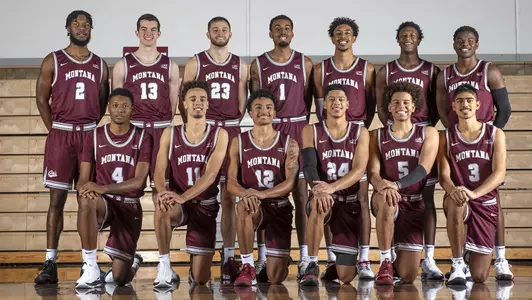
Men's basketball 2020-21 season preview
11/25/2020 10:31:00 AM | Men's Basketball
A year ago prior to his team's first preseason practice, head coach Travis DeCuire emphasized the word patience. It was something DeCuire was learning he would have to become good at, after graduating a class of veteran seniors who had become player-coaches as much as they were traditional student-athletes.
If only DeCuire knew then that last year's comment would be a precursor for what was to come during a wild offseason and an upcoming 2020-21 basketball season that will look unlike any before.
A SEASON UNLIKE ANY OTHER
It's not hyperbolic to say that no member of the Griz roster or coaching staff has ever seen anything like the last several months, and likely, what's still to come in the months ahead. Plenty has changed since Montana's chase for a Big Sky Conference three-peat came to an abrupt halt in mid-March in Boise, Idaho, due to COVID-19.
For one, face masks are now a necessity when leaving one's house or entering Dahlberg Arena. The student-athletes have gaiter-style masks that they wear around their necks while on the court, and are required to fully wear when on the sidelines or in between drills; the coaching staff can be seen wearing a mask at all times.
After months of uncertainty if there would even be a 2020-21 basketball season, the answer now seems to be that yes, there will be. What that will look like? It's still to be determined.
"The question I get asked on a daily basis is if there will be a season," seventh-year head coach Travis DeCuire said. "The answer is now yes, and the answer is also I don't know. Will the season start? Yes, I think it will. Will there be a completion to the season? That part is still up in the air."
The simple part – the 'yes' – is due to the fact that there are dates on the calendar. The NCAA in September pushed back the start date several weeks, in hopes that the country would have a better grasp of the coronavirus pandemic and to allow students at most universities to depart campus for winter break. Scheduling non-conference games was a work in progress, with Montana's schedule not being released until the week leading up to its first game. But there are now games to prepare for.
The 'I don't know' part is more complex. As sports fans have seen this fall in the college football circles, postponements and full-on cancelations are common. In basketball, where games are played several times per week, one positive case could wipe out several weeks of competition.
"A lot of times we may not know for sure if a game will be played until the ball is tipped," DeCuire said. "We have to be ready for anything and everything."
DeCuire's biggest question remains with contact tracing.
"If one guy pops positive, we all could be shut down for 14 days," he said.
Going two full weeks without any training or physical activity makes it nearly impossible to jump back in right away and play games, meaning it's not unreasonable to suggest that a team might be shut down for an additional week, just to work back its stamina.
"Unless there are protocols in place that allow us to continue to push through, while still keeping the student-athletes healthy, one positive case could essentially end a season.
"I won't feel great about where we're at until we're in Boise and we're playing in the conference tournament."
Coaches are creatures of habit, so a pandemic isn't ideal. They're also planners. While most people live week-to-week, if not by the day, coaches are often looking months, if not years in advance. That's how they're forced to operate in the business, especially when it comes to recruiting and scheduling.
Not so fast. By the time official practices began in mid-October, DeCuire estimates that he would have already written up practice plans for all 30 of his team's NCAA-allotted practices. Before the Grizzlies even stepped on the court for that first practice, he had already ripped up half of them and started over.
"Everything's day-to-day right now," DeCuire said. "Nothing is normal or concrete. Our ability to be flexible is going to be important, and probably our biggest challenge."
Like student-athletes across the country, Montana has been affected by COVID-19. Even if the Griz student-athletes are taking care of themselves, even being around someone who tests positive can force a full shutdown.
"We have to be prepared to stop and start, stop and start," the seventh-year head coach said, noting that he has canceled more practices than ever before, either due to COVID-19 precautions, injuries or a simple need for rest due to lack of conditioning leading up to the season. "We've already been affected by that, and there's no working around it."
PLENTY OF NEW FACES
Fans will need to brush up on the roster this fall, as a lot has changed. Gone are four key pieces from last year's team, including All-Big Sky players Sayeed Pridgett and Kendal Manuel. Pridgett was a two-time first-team selection who finished his career ranked fourth in school history for scoring.
Returning is just one upperclassman: Mack Anderson, a junior from Bozeman, who averaged 11.9 minutes, 3.3 points and 1.8 rebounds per game a season ago.
The following bullets show how much has changed:
So why be optimistic about the group, despite all that's been lost? Well for one, Montana has a strong track record of being good, even when the cards are stacked against it. Think back to 2014-15 and DeCuire's first season. The Griz were picked to finish eighth in the conference; they ended up winning a regular-season title. Or the 2017-18 season, when Montana had just one senior and was coming off of a .500 season, only to run through the conference and win regular-season and tournament championships. Even last year, after graduating a group that had the best two-year stretch in school history, Montana was in position to win again going into the final week of the season.
The truth is, whether Montana is the unanimous favorite or a heavy underdog in the midst of a rebuild, the Griz show up year in and year out. It's why they've played in the NCAA tournament five times in the past decade and have advanced to the conference championship game in all but one season under DeCuire.
RETURNING UNDERCLASSMEN
Mack Anderson, Freddy Brown III and Eddy Egun are Montana's longest-tenured players. Those are the only three players who were part of Montana's 2019 championship team, despite that championship coming just a season ago.
Egun was a redshirt that season, before averaging 7.8 minutes across 28 game a season ago. Brown played as a true freshman in 2018-19, seeing 32 minutes across 15 games, before redshirting last year. Anderson, Montana's lone player from the Treasure State, has the most returning experience, playing in 59 games over the past two seasons, averaging 11.9 minutes per game last year.
Despite little returning, Montana does have some key returnees. Anderson started six games last season, ranked second on the team for blocked shots and would have led the Big Sky with his .660 conference shooting percentage, if he took enough shots to qualify. Then there's the sophomore class. The trio of Derrick Carter-Hollinger, Kyle Owens and Josh Vazquez combined to start a school-record 40 games as true freshmen, playing three valuable roles. Carter-Hollinger shot .597 from the floor and was named the league's Freshman of the Year; Owens was big on both ends, averaging 4.6 points and 2.3 rebounds per game, and scoring in double figures five times; Vazquez ranked sixth in Big Sky play with 1.6 steals per game and ranked second on the team for 3-pointers.
TALKING TRANSFERS
While Montana returns little from last year, the team isn't as young as it seems. Part of that is the experience that last year's freshman class brings. Even more, it's because of four transfers who were not on the court last year, but will be able to play this year – and who have Division-I game experience, to boot.
The biggest name is Michael Steadman, Montana's 6-10 forward from San Jose State, who in November was named to the All-Big Sky preseason team, despite never stepping foot on the court in a Big Sky game.
Steadman redshirted last season, per NCAA transfer rules, and took advantage of the year. In addition to his skill development on the court, Steadman took his health and nutrition more seriously, most notably shedding 35 pounds. Crediting better sleep, weight training and now cooking his own meals six nights per week instead of eating out, Steadman feels quicker, his knees hurt less and he feels more apt to play in DeCuire's system.
In his one season at San Jose State, Steadman was a force, leading the Spartans for scoring (13.2 points per game) and rebounding (8.5 per game) and ranking third in the Mountain West for shooting (.483).
"He's really changed his body and has learned how to score on a high percentage of his touches," DeCuire said of Steadman. "He's grown in terms of how to play the game when the ball isn't in his hands.
"He very easily could be in the Pac-12 right now," DeCuire continued. "But the most important thing to him was to become the best basketball player he could become, and we identified some areas that could help him do that if he focused on the right things. The fact that we identified some areas of improvement, and showed him how we could help him improve, helped us separate from some of the other opportunities that were out there."
Cameron Satterwhite, like Steadman, is a graduate transfer who has one year of immediate eligibility. The coaching staff was drawn to him for two main reasons: First, he knows the league, having played two years for Northern Arizona. Second, he has NCAA tournament experience, being part of Loyola Chicago's historic run to the Final Four in 2018. Last year for NAU, Satterwhite averaged 9.0 points per game on .427 shooting, ranking third on the team with 30 3-pointers. Cameron Parker will be a junior after beginning his career at Sacred Heart. After a debut season that earned him NEC All-Rookie Team honors, Parker averaged 10.2 points and 0.9 steals per game as a sophomore, in addition to a 7.8 assists-per-game average that would have ranked fourth nationally had he not missed the final two months of the season due to injury. In December, he dished out an NCAA single-game record 24 assists.
Also in the mix is Darius Henderson, a midyear transfer from UMass Lowell, who will be eligible to play in the early weeks of the season. In parts of two seasons, Henderson played in 40 games – earning 31 starts – and averaged 5.1 points and 2.6 rebounds per game.
"These guys are bigger than most think," DeCuire said. "You can't replace playing time, you can't replace experience, and these guys have it. It's huge to have guys who are confident and who have been part of big-time Division-I basketball, which is why we went out and got them."
RELYING ON FRESHMEN AGAIN
Montana had a four-person signing class last November, bringing in California natives Robby Beasley (6-3 guard from Dublin) and Brandon Whitney (6-1 guard from Mission Hills) and Australians Josh Bannan (6-9 forward from Victoria) and Hunter Clarke (6-5 guard from Kaleen). With several spots to fill, expect to see several of them receiving playing time early on.
"They're well coached," DeCuire said of the freshman class. "They have done as good a job as anyone has of picking up information and adjusting to it. They make adjustments that allow them to compete for roles, which is what we expect when we bring guys like them in."
DeCuire has never been shy about playing freshmen. In fact, in his six seasons in Missoula, every player who has played as a true freshman and has stayed in Missoula for four years, has found his name in the record books. The list includes Fabijan Krslovic, DeCuire's first commit who played in all 132 games during his four seasons, earning 116 starts. It also includes Michael Oguine, who was the 2018 Big Sky Defensive Player of the Year and Big Sky Championship MVP, and finished his career ranked in the top 10 for career scoring, steals and games started. His teammate, Bobby Moorehead, became known as a lockdown defender who made 168 3-pointers and set a school record for career games played. Last year, Sayeed Pridgett graduated as a two-time All-Big Sky first-team selection who became the first Grizzly in nearly 40 seasons to eclipse 1,670 career points. That list doesn't even include last year's freshman class, which is well on its way to making its mark as well.
The point is, if you can contribute as a true freshman, you'll get your chance, especially this season.
"We've always made sure they've known it's out there for them, but that they have to earn it," DeCuire said. "But without question, these guys want to play. When recruiting, I'll mention a guy like Fab and compare them to someone, maybe in their hometown, who they can identify with, who maybe didn't get on the floor right away, or maybe didn't win. When you paint those two pictures, they're going to choose the University of Montana every time, because no one wants to not be on the floor, unless maybe it's in a winning situation."
COMPETITION WILL BE AT A PREMIUM
Four players started 20 or more games in 2019-20. None of them are back, meaning there are several spots up for grabs. Rather than it be a concern, though, DeCuire is excited about the fluidity, because it increases the level of competition on a day-to-day basis.
"Right now, all of the jobs are open for competition, all five jobs are available," DeCuire said. "It's creating a highly competitive environment and it'll be interesting to see how the chips fall."
DEPTH WILL BE TESTED
DeCuire has never been known to play a deep lineup. By the middle of most seasons, his rotation has generally been whittled down to seven or eight players. In fact, over the past three seasons, Montana has never had more than eight players average more than 10 minutes per game.
That could change this year, and it may be out of DeCuire's control.
"This season is going to be different," DeCuire said. "Teams can't rely on just a few players. The team with the most depth, and the teams who handle COVID protocols the best, will be the ones who will have the most success."
Depth will be a necessity, especially if COVID-19 restricts a student-athlete from playing on a given night.
"Be ready for guys with limited roles to look up and find themselves playing competitive minutes when they least expect it," DeCuire said. "This is one of those years where you will have to have all 15 guys prepared to play. Even if they go five, six, seven games without playing, they might look up one night and we need them."
DeCuire believes the depth plays to Montana's advantage. Even if he generally doesn't use a long lineup, he feels like he has the pieces to do so this year. Even more, he likes his team's versatility.
"I think we can be a pretty deep team in terms of talent, and I think we can be a deep team in terms of versatility," he said. "We have a lot of guys who can play a lot of different positions, and can go with a lot of different lineups."
In addition to the need for more bodies, there will likely be fewer restrictions. The NCAA announced in October that the 2020-21 season will not count against a player's eligibility, meaning, in theory, everyone could return next year in the same class they enter this year at. Because there are no restrictions, there is less of a need to redshirt players.
RUNNING THE POINT
If one thing is for sure, it's that DeCuire knows how to coach and develop guards. It's what he was when he set Montana's all-time record for career assists, a mark he still holds nearly 30 years later. In recent years, Montana has become guard heavy, including 2019 graduates Michael Oguine and Ahmaad Rorie, who both rank in the top eight for career scoring.
Montana still will be guard heavy in 2020-21, but it may also have the benefit of having true point guards. A season ago, four different players ran the point at times. It showed the Grizzlies' ability to be versatile, but also was a bit unusual when Pridgett, who could play four different spots, was, at times, bringing the ball up the court.
This year, Montana has a depth of pure point guards. Josh Vazquez, who ran the point at times last year, is a sophomore and will have the ability to do so again. He ranked fourth on the team for assists and had just five games with a negative assist-to-turnover ratio over the final 21 games of the season. There's also Whitney, who averaged 26.0 points and 6.0 assists per game as a senior at Bishop Alemany High School outside of Los Angeles. Montana also added Parker to the mix in the offseason, who has Division-I experience and holds an NCAA assists record previously held by Trae Young.
POST PLAY
From Krslovic to Jamar Akoh, Montana has had some big forwards in recent memory, but probably hasn't had a true post threat since Martin Breunig in 2015. That could change this year.
In addition to Anderson taking on an expanded role, Montana has Steadman, one of the league's top players, and Bannan, who has competed at the NBA Global Academy and the NBL1, a semi-professional Australian league that is on par with the NBA G-League and features some G-League players.
Montana has five players listed at 6-8 or taller, giving them the ability to work inside or outside on offense.
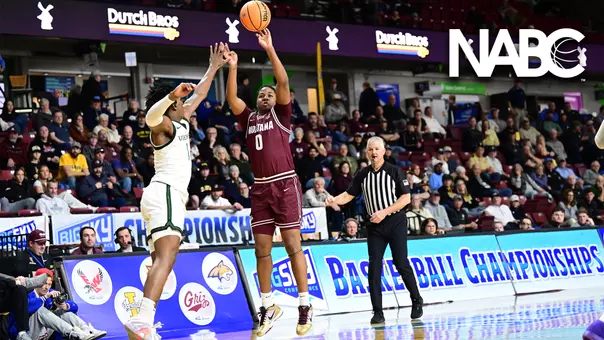
Gallery: (11-2-2020) MBB: Preseason Practices
ADJUSTMENTS ON THE FLY
Montana has 24 dates on its schedule, but DeCuire will flat out say right now those 24 dates will not hold. Given the circumstances there are bound to be postponements, cancelations or even the scheduling of new games.
He fully expects to miss Big Sky games due to COVID-19 – either because he can't field a team or Montana's opponent can't. That is a given. And with teams playing 20 league games in a tight window, there's little room to reschedule canceled games.
DeCuire knows this and has accepted it. His focus is to allow his team to play as many games as safely possible.
"We need games, and we need competition," DeCuire said. "How will we do that? What will that look like? I'm not sure, but we're open to anything."
So, in theory, if one week Montana's opponent can't play, is it possible that the Grizzlies could try and schedule a different game that week?
"We're open to anything," he said. "Absolutely."
What will play out over the course of the season is uncertain, but the Grizzlies know they have four non-conference road games on the schedule, in addition to 20 league contests.
The Grizzlies will once again challenge themselves in non-conference, traveling to three Pac-12 and one SEC schools: USC (Nov. 28), Georgia (Dec. 8), Washington (Dec. 16) and Arizona (Dec. 22).
"We got to a point where we decided to play the guarantee games that we could get and start there," DeCuire said. "We've got four games. We're moving forward and starting to prepare for those, and if the right thing presents itself, we'll figure that out."
Scheduling during the COVID-19 pandemic became harder than ever before, despite scheduling fewer games. There was uncertainty of if there would be a season, teams were unsure if non-conference would happen, teams still are unsure how testing protocols will work, plus it has made it harder to get teams to come to Missoula.
During conference play, the Grizzlies will play 20 league games, but in a non-traditional format. Montana will still play each team twice, but instead of facing off several weeks apart will now play back-to-back, mostly in the same location. Because of this, it will likely alter teams' strategies and preparation.
"I'm intrigued to see who's better at making changes and adjustments on one day of preparation, without overworking guys," DeCuire said. "There are some coaches who I think are really good at making adjustments, who might have some tricks up their sleeves. We've always made changes from Game 1 to Game 2, but we'll now be doing it in a shorter period of time."
The Grizzlies are set to host Northern Colorado (Dec. 31 and Jan. 2), Northern Arizona (Jan. 14 and 16), Montana State (Jan. 28), Weber State (Feb. 11 and 13), Eastern Washington (Feb. 20) and Idaho (March 4 and 6). On the road, the Grizzlies will face Southern Utah (Dec. 3 and 5), Sacramento State (Jan. 21 and 23), Montana State (Jan. 30), Portland State (Feb. 4 and 6), Eastern Washington (Feb. 18), and Idaho State (Feb. 23 and 25).
As a sign of respect for what Montana has done on an annual basis, the league's coaches and media picked the Grizzlies to finish second in the Big Sky Conference preseason poll, despite so many unknowns.
"We're grateful to be in this situation," DeCuire said. "I like it, but I don't like it, too, because sometimes your student-athletes read those articles and think it's just going to happen. We have to become a top-two team, and we have a lot of work to be that."
Eastern Washington was the preseason favorite in both polls, which DeCuire agreed with. The Eagles are the defending regular-season champions and have played Montana in the past two conference tournament finals. They return preseason all-conference members Kim Aiken Jr. and Jacob Davison, the preseason MVP.
"Eastern returns the most talent and they won a championship, so they deserve to be the favorites," DeCuire said. "They've done a phenomenal job of recruiting players and finding guys who fit their style."
After the Eagles, the race is unpredictable.
"If Weber State can get its players to mesh and get its old chemistry they've had in the past, they'll be dangerous," DeCuire said. "One would assume Northern Colorado would carry over what they have been doing, even with a new coach. Portland State's style of play is different from everyone else's, and with really good athletes and a ton of confidence, they could have an advantage in a short-turnaround season.
Even still, every year it seems, someone rises from the middle or bottom of the pack as a dark horse.
"The reality is, every year someone you don't talk about jumps in, so I'm not leaving anyone out," DeCuire said. "Without a doubt, there will be chaos and it will be unpredictable."
LOFTY, BUT UNCERTAIN, EXPECTATIONS
The expectation every year is to compete for a conference championship. It's the territory that comes with playing for Montana, which has done so more times in the past decade than not. DeCuire cautions those overly optimistic, though, that his team has a lot of work to do.
The team's tradition is a lot of what got his younger players to buy in to the program, but that group hasn't been part of the success – yet.
"We have to recreate our culture of winning, on and off the floor," he said. "We have so many faces that we really don't have any guys in the room who can say, 'This is how we did it, and it works.' We have to recreate a level of trust, a level of confidence.
"So at this point, I don't have big expectations. I do believe, and I am confident that we will get there. The question is how long? Will it be in the next 30 days? 90 days? A full season?"
Take the uncertainty of Montana's 2020-21 roster and add in the uncertainty of everything from the past several months and it leaves even more uncertainty.
"It feels like watching the presidential race," DeCuire said. "You may expect something, you may think something will happen, you may want something to happen, but it doesn't mean it will. It doesn't take much to throw things off. So we'll just keep trusting the process and managing the day-to-day.
"Which becomes harder because right now it's all day-to-day."
2019-20 IN REVIEW
WINNING WAYS
CHAMPIONSHIP CULTURE
DANCING IN MARCH
GRIZ HISTORY
Additional Preseason Links:
If only DeCuire knew then that last year's comment would be a precursor for what was to come during a wild offseason and an upcoming 2020-21 basketball season that will look unlike any before.
A SEASON UNLIKE ANY OTHER
It's not hyperbolic to say that no member of the Griz roster or coaching staff has ever seen anything like the last several months, and likely, what's still to come in the months ahead. Plenty has changed since Montana's chase for a Big Sky Conference three-peat came to an abrupt halt in mid-March in Boise, Idaho, due to COVID-19.
For one, face masks are now a necessity when leaving one's house or entering Dahlberg Arena. The student-athletes have gaiter-style masks that they wear around their necks while on the court, and are required to fully wear when on the sidelines or in between drills; the coaching staff can be seen wearing a mask at all times.
After months of uncertainty if there would even be a 2020-21 basketball season, the answer now seems to be that yes, there will be. What that will look like? It's still to be determined.
"The question I get asked on a daily basis is if there will be a season," seventh-year head coach Travis DeCuire said. "The answer is now yes, and the answer is also I don't know. Will the season start? Yes, I think it will. Will there be a completion to the season? That part is still up in the air."
The simple part – the 'yes' – is due to the fact that there are dates on the calendar. The NCAA in September pushed back the start date several weeks, in hopes that the country would have a better grasp of the coronavirus pandemic and to allow students at most universities to depart campus for winter break. Scheduling non-conference games was a work in progress, with Montana's schedule not being released until the week leading up to its first game. But there are now games to prepare for.
The 'I don't know' part is more complex. As sports fans have seen this fall in the college football circles, postponements and full-on cancelations are common. In basketball, where games are played several times per week, one positive case could wipe out several weeks of competition.
"A lot of times we may not know for sure if a game will be played until the ball is tipped," DeCuire said. "We have to be ready for anything and everything."
DeCuire's biggest question remains with contact tracing.
"If one guy pops positive, we all could be shut down for 14 days," he said.
Going two full weeks without any training or physical activity makes it nearly impossible to jump back in right away and play games, meaning it's not unreasonable to suggest that a team might be shut down for an additional week, just to work back its stamina.
"Unless there are protocols in place that allow us to continue to push through, while still keeping the student-athletes healthy, one positive case could essentially end a season.
"I won't feel great about where we're at until we're in Boise and we're playing in the conference tournament."
PATIENCE WILL BE KEYLook who's officially 𝗕𝗔𝗖𝗞!#GrizHoops #GoGriz pic.twitter.com/KUcXw6W0VA
— Montana Griz BB (@MontanaGrizBB) October 16, 2020
Coaches are creatures of habit, so a pandemic isn't ideal. They're also planners. While most people live week-to-week, if not by the day, coaches are often looking months, if not years in advance. That's how they're forced to operate in the business, especially when it comes to recruiting and scheduling.
Not so fast. By the time official practices began in mid-October, DeCuire estimates that he would have already written up practice plans for all 30 of his team's NCAA-allotted practices. Before the Grizzlies even stepped on the court for that first practice, he had already ripped up half of them and started over.
"Everything's day-to-day right now," DeCuire said. "Nothing is normal or concrete. Our ability to be flexible is going to be important, and probably our biggest challenge."
Like student-athletes across the country, Montana has been affected by COVID-19. Even if the Griz student-athletes are taking care of themselves, even being around someone who tests positive can force a full shutdown.
"We have to be prepared to stop and start, stop and start," the seventh-year head coach said, noting that he has canceled more practices than ever before, either due to COVID-19 precautions, injuries or a simple need for rest due to lack of conditioning leading up to the season. "We've already been affected by that, and there's no working around it."
PLENTY OF NEW FACES
Fans will need to brush up on the roster this fall, as a lot has changed. Gone are four key pieces from last year's team, including All-Big Sky players Sayeed Pridgett and Kendal Manuel. Pridgett was a two-time first-team selection who finished his career ranked fourth in school history for scoring.
Returning is just one upperclassman: Mack Anderson, a junior from Bozeman, who averaged 11.9 minutes, 3.3 points and 1.8 rebounds per game a season ago.
The following bullets show how much has changed:
- Montana is one of 23 teams across the entire country that brings back five or fewer letterwinners from last year's roster.
- Montana is one of 23 teams nationally with nine or more underclassmen (freshmen or sophomores) on its roster.
- Montana is one of 22 teams nationally with eight or more newcomers, or players on roster who have yet to play for the program.
- Montana has only two seniors, neither who has played a game for the Griz
So why be optimistic about the group, despite all that's been lost? Well for one, Montana has a strong track record of being good, even when the cards are stacked against it. Think back to 2014-15 and DeCuire's first season. The Griz were picked to finish eighth in the conference; they ended up winning a regular-season title. Or the 2017-18 season, when Montana had just one senior and was coming off of a .500 season, only to run through the conference and win regular-season and tournament championships. Even last year, after graduating a group that had the best two-year stretch in school history, Montana was in position to win again going into the final week of the season.
The truth is, whether Montana is the unanimous favorite or a heavy underdog in the midst of a rebuild, the Griz show up year in and year out. It's why they've played in the NCAA tournament five times in the past decade and have advanced to the conference championship game in all but one season under DeCuire.
RETURNING UNDERCLASSMEN
Mack Anderson, Freddy Brown III and Eddy Egun are Montana's longest-tenured players. Those are the only three players who were part of Montana's 2019 championship team, despite that championship coming just a season ago.
Egun was a redshirt that season, before averaging 7.8 minutes across 28 game a season ago. Brown played as a true freshman in 2018-19, seeing 32 minutes across 15 games, before redshirting last year. Anderson, Montana's lone player from the Treasure State, has the most returning experience, playing in 59 games over the past two seasons, averaging 11.9 minutes per game last year.
Despite little returning, Montana does have some key returnees. Anderson started six games last season, ranked second on the team for blocked shots and would have led the Big Sky with his .660 conference shooting percentage, if he took enough shots to qualify. Then there's the sophomore class. The trio of Derrick Carter-Hollinger, Kyle Owens and Josh Vazquez combined to start a school-record 40 games as true freshmen, playing three valuable roles. Carter-Hollinger shot .597 from the floor and was named the league's Freshman of the Year; Owens was big on both ends, averaging 4.6 points and 2.3 rebounds per game, and scoring in double figures five times; Vazquez ranked sixth in Big Sky play with 1.6 steals per game and ranked second on the team for 3-pointers.
TALKING TRANSFERS
While Montana returns little from last year, the team isn't as young as it seems. Part of that is the experience that last year's freshman class brings. Even more, it's because of four transfers who were not on the court last year, but will be able to play this year – and who have Division-I game experience, to boot.
The biggest name is Michael Steadman, Montana's 6-10 forward from San Jose State, who in November was named to the All-Big Sky preseason team, despite never stepping foot on the court in a Big Sky game.
Steadman redshirted last season, per NCAA transfer rules, and took advantage of the year. In addition to his skill development on the court, Steadman took his health and nutrition more seriously, most notably shedding 35 pounds. Crediting better sleep, weight training and now cooking his own meals six nights per week instead of eating out, Steadman feels quicker, his knees hurt less and he feels more apt to play in DeCuire's system.
In his one season at San Jose State, Steadman was a force, leading the Spartans for scoring (13.2 points per game) and rebounding (8.5 per game) and ranking third in the Mountain West for shooting (.483).
"He's really changed his body and has learned how to score on a high percentage of his touches," DeCuire said of Steadman. "He's grown in terms of how to play the game when the ball isn't in his hands.
"He very easily could be in the Pac-12 right now," DeCuire continued. "But the most important thing to him was to become the best basketball player he could become, and we identified some areas that could help him do that if he focused on the right things. The fact that we identified some areas of improvement, and showed him how we could help him improve, helped us separate from some of the other opportunities that were out there."
The Grizzlies knew they'd have Steadman, but they wanted more, so in the offseason, despite not being able to have recruits visit campus, they signed two Division-I transfers.Despite never playing a #BigSkyMBB game, the league's coaches know what @mikesteady123 can do!
— Montana Griz BB (@MontanaGrizBB) November 10, 2020
📰 https://t.co/394wh77SpP#GrizHoops #GoGriz pic.twitter.com/0tnL9ldU0C
Cameron Satterwhite, like Steadman, is a graduate transfer who has one year of immediate eligibility. The coaching staff was drawn to him for two main reasons: First, he knows the league, having played two years for Northern Arizona. Second, he has NCAA tournament experience, being part of Loyola Chicago's historic run to the Final Four in 2018. Last year for NAU, Satterwhite averaged 9.0 points per game on .427 shooting, ranking third on the team with 30 3-pointers. Cameron Parker will be a junior after beginning his career at Sacred Heart. After a debut season that earned him NEC All-Rookie Team honors, Parker averaged 10.2 points and 0.9 steals per game as a sophomore, in addition to a 7.8 assists-per-game average that would have ranked fourth nationally had he not missed the final two months of the season due to injury. In December, he dished out an NCAA single-game record 24 assists.
Also in the mix is Darius Henderson, a midyear transfer from UMass Lowell, who will be eligible to play in the early weeks of the season. In parts of two seasons, Henderson played in 40 games – earning 31 starts – and averaged 5.1 points and 2.6 rebounds per game.
"These guys are bigger than most think," DeCuire said. "You can't replace playing time, you can't replace experience, and these guys have it. It's huge to have guys who are confident and who have been part of big-time Division-I basketball, which is why we went out and got them."
RELYING ON FRESHMEN AGAIN
Montana had a four-person signing class last November, bringing in California natives Robby Beasley (6-3 guard from Dublin) and Brandon Whitney (6-1 guard from Mission Hills) and Australians Josh Bannan (6-9 forward from Victoria) and Hunter Clarke (6-5 guard from Kaleen). With several spots to fill, expect to see several of them receiving playing time early on.
"They're well coached," DeCuire said of the freshman class. "They have done as good a job as anyone has of picking up information and adjusting to it. They make adjustments that allow them to compete for roles, which is what we expect when we bring guys like them in."
DeCuire has never been shy about playing freshmen. In fact, in his six seasons in Missoula, every player who has played as a true freshman and has stayed in Missoula for four years, has found his name in the record books. The list includes Fabijan Krslovic, DeCuire's first commit who played in all 132 games during his four seasons, earning 116 starts. It also includes Michael Oguine, who was the 2018 Big Sky Defensive Player of the Year and Big Sky Championship MVP, and finished his career ranked in the top 10 for career scoring, steals and games started. His teammate, Bobby Moorehead, became known as a lockdown defender who made 168 3-pointers and set a school record for career games played. Last year, Sayeed Pridgett graduated as a two-time All-Big Sky first-team selection who became the first Grizzly in nearly 40 seasons to eclipse 1,670 career points. That list doesn't even include last year's freshman class, which is well on its way to making its mark as well.
The point is, if you can contribute as a true freshman, you'll get your chance, especially this season.
"We've always made sure they've known it's out there for them, but that they have to earn it," DeCuire said. "But without question, these guys want to play. When recruiting, I'll mention a guy like Fab and compare them to someone, maybe in their hometown, who they can identify with, who maybe didn't get on the floor right away, or maybe didn't win. When you paint those two pictures, they're going to choose the University of Montana every time, because no one wants to not be on the floor, unless maybe it's in a winning situation."
When you come to Montana, be ready to play as a true freshman.
— Montana Griz BB (@MontanaGrizBB) November 6, 2020
📰 https://t.co/Ag4ju3YrOc#GrizHoops #GoGriz pic.twitter.com/QqoQhXtbZ5
COMPETITION WILL BE AT A PREMIUM
Four players started 20 or more games in 2019-20. None of them are back, meaning there are several spots up for grabs. Rather than it be a concern, though, DeCuire is excited about the fluidity, because it increases the level of competition on a day-to-day basis.
"Right now, all of the jobs are open for competition, all five jobs are available," DeCuire said. "It's creating a highly competitive environment and it'll be interesting to see how the chips fall."
DEPTH WILL BE TESTED
DeCuire has never been known to play a deep lineup. By the middle of most seasons, his rotation has generally been whittled down to seven or eight players. In fact, over the past three seasons, Montana has never had more than eight players average more than 10 minutes per game.
That could change this year, and it may be out of DeCuire's control.
"This season is going to be different," DeCuire said. "Teams can't rely on just a few players. The team with the most depth, and the teams who handle COVID protocols the best, will be the ones who will have the most success."
Depth will be a necessity, especially if COVID-19 restricts a student-athlete from playing on a given night.
"Be ready for guys with limited roles to look up and find themselves playing competitive minutes when they least expect it," DeCuire said. "This is one of those years where you will have to have all 15 guys prepared to play. Even if they go five, six, seven games without playing, they might look up one night and we need them."
DeCuire believes the depth plays to Montana's advantage. Even if he generally doesn't use a long lineup, he feels like he has the pieces to do so this year. Even more, he likes his team's versatility.
"I think we can be a pretty deep team in terms of talent, and I think we can be a deep team in terms of versatility," he said. "We have a lot of guys who can play a lot of different positions, and can go with a lot of different lineups."
In addition to the need for more bodies, there will likely be fewer restrictions. The NCAA announced in October that the 2020-21 season will not count against a player's eligibility, meaning, in theory, everyone could return next year in the same class they enter this year at. Because there are no restrictions, there is less of a need to redshirt players.
RUNNING THE POINT
If one thing is for sure, it's that DeCuire knows how to coach and develop guards. It's what he was when he set Montana's all-time record for career assists, a mark he still holds nearly 30 years later. In recent years, Montana has become guard heavy, including 2019 graduates Michael Oguine and Ahmaad Rorie, who both rank in the top eight for career scoring.
Montana still will be guard heavy in 2020-21, but it may also have the benefit of having true point guards. A season ago, four different players ran the point at times. It showed the Grizzlies' ability to be versatile, but also was a bit unusual when Pridgett, who could play four different spots, was, at times, bringing the ball up the court.
This year, Montana has a depth of pure point guards. Josh Vazquez, who ran the point at times last year, is a sophomore and will have the ability to do so again. He ranked fourth on the team for assists and had just five games with a negative assist-to-turnover ratio over the final 21 games of the season. There's also Whitney, who averaged 26.0 points and 6.0 assists per game as a senior at Bishop Alemany High School outside of Los Angeles. Montana also added Parker to the mix in the offseason, who has Division-I experience and holds an NCAA assists record previously held by Trae Young.
POST PLAY
From Krslovic to Jamar Akoh, Montana has had some big forwards in recent memory, but probably hasn't had a true post threat since Martin Breunig in 2015. That could change this year.
In addition to Anderson taking on an expanded role, Montana has Steadman, one of the league's top players, and Bannan, who has competed at the NBA Global Academy and the NBL1, a semi-professional Australian league that is on par with the NBA G-League and features some G-League players.
Montana has five players listed at 6-8 or taller, giving them the ability to work inside or outside on offense.
ADJUSTMENTS ON THE FLY
Montana has 24 dates on its schedule, but DeCuire will flat out say right now those 24 dates will not hold. Given the circumstances there are bound to be postponements, cancelations or even the scheduling of new games.
He fully expects to miss Big Sky games due to COVID-19 – either because he can't field a team or Montana's opponent can't. That is a given. And with teams playing 20 league games in a tight window, there's little room to reschedule canceled games.
DeCuire knows this and has accepted it. His focus is to allow his team to play as many games as safely possible.
"We need games, and we need competition," DeCuire said. "How will we do that? What will that look like? I'm not sure, but we're open to anything."
So, in theory, if one week Montana's opponent can't play, is it possible that the Grizzlies could try and schedule a different game that week?
"We're open to anything," he said. "Absolutely."
What will play out over the course of the season is uncertain, but the Grizzlies know they have four non-conference road games on the schedule, in addition to 20 league contests.
The Grizzlies will once again challenge themselves in non-conference, traveling to three Pac-12 and one SEC schools: USC (Nov. 28), Georgia (Dec. 8), Washington (Dec. 16) and Arizona (Dec. 22).
"We got to a point where we decided to play the guarantee games that we could get and start there," DeCuire said. "We've got four games. We're moving forward and starting to prepare for those, and if the right thing presents itself, we'll figure that out."
Scheduling during the COVID-19 pandemic became harder than ever before, despite scheduling fewer games. There was uncertainty of if there would be a season, teams were unsure if non-conference would happen, teams still are unsure how testing protocols will work, plus it has made it harder to get teams to come to Missoula.
During conference play, the Grizzlies will play 20 league games, but in a non-traditional format. Montana will still play each team twice, but instead of facing off several weeks apart will now play back-to-back, mostly in the same location. Because of this, it will likely alter teams' strategies and preparation.
"I'm intrigued to see who's better at making changes and adjustments on one day of preparation, without overworking guys," DeCuire said. "There are some coaches who I think are really good at making adjustments, who might have some tricks up their sleeves. We've always made changes from Game 1 to Game 2, but we'll now be doing it in a shorter period of time."
The Grizzlies are set to host Northern Colorado (Dec. 31 and Jan. 2), Northern Arizona (Jan. 14 and 16), Montana State (Jan. 28), Weber State (Feb. 11 and 13), Eastern Washington (Feb. 20) and Idaho (March 4 and 6). On the road, the Grizzlies will face Southern Utah (Dec. 3 and 5), Sacramento State (Jan. 21 and 23), Montana State (Jan. 30), Portland State (Feb. 4 and 6), Eastern Washington (Feb. 18), and Idaho State (Feb. 23 and 25).
NEAR THE TOP AGAINFour non-conference dates are set, beginning Nov. 28 at USC!
— Montana Griz BB (@MontanaGrizBB) November 18, 2020
📰 https://t.co/cyH0TZT0c0 #GrizHoops #GoGriz pic.twitter.com/3dIbooza9F
As a sign of respect for what Montana has done on an annual basis, the league's coaches and media picked the Grizzlies to finish second in the Big Sky Conference preseason poll, despite so many unknowns.
"We're grateful to be in this situation," DeCuire said. "I like it, but I don't like it, too, because sometimes your student-athletes read those articles and think it's just going to happen. We have to become a top-two team, and we have a lot of work to be that."
Eastern Washington was the preseason favorite in both polls, which DeCuire agreed with. The Eagles are the defending regular-season champions and have played Montana in the past two conference tournament finals. They return preseason all-conference members Kim Aiken Jr. and Jacob Davison, the preseason MVP.
"Eastern returns the most talent and they won a championship, so they deserve to be the favorites," DeCuire said. "They've done a phenomenal job of recruiting players and finding guys who fit their style."
After the Eagles, the race is unpredictable.
Joining Montana near the top is Weber State and Northern Colorado, who were each picked third in a poll. Like Montana, the Wildcats have plenty of turnover and Division-I transfers. Northern Colorado has a new head coach, but a strong foundation of success. Portland State is also in the mix, running a unique style that could play to its advantage in a season with short turnarounds.Still have a lot of work to do. Still have more to prove.
— Montana Griz BB (@MontanaGrizBB) November 11, 2020
📰 https://t.co/ru2GbpYBvd #GrizHoops #GoGriz #BigSkyMBB pic.twitter.com/9CROZuCC2H
"If Weber State can get its players to mesh and get its old chemistry they've had in the past, they'll be dangerous," DeCuire said. "One would assume Northern Colorado would carry over what they have been doing, even with a new coach. Portland State's style of play is different from everyone else's, and with really good athletes and a ton of confidence, they could have an advantage in a short-turnaround season.
Even still, every year it seems, someone rises from the middle or bottom of the pack as a dark horse.
"The reality is, every year someone you don't talk about jumps in, so I'm not leaving anyone out," DeCuire said. "Without a doubt, there will be chaos and it will be unpredictable."
LOFTY, BUT UNCERTAIN, EXPECTATIONS
The expectation every year is to compete for a conference championship. It's the territory that comes with playing for Montana, which has done so more times in the past decade than not. DeCuire cautions those overly optimistic, though, that his team has a lot of work to do.
The team's tradition is a lot of what got his younger players to buy in to the program, but that group hasn't been part of the success – yet.
"We have to recreate our culture of winning, on and off the floor," he said. "We have so many faces that we really don't have any guys in the room who can say, 'This is how we did it, and it works.' We have to recreate a level of trust, a level of confidence.
"So at this point, I don't have big expectations. I do believe, and I am confident that we will get there. The question is how long? Will it be in the next 30 days? 90 days? A full season?"
Take the uncertainty of Montana's 2020-21 roster and add in the uncertainty of everything from the past several months and it leaves even more uncertainty.
"It feels like watching the presidential race," DeCuire said. "You may expect something, you may think something will happen, you may want something to happen, but it doesn't mean it will. It doesn't take much to throw things off. So we'll just keep trusting the process and managing the day-to-day.
"Which becomes harder because right now it's all day-to-day."
2019-20 IN REVIEW
- Montana won 18 games, marking the 12th consecutive season that the Grizzlies have finished with a .500 or better record. The Grizzlies finished in the top three in the Big Sky Conference for the fifth time in six seasons under Travis DeCuire.
- Despite the season being cut short, Montana has won 44 games over the past two seasons, the seventh-best two-year stretch in school history. During Sayeed Pridgett's four-year career, the Grizzlies won 86 games, also the seventh-best four-year stretch.
- Montana had three players earn postseason all-conference recognition, in addition to four Big Sky Conference Player of the Week honors.
- On the season, Montana ranked 21st nationally for shooting percentage, including 55th from 3-point range.
- Montana led the Big Sky Conference for field-goal percentage (.498), 3-point field-goal percentage (.394) and turnover margin (+3.5). Additionally, the Grizzlies ranked in the top three for scoring offense (74.1), scoring margin (+6.4), free-throw percentage (.745), field-goal defense (.436), assists (13.3), steals (6.3) and assist-to-turnover ratio (1.2).
- The Grizzlies were the only team to rank in the top three in Big Sky play for both field-goal percentage and field-goal defense.
- Montana played the nation's seventh-toughest non-conference schedule, facing two top-25 opponents and five from Power-5 conferences. Overall, the Grizzlies' six Division-I losses during non-conference play came against teams who went a combined 60-17 (.779) during non-conference, including 45-2 (.957) in their home venues.
- The Grizzlies had plenty of success, despite graduating four starters and the majority of their minutes, points and rebounds from last year's championship team.
- Of the 10 players who saw the court in 2019-20, just four played a season ago. In Montana's rotation were three true freshmen, a redshirt freshman and two transfers.
- Of Montana's eight players who averaged at least 10 minutes per game, three were true freshmen. The trio accounted for 31.9 percent of the team's minutes, 30.2 percent of its rebounds and 23.2 percent of its scoring.
- Montana started at least one freshman in all but one game this season, with the three totaling a school-record 40 combined starts.
- After a tough start to the season, Montana found its groove beginning with a Jan. 9 victory at Eastern Washington. From that point forward – a span of 16 games, more than half of the season – Montana averaged 76.6 points per game and a +7.8 scoring margin. Even more impressive, the Grizzlies shot .517 during that span, including .407 from 3-point range. Extracted over an entire season, Montana's shooting percentage would have ranked second in the entire nation – only trailing Dayton – as would its 3-point percentage – only trailing BYU.
- During that span, Montana jumped heavily in the national rankings, including 234 spots for 3-point field-goal percentage (55th), 207 spots for field goal percentage (21st) and 130 spots for scoring.
- Montana's defense held Big Sky opponents to just 67.7 points per game, with 14 of the 20 teams being held under their season scoring average.
- The Grizzlies held five opponents under 60 points.
- Montana gave up more than 74 points in regulation just three times.
- Montana led the Big Sky with a +3.5 turnover margin, averaging just 10.7 giveaways per game. The Grizzlies ranked 40th nationally for turnover margin and 70th for turnovers per game.
- Montana averaged more than 4,000 fans per game, a better average than three Pac-12 schools and four from the Mountain West.
- In January, Montana earned its 1,000th home victory. The Grizzlies are one of just 10 Division-I schools who have been playing in their current home venue for at least 60 years and have won at least 70 percent of their home games.
- Montana once again swept the season series over Montana State, winning for the 19th time in the past 20 games over the past decade. The Grizzlies' home contest against the Cats was the 300th al-time meeting, the fifth-longest rivalry in college basketball history.
- Montana swept Big Sky regular-season champion Eastern Washington, including a 90-63 road win in Cheney.
- Sayeed Pridgett was named to the All-Big Sky Conference first team for the second season in a row. He is the 16th player in school history to earn two first-team honors. He also earned NABC All-District recognition.
- Pridgett proved to again be one of the league's top players, being the only player to rank in the top 10 for scoring (20.0 points per game, third); shooting (.511, fourth); rebounding (6.9 per game, seventh) and assists (4.3 per game, fourth). Pridgett also ranked fifth for defensive rebounds (5.3 per game); seventh for minutes played (35.6 per game); 10th for assist-to-turnover ratio (1.3); 13th for free-throw percentage (.673); and 13th for steals (1.1 per game).
- Nationally, Pridgett was one of 14 players to rank in the top 40 for both scoring and minutes played.
- Pridgett finished his Griz career ranked fourth in school history for scoring, totaling nearly 1,700 points, the most by a Grizzly since the early 1980s.
- Pridgett also finished his career ranked in the top 10 for steals and top 15 for rebounding and assists.
- Pridgett's 613 points in 2019-20 were the seventh-most in a season in school history.
- Kendal Manuel earned second-team All-Big Sky Conference recognition. During the season, Manuel scored his 1,000th career point, with nearly 800 of them coming in two seasons at Montana.
- Manuel led the Big Sky Conference for free-throw shooting (.906) and ranked third for minutes played (37.5 per game), fifth for 3-pointers made (2.1 per game), sixth for field-goal percentage (.472) and ninth for scoring (16.4 per game).
- Manuel set a school record with a career. 883 free-throw shooting percentage. The figure ranks second in Big Sky history.
- On the season, Manuel made more than 90 percent of his free-throw attempts, a figure which ranked sixth nationally this season.
- Pridgett (36:16, 36th) and Manuel (36:09, 38th) were among the nation's leaders for time on the court. Montana and Arkansas were the only two teams to have two players rank in the top 40 nationally for minutes played.
- Freshman Derrick Carter-Hollinger was named the Big Sky Conference's Freshman of the Year. Carter-Hollinger is the Grizzlies' fourth recipient of the award, joining Daren Engellant (1989), Kevin Criswell (2003) and Cameron Rundles (2007).
- Junior Timmy Falls ranked seventh in Big Sky Conference play for steals (1.5 per game) and 10th for assists (3.2). He had the league's second-best assist-to-turnover ratio (2.4).
- Freshman Josh Vazquez ranked sixth in Big Sky Conference play for steals (1.6 per game).
WINNING WAYS
- Montana is one of 19 schools nationally to post a .500 or better record in 12 consecutive seasons (Arizona, Baylor, Belmont, Cincinnati, Duke, Florida State, Gonzaga, Kansas, Kentucky, Louisville, Maryland, Memphis, Michigan State, Ohio State, Saint Mary's, San Diego State, Vermont, VCU and Xavier).
- Over the past three seasons, Montana is 70-30 (.700), which stands as the 32nd-best winning percentage in the NCAA during that span. The Grizzlies are one of 34 programs nationally to win at least 66 percent of their games over the past decade (215-109, .664).
- Entering the 2020-21 season, Montana is 1,507-1,261 all-time (.544).
CHAMPIONSHIP CULTURE
- Montana has won more Big Sky tournament titles than any other school (11). The Grizzlies also have won the regular-season title 12 times.
- Dating back to 1991, every four-year player has won a conference championship.
- Montana has won five regular-season Big Sky titles in the past nine seasons, and has finished in the top three all but once dating back to 2008-09.
- In the last five years, Montana has played in the Big Sky Conference championship game four times, trailing only Gonzaga, Iona and Villanova nationally. In the last 10 years, Montana has played in the Big Sky Conference championship game eight times, trailing only Gonzaga and New Mexico State.
DANCING IN MARCH
- Montana has played in the NCAA Tournament 12 times, including in both 2018 and 2019.
- The Grizzlies' first NCAA Tournament appearance came in 1975, earning a win over Utah State in the Round-of-32 before narrowly falling to John Wooden's final national championship team at UCLA. Montana also earned an NCAA Tournament win in 2006, knocking off No. 5 seed Nevada.
- Montana has played in the NCAA Tournament five times in the past decade; compared to Pac-12 programs, Montana ranks ahead of Arizona State, Cal, Colorado, Oregon State, Stanford, USC, Utah, Washington and Washington State.
- The Grizzlies have played in the NIT four times and CBI once.
GRIZ HISTORY
- Notable former head coaches include College Basketball Hall of Famers Jud Heathcote and Mike Montgomery, in addition to Montana alums Blaine Taylor, Larry Krystkowiak and Wayne Tinkle.
- Krystkowiak is Montana's all-time leading scorer (2,017) and rebounder (1,105). He is one of 123 Division-I players in NCAA history with more than 2,000 career points and 1,000 career rebounds.
- Montana has had seven NBA Draft picks, including first-round selections Michael Ray Richardson and Lee Johnson. Currently, 15 former players are playing professionally overseas; At least 74 players total have continued their playing careers after college.
- The 2020-21 team had 100-percent voter registration during the 2020 election.
Additional Preseason Links:
- Inside The Den: Assistant coaches roundtable podcast
- Montana announces TV broadcasts, tip times
- Video update with Owens
- Recruiting in holding pattern for Griz Hoops
- Basketball to start season without fans
- Video update with Parker
- Inside The Den: Basketball preview podcast
- Montana to challenge itself during non-conference play
- Video: Big Sky Digital Media Day
- Coaches, media pick Montana 2nd in preseason polls
- Transformed Steadman named to preseason team
- Video update with Anderson
- Freshmen eager to make immediate impact
- Big Sky Digital Media Day to be held Nov. 12
- Video update with Whitney
- Get To Know The Griz: Brown & Parker
- Video update with Bannan
- Big Sky Conference announces 2020-21 schedule
- First practice video
- Patience, flexibility remain paramount in 2020-21
- Get To Know The Griz: Carter-Hollinger & Owens
Players Mentioned

F
/ Men's Basketball
F
/ Men's Basketball
F
/ Men's Basketball
G
/ Men's Basketball
Forward
/ Men's Basketball
G
/ Men's Basketball
F
/ Men's Basketball
F
/ Men's Basketball
G
/ Men's Basketball
G
/ Men's Basketball
G
/ Men's Basketball
F
/ Men's Basketball
F
/ Men's Basketball
G
/ Men's Basketball
G
/ Men's Basketball
G
/ Men's Basketball
F
/ Men's Basketball
G
/ Men's Basketball
G
/ Men's Basketball
G
/ Men's Basketball
G
/ Men's Basketball
F
/ Men's Basketball
G
/ Men's Basketball
G
/ Men's Basketball
G
/ Men's Basketball2006 Griz Basketball Flashback: NCAA Tournament Win Over Nevada
Monday, March 30
Name As Many 90's NBA Players: Griz Basketball
Monday, March 30
Dairy Challenge: Griz Basketball
Monday, March 30
Name As Many Dinosaurs: Griz Basketball
Monday, March 30