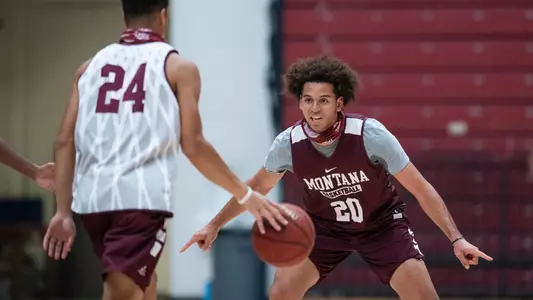
Photo by: Derek Johnson
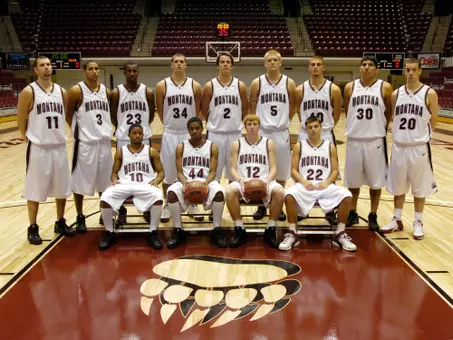
Montana freshmen eager to make immediate impact
11/6/2020 1:03:00 PM | Men's Basketball
What a wild time it is to be a college freshman.
In the last six months alone, many have already had their high-school graduations wiped away and now are experiencing a first semester of college without most of the things that make college memorable.
At least there's basketball.
"That's the one thing that's kept me going," said freshman Robby Beasley, a guard from Dublin, California. "Through all of the chaos, we've still been able to play basketball."
Moves to Missoula over the summer were delayed. Offseason workouts were abbreviated. Even now, practices are conducted with masks and some semblance of social distancing. Once seriously in doubt, the NCAA is now weeks away from beginning a delayed basketball season – one that will be full of hiccups, but looks to get off the ground.
As for a schedule? That piece is still a work in progress. But again, at least there's basketball.
"Just being out here together, it definitely gets me going," fellow freshman, and California native, Brandon Whitney said. "Now we get to work toward something. We have a season that is actually coming, so that's a big push for us to get going."
Montana's freshman class, which includes Beasley, Whitney and Australians Josh Bannan and Hunter Clarke, has been highly touted since the quartet signed their National Letters of Intent last November. Beasley, for example, was a three-star prospect. Bannan had opportunities to play professionally in the Australian circuit.
Instead, they chose Montana.
Bannan was intrigued by the professional ranks in Australia, but decided that playing in the United States was his best opportunity to grow his all-around game. For Beasley, it had a lot to do with the relationships Montana's staff built with him early on. The support of Griz Nation and five NCAA tournament appearances in the past decade didn't hurt either.
"Even before I was recruited, I saw how Timmy (Falls) was recruited," said Beasley, who was teammates with Falls at Dublin High School. "I saw how the community embraced him and what the support was like at Montana. It got me really excited."
There's also the fact that head coach Travis DeCuire has never been shy about giving young players time on the floor if they prove they deserve it.
In fact, while Montana has hit on transfers from time to time, the Grizzlies' biggest success has been the players who commit to Montana out of high school, play four seasons for the Grizzlies and leave as stars.
Since DeCuire arrived to Missoula in 2014-15, a total of 15 players have seen the floor as true freshmen. There have been a few along the way that didn't work out, many who saw limited playing time and chose to pursue opportunities at a lower level. But for the most part, Montana has hit with its true freshmen – and hit big!
It's what happened to Fabijan Krslovic, DeCuire's first commit in 2014. Krslovic started 26 games as a true freshman and ranked second on the team for rebounding. Four years later, he had played in every game during that span, earning 116 starts and becoming an all-around representative for Griz basketball for his tenacity, toughness, and leadership on and off the court.
A year later, Michael Oguine and Bobby Moorehead became Grizzlies. Oguine started 30 games that first season on his way to one of the best Griz careers in recent memory. He finished his career as a three-time All-Big Sky selection, the 2018 Defensive Player of the Year and Big Sky tournament MVP, and ranks in the top 10 in school history for scoring, steals, and games started. Moorehead played in all 33 games as a freshman, averaging 18 minutes per contest, before settling into his role that included locking down opponents' top scorers, 168 made 3-pointers and a school-record 134 games played.
The next year, Sayeed Pridgett joined the mix. As a true freshman, Pridgett started 11 contests (and played in 31 of 32 games overall) while averaging 8.1 points per contest. When he graduated this past spring, he was a two-time All-Big Sky first-team selection and became the first Grizzly in nearly 40 seasons to eclipse 1,670 career points. He ranks fourth for career scoring, sixth for steals and in the top 15 for rebounds and assists.
Of those who have played as true freshmen, and who have stayed all four years at Montana, each has found his way into the Griz record books.
That list doesn't even include the current batch of Grizzlies who played as true freshmen: Mack Anderson and Freddy Brown in 2019 and Derrick Carter-Hollinger, Kyle Owens, and Josh Vazquez in 2020. The latter trio set a school record for most combined starts by true freshmen in the same season and are poised for big sophomore campaigns. Carter-Hollinger was named the league's Freshman of the Year.
The point is, if you can play you'll get your opportunity early at Montana.
"I think what separates us from a lot of other places is that we recruit freshmen to have an early impact, and to do so at a program that's been fortunate to compete for championships," DeCuire said.
It was part of the recruiting pitch to the current group of newcomers. Not that they needed it, though.
The type of player Montana recruits is one who has the edge on his own. The player who has a chip on his shoulder, that he can play with the best, even if he's just 18 years old and adjusting to a new style and new concepts.
"We've always made sure they've known it's out there for them, but that they have to earn it," DeCuire said. "But without question, these guys want to play. When recruiting, I'll mention a guy like Fab and compare them to someone, maybe in their hometown, who they can identify with, who maybe didn't get on the floor right away, or maybe didn't win. When you paint those two pictures, they're going to choose the University of Montana every time, because no one wants to not be on the floor, unless maybe it's in a winning situation."
Adjusting to the college game, for many, has been the hardest part. The biggest challenge? Speed.
Quicker pace. Faster players. Not to mention more physical players and more to learn.
"I really underestimated the speed," Beasley said. "We're constantly going up and down the court. You're moving at a quick pace and you're having to constantly play super hard."
"The flow of the game is just faster," Whitney added. "You're constantly pushing the ball up the court."
Even Bannan, who is used to the Australian game that features a different style, speed is one of his biggest adjustments.
"It's definitely a faster pace," he said. "You're constantly moving and the guys here tend to be a bit more athletic."
DeCuire sees it on an annual basis, which is one of the hardest parts, for him, about playing freshmen so early in their careers. So what is it about speed that makes it so challenging to adjust to?
"The athleticism is No. 1, because you're going to have faster players on the floor," DeCuire said.
But it's not just limited to that. The shot clock, being 30 seconds, forces teams to play with more tempo, and DeCuire notes one of the biggest factors stems from the defensive end.
"The defenses are so much better at this level than they are at high school that it forces the offense to play at a higher tempo in order to have success."
Speed is one thing, but it's magnified when you add in the fact that players are asked to learn more things than they're used to, they're playing against older and stronger competition, and the attention to detail is heightened.
"In high school, it's easy to get lazy and now always get to your spots (on defense), but here, in college, you have to be in your spots 110 percent of the time," Beasley said. "You have to do it to perfection. It matters that much."
Beasley got a glimpse of what was expected by watching Falls. Whitney had developed friendships with Egun and Owens while playing against each other in southern California.
For Bannan, who is used to an Australian style, which he says tends to eliminate the mid-range game, he not only was adjusting to greater speed and physicality, but to a new system on a new continent. Shortly after associate head coach Chris Cobb traveled across the globe to watch Bannan play in person in 2018, though, he got him in contact with Krslovic. The two chatted about what Montana and playing in the United States was like, and Bannan agreed this would be his best opportunity to take his game to the next level.
The adjustment for the freshmen has been a roller coaster, but DeCuire is, overall, pleased with what he's seen from his newcomers.
"They're well coached and they're not lacking in confidence, which is important," DeCuire said. "When we make corrections or give them information, they can take in that information and it doesn't paralyze them. A lot of times, you'll get young guys who are in new-structured environments and it takes a long time to break old habits and create new ones. Fortunately for these guys, what we do isn't much different from what they've been doing."
Perhaps more this year than ever, with COVID-19 testing and contact tracing possibly wiping out players or groups for periods of time, DeCuire has stressed to his team the importance of being ready. He believes there's no such thing as an eight-man rotation – a style he has become accustomed to running – because every guy will be needed.
It can be a daunting task for a freshman to be thrust into that type of role, but again maybe not. After all, Montana recruits players who expect to compete immediately.
"Coming in, I wanted to be a big part of this team right away, so I've always been working my hardest to stay ready to go," Whitney said.
Added Beasley: "We have a really deep team this year and have a lot of guys who can do big things. I want to be one of those guys. I want to be a player who my teammates can count on, so I'm just staying ready for when my number is called."
It is probable that his number will be called sometime on Nov. 28 – a date likely to be Montana's season opener. In the three weeks until then, Montana will work to find a rotation of guys who can help the Grizzlies content for another conference championship.
Plenty is up in the air still, but don't be surprised to once again see several freshmen playing key roles. Also don't be surprised to see an attitude similar to some of the true freshmen who have come before this group.
"I love winning. I hate losing," Bannan said. "I'll do anything I can to help the team win."
It seems like this group will fit in just fine at Montana.
In addition to Bannan, Beasley and Whitney, freshman Hunter Clarke is currently in Australia, where he stayed for the early part of his recovery from an injury. He is expected to join the Grizzlies in Missoula by the end of the month.
In the last six months alone, many have already had their high-school graduations wiped away and now are experiencing a first semester of college without most of the things that make college memorable.
At least there's basketball.
"That's the one thing that's kept me going," said freshman Robby Beasley, a guard from Dublin, California. "Through all of the chaos, we've still been able to play basketball."
Moves to Missoula over the summer were delayed. Offseason workouts were abbreviated. Even now, practices are conducted with masks and some semblance of social distancing. Once seriously in doubt, the NCAA is now weeks away from beginning a delayed basketball season – one that will be full of hiccups, but looks to get off the ground.
As for a schedule? That piece is still a work in progress. But again, at least there's basketball.
"Just being out here together, it definitely gets me going," fellow freshman, and California native, Brandon Whitney said. "Now we get to work toward something. We have a season that is actually coming, so that's a big push for us to get going."
Montana's freshman class, which includes Beasley, Whitney and Australians Josh Bannan and Hunter Clarke, has been highly touted since the quartet signed their National Letters of Intent last November. Beasley, for example, was a three-star prospect. Bannan had opportunities to play professionally in the Australian circuit.
Instead, they chose Montana.
Bannan was intrigued by the professional ranks in Australia, but decided that playing in the United States was his best opportunity to grow his all-around game. For Beasley, it had a lot to do with the relationships Montana's staff built with him early on. The support of Griz Nation and five NCAA tournament appearances in the past decade didn't hurt either.
"Even before I was recruited, I saw how Timmy (Falls) was recruited," said Beasley, who was teammates with Falls at Dublin High School. "I saw how the community embraced him and what the support was like at Montana. It got me really excited."
There's also the fact that head coach Travis DeCuire has never been shy about giving young players time on the floor if they prove they deserve it.
In fact, while Montana has hit on transfers from time to time, the Grizzlies' biggest success has been the players who commit to Montana out of high school, play four seasons for the Grizzlies and leave as stars.
Since DeCuire arrived to Missoula in 2014-15, a total of 15 players have seen the floor as true freshmen. There have been a few along the way that didn't work out, many who saw limited playing time and chose to pursue opportunities at a lower level. But for the most part, Montana has hit with its true freshmen – and hit big!
It's what happened to Fabijan Krslovic, DeCuire's first commit in 2014. Krslovic started 26 games as a true freshman and ranked second on the team for rebounding. Four years later, he had played in every game during that span, earning 116 starts and becoming an all-around representative for Griz basketball for his tenacity, toughness, and leadership on and off the court.
A year later, Michael Oguine and Bobby Moorehead became Grizzlies. Oguine started 30 games that first season on his way to one of the best Griz careers in recent memory. He finished his career as a three-time All-Big Sky selection, the 2018 Defensive Player of the Year and Big Sky tournament MVP, and ranks in the top 10 in school history for scoring, steals, and games started. Moorehead played in all 33 games as a freshman, averaging 18 minutes per contest, before settling into his role that included locking down opponents' top scorers, 168 made 3-pointers and a school-record 134 games played.
The next year, Sayeed Pridgett joined the mix. As a true freshman, Pridgett started 11 contests (and played in 31 of 32 games overall) while averaging 8.1 points per contest. When he graduated this past spring, he was a two-time All-Big Sky first-team selection and became the first Grizzly in nearly 40 seasons to eclipse 1,670 career points. He ranks fourth for career scoring, sixth for steals and in the top 15 for rebounds and assists.
Of those who have played as true freshmen, and who have stayed all four years at Montana, each has found his way into the Griz record books.
That list doesn't even include the current batch of Grizzlies who played as true freshmen: Mack Anderson and Freddy Brown in 2019 and Derrick Carter-Hollinger, Kyle Owens, and Josh Vazquez in 2020. The latter trio set a school record for most combined starts by true freshmen in the same season and are poised for big sophomore campaigns. Carter-Hollinger was named the league's Freshman of the Year.
The point is, if you can play you'll get your opportunity early at Montana.
"I think what separates us from a lot of other places is that we recruit freshmen to have an early impact, and to do so at a program that's been fortunate to compete for championships," DeCuire said.
It was part of the recruiting pitch to the current group of newcomers. Not that they needed it, though.
The type of player Montana recruits is one who has the edge on his own. The player who has a chip on his shoulder, that he can play with the best, even if he's just 18 years old and adjusting to a new style and new concepts.
"We've always made sure they've known it's out there for them, but that they have to earn it," DeCuire said. "But without question, these guys want to play. When recruiting, I'll mention a guy like Fab and compare them to someone, maybe in their hometown, who they can identify with, who maybe didn't get on the floor right away, or maybe didn't win. When you paint those two pictures, they're going to choose the University of Montana every time, because no one wants to not be on the floor, unless maybe it's in a winning situation."
Adjusting to the college game, for many, has been the hardest part. The biggest challenge? Speed.
Quicker pace. Faster players. Not to mention more physical players and more to learn.
"I really underestimated the speed," Beasley said. "We're constantly going up and down the court. You're moving at a quick pace and you're having to constantly play super hard."
"The flow of the game is just faster," Whitney added. "You're constantly pushing the ball up the court."
Even Bannan, who is used to the Australian game that features a different style, speed is one of his biggest adjustments.
"It's definitely a faster pace," he said. "You're constantly moving and the guys here tend to be a bit more athletic."
DeCuire sees it on an annual basis, which is one of the hardest parts, for him, about playing freshmen so early in their careers. So what is it about speed that makes it so challenging to adjust to?
"The athleticism is No. 1, because you're going to have faster players on the floor," DeCuire said.
But it's not just limited to that. The shot clock, being 30 seconds, forces teams to play with more tempo, and DeCuire notes one of the biggest factors stems from the defensive end.
"The defenses are so much better at this level than they are at high school that it forces the offense to play at a higher tempo in order to have success."
Speed is one thing, but it's magnified when you add in the fact that players are asked to learn more things than they're used to, they're playing against older and stronger competition, and the attention to detail is heightened.
"In high school, it's easy to get lazy and now always get to your spots (on defense), but here, in college, you have to be in your spots 110 percent of the time," Beasley said. "You have to do it to perfection. It matters that much."
Beasley got a glimpse of what was expected by watching Falls. Whitney had developed friendships with Egun and Owens while playing against each other in southern California.
For Bannan, who is used to an Australian style, which he says tends to eliminate the mid-range game, he not only was adjusting to greater speed and physicality, but to a new system on a new continent. Shortly after associate head coach Chris Cobb traveled across the globe to watch Bannan play in person in 2018, though, he got him in contact with Krslovic. The two chatted about what Montana and playing in the United States was like, and Bannan agreed this would be his best opportunity to take his game to the next level.
The adjustment for the freshmen has been a roller coaster, but DeCuire is, overall, pleased with what he's seen from his newcomers.
"They're well coached and they're not lacking in confidence, which is important," DeCuire said. "When we make corrections or give them information, they can take in that information and it doesn't paralyze them. A lot of times, you'll get young guys who are in new-structured environments and it takes a long time to break old habits and create new ones. Fortunately for these guys, what we do isn't much different from what they've been doing."
Perhaps more this year than ever, with COVID-19 testing and contact tracing possibly wiping out players or groups for periods of time, DeCuire has stressed to his team the importance of being ready. He believes there's no such thing as an eight-man rotation – a style he has become accustomed to running – because every guy will be needed.
It can be a daunting task for a freshman to be thrust into that type of role, but again maybe not. After all, Montana recruits players who expect to compete immediately.
"Coming in, I wanted to be a big part of this team right away, so I've always been working my hardest to stay ready to go," Whitney said.
Added Beasley: "We have a really deep team this year and have a lot of guys who can do big things. I want to be one of those guys. I want to be a player who my teammates can count on, so I'm just staying ready for when my number is called."
It is probable that his number will be called sometime on Nov. 28 – a date likely to be Montana's season opener. In the three weeks until then, Montana will work to find a rotation of guys who can help the Grizzlies content for another conference championship.
Plenty is up in the air still, but don't be surprised to once again see several freshmen playing key roles. Also don't be surprised to see an attitude similar to some of the true freshmen who have come before this group.
"I love winning. I hate losing," Bannan said. "I'll do anything I can to help the team win."
It seems like this group will fit in just fine at Montana.
In addition to Bannan, Beasley and Whitney, freshman Hunter Clarke is currently in Australia, where he stayed for the early part of his recovery from an injury. He is expected to join the Grizzlies in Missoula by the end of the month.
Players Mentioned

F
/ Men's Basketball
F
/ Men's Basketball
F
/ Men's Basketball
G
/ Men's Basketball
F
/ Men's Basketball
G
/ Men's Basketball
G
/ Men's Basketball
F
/ Men's Basketball
G
/ Men's Basketball
G
/ Men's Basketball
G
/ Men's BasketballMonday, March 30
Monday, March 30
Monday, March 30
Monday, March 30