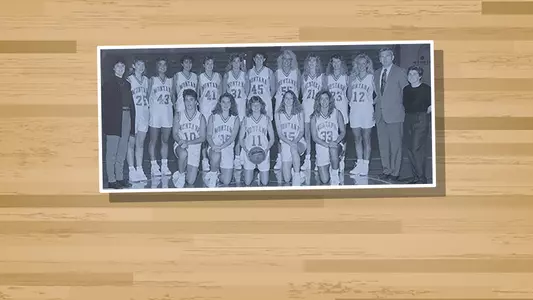
Lady Griz Rewind :: 1992-93
4/17/2020 3:21:00 PM | Women's Basketball
Robin Selvig likes to tell this story.
It was the coach's first season coaching the Lady Griz, in 1978-79. His team was 6-7 in late January as it prepared for a Friday night game in Bozeman.
It would be Montana's first meeting that season against Montana State, which also was under a first-year coach, Maureen Frederick, who told a radio station in the days leading up to the game that her team was better than Montana at every position.
Montana would win the game 61-58, one of Selvig's 865 victories over his distinguished 38-year career. Seventy-seven of those victories would come against the Bobcats.
Selvig and the Lady Griz would defeat Montana State the first 23 times the two teams played each other. His first loss to the Bobcats would not come until the 1987-88 season, his first loss to MSU in Missoula would not arrive until the injury-plagued season of 1998-99.
When Judy Spoelstra arrived at Montana State prior to the 1989-90 season, the Bobcats' new coach knew how things stood in the Big Sky Conference.
She had arrived in Bozeman after three years as an assistant at Idaho. Those Vandal teams went 0-7 against Montana, losing by an average of more than 24 points per game.
But that was as an assistant. Now the former Oregon State All-American had her own team, her own program.
"She just had tons of energy and was real personable. Everybody liked her," says Montana State women's basketball sports information director Tom Schulz, who arrived in Bozeman a year before Spoelstra and is still covering the Bobcats.
"At the time, women's athletics was a separate department from the men, and she came in and really gave the department a boost and a lot of energy."
Montana State would snap Montana's 67-game winning streak against conference opponents with a 74-71 win in Bozeman in February 1992, in Spoelstra's third year, but the Lady Griz would win the Big Sky championship the next month and advance to the NCAA tournament for the fifth straight year.
The 1992-93 season would be one of transition for Montana. Gone was Shannon Cate, who had capped her career the year before by leading the Lady Griz to an NCAA tournament win at Wisconsin and earning Kodak All-America honors.
Also gone was Julie Epperly, the team's starting point guard the previous two seasons.
"We had lots of unknowns. There were lots of questions going into that year with Shannon graduating, because she was obviously a big part of our team before that," said Selvig.
It was a year that opened with a buzz about the NCAA tournament, of which Montana had become a regular qualifier. But this year would be different. Missoula was already a pre-determined host of the NCAA West Regional.
Sure, the Lady Griz would need to make the tournament in the first place and then would have to win two games to make the regional, but wasn't it fun to think about?
"That was certainly in the back of the minds of a lot of people. That would have been something to dream about doing," said Selvig.
"But we didn't get in the tournament, so that took care of that."
That was because of Spoelstra and what she was building in Bozeman. Montana State and Boise State, then under coach June Daugherty, were the two teams that rose up and fought Montana for supremacy in the early years of the Big Sky Conference.
"She knew the league and the type of kids we'd need to compete against Montana," says Schulz of Spoelstra. "She set her recruiting sights on that and went out and knew she was going to have to battle for some of the better kids in the state.
"One of her first big recruiting classes was to get three Class C kids. That was the foundation of her starting to build the program."
Montana returned three starters in 1992-93, and it was Jodi Hinrichs' 10 points, Ann Lake's 12 rebounds and Kelly Pilcher's three assists that helped the Lady Griz open the season with a 61-56 home win over BYU, a team that would go 24-4 in the regular season and earn a No. 12 seed in the NCAA tournament.
After opening Providence's tournament with a 78-63 win over George Mason, Montana fell 74-63 to the host Friars largely because of 28 turnovers.
Then came the highlight game of the nonconference schedule, a visit to Southwest Missouri State, a team coming off a 31-3 season and a run to the Final Four the year before.
A No. 8 seed but riding the scoring of Jackie Stiles, the Bears defeated Kansas in the first round before knocking off No. 1 seed Iowa in the round of 32 by a point.
Regionals were a cakewalk, with Southwest Missouri defeating No. 5 UCLA 83-57 in the Sweet 16, Mississippi 94-71 in the Midwest Region final.
The dream run would end with a 12-point loss to Western Kentucky in the national semifinals.
Stiles was gone in 1992-93, but the city of Springfield still loved its women's basketball. The program would lead the nation in attendance that season at more than 7,400 per game.
That's what would be awaiting Montana in its fourth game of the season. The Bears entered the game ranked No. 25 in the nation.
"I was interested in playing there because they were drawing. I liked to get series where people had crowds," said Selvig, whose team would defeat Southwest Missouri the following season in Missoula.
"I thought it made it more fun for our players to go play opponents like that, and they had a good crowd."
Montana led the nation in field goal percentage defense that season at .317 and limited the Bears to 31.6 percent shooting, but the Lady Griz could not overcome a season-high 31 turnovers and fell 49-46.
"We had plenty of turnovers that game, but that was probably less than the average they caused," Selvig said. "They were double-trap pressure all over the place. That was their MO. We hung in the game and had a chance."
The Bears would earn a No. 7 seed in that spring's NCAA tournament and go on another run, advancing to the Elite Eight before falling to Louisiana Tech.
Montana, now 2-2, answered with four straight home wins, first Gonzaga and Washington State, then Lady Griz Holiday Classic blowout victories over Western Carolina and Rhode Island.
Those two teams took 140 shots and made just 32 (.229).
Montana opened the new calendar year with a road trip to Drake and Iowa State.
The game against Drake would be a rematch of the very first Lady Griz Classic championship game, one won by the Bulldogs 71-65 in 1981-82. That Drake team was led by Lorri Bauman, who would score 3,115 points as a Bulldog, a career average of 26.0.
Eleven years later, Montana built a 36-23 halftime lead but could not contain Drake after that. The Bulldogs, coached by Lisa Bluder, now 20 years into her career as the successful coach at Iowa, shot 54.8 percent the rest of the way to win 90-83 in overtime, spoiling a 22-point outing by Carla Beattie.
"Drake would have been a really good win," said Selvig. "They had a really good program in the early years."
A 65-36 win at Iowa State three days later would seem to be a signature victory, but that would be looking through a more recent lens. That ISU team would go 2-25. The game against Montana drew a crowd of 278.
Two years later Bill Fennelly would be hired. Today the Cyclones, who had an average home attendance last winter of more than 9,600, are one of the sports great success stories.
One of Iowa State's two wins in 1992-93 was an early-season victory over Montana State, which hardly set the stage for what would come in March.
The Big Sky Conference began sponsoring women's sports in 1988-89, and Montana overwhelmed the league in the early years, winning the regular-season title the first three years with perfect 16-0 records, with tournament championships and trips to the NCAAs to follow.
Boise State broke through and won the league in 1991-92, with Montana finishing a game back. The Lady Griz would go to Boise and knock off the Broncos in the Big Sky tournament championship game.
Entering league play in 1992-93, Montana had gone 69-3 against Big Sky opponents the previous four years, with those three losses coming by three, four and seven points.
So it surprised no one that Montana was 6-0 in early February when Montana State came to town, with an average margin of victory of 25.5.
Lake had a 26-point, nine-rebound, six-assist, five-steal game in a home win over Eastern Washington, Montana had six players in double figures in a 98-76 win at Weber State, and the Lady Griz suffocated Northern Arizona in Flagstaff, winning 80-31.
Montana trailed Boise State in Missoula at the half, 26-22, before going 18 for 28 in the second half to rally for a 75-63 victory.
That set up a matchup against Montana State, which also was 6-0 in league.
In front of a crowd of 7,022, it wasn't close. Montana held the Bobcats to 26.8 percent shooting and won 65-49. "It was a huge crowd and we kind of laid an egg," says Schulz.
The Lady Griz would keep rolling, winning its next six to improve to 13-0 in league. That included an 81-70 win at Boise State, behind Lake's 21 points and Pilcher's 11 assists.
But this would be no anticlimactic denouement, with Montana waltzing to another title.
After losing in Missoula, Montana State would also win six straight, including a big 69-66 victory at Boise State, setting up a matchup in Bozeman of the 13-0 Lady Griz and 12-1 Bobcats on the final day of the regular season.
"It was a good thing for fans, if you draw it out and it comes down to Montana and Montana State in a big one," said Selvig. "It was a pretty intense rivalry those days. I think I got a few things thrown at me."
There would have been plenty of suspects to choose from. The game drew a then MSU-record 5,743 fans.
"We got on a pretty good roll that year and the community started picking up and coming to our games. Knowing that final game we had an opportunity to get to 20 wins and be co-champions, that was a pretty big thing," says Schulz. "We filled up the Brick pretty good."
Montana held Montana State to 32.1 percent shooting, which normally would have meant a Lady Griz victory, but Montana turned the ball over 22 times and Montana State pulled out a 53-48 win.
"I think that's the game they threw a little half-court trap at us and we didn't handle it well and had some bad turnovers," said Selvig.
The two Montana schools would be co-champs, which led to even more drama: Which team would host the Big Sky tournament the following weekend?
In those days it came down to a coin flip. Actually two. The first one, if you can believe it, only determined who would get to make the call on the flip that decided hosting rights.
"We went into the officials' locker room. Marla Denham and Mary Whatford had worked the game. Robin and Judy were in there. Our AD. It was tight," recalls Schulz.
"While we were waiting for this commemorative coin from the Big Sky to show up, Judy ran out to the team and asked them what they wanted her to call. Without a second to think about it, they yelled, 'Tails never fails.'"
As the home team, Montana State got the honor. Spoelstra called tails, and that's what came up. All that did was give her the right to call the next flip, which would decide hosting rights. She called tails again, and again she was right.
"The whole crowd knew what was happening and stayed," says Schulz. "We got around the side of the stands and Judy just kind of raised her hand. I remember running over to the PA saying we'd won it. The crowd erupted. That was one of the first big moments of women's basketball history for us."
The next weekend, No. 1 seed Montana State easily handled No. 4 Idaho, 57-43, in the semifinals and No. 2 Montana used a big play late in the game from Pilcher and got 21 points and 14 rebounds from Lake to knock off No. 3 Boise State 70-68.
Facing Montana State on the Bobcats' home floor for the second time in eight days, Montana cut its turnovers down to 11 in the championship game, but MSU shot 40.8 percent and outscored the Lady Griz at the line 20-5 to win 64-57.
Behind 16 points and nine rebounds from tournament MVP Cass Bauer, one of those Class C players -- Bauer was from Hysham -- that made up Spoelstra's first key recruiting class, Montana State celebrated in front of a new record, 6,333 fans.
"MSU had never hosted anything like that before. The whole community was on board. Everybody was into it," says Schulz.
Montana State would make its first trip to the NCAA tournament in a year when the field was still made up of 48 teams. The No. 10 Bobcats would travel to Seattle and fall 80-51 to No. 7 Washington.
Montana State would finish a game behind co-champions Montana and Boise State in 1993-94, third again in 1994-95 behind the same two teams.
That's when Oregon State came calling for Spoelstra, who had led the Beavers to the Sweet 16 as a player in 1983, the season she was named a second-team Kodak All-American.
Spoelstra, who would be voted the Pac-10 Coach of the Year in 1999-2000, led Oregon State to the NCAA tournament in her first season back in Corvallis, in 1995-96, and to the WNIT four straight seasons in the early 2000s before being let go in 2005.
She would later work as an assistant coach at Washington.
"She was a good coach. She had good teams while she was at Montana State. They had it going that year pretty good. The crowds were good. It was intense," says Selvig.
"I still have a good relationship with her now. We'd visit when we'd be out recruiting, and since she's been out of coaching I've run into her."
Missoula would welcome No. 1 Stanford, No. 2 Texas Tech, No. 3 USC and No. 4 Colorado for the NCAA regional two weeks later, but that would be one NCAA tournament that would take place without Montana, the only time in an 11-year run.
"That wasn't a fun bus ride home, but that's sports. You've got to handle those situations too," said Selvig. "We had a good year and a great run in conference until the end. You don't win them all every year, and they had a good team.
"But looking back, you had to feel good what the team did. Conference co-champs. Pretty good record. The ladies did well."
Notes: Montana State would not return to the NCAA tournament until the 2016-17 season. ... Ann Lake, then a junior, led Montana at 12.4 points and 8.7 rebounds per game to earn All-Big Sky Conference honors. ... Joy Anderson, the only senior on the 1992-93 team, would earn All-Big Sky honors as well, as did junior Kelly Pilcher and sophomore Kristy Langton. ... Lake and Pilcher were named to the Big Sky All-Tournament team. ... Junior center Jill Frohlich blocked 85 shots that season, which at the time set a new program record. ... Montana finished 23-5, the 13th time in an 18-year run of 20-win seasons.
It was the coach's first season coaching the Lady Griz, in 1978-79. His team was 6-7 in late January as it prepared for a Friday night game in Bozeman.
It would be Montana's first meeting that season against Montana State, which also was under a first-year coach, Maureen Frederick, who told a radio station in the days leading up to the game that her team was better than Montana at every position.
Montana would win the game 61-58, one of Selvig's 865 victories over his distinguished 38-year career. Seventy-seven of those victories would come against the Bobcats.
Selvig and the Lady Griz would defeat Montana State the first 23 times the two teams played each other. His first loss to the Bobcats would not come until the 1987-88 season, his first loss to MSU in Missoula would not arrive until the injury-plagued season of 1998-99.
When Judy Spoelstra arrived at Montana State prior to the 1989-90 season, the Bobcats' new coach knew how things stood in the Big Sky Conference.
She had arrived in Bozeman after three years as an assistant at Idaho. Those Vandal teams went 0-7 against Montana, losing by an average of more than 24 points per game.
But that was as an assistant. Now the former Oregon State All-American had her own team, her own program.
"She just had tons of energy and was real personable. Everybody liked her," says Montana State women's basketball sports information director Tom Schulz, who arrived in Bozeman a year before Spoelstra and is still covering the Bobcats.
"At the time, women's athletics was a separate department from the men, and she came in and really gave the department a boost and a lot of energy."
Montana State would snap Montana's 67-game winning streak against conference opponents with a 74-71 win in Bozeman in February 1992, in Spoelstra's third year, but the Lady Griz would win the Big Sky championship the next month and advance to the NCAA tournament for the fifth straight year.
The 1992-93 season would be one of transition for Montana. Gone was Shannon Cate, who had capped her career the year before by leading the Lady Griz to an NCAA tournament win at Wisconsin and earning Kodak All-America honors.
Also gone was Julie Epperly, the team's starting point guard the previous two seasons.
"We had lots of unknowns. There were lots of questions going into that year with Shannon graduating, because she was obviously a big part of our team before that," said Selvig.
It was a year that opened with a buzz about the NCAA tournament, of which Montana had become a regular qualifier. But this year would be different. Missoula was already a pre-determined host of the NCAA West Regional.
Sure, the Lady Griz would need to make the tournament in the first place and then would have to win two games to make the regional, but wasn't it fun to think about?
"That was certainly in the back of the minds of a lot of people. That would have been something to dream about doing," said Selvig.
"But we didn't get in the tournament, so that took care of that."
That was because of Spoelstra and what she was building in Bozeman. Montana State and Boise State, then under coach June Daugherty, were the two teams that rose up and fought Montana for supremacy in the early years of the Big Sky Conference.
"She knew the league and the type of kids we'd need to compete against Montana," says Schulz of Spoelstra. "She set her recruiting sights on that and went out and knew she was going to have to battle for some of the better kids in the state.
"One of her first big recruiting classes was to get three Class C kids. That was the foundation of her starting to build the program."
Montana returned three starters in 1992-93, and it was Jodi Hinrichs' 10 points, Ann Lake's 12 rebounds and Kelly Pilcher's three assists that helped the Lady Griz open the season with a 61-56 home win over BYU, a team that would go 24-4 in the regular season and earn a No. 12 seed in the NCAA tournament.
After opening Providence's tournament with a 78-63 win over George Mason, Montana fell 74-63 to the host Friars largely because of 28 turnovers.
Then came the highlight game of the nonconference schedule, a visit to Southwest Missouri State, a team coming off a 31-3 season and a run to the Final Four the year before.
A No. 8 seed but riding the scoring of Jackie Stiles, the Bears defeated Kansas in the first round before knocking off No. 1 seed Iowa in the round of 32 by a point.
Regionals were a cakewalk, with Southwest Missouri defeating No. 5 UCLA 83-57 in the Sweet 16, Mississippi 94-71 in the Midwest Region final.
The dream run would end with a 12-point loss to Western Kentucky in the national semifinals.
Stiles was gone in 1992-93, but the city of Springfield still loved its women's basketball. The program would lead the nation in attendance that season at more than 7,400 per game.
That's what would be awaiting Montana in its fourth game of the season. The Bears entered the game ranked No. 25 in the nation.
"I was interested in playing there because they were drawing. I liked to get series where people had crowds," said Selvig, whose team would defeat Southwest Missouri the following season in Missoula.
"I thought it made it more fun for our players to go play opponents like that, and they had a good crowd."
Montana led the nation in field goal percentage defense that season at .317 and limited the Bears to 31.6 percent shooting, but the Lady Griz could not overcome a season-high 31 turnovers and fell 49-46.
"We had plenty of turnovers that game, but that was probably less than the average they caused," Selvig said. "They were double-trap pressure all over the place. That was their MO. We hung in the game and had a chance."
The Bears would earn a No. 7 seed in that spring's NCAA tournament and go on another run, advancing to the Elite Eight before falling to Louisiana Tech.
Montana, now 2-2, answered with four straight home wins, first Gonzaga and Washington State, then Lady Griz Holiday Classic blowout victories over Western Carolina and Rhode Island.
Those two teams took 140 shots and made just 32 (.229).
Montana opened the new calendar year with a road trip to Drake and Iowa State.
The game against Drake would be a rematch of the very first Lady Griz Classic championship game, one won by the Bulldogs 71-65 in 1981-82. That Drake team was led by Lorri Bauman, who would score 3,115 points as a Bulldog, a career average of 26.0.
Eleven years later, Montana built a 36-23 halftime lead but could not contain Drake after that. The Bulldogs, coached by Lisa Bluder, now 20 years into her career as the successful coach at Iowa, shot 54.8 percent the rest of the way to win 90-83 in overtime, spoiling a 22-point outing by Carla Beattie.
"Drake would have been a really good win," said Selvig. "They had a really good program in the early years."
A 65-36 win at Iowa State three days later would seem to be a signature victory, but that would be looking through a more recent lens. That ISU team would go 2-25. The game against Montana drew a crowd of 278.
Two years later Bill Fennelly would be hired. Today the Cyclones, who had an average home attendance last winter of more than 9,600, are one of the sports great success stories.
One of Iowa State's two wins in 1992-93 was an early-season victory over Montana State, which hardly set the stage for what would come in March.
The Big Sky Conference began sponsoring women's sports in 1988-89, and Montana overwhelmed the league in the early years, winning the regular-season title the first three years with perfect 16-0 records, with tournament championships and trips to the NCAAs to follow.
Boise State broke through and won the league in 1991-92, with Montana finishing a game back. The Lady Griz would go to Boise and knock off the Broncos in the Big Sky tournament championship game.
Entering league play in 1992-93, Montana had gone 69-3 against Big Sky opponents the previous four years, with those three losses coming by three, four and seven points.
So it surprised no one that Montana was 6-0 in early February when Montana State came to town, with an average margin of victory of 25.5.
Lake had a 26-point, nine-rebound, six-assist, five-steal game in a home win over Eastern Washington, Montana had six players in double figures in a 98-76 win at Weber State, and the Lady Griz suffocated Northern Arizona in Flagstaff, winning 80-31.
Montana trailed Boise State in Missoula at the half, 26-22, before going 18 for 28 in the second half to rally for a 75-63 victory.
That set up a matchup against Montana State, which also was 6-0 in league.
In front of a crowd of 7,022, it wasn't close. Montana held the Bobcats to 26.8 percent shooting and won 65-49. "It was a huge crowd and we kind of laid an egg," says Schulz.
The Lady Griz would keep rolling, winning its next six to improve to 13-0 in league. That included an 81-70 win at Boise State, behind Lake's 21 points and Pilcher's 11 assists.
But this would be no anticlimactic denouement, with Montana waltzing to another title.
After losing in Missoula, Montana State would also win six straight, including a big 69-66 victory at Boise State, setting up a matchup in Bozeman of the 13-0 Lady Griz and 12-1 Bobcats on the final day of the regular season.
"It was a good thing for fans, if you draw it out and it comes down to Montana and Montana State in a big one," said Selvig. "It was a pretty intense rivalry those days. I think I got a few things thrown at me."
There would have been plenty of suspects to choose from. The game drew a then MSU-record 5,743 fans.
"We got on a pretty good roll that year and the community started picking up and coming to our games. Knowing that final game we had an opportunity to get to 20 wins and be co-champions, that was a pretty big thing," says Schulz. "We filled up the Brick pretty good."
Montana held Montana State to 32.1 percent shooting, which normally would have meant a Lady Griz victory, but Montana turned the ball over 22 times and Montana State pulled out a 53-48 win.
"I think that's the game they threw a little half-court trap at us and we didn't handle it well and had some bad turnovers," said Selvig.
The two Montana schools would be co-champs, which led to even more drama: Which team would host the Big Sky tournament the following weekend?
In those days it came down to a coin flip. Actually two. The first one, if you can believe it, only determined who would get to make the call on the flip that decided hosting rights.
"We went into the officials' locker room. Marla Denham and Mary Whatford had worked the game. Robin and Judy were in there. Our AD. It was tight," recalls Schulz.
"While we were waiting for this commemorative coin from the Big Sky to show up, Judy ran out to the team and asked them what they wanted her to call. Without a second to think about it, they yelled, 'Tails never fails.'"
As the home team, Montana State got the honor. Spoelstra called tails, and that's what came up. All that did was give her the right to call the next flip, which would decide hosting rights. She called tails again, and again she was right.
"The whole crowd knew what was happening and stayed," says Schulz. "We got around the side of the stands and Judy just kind of raised her hand. I remember running over to the PA saying we'd won it. The crowd erupted. That was one of the first big moments of women's basketball history for us."
The next weekend, No. 1 seed Montana State easily handled No. 4 Idaho, 57-43, in the semifinals and No. 2 Montana used a big play late in the game from Pilcher and got 21 points and 14 rebounds from Lake to knock off No. 3 Boise State 70-68.
Facing Montana State on the Bobcats' home floor for the second time in eight days, Montana cut its turnovers down to 11 in the championship game, but MSU shot 40.8 percent and outscored the Lady Griz at the line 20-5 to win 64-57.
Behind 16 points and nine rebounds from tournament MVP Cass Bauer, one of those Class C players -- Bauer was from Hysham -- that made up Spoelstra's first key recruiting class, Montana State celebrated in front of a new record, 6,333 fans.
"MSU had never hosted anything like that before. The whole community was on board. Everybody was into it," says Schulz.
Montana State would make its first trip to the NCAA tournament in a year when the field was still made up of 48 teams. The No. 10 Bobcats would travel to Seattle and fall 80-51 to No. 7 Washington.
Montana State would finish a game behind co-champions Montana and Boise State in 1993-94, third again in 1994-95 behind the same two teams.
That's when Oregon State came calling for Spoelstra, who had led the Beavers to the Sweet 16 as a player in 1983, the season she was named a second-team Kodak All-American.
Spoelstra, who would be voted the Pac-10 Coach of the Year in 1999-2000, led Oregon State to the NCAA tournament in her first season back in Corvallis, in 1995-96, and to the WNIT four straight seasons in the early 2000s before being let go in 2005.
She would later work as an assistant coach at Washington.
"She was a good coach. She had good teams while she was at Montana State. They had it going that year pretty good. The crowds were good. It was intense," says Selvig.
"I still have a good relationship with her now. We'd visit when we'd be out recruiting, and since she's been out of coaching I've run into her."
Missoula would welcome No. 1 Stanford, No. 2 Texas Tech, No. 3 USC and No. 4 Colorado for the NCAA regional two weeks later, but that would be one NCAA tournament that would take place without Montana, the only time in an 11-year run.
"That wasn't a fun bus ride home, but that's sports. You've got to handle those situations too," said Selvig. "We had a good year and a great run in conference until the end. You don't win them all every year, and they had a good team.
"But looking back, you had to feel good what the team did. Conference co-champs. Pretty good record. The ladies did well."
Notes: Montana State would not return to the NCAA tournament until the 2016-17 season. ... Ann Lake, then a junior, led Montana at 12.4 points and 8.7 rebounds per game to earn All-Big Sky Conference honors. ... Joy Anderson, the only senior on the 1992-93 team, would earn All-Big Sky honors as well, as did junior Kelly Pilcher and sophomore Kristy Langton. ... Lake and Pilcher were named to the Big Sky All-Tournament team. ... Junior center Jill Frohlich blocked 85 shots that season, which at the time set a new program record. ... Montana finished 23-5, the 13th time in an 18-year run of 20-win seasons.
Thursday, June 04
Friday, May 01
Friday, May 01
Friday, May 01