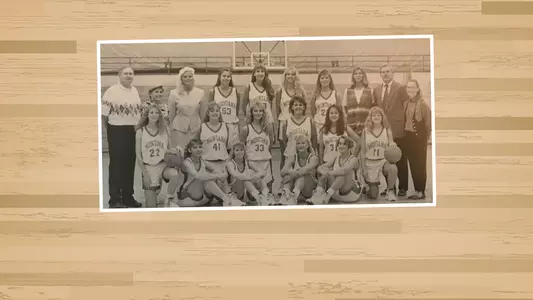
Lady Griz Rewind :: 1994-95
4/3/2020 2:34:00 PM | Women's Basketball
And so it begins, the great shelter-in-place project of 2020: the inputting of old Lady Griz box scores into our electronic statistics program.
We already have everything from 1995-96 through last month's final game of the 2019-20 season. Now? Settling in and attacking the 1979-80 to 1994-95 era, working backwards.
Let's see: five box scores per hour, 30-plus games per season, 16 years of statistics and results. Yep, it's going to be a chore -- one hour of inputting feels like a day -- but the end result is going to be amazing.
And we've got the time.
Ever wonder who has had the most double-doubles in program history? Or what the top 10 seasons have been for scoring by a Lady Griz freshman?
Wish you could look up the box score from Montana's 74-72 overtime home loss to Stanford in the 1988 NCAA tournament, a game that drew more than 8,700 fans to Dahlberg Arena?
Hoping to one day see the season-by-season statistics of every Lady Griz player from the last 40 years and even checking out their game-by-game performances for any given season?
All of it will soon be a reality, all of it online or easily retrievable with a few keystrokes instead of shuffling through hundreds of pieces of paper, more and more of them being hand-written the deeper and farther back this project gets.
But instead of just putting up season-by-season links deep on our website, a better idea: with the help of former Lady Griz coach Robin Selvig, we'll bring those seasons to life, one per week.
Because the real gems waiting to be discovered are not the numbers themselves but the stories behind them, the tales Selvig can still recall in amazing detail, even from games two and three decades ago.
And besides, he's been bored and fully welcomed the distraction -- and trip back in time -- in these days before his mountain bike trails lose their snow, dry up and become rideable, and his gardens spring to life.
We've got to catch him while we can. So we begin, starting with the 1994-95 season.
If there was one season that could serve as the exemplar of the Lady Griz basketball program over the years, you'd be hard-pressed to find a better one than 1994-95.
Home games against Oklahoma, Vanderbilt and Tennessee, neutral-site games against Duke and Syracuse, Big Sky Conference regular-season and tournament championships, which came with very little resistance, a win in the NCAA tournament, an average home attendance of more than 5,200.
That season had everything Selvig's program became known for. We'll play anyone anywhere. And if you come to Missoula, you'd better be prepared for a big-time environment, because our fans will be ready.
"I think that's a fair analysis. We were able to generate some good schedules and get some of those people at home, and that season was one of them," he says.
"I used to say in recruiting, we're a nationally competitive program in a small-town environment. And we were for a lot of years."
The team had four seniors -- Carla Beattie, Jodi Hinrichs, Kristy Langton and Lora Morast. The only returning starter other than Langton was junior guard Sherri Brooks.
And then there was the anticipated arrival of Skyla Sisco, who had redshirted the season before but had showed her coaches and teammates, on a daily basis, the skills that would later make her a four-time All-Big Sky selection and the league MVP in 1997-98.
After warming up with an easy victory over Simon Fraser in their opener, the Lady Griz got Oklahoma and Vanderbilt in back-to-back home games thanks to an entry into the preseason WNIT.
Montana handled Oklahoma -- the Sooners, who would be a No. 7 seed in that year's NCAA tournament, would hire Sherri Coale two seasons later, and she would have them in the Final Four by 2001-02 -- then faced Vanderbilt two days later.
The Lady Griz led the Commodores by one at the half but would fall 69-65 despite a 19-point, 10-rebound double-double by Hinrichs.
Beattie, who was going to be the season's starting point guard, was lost for the year to a torn Achilles in the game. She would return for a second senior season in 1995-96.
Another SEC team, Tennessee, would arrive in December. Montana would lose 66-61 to the No. 1-ranked Lady Vols.
Vanderbilt and Tennessee would both be No. 1 seeds when the NCAA tournament rolled around in March. Montana got both at home and lost by a total of nine points in front of more than 12,000 fans.
It was the Lady Griz season of all Lady Griz seasons, one of opportunities and near misses. Montana would go 1-3 against its ranked opponents, the three losses coming by a total of 20 points.
After falling to Vanderbilt, it was off to Old Dominion's tournament in Virginia, a lineup that featured the host school, which won AIAW national titles in 1979 and '80 with Nancy Lieberman and a 1985 NCAA championship, plus Duke, Syracuse and … Montana.
"Our ex-president, Jim Koch (1986-90), got us in that tournament. He was a big basketball fan and followed our program, and he wanted us to come play at Old Dominion," said Selvig.
With Koch, then the ODU president, watching, Montana lost 89-49 to Duke, which was just emerging as a national power under third-year coach Gail Goestenkors, who would twice lead the Blue Devils to the national championship game in subsequent years.
Duke led 46-17 at the half. Montana shot 27.3 percent for the game. It was Selvig's 17th year at Montana and the most one-sided loss his team had ever suffered.
"And it could have been worse. That was just a nightmare game," said Selvig. "From start to finish, we were just lost, and they hit everything. I remember staying up all night watching video of that.
"I felt bad that we didn't show better (for Koch). Then we beat a pretty good Syracuse team the next day (76-55 on 51.8 percent shooting). That kind of took the sting out of it."
Duke was unranked at the time but would go on to be a No. 5 seed in the NCAA tournament.
Sitting 3-2 on the season, Montana would defeat UTEP and Southwest Texas State at the latter's tournament, then return home for a victory over MSU Billings in preparation for hosting No. 1 Tennessee on Dec. 19.
Montana would fall to the Lady Vols, who would go on to finish runner-up to Connecticut in the NCAA tournament, before a crowd of 8,371, then go into Christmas break with a 73-47 road win at Nevada two days later.
The Lady Griz would claim their home tournament after Christmas, with wins over Cal Poly and Illinois State, with those teams combining to score 94 points.
Despite its loaded nonconference schedule, Montana would lead the nation in scoring defense that season at 54.2 points per game.
Montana would hold 16 opponents that season to fewer than 50 points. The team averaged nearly 13 steals per game, with Brooks swiping 115 by herself.
Brooks' 115 steals are still a program record, as are the 425 by that team, a total that is 88 more than any other Lady Griz squad has had.
It's the Joe DiMaggio and his 56-game hitting streak of Montana records, likely never to be even approached much less broken.
"She had great instincts and long arms. She was quick side to side. She could take over games defensively," said Selvig of Brooks.
"We were playing zone almost exclusively. Even at the top of the zone she got her hands on things. She was a great defender."
Montana opened 1995 with a 72-42 home win over Gonzaga, then traveled to Salt Lake City for its final pre-conference game against Utah.
If anyone watched Montana's Big Sky tournament loss to Northern Arizona last month in Boise, they would have seen Julie Krommenhoek referee the game. She is a regular in Missoula as well.
She is more than a distinctive name. She was also an excellent player.
Back in 1994-95 she was a deadly shooting guard for the Utes. Behind her 27 points -- she went 9 for 11 overall and hit four of her five 3-point attempts -- Utah, which would be a No. 8 seed in the NCAA tournament that spring, won 72-46.
"She was really good, a left-hander who could really shoot it. We had a lot of battles with them over the years. That one wasn't much fun," said Selvig.
"After our two butt-kickings that year (to Duke and Utah), we were able to bounce back and go forward."
Indeed: Montana would win 16 of its next 18 games.
The Lady Griz went 12-2 in league, winning the regular-season title by two games over Boise State. Montana lost a pair of road games by three points -- at Boise State and Eastern Washington. Its 12 wins came by an average of 27.4 points per game. The closest: a comfortable 17-point margin.
Brooks, Hinrichs, Langton and Sisco would each be voted All-Big Sky, but despite winning the league by two games, league MVP honors went to Boise State's Michelle Schultz, who averaged 19.9 points per game.
The always-balanced Lady Griz had four players who averaged between 9.3 and 12.6 points per game.
"I always thought the team that won the league should get the MVP. The most important stat is winning games," said Selvig, whose team limited Schultz to five made field goals in the teams' two meetings.
Montana hosted the Big Sky tournament and had little trouble, defeating Eastern Washington, 72-45, and Montana State, 75-57, behind Langton, the MVP.
More than 6,100 showed up for the title game, the sixth time that winter it had a crowd of six thousand or more. "It's amazing to look back at those attendance numbers," said Selvig. "It wasn't unusual for us to get six (thousand) for a big game."
The home rematch with Boise State in late February, which Montana won easily, 68-49, drew a crowd of 8,276. They watched the Lady Griz hold the Broncos to three made baskets in the first half.
"Boise started out as the WAR game, the women's attendance record game," said Selvig. "That was a promotion we had. We always got big crowds for the WAR game.
"Then when the Gulf War started (in 1990), it didn't make sense to be having the WAR game, so it was changed to 'Get Noisy for Boise.'"
Montana, which had become a regular on the national postseason scene, would make its 10th appearance in the NCAA tournament since the 1982-83 season. The Lady Griz earned a No. 12 seed and were sent south to play at No. 5 San Diego State.
That Langton was held scoreless and Montana was forced into 24 turnovers should have been the end of the season for the Lady Griz.
But they held the Aztecs, who grabbed 24 offensive rebounds and took 27 more shots than Montana, to 28.4 percent shooting and got a combined 28 points on 11-of-15 shooting and 19 rebounds from Hinrichs and Lora Morast to win 57-46.
"Our defense was really good that year. We held a lot of teams in the 40s. That's obviously what won that game for us," said Selvig.
Next up: a round-of-32 game against Purdue on a neutral floor. The Boilermakers were coming off a trip to the Final Four and won 62-51 to end Montana's season.
"We were competitive against Purdue, but they were big. They played a 1-3-1 with a 6-5 girl up in front of it," said Selvig.
"We had a hard time with that. We were never out of it, but it was never like we made a run to have a chance to win. But it was competitive."
Purdue would go on to knock off No. 1 Vanderbilt 67-66 in the round of 16 before falling 69-58 in the regional final to No. 2 Stanford.
When Montana defeated San Diego State, it was the program's sixth NCAA tournament win, its third in four years. No one at the time would have believed that in 2020 it would still be Montana's and the Big Sky's last NCAA tournament victory.
But even in 1995, things had started to change, with the schools that would become the members of the Power 5 starting to pull away.
Two opponents that year, Oklahoma and Duke, had been mostly average throughout the 80s and early 90s. Then they took off.
"It was starting to become that way. Early on in my career, a lot of big programs and big conferences hadn't invested much in women's sports," said Selvig.
"It was about that time that they started getting lots of players and putting money into their programs. It got tougher and tougher that way."
But us? We're headed in the opposite direction, toward the early 90s and 1980s. Check back next week for a breakdown of the 1993-94 season, one that ended with a shot rolling off the rim at Stanford that could have sent Montana to the Sweet 16.
Does Selvig remember that shot, that moment? Like it happened yesterday.
We already have everything from 1995-96 through last month's final game of the 2019-20 season. Now? Settling in and attacking the 1979-80 to 1994-95 era, working backwards.
Let's see: five box scores per hour, 30-plus games per season, 16 years of statistics and results. Yep, it's going to be a chore -- one hour of inputting feels like a day -- but the end result is going to be amazing.
And we've got the time.
Ever wonder who has had the most double-doubles in program history? Or what the top 10 seasons have been for scoring by a Lady Griz freshman?
Wish you could look up the box score from Montana's 74-72 overtime home loss to Stanford in the 1988 NCAA tournament, a game that drew more than 8,700 fans to Dahlberg Arena?
Hoping to one day see the season-by-season statistics of every Lady Griz player from the last 40 years and even checking out their game-by-game performances for any given season?
All of it will soon be a reality, all of it online or easily retrievable with a few keystrokes instead of shuffling through hundreds of pieces of paper, more and more of them being hand-written the deeper and farther back this project gets.
But instead of just putting up season-by-season links deep on our website, a better idea: with the help of former Lady Griz coach Robin Selvig, we'll bring those seasons to life, one per week.
Because the real gems waiting to be discovered are not the numbers themselves but the stories behind them, the tales Selvig can still recall in amazing detail, even from games two and three decades ago.
And besides, he's been bored and fully welcomed the distraction -- and trip back in time -- in these days before his mountain bike trails lose their snow, dry up and become rideable, and his gardens spring to life.
We've got to catch him while we can. So we begin, starting with the 1994-95 season.
If there was one season that could serve as the exemplar of the Lady Griz basketball program over the years, you'd be hard-pressed to find a better one than 1994-95.
Home games against Oklahoma, Vanderbilt and Tennessee, neutral-site games against Duke and Syracuse, Big Sky Conference regular-season and tournament championships, which came with very little resistance, a win in the NCAA tournament, an average home attendance of more than 5,200.
That season had everything Selvig's program became known for. We'll play anyone anywhere. And if you come to Missoula, you'd better be prepared for a big-time environment, because our fans will be ready.
"I think that's a fair analysis. We were able to generate some good schedules and get some of those people at home, and that season was one of them," he says.
"I used to say in recruiting, we're a nationally competitive program in a small-town environment. And we were for a lot of years."
The team had four seniors -- Carla Beattie, Jodi Hinrichs, Kristy Langton and Lora Morast. The only returning starter other than Langton was junior guard Sherri Brooks.
And then there was the anticipated arrival of Skyla Sisco, who had redshirted the season before but had showed her coaches and teammates, on a daily basis, the skills that would later make her a four-time All-Big Sky selection and the league MVP in 1997-98.
After warming up with an easy victory over Simon Fraser in their opener, the Lady Griz got Oklahoma and Vanderbilt in back-to-back home games thanks to an entry into the preseason WNIT.
Montana handled Oklahoma -- the Sooners, who would be a No. 7 seed in that year's NCAA tournament, would hire Sherri Coale two seasons later, and she would have them in the Final Four by 2001-02 -- then faced Vanderbilt two days later.
The Lady Griz led the Commodores by one at the half but would fall 69-65 despite a 19-point, 10-rebound double-double by Hinrichs.
Beattie, who was going to be the season's starting point guard, was lost for the year to a torn Achilles in the game. She would return for a second senior season in 1995-96.
Another SEC team, Tennessee, would arrive in December. Montana would lose 66-61 to the No. 1-ranked Lady Vols.
Vanderbilt and Tennessee would both be No. 1 seeds when the NCAA tournament rolled around in March. Montana got both at home and lost by a total of nine points in front of more than 12,000 fans.
It was the Lady Griz season of all Lady Griz seasons, one of opportunities and near misses. Montana would go 1-3 against its ranked opponents, the three losses coming by a total of 20 points.
After falling to Vanderbilt, it was off to Old Dominion's tournament in Virginia, a lineup that featured the host school, which won AIAW national titles in 1979 and '80 with Nancy Lieberman and a 1985 NCAA championship, plus Duke, Syracuse and … Montana.
"Our ex-president, Jim Koch (1986-90), got us in that tournament. He was a big basketball fan and followed our program, and he wanted us to come play at Old Dominion," said Selvig.
With Koch, then the ODU president, watching, Montana lost 89-49 to Duke, which was just emerging as a national power under third-year coach Gail Goestenkors, who would twice lead the Blue Devils to the national championship game in subsequent years.
Duke led 46-17 at the half. Montana shot 27.3 percent for the game. It was Selvig's 17th year at Montana and the most one-sided loss his team had ever suffered.
"And it could have been worse. That was just a nightmare game," said Selvig. "From start to finish, we were just lost, and they hit everything. I remember staying up all night watching video of that.
"I felt bad that we didn't show better (for Koch). Then we beat a pretty good Syracuse team the next day (76-55 on 51.8 percent shooting). That kind of took the sting out of it."
Duke was unranked at the time but would go on to be a No. 5 seed in the NCAA tournament.
Sitting 3-2 on the season, Montana would defeat UTEP and Southwest Texas State at the latter's tournament, then return home for a victory over MSU Billings in preparation for hosting No. 1 Tennessee on Dec. 19.
Montana would fall to the Lady Vols, who would go on to finish runner-up to Connecticut in the NCAA tournament, before a crowd of 8,371, then go into Christmas break with a 73-47 road win at Nevada two days later.
The Lady Griz would claim their home tournament after Christmas, with wins over Cal Poly and Illinois State, with those teams combining to score 94 points.
Despite its loaded nonconference schedule, Montana would lead the nation in scoring defense that season at 54.2 points per game.
Montana would hold 16 opponents that season to fewer than 50 points. The team averaged nearly 13 steals per game, with Brooks swiping 115 by herself.
Brooks' 115 steals are still a program record, as are the 425 by that team, a total that is 88 more than any other Lady Griz squad has had.
It's the Joe DiMaggio and his 56-game hitting streak of Montana records, likely never to be even approached much less broken.
"She had great instincts and long arms. She was quick side to side. She could take over games defensively," said Selvig of Brooks.
"We were playing zone almost exclusively. Even at the top of the zone she got her hands on things. She was a great defender."
Montana opened 1995 with a 72-42 home win over Gonzaga, then traveled to Salt Lake City for its final pre-conference game against Utah.
If anyone watched Montana's Big Sky tournament loss to Northern Arizona last month in Boise, they would have seen Julie Krommenhoek referee the game. She is a regular in Missoula as well.
She is more than a distinctive name. She was also an excellent player.
Back in 1994-95 she was a deadly shooting guard for the Utes. Behind her 27 points -- she went 9 for 11 overall and hit four of her five 3-point attempts -- Utah, which would be a No. 8 seed in the NCAA tournament that spring, won 72-46.
"She was really good, a left-hander who could really shoot it. We had a lot of battles with them over the years. That one wasn't much fun," said Selvig.
"After our two butt-kickings that year (to Duke and Utah), we were able to bounce back and go forward."
Indeed: Montana would win 16 of its next 18 games.
The Lady Griz went 12-2 in league, winning the regular-season title by two games over Boise State. Montana lost a pair of road games by three points -- at Boise State and Eastern Washington. Its 12 wins came by an average of 27.4 points per game. The closest: a comfortable 17-point margin.
Brooks, Hinrichs, Langton and Sisco would each be voted All-Big Sky, but despite winning the league by two games, league MVP honors went to Boise State's Michelle Schultz, who averaged 19.9 points per game.
The always-balanced Lady Griz had four players who averaged between 9.3 and 12.6 points per game.
"I always thought the team that won the league should get the MVP. The most important stat is winning games," said Selvig, whose team limited Schultz to five made field goals in the teams' two meetings.
Montana hosted the Big Sky tournament and had little trouble, defeating Eastern Washington, 72-45, and Montana State, 75-57, behind Langton, the MVP.
More than 6,100 showed up for the title game, the sixth time that winter it had a crowd of six thousand or more. "It's amazing to look back at those attendance numbers," said Selvig. "It wasn't unusual for us to get six (thousand) for a big game."
The home rematch with Boise State in late February, which Montana won easily, 68-49, drew a crowd of 8,276. They watched the Lady Griz hold the Broncos to three made baskets in the first half.
"Boise started out as the WAR game, the women's attendance record game," said Selvig. "That was a promotion we had. We always got big crowds for the WAR game.
"Then when the Gulf War started (in 1990), it didn't make sense to be having the WAR game, so it was changed to 'Get Noisy for Boise.'"
Montana, which had become a regular on the national postseason scene, would make its 10th appearance in the NCAA tournament since the 1982-83 season. The Lady Griz earned a No. 12 seed and were sent south to play at No. 5 San Diego State.
That Langton was held scoreless and Montana was forced into 24 turnovers should have been the end of the season for the Lady Griz.
But they held the Aztecs, who grabbed 24 offensive rebounds and took 27 more shots than Montana, to 28.4 percent shooting and got a combined 28 points on 11-of-15 shooting and 19 rebounds from Hinrichs and Lora Morast to win 57-46.
"Our defense was really good that year. We held a lot of teams in the 40s. That's obviously what won that game for us," said Selvig.
Next up: a round-of-32 game against Purdue on a neutral floor. The Boilermakers were coming off a trip to the Final Four and won 62-51 to end Montana's season.
"We were competitive against Purdue, but they were big. They played a 1-3-1 with a 6-5 girl up in front of it," said Selvig.
"We had a hard time with that. We were never out of it, but it was never like we made a run to have a chance to win. But it was competitive."
Purdue would go on to knock off No. 1 Vanderbilt 67-66 in the round of 16 before falling 69-58 in the regional final to No. 2 Stanford.
When Montana defeated San Diego State, it was the program's sixth NCAA tournament win, its third in four years. No one at the time would have believed that in 2020 it would still be Montana's and the Big Sky's last NCAA tournament victory.
But even in 1995, things had started to change, with the schools that would become the members of the Power 5 starting to pull away.
Two opponents that year, Oklahoma and Duke, had been mostly average throughout the 80s and early 90s. Then they took off.
"It was starting to become that way. Early on in my career, a lot of big programs and big conferences hadn't invested much in women's sports," said Selvig.
"It was about that time that they started getting lots of players and putting money into their programs. It got tougher and tougher that way."
But us? We're headed in the opposite direction, toward the early 90s and 1980s. Check back next week for a breakdown of the 1993-94 season, one that ended with a shot rolling off the rim at Stanford that could have sent Montana to the Sweet 16.
Does Selvig remember that shot, that moment? Like it happened yesterday.


Monday, August 17
Monday, August 10
Monday, August 03
Friday, June 19