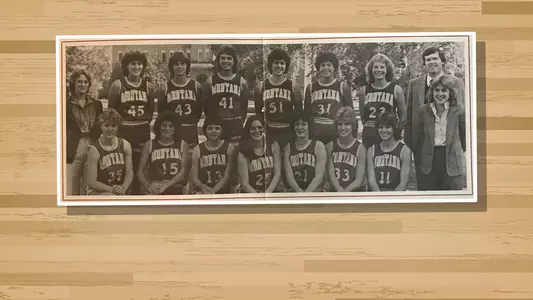
Lady Griz Rewind :: 1982-83
5/14/2020 4:10:00 PM | Women's Basketball
Here is something you might not know about Doris Deden: she was recruited out of high school by Robin Selvig and Tara VanDerveer, two coaches with nearly 2,000 wins between them.
Of course that was back in the late 70s, when they were just getting started in the profession.
Selvig was hired by Montana in June 1978, getting picked over VanDerveer, who was one of the other two finalists.
It wasn't much later that VanDerveer was hired by Idaho.
And when Deden was a senior at Sentinel High in Missoula in 1979-80, the second year for both coaches at their schools, they both wanted the 6-foot-1 center to come play for them.
The Dedens, Richard and Nancy and their five kids, had relocated to Missoula from Sandpoint, Idaho, years before. Those early memories gave the Vandals the inside track.
"That's a little slice of heaven," Deden says of Sandpoint, not knowing back then that Moscow isn't ... well, it isn't Sandpoint. "Idaho was my main interest when I was being recruited."
Recruiting was different back then. VanDerveer, who ended the 2019-20 season with 1,094 career wins, four short of Pat Summitt's record of 1,098, reached out primarily by letter.
Of course she wasn't the Pat VanDerveer of today back then, just a young coach with a name that was easy for a recruit to misspell.
Montana had two advantages in its recruitment of Deden: Her older sister, Linda, was a Lady Griz and a player on Selvig's first two teams.
Economics played a role as well. Deden was the fourth of five kids. They couldn't just go to college wherever they wanted.
In fact, that's one of the reasons the Dedens, who valued education first, sports a close second, moved to Missoula in the first place: access to the local university.
"The problem was there wasn't any money (for scholarships) in those days," says Deden. "Idaho I think offered half a ride. My parents just couldn't afford that. I was the fourth kid."
VanDerveer wouldn't have coached Deden anyway. After two years at Idaho she was off to Ohio State, then to Stanford, where she remains, on her way to overtaking Summitt.
Deden ended up at Montana, which was establishing itself quickly.
Her sister had played her first two seasons under Eddye McClure, her last two under Selvig. Wins her first two years: 11. Wins her final two years: 32.
"Not that the coaches before Robin were bad. They were good people, but you bring in somebody who played for the men's team and had a history of being a high school coach in the state," Deden says.
"Then you put him as head coach when women's sports didn't have much of a following, and it was totally amazing for our program."
Montana went 22-5 in 1981-82, Deden's sophomore year, and ended its season in the AIAW national tournament with a first-round loss to Wayland Baptist in Berkeley, Calif.
When the 1982-83 season rolled around, the Lady Griz were loaded with experience for the first time in what was Selvig's fifth year.
Six players who had started 17 or more games the year before were back, led by senior Juli Eckmann and Deden and Cheri Bratt, juniors who had been voted second-team All-Northwest Women's Basketball League the season before.
All three players would start all 30 games in 1982-83, as would junior Shari Thesenvitz. Sophomore Anita Novak would break into the starting lineup early in the season and start the final 24 games.
"We were experienced and we were deep," says Selvig. "We knew we had a good team coming back."
The team's greatest strength: its balance. Bratt would lead the team in scoring (and assists and steals) at 10.8 points per game. The other four starters would all average between 8.4 and 9.5 points.
All five shot 40 percent or better.
"We were really balanced, as balanced a team as we probably had," said Selvig, whose squad that season had 10 different players who led the team in scoring at least once, which is remarkable.
"We had lots of kids who could score. It was hard for defenses to try to figure out who to stop."
Interest in what Selvig was building was picking up as well. Montana averaged 938 fans per game in 1981-82, with six home dates surpassing 1,000.
The Lady Griz opened the 1982-83 season with a 69-59 home win over Washington State, coming back from a two-point halftime deficit in front of a crowd of 1,377.
"It was starting to pick up. You could feel it. Our crowds would be into it. We had a lot more people at our games than anywhere on the road," he said.
The team had crowds that exceeded 2,000 fans twice during the regular season, but both of those came as part of doubleheaders with the men's team, which didn't have a crowd of fewer than 5,600 in its 18 home games that winter.
The Lady Griz broke 2,000 on their own for the first time in program history later that season when they defeated Weber State in the championship game of the newly formed Mountain West Athletic Conference.
(The Big Sky Conference would not bring women's sports under the league umbrella until 1988-89.)
Montana's 13 regular season games that season away from Missoula were played in front of 2,985 fans, an average of fewer than 230 per game.
California: 310. Pacific: 106. Washington State: 100. Portland State, Idaho and Boise State: all 150.
After opening 5-0, Montana would travel to the Bay Area for Cal's tournament, followed by a game at nearby Pacific.
The Lady Griz would go 1-2 on the trip, falling to Arkansas, which was in its second year of six straight seasons with 20 or more wins, 55-43, and 79-77 in overtime at Pacific, despite Thesenvitz's 19 points and 14 rebounds.
In between was a 56-55 win at Cal, with Deden going for 12 points and 10 rebounds, Bratt 14 points, eight steals and seven rebounds. The Bears cost themselves with a 9-for-22 effort from the line.
Sitting at 6-2 after the overtime loss to Pacific, it would be 80 days before Montana would lose again.
The Lady Griz would close 1982 with a 72-57 home win over BYU, with freshman Sharla Muralt announcing herself with a 15-point, 17-rebound game, and a 65-44 road win at Washington State.
Montana opened 1983 with lopsided wins over Utah State (halftime score: Lady Griz 47, Aggies 7) and Cal State Fullerton to claim the Lady Griz Insurance Classic, then closed out its nonconference schedule with a 63-59 road win at Washington.
The standings show Montana won the Mountain West title with a 13-1 record, two games better than 11-3 Weber State, but it was no easy path to the championship.
The Lady Griz opened league 8-0. Four of those wins came in overtime, three on the road.
"There were a lot of good teams in the league. We won some tight games. That's how you win sometimes, you've got to have some good fortune," said Selvig. "It was very competitive."
Both of Montana's wins over Weber State came in overtime. In the teams' second game, in Missoula, the Wildcats, up one with six seconds left, could have won it at the free throw line.
But the Wildcats went 1 for 2 and Bratt hit a 22-footer at the buzzer to force overtime.
Novak had 21 points and 15 rebounds in Montana's 73-70 win over WSU in Ogden, Eckmann totaled 23 points on 11-of-13 shooting in its 71-65 win in Missoula.
It was just enough to get past Weber State star Carla Taylor, who would be named the team's head coach prior to the 1988-89 season and lead the Wildcats through 2010-11.
Montana would be 10-0 in league when the Lady Griz traveled to Idaho, which was in its third year under coach Pat Dobratz, the third finalist for the Montana job when Selvig was hired.
The Vandals snapped Montana's 15-game winning streak with a 64-58 victory.
Dobratz would lead Idaho to the NCAA tournament in 1984-85 with a team that went 28-2. The Vandals won the WNIT in 1985-86, going 26-5 overall.
Then she was done, getting out of coaching with a six-year record of 142-39. She was 32 years old.
"I got out while I was young and successful. I wanted to do something else," she said in 2007, when she was inducted into the Idaho Hall of Fame.
She was a star player at South Dakota State in the 70s, then joined Washington coach Kathie Neir as a graduate assistant before getting hired at Idaho, succeeding VanDerveer.
"It was the perfect time in my life," she said. "It was 24-7, but it's what I wanted to do while I was young, while it was fun."
Then she abruptly left, returning to Seattle to join Neir, who had also gotten out of coaching, to teach youth swimming. Dobratz later became a teacher. She never did coach basketball again.
Montana would conclude the regular season with wins over Boise State, Portland State and Eastern Washington to finish 13-1 in league.
Montana got 18 points, seven assists, six rebounds and four steals from Bratt as the Lady Griz defeated Montana State 75-57 in the Mountain West tournament semifinals.
In the championship game, in front of 2,008 fans, Thesenvitz scored 22 points and Montana shot 48.1 percent in a 66-63 win over Weber State.
The NCAA tournament made its debut in 1982 with 32 teams. Sixteen teams made the AIAW national tournament that season in the final year of that organization.
In 1983, the NCAA expanded to 36 teams for its tournament but there were only 14 automatic bids. The new Mountain West was not one of them, so Montana had to wait to find out if 26-3 was good enough for an at-large spot.
It was. "It was a thrill to get the information," said Selvig, who would lead Montana to 21 NCAA tournaments in his 38-year career.
Because the field had expanded from 32 to 36 teams, the tournament started with four opening-round games, with each winner going on to face their region's No. 1 seed in the first round.
Montana was paired with Northeast Louisiana, which was 22-5 and an at-large out of the Southland Conference.
It wasn't long after the Lady Griz arrived in Monroe, La., and had checked into the Ramada Inn that they were sent scurrying outside by the result of an electrical fire in their wing of the building.
"We were still able to get in. We just had to wait a while, so that was kind of interesting," said Selvig.
The Lady Griz got the Lady Indians at the wrong time in that program's history. Fifth-year coach Linda Harper had brought in 6-foot-3, 200-pound freshman center Lisa Ingram from Fort Lauderdale, Fla., and freshman point guard Eun Jung Lee from South Korea.
Lee would be named the Southland Conference player of the year four times. Ingram was voted first-team all-league four times.
Ingram ranks first (2,601) in program history in scoring, Lee (2,208) second. Ingram is the Lady Indians' career leader in rebounds (1,173), Lee the leader in assists (978).
They would form the foundation of a team that would make it the Final Four two years later, in 1985. That team would lose a national semifinal by 10 to Old Dominion, which would win the title over Georgia.
"If there was a WNBA then, those are two who would have been playing in it," said Selvig.
Montana had faced Wayland Baptist in the AIAW national tournament the year before. This was no Wayland Baptist.
"We had heard of Lisa Ingram. We knew who she was. And the guard they had was just incredible," said Deden. "We were playing someone on another level than the year before.
"I played center at 6-1 but I was never real bulky. I'm kind of slight. I don't remember how tall (Ingram) was, but she was so strong, so formidable. She was impossible for us to stop."
Ingram would go for 34 points on 15-of-19 shooting and 14 rebounds, plus four steals, three blocks and three assists. Lee had 13 points and 10 assists as the Lady Indians shot 51.7 percent.
Northeast Louisiana led 41-29 at the half and would go on to win 72-53.
But there is an important note about that final score. Only Louisiana Tech, which would fall in the national championship game to USC, held the Lady Indians to fewer points that season.
"Our girls did a pretty good job," said Selvig after the game. "We just couldn't outscore them."
The game came on a Tuesday night, just three days after Montana had hosted Weber State in the championship game of the Mountain West tournament.
The game brought 2,761 to Ewing Coliseum. Montana had played in front of a larger crowd just once, at Oregon the season before, on Senior Day for Bev Smith.
"They had a crowd and atmosphere. They had what felt like the entire football team sitting behind us, so it was a hostile environment. They had it going," said Selvig.
Northeast Louisiana would go on to lose to No. 1 seed USC in the first round of the West Region, 99-85. It was the most points scored by an opponent against USC that season.
"Not many people played USC tough that year. They did," said Selvig, who was voted the Mountain West Coach of the Year in 1982-83.
Bratt was voted first-team All-Mountain West, Eckmann second team.
Montana would be returning four starters in 1983-84, the season that produced the moment that still gives Bratt chills 36 years later, the one Selvig says is the seminal event in Lady Griz history.
Oregon State, the NCAA tournament and 4,093 fans for a women's game at Dahlberg Arena? It's coming next week.
Of course that was back in the late 70s, when they were just getting started in the profession.
Selvig was hired by Montana in June 1978, getting picked over VanDerveer, who was one of the other two finalists.
It wasn't much later that VanDerveer was hired by Idaho.
And when Deden was a senior at Sentinel High in Missoula in 1979-80, the second year for both coaches at their schools, they both wanted the 6-foot-1 center to come play for them.
The Dedens, Richard and Nancy and their five kids, had relocated to Missoula from Sandpoint, Idaho, years before. Those early memories gave the Vandals the inside track.
"That's a little slice of heaven," Deden says of Sandpoint, not knowing back then that Moscow isn't ... well, it isn't Sandpoint. "Idaho was my main interest when I was being recruited."
Recruiting was different back then. VanDerveer, who ended the 2019-20 season with 1,094 career wins, four short of Pat Summitt's record of 1,098, reached out primarily by letter.
Of course she wasn't the Pat VanDerveer of today back then, just a young coach with a name that was easy for a recruit to misspell.
Montana had two advantages in its recruitment of Deden: Her older sister, Linda, was a Lady Griz and a player on Selvig's first two teams.
Economics played a role as well. Deden was the fourth of five kids. They couldn't just go to college wherever they wanted.
In fact, that's one of the reasons the Dedens, who valued education first, sports a close second, moved to Missoula in the first place: access to the local university.
"The problem was there wasn't any money (for scholarships) in those days," says Deden. "Idaho I think offered half a ride. My parents just couldn't afford that. I was the fourth kid."
VanDerveer wouldn't have coached Deden anyway. After two years at Idaho she was off to Ohio State, then to Stanford, where she remains, on her way to overtaking Summitt.
Deden ended up at Montana, which was establishing itself quickly.
Her sister had played her first two seasons under Eddye McClure, her last two under Selvig. Wins her first two years: 11. Wins her final two years: 32.
"Not that the coaches before Robin were bad. They were good people, but you bring in somebody who played for the men's team and had a history of being a high school coach in the state," Deden says.
"Then you put him as head coach when women's sports didn't have much of a following, and it was totally amazing for our program."
Montana went 22-5 in 1981-82, Deden's sophomore year, and ended its season in the AIAW national tournament with a first-round loss to Wayland Baptist in Berkeley, Calif.
When the 1982-83 season rolled around, the Lady Griz were loaded with experience for the first time in what was Selvig's fifth year.
Six players who had started 17 or more games the year before were back, led by senior Juli Eckmann and Deden and Cheri Bratt, juniors who had been voted second-team All-Northwest Women's Basketball League the season before.
All three players would start all 30 games in 1982-83, as would junior Shari Thesenvitz. Sophomore Anita Novak would break into the starting lineup early in the season and start the final 24 games.
"We were experienced and we were deep," says Selvig. "We knew we had a good team coming back."
The team's greatest strength: its balance. Bratt would lead the team in scoring (and assists and steals) at 10.8 points per game. The other four starters would all average between 8.4 and 9.5 points.
All five shot 40 percent or better.
"We were really balanced, as balanced a team as we probably had," said Selvig, whose squad that season had 10 different players who led the team in scoring at least once, which is remarkable.
"We had lots of kids who could score. It was hard for defenses to try to figure out who to stop."
Interest in what Selvig was building was picking up as well. Montana averaged 938 fans per game in 1981-82, with six home dates surpassing 1,000.
The Lady Griz opened the 1982-83 season with a 69-59 home win over Washington State, coming back from a two-point halftime deficit in front of a crowd of 1,377.
"It was starting to pick up. You could feel it. Our crowds would be into it. We had a lot more people at our games than anywhere on the road," he said.
The team had crowds that exceeded 2,000 fans twice during the regular season, but both of those came as part of doubleheaders with the men's team, which didn't have a crowd of fewer than 5,600 in its 18 home games that winter.
The Lady Griz broke 2,000 on their own for the first time in program history later that season when they defeated Weber State in the championship game of the newly formed Mountain West Athletic Conference.
(The Big Sky Conference would not bring women's sports under the league umbrella until 1988-89.)
Montana's 13 regular season games that season away from Missoula were played in front of 2,985 fans, an average of fewer than 230 per game.
California: 310. Pacific: 106. Washington State: 100. Portland State, Idaho and Boise State: all 150.
After opening 5-0, Montana would travel to the Bay Area for Cal's tournament, followed by a game at nearby Pacific.
The Lady Griz would go 1-2 on the trip, falling to Arkansas, which was in its second year of six straight seasons with 20 or more wins, 55-43, and 79-77 in overtime at Pacific, despite Thesenvitz's 19 points and 14 rebounds.
In between was a 56-55 win at Cal, with Deden going for 12 points and 10 rebounds, Bratt 14 points, eight steals and seven rebounds. The Bears cost themselves with a 9-for-22 effort from the line.
Sitting at 6-2 after the overtime loss to Pacific, it would be 80 days before Montana would lose again.
The Lady Griz would close 1982 with a 72-57 home win over BYU, with freshman Sharla Muralt announcing herself with a 15-point, 17-rebound game, and a 65-44 road win at Washington State.
Montana opened 1983 with lopsided wins over Utah State (halftime score: Lady Griz 47, Aggies 7) and Cal State Fullerton to claim the Lady Griz Insurance Classic, then closed out its nonconference schedule with a 63-59 road win at Washington.
The standings show Montana won the Mountain West title with a 13-1 record, two games better than 11-3 Weber State, but it was no easy path to the championship.
The Lady Griz opened league 8-0. Four of those wins came in overtime, three on the road.
"There were a lot of good teams in the league. We won some tight games. That's how you win sometimes, you've got to have some good fortune," said Selvig. "It was very competitive."
Both of Montana's wins over Weber State came in overtime. In the teams' second game, in Missoula, the Wildcats, up one with six seconds left, could have won it at the free throw line.
But the Wildcats went 1 for 2 and Bratt hit a 22-footer at the buzzer to force overtime.
Novak had 21 points and 15 rebounds in Montana's 73-70 win over WSU in Ogden, Eckmann totaled 23 points on 11-of-13 shooting in its 71-65 win in Missoula.
It was just enough to get past Weber State star Carla Taylor, who would be named the team's head coach prior to the 1988-89 season and lead the Wildcats through 2010-11.
Montana would be 10-0 in league when the Lady Griz traveled to Idaho, which was in its third year under coach Pat Dobratz, the third finalist for the Montana job when Selvig was hired.
The Vandals snapped Montana's 15-game winning streak with a 64-58 victory.
Dobratz would lead Idaho to the NCAA tournament in 1984-85 with a team that went 28-2. The Vandals won the WNIT in 1985-86, going 26-5 overall.
Then she was done, getting out of coaching with a six-year record of 142-39. She was 32 years old.
"I got out while I was young and successful. I wanted to do something else," she said in 2007, when she was inducted into the Idaho Hall of Fame.
She was a star player at South Dakota State in the 70s, then joined Washington coach Kathie Neir as a graduate assistant before getting hired at Idaho, succeeding VanDerveer.
"It was the perfect time in my life," she said. "It was 24-7, but it's what I wanted to do while I was young, while it was fun."
Then she abruptly left, returning to Seattle to join Neir, who had also gotten out of coaching, to teach youth swimming. Dobratz later became a teacher. She never did coach basketball again.
Montana would conclude the regular season with wins over Boise State, Portland State and Eastern Washington to finish 13-1 in league.
Montana got 18 points, seven assists, six rebounds and four steals from Bratt as the Lady Griz defeated Montana State 75-57 in the Mountain West tournament semifinals.
In the championship game, in front of 2,008 fans, Thesenvitz scored 22 points and Montana shot 48.1 percent in a 66-63 win over Weber State.
The NCAA tournament made its debut in 1982 with 32 teams. Sixteen teams made the AIAW national tournament that season in the final year of that organization.
In 1983, the NCAA expanded to 36 teams for its tournament but there were only 14 automatic bids. The new Mountain West was not one of them, so Montana had to wait to find out if 26-3 was good enough for an at-large spot.
It was. "It was a thrill to get the information," said Selvig, who would lead Montana to 21 NCAA tournaments in his 38-year career.
Because the field had expanded from 32 to 36 teams, the tournament started with four opening-round games, with each winner going on to face their region's No. 1 seed in the first round.
Montana was paired with Northeast Louisiana, which was 22-5 and an at-large out of the Southland Conference.
It wasn't long after the Lady Griz arrived in Monroe, La., and had checked into the Ramada Inn that they were sent scurrying outside by the result of an electrical fire in their wing of the building.
"We were still able to get in. We just had to wait a while, so that was kind of interesting," said Selvig.
The Lady Griz got the Lady Indians at the wrong time in that program's history. Fifth-year coach Linda Harper had brought in 6-foot-3, 200-pound freshman center Lisa Ingram from Fort Lauderdale, Fla., and freshman point guard Eun Jung Lee from South Korea.
Lee would be named the Southland Conference player of the year four times. Ingram was voted first-team all-league four times.
Ingram ranks first (2,601) in program history in scoring, Lee (2,208) second. Ingram is the Lady Indians' career leader in rebounds (1,173), Lee the leader in assists (978).
They would form the foundation of a team that would make it the Final Four two years later, in 1985. That team would lose a national semifinal by 10 to Old Dominion, which would win the title over Georgia.
"If there was a WNBA then, those are two who would have been playing in it," said Selvig.
Montana had faced Wayland Baptist in the AIAW national tournament the year before. This was no Wayland Baptist.
"We had heard of Lisa Ingram. We knew who she was. And the guard they had was just incredible," said Deden. "We were playing someone on another level than the year before.
"I played center at 6-1 but I was never real bulky. I'm kind of slight. I don't remember how tall (Ingram) was, but she was so strong, so formidable. She was impossible for us to stop."
Ingram would go for 34 points on 15-of-19 shooting and 14 rebounds, plus four steals, three blocks and three assists. Lee had 13 points and 10 assists as the Lady Indians shot 51.7 percent.
Northeast Louisiana led 41-29 at the half and would go on to win 72-53.
But there is an important note about that final score. Only Louisiana Tech, which would fall in the national championship game to USC, held the Lady Indians to fewer points that season.
"Our girls did a pretty good job," said Selvig after the game. "We just couldn't outscore them."
The game came on a Tuesday night, just three days after Montana had hosted Weber State in the championship game of the Mountain West tournament.
The game brought 2,761 to Ewing Coliseum. Montana had played in front of a larger crowd just once, at Oregon the season before, on Senior Day for Bev Smith.
"They had a crowd and atmosphere. They had what felt like the entire football team sitting behind us, so it was a hostile environment. They had it going," said Selvig.
Northeast Louisiana would go on to lose to No. 1 seed USC in the first round of the West Region, 99-85. It was the most points scored by an opponent against USC that season.
"Not many people played USC tough that year. They did," said Selvig, who was voted the Mountain West Coach of the Year in 1982-83.
Bratt was voted first-team All-Mountain West, Eckmann second team.
Montana would be returning four starters in 1983-84, the season that produced the moment that still gives Bratt chills 36 years later, the one Selvig says is the seminal event in Lady Griz history.
Oregon State, the NCAA tournament and 4,093 fans for a women's game at Dahlberg Arena? It's coming next week.
Lady Griz Basketball Locker Room Unveiling - 5/1/26
Friday, May 01
Griz Track & Field - Montana Open Highlights - 4/25/26
Friday, May 01
Griz Softball vs. Idaho State Game-Winning Hit - 3/25/26
Friday, May 01
Griz Softball Championship Series Promo
Friday, May 01