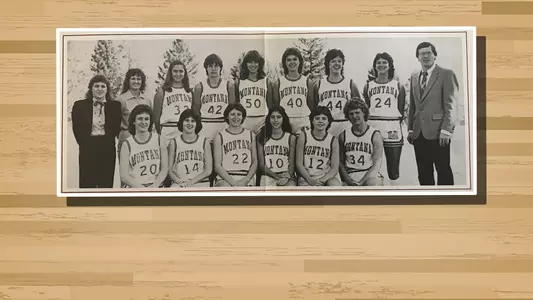
Lady Griz Rewind :: 1983-84
5/21/2020 7:42:00 PM | Women's Basketball
A year before Mike Tyson made his professional debut, in March 1985, Cheri Bratt was standing beside either Juliette Robinson or Amy Alkek, both USC guards, on the edge of the center circle inside the Los Angeles Sports Arena, awaiting the opening tip in a Sweet 16 game of the 1984 NCAA tournament.
The Lady Griz had made it there by knocking off Oregon State the weekend before in Missoula, 56-47, their first NCAA tournament victory in program history. USC, the defending national champion, had handled BYU 97-72 in a year when the women's tournament was made up of just 32 teams.
Montana coach Robin Selvig had said all the right things in the days leading up to the game.
"We are playing great basketball right now. Based on what we've done this season, we feel like we can play with anyone in the country. We know we will be big underdogs but we have a lot of confidence in our own abilities," he said.
Later in his career, Tyson would say, "Everybody has a plan until they get punched in the mouth." For Bratt that moment came, quite unexpectedly, when the ball was tossed into the air to start the game. But it had nothing to do with getting hit in the mouth.
"You go down there and you're already super intimidated. I was standing next to one of their players and we were getting ready for the ball to go up. When it did, she reached over and covered my eyes so I couldn't see where the ball went," she recalled this week.
"I was like, what the heck? Who does that? I will never forget that. It was such an intimidation factor."
She handled it just fine. Montana won the tip and Bratt scored the opening points 30 seconds into a game Montana would lose 76-51. USC would go on to defeat Long Beach State, Louisiana Tech and Tennessee to win its second consecutive national championship 12 days later.
But before the USC game, before the program-changing win over Oregon State, before that season's 19-game winning streak or 14-0 run through the Mountain West Athletic Conference, there was that June day in 1978 when Director of Athletics Harley Lewis sat down with Selvig, then just a candidate.
Earlier that year it was decided to move Montana's women's athletic teams from under the oversight of the Department of Physical Education to the Department of Athletics.
All the coaches of those teams quit en masse, opposed to the idea of joining the men's programs and changing what they believed to be their mission, which was based more on opportunity than competition.
So there was a job opening for the Montana women's basketball program.
Selvig seemed to have the inside track. He had played at Montana earlier that decade and had spent the previous three seasons coaching high school girls' basketball in the state.
But he had some tough competition for the job. Tara VanDerveer interviewed. You might have heard of her. Early next season she will pass Pat Summitt as the career leader for wins in NCAA Division I basketball.
Also seeking the job was Pat Dobratz, who you probably have not heard of. She led Idaho to a 28-2 record and the NCAA tournament in 1984-85 and the WNIT title in 1985-86 before getting out of coaching at the age of 32.
Mike Montgomery, the Montana men's coach at the time, was tasked by Lewis to run the search for the new women's coach. He forwarded Selvig's name as the right person for the job, over VanDerveer, who had been a graduate assistant coach at Ohio State the previous two seasons.
"When you look back, she would have been a good hire, but I'm not convinced she would have done any better than Robin, if as well," Lewis said this week from his summer home on the shores of Lake Superior, on Michigan's Upper Peninsula.
"I don't think she had the reputation, the Montana vibe about her."
She would get the Idaho job shortly thereafter, lasting two years before being wooed back to Ohio State, then Stanford, where she remains. She was replaced at Idaho by Dobratz, who was a graduate assistant coach at Washington.
Lewis, who spends his winters living on the White River in Arkansas, a retirement cycle that gives him year-round fishing, was asked this week if he could have envisioned back then that within six years Montana would be drawing a crowd of 4,000 fans for an NCAA tournament game.
A women's NCAA tournament game.
"Given the condition of women's basketball at the time? No. There was very little support for women's athletics prior to it being combined with the men," Lewis said. "I didn't expect to get the support we would get for women's athletics and women's basketball.
"Robin did yeoman's work and he had tremendous loyalties to the University of Montana. He was a great recruiter, particularly of Montana girls."
It was two Montana girls -- Bratt, of Kalispell, and Doris Deden Hasquet, of Missoula -- who would be the lone seniors on Selvig's sixth team, in 1983-84, as the Lady Griz attempted to improve upon the previous season's record performance: a 26-4 record and their first trip to the NCAA tournament.
The team's third returning starter was junior forward Anita Novak.
The team also brought back a healthy Barb Kavanagh, a guard who had had an injury-plagued sophomore season, and guard Margaret Williams. Those five would start all 30 games that season.
After averaging 8.5 points as a freshman in 1981-82, a stress fracture caused Kavanagh to miss 13 games in 1982-83 and score just 51 points in 17 games played. It was like getting back a fourth returning starter when she came back healthy for her junior year.
"She was a real good all-around player. She was a natural two guard but skilled enough to play the point," says Selvig.
"She had good size. She could pass, she could score, just a versatile guard, an all-around type of player who could handle as well as score."
With sophomore Sharla Muralt averaging more than 20 minutes off the bench, Montana had five players who averaged between 9.6 (Muralt) and 12.6 (Bratt) points per game for a team that averaged nearly 70 (69.6).
Awaiting them in 1983-84 was a new $148,000 scoreboard inside Dahlberg Arena -- actually matching 3 foot x 24 foot scoreboards that hung below the press boxes and replaced the center-hung scoreboard -- and another challenging schedule.
Montana would open the season against No. 17 Penn State, which was coming off a Sweet 16 appearance the previous March, at Wyoming's tournament, and the Lady Griz had gotten an invite to the Giusti Tournament of Champions in Portland right before Christmas.
That field would include Georgia, which was coming off a run to the Final Four, plus Oregon and Oregon State, and Montana's opening-round opponent, Kansas State, which would enter the game ranked No. 6.
"It was a huge deal. It was the premier tournament in the country back then, so playing in that was a thrill for us," said Selvig.
Montana would open with a 73-65 loss to Penn State in Laramie, with Bratt, first-team All-Mountain West Athletic Conference the year before, opening her final season with 21 points, seven rebounds, seven steals and three assists.
Deden (14 points, 11 rebounds) and Novak (12 points, 11 rebounds) both had double-doubles, but Montana could not overcome 33 turnovers, despite holding the Penn State to 34.3 percent shooting.
The Nittany Lions would go on to earn a No. 8 seed in the NCAA tournament, part of 14 trips to the NCAAs in 15 seasons under coach Rene Portland.
Montana would answer with wins over Wyoming and Nevada on the road trip, then sweep a home-and-home series with Washington State to improve to 6-1 going into the Giusti.
"We've gained some valuable experience in nationals the last two seasons," said Selvig before the 1983-84 season. "I think it's time for us to play some of the top teams in the country."
The Lady Griz trailed Kansas State 29-22 at the half in their opener in Portland but would get a 25-footer from Kavanagh at the end of regulation to send the game to overtime, where the Wildcats would win it 64-62 on a buzzer-beater of their own.
Kansas State, which would go 25-6 that season, was coached by Lynn Hickey, now the AD at Eastern Washington. The Wildcats would be a No. 3 seed that March in the NCAA tournament in the Midwest Region.
Montana bounced back with a 54-49 win over Utah, an NCAA tournament team the season before, and closed with a 62-60 loss to Oregon, which, like Kansas State, would be a No. 3 seed in the NCAA tournament later that season, despite holding the Ducks to 31.4 percent shooting.
That made the Lady Griz 0-14 in their history against former Northwest Women's Basketball League opponents Oregon and Oregon State.
Montana won the Lady Griz Insurance Classic in early January with wins over Calgary and Colorado State, the former victory not recognized by the NCAA, then went into league with a 59-58 home win over Washington.
That win came courtesy of a pair of clutch free throws by Kavanagh with 21 seconds left that put Montana up three in an era before the 3-point shot.
The Lady Griz would go 14-0 through their Mountain West Athletic Conference schedule, making them 39-1 in league over the final three seasons of Bratt and Deden.
Eastern Washington would finish a strong 12-2 to finish second, but there was a sizeable gap between Montana and everyone else.
The Lady Griz won 63-47 at Eastern Washington and defeated the Eagles 88-70 in Missoula, with Deden going for 27 points on 9-of-17 shooting and making all nine of her free throw attempts.
Montana would close out its league schedule with an 80-44 home win over Weber State and an 82-50 drubbing of Idaho State, giving the Lady Griz an average margin of victory in league of 19 points per game.
Montana's two closest wins came against third-place Idaho, 60-56 and 69-64, which would be a foreshadowing of the following season, when the Vandals won the league at 13-1, with a three-game sweep of the Lady Griz on their way to their 28-2 finish.
But in March 1984, the Lady Griz were rolling. And hosting the league tournament, which would become routine in the years that followed.
Muralt came off the bench to score 31 points as Montana defeated No. 4 Montana State 84-66 in the conference tournament semifinals. In the title game against the No. 2 Eagles, the Lady Griz won 77-62, with Novak going for 22 points, Deden 19 points and 12 boards.
Early the next week, Montana got the word: the Lady Griz were given the No. 4 seed in the eight-team West Region and would host No. 5 Oregon State on Sunday at 3 p.m. at Dahlberg Arena.
In three years Montana had gone from making its nationals debut against Wayland Baptist in the AIAW tournament to traveling to Northeast Louisiana and the NCAA tournament to hosting a game in Missoula.
"We're really excited about being chosen to host a first-round game," said Selvig that week. "It's a great thing for our program and a tribute to our fans, since attendance is one of the criteria used in selecting the host sites."
Oregon State no longer had 6-foot-5 Carol Menken, who in one of her seasons in Corvallis led the nation in scoring and field goal percentage, but the Beavers did have junior guard Juli Coleman.
Oregon State received an at-large bid to the tournament after finishing runner-up to Oregon in the Northern Pacific Athletic Conference tournament. Coleman was voted MVP after scoring 58 points in two games.
"We're happy to be in the tournament, but we aren't just satisfied to be here," said Selvig, whose team had won its previous 36 games at home, 37 if you count Calgary. "We have a lot of experience and playing at home, this is our best chance ever to win one."
Montana had drawn a crowd of 1,859 for its championship-game victory over Eastern Washington the weekend before, which came close to surpassing the program record of 2,008 that had shown up for the Mountain West title game in 1983, a 66-63 win over Weber State.
Lewis and his game-management team were ready for a crowd that might crack 2,000 once again.
"We weren't prepared for anything more than 1,800 or 2,000. We felt like that would be a pretty good crowd," he said. "We didn't have the upper deck rolled out, just the lower deck."
"There was no way to anticipate what it was going to be. Obviously you hoped you'd have a good crowd since we were hosting an NCAA game, but you had no idea what to expect," said Selvig. "They just kept coming in."
"You could just feel the excitement in the air when you were warming up and people were coming in," says Bratt. "We always went (into the locker room) for our pregame talk, and when we came back out, they were pulling the bleachers out on the top level.
"To this day, it still gives me goosebumps."
"The thing I specifically remember is Harley, who was a hands-on AD, helping pull out bleachers because the crowd kept coming in," says Selvig.
When everyone was in and counted, the attendance was 4,030, more than double the program record. Of the 16 first-round games in the 1984 NCAA tournament, only Texas, at 4,876 for its game against Drake, drew better.
Montana brought them in, then got them hooked with a 56-47 win, its first victory over either of the Oregon schools, with Coleman being held to four points on 2-of-12 shooting, more than 19 below her average.
Montana, which led 33-23 at the half, shot 51.1 percent and had five players score between eight and 13 points.
"That was just the nature of that team. We had six good scorers. We didn't go that deep with that team, but we stayed healthy," says Selvig.
Montana would average 1,219 for its home games that season. That would bump up to 1,596 in 1984-85, which ranked 15th in the nation.
Montana would finish in the top 16 the first 14 years the NCAA tracked attendance. Those fans were rewarded with a home record of 204-12 during that span.
"(The Oregon State game) was a springboard for our program in terms of attendance and following," said Selvig. "That set the stage for more and more."
With a first-round win over Oregon State in hand, it was off to Los Angeles the following weekend and a matchup in the Sweet 16 against defending national champion USC.
The Trojans, in 1976-77, had been the first Division I women's basketball team in the nation to offer scholarships, and they had used that to their recruiting advantage.
They played in the 1981 AIAW national championship game, falling by three to Old Dominion, then lost to Tennessee by a point in the 1982 NCAA tournament in a regional final. They broke through for a national championship in 1983.
On the 1983-84 team were sophomore Cheryl Miller and 6-foot-3 seniors Pam and Paula McGee. Miller, the national player of the year in '84, would finish her career as a 3,000-point scorer. Both McGees passed 2,000 for their careers.
"This is basically the same team that won the national championship last season," said Selvig. "It is quite obviously the most talented team we have ever played. They have all the ingredients you need to be successful: size, speed and quickness.
"But we are playing great basketball right now. Based on what we've done this season, we feel like we can play with anyone in the country."
Today Selvig says, "You're going to talk, hope and dream, but they were in a class of their own that year. They were just really, really good."
But there were highlights, especially before the game, courtesy of a Griz booster from Anaconda who managed a hotel and condominium complex in Marina Del Rey.
Both Selvig and Bratt tell stories that start with I shouldn't be saying this since it was probably illegal, but ...
"We got plush rooms. It was quite the deal," says Selvig.
"They were these high-rises right on the beach. Every room was this beautiful suite that opened to the ocean," recalls Bratt.
"We just kind of had the run of the place. I think we all got credit cards to go get a haircut or massage. We had so much fun. We literally could go get whatever we wanted. For that to be my senior year and my last trip, it was one to remember."
Note to NCAA: Nothing to see here.
Looking and feeling good thanks to free haircuts and massages, Bratt did indeed open the scoring, but USC would soon exert itself, going up 16-4 midway through the first half.
It was 31-15 at the break, with Montana going 7 for 25 with 12 turnovers in the first half.
"Going in, we thought we could give them a ball game. I didn't think anyone could beat us this bad, but they took us out of our offense in the first half," Selvig said at his postgame press conference.
The Big Three were too much, with Miller and the McGees combining for 60 points on 26-of-36 shooting. Paula McGee scored a game-high 22 points on 9-of-9 shooting.
"I thought our only hope was if we could play a little better defense than the other teams they faced had played, but matchups were difficult. It was hard to stay with them," says Bratt.
USC would go on to win 76-51. But there was this: It was the fewest points USC scored in a home game that season.
"We gave them a pretty decent game. We represented ourselves pretty well, given the situation," says Bratt.
"We played hard, I know that. You can't ever take that away from us. We always played hard. We had that going for us."
Bratt, who before the Oregon State game was named one of 30 finalists for the Wade Trophy, the national player of the year award won by Miller, would finish with 21 points on 10-of-18 shooting.
"I remember shooting a jump hook over Cheryl Miller. That's my satisfaction from that game," says Bratt. "I knew it was my last game. You want to go out with guns blazing and go down giving it everything you've got."
The game marked the end of the Bratt and Deden era, which followed the Jill Greenfield era.
Montana would go 96-21 in their four years and win four league titles, the first two in the Northwest Women's Basketball League, the last two in the Mountain West Athletic Conference.
But their lasting legacy? They made people not only take notice, they made them want to come out and watch. In a time when Montana men's basketball ruled the landscape, the Lady Griz showed they could play a little bit too.
"When we first started, we had friends and family in the stands, so I think we really put a stamp on it. It really was a jumpstart," says Bratt. "People realized, boy, these girls can play."
The Lady Griz had made it there by knocking off Oregon State the weekend before in Missoula, 56-47, their first NCAA tournament victory in program history. USC, the defending national champion, had handled BYU 97-72 in a year when the women's tournament was made up of just 32 teams.
Montana coach Robin Selvig had said all the right things in the days leading up to the game.
"We are playing great basketball right now. Based on what we've done this season, we feel like we can play with anyone in the country. We know we will be big underdogs but we have a lot of confidence in our own abilities," he said.
Later in his career, Tyson would say, "Everybody has a plan until they get punched in the mouth." For Bratt that moment came, quite unexpectedly, when the ball was tossed into the air to start the game. But it had nothing to do with getting hit in the mouth.
"You go down there and you're already super intimidated. I was standing next to one of their players and we were getting ready for the ball to go up. When it did, she reached over and covered my eyes so I couldn't see where the ball went," she recalled this week.
"I was like, what the heck? Who does that? I will never forget that. It was such an intimidation factor."
She handled it just fine. Montana won the tip and Bratt scored the opening points 30 seconds into a game Montana would lose 76-51. USC would go on to defeat Long Beach State, Louisiana Tech and Tennessee to win its second consecutive national championship 12 days later.
But before the USC game, before the program-changing win over Oregon State, before that season's 19-game winning streak or 14-0 run through the Mountain West Athletic Conference, there was that June day in 1978 when Director of Athletics Harley Lewis sat down with Selvig, then just a candidate.
Earlier that year it was decided to move Montana's women's athletic teams from under the oversight of the Department of Physical Education to the Department of Athletics.
All the coaches of those teams quit en masse, opposed to the idea of joining the men's programs and changing what they believed to be their mission, which was based more on opportunity than competition.
So there was a job opening for the Montana women's basketball program.
Selvig seemed to have the inside track. He had played at Montana earlier that decade and had spent the previous three seasons coaching high school girls' basketball in the state.
But he had some tough competition for the job. Tara VanDerveer interviewed. You might have heard of her. Early next season she will pass Pat Summitt as the career leader for wins in NCAA Division I basketball.
Also seeking the job was Pat Dobratz, who you probably have not heard of. She led Idaho to a 28-2 record and the NCAA tournament in 1984-85 and the WNIT title in 1985-86 before getting out of coaching at the age of 32.
Mike Montgomery, the Montana men's coach at the time, was tasked by Lewis to run the search for the new women's coach. He forwarded Selvig's name as the right person for the job, over VanDerveer, who had been a graduate assistant coach at Ohio State the previous two seasons.
"When you look back, she would have been a good hire, but I'm not convinced she would have done any better than Robin, if as well," Lewis said this week from his summer home on the shores of Lake Superior, on Michigan's Upper Peninsula.
"I don't think she had the reputation, the Montana vibe about her."
She would get the Idaho job shortly thereafter, lasting two years before being wooed back to Ohio State, then Stanford, where she remains. She was replaced at Idaho by Dobratz, who was a graduate assistant coach at Washington.
Lewis, who spends his winters living on the White River in Arkansas, a retirement cycle that gives him year-round fishing, was asked this week if he could have envisioned back then that within six years Montana would be drawing a crowd of 4,000 fans for an NCAA tournament game.
A women's NCAA tournament game.
"Given the condition of women's basketball at the time? No. There was very little support for women's athletics prior to it being combined with the men," Lewis said. "I didn't expect to get the support we would get for women's athletics and women's basketball.
"Robin did yeoman's work and he had tremendous loyalties to the University of Montana. He was a great recruiter, particularly of Montana girls."
It was two Montana girls -- Bratt, of Kalispell, and Doris Deden Hasquet, of Missoula -- who would be the lone seniors on Selvig's sixth team, in 1983-84, as the Lady Griz attempted to improve upon the previous season's record performance: a 26-4 record and their first trip to the NCAA tournament.
The team's third returning starter was junior forward Anita Novak.
The team also brought back a healthy Barb Kavanagh, a guard who had had an injury-plagued sophomore season, and guard Margaret Williams. Those five would start all 30 games that season.
After averaging 8.5 points as a freshman in 1981-82, a stress fracture caused Kavanagh to miss 13 games in 1982-83 and score just 51 points in 17 games played. It was like getting back a fourth returning starter when she came back healthy for her junior year.
"She was a real good all-around player. She was a natural two guard but skilled enough to play the point," says Selvig.
"She had good size. She could pass, she could score, just a versatile guard, an all-around type of player who could handle as well as score."
With sophomore Sharla Muralt averaging more than 20 minutes off the bench, Montana had five players who averaged between 9.6 (Muralt) and 12.6 (Bratt) points per game for a team that averaged nearly 70 (69.6).
Awaiting them in 1983-84 was a new $148,000 scoreboard inside Dahlberg Arena -- actually matching 3 foot x 24 foot scoreboards that hung below the press boxes and replaced the center-hung scoreboard -- and another challenging schedule.
Montana would open the season against No. 17 Penn State, which was coming off a Sweet 16 appearance the previous March, at Wyoming's tournament, and the Lady Griz had gotten an invite to the Giusti Tournament of Champions in Portland right before Christmas.
That field would include Georgia, which was coming off a run to the Final Four, plus Oregon and Oregon State, and Montana's opening-round opponent, Kansas State, which would enter the game ranked No. 6.
"It was a huge deal. It was the premier tournament in the country back then, so playing in that was a thrill for us," said Selvig.
Montana would open with a 73-65 loss to Penn State in Laramie, with Bratt, first-team All-Mountain West Athletic Conference the year before, opening her final season with 21 points, seven rebounds, seven steals and three assists.
Deden (14 points, 11 rebounds) and Novak (12 points, 11 rebounds) both had double-doubles, but Montana could not overcome 33 turnovers, despite holding the Penn State to 34.3 percent shooting.
The Nittany Lions would go on to earn a No. 8 seed in the NCAA tournament, part of 14 trips to the NCAAs in 15 seasons under coach Rene Portland.
Montana would answer with wins over Wyoming and Nevada on the road trip, then sweep a home-and-home series with Washington State to improve to 6-1 going into the Giusti.
"We've gained some valuable experience in nationals the last two seasons," said Selvig before the 1983-84 season. "I think it's time for us to play some of the top teams in the country."
The Lady Griz trailed Kansas State 29-22 at the half in their opener in Portland but would get a 25-footer from Kavanagh at the end of regulation to send the game to overtime, where the Wildcats would win it 64-62 on a buzzer-beater of their own.
Kansas State, which would go 25-6 that season, was coached by Lynn Hickey, now the AD at Eastern Washington. The Wildcats would be a No. 3 seed that March in the NCAA tournament in the Midwest Region.
Montana bounced back with a 54-49 win over Utah, an NCAA tournament team the season before, and closed with a 62-60 loss to Oregon, which, like Kansas State, would be a No. 3 seed in the NCAA tournament later that season, despite holding the Ducks to 31.4 percent shooting.
That made the Lady Griz 0-14 in their history against former Northwest Women's Basketball League opponents Oregon and Oregon State.
Montana won the Lady Griz Insurance Classic in early January with wins over Calgary and Colorado State, the former victory not recognized by the NCAA, then went into league with a 59-58 home win over Washington.
That win came courtesy of a pair of clutch free throws by Kavanagh with 21 seconds left that put Montana up three in an era before the 3-point shot.
The Lady Griz would go 14-0 through their Mountain West Athletic Conference schedule, making them 39-1 in league over the final three seasons of Bratt and Deden.
Eastern Washington would finish a strong 12-2 to finish second, but there was a sizeable gap between Montana and everyone else.
The Lady Griz won 63-47 at Eastern Washington and defeated the Eagles 88-70 in Missoula, with Deden going for 27 points on 9-of-17 shooting and making all nine of her free throw attempts.
Montana would close out its league schedule with an 80-44 home win over Weber State and an 82-50 drubbing of Idaho State, giving the Lady Griz an average margin of victory in league of 19 points per game.
Montana's two closest wins came against third-place Idaho, 60-56 and 69-64, which would be a foreshadowing of the following season, when the Vandals won the league at 13-1, with a three-game sweep of the Lady Griz on their way to their 28-2 finish.
But in March 1984, the Lady Griz were rolling. And hosting the league tournament, which would become routine in the years that followed.
Muralt came off the bench to score 31 points as Montana defeated No. 4 Montana State 84-66 in the conference tournament semifinals. In the title game against the No. 2 Eagles, the Lady Griz won 77-62, with Novak going for 22 points, Deden 19 points and 12 boards.
Early the next week, Montana got the word: the Lady Griz were given the No. 4 seed in the eight-team West Region and would host No. 5 Oregon State on Sunday at 3 p.m. at Dahlberg Arena.
In three years Montana had gone from making its nationals debut against Wayland Baptist in the AIAW tournament to traveling to Northeast Louisiana and the NCAA tournament to hosting a game in Missoula.
"We're really excited about being chosen to host a first-round game," said Selvig that week. "It's a great thing for our program and a tribute to our fans, since attendance is one of the criteria used in selecting the host sites."
Oregon State no longer had 6-foot-5 Carol Menken, who in one of her seasons in Corvallis led the nation in scoring and field goal percentage, but the Beavers did have junior guard Juli Coleman.
Oregon State received an at-large bid to the tournament after finishing runner-up to Oregon in the Northern Pacific Athletic Conference tournament. Coleman was voted MVP after scoring 58 points in two games.
"We're happy to be in the tournament, but we aren't just satisfied to be here," said Selvig, whose team had won its previous 36 games at home, 37 if you count Calgary. "We have a lot of experience and playing at home, this is our best chance ever to win one."
Montana had drawn a crowd of 1,859 for its championship-game victory over Eastern Washington the weekend before, which came close to surpassing the program record of 2,008 that had shown up for the Mountain West title game in 1983, a 66-63 win over Weber State.
Lewis and his game-management team were ready for a crowd that might crack 2,000 once again.
"We weren't prepared for anything more than 1,800 or 2,000. We felt like that would be a pretty good crowd," he said. "We didn't have the upper deck rolled out, just the lower deck."
"There was no way to anticipate what it was going to be. Obviously you hoped you'd have a good crowd since we were hosting an NCAA game, but you had no idea what to expect," said Selvig. "They just kept coming in."
"You could just feel the excitement in the air when you were warming up and people were coming in," says Bratt. "We always went (into the locker room) for our pregame talk, and when we came back out, they were pulling the bleachers out on the top level.
"To this day, it still gives me goosebumps."
"The thing I specifically remember is Harley, who was a hands-on AD, helping pull out bleachers because the crowd kept coming in," says Selvig.
When everyone was in and counted, the attendance was 4,030, more than double the program record. Of the 16 first-round games in the 1984 NCAA tournament, only Texas, at 4,876 for its game against Drake, drew better.
Montana brought them in, then got them hooked with a 56-47 win, its first victory over either of the Oregon schools, with Coleman being held to four points on 2-of-12 shooting, more than 19 below her average.
Montana, which led 33-23 at the half, shot 51.1 percent and had five players score between eight and 13 points.
"That was just the nature of that team. We had six good scorers. We didn't go that deep with that team, but we stayed healthy," says Selvig.
Montana would average 1,219 for its home games that season. That would bump up to 1,596 in 1984-85, which ranked 15th in the nation.
Montana would finish in the top 16 the first 14 years the NCAA tracked attendance. Those fans were rewarded with a home record of 204-12 during that span.
"(The Oregon State game) was a springboard for our program in terms of attendance and following," said Selvig. "That set the stage for more and more."
With a first-round win over Oregon State in hand, it was off to Los Angeles the following weekend and a matchup in the Sweet 16 against defending national champion USC.
The Trojans, in 1976-77, had been the first Division I women's basketball team in the nation to offer scholarships, and they had used that to their recruiting advantage.
They played in the 1981 AIAW national championship game, falling by three to Old Dominion, then lost to Tennessee by a point in the 1982 NCAA tournament in a regional final. They broke through for a national championship in 1983.
On the 1983-84 team were sophomore Cheryl Miller and 6-foot-3 seniors Pam and Paula McGee. Miller, the national player of the year in '84, would finish her career as a 3,000-point scorer. Both McGees passed 2,000 for their careers.
"This is basically the same team that won the national championship last season," said Selvig. "It is quite obviously the most talented team we have ever played. They have all the ingredients you need to be successful: size, speed and quickness.
"But we are playing great basketball right now. Based on what we've done this season, we feel like we can play with anyone in the country."
Today Selvig says, "You're going to talk, hope and dream, but they were in a class of their own that year. They were just really, really good."
But there were highlights, especially before the game, courtesy of a Griz booster from Anaconda who managed a hotel and condominium complex in Marina Del Rey.
Both Selvig and Bratt tell stories that start with I shouldn't be saying this since it was probably illegal, but ...
"We got plush rooms. It was quite the deal," says Selvig.
"They were these high-rises right on the beach. Every room was this beautiful suite that opened to the ocean," recalls Bratt.
"We just kind of had the run of the place. I think we all got credit cards to go get a haircut or massage. We had so much fun. We literally could go get whatever we wanted. For that to be my senior year and my last trip, it was one to remember."
Note to NCAA: Nothing to see here.
Looking and feeling good thanks to free haircuts and massages, Bratt did indeed open the scoring, but USC would soon exert itself, going up 16-4 midway through the first half.
It was 31-15 at the break, with Montana going 7 for 25 with 12 turnovers in the first half.
"Going in, we thought we could give them a ball game. I didn't think anyone could beat us this bad, but they took us out of our offense in the first half," Selvig said at his postgame press conference.
The Big Three were too much, with Miller and the McGees combining for 60 points on 26-of-36 shooting. Paula McGee scored a game-high 22 points on 9-of-9 shooting.
"I thought our only hope was if we could play a little better defense than the other teams they faced had played, but matchups were difficult. It was hard to stay with them," says Bratt.
USC would go on to win 76-51. But there was this: It was the fewest points USC scored in a home game that season.
"We gave them a pretty decent game. We represented ourselves pretty well, given the situation," says Bratt.
"We played hard, I know that. You can't ever take that away from us. We always played hard. We had that going for us."
Bratt, who before the Oregon State game was named one of 30 finalists for the Wade Trophy, the national player of the year award won by Miller, would finish with 21 points on 10-of-18 shooting.
"I remember shooting a jump hook over Cheryl Miller. That's my satisfaction from that game," says Bratt. "I knew it was my last game. You want to go out with guns blazing and go down giving it everything you've got."
The game marked the end of the Bratt and Deden era, which followed the Jill Greenfield era.
Montana would go 96-21 in their four years and win four league titles, the first two in the Northwest Women's Basketball League, the last two in the Mountain West Athletic Conference.
But their lasting legacy? They made people not only take notice, they made them want to come out and watch. In a time when Montana men's basketball ruled the landscape, the Lady Griz showed they could play a little bit too.
"When we first started, we had friends and family in the stands, so I think we really put a stamp on it. It really was a jumpstart," says Bratt. "People realized, boy, these girls can play."
Friday, June 19
Thursday, June 04
Friday, May 01
Friday, May 01