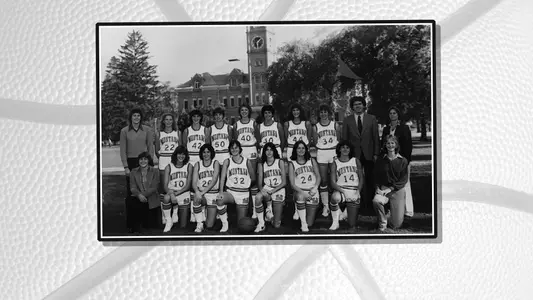
Lady Griz Rewind :: 1981-82
5/7/2020 5:54:00 PM | Women's Basketball
Her name jumps off the rosters from those days, though not the name itself as much as her hometown: San Diego, Calif.
Robin Selvig's early teams were almost all Montana players. As a former high school coach in the state, it was a philosophy he had, based on opportunities he wanted to provide.
Plus, he knew the state, and it would prove to be good to him for nearly four decades.
It also was a reflection of the era. There was no summer recruiting, no AAU tournaments.
If a player from out of state wanted to play for Montana, they would have to reach out, send film and arrange, at their own expense, a trip to campus for an individual tryout, which was allowed then under AIAW regulations.
But Janet Ruetten, deep down, was more a Montanan than a Californian, regardless of what those rosters suggested. Her mom was from Gildford, her dad from Havre.
The family only ended up in Southern California after Richard Ruetten finished up his PhD in history at Oregon -- this following his getting drafted to fight in the Korean War, where he was shot -- and took a job teaching at San Diego State.
"We had a tent-trailer, a little pop-up one, and we'd take trips up there in the summer. We'd go up there to vacation and see relatives," says Ruetten, now retired and living in Chula Vista, south of San Diego, after a career as a psychiatric nurse.
She was her league's player of the year as a senior at Patrick Henry High and led her team to a perfect 33-0 finish. In the days before state tournaments for girls in California, they had to settle for a city title.
She was all set to attend and play basketball at UC Irvine.
"For some crazy reason, a few weeks before school, my mom and I drove up there, and we ended up getting an interview and individual tryout with Robin," she says. "I'd always loved Montana, and I guess I wanted to get away from the local.
"He told me to dribble around and throw in some baskets. I guess he had a keen eye, but it was a little stressful. I got a partial scholarship on what was a whim."
She would be a freshman on Selvig's second team, in 1979-80, and she would prove the coach's eye for talent was dialed in. Ruetten would average 10.3 points and 4.6 rebounds as Montana finished 19-10 in her first year on campus.
But it wasn't easy.
"On offense I had to remember four different positions. It was quite challenging because he'd be yelling. Sometimes I'd just zone out. It was too much information for me," Ruetten says.
"Someone told me, you're lucky if he's yelling at you. It means you're important, but I was a very sensitive soul."
That soul found its mate the next year, when Shannon Green, from Big Sandy, arrived on campus and joined the Lady Griz.
They were not related, but they learned they did have a connection that went back a ways. Ruetten's mom, then Margaret Mary Conway, had long ago dated Lawrence Green, Shannon's dad.
"That first year, Shannon and I did a lot of things. Let's just say we were out about on the town. A lot. Maybe a little too wild," she says.
"I remember us going to one place because it had a mechanical bull. We certainly had a connection that was really unique."
They were teammates as Montana went 22-8 in 1980-81, with Green a freshman, Ruetten a sophomore.
As the start of the 1981-82 school year approached, the Lady Griz were primed for a breakout season.
Jill Greenfield, who averaged 16.1 points and 10.6 rebounds the year before, was gone, but starters Doris Deden and Cheri Bratt were back, and the team continued to get better from the bottom up through recruiting.
Back home in San Diego that August, Ruetten had a restless night of sleep, one full of tossing and turning. She'd never experienced anything like it before. She always slept well. Always. But not that night.
The next day her mom was on the phone when her face lost all its color.
"My mom never cries and I saw something on her face. I knew something terrible had happened," Ruetten says. "It just hit me like a ton of bricks. I was devastated."
Green had been in a single-vehicle rollover the night before on a gravel road outside Big Sandy and had been pinned in place and upside-down for hours by the steering wheel before she was found.
She seemed to be fine later that morning at the hospital before passing away quickly. It's believed she had developed a blood clot from the steering wheel and that it had gotten loose and reached a vital organ.
All Ruetten could think about was Green. And the restless night she'd had. "We're all connected, but sometimes you have a deeper connection on a subconscious level. There is no other way to explain it," she says.
"Some part of me knew she was in trouble. I couldn't sleep that night because she was upside-down in her truck. I just hoped she realized she wasn't alone."
Ruetten returned to campus for the start of the fall semester just days later and her junior year as a Lady Griz, but things would never be the same. They could never be the same.
She played in the season's first 10 games before deciding she couldn't take it anymore. She left the team in early January and returned to San Diego.
"Being a pretty sensitive person, I had a hard time when I came back as a junior," she says. "Emotionally I just wasn't there. I had changed as a person. It changed my whole attitude and my belief systems.
"I know I disappointed a lot of people when I left, but I had to take care of my emotional health. I needed to recollect myself to be able to move on in life."
Before the 1981-82 season began, Ruetten wrote a poem, "Shannon Green Lives On," which shows up on the opening page of that year's media guide, where it lives on.
There also is a commemorative brick in the Oval on campus, purchased by her parents to recognize her 85.2 percent free throw percentage as a freshman, then a school record.
The brick remains, as do Ruetten's memories.
"I don't think about her every day, but I still think about what it would have been like if she was still alive," says Ruetten. "In her death, there was purpose.
"We had some kind of connection. I've never forgotten that. And Montana is always in my heart."
In addition to seven letterwinners who returned in 1981-82, Montana added a pair of transfers and brought in a strong freshman class.
When Montana won at Stanford during the 1980-81 season, Siobhan Hathhorn scored two points for the Cardinal as the Lady Griz won 65-49. After the season, she switched teams.
The Lady Griz also welcomed Ruth Fugelberg, of Polson, who played at Boise State in 1978-79 and 1979-80. In the latter season she was second-team All-Northwest Women's Basketball League.
In a move you wouldn't see today, she took a year off from basketball at Boise State to do an academic exchange program at Bowling Green. With that complete she resumed her career at Montana.
One of the incoming freshmen was Anita Novak, a Converse High School All-American at Magic City Campus High in Minot, N.D.
A 6-foot-2 center, Novak was pursued by more than 75 schools before she decided on Montana. "I promised I'd find her a husband," says Selvig of his recruiting tactics.
Indeed he did. Novak would marry Selvig's brother, Doug. They would have a son, Derek, and daughter, Carly, who both would play basketball at Montana.
"Minot had a really good high school program at that time," says Selvig, who had tapped into the school earlier, bringing Juli Eckmann to Montana. She would average 9.3 points while starting all 27 games in 1981-82 as a junior.
It was another freshman, Barb Kavanaugh, of Fort Collins, Colo., who would become a starter that season and play a team-high 844 minutes (31.3/g).
It's why Selvig said in his team's season preview that the Lady Griz were "young but extremely talented."
It was also a time of transition in the Northwest Women's Basketball League. For more than a decade the AIAW had overseen college women's basketball. Now the NCAA was getting involved.
The league would be split but instead of Mountain and Coast divisions as it had been, it was AIAW and Open, the latter being Oregon, Oregon State and Washington.
The teams in the Open Division would be pursuing spots in the NCAA tournament while the rest would be continuing with the AIAW. For now.
Montana would play all three Open schools in cross-division games but the results wouldn't be reflected in the NWBL standings.
Those would be derived from Montana's matchups against its AIAW Division opponents: Alaska-Anchorage, Boise State, Eastern Washington, Montana State, Portland State and Washington State.
The winner would earn one of 16 spots in the AIAW national tournament.
Montana had gone 9-3 in league the year before to win its division. Even the league office was skeptical of a repeat in 1981-82, with Greenfield and two other starters gone.
The NWBL's official season preview suggested Montana "could be hard-pressed to defend its NWBL Mountain Division title."
After opening the season with wins over Great Falls and Carroll, Montana traveled north to Alaska-Anchorage for two league games against the Seawolves.
It was fortuitous timing that Hathhorn had joined the team in the offseason. She was from Anchorage.
"Her parents put on a fish feed for us. I think her family owned a fishing boat," says Selvig. "I remember that it was a lot of good food, so that trip was a lot of fun."
It also led to two victories, with Novak scoring what would be a season-high 19 points in the first game. Deden scored 19 points in the second game.
Home wins over Western Montana, Montana Tech and Weber State moved Montana to 7-0 as the Lady Griz prepared for a pre-Christmas trip to face Utah and BYU.
Montana opened with a 58-48 win at Utah, holding the Utes, who made the AIAW national tournament in 1976 and '77, to 32.1 percent shooting.
The Lady Griz would lead the nation in scoring defense in 1981-82 and finish fifth in field goal percentage defense.
Montana would go into the holiday break 8-1 after falling to BYU 76-66. The Cougars would go 22 for 24 from the line while the Lady Griz went 8 for 18.
BYU would go on to win 24 games and advance to the WNIT.
After opening January with a 68-35 rout of Carroll, Montana hosted the second Lady Griz Insurance Classic, this one featuring Stanford, Washington and Drake.
Behind 20 points from Deden, Montana got past Stanford 65-52, then lost to Drake in the championship game 71-65.
Lorri Bauman would finish with 24 points on 9-of-11 shooting, which was actually less than her four-year career average of 26.0. She totaled 3,115 points in four years at Drake.
That Drake team would go on to win 28 games and reach the Elite 8, with NCAA tournament wins over Ohio State and Long Beach State. The Bulldogs fell to Maryland in the West Regional final at Palo Alto, Calif.
"(Bauman) was a 6-3 center, a physical player," said Selvig. "She was really good. She was the real deal and Drake was really good."
Montana drew a season-high 1,730 fans for its 88-60 home win over Montana State as the Lady Griz improved to 3-0 in league.
It would be one of six games that winter that Montana attracted a crowd of 1,000 or more. The season average was 938. "It was starting to pick up," said Selvig.
Montana would win its next nine league games as well to win the AIAW Division at 12-0, the first of eight perfect league finishes for the Lady Griz under Selvig in his career.
But it wasn't always easy. Six of those final nine league games were decided by 12 points or fewer, including the home finale, a 52-50 win over Eastern Washington, which would tie for second with Washington State at 8-4 behind Montana in the division.
The Eagles were then coached by Bill Smithpeters.
Montana led 49-48 with less than 15 seconds left when Bratt was intentionally fouled bringing the ball up the court.
She made both free throws to make it 51-48, which would have been nearly insurmountable given the lack of a 3-point shot at the time, but Selvig had been called for a technical foul for running onto the court after Bratt was aggressively fouled.
"That was the most incredible thing I've ever seen in my life," Selvig said after the game. "Smithpeters called it on me. He threatened to protest the game if they didn't give me a technical.
"That's the first time I've ever had the other coach call a technical on me. The girl had thrown Cheri down. I just wanted to make sure she was all right."
Montana completed its perfect 12-0 run through league with a 73-57 win at Portland State behind Hathhorn's 16 points, the first and only time she led the team in scoring that season.
The road trip and regular season concluded with games at Oregon State and Oregon, teams that had had the upper-hand on Montana over the years.
The Lady Griz would fall to the Beavers 72-65, with Jan Martin scoring 26 points for OSU and future Montana State coach Judy Spoelstra adding 23.
Montana shot 51.1 percent but could not overcome 29 turnovers.
The next day Montana lost 70-56 at No. 9 Oregon. Senior (finally!) Bev Smith, the NWBL Player of the Year, had 20 points, 13 rebounds and six assists.
Oregon would go on to make the NCAA tournament and lost a first-round game at home to Missouri.
Oregon State would win the WNIT for the second time in three years, defeating Florida State in the title game when winning the championship took just three victories. Spoelstra was voted WNIT MVP.
Selvig was voted the NWBL Coach of the Year, Deden and Bratt second-team All-NWBL as Montana awaited its postseason assignment from the AIAW.
There was hope Montana could host a four-team regional, but the Lady Griz were sent to Berkeley, Calif., along with Wayland Baptist and Arkansas.
Montana would face the Flying Queens, Arkansas would take on host Cal.
"Wayland Baptist was a pretty big name in women's basketball back then," said Selvig. Indeed, it had played in the AIAW national semifinals in 1976 and lost by one point to eventual national champion Delta State.
"It was a national tournament. There wasn't all the hoop-da-la that goes with the NCAA tournament, but it felt like a big deal. We were excited to go there," said Selvig.
"All I remember is we couldn't make a shot. We couldn't score and neither could they. It was a defensive battle, one we could have won."
The game was tied 48-48 before Wayland Baptist pulled away for a 57-52 win. Montana went just 14 for 27 from the line.
"We played well enough to win everywhere except the free throw line," Selvig said after the game.
Wayland Baptist would defeat California in the regional final, then lose 82-63 to Texas in Philadelphia in the national semifinals. The Longhorns lost to Rutgers in the championship game in what would be the final AIAW tournament.
Louisiana Tech would win the NCAA tournament. From then on everyone was playing to make the NCAAs.
"Mostly it was because you received some money to go (to the NCAA tournament). For the AIAW you were on your own. You paid your own way," said Selvig.
The season was complete. Montana would finish with a record of 22-5. The four regular-season losses came at BYU, at home against Drake and on the road against Oregon State and Oregon. All four played in the postseason.
Then the AIAW loss to Wayland Baptist. A strong body of work for a team without a senior on the team.
"We had a really good year. Our losses were to really good teams. We managed to keep the slate clean from the rest," said Selvig.
Montana would have more than five losses in a season just three times over the next 15 years. It was starting to become something.
"Lady Griz basketball has become a tradition," Selvig said after the 1981-82 season. "The fact that we've had back-to-back 20-win seasons proves that we're a strong team.
"We've established ourselves as one of the best teams in the Northwest."
What will 1982-83 bring? The team's first NCAA tournament appearance for one.
Robin Selvig's early teams were almost all Montana players. As a former high school coach in the state, it was a philosophy he had, based on opportunities he wanted to provide.
Plus, he knew the state, and it would prove to be good to him for nearly four decades.
It also was a reflection of the era. There was no summer recruiting, no AAU tournaments.
If a player from out of state wanted to play for Montana, they would have to reach out, send film and arrange, at their own expense, a trip to campus for an individual tryout, which was allowed then under AIAW regulations.
But Janet Ruetten, deep down, was more a Montanan than a Californian, regardless of what those rosters suggested. Her mom was from Gildford, her dad from Havre.
The family only ended up in Southern California after Richard Ruetten finished up his PhD in history at Oregon -- this following his getting drafted to fight in the Korean War, where he was shot -- and took a job teaching at San Diego State.
"We had a tent-trailer, a little pop-up one, and we'd take trips up there in the summer. We'd go up there to vacation and see relatives," says Ruetten, now retired and living in Chula Vista, south of San Diego, after a career as a psychiatric nurse.
She was her league's player of the year as a senior at Patrick Henry High and led her team to a perfect 33-0 finish. In the days before state tournaments for girls in California, they had to settle for a city title.
She was all set to attend and play basketball at UC Irvine.
"For some crazy reason, a few weeks before school, my mom and I drove up there, and we ended up getting an interview and individual tryout with Robin," she says. "I'd always loved Montana, and I guess I wanted to get away from the local.
"He told me to dribble around and throw in some baskets. I guess he had a keen eye, but it was a little stressful. I got a partial scholarship on what was a whim."
She would be a freshman on Selvig's second team, in 1979-80, and she would prove the coach's eye for talent was dialed in. Ruetten would average 10.3 points and 4.6 rebounds as Montana finished 19-10 in her first year on campus.
But it wasn't easy.
"On offense I had to remember four different positions. It was quite challenging because he'd be yelling. Sometimes I'd just zone out. It was too much information for me," Ruetten says.
"Someone told me, you're lucky if he's yelling at you. It means you're important, but I was a very sensitive soul."
That soul found its mate the next year, when Shannon Green, from Big Sandy, arrived on campus and joined the Lady Griz.
They were not related, but they learned they did have a connection that went back a ways. Ruetten's mom, then Margaret Mary Conway, had long ago dated Lawrence Green, Shannon's dad.
"That first year, Shannon and I did a lot of things. Let's just say we were out about on the town. A lot. Maybe a little too wild," she says.
"I remember us going to one place because it had a mechanical bull. We certainly had a connection that was really unique."
They were teammates as Montana went 22-8 in 1980-81, with Green a freshman, Ruetten a sophomore.
As the start of the 1981-82 school year approached, the Lady Griz were primed for a breakout season.
Jill Greenfield, who averaged 16.1 points and 10.6 rebounds the year before, was gone, but starters Doris Deden and Cheri Bratt were back, and the team continued to get better from the bottom up through recruiting.
Back home in San Diego that August, Ruetten had a restless night of sleep, one full of tossing and turning. She'd never experienced anything like it before. She always slept well. Always. But not that night.
The next day her mom was on the phone when her face lost all its color.
"My mom never cries and I saw something on her face. I knew something terrible had happened," Ruetten says. "It just hit me like a ton of bricks. I was devastated."
Green had been in a single-vehicle rollover the night before on a gravel road outside Big Sandy and had been pinned in place and upside-down for hours by the steering wheel before she was found.
She seemed to be fine later that morning at the hospital before passing away quickly. It's believed she had developed a blood clot from the steering wheel and that it had gotten loose and reached a vital organ.
All Ruetten could think about was Green. And the restless night she'd had. "We're all connected, but sometimes you have a deeper connection on a subconscious level. There is no other way to explain it," she says.
"Some part of me knew she was in trouble. I couldn't sleep that night because she was upside-down in her truck. I just hoped she realized she wasn't alone."
Ruetten returned to campus for the start of the fall semester just days later and her junior year as a Lady Griz, but things would never be the same. They could never be the same.
She played in the season's first 10 games before deciding she couldn't take it anymore. She left the team in early January and returned to San Diego.
"Being a pretty sensitive person, I had a hard time when I came back as a junior," she says. "Emotionally I just wasn't there. I had changed as a person. It changed my whole attitude and my belief systems.
"I know I disappointed a lot of people when I left, but I had to take care of my emotional health. I needed to recollect myself to be able to move on in life."
Before the 1981-82 season began, Ruetten wrote a poem, "Shannon Green Lives On," which shows up on the opening page of that year's media guide, where it lives on.
There also is a commemorative brick in the Oval on campus, purchased by her parents to recognize her 85.2 percent free throw percentage as a freshman, then a school record.
The brick remains, as do Ruetten's memories.
"I don't think about her every day, but I still think about what it would have been like if she was still alive," says Ruetten. "In her death, there was purpose.
"We had some kind of connection. I've never forgotten that. And Montana is always in my heart."
In addition to seven letterwinners who returned in 1981-82, Montana added a pair of transfers and brought in a strong freshman class.
When Montana won at Stanford during the 1980-81 season, Siobhan Hathhorn scored two points for the Cardinal as the Lady Griz won 65-49. After the season, she switched teams.
The Lady Griz also welcomed Ruth Fugelberg, of Polson, who played at Boise State in 1978-79 and 1979-80. In the latter season she was second-team All-Northwest Women's Basketball League.
In a move you wouldn't see today, she took a year off from basketball at Boise State to do an academic exchange program at Bowling Green. With that complete she resumed her career at Montana.
One of the incoming freshmen was Anita Novak, a Converse High School All-American at Magic City Campus High in Minot, N.D.
A 6-foot-2 center, Novak was pursued by more than 75 schools before she decided on Montana. "I promised I'd find her a husband," says Selvig of his recruiting tactics.
Indeed he did. Novak would marry Selvig's brother, Doug. They would have a son, Derek, and daughter, Carly, who both would play basketball at Montana.
"Minot had a really good high school program at that time," says Selvig, who had tapped into the school earlier, bringing Juli Eckmann to Montana. She would average 9.3 points while starting all 27 games in 1981-82 as a junior.
It was another freshman, Barb Kavanaugh, of Fort Collins, Colo., who would become a starter that season and play a team-high 844 minutes (31.3/g).
It's why Selvig said in his team's season preview that the Lady Griz were "young but extremely talented."
It was also a time of transition in the Northwest Women's Basketball League. For more than a decade the AIAW had overseen college women's basketball. Now the NCAA was getting involved.
The league would be split but instead of Mountain and Coast divisions as it had been, it was AIAW and Open, the latter being Oregon, Oregon State and Washington.
The teams in the Open Division would be pursuing spots in the NCAA tournament while the rest would be continuing with the AIAW. For now.
Montana would play all three Open schools in cross-division games but the results wouldn't be reflected in the NWBL standings.
Those would be derived from Montana's matchups against its AIAW Division opponents: Alaska-Anchorage, Boise State, Eastern Washington, Montana State, Portland State and Washington State.
The winner would earn one of 16 spots in the AIAW national tournament.
Montana had gone 9-3 in league the year before to win its division. Even the league office was skeptical of a repeat in 1981-82, with Greenfield and two other starters gone.
The NWBL's official season preview suggested Montana "could be hard-pressed to defend its NWBL Mountain Division title."
After opening the season with wins over Great Falls and Carroll, Montana traveled north to Alaska-Anchorage for two league games against the Seawolves.
It was fortuitous timing that Hathhorn had joined the team in the offseason. She was from Anchorage.
"Her parents put on a fish feed for us. I think her family owned a fishing boat," says Selvig. "I remember that it was a lot of good food, so that trip was a lot of fun."
It also led to two victories, with Novak scoring what would be a season-high 19 points in the first game. Deden scored 19 points in the second game.
Home wins over Western Montana, Montana Tech and Weber State moved Montana to 7-0 as the Lady Griz prepared for a pre-Christmas trip to face Utah and BYU.
Montana opened with a 58-48 win at Utah, holding the Utes, who made the AIAW national tournament in 1976 and '77, to 32.1 percent shooting.
The Lady Griz would lead the nation in scoring defense in 1981-82 and finish fifth in field goal percentage defense.
Montana would go into the holiday break 8-1 after falling to BYU 76-66. The Cougars would go 22 for 24 from the line while the Lady Griz went 8 for 18.
BYU would go on to win 24 games and advance to the WNIT.
After opening January with a 68-35 rout of Carroll, Montana hosted the second Lady Griz Insurance Classic, this one featuring Stanford, Washington and Drake.
Behind 20 points from Deden, Montana got past Stanford 65-52, then lost to Drake in the championship game 71-65.
Lorri Bauman would finish with 24 points on 9-of-11 shooting, which was actually less than her four-year career average of 26.0. She totaled 3,115 points in four years at Drake.
That Drake team would go on to win 28 games and reach the Elite 8, with NCAA tournament wins over Ohio State and Long Beach State. The Bulldogs fell to Maryland in the West Regional final at Palo Alto, Calif.
"(Bauman) was a 6-3 center, a physical player," said Selvig. "She was really good. She was the real deal and Drake was really good."
Montana drew a season-high 1,730 fans for its 88-60 home win over Montana State as the Lady Griz improved to 3-0 in league.
It would be one of six games that winter that Montana attracted a crowd of 1,000 or more. The season average was 938. "It was starting to pick up," said Selvig.
Montana would win its next nine league games as well to win the AIAW Division at 12-0, the first of eight perfect league finishes for the Lady Griz under Selvig in his career.
But it wasn't always easy. Six of those final nine league games were decided by 12 points or fewer, including the home finale, a 52-50 win over Eastern Washington, which would tie for second with Washington State at 8-4 behind Montana in the division.
The Eagles were then coached by Bill Smithpeters.
Montana led 49-48 with less than 15 seconds left when Bratt was intentionally fouled bringing the ball up the court.
She made both free throws to make it 51-48, which would have been nearly insurmountable given the lack of a 3-point shot at the time, but Selvig had been called for a technical foul for running onto the court after Bratt was aggressively fouled.
"That was the most incredible thing I've ever seen in my life," Selvig said after the game. "Smithpeters called it on me. He threatened to protest the game if they didn't give me a technical.
"That's the first time I've ever had the other coach call a technical on me. The girl had thrown Cheri down. I just wanted to make sure she was all right."
Montana completed its perfect 12-0 run through league with a 73-57 win at Portland State behind Hathhorn's 16 points, the first and only time she led the team in scoring that season.
The road trip and regular season concluded with games at Oregon State and Oregon, teams that had had the upper-hand on Montana over the years.
The Lady Griz would fall to the Beavers 72-65, with Jan Martin scoring 26 points for OSU and future Montana State coach Judy Spoelstra adding 23.
Montana shot 51.1 percent but could not overcome 29 turnovers.
The next day Montana lost 70-56 at No. 9 Oregon. Senior (finally!) Bev Smith, the NWBL Player of the Year, had 20 points, 13 rebounds and six assists.
Oregon would go on to make the NCAA tournament and lost a first-round game at home to Missouri.
Oregon State would win the WNIT for the second time in three years, defeating Florida State in the title game when winning the championship took just three victories. Spoelstra was voted WNIT MVP.
Selvig was voted the NWBL Coach of the Year, Deden and Bratt second-team All-NWBL as Montana awaited its postseason assignment from the AIAW.
There was hope Montana could host a four-team regional, but the Lady Griz were sent to Berkeley, Calif., along with Wayland Baptist and Arkansas.
Montana would face the Flying Queens, Arkansas would take on host Cal.
"Wayland Baptist was a pretty big name in women's basketball back then," said Selvig. Indeed, it had played in the AIAW national semifinals in 1976 and lost by one point to eventual national champion Delta State.
"It was a national tournament. There wasn't all the hoop-da-la that goes with the NCAA tournament, but it felt like a big deal. We were excited to go there," said Selvig.
"All I remember is we couldn't make a shot. We couldn't score and neither could they. It was a defensive battle, one we could have won."
The game was tied 48-48 before Wayland Baptist pulled away for a 57-52 win. Montana went just 14 for 27 from the line.
"We played well enough to win everywhere except the free throw line," Selvig said after the game.
Wayland Baptist would defeat California in the regional final, then lose 82-63 to Texas in Philadelphia in the national semifinals. The Longhorns lost to Rutgers in the championship game in what would be the final AIAW tournament.
Louisiana Tech would win the NCAA tournament. From then on everyone was playing to make the NCAAs.
"Mostly it was because you received some money to go (to the NCAA tournament). For the AIAW you were on your own. You paid your own way," said Selvig.
The season was complete. Montana would finish with a record of 22-5. The four regular-season losses came at BYU, at home against Drake and on the road against Oregon State and Oregon. All four played in the postseason.
Then the AIAW loss to Wayland Baptist. A strong body of work for a team without a senior on the team.
"We had a really good year. Our losses were to really good teams. We managed to keep the slate clean from the rest," said Selvig.
Montana would have more than five losses in a season just three times over the next 15 years. It was starting to become something.
"Lady Griz basketball has become a tradition," Selvig said after the 1981-82 season. "The fact that we've had back-to-back 20-win seasons proves that we're a strong team.
"We've established ourselves as one of the best teams in the Northwest."
What will 1982-83 bring? The team's first NCAA tournament appearance for one.
Wednesday, September 09
Monday, September 07
Tuesday, September 01
Monday, August 31