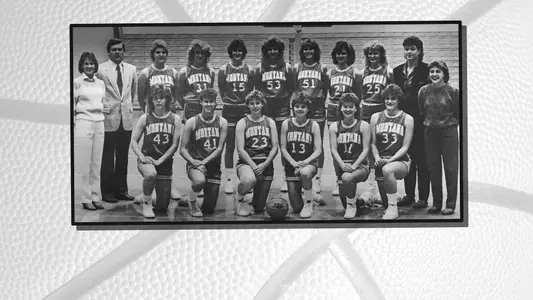
Lady Griz Rewind :: 1986-87
6/12/2020 5:49:00 PM | Women's Basketball
Is it fair that a 31-game season that lasts more than five months, from the first practice through the final horn of the last game, gets defined not by its many successes but by what happens in a span of 20 minutes?
Probably not, but that's sports. In matters such as these, we're predisposed, are we not, to reflect not on what was but on what could have been.
The 1986-87 Montana women's basketball team won 26 games, including 17 straight between late December and early March, won the Mountain West Athletic Conference title by four games, going 12-0, and won at Nebraska in mid-December, the first road win over a ranked team in program history.
That's what was. This is what could have been: On March 7 inside Dahlberg Arena, in the championship game of the Mountain West tournament, the Lady Griz led No. 2 seed Eastern Washington 42-28 at the half.
Montana was just 20 minutes from going to its fourth NCAA tournament in five years, by this time a postseason destination that was not just a lofty hope within the program but an expectation. Anything else would be a letdown.
"That was absolutely our expectation, to win and go onto the tournament," says Margaret Williams, the point guard on that team. "And everything was going as planned. We were dominating them."
Eastern Washington coach Bill Smithpeters says his 1985-86 team, the one that lost 65-39 to Montana in that season's tournament championship game in Missoula, was the best he had in his 18 seasons in Cheney.
But his 1986-87 team, the one trailing by 14 at the half on that March day in Missoula, the one getting dominated, again, by Montana, had won 13 of its previous 14 games. They were good, and they knew it. That's why the locker room just felt different this time around.
"The previous year losing at Montana, the halftime was just discouragement. This time you could feel the kids were angry," says Mike Divilbiss, an assistant for Smithpeters those two seasons.
"It was a different vibe. It wasn't like, here we go again. It was more, we're better than this. You could feel that the kids believed it before (Smithpeters) even opened his mouth and started talking about it."
Montana had won 78 of its previous 79 games at home, a two-point loss to Idaho in 1984-85 the only hiccup, the Lady Griz were up by 14 and rolling, and a crowd of nearly 2,000 was already thinking about the postgame trophy celebration.
"That's why as a coach you don't ever relax, because anything can happen, and that was one of those games when lots of things happened. It was a nightmare second half," says then Lady Griz coach Robin Selvig.
Everything came together for the Eagles, who would rally for a 77-74 victory to steal the league's NCAA tournament bid from Montana's grasp, but to appreciate how that 20 minutes came to be, you have to go back ... back ... back.
"I feel there are reasons for things taking place," says Smithpeters, who turns 90 two weeks from Monday and took a break from doing some work on the deck at his home in Spokane on Wednesday for a delightful phone interview.
"You maybe don't understand them at the time, but there is meaning behind it."
Coming of age in Mt. Vernon, Ill., in the 1940s, Smithpeters was just a product of his environment, an athlete who came through a school that at the time had more championships than any other in the state, despite its modest population of 15,000 and the state's then one-class tournament system.
Basketball was king, but it's not all Smithpeters excelled at.
He was drafted by the St. Louis Cardinals coming out of high school and played one year in the team's minor league system before the realities of the Korean War changed a lot of young men's plans.
"I was 19, single, prime draft bait, so I joined the Air Force instead of being drafted into the Army," says Smithpeters, who was stationed in St. John's, Newfoundland, where he was asked in his spare time to start a men's basketball team at nearby Memorial University.
"They wanted another program for the students besides hockey. We didn't lose a game in two years until our final game when we went to Nova Scotia. We lost that one," he says, putting truth to the postulate that in sports we're wired to focus on what could have been.
His future father-in-law was stationed at the same place, and the man's daughter, who would become Smithpeters' wife, had been asked to start a cheerleading team at Memorial.
"Somehow these things are meant to be in your life, even if you don't understand them at the time," he says.
Released from the Air Force after three years, Smithpeters began teaching and coaching in Ohio, and he may never have worked west of the Mississippi but for an unexpected turn.
Three days before John F. Kennedy was assassinated in November 1963, Smithpeters' mother-in-law died from a cerebral hemorrhage. She and her husband, who was two years from retirement, were stationed at the time at Fairchild Air Force Base near Spokane.
The Smithpeters would move to Washington to support him.
Smithpeters got a teaching and coaching job in Medical Lake. He would later move to Spokane and start teaching and coaching at Mead High, where he spent nine years.
In the mid-70s, Eastern Washington's athletics administrators wanted to do what Montana's would do a few years later: bring the school's women's teams into the department and provide them a more competitive environment then they were getting.
They reached out to Smithpeters and came to an agreement. He would spend his first three years as the coach at Eastern Washington teaching at Mead during the day in order to reach the retirement minimum for years served and coaching the Eagles after school.
His first four teams would go 100-34, including a 66-62 win in Missoula in Selvig's second year coaching the Lady Griz.
Smithpeters' start at Eastern Washington mirrored that of H. George Frederickson, the first president at EWU to acknowledge that status and greater public recognition for a school could most easily be gained through success in intercollegiate athletics.
What had been a host of NAIA teams started to become NCAA in the late 70s. Smithpeters' program would be the department's bellwether, winning the Mountain Division of the Northwest Women's Basketball League in 1979-80 by two games over Montana.
But the Lady Griz soon elevated themselves above everybody else, winning back-to-back NWBL titles, in 1981 and '82, then winning four of the first five Mountain West regular-season championships.
"I really enjoyed Robin and playing Montana," says Smithpeters. "They were the best challenge around, and that included the Pac-12 schools."
Need another entry from the Things Happen for a Reason file?
Divilbiss, who played at Winona State, was coaching and teaching in southeastern Minnesota in the mid-80s but wanted to break into the college game. So he sent an armful of letters to coaches across the country.
Smithpeters was the only one who replied. He needed a graduate assistant coach, starting with the 1985-86 season. So Divilbiss packed his things and headed west.
Montana won the Mountain West in 1985-86, going 13-1, its lone league loss coming on the road at Eastern Washington. The Lady Griz hosted and won the tournament, getting by Montana State by four, then crushing the Eagles. Montana led 38-16 at the half on its way to a 65-39 win.
With four starters back in 1986-87, the Eagles would open 0-5, which was maybe the best thing that could have happened to them.
"What got us going was starting 0-5. We didn't think we were going to win another game. The adversity we went through at the beginning of the year heightened the sense of urgency for everyone," says Divilbiss.
The Women's Basketball Yearbook, a national publication during that era, in its preseason coverage in 1986-87 listed Montana as the favorite to once again win the Mountain West. It had Eastern Washington as the top contender. For other contenders it listed "None."
It would be a two-team league, especially true after Idaho lost not only five starters but its coach after going 26-5 and winning the NWIT in Amarillo the year before.
(It would be nearly two decades before the Vandals exceeded 20 wins in a season again, in 2003-04 under ... Divilbiss.)
Montana was loaded with experience in 1986-87, with returning starters Williams, Marti Leibenguth and Dawn Silliker.
Lisa McLeod, who had backed up Sharla Muralt at center the season before as a freshman, was back as well. She would lead the team in scoring as a sophomore.
"She had great quickness and was strong too," says Selvig. "She was really athletic and used her athleticism to battle bigger, stronger people."
McLeod would block 62 shots, 19 more than she had in her freshman season, when she set the school record.
"She shot 50 percent that year and was really tough for people to guard," says Selvig. "For as good as she was on the offensive end, she was even better on the defensive end."
Rounding out the starting lineup in 1986-87 was senior guard Natalie Chamberlain, who had started 18 games as a sophomore as Natalie Streeter and had come off the bench the season before.
New for 1986-87 was the 3-point line, which was an experimental rule that season. The NCAA allowed leagues to use it if they wanted. The Mountain West voted it in.
Teams could use it during nonconference games, but only if their opponent agreed. It would be in place during league games and the tournament, and it would play a big role in the championship game.
Montana's opponents would take 80 3-pointers that season. The Lady Griz would go just 4 for 15.
"We really went for it," jokes Selvig. "It didn't really change anything about the way we did things. Some teams made it a part of what they were trying to do, but we certainly didn't."
"It really wasn't that big a change. If it happened in a game, it happened," says Williams, who hit her one attempt that season and called it good at 1.000.
"My job wasn't to be a scorer, so it wasn't something I was looking for. I think it just took time for the idea that you could take full advantage of it to settle in."
Montana opened its season hosting Gooch Foster's California team that would end its season joining the Lady Griz in Amarillo, Texas, for the NWIT.
Behind 17 points from McLeod, 16 from Silliker and 13 from Chamberlain, Montana would open 1-0 with a 67-62 overtime victory.
Three days later Montana improved to 3-0 with a 40-point home win over Western Montana. Jean McNulty, who had totaled 29 points and 36 rebounds as a freshman the year before, exploded for 24 points on 11-of-14 shooting and 13 rebounds.
Only one player in program history (McCalle Feller, with eight) would become a 1,000-point scorer while totaling fewer points as a freshman than McNulty's 29.
McNulty's scoring-average progression over four seasons: 1.5 > 9.1 > 13.7 > 20.4.
"She was really good. A great scorer," says Selvig. "At that time, her overall game was getting better and better. She just started coming on. Her next three seasons she was a consistent double-figure scorer.
"She had a turnaround fade-away that nobody could get at. And she shot it at a good percentage."
Montana won the Domino's Pizza Classic, with wins over Saint Mary's and Calgary, the latter not counting on the season record or individual statistics, then traveled to Nebraska for games against the No. 19 Cornhuskers and one day later Creighton, which would be an NWIT team as well in March.
McNulty scored 12 points off the bench on 6-of-7 shooting against Nebraska and Leibenguth went 4 for 5. Montana, down one at the half, won 55-52.
"It was a great win at Nebraska. That was huge for us," says Selvig. "I remember Marti had gotten smacked in the nose. They stuffed some cotton up there and she played with blood running down."
The next afternoon in Omaha, Montana fell for the first time, 70-47 at Creighton after getting outscored 38-21 in the second half. The Bluejays, who were whistled for just eight fouls in the game, shot 50 percent, while the Lady Griz turned the ball over 20 times.
The victory upped Creighton's home-court winning streak to 34 games.
Montana would go into Christmas break 8-1 after picking up a home win over UC Irvine and road win at Nevada.
Between Christmas and New Year's, Montana traveled to Seattle for Washington's tournament. The Lady Griz lost to the Huskies, who would go on to be a No. 8 seed in the NCAA tournament, 68-56, then defeated Notre Dame the next day 50-48.
The Fighting Irish would hire Muffet McGraw away from Lehigh in the offseason. She would have Notre Dame playing in the Final Four within a decade.
Montana wrapped up its pre-league schedule with a 70-46 home win over Colorado State in typical Lady Griz fashion: seven players scored between seven and 12 points.
Nine came from Chamberlain, who hit the first 3-pointer in program history.
It was the first season for Colorado State under new coach Brian Berger, who had previously been at Chapman, a Division II school in California, the team Eastern Washington lost to as the Eagles opened the 1986-87 season with a 0-5 record.
When Montana began its Mountain West schedule with a game at Eastern Washington in early January, Smithpeters gave a state-of-the-league address.
"There seems to be two levels," he said at the time. "Montana playing on one level and everybody else playing on another. I think Montana's got the best personnel since Robin has been there."
The Lady Griz led 40-31 at the half and held on for a 76-71 victory in Cheney, No. 3 of what would be a 17-game winning streak.
Eastern Washington would lose at home the next night to Montana State by five, then drop to 0-3 in league with a 63-45 loss at Weber State.
Making the four-team Mountain West tournament was starting to feel like a longshot for the Eagles, but Smithpeters had just the temperament to turn things around.
Divilbiss would be hired by Lewis-Clark State after the season. He would be there for 14 years before being hired by Idaho. He would later be the associate head coach at Wisconsin-Green Bay and Illinois.
He's currently the athletic director at Lakeland High in Rathdrum, Idaho.
It was during his two years with Smithpeters that he learned his most important lesson about coaching women.
"I learned that women will not follow a leader who is not strong morally, and he lived what he preached," says Divilbiss, who was in his mid-20s at the time. "Coach was a tremendous gentleman with tremendous morals and values.
"Watching him be a role model for two years, I'd like to think helped me a ton."
The Eagles won by 20 at Idaho State, then swept Idaho and Boise State at home, the former by a score of 83-43, and they were off and running.
"We won a couple of games and just got confident and off we went," Divilbiss says. "It's hard to explain. We knew we had a talented team. We just had to figure out who we were."
Eastern Washington picked up a big win in early February at Montana State, which would tie for third with Weber State in the league standings, one game behind the second-place Eagles.
A day later, Eastern Washington would lose 80-64 at Montana, but it's a game the Eagles would lead by one at the half.
"The win at Montana State was a big one for us. That gave the kids a lot of confidence. Then playing Montana so well the next night, you could feel the confidence grow after that weekend."
The game marked the 11th time a Smithpeters-coached team had faced the Lady Griz in Missoula. He was stuck on the lone win his team picked up in 1979-80.
"I didn't understand the fun time it was to coach there because we were losing to them what seemed like every season, but it was a fun time," says Smithpeters.
"I enjoyed the fans there. They liked to get on the visiting coach. I always wore red socks and they would remember that from year to year. They would always be, Where are the red socks? So I'd pull my pants leg up so they could see I had my red socks on."
Montana had more highlights than scares along the way to a 12-0 league finish.
McLeod, with 29 points, a season-high for the Lady Griz that season, and Leibenguth combined to go 24 for 31 and 51 points in an 85-61 home win over Idaho State.
Both would be named first-team All-Mountain West at regular season's end, with Williams earning second-team honors.
Six days later, Leibenguth scored 25 points on 10-of-14 shooting as Montana rallied back from a 42-33 halftime deficit at Idaho.
After that escape, Montana would win its final eight league games by an average of more than 21 points per game, including two wins over Montana State.
The Lady Griz entered March with a 96-53 home win over Idaho and a 58-41 home win over Montana State. They had gone unbeaten in league for the second time in four years and took a 16-game winning streak into the Mountain West tournament.
After losing at Montana, Eastern Washington would win its final eight regular-season games, averaging nearly 80 points per game.
Montana, behind 11 assists from Williams, 17 points from Leibenguth and a 16-point, 10-rebound double-double from McLeod, got past No. 4 Montana State in one semifinal, 64-56.
No. 2 Eastern Washington advanced to the championship game with a 71-65 win over No. 3 Weber State.
The stage was set. And Montana responded with a dream first half in the title game. The Lady Griz went 18 for 35, a perfect 6 for 6 from the line and led 42-28.
Given that advantage at home in a big-game environment, Montana wins 99 out of 100 times. March 7, 1987, would be the one. "It was a crusher," says Selvig.
There weren't any X's and O's adjustments to be made in the locker room, no fiery speeches that needed to be delivered. "He never talked about winning and the end result," says Divilbiss. "He was really good about that. He just told them, 'You're better than this.'"
Without a play-by-play available, it's hard to know how exactly it played out, but the Eagles would take 24 shots in the second half and make 17 (.708).
"I don't know what happened," says Williams. "Momentum is just this amazing thing when it starts. You can feel it.
"They made some shots, we made a few mistakes, they got the momentum. As a player, I could feel it, and then you start thinking about it a little bit. Then you get a little tighter. There was a real sense of, something's happening and it becomes this self-fulfilling prophecy."
Eastern Washington had the pieces it needed and took a simplistic approach to attacking Montana's zone defense.
Roj Johal would enter the ball on the right wing to Sonya Gaubinger. She had Brenda Souther, a 6-foot-2 center on the block. Across the court she had Susan Smith set up on the 3-point line and Lisa Danner, who would make her way to the short corner on any skip pass.
It wasn't complex, just a stretching of the zone, an overloading of more scorers than there were defenders for the briefest of times, but it was deadly efficient during the 20 minutes that would define the season for both teams.
Four of Eastern Washington's five starters played all 40 minutes in the game. The other played more than 34. They went all in and rode it as far as they could.
"Sonya really did a nice job of making reads, of when to get it to Brenda and when to skip it to Susan. Susan would either hit a three or hit one more pass down to the baseline to Lisa, which created a big rotation problem," says Divilbiss.
"We didn't reverse it in the first half. We tried to force it into Brenda. We just got really efficient offensively. It was dirt simple. The kids got into a flow. You could feel it but nobody wanted to say anything. I'll bet we scored on 70 percent of our possessions when we got the ball swung."
A big reason the comeback happened was the new 3-point shot. Smith would go 4 for 7 and the Eagles would finish 6 for 11, or two more makes than Montana would make all season.
Today six makes would feel like a team had a mostly average night from the arc. Back then, it probably felt like Eastern Washington was hitting 16 of them. It helped swing the scoreboard in a hurry.
"Momentum-wise those were big. The 3-pointer just hadn't been a part of too many teams' offense by then," says Selvig.
"And Souther was always a load. You always had to figure out how to contain her and we probably gave up some outside stuff because of it."
"I suspect Rob was yelling at us to get to the shooters," says Williams, likely suspecting correctly.
McLeod and Souther would match double-doubles, but the Eagle was more efficient in doing so. She had 24 points on 10-of-12 shooting to go along with 11 rebounds.
McLeod, in one of just five games all season when she did not record a blocked shot, had 22 points on 10-of-24 shooting and 10 rebounds.
"She was a good player. She was skilled. People don't remember centers back then being very mobile, but I thought she was. She could move. I compare her to Jayne Appel from Stanford," says McLeod, whose daughter, Joslyn Tinkle, would be a teammate of Appel's for one season with the Cardinal.
Johal and Gaubinger were just 4 for 18 shooting the ball, but they combined for 12 assists and two big 3-pointers of their own. Souther had just two missed shots, Smith went 5 for 9 with four triples, Danner 8 for 12.
The Eagles had 20 assists in the game on 27 made baskets, the most assists an opponent had against Montana that season.
"They started hitting shots, and we just couldn't stop them. They put together the half of a lifetime," says Selvig. "They had a heck of a second half."
"We hadn't been in that position all year, so when it started happening, we kind of tightened up and they started feeling it," says McLeod, now Lisa Tinkle, wife of Oregon State men's basketball coach Wayne Tinkle.
Williams sat out the 1984-85 season, when Montana lost a home game to Idaho. The 77-74 loss to Eastern Washington, then, would be the first home defeat of her career as a player after 61 straight wins.
"That was a team we should have beat, especially at home. It was so stunning. Being a senior, you're done all of a sudden after all those years," Williams says.
"Everyone's career has to end, but that's not the way I was thinking. It wasn't easy to swallow that loss."
With a 14-point cushion going into the second half, Montana could have won with average shooting. Instead the Lady Griz went 13 for 39 after shooting better than 50 percent in the first half.
They either needed to be a little bit better or have Eastern Washington miss another shot or two.
"At 90 years old, you forget a lot, but there are things you really remember," says Smithpeters. "The thing I remember most about the second half is we really got after them defensively and got good offense from a number of players. It wasn't one player who carried us.
"If you follow sports, you know sometimes you're on and sometimes you're off, and you don't know why you can't be on most of the time. But that second half, it was a very rewarding half for everyone we had there from Eastern."
When the game ended, when the horn had sounded, when the Eagles had done the unthinkable, they just hung out, taking it all in.
"It took us a long time to get to the locker room," says Divilbiss. "We didn't want to leave the floor. We had so much respect for Robin and his girls and their program, we understood what had just happened.
"I was so happy for Coach. He was really frustrated. Robin had had so much success against him and Eastern. Of course, there was no shame in that, with the job (Selvig) was doing."
The NCAA tournament had been so close, just 20 minutes away. Now that dream was gone, ripped from their hands so unexpectedly.
"It was just such a solemn locker room," says McLeod. "Everybody was in shock, like what just happened and wishing you could go back and redo it and do it differently.
"I felt like that was one of our best teams while I was there. There was so much talent, so it felt like something had slipped away. Our chance to go back to the tournament had died."
Eastern Washington would earn a No. 7 seed in the West Regional in the 40-team NCAA tournament but have to play at No. 10 Oregon, which earned one of the tournament's final at-large bids.
Oregon won 75-56 as Eastern Washington shot less than 37 percent.
Smithpeters would coach through the 1993-94 season before retiring. He would lose his final nine games against the Lady Griz in Missoula and finish 2-19 in the building against Montana in his career.
But he got one of them when it mattered most.
"I think Eastern and Montana developed a good relationship, a good rivalry. It was always to me a very clean game but it was always a very physical game," says Smithpeters, who was induced into the EWU Hall of Fame in 2010.
"They were good, hard, physical competitions and that's a tribute to Robin and his coaching techniques. He was an outstanding coach who was able to get his players to play the way he wanted them to play."
Montana made a national tournament for the seventh consecutive year but not the one anyone had wanted. But with the NCAA tournament still capped at 40 and the NWIT sitting on eight, the Lady Griz were one of the final 48 teams in the nation still playing. A small consolation.
Montana took the No. 4 seed to Amarillo, Texas, where it had been two years before, the season Idaho was going 28-2 and representing the Mountain West in the NCAA tournament.
The Lady Griz lost 92-74 to Arkansas, sending the Razorbacks to the line 47 times and having three players foul out, then picked up NWIT win No. 1 in five games in Amarillo with a 75-73 comeback victory over DePaul, a team that would win the NWIT the following year.
Kris Moede came off the bench in that game and went 8 for 12 for 16 points, two off her season high as the Lady Griz would rally from down 10 in the second half. She hit the game-winning shot with 26 seconds remaining.
The season would end with a 78-68 loss to Stephen F. Austin, then being coached by Gary Blair, who would go on to lead Arkansas to the 1998 Final Four and Texas A&M to the 2011 national championship.
It was a career progression, a move up the coaching ladder, that never appealed to Selvig, much to the surprise and delight of Smithpeters.
"I thought Robin would try to go to a, quote, bigger school," says Smithpeters. "I admire him for staying there and keeping the program going. Robin staying like he did, that was really special."
If the 1986-87 season turned out to be memorable for all the wrong reasons, of dreams denied and hopes shattered, the 1987-88 season would help make up for it, at least for the players who were returning.
A 26-0 start to the season? Check. An NCAA tournament bid? Check. A home game against Stanford that drew nearly 9,000 fans? Check.
"Robin recruited people who liked to compete. We had a good core coming back. We wanted to regroup and get better. We wanted to go undefeated again, win the championship and go to the tournament," says McLeod. "That was our goal."
Until next week ...
Probably not, but that's sports. In matters such as these, we're predisposed, are we not, to reflect not on what was but on what could have been.
The 1986-87 Montana women's basketball team won 26 games, including 17 straight between late December and early March, won the Mountain West Athletic Conference title by four games, going 12-0, and won at Nebraska in mid-December, the first road win over a ranked team in program history.
That's what was. This is what could have been: On March 7 inside Dahlberg Arena, in the championship game of the Mountain West tournament, the Lady Griz led No. 2 seed Eastern Washington 42-28 at the half.
Montana was just 20 minutes from going to its fourth NCAA tournament in five years, by this time a postseason destination that was not just a lofty hope within the program but an expectation. Anything else would be a letdown.
"That was absolutely our expectation, to win and go onto the tournament," says Margaret Williams, the point guard on that team. "And everything was going as planned. We were dominating them."
Eastern Washington coach Bill Smithpeters says his 1985-86 team, the one that lost 65-39 to Montana in that season's tournament championship game in Missoula, was the best he had in his 18 seasons in Cheney.
But his 1986-87 team, the one trailing by 14 at the half on that March day in Missoula, the one getting dominated, again, by Montana, had won 13 of its previous 14 games. They were good, and they knew it. That's why the locker room just felt different this time around.
"The previous year losing at Montana, the halftime was just discouragement. This time you could feel the kids were angry," says Mike Divilbiss, an assistant for Smithpeters those two seasons.
"It was a different vibe. It wasn't like, here we go again. It was more, we're better than this. You could feel that the kids believed it before (Smithpeters) even opened his mouth and started talking about it."
Montana had won 78 of its previous 79 games at home, a two-point loss to Idaho in 1984-85 the only hiccup, the Lady Griz were up by 14 and rolling, and a crowd of nearly 2,000 was already thinking about the postgame trophy celebration.
"That's why as a coach you don't ever relax, because anything can happen, and that was one of those games when lots of things happened. It was a nightmare second half," says then Lady Griz coach Robin Selvig.
Everything came together for the Eagles, who would rally for a 77-74 victory to steal the league's NCAA tournament bid from Montana's grasp, but to appreciate how that 20 minutes came to be, you have to go back ... back ... back.
"I feel there are reasons for things taking place," says Smithpeters, who turns 90 two weeks from Monday and took a break from doing some work on the deck at his home in Spokane on Wednesday for a delightful phone interview.
"You maybe don't understand them at the time, but there is meaning behind it."
Coming of age in Mt. Vernon, Ill., in the 1940s, Smithpeters was just a product of his environment, an athlete who came through a school that at the time had more championships than any other in the state, despite its modest population of 15,000 and the state's then one-class tournament system.
Basketball was king, but it's not all Smithpeters excelled at.
He was drafted by the St. Louis Cardinals coming out of high school and played one year in the team's minor league system before the realities of the Korean War changed a lot of young men's plans.
"I was 19, single, prime draft bait, so I joined the Air Force instead of being drafted into the Army," says Smithpeters, who was stationed in St. John's, Newfoundland, where he was asked in his spare time to start a men's basketball team at nearby Memorial University.
"They wanted another program for the students besides hockey. We didn't lose a game in two years until our final game when we went to Nova Scotia. We lost that one," he says, putting truth to the postulate that in sports we're wired to focus on what could have been.
His future father-in-law was stationed at the same place, and the man's daughter, who would become Smithpeters' wife, had been asked to start a cheerleading team at Memorial.
"Somehow these things are meant to be in your life, even if you don't understand them at the time," he says.
Released from the Air Force after three years, Smithpeters began teaching and coaching in Ohio, and he may never have worked west of the Mississippi but for an unexpected turn.
Three days before John F. Kennedy was assassinated in November 1963, Smithpeters' mother-in-law died from a cerebral hemorrhage. She and her husband, who was two years from retirement, were stationed at the time at Fairchild Air Force Base near Spokane.
The Smithpeters would move to Washington to support him.
Smithpeters got a teaching and coaching job in Medical Lake. He would later move to Spokane and start teaching and coaching at Mead High, where he spent nine years.
In the mid-70s, Eastern Washington's athletics administrators wanted to do what Montana's would do a few years later: bring the school's women's teams into the department and provide them a more competitive environment then they were getting.
They reached out to Smithpeters and came to an agreement. He would spend his first three years as the coach at Eastern Washington teaching at Mead during the day in order to reach the retirement minimum for years served and coaching the Eagles after school.
His first four teams would go 100-34, including a 66-62 win in Missoula in Selvig's second year coaching the Lady Griz.
Smithpeters' start at Eastern Washington mirrored that of H. George Frederickson, the first president at EWU to acknowledge that status and greater public recognition for a school could most easily be gained through success in intercollegiate athletics.
What had been a host of NAIA teams started to become NCAA in the late 70s. Smithpeters' program would be the department's bellwether, winning the Mountain Division of the Northwest Women's Basketball League in 1979-80 by two games over Montana.
But the Lady Griz soon elevated themselves above everybody else, winning back-to-back NWBL titles, in 1981 and '82, then winning four of the first five Mountain West regular-season championships.
"I really enjoyed Robin and playing Montana," says Smithpeters. "They were the best challenge around, and that included the Pac-12 schools."
Need another entry from the Things Happen for a Reason file?
Divilbiss, who played at Winona State, was coaching and teaching in southeastern Minnesota in the mid-80s but wanted to break into the college game. So he sent an armful of letters to coaches across the country.
Smithpeters was the only one who replied. He needed a graduate assistant coach, starting with the 1985-86 season. So Divilbiss packed his things and headed west.
Montana won the Mountain West in 1985-86, going 13-1, its lone league loss coming on the road at Eastern Washington. The Lady Griz hosted and won the tournament, getting by Montana State by four, then crushing the Eagles. Montana led 38-16 at the half on its way to a 65-39 win.
With four starters back in 1986-87, the Eagles would open 0-5, which was maybe the best thing that could have happened to them.
"What got us going was starting 0-5. We didn't think we were going to win another game. The adversity we went through at the beginning of the year heightened the sense of urgency for everyone," says Divilbiss.
The Women's Basketball Yearbook, a national publication during that era, in its preseason coverage in 1986-87 listed Montana as the favorite to once again win the Mountain West. It had Eastern Washington as the top contender. For other contenders it listed "None."
It would be a two-team league, especially true after Idaho lost not only five starters but its coach after going 26-5 and winning the NWIT in Amarillo the year before.
(It would be nearly two decades before the Vandals exceeded 20 wins in a season again, in 2003-04 under ... Divilbiss.)
Montana was loaded with experience in 1986-87, with returning starters Williams, Marti Leibenguth and Dawn Silliker.
Lisa McLeod, who had backed up Sharla Muralt at center the season before as a freshman, was back as well. She would lead the team in scoring as a sophomore.
"She had great quickness and was strong too," says Selvig. "She was really athletic and used her athleticism to battle bigger, stronger people."
McLeod would block 62 shots, 19 more than she had in her freshman season, when she set the school record.
"She shot 50 percent that year and was really tough for people to guard," says Selvig. "For as good as she was on the offensive end, she was even better on the defensive end."
Rounding out the starting lineup in 1986-87 was senior guard Natalie Chamberlain, who had started 18 games as a sophomore as Natalie Streeter and had come off the bench the season before.
New for 1986-87 was the 3-point line, which was an experimental rule that season. The NCAA allowed leagues to use it if they wanted. The Mountain West voted it in.
Teams could use it during nonconference games, but only if their opponent agreed. It would be in place during league games and the tournament, and it would play a big role in the championship game.
Montana's opponents would take 80 3-pointers that season. The Lady Griz would go just 4 for 15.
"We really went for it," jokes Selvig. "It didn't really change anything about the way we did things. Some teams made it a part of what they were trying to do, but we certainly didn't."
"It really wasn't that big a change. If it happened in a game, it happened," says Williams, who hit her one attempt that season and called it good at 1.000.
"My job wasn't to be a scorer, so it wasn't something I was looking for. I think it just took time for the idea that you could take full advantage of it to settle in."
Montana opened its season hosting Gooch Foster's California team that would end its season joining the Lady Griz in Amarillo, Texas, for the NWIT.
Behind 17 points from McLeod, 16 from Silliker and 13 from Chamberlain, Montana would open 1-0 with a 67-62 overtime victory.
Three days later Montana improved to 3-0 with a 40-point home win over Western Montana. Jean McNulty, who had totaled 29 points and 36 rebounds as a freshman the year before, exploded for 24 points on 11-of-14 shooting and 13 rebounds.
Only one player in program history (McCalle Feller, with eight) would become a 1,000-point scorer while totaling fewer points as a freshman than McNulty's 29.
McNulty's scoring-average progression over four seasons: 1.5 > 9.1 > 13.7 > 20.4.
"She was really good. A great scorer," says Selvig. "At that time, her overall game was getting better and better. She just started coming on. Her next three seasons she was a consistent double-figure scorer.
"She had a turnaround fade-away that nobody could get at. And she shot it at a good percentage."
Montana won the Domino's Pizza Classic, with wins over Saint Mary's and Calgary, the latter not counting on the season record or individual statistics, then traveled to Nebraska for games against the No. 19 Cornhuskers and one day later Creighton, which would be an NWIT team as well in March.
McNulty scored 12 points off the bench on 6-of-7 shooting against Nebraska and Leibenguth went 4 for 5. Montana, down one at the half, won 55-52.
"It was a great win at Nebraska. That was huge for us," says Selvig. "I remember Marti had gotten smacked in the nose. They stuffed some cotton up there and she played with blood running down."
The next afternoon in Omaha, Montana fell for the first time, 70-47 at Creighton after getting outscored 38-21 in the second half. The Bluejays, who were whistled for just eight fouls in the game, shot 50 percent, while the Lady Griz turned the ball over 20 times.
The victory upped Creighton's home-court winning streak to 34 games.
Montana would go into Christmas break 8-1 after picking up a home win over UC Irvine and road win at Nevada.
Between Christmas and New Year's, Montana traveled to Seattle for Washington's tournament. The Lady Griz lost to the Huskies, who would go on to be a No. 8 seed in the NCAA tournament, 68-56, then defeated Notre Dame the next day 50-48.
The Fighting Irish would hire Muffet McGraw away from Lehigh in the offseason. She would have Notre Dame playing in the Final Four within a decade.
Montana wrapped up its pre-league schedule with a 70-46 home win over Colorado State in typical Lady Griz fashion: seven players scored between seven and 12 points.
Nine came from Chamberlain, who hit the first 3-pointer in program history.
It was the first season for Colorado State under new coach Brian Berger, who had previously been at Chapman, a Division II school in California, the team Eastern Washington lost to as the Eagles opened the 1986-87 season with a 0-5 record.
When Montana began its Mountain West schedule with a game at Eastern Washington in early January, Smithpeters gave a state-of-the-league address.
"There seems to be two levels," he said at the time. "Montana playing on one level and everybody else playing on another. I think Montana's got the best personnel since Robin has been there."
The Lady Griz led 40-31 at the half and held on for a 76-71 victory in Cheney, No. 3 of what would be a 17-game winning streak.
Eastern Washington would lose at home the next night to Montana State by five, then drop to 0-3 in league with a 63-45 loss at Weber State.
Making the four-team Mountain West tournament was starting to feel like a longshot for the Eagles, but Smithpeters had just the temperament to turn things around.
Divilbiss would be hired by Lewis-Clark State after the season. He would be there for 14 years before being hired by Idaho. He would later be the associate head coach at Wisconsin-Green Bay and Illinois.
He's currently the athletic director at Lakeland High in Rathdrum, Idaho.
It was during his two years with Smithpeters that he learned his most important lesson about coaching women.
"I learned that women will not follow a leader who is not strong morally, and he lived what he preached," says Divilbiss, who was in his mid-20s at the time. "Coach was a tremendous gentleman with tremendous morals and values.
"Watching him be a role model for two years, I'd like to think helped me a ton."
The Eagles won by 20 at Idaho State, then swept Idaho and Boise State at home, the former by a score of 83-43, and they were off and running.
"We won a couple of games and just got confident and off we went," Divilbiss says. "It's hard to explain. We knew we had a talented team. We just had to figure out who we were."
Eastern Washington picked up a big win in early February at Montana State, which would tie for third with Weber State in the league standings, one game behind the second-place Eagles.
A day later, Eastern Washington would lose 80-64 at Montana, but it's a game the Eagles would lead by one at the half.
"The win at Montana State was a big one for us. That gave the kids a lot of confidence. Then playing Montana so well the next night, you could feel the confidence grow after that weekend."
The game marked the 11th time a Smithpeters-coached team had faced the Lady Griz in Missoula. He was stuck on the lone win his team picked up in 1979-80.
"I didn't understand the fun time it was to coach there because we were losing to them what seemed like every season, but it was a fun time," says Smithpeters.
"I enjoyed the fans there. They liked to get on the visiting coach. I always wore red socks and they would remember that from year to year. They would always be, Where are the red socks? So I'd pull my pants leg up so they could see I had my red socks on."
Montana had more highlights than scares along the way to a 12-0 league finish.
McLeod, with 29 points, a season-high for the Lady Griz that season, and Leibenguth combined to go 24 for 31 and 51 points in an 85-61 home win over Idaho State.
Both would be named first-team All-Mountain West at regular season's end, with Williams earning second-team honors.
Six days later, Leibenguth scored 25 points on 10-of-14 shooting as Montana rallied back from a 42-33 halftime deficit at Idaho.
After that escape, Montana would win its final eight league games by an average of more than 21 points per game, including two wins over Montana State.
The Lady Griz entered March with a 96-53 home win over Idaho and a 58-41 home win over Montana State. They had gone unbeaten in league for the second time in four years and took a 16-game winning streak into the Mountain West tournament.
After losing at Montana, Eastern Washington would win its final eight regular-season games, averaging nearly 80 points per game.
Montana, behind 11 assists from Williams, 17 points from Leibenguth and a 16-point, 10-rebound double-double from McLeod, got past No. 4 Montana State in one semifinal, 64-56.
No. 2 Eastern Washington advanced to the championship game with a 71-65 win over No. 3 Weber State.
The stage was set. And Montana responded with a dream first half in the title game. The Lady Griz went 18 for 35, a perfect 6 for 6 from the line and led 42-28.
Given that advantage at home in a big-game environment, Montana wins 99 out of 100 times. March 7, 1987, would be the one. "It was a crusher," says Selvig.
There weren't any X's and O's adjustments to be made in the locker room, no fiery speeches that needed to be delivered. "He never talked about winning and the end result," says Divilbiss. "He was really good about that. He just told them, 'You're better than this.'"
Without a play-by-play available, it's hard to know how exactly it played out, but the Eagles would take 24 shots in the second half and make 17 (.708).
"I don't know what happened," says Williams. "Momentum is just this amazing thing when it starts. You can feel it.
"They made some shots, we made a few mistakes, they got the momentum. As a player, I could feel it, and then you start thinking about it a little bit. Then you get a little tighter. There was a real sense of, something's happening and it becomes this self-fulfilling prophecy."
Eastern Washington had the pieces it needed and took a simplistic approach to attacking Montana's zone defense.
Roj Johal would enter the ball on the right wing to Sonya Gaubinger. She had Brenda Souther, a 6-foot-2 center on the block. Across the court she had Susan Smith set up on the 3-point line and Lisa Danner, who would make her way to the short corner on any skip pass.
It wasn't complex, just a stretching of the zone, an overloading of more scorers than there were defenders for the briefest of times, but it was deadly efficient during the 20 minutes that would define the season for both teams.
Four of Eastern Washington's five starters played all 40 minutes in the game. The other played more than 34. They went all in and rode it as far as they could.
"Sonya really did a nice job of making reads, of when to get it to Brenda and when to skip it to Susan. Susan would either hit a three or hit one more pass down to the baseline to Lisa, which created a big rotation problem," says Divilbiss.
"We didn't reverse it in the first half. We tried to force it into Brenda. We just got really efficient offensively. It was dirt simple. The kids got into a flow. You could feel it but nobody wanted to say anything. I'll bet we scored on 70 percent of our possessions when we got the ball swung."
A big reason the comeback happened was the new 3-point shot. Smith would go 4 for 7 and the Eagles would finish 6 for 11, or two more makes than Montana would make all season.
Today six makes would feel like a team had a mostly average night from the arc. Back then, it probably felt like Eastern Washington was hitting 16 of them. It helped swing the scoreboard in a hurry.
"Momentum-wise those were big. The 3-pointer just hadn't been a part of too many teams' offense by then," says Selvig.
"And Souther was always a load. You always had to figure out how to contain her and we probably gave up some outside stuff because of it."
"I suspect Rob was yelling at us to get to the shooters," says Williams, likely suspecting correctly.
McLeod and Souther would match double-doubles, but the Eagle was more efficient in doing so. She had 24 points on 10-of-12 shooting to go along with 11 rebounds.
McLeod, in one of just five games all season when she did not record a blocked shot, had 22 points on 10-of-24 shooting and 10 rebounds.
"She was a good player. She was skilled. People don't remember centers back then being very mobile, but I thought she was. She could move. I compare her to Jayne Appel from Stanford," says McLeod, whose daughter, Joslyn Tinkle, would be a teammate of Appel's for one season with the Cardinal.
Johal and Gaubinger were just 4 for 18 shooting the ball, but they combined for 12 assists and two big 3-pointers of their own. Souther had just two missed shots, Smith went 5 for 9 with four triples, Danner 8 for 12.
The Eagles had 20 assists in the game on 27 made baskets, the most assists an opponent had against Montana that season.
"They started hitting shots, and we just couldn't stop them. They put together the half of a lifetime," says Selvig. "They had a heck of a second half."
"We hadn't been in that position all year, so when it started happening, we kind of tightened up and they started feeling it," says McLeod, now Lisa Tinkle, wife of Oregon State men's basketball coach Wayne Tinkle.
Williams sat out the 1984-85 season, when Montana lost a home game to Idaho. The 77-74 loss to Eastern Washington, then, would be the first home defeat of her career as a player after 61 straight wins.
"That was a team we should have beat, especially at home. It was so stunning. Being a senior, you're done all of a sudden after all those years," Williams says.
"Everyone's career has to end, but that's not the way I was thinking. It wasn't easy to swallow that loss."
With a 14-point cushion going into the second half, Montana could have won with average shooting. Instead the Lady Griz went 13 for 39 after shooting better than 50 percent in the first half.
They either needed to be a little bit better or have Eastern Washington miss another shot or two.
"At 90 years old, you forget a lot, but there are things you really remember," says Smithpeters. "The thing I remember most about the second half is we really got after them defensively and got good offense from a number of players. It wasn't one player who carried us.
"If you follow sports, you know sometimes you're on and sometimes you're off, and you don't know why you can't be on most of the time. But that second half, it was a very rewarding half for everyone we had there from Eastern."
When the game ended, when the horn had sounded, when the Eagles had done the unthinkable, they just hung out, taking it all in.
"It took us a long time to get to the locker room," says Divilbiss. "We didn't want to leave the floor. We had so much respect for Robin and his girls and their program, we understood what had just happened.
"I was so happy for Coach. He was really frustrated. Robin had had so much success against him and Eastern. Of course, there was no shame in that, with the job (Selvig) was doing."
The NCAA tournament had been so close, just 20 minutes away. Now that dream was gone, ripped from their hands so unexpectedly.
"It was just such a solemn locker room," says McLeod. "Everybody was in shock, like what just happened and wishing you could go back and redo it and do it differently.
"I felt like that was one of our best teams while I was there. There was so much talent, so it felt like something had slipped away. Our chance to go back to the tournament had died."
Eastern Washington would earn a No. 7 seed in the West Regional in the 40-team NCAA tournament but have to play at No. 10 Oregon, which earned one of the tournament's final at-large bids.
Oregon won 75-56 as Eastern Washington shot less than 37 percent.
Smithpeters would coach through the 1993-94 season before retiring. He would lose his final nine games against the Lady Griz in Missoula and finish 2-19 in the building against Montana in his career.
But he got one of them when it mattered most.
"I think Eastern and Montana developed a good relationship, a good rivalry. It was always to me a very clean game but it was always a very physical game," says Smithpeters, who was induced into the EWU Hall of Fame in 2010.
"They were good, hard, physical competitions and that's a tribute to Robin and his coaching techniques. He was an outstanding coach who was able to get his players to play the way he wanted them to play."
Montana made a national tournament for the seventh consecutive year but not the one anyone had wanted. But with the NCAA tournament still capped at 40 and the NWIT sitting on eight, the Lady Griz were one of the final 48 teams in the nation still playing. A small consolation.
Montana took the No. 4 seed to Amarillo, Texas, where it had been two years before, the season Idaho was going 28-2 and representing the Mountain West in the NCAA tournament.
The Lady Griz lost 92-74 to Arkansas, sending the Razorbacks to the line 47 times and having three players foul out, then picked up NWIT win No. 1 in five games in Amarillo with a 75-73 comeback victory over DePaul, a team that would win the NWIT the following year.
Kris Moede came off the bench in that game and went 8 for 12 for 16 points, two off her season high as the Lady Griz would rally from down 10 in the second half. She hit the game-winning shot with 26 seconds remaining.
The season would end with a 78-68 loss to Stephen F. Austin, then being coached by Gary Blair, who would go on to lead Arkansas to the 1998 Final Four and Texas A&M to the 2011 national championship.
It was a career progression, a move up the coaching ladder, that never appealed to Selvig, much to the surprise and delight of Smithpeters.
"I thought Robin would try to go to a, quote, bigger school," says Smithpeters. "I admire him for staying there and keeping the program going. Robin staying like he did, that was really special."
If the 1986-87 season turned out to be memorable for all the wrong reasons, of dreams denied and hopes shattered, the 1987-88 season would help make up for it, at least for the players who were returning.
A 26-0 start to the season? Check. An NCAA tournament bid? Check. A home game against Stanford that drew nearly 9,000 fans? Check.
"Robin recruited people who liked to compete. We had a good core coming back. We wanted to regroup and get better. We wanted to go undefeated again, win the championship and go to the tournament," says McLeod. "That was our goal."
Until next week ...
Players Mentioned

G
/ Women's BasketballLady Griz Basketball Locker Room Unveiling - 5/1/26
Friday, May 01
Griz Track & Field - Montana Open Highlights - 4/25/26
Friday, May 01
Griz Softball vs. Idaho State Game-Winning Hit - 3/25/26
Friday, May 01
Griz Softball Championship Series Promo
Friday, May 01