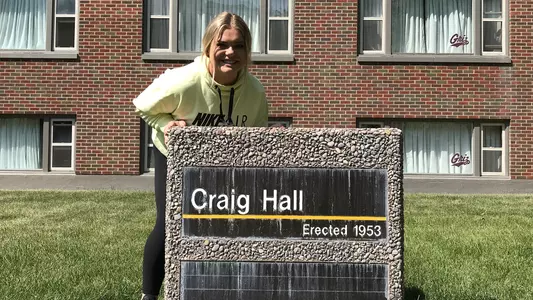
The Craig Hall Chronicles :: Meredith Udovich
8/28/2020 6:19:00 PM | Soccer
Claire Howard fears no woman, at least those with a ball at their feet. Respect? That's a different category all together.
There are a number of players she's faced over the years -- the net at her back, the field in front, the intensity of the action encroaching on her sacred turf before goal -- who she knows she needs to keep tabs on, no matter how far removed they are from the ball.
They are just that dangerous. They don't need a number of touches to set themselves up. All they require is a sliver of time and space, the ball either on the ground or in the air. And just like that, Howard is forced to take action.
It's a respect that has to be earned over time, not something she gives up easily.
And when it comes, it means something. It has the stamp of approval from a goalkeeper with 26 career shutouts, someone who has given up 56 goals in 62 matches played, or one goal every 103 minutes she has been on the field.
It's not extended only to players she has seen up close and personal. The college soccer junkie years ago was left with a dropped jaw when she first saw South Carolina's Savannah McCaskill, all 5-foot-4 of her, get after it.
The two-time SEC Offensive Player of the Year finished her career with 40 goals, 17 of which were game-winners. But McCaskill could do more than score. She could read the game, evidenced by her 34 career assists.
She knew when to take her shots and the times when she drew so much attention that one of her teammates had to be better positioned to score.
It was McCaskill who came to mind earlier this month when Howard faced Montana freshman Meredith Udovich for the first time.
Their builds are similar. So are their games.
"The first couple of practices, I was like, beginner's luck. Then it was every practice producing the same results. I was like, that is literally Savannah McCaskill," says Howard.
You may think that's a bit of hyperbole -- and certainly it is to an extent; McCaskill was a three-time all-American -- but consider that Montana coach Chris Citowicki reached the same conclusion about Udovich at nearly the same time, a few practices into the season.
"(McCaskill) was an incredible player and built just like Meredith," he says, meaning, as he describes it, "a tank."
"Claire came up to me one day and says, 'Have you heard of Savannah McCaskill? Meredith is just like her.' I said, 'I can't believe you just said that! I was just looking at footage of her 24 hours ago and thinking, that's Meredith right there.'"
That's a lot of pressure to put on Udovich, who Citowicki doesn't believe would be a starter as a freshman, not with what he has in upperclassmen.
But he starts laughing, with a touch of mania and hand-rubbing so common to coaches who envision the future and how it might play out, when he pictures Udovich running onto the field, fresh legs to go up against a set of defenders worn out by marking Alexa Coyle and Mimi Eiden.
"Oh, the little freshman is coming on. Ha-ha-ha. Good luck. One, you won't catch her. Two, if you get close to her, she'll deck you," he says.
There it is again, another hint dropped about Udovich. She's 5-foot-2. She's already been called a tank by her coach, and now he's claiming she'll rough you up if you invade her personal space.
Just who is this girl?
"She almost plays with anger sometimes. I've seen footage of her in games, unleashed, and it's scary," by which Citowicki means for the other team. If she's on your side, you do that thing with the laugh and the hand-rubbing.
If we've made Udovich out to be some sort of unrepentant terror, perhaps her sister, a five-year member of the women's soccer team at Washington, her career wrapped up after a trip to the 2019 NCAA tournament, could change the tone and direction of this article. Or not.
"We're not that different off the field. On the field we're very different," she says. "I'm very ... a nicer player." The pause she needed is as revealing as anything. Hmm, how to delicately put this?
"She just puts her heart out on the field. She uses her emotions and just goes all out. She's a tough one. I wouldn't want to play against her."
Maybe her mom can soften the edges a bit, perhaps add some rainbows and butterflies and hugs to all the bruises and broken bones and mayhem we're picturing.
"Meredith is our little scrapper. She definitely changes the game. Brings a higher intensity. People that know her on the field would probably not think she is quiet," Tami Udovich says.
"She is genuinely kind, but she may not necessarily play that way."
Her dad is a longshoreman, which is neither here nor there, but it felt like this was the perfect spot to introduce such a thing. That just feels so ... right.
Now that we've started painting a picture of Udovich, it's time to add some different brush strokes that will dramatically alter the finished product and how you ultimately view her.
This one might do the most: From junior high to high school, the highlight of her day -- when she wasn't on the soccer field with Washington Premier -- was when she got to work with kids with disabilities.
"I fell in love with doing that," she says, revealing a big heart that is bent more toward helping people than creating destruction. Of course that's part of it and why she is at Montana, but that's something that starts on the field and ends on the field, not something she takes home.
"The more I'm around her, the more I love being around Meredith," says Citowicki. "She surprises me every single day with what she offers to this team."
Last summer she took it a step further, working with disabled children in a hippotherapy setting, which is another way of saying equine-assisted therapy, which is another way of saying the use of horseback riding as therapeutic treatment to improve coordination, balance and strength.
Which is another way of saying: That sounds pretty awesome.
"We would ride horses, play games, get them to use their muscles in a different way," she says. "They would get close to you, and you would feel that. It was life-changing."
She means for her, though it was for everybody involved.
She wants to be in the life-changing business when all this soccer stuff is done, perhaps as an occupational therapist, maybe a nurse.
Part of that is just her nature. Some of it stems to that day when she was 11 and at a soccer tryout.
She'd lost 15 pounds in a span of two weeks and was making up to a dozen trips to the bathroom every night, so something was amiss. Her mom had her scheduled for an appointment to get things checked out.
At that tryout was the father of another player. He was a Type 1 diabetic and knew the signs. He had a hunch when he saw the girl who was looking gaunt and pale and what it might mean.
He offered to use the equipment he had in his car to check Udovich's blood-sugar level. She registered 600. Normal is 100.
"He said, 'Yeah, she needs to go to the hospital right now.' We had no idea. It came out of nowhere," says Tami.
She was diagnosed with the same thing, and that's a lot to hang on any family that wasn't prepared for the news. For an 11-year-old, who up to that day had been living a mostly carefree life, full of family and soccer? It's even more to take on.
Either Udovich was exceptionally mature for her age, or that just brought it out of her earlier than would be normal or expected. Either way, her childhood would never be the same again.
"She took it on and handled it, but it changes things in ways people don't know," says Tami. "She's had 2 a.m. blood checks for six years. She wasn't able to go to sleepovers when she was younger.
"Every day she has a life-threatening disease. It's not visible, so nobody knows the struggle, but it's 24 hours a day. She just has to deal with a lot, but she deals with it. There is so much to it. She is just amazing."
Never once does Udovich's mom use the word amazing to describe her daughter on the soccer field, so it's got some weight to it, some perspective, some real meaning.
Dating back further: It's no surprise Udovich ended up going all in on soccer.
She probably would have been an incredible gymnast. "She's always been strong," says Tami. "In gymnastics, she could pull herself up on anything. She climbed anything at the park. She was always climbing things she shouldn't be climbing. Her strength has always been there."
But? "She just couldn't stand in line that long to wait for her turn."
Part of the appeal of soccer was family. Both her parents played. Both older sisters as well, with Jessica blazing the path to the college game.
Part of it was geography. Both parents grew up in Tacoma, then settled in Puyallup after they were married.
They didn't do it because Washington Premier, a powerhouse soccer club that competes at the ECNL level, was in Puyallup, but it didn't hurt that the club's home field was just a 15-minute drive away.
Some of these stories detail the sacrifice of having to spend hours and hours in a car each week, getting soccer players with stars in their eyes to the coaches and clubs who can help bring those dreams to life.
This isn't one of them. Proximity just made everything easier.
"I started at seven and am still best friends with a lot of those girls," says Jessica, who played with a number of the same girls year after year, as they moved up in age group. She had teammates who traveled from Wenatchee, Spokane, just for a chance to play with Premier.
"That friend group and then having it right in our backyard," is why they got so hooked on the sport.
Jessica gravitated toward the back line. Meredith, four years younger, liked being in the action up front. For both, it just fit their personalities.
"We're two totally different players," says Meredith. "I like to score and go at people. She is more of a calm-and-collected type of player.
"People always say I go through people, but I don't try. I'm usually one of the smallest players on the field, so I kind of have to use that as an advantage, to be strong against people."
Both mention how they wish they hadn't been born so far apart. For as close as they are as sisters, the age difference kept them from ever being teammates.
Jessica was good. Good enough that Washington offered her a scholarship when she was just a sophomore. She committed before she was halfway through high school.
"Honestly, I didn't know that much about (the recruiting process). I loved U-Dub and the team when I went to visit, and one of my best friends at the time was looking at U-Dub as well," she says.
"And I liked the idea of staying close to home."
Sounds like a storybook, right, the girl getting to play for the nearby Huskies, just 30 miles up the road?
She doesn't regret the decision, but when players started arriving from California and other parts of the country, getting the opportunity to experience the Northwest for the first time, she says it wouldn't have hurt to at least take a look at what else was out there.
"Getting a scholarship somewhere is such a great way to get that chance to move somewhere else and experience something different," she says.
"I've always lived in Washington, so I kind of wish I had taken the chance to try something new. That's why I was really excited for (Meredith) to go off to Montana, just so she can get a different feel for a different place."
There is another reason she feels wistful these days. Hers was a career you wouldn't think could even be possible. Four years, four knee injuries, four knee surgeries.
As a freshman in 2015, she tore the ACL in her right knee two games into the season. A year later, also in August, she did the same thing. Two years, lost, never to be recovered.
Finally, in 2017, a reprieve. Twenty matches played, twenty matches started for a team that knocked off No. 2 Florida and No. 24 Utah in Seattle and lost 1-0 at Stanford on a goal in the 86th minute, a team that would go 23-1 and win the national championship.
Two months after that season was over, in January, she tore the meniscus in her right knee. That August, at the start of her fourth year, after playing all 90 minutes in Washington's 2-1 loss at No. 7 Florida in the Huskies' season opener, she tore the ACL in her left knee.
How much is too much? Still, she soldiered on. As a fifth-year senior last fall, she played in 11 of 21 matches on Washington's NCAA tournament team.
She did not play in the Huskies' 1-0 win at Washington State to end the regular season, a satisfying rivalry-game victory against a team that would advance to the national semifinals.
She did not play in Washington's 1-0 home win over Seattle in the first round of the NCAA tournament. She ended her career playing some minutes off the bench as Washington's season came to an end against South Florida in Tallahassee last November.
There is a lot more to be told about her story, but Jessica isn't the one who is going to reveal it. She wants her official stance to be that any frustrations she had were strictly from her injuries and only getting to play one and a half seasons out of five.
"It didn't go as expected, but I wouldn't change it," she says. "I feel like I learned a lot. I loved everything else about U-Dub."
Her sister claims she's being too nice, that she's holding back, suggesting there is so much more to the story. Tami vaguely says, "She had a coach you couldn't approach. Meredith kind of learned that lesson."
That's why Meredith spread a wide net when it came time to apply those lessons learned to the recruiting process. She wanted to find the right fit, not the school with the biggest name.
Like Reese Elliott, who had an older sister who didn't find what she was looking for at Bowling Green, who passed on Utah of the Pac-12 in favor of Montana, Udovich had an open mind.
She wanted to be won over, genuinely. She was all about the experience and was willing to talk to any coach who wanted to make a pitch.
That's how an email from Udovich ended up in Citowicki's in-box one day. He looked into her, then talked to her coaches, who said, "'This is not a kid you want to pass on,'" says Citowicki.
Indeed: She would end up playing in the High School All-American Game in Orlando in December of her senior year. Players like that don't typically reach out to Montana. They get reached out to.
"I couldn't believe it. How does someone like that end up here?" That's a revealing question from the coach who thinks he can convince any player in the country that Montana is the right place for them if he can just talk to them.
He wanted to close the deal so quickly that he gave his recruiting presentation over the phone, the first time he's pulled that off. He sent the Udovichs his PowerPoint presentation, then had them follow along from home.
Done. Committed.
Elliott and Udovich make up a small sample size, but maybe it's indicative of a generational shift, a sea change, a distant cousin of wokeness, of players no longer so concerned about the who and where as much as they are about the why and how.
And Montana will be there for them, those who are open to something different, arms spread wide, open communication at the ready, partners in the journey Citowicki is on as much as they are players.
"She wanted to find somewhere that felt like family," says Tami. "Chris made her feel comfortable in talking to him, somebody you could go to if there was ever an issue. He's one of those coaches that you're not afraid to approach."
It helped that Brooke Johnston, a former teammate of Udovich's at Puyallup High, was a Grizzly, two years Udovich's elder.
"I saw all her stories and how much she loved it and thought I should check it out," says Udovich. "I fell in love with it right away. I liked the environment and family culture."
It's an odd thing about recruiting. For a time, what can feel like ages ago, this year's freshmen were all Citowicki could think about.
When they committed, he moved on to the next recruiting class, to his Montana team. They were in a holding pattern, Montana commits but not yet quite Grizzlies.
Then they arrived in Missoula late last month and it was like being reintroduced all over again. All it took was a practice or two for Citowicki to remember why they had all been recruited in the first place.
Call it delayed gratification.
"That happens to all of us," says Citowicki. "We sign, then you work on the next group of recruits. Then you wait and you wait."
Verbal commits become signees of National Letters of Intent become freshmen, no longer figments but running all over South Campus Stadium, real for the first time.
"You don't look at (Meredith) and think, there is your classic six-foot, uber-athletic Division I athlete," Citowicki says. "She's shorter, but she's strong. There is so much power in that frame of hers.
"You just don't expect it. The speed, the quickness, the power in the shot. She surprises you. Her ceiling is exceptionally high. If you partner her up with the right people, she's going to be a devastating player."
Fans of the program might have their minds drift back to Erin Craig, who played from 2009-12. After scoring three goals as a freshman and sophomore, Craig totaled 17 her final two seasons.
She was the type of player who wasn't going to be denied. It didn't have to look pretty or technically perfect. It just had to result in the ball ending up in the net.
"Whatever it takes, Meredith will find a way to get it done," says Citowicki. "That's what most appealed to me about her. She finds ways to create opportunities for herself.
"My job is to put her in a position where she can do those things. You don't have to free her up. You can put her among three people and she'll still get a shot off."
Her mom will be around, probably every time Montana plays a game over the next four years. This is daughter No. 3, the last one. "You don't want to miss that time, because it does end," she says.
Jessica will be around when she can, but she's on to new things. That those things are no longer soccer is still a subject of some sensitivity, as it is with all recent graduates who go from player to former player, often before they're ready.
She is less than a year removed from her own collegiate career coming to an end. Now the younger sister who opted to venture out is just beginning hers.
"I keep telling people I'm sad I'm done playing soccer, but I'm going to live through her. I'm so excited to see how she does," she says.
You'll see her for the first time and come up with your own descriptors, of her playing style, of what she reminds you of. Call her what you want. None of it will bother her.
"I've heard bull probably the most," she says. "I'm used to it. It just boosts me up a little bit."
McCaskill probably went through the same thing as she moved up the soccer ladder, having to prove herself at every new stop, the burden of the short in stature in the world of sports, where height brings with it the assumption of gifted.
Maybe she didn't look like the player you thought she should be. Then she scored on you, over and over again. And you came around.
"One of the first things you recognize about Meredith is that she can shoot the ball extremely well. Even under pressure, her shot is accurate and powerful," says Howard.
"You have to take note of her. You have to know where she is and recognize that she doesn't need much room to be able to score. Coming in as a freshman and being able to do that is extremely exciting."
Howard is to the point now where she no longer needs to be concerned with making a name for herself. She's done that. Soon, whenever the games begin, she'll sit atop the Big Sky Conference record book for career shutouts.
That allows her to take a big-picture approach. She came into a successful program, with Montana claiming Big Sky titles in 2011, '12 and '14, and has helped the Grizzlies continue that championship trend, winning the tournament in 2018, the regular season last year.
Her focus now isn't so much on her, if it truly ever was. It's making sure, whenever that happens to be, that she is leaving the program in the possession of players she believes can keep Montana where it's been and where it intends to remain.
"There were players who paved the way for me and there are players (in the freshman class) who will pave the way for others, which is exciting," Howard says.
"They are super eager, super willing to learn. There will be learning curves and trial and error, but this program will be in good hands."
There are a number of players she's faced over the years -- the net at her back, the field in front, the intensity of the action encroaching on her sacred turf before goal -- who she knows she needs to keep tabs on, no matter how far removed they are from the ball.
They are just that dangerous. They don't need a number of touches to set themselves up. All they require is a sliver of time and space, the ball either on the ground or in the air. And just like that, Howard is forced to take action.
It's a respect that has to be earned over time, not something she gives up easily.
And when it comes, it means something. It has the stamp of approval from a goalkeeper with 26 career shutouts, someone who has given up 56 goals in 62 matches played, or one goal every 103 minutes she has been on the field.
It's not extended only to players she has seen up close and personal. The college soccer junkie years ago was left with a dropped jaw when she first saw South Carolina's Savannah McCaskill, all 5-foot-4 of her, get after it.
The two-time SEC Offensive Player of the Year finished her career with 40 goals, 17 of which were game-winners. But McCaskill could do more than score. She could read the game, evidenced by her 34 career assists.
She knew when to take her shots and the times when she drew so much attention that one of her teammates had to be better positioned to score.
It was McCaskill who came to mind earlier this month when Howard faced Montana freshman Meredith Udovich for the first time.
Their builds are similar. So are their games.
"The first couple of practices, I was like, beginner's luck. Then it was every practice producing the same results. I was like, that is literally Savannah McCaskill," says Howard.
You may think that's a bit of hyperbole -- and certainly it is to an extent; McCaskill was a three-time all-American -- but consider that Montana coach Chris Citowicki reached the same conclusion about Udovich at nearly the same time, a few practices into the season.
"(McCaskill) was an incredible player and built just like Meredith," he says, meaning, as he describes it, "a tank."
"Claire came up to me one day and says, 'Have you heard of Savannah McCaskill? Meredith is just like her.' I said, 'I can't believe you just said that! I was just looking at footage of her 24 hours ago and thinking, that's Meredith right there.'"
That's a lot of pressure to put on Udovich, who Citowicki doesn't believe would be a starter as a freshman, not with what he has in upperclassmen.
But he starts laughing, with a touch of mania and hand-rubbing so common to coaches who envision the future and how it might play out, when he pictures Udovich running onto the field, fresh legs to go up against a set of defenders worn out by marking Alexa Coyle and Mimi Eiden.
"Oh, the little freshman is coming on. Ha-ha-ha. Good luck. One, you won't catch her. Two, if you get close to her, she'll deck you," he says.
There it is again, another hint dropped about Udovich. She's 5-foot-2. She's already been called a tank by her coach, and now he's claiming she'll rough you up if you invade her personal space.
Just who is this girl?
"She almost plays with anger sometimes. I've seen footage of her in games, unleashed, and it's scary," by which Citowicki means for the other team. If she's on your side, you do that thing with the laugh and the hand-rubbing.
If we've made Udovich out to be some sort of unrepentant terror, perhaps her sister, a five-year member of the women's soccer team at Washington, her career wrapped up after a trip to the 2019 NCAA tournament, could change the tone and direction of this article. Or not.
"We're not that different off the field. On the field we're very different," she says. "I'm very ... a nicer player." The pause she needed is as revealing as anything. Hmm, how to delicately put this?
"She just puts her heart out on the field. She uses her emotions and just goes all out. She's a tough one. I wouldn't want to play against her."
Maybe her mom can soften the edges a bit, perhaps add some rainbows and butterflies and hugs to all the bruises and broken bones and mayhem we're picturing.
"Meredith is our little scrapper. She definitely changes the game. Brings a higher intensity. People that know her on the field would probably not think she is quiet," Tami Udovich says.
"She is genuinely kind, but she may not necessarily play that way."
Her dad is a longshoreman, which is neither here nor there, but it felt like this was the perfect spot to introduce such a thing. That just feels so ... right.
Now that we've started painting a picture of Udovich, it's time to add some different brush strokes that will dramatically alter the finished product and how you ultimately view her.
This one might do the most: From junior high to high school, the highlight of her day -- when she wasn't on the soccer field with Washington Premier -- was when she got to work with kids with disabilities.
"I fell in love with doing that," she says, revealing a big heart that is bent more toward helping people than creating destruction. Of course that's part of it and why she is at Montana, but that's something that starts on the field and ends on the field, not something she takes home.
"The more I'm around her, the more I love being around Meredith," says Citowicki. "She surprises me every single day with what she offers to this team."
Last summer she took it a step further, working with disabled children in a hippotherapy setting, which is another way of saying equine-assisted therapy, which is another way of saying the use of horseback riding as therapeutic treatment to improve coordination, balance and strength.
Which is another way of saying: That sounds pretty awesome.
"We would ride horses, play games, get them to use their muscles in a different way," she says. "They would get close to you, and you would feel that. It was life-changing."
She means for her, though it was for everybody involved.
She wants to be in the life-changing business when all this soccer stuff is done, perhaps as an occupational therapist, maybe a nurse.
Part of that is just her nature. Some of it stems to that day when she was 11 and at a soccer tryout.
She'd lost 15 pounds in a span of two weeks and was making up to a dozen trips to the bathroom every night, so something was amiss. Her mom had her scheduled for an appointment to get things checked out.
At that tryout was the father of another player. He was a Type 1 diabetic and knew the signs. He had a hunch when he saw the girl who was looking gaunt and pale and what it might mean.
He offered to use the equipment he had in his car to check Udovich's blood-sugar level. She registered 600. Normal is 100.
"He said, 'Yeah, she needs to go to the hospital right now.' We had no idea. It came out of nowhere," says Tami.
She was diagnosed with the same thing, and that's a lot to hang on any family that wasn't prepared for the news. For an 11-year-old, who up to that day had been living a mostly carefree life, full of family and soccer? It's even more to take on.
Either Udovich was exceptionally mature for her age, or that just brought it out of her earlier than would be normal or expected. Either way, her childhood would never be the same again.
"She took it on and handled it, but it changes things in ways people don't know," says Tami. "She's had 2 a.m. blood checks for six years. She wasn't able to go to sleepovers when she was younger.
"Every day she has a life-threatening disease. It's not visible, so nobody knows the struggle, but it's 24 hours a day. She just has to deal with a lot, but she deals with it. There is so much to it. She is just amazing."
Never once does Udovich's mom use the word amazing to describe her daughter on the soccer field, so it's got some weight to it, some perspective, some real meaning.
Dating back further: It's no surprise Udovich ended up going all in on soccer.
She probably would have been an incredible gymnast. "She's always been strong," says Tami. "In gymnastics, she could pull herself up on anything. She climbed anything at the park. She was always climbing things she shouldn't be climbing. Her strength has always been there."
But? "She just couldn't stand in line that long to wait for her turn."
Part of the appeal of soccer was family. Both her parents played. Both older sisters as well, with Jessica blazing the path to the college game.
Part of it was geography. Both parents grew up in Tacoma, then settled in Puyallup after they were married.
They didn't do it because Washington Premier, a powerhouse soccer club that competes at the ECNL level, was in Puyallup, but it didn't hurt that the club's home field was just a 15-minute drive away.
Some of these stories detail the sacrifice of having to spend hours and hours in a car each week, getting soccer players with stars in their eyes to the coaches and clubs who can help bring those dreams to life.
This isn't one of them. Proximity just made everything easier.
"I started at seven and am still best friends with a lot of those girls," says Jessica, who played with a number of the same girls year after year, as they moved up in age group. She had teammates who traveled from Wenatchee, Spokane, just for a chance to play with Premier.
"That friend group and then having it right in our backyard," is why they got so hooked on the sport.
Jessica gravitated toward the back line. Meredith, four years younger, liked being in the action up front. For both, it just fit their personalities.
"We're two totally different players," says Meredith. "I like to score and go at people. She is more of a calm-and-collected type of player.
"People always say I go through people, but I don't try. I'm usually one of the smallest players on the field, so I kind of have to use that as an advantage, to be strong against people."
Both mention how they wish they hadn't been born so far apart. For as close as they are as sisters, the age difference kept them from ever being teammates.
Jessica was good. Good enough that Washington offered her a scholarship when she was just a sophomore. She committed before she was halfway through high school.
"Honestly, I didn't know that much about (the recruiting process). I loved U-Dub and the team when I went to visit, and one of my best friends at the time was looking at U-Dub as well," she says.
"And I liked the idea of staying close to home."
Sounds like a storybook, right, the girl getting to play for the nearby Huskies, just 30 miles up the road?
She doesn't regret the decision, but when players started arriving from California and other parts of the country, getting the opportunity to experience the Northwest for the first time, she says it wouldn't have hurt to at least take a look at what else was out there.
"Getting a scholarship somewhere is such a great way to get that chance to move somewhere else and experience something different," she says.
"I've always lived in Washington, so I kind of wish I had taken the chance to try something new. That's why I was really excited for (Meredith) to go off to Montana, just so she can get a different feel for a different place."
There is another reason she feels wistful these days. Hers was a career you wouldn't think could even be possible. Four years, four knee injuries, four knee surgeries.
As a freshman in 2015, she tore the ACL in her right knee two games into the season. A year later, also in August, she did the same thing. Two years, lost, never to be recovered.
Finally, in 2017, a reprieve. Twenty matches played, twenty matches started for a team that knocked off No. 2 Florida and No. 24 Utah in Seattle and lost 1-0 at Stanford on a goal in the 86th minute, a team that would go 23-1 and win the national championship.
Two months after that season was over, in January, she tore the meniscus in her right knee. That August, at the start of her fourth year, after playing all 90 minutes in Washington's 2-1 loss at No. 7 Florida in the Huskies' season opener, she tore the ACL in her left knee.
How much is too much? Still, she soldiered on. As a fifth-year senior last fall, she played in 11 of 21 matches on Washington's NCAA tournament team.
She did not play in the Huskies' 1-0 win at Washington State to end the regular season, a satisfying rivalry-game victory against a team that would advance to the national semifinals.
She did not play in Washington's 1-0 home win over Seattle in the first round of the NCAA tournament. She ended her career playing some minutes off the bench as Washington's season came to an end against South Florida in Tallahassee last November.
There is a lot more to be told about her story, but Jessica isn't the one who is going to reveal it. She wants her official stance to be that any frustrations she had were strictly from her injuries and only getting to play one and a half seasons out of five.
"It didn't go as expected, but I wouldn't change it," she says. "I feel like I learned a lot. I loved everything else about U-Dub."
Her sister claims she's being too nice, that she's holding back, suggesting there is so much more to the story. Tami vaguely says, "She had a coach you couldn't approach. Meredith kind of learned that lesson."
That's why Meredith spread a wide net when it came time to apply those lessons learned to the recruiting process. She wanted to find the right fit, not the school with the biggest name.
Like Reese Elliott, who had an older sister who didn't find what she was looking for at Bowling Green, who passed on Utah of the Pac-12 in favor of Montana, Udovich had an open mind.
She wanted to be won over, genuinely. She was all about the experience and was willing to talk to any coach who wanted to make a pitch.
That's how an email from Udovich ended up in Citowicki's in-box one day. He looked into her, then talked to her coaches, who said, "'This is not a kid you want to pass on,'" says Citowicki.
Indeed: She would end up playing in the High School All-American Game in Orlando in December of her senior year. Players like that don't typically reach out to Montana. They get reached out to.
"I couldn't believe it. How does someone like that end up here?" That's a revealing question from the coach who thinks he can convince any player in the country that Montana is the right place for them if he can just talk to them.
He wanted to close the deal so quickly that he gave his recruiting presentation over the phone, the first time he's pulled that off. He sent the Udovichs his PowerPoint presentation, then had them follow along from home.
Done. Committed.
Elliott and Udovich make up a small sample size, but maybe it's indicative of a generational shift, a sea change, a distant cousin of wokeness, of players no longer so concerned about the who and where as much as they are about the why and how.
And Montana will be there for them, those who are open to something different, arms spread wide, open communication at the ready, partners in the journey Citowicki is on as much as they are players.
"She wanted to find somewhere that felt like family," says Tami. "Chris made her feel comfortable in talking to him, somebody you could go to if there was ever an issue. He's one of those coaches that you're not afraid to approach."
It helped that Brooke Johnston, a former teammate of Udovich's at Puyallup High, was a Grizzly, two years Udovich's elder.
"I saw all her stories and how much she loved it and thought I should check it out," says Udovich. "I fell in love with it right away. I liked the environment and family culture."
It's an odd thing about recruiting. For a time, what can feel like ages ago, this year's freshmen were all Citowicki could think about.
When they committed, he moved on to the next recruiting class, to his Montana team. They were in a holding pattern, Montana commits but not yet quite Grizzlies.
Then they arrived in Missoula late last month and it was like being reintroduced all over again. All it took was a practice or two for Citowicki to remember why they had all been recruited in the first place.
Call it delayed gratification.
"That happens to all of us," says Citowicki. "We sign, then you work on the next group of recruits. Then you wait and you wait."
Verbal commits become signees of National Letters of Intent become freshmen, no longer figments but running all over South Campus Stadium, real for the first time.
"You don't look at (Meredith) and think, there is your classic six-foot, uber-athletic Division I athlete," Citowicki says. "She's shorter, but she's strong. There is so much power in that frame of hers.
"You just don't expect it. The speed, the quickness, the power in the shot. She surprises you. Her ceiling is exceptionally high. If you partner her up with the right people, she's going to be a devastating player."
Fans of the program might have their minds drift back to Erin Craig, who played from 2009-12. After scoring three goals as a freshman and sophomore, Craig totaled 17 her final two seasons.
She was the type of player who wasn't going to be denied. It didn't have to look pretty or technically perfect. It just had to result in the ball ending up in the net.
"Whatever it takes, Meredith will find a way to get it done," says Citowicki. "That's what most appealed to me about her. She finds ways to create opportunities for herself.
"My job is to put her in a position where she can do those things. You don't have to free her up. You can put her among three people and she'll still get a shot off."
Her mom will be around, probably every time Montana plays a game over the next four years. This is daughter No. 3, the last one. "You don't want to miss that time, because it does end," she says.
Jessica will be around when she can, but she's on to new things. That those things are no longer soccer is still a subject of some sensitivity, as it is with all recent graduates who go from player to former player, often before they're ready.
She is less than a year removed from her own collegiate career coming to an end. Now the younger sister who opted to venture out is just beginning hers.
"I keep telling people I'm sad I'm done playing soccer, but I'm going to live through her. I'm so excited to see how she does," she says.
You'll see her for the first time and come up with your own descriptors, of her playing style, of what she reminds you of. Call her what you want. None of it will bother her.
"I've heard bull probably the most," she says. "I'm used to it. It just boosts me up a little bit."
McCaskill probably went through the same thing as she moved up the soccer ladder, having to prove herself at every new stop, the burden of the short in stature in the world of sports, where height brings with it the assumption of gifted.
Maybe she didn't look like the player you thought she should be. Then she scored on you, over and over again. And you came around.
"One of the first things you recognize about Meredith is that she can shoot the ball extremely well. Even under pressure, her shot is accurate and powerful," says Howard.
"You have to take note of her. You have to know where she is and recognize that she doesn't need much room to be able to score. Coming in as a freshman and being able to do that is extremely exciting."
Howard is to the point now where she no longer needs to be concerned with making a name for herself. She's done that. Soon, whenever the games begin, she'll sit atop the Big Sky Conference record book for career shutouts.
That allows her to take a big-picture approach. She came into a successful program, with Montana claiming Big Sky titles in 2011, '12 and '14, and has helped the Grizzlies continue that championship trend, winning the tournament in 2018, the regular season last year.
Her focus now isn't so much on her, if it truly ever was. It's making sure, whenever that happens to be, that she is leaving the program in the possession of players she believes can keep Montana where it's been and where it intends to remain.
"There were players who paved the way for me and there are players (in the freshman class) who will pave the way for others, which is exciting," Howard says.
"They are super eager, super willing to learn. There will be learning curves and trial and error, but this program will be in good hands."


Players Mentioned

F
/ Soccer
F
/ Soccer
D
/ Soccer
G
/ Soccer
G
/ Soccer
F
/ SoccerThursday, June 04
Friday, May 01
Friday, May 01
Friday, May 01