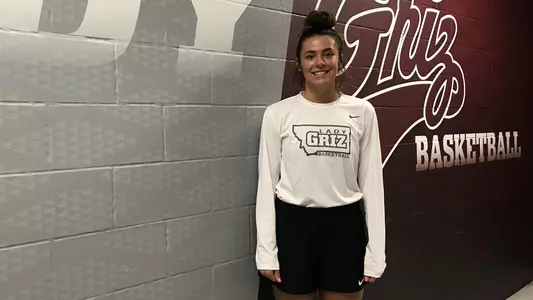
Freshman orientation with Kyndall Keller
9/25/2020 6:36:00 PM | Women's Basketball
Get Dustin Kraske, the girls' basketball coach at Havre High the last 14 years, talking about Kyndall Keller, and he has no shortage of stories to tap into.
He's been telling them so often to so many people that they flow easily now, even after Keller has left his program to become the first Lady Griz from Havre since April Sather in the mid-90s.
About how she walked into the gym for tryouts as a freshman and left no doubt that she was not just going to be on varsity but would be starting the team's opener on a veteran team.
About those magical seasons when she was a sophomore and junior, when Havre won 47 of 48 games and a pair of Class A state titles.
About the day she was named the Gatorade Montana Player of the Year last March, the first for the school since Loree Payne more than two decades earlier.
But one question gives him pause. He thinks for a moment. The memories of her four years -- and even before -- come flooding back to mind. Another moment passes.
"I can't answer that," he finally says, stumped by a seemingly straightforward question. What moment, whether it be in a game, at practice or away from the court, best encapsulates Kyndall Keller?
He has no answer. Then it finally it comes to him.
"What captures Kyndall to me is the work ethic of the every day. That's it to me," he says. "You watch that kid at the end of any workout, whether it's the summer by herself or a practice and she's drenched and tired.
"My lasting memory of her is an exhausted kid who has just given it everything she has."
It's both instructive and revealing that seven people, all with some serious basketball jones, were recently asked about Keller.
Not one of them mentioned any particular skillset she possesses that sets her apart. No talk of a deadly pull-up jumper, of someone who will harass a ball-handler to tears, who rebounds like a forward in a guard's body or hits 3-pointers like she's spotted up 10 feet from the basket instead of 21.
All the talk centers on two things: her work ethic and the desire, the deep-down need, to win. Everything else is just a byproduct of that which is essential to her makeup.
"The biggest thing I've noticed is that she is very similar to her dad, which was very similar to my sister," says Juliann Solomon, a third-grade teacher at Warren Elementary in Helena, maybe better known to you as Juliann Keller, who played for the Lady Griz from 2001 to '05.
Her sister, Cheryl -- both of them Kyndall's aunts -- played for Montana from 1998 to 2002. Their oldest of four brothers, Bill, is Kyndall's dad.
"They just have that hard-nosed mentality, the I'm going to go out and do it, and I'm going to do it until I get it right. No matter who's coaching me, they are going to get my full effort."
You know the type. And you love the type. It's the type that draws you in, that has you aching for her losses and celebrating her wins, right along with her. It's the kind of player the foundation of the Lady Griz program has been built upon.
Sure, there have been the superstars over the years, but Montana wouldn't have the history it does without this:
"Kyndall's at the top of the pack in sprints, and I don't think she's the fastest girl on the team," says assistant coach Jordan Sullivan. "She is not going to be outworked, which is a dream for coaches."
That type of player tends to stick with a coach. Consider how easily the memories of Cheryl Keller return to Robin Selvig, even though he coached her 20 years ago.
It's like it happened last season.
"I remember she played the top of the zone and they were passing outside it and she shot out and got it like she did so many times and went down and missed an uncontested layup," he says, laughing not so much at that but at what came next.
"They rebound, come back down and the next possession she steals it again and went down and made it. I don't think I'd ever seen that before. I coached a lot of kids who were hard workers, but she was relentless in practice and games."
Today it's as if she is giving of scouting report of herself and not her brother's daughter.
"She is a student of the game, so willing to listen, and she's going to work hard all the time. She may not be the most athletic or the tallest or any of that, but she is determined," says Cheryl. "She is going to go out there and deliver a good result.
"And more important, she is a good person and an excellent teammate. She is a kind person who has an intense drive."
Who else, of those who may not have been around for the previous Kellers, is thinking, wait, is this McKenzie Johnston all over again? Yes. Yes it is, and we'll all be better because of it.
"She does bring that McKenzie Johnston toughness," says first-year Lady Griz head coach Mike Petrino, who spent the previous four years as an assistant tracking Keller at both Havre High and on the club circuit. "I'm going to out-work and out-compete you."
She says it all started when she was in third grade, when her dad took her and some fourth graders to a youth tournament. She remembers it being in Helena. He thought it was Malta.
The location doesn't matter, just this: the team lost by 40 points to another team of third and fourth graders.
You might remember the story of Mike Krzyzewski, how his third team at Duke lost 109-66 to Virginia in the 1983 ACC tournament.
After the game the coach went out with some friends for dinner. One of them raised a glass and proposed: Here's to forgetting what just happened. Krzyzewski corrected him: Here's to never forgetting.
Keep the loss in a prominent place. Feed off of it. Burn it for fuel.
"Right there I wanted to get into the gym to get better," says Keller. She was in the third grade. "If that motivated her at that age, that would be pretty incredible," says her dad, who played basketball at tiny Turner High and later Carroll.
His lesson for both of his kids, whether it be related to sports or not: Don't be that what-if person, who wonders forever what could have been had they just done things a little bit differently, tried a little bit harder, took that chance when the easy way out was to let it pass.
"Everybody has a woulda-coulda-shoulda story," he says. "Don't be that person. Go make your own story." And she has.
It's something he learned from his grandpa, decades ago, when he was a kid. Whatever you do, whether you like it or not, always do it to the best of your abilities.
It's part of the reason the six children of Gerald and Shirley Keller all attended college on athletic scholarships.
Imagine that scene, that incubator: Maybe 5,000 acres of farmland, three or four thousand acres of pasture, another place near Harlem, 600 more acres of irrigated hay ground.
First Bill, then Raymond, then Kevin, then Russell. Finally two girls, Cheryl and Juliann.
Imagine the life lessons, of hard work during the day, followed by backyard baseball or basketball on the rim that had been hung on the side of the shop until the sun finally set, the two -- hard work and play -- intermingling until there was no separation.
"Cheryl can probably tell you a story or two about running behind the bat a couple of times when she was a little girl," says Bill. And people who didn't know her thought a missed layup was going to hold her down? You get up, dust yourself off and get it right the next time.
Toughness? "There were six of us, so we would compete against each other, when my brothers would let us. That wasn't always the case," says Cheryl.
"They would go outside and play, and I would follow them out. I wanted to play too. It often ended up with me going back into the house to tattle. Hey, they won't let me play!" Title IX on a micro-level, handled locally. The girls earned their hard-fought opportunities.
She played at Turner High, just like her older brothers, but only as a freshman. The signs were ominous. In the younger grades, there weren't going to be enough girls to even have a basketball team in the future, once Juliann, three years behind, moved up.
Gerald and Shirley did what they had to do. They bought a house in Malta. Weekends during the school year were spent on the farm. During the week, Shirley and the two girls would live in Malta, which just happened to have a juggernaut of a girls' basketball program under coach Del Fried.
Consider that in the 1990s, a decade of dominance for the Lady Griz, Greta Koss, Skyla Sisco and Linda Cummings all moved on from Malta to join Selvig's program in Missoula.
Koss was the 1996 Big Sky MVP, Sisco the MVP two years later. Cummings was two times All-Big Sky Conference.
"It was an incredible program. We were fortunate to be part of it and blessed our parents were able to give us that opportunity," says Cheryl, who was a Lady Griz freshman in 1998-99, All-Big Sky by the time she was a senior.
Her younger sister arrived three years later, both of them Lady Griz for one season, in 2001-02.
Through current Malta alumnae Sophia Stiles, the program that Fried built and then passed down to other coaches has supplied Montana with eight players in all.
"It's amazing what that small town has been able to contribute to the Lady Griz program," says Cheryl.
The younger sisters were only doing what their older brothers had done before them, which is turn athletics into opportunities.
Bill played basketball at Carroll, Raymond at Glendive Community College. Kevin was on the rodeo team at MSU Northern. Russell played basketball at Montana Tech before finishing his career at Northern.
It was at Carroll that Bill met Karen Gross, who had her own basketball pedigree. She was the state tournament MVP as a junior as Helena High, under her dad, coach Jim Gross, won the 1984 Class AA state tournament.
Karen would go on to play at Carroll, as would her sister. Another sister played at Western. Her brother played football at Carroll.
After teaching English, history and government, and coaching at Helena High from 1973-92, Jim Gross took over the women's basketball program at Carroll in 1992. Karen was an early assistant, while Bill Keller played for the men's team.
"We met at a Carroll College basketball camp. Probably broke every rule in the book, I suppose," he says.
So Kyndall Keller had basketball in her blood when she was born in 2001. She also had some early exposure to the game.
Her dad was the girls' coach at Chinook High at the time of her birth. In fact he missed a postseason game the day she was born. He was back on the sideline the next morning, for a loser-out game, an early sign that family and basketball would both be of utmost importance.
He later packed her around the state as he and some friends -- "We were still young enough that me and a bunch of guys from the Hi-Line thought we were still rock stars," he says -- played in every men's tournament they could find. "So naturally she was around it. She seemed to like it."
Her earliest memories of Lady Griz basketball are not of Juliann on the court -- her aunt was a junior in 2003-04 when Montana hosted Louisiana Tech in an NCAA tournament game, a senior in 2004-05 when the Lady Griz won the Big Sky again -- but of those things surrounding the games.
"The only thing I can remember is high-fiving Monte and wearing a cheerleading outfit. That's all I can remember," she says.
Soon enough she would be in the third grade and playing the sport herself. And soon enough she would be in anguish over losing a game to some age-group peers by 40 points. But it wasn't just her basketball trajectory that was changed that day.
"We didn't compete and got beat pretty good," says Bill. "It brought it to my attention that we had some work to do in Havre. We needed to get kids in the gym and teams playing."
Those players who lost by 40 points as third and fourth graders would be the same players who made up a bulk of Havre's state-title teams in 2018 and '19.
"We started getting them in the gym three nights a week. They started playing all the time," says Bill, a banker in Havre, who helped create the youth program in town.
Kyndall Keller turned that disappointment, of not measuring up, of not even being able to compete, of running into someone just like her, just way, way better at basketball, into something that would drive her to improve. Here's to never forgetting, right?
"(Bill and Karen) didn't have to provide much pushing," says Kraske. "It was always her motivation to be very, very good."
But Bill provided the time. He was more than a rebounder or someone who would drive her to the gym, then home when she was done. He knew basketball, and he knew what his daughter needed to work on to improve.
"Bill spent a ton of time with Kyndall, especially when she was younger. He was always very technical on the skills she needed to work on, always good on forecasting. 'As you get older, you're going to have to do A, B and C better,'" says Kraske.
"He did a nice job with Kyndall, putting a program together that helped her be very good. She wanted to be really, really good, and Bill put the time in with her to help her be really good. We were fortunate as a program to get the reward of that hard work."
Keller was an eighth grader in 2016, when Havre made the state tournament but lost in the opening round to Columbia Falls.
She arrived at the gym the next fall, a freshman at the all-player tryout that Kraske holds prior to each season to fill his varsity and JV rosters.
"The first day of our tryouts, we have all the kids together, 9 through 12," he says. "If there is a kid who needs to move up, it's obvious. Anybody can see it.
"It was very well understood that she was one of the better players in the program the moment she stepped on the floor. It wasn't like she had to prove herself. Everybody knew she could play."
She says the transition to high school basketball was more difficult than it's been going from Blue Pony to Lady Griz, but imagine the momentum she carried into her freshman year.
The previous March, that month when basketball's postseason madness sucks us all in, Keller and her dad were at home watching the Connecticut women, the team of her devotion, win again.
He had an idea. How would she like to go to Indianapolis for the Final Four? She probably would have run there.
They both had the feeling this was going to be a once-in-a-lifetime trip, so he splurged and bought floor seats.
In the semifinals, an 80-51 win over Oregon State, they were surrounded by former Connecticut players, a perk of their seating location. It was a who's who of the college women's game from the previous two decades sitting in their section, walking past to get to their seats, screaming for the latest Huskies.
Two days later, on their way to the national championship game, Connecticut against Syracuse, Bill did what he does best, connect with people, and started a conversation with an older couple.
"Dad, you don't have to talk to everybody," she's told him before. This time she was glad she let it go.
They were Connecticut fans, who traveled wherever the team went. And they loved the story of how a dad from Montana had traveled to Indianapolis with his basketball-loving daughter so she could see her favorite team play in person.
They extended an invitation: After the Huskies won that night -- and there was no doubt they were going to win -- there would be a semi-private post-game party back at the team hotel, just the coaches, the players, their families and some boosters, which they were.
"This is no lie," Bill says. "The guy gives us his number and says, 'Call me.'"
Sitting in their seats before the title game, the Kellers were spotted from across the court before the game. The same gentleman walked over and once again said to call him afterwards. He wanted them to attend the team's party.
There was still some disbelief, as any of us would have had. There was no way this was legit.
Connecticut won easily, 82-51, to finish 38-0 on the season and win its fourth consecutive national championship.
The Kellers did as they had been invited to do and walked to the team's hotel. They dialed the number they'd been given. They were met, brought past security and walked into a scene straight out of Kyndall's dreams.
It was just as they had been told: the coaches, the players, their families, a handful of others.
"We sat with Moriah Jefferson's and Morgan Tuck's parents and visited with them for a while," Bill says. Their daughters had not long before been named to the Final Four all-tournament team.
"Out of dumb luck, we hung out with the UConn Huskies after their title win. It was a pretty cool trip."
Havre would fall short of winning a Class A title in 2017, when Keller was a freshman, losing to eventual champion Columbia Falls in the semifinals.
Behind Keller, the state tournament MVP when she was a sophomore, the Blue Ponies would defeat Hardin in the 2018 title game to cap a 24-0 season.
Havre -- and Keller as MVP -- would repeat in 2019, once again getting past Hardin in the championship game after losing just once during the season.
It was the reward for the effort put in for years and years prior, the type of story, that nothing is achieved without a lot of hard work and sacrifice, that the Hi-Line, founded on such a belief, could embrace and celebrate.
"What I really appreciated about Kyndall was from the end of one season to the start of the next, she worked to be so much better. She identified deficiencies in her game, then committed to the gym and getting better," says Kraske.
"She was better every year, and it was an obvious better."
Colleges began not just noticing but reaching out. Speculation that she would one day be a Lady Griz began probably 10 minutes after Bill and Karen learned they were having a baby girl.
But what about Carroll? Both parents had played there. And Keller had begun playing club basketball for Rachelle Sayers, the current coach of the Saints.
"She kept her goals pretty close to herself," her dad says. Her aunts gave her some distance as well, knowing this was her life, her choice. "Deep down, we all knew that would be really cool, but I always told her to do what's best for you," says Juliann. "Go where your heart tells you to go.
"We were all going to be proud of her no matter where she went."
She may not have revealed too much, but she does now. Montana is where she wanted to be, where her heart told her to go.
It made attending Lady Griz camps each summer feel more like a tryout, full of pressure and stress. She never knew when somebody might be watching, evaluating, making decisions.
"When I'd go to other camps, I'd want to do well, you always want to do well, but it's not where I wanted to be," she says.
"When I came here, I wanted to do well and wanted to perform, because this is where I wanted to be. You want to come in ready to go."
The offer arrived in July before her senior year, and it's the most Montana of stories.
She had been in Missoula for camp, then traveled to California for an AAU tournament. On the way home, the extended family gathered at Swan Lake to celebrate Gerald and Shirley's 50th anniversary.
The Lady Griz tried to reach her with an offer. They couldn't get through. Where she was had no service.
Eventually the two sides connected and a scholarship was offered. That Keller was surrounded by her family at the time only made it better. "Everyone went crazy. It was perfect timing," she says.
She'll wear No. 12, same as Cheryl, "but she doesn't need to be compared to what was instead of blazing her own trail," she says. "I'm excited for her to wear No. 12, but I'm going to let her define her own success as No. 12, which I know she'll do. She's going to write her own story."
The Hi-Line extends hundreds and hundreds of miles across northern Montana, but it's connected by more than just a common highway. It's linked by basketball, a way of life, by hardiness that the land and weather demand. All of it serves as a unifier.
Communities are more than just a series of streets, a grocery store, a post office, a church or two. They extend for miles and miles beyond the towns proper, across farms and ranch land. And it's high school sports that does the best at uniting everyone, despite the distance.
"Sporting events become community events. Havre, for a very long time, has come to our games to support our teams," says Kraske. "And the kids from other towns for the most part know each other."
Greta Koss grew up idolizing Sophia Stiles' mom. When Stiles and Malta were destroying every opponent in their path, Keller was a smitten middle schooler.
"She walked into the gym and everybody knew who she was. You wanted to be like her. It was every little girl's dream to be like Sophia Stiles," says Keller, who inherited that crown from Stiles and now passes it down the line, to the next, and so on and so on.
Once Stiles left Malta for Missoula, she transformed into something new: she became the Hi-Line's own, just like Keller has, no longer linked only to their hometown.
"I moved to Las Vegas and coached JV and freshmen my first couple years here," says Cheryl, wife of former Griz basketball player Deldre Carr and mother of three. "Parents don't show up to games. You have a game at 4 or 4:30 and you might have three of four parents there.
"In the city, where people work until 5, it's just different. In small-town Montana, that's what everybody did, whether you had kids playing or not. In the rural communities, you have farmers and ranchers who can make their own schedule. Supporting their school is a priority. It's such a special thing."
She graduated from Malta High but she says it's Turner that will always be home. Those teams and schools she wanted to beat so badly back in the day, and those that wanted so badly to take down Malta? All those distinctions melt away over time.
"Sports are only a small part of our lives. Those barriers kind of come down once you've moved on to your next thing," says Cheryl. "It's not Malta versus Havre. At that point we're just Hi-Line kids."
Keller is just the latest to make the move from the Hi-Line to Missoula. She is who she is. She isn't going to change now. Why, when it's worked so well in the past?
"She's stood out to me for her competitiveness at practice," says lone Lady Griz senior Madi Schoening, known since her freshman year for the same thing. "She reminds me of myself, someone who gets after it. There are a lot of promising features about her that I love seeing in a freshman."
She remembers that time in middle school, at the Blue Pony summer camp at the high school gym. She was knocked out of lightning and almost started to cry. There is winning and then there is everything else. In her hierarchy, only one thing matters.
Havre kept winning last winter. The Blue Ponies were 20-2 entering the state tournament. They crushed Hamilton in the first round before falling by seven to Billings Central in the semifinals.
It was only her fourth loss in her last 72 basketball games. Before she could make it right, against Browning in a loser-out game on a Saturday morning in Billings in March, the tournament was canceled.
She begins her time as a Lady Griz on a personal one-game losing streak. She doesn't say it, but she needs to get it out of her system. She waits as the pressure builds up. At some point it will need a release. Pity the opponent.
"You have to experience losing too. I haven't lost much in my life, but when I have, it's been big losses," she says.
"I wasn't always like that. I was kind of shy. But I've come to hate losing. I have this mentality where I hate to lose and hate to not work hard. There is just something about me where I don't take it easy. That's how I roll. I don't know why."
We do now. It was never a decision for her to make, never an option to choose. Her family history made it for her. Progeny of the Kellers, both Bill and Karen, product of Havre, pride of the Hi-Line, she is now a Lady Griz, one of ours while forever being one of theirs.
He's been telling them so often to so many people that they flow easily now, even after Keller has left his program to become the first Lady Griz from Havre since April Sather in the mid-90s.
About how she walked into the gym for tryouts as a freshman and left no doubt that she was not just going to be on varsity but would be starting the team's opener on a veteran team.
About those magical seasons when she was a sophomore and junior, when Havre won 47 of 48 games and a pair of Class A state titles.
About the day she was named the Gatorade Montana Player of the Year last March, the first for the school since Loree Payne more than two decades earlier.
But one question gives him pause. He thinks for a moment. The memories of her four years -- and even before -- come flooding back to mind. Another moment passes.
"I can't answer that," he finally says, stumped by a seemingly straightforward question. What moment, whether it be in a game, at practice or away from the court, best encapsulates Kyndall Keller?
He has no answer. Then it finally it comes to him.
"What captures Kyndall to me is the work ethic of the every day. That's it to me," he says. "You watch that kid at the end of any workout, whether it's the summer by herself or a practice and she's drenched and tired.
"My lasting memory of her is an exhausted kid who has just given it everything she has."
It's both instructive and revealing that seven people, all with some serious basketball jones, were recently asked about Keller.
Not one of them mentioned any particular skillset she possesses that sets her apart. No talk of a deadly pull-up jumper, of someone who will harass a ball-handler to tears, who rebounds like a forward in a guard's body or hits 3-pointers like she's spotted up 10 feet from the basket instead of 21.
All the talk centers on two things: her work ethic and the desire, the deep-down need, to win. Everything else is just a byproduct of that which is essential to her makeup.
"The biggest thing I've noticed is that she is very similar to her dad, which was very similar to my sister," says Juliann Solomon, a third-grade teacher at Warren Elementary in Helena, maybe better known to you as Juliann Keller, who played for the Lady Griz from 2001 to '05.
Her sister, Cheryl -- both of them Kyndall's aunts -- played for Montana from 1998 to 2002. Their oldest of four brothers, Bill, is Kyndall's dad.
"They just have that hard-nosed mentality, the I'm going to go out and do it, and I'm going to do it until I get it right. No matter who's coaching me, they are going to get my full effort."
You know the type. And you love the type. It's the type that draws you in, that has you aching for her losses and celebrating her wins, right along with her. It's the kind of player the foundation of the Lady Griz program has been built upon.
Sure, there have been the superstars over the years, but Montana wouldn't have the history it does without this:
"Kyndall's at the top of the pack in sprints, and I don't think she's the fastest girl on the team," says assistant coach Jordan Sullivan. "She is not going to be outworked, which is a dream for coaches."
That type of player tends to stick with a coach. Consider how easily the memories of Cheryl Keller return to Robin Selvig, even though he coached her 20 years ago.
It's like it happened last season.
"I remember she played the top of the zone and they were passing outside it and she shot out and got it like she did so many times and went down and missed an uncontested layup," he says, laughing not so much at that but at what came next.
"They rebound, come back down and the next possession she steals it again and went down and made it. I don't think I'd ever seen that before. I coached a lot of kids who were hard workers, but she was relentless in practice and games."
Today it's as if she is giving of scouting report of herself and not her brother's daughter.
"She is a student of the game, so willing to listen, and she's going to work hard all the time. She may not be the most athletic or the tallest or any of that, but she is determined," says Cheryl. "She is going to go out there and deliver a good result.
"And more important, she is a good person and an excellent teammate. She is a kind person who has an intense drive."
Who else, of those who may not have been around for the previous Kellers, is thinking, wait, is this McKenzie Johnston all over again? Yes. Yes it is, and we'll all be better because of it.
"She does bring that McKenzie Johnston toughness," says first-year Lady Griz head coach Mike Petrino, who spent the previous four years as an assistant tracking Keller at both Havre High and on the club circuit. "I'm going to out-work and out-compete you."
She says it all started when she was in third grade, when her dad took her and some fourth graders to a youth tournament. She remembers it being in Helena. He thought it was Malta.
The location doesn't matter, just this: the team lost by 40 points to another team of third and fourth graders.
You might remember the story of Mike Krzyzewski, how his third team at Duke lost 109-66 to Virginia in the 1983 ACC tournament.
After the game the coach went out with some friends for dinner. One of them raised a glass and proposed: Here's to forgetting what just happened. Krzyzewski corrected him: Here's to never forgetting.
Keep the loss in a prominent place. Feed off of it. Burn it for fuel.
"Right there I wanted to get into the gym to get better," says Keller. She was in the third grade. "If that motivated her at that age, that would be pretty incredible," says her dad, who played basketball at tiny Turner High and later Carroll.
His lesson for both of his kids, whether it be related to sports or not: Don't be that what-if person, who wonders forever what could have been had they just done things a little bit differently, tried a little bit harder, took that chance when the easy way out was to let it pass.
"Everybody has a woulda-coulda-shoulda story," he says. "Don't be that person. Go make your own story." And she has.
It's something he learned from his grandpa, decades ago, when he was a kid. Whatever you do, whether you like it or not, always do it to the best of your abilities.
It's part of the reason the six children of Gerald and Shirley Keller all attended college on athletic scholarships.
Imagine that scene, that incubator: Maybe 5,000 acres of farmland, three or four thousand acres of pasture, another place near Harlem, 600 more acres of irrigated hay ground.
First Bill, then Raymond, then Kevin, then Russell. Finally two girls, Cheryl and Juliann.
Imagine the life lessons, of hard work during the day, followed by backyard baseball or basketball on the rim that had been hung on the side of the shop until the sun finally set, the two -- hard work and play -- intermingling until there was no separation.
"Cheryl can probably tell you a story or two about running behind the bat a couple of times when she was a little girl," says Bill. And people who didn't know her thought a missed layup was going to hold her down? You get up, dust yourself off and get it right the next time.
Toughness? "There were six of us, so we would compete against each other, when my brothers would let us. That wasn't always the case," says Cheryl.
"They would go outside and play, and I would follow them out. I wanted to play too. It often ended up with me going back into the house to tattle. Hey, they won't let me play!" Title IX on a micro-level, handled locally. The girls earned their hard-fought opportunities.
She played at Turner High, just like her older brothers, but only as a freshman. The signs were ominous. In the younger grades, there weren't going to be enough girls to even have a basketball team in the future, once Juliann, three years behind, moved up.
Gerald and Shirley did what they had to do. They bought a house in Malta. Weekends during the school year were spent on the farm. During the week, Shirley and the two girls would live in Malta, which just happened to have a juggernaut of a girls' basketball program under coach Del Fried.
Consider that in the 1990s, a decade of dominance for the Lady Griz, Greta Koss, Skyla Sisco and Linda Cummings all moved on from Malta to join Selvig's program in Missoula.
Koss was the 1996 Big Sky MVP, Sisco the MVP two years later. Cummings was two times All-Big Sky Conference.
"It was an incredible program. We were fortunate to be part of it and blessed our parents were able to give us that opportunity," says Cheryl, who was a Lady Griz freshman in 1998-99, All-Big Sky by the time she was a senior.
Her younger sister arrived three years later, both of them Lady Griz for one season, in 2001-02.
Through current Malta alumnae Sophia Stiles, the program that Fried built and then passed down to other coaches has supplied Montana with eight players in all.
"It's amazing what that small town has been able to contribute to the Lady Griz program," says Cheryl.
The younger sisters were only doing what their older brothers had done before them, which is turn athletics into opportunities.
Bill played basketball at Carroll, Raymond at Glendive Community College. Kevin was on the rodeo team at MSU Northern. Russell played basketball at Montana Tech before finishing his career at Northern.
It was at Carroll that Bill met Karen Gross, who had her own basketball pedigree. She was the state tournament MVP as a junior as Helena High, under her dad, coach Jim Gross, won the 1984 Class AA state tournament.
Karen would go on to play at Carroll, as would her sister. Another sister played at Western. Her brother played football at Carroll.
After teaching English, history and government, and coaching at Helena High from 1973-92, Jim Gross took over the women's basketball program at Carroll in 1992. Karen was an early assistant, while Bill Keller played for the men's team.
"We met at a Carroll College basketball camp. Probably broke every rule in the book, I suppose," he says.
So Kyndall Keller had basketball in her blood when she was born in 2001. She also had some early exposure to the game.
Her dad was the girls' coach at Chinook High at the time of her birth. In fact he missed a postseason game the day she was born. He was back on the sideline the next morning, for a loser-out game, an early sign that family and basketball would both be of utmost importance.
He later packed her around the state as he and some friends -- "We were still young enough that me and a bunch of guys from the Hi-Line thought we were still rock stars," he says -- played in every men's tournament they could find. "So naturally she was around it. She seemed to like it."
Her earliest memories of Lady Griz basketball are not of Juliann on the court -- her aunt was a junior in 2003-04 when Montana hosted Louisiana Tech in an NCAA tournament game, a senior in 2004-05 when the Lady Griz won the Big Sky again -- but of those things surrounding the games.
"The only thing I can remember is high-fiving Monte and wearing a cheerleading outfit. That's all I can remember," she says.
Soon enough she would be in the third grade and playing the sport herself. And soon enough she would be in anguish over losing a game to some age-group peers by 40 points. But it wasn't just her basketball trajectory that was changed that day.
"We didn't compete and got beat pretty good," says Bill. "It brought it to my attention that we had some work to do in Havre. We needed to get kids in the gym and teams playing."
Those players who lost by 40 points as third and fourth graders would be the same players who made up a bulk of Havre's state-title teams in 2018 and '19.
"We started getting them in the gym three nights a week. They started playing all the time," says Bill, a banker in Havre, who helped create the youth program in town.
Kyndall Keller turned that disappointment, of not measuring up, of not even being able to compete, of running into someone just like her, just way, way better at basketball, into something that would drive her to improve. Here's to never forgetting, right?
"(Bill and Karen) didn't have to provide much pushing," says Kraske. "It was always her motivation to be very, very good."
But Bill provided the time. He was more than a rebounder or someone who would drive her to the gym, then home when she was done. He knew basketball, and he knew what his daughter needed to work on to improve.
"Bill spent a ton of time with Kyndall, especially when she was younger. He was always very technical on the skills she needed to work on, always good on forecasting. 'As you get older, you're going to have to do A, B and C better,'" says Kraske.
"He did a nice job with Kyndall, putting a program together that helped her be very good. She wanted to be really, really good, and Bill put the time in with her to help her be really good. We were fortunate as a program to get the reward of that hard work."
Keller was an eighth grader in 2016, when Havre made the state tournament but lost in the opening round to Columbia Falls.
She arrived at the gym the next fall, a freshman at the all-player tryout that Kraske holds prior to each season to fill his varsity and JV rosters.
"The first day of our tryouts, we have all the kids together, 9 through 12," he says. "If there is a kid who needs to move up, it's obvious. Anybody can see it.
"It was very well understood that she was one of the better players in the program the moment she stepped on the floor. It wasn't like she had to prove herself. Everybody knew she could play."
She says the transition to high school basketball was more difficult than it's been going from Blue Pony to Lady Griz, but imagine the momentum she carried into her freshman year.
The previous March, that month when basketball's postseason madness sucks us all in, Keller and her dad were at home watching the Connecticut women, the team of her devotion, win again.
He had an idea. How would she like to go to Indianapolis for the Final Four? She probably would have run there.
They both had the feeling this was going to be a once-in-a-lifetime trip, so he splurged and bought floor seats.
In the semifinals, an 80-51 win over Oregon State, they were surrounded by former Connecticut players, a perk of their seating location. It was a who's who of the college women's game from the previous two decades sitting in their section, walking past to get to their seats, screaming for the latest Huskies.
Two days later, on their way to the national championship game, Connecticut against Syracuse, Bill did what he does best, connect with people, and started a conversation with an older couple.
"Dad, you don't have to talk to everybody," she's told him before. This time she was glad she let it go.
They were Connecticut fans, who traveled wherever the team went. And they loved the story of how a dad from Montana had traveled to Indianapolis with his basketball-loving daughter so she could see her favorite team play in person.
They extended an invitation: After the Huskies won that night -- and there was no doubt they were going to win -- there would be a semi-private post-game party back at the team hotel, just the coaches, the players, their families and some boosters, which they were.
"This is no lie," Bill says. "The guy gives us his number and says, 'Call me.'"
Sitting in their seats before the title game, the Kellers were spotted from across the court before the game. The same gentleman walked over and once again said to call him afterwards. He wanted them to attend the team's party.
There was still some disbelief, as any of us would have had. There was no way this was legit.
Connecticut won easily, 82-51, to finish 38-0 on the season and win its fourth consecutive national championship.
The Kellers did as they had been invited to do and walked to the team's hotel. They dialed the number they'd been given. They were met, brought past security and walked into a scene straight out of Kyndall's dreams.
It was just as they had been told: the coaches, the players, their families, a handful of others.
"We sat with Moriah Jefferson's and Morgan Tuck's parents and visited with them for a while," Bill says. Their daughters had not long before been named to the Final Four all-tournament team.
"Out of dumb luck, we hung out with the UConn Huskies after their title win. It was a pretty cool trip."
Havre would fall short of winning a Class A title in 2017, when Keller was a freshman, losing to eventual champion Columbia Falls in the semifinals.
Behind Keller, the state tournament MVP when she was a sophomore, the Blue Ponies would defeat Hardin in the 2018 title game to cap a 24-0 season.
Havre -- and Keller as MVP -- would repeat in 2019, once again getting past Hardin in the championship game after losing just once during the season.
It was the reward for the effort put in for years and years prior, the type of story, that nothing is achieved without a lot of hard work and sacrifice, that the Hi-Line, founded on such a belief, could embrace and celebrate.
"What I really appreciated about Kyndall was from the end of one season to the start of the next, she worked to be so much better. She identified deficiencies in her game, then committed to the gym and getting better," says Kraske.
"She was better every year, and it was an obvious better."
Colleges began not just noticing but reaching out. Speculation that she would one day be a Lady Griz began probably 10 minutes after Bill and Karen learned they were having a baby girl.
But what about Carroll? Both parents had played there. And Keller had begun playing club basketball for Rachelle Sayers, the current coach of the Saints.
"She kept her goals pretty close to herself," her dad says. Her aunts gave her some distance as well, knowing this was her life, her choice. "Deep down, we all knew that would be really cool, but I always told her to do what's best for you," says Juliann. "Go where your heart tells you to go.
"We were all going to be proud of her no matter where she went."
She may not have revealed too much, but she does now. Montana is where she wanted to be, where her heart told her to go.
It made attending Lady Griz camps each summer feel more like a tryout, full of pressure and stress. She never knew when somebody might be watching, evaluating, making decisions.
"When I'd go to other camps, I'd want to do well, you always want to do well, but it's not where I wanted to be," she says.
"When I came here, I wanted to do well and wanted to perform, because this is where I wanted to be. You want to come in ready to go."
The offer arrived in July before her senior year, and it's the most Montana of stories.
She had been in Missoula for camp, then traveled to California for an AAU tournament. On the way home, the extended family gathered at Swan Lake to celebrate Gerald and Shirley's 50th anniversary.
The Lady Griz tried to reach her with an offer. They couldn't get through. Where she was had no service.
Eventually the two sides connected and a scholarship was offered. That Keller was surrounded by her family at the time only made it better. "Everyone went crazy. It was perfect timing," she says.
She'll wear No. 12, same as Cheryl, "but she doesn't need to be compared to what was instead of blazing her own trail," she says. "I'm excited for her to wear No. 12, but I'm going to let her define her own success as No. 12, which I know she'll do. She's going to write her own story."
The Hi-Line extends hundreds and hundreds of miles across northern Montana, but it's connected by more than just a common highway. It's linked by basketball, a way of life, by hardiness that the land and weather demand. All of it serves as a unifier.
Communities are more than just a series of streets, a grocery store, a post office, a church or two. They extend for miles and miles beyond the towns proper, across farms and ranch land. And it's high school sports that does the best at uniting everyone, despite the distance.
"Sporting events become community events. Havre, for a very long time, has come to our games to support our teams," says Kraske. "And the kids from other towns for the most part know each other."
Greta Koss grew up idolizing Sophia Stiles' mom. When Stiles and Malta were destroying every opponent in their path, Keller was a smitten middle schooler.
"She walked into the gym and everybody knew who she was. You wanted to be like her. It was every little girl's dream to be like Sophia Stiles," says Keller, who inherited that crown from Stiles and now passes it down the line, to the next, and so on and so on.
Once Stiles left Malta for Missoula, she transformed into something new: she became the Hi-Line's own, just like Keller has, no longer linked only to their hometown.
"I moved to Las Vegas and coached JV and freshmen my first couple years here," says Cheryl, wife of former Griz basketball player Deldre Carr and mother of three. "Parents don't show up to games. You have a game at 4 or 4:30 and you might have three of four parents there.
"In the city, where people work until 5, it's just different. In small-town Montana, that's what everybody did, whether you had kids playing or not. In the rural communities, you have farmers and ranchers who can make their own schedule. Supporting their school is a priority. It's such a special thing."
She graduated from Malta High but she says it's Turner that will always be home. Those teams and schools she wanted to beat so badly back in the day, and those that wanted so badly to take down Malta? All those distinctions melt away over time.
"Sports are only a small part of our lives. Those barriers kind of come down once you've moved on to your next thing," says Cheryl. "It's not Malta versus Havre. At that point we're just Hi-Line kids."
Keller is just the latest to make the move from the Hi-Line to Missoula. She is who she is. She isn't going to change now. Why, when it's worked so well in the past?
"She's stood out to me for her competitiveness at practice," says lone Lady Griz senior Madi Schoening, known since her freshman year for the same thing. "She reminds me of myself, someone who gets after it. There are a lot of promising features about her that I love seeing in a freshman."
She remembers that time in middle school, at the Blue Pony summer camp at the high school gym. She was knocked out of lightning and almost started to cry. There is winning and then there is everything else. In her hierarchy, only one thing matters.
Havre kept winning last winter. The Blue Ponies were 20-2 entering the state tournament. They crushed Hamilton in the first round before falling by seven to Billings Central in the semifinals.
It was only her fourth loss in her last 72 basketball games. Before she could make it right, against Browning in a loser-out game on a Saturday morning in Billings in March, the tournament was canceled.
She begins her time as a Lady Griz on a personal one-game losing streak. She doesn't say it, but she needs to get it out of her system. She waits as the pressure builds up. At some point it will need a release. Pity the opponent.
"You have to experience losing too. I haven't lost much in my life, but when I have, it's been big losses," she says.
"I wasn't always like that. I was kind of shy. But I've come to hate losing. I have this mentality where I hate to lose and hate to not work hard. There is just something about me where I don't take it easy. That's how I roll. I don't know why."
We do now. It was never a decision for her to make, never an option to choose. Her family history made it for her. Progeny of the Kellers, both Bill and Karen, product of Havre, pride of the Hi-Line, she is now a Lady Griz, one of ours while forever being one of theirs.
Players Mentioned

G
/ Women's Basketball
G
/ Women's Basketball
F
/ Women's Basketball
G
/ Women's BasketballFriday, June 19
Thursday, June 04
Friday, May 01
Friday, May 01